
Charles E W Bean, Diaries, AWM38 3DRL 606/274B/1 - 1918 - 1939 - Part 1
AWM138
Official History,
1914-18 War: Records of C E W Bean,
Official Historian.
Diaries and Notebooks
Item number: 3DRL606/274B/1
Title: Folder, 1918 - 1939
Covers demobilization and the W M Hughes -
Sir John Monash controversy relating to
mutinies and the relief of Australian units;
includes Bean's notes, cuttings, extracts of
official records and records of Bean's
conversations with W M Hughes in 1926.
AWM38-3DRL606/274B/1
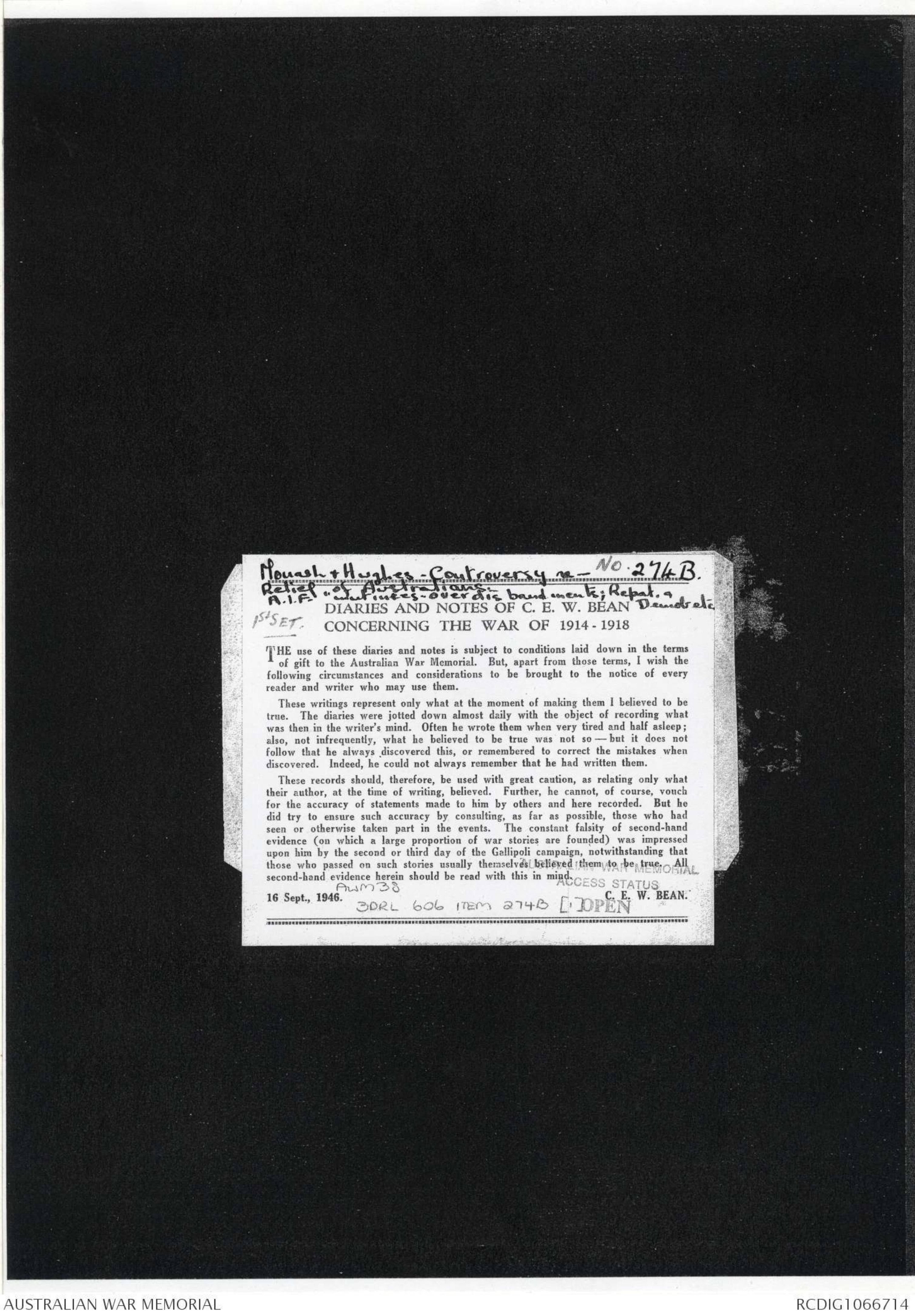
Monash & Hughes - Controversy re - No. 274B
Relief of Australians.
AIF continues over disbandments; Repat. & Demob etc.
DIARIES AND NOTES OF C. E. W. BEAN
1st SET CONCERNING THE WAR OF 1914 - 1918
THE use of these diaries and notes is subject to conditions laid down in the terms
of gift to the Australian War Memorial. But, apart from those terms, I wish the
following circumstances and considerations to be brought to the notice of every
reader and writer who may use them.
These writings represent only what at the moment of making them I believed to be
true. The diaries were jotted down almost daily with the object of recording what
was then in the writer's mind. Often he wrote them when very tired and half asleep;
also, not infrequently, what he believed to be true was not so – but it does not
follow that he always discovered this, or remembered to correct the mistakes when
discovered. Indeed, he could not always remember that he had written them.
These records should, therefore, be used with great caution, as relating only what
their author, at the time of writing, believed. Further, he cannot, of course, vouch
for the accuracy of statements made to him by others and here recorded. But he
did try to ensure such accuracy by consulting, as far as possible, those who had
seen or otherwise taken part in the events. The constant falsity of second-hand
evidence (on which a large proportion of war stories are founded) was impressed
upon him by the second or third day of the Gallipoli campaign, notwithstanding that
those who passed on such stories usually themselves believed them to be true. All
second-hand evidence herein should be read with this in mind.
AWM38
16 Sept., 1946. C. E. W. BEAN.
3DRL 606 ITEM 274B [1]
AUSTRALIAN WAR MEMORIAL
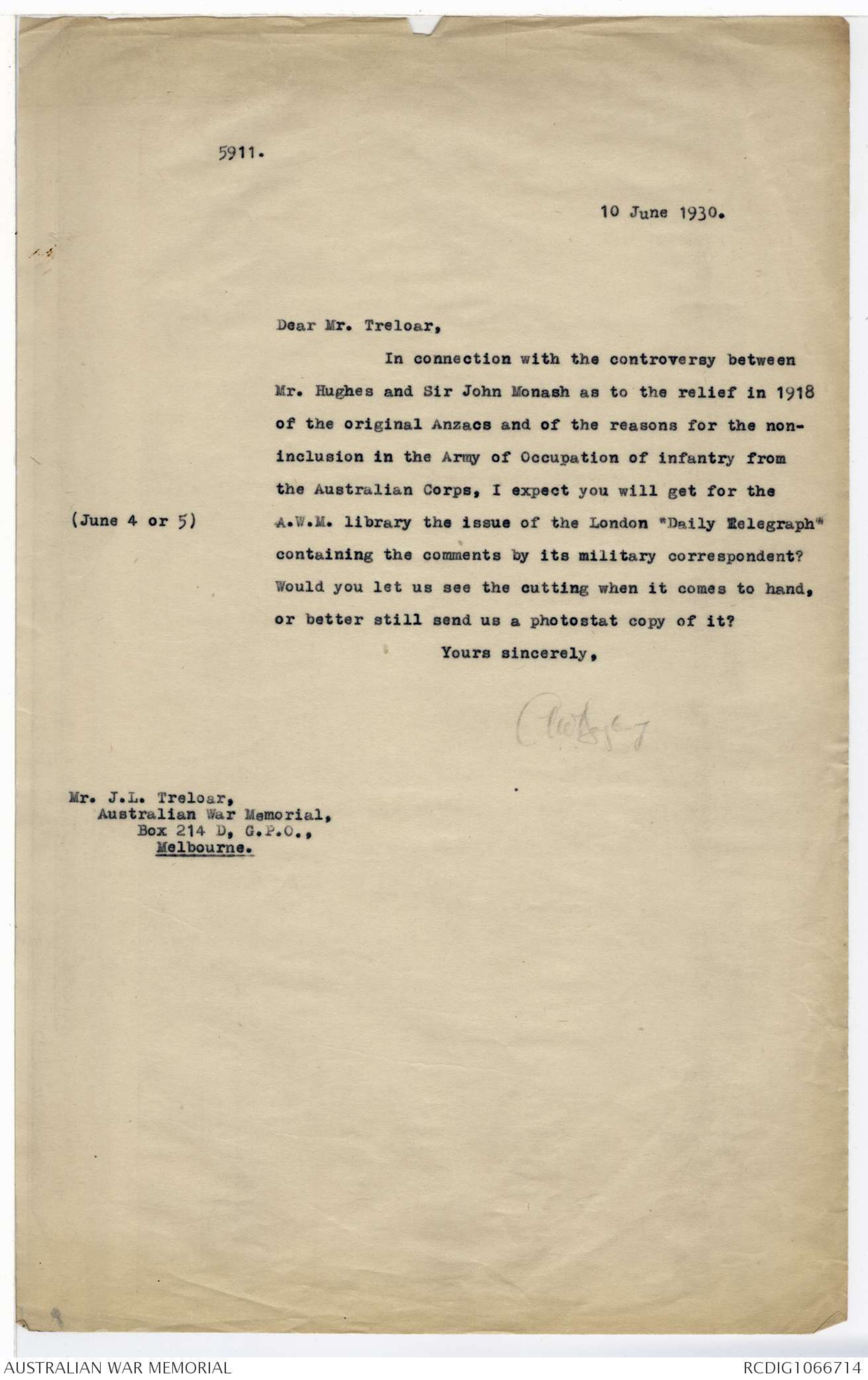
5911.
10 June 1930.
Dear Mr. Treloar,
In connection with the controversy between
Mr. Hughes and Sir John Monash as to the relief in 1918
of the original Anzacs and of the reasons for the non-inclusion
in the Army of Occupation of infantry from
the Australian Corps, I expect you will get for the
[*June 4 or 5*] A.W.M. library the issue of the London "Daily Telegraph"
containing the comments by its military correspondent?
Would you let us see the cutting when it comes to hand,
or better still send us a photostat copy of it?
Yours sincerely,
CEW Bean
Mr. J. L. Treloar,
Australian War Memorial,
Box 214 D, G.P.O.,
Melbourne.
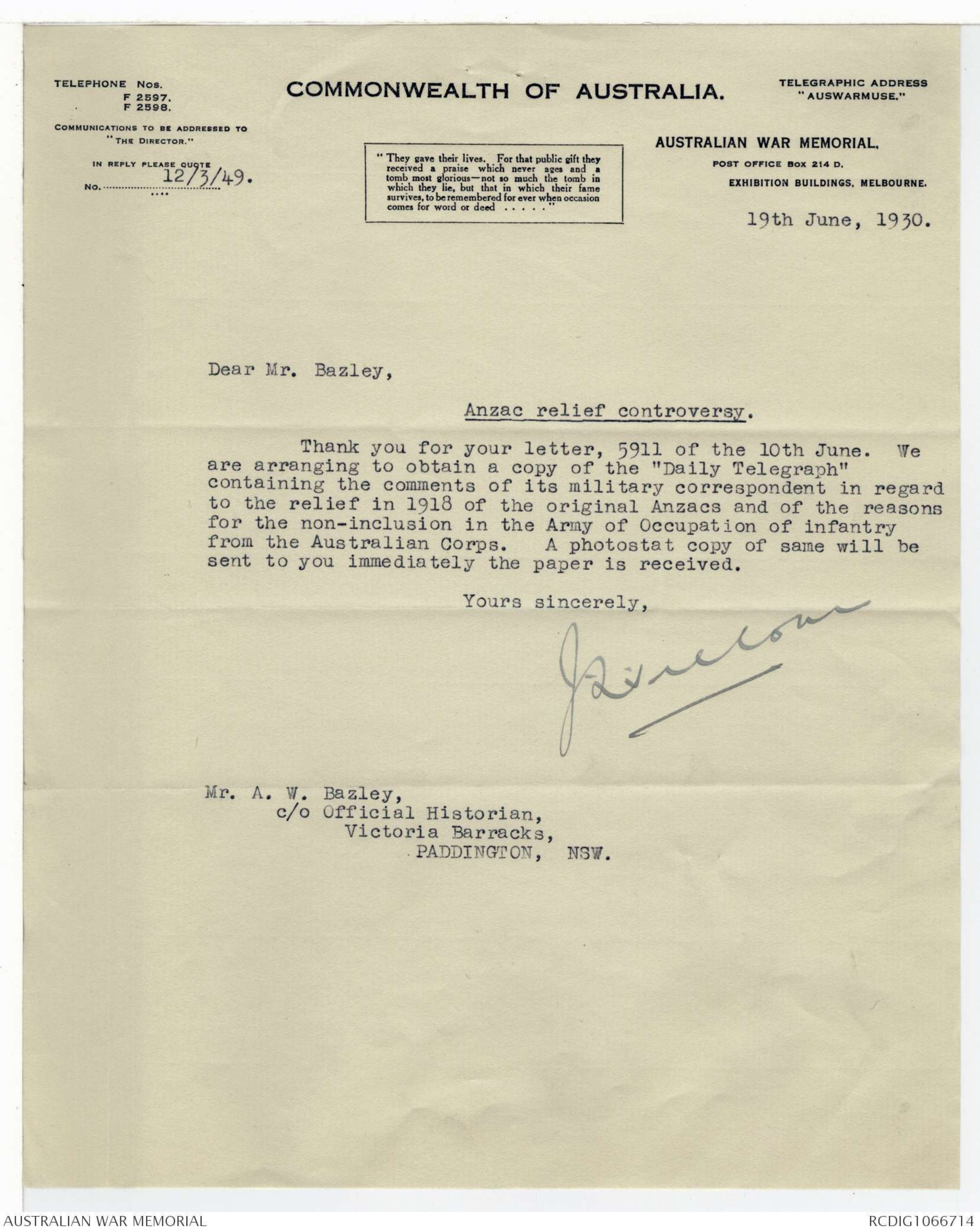
12/3/49.
19th June, 1930.
Dear Mr. Bazley,
Anzac relief controversy.
Thank you for your letter, 5911 of the 10th June. We
are arranging to obtain a copy of the "Daily Telegraph"
containing the comments of its military correspondent in regard
to the relief in 1918 of the original Anzacs and of the reasons
for the non-inclusion in the Army of Occupation of infantry
from the Australian Corps. A photostat copy of same will be
sent to you immediately the paper is received.
Yours sincerely,
J Treloar
Mr. A. W. Bazley,
c/o Official Historian,
Victoria Barracks,
PADDINGTON, NSW.
I&N
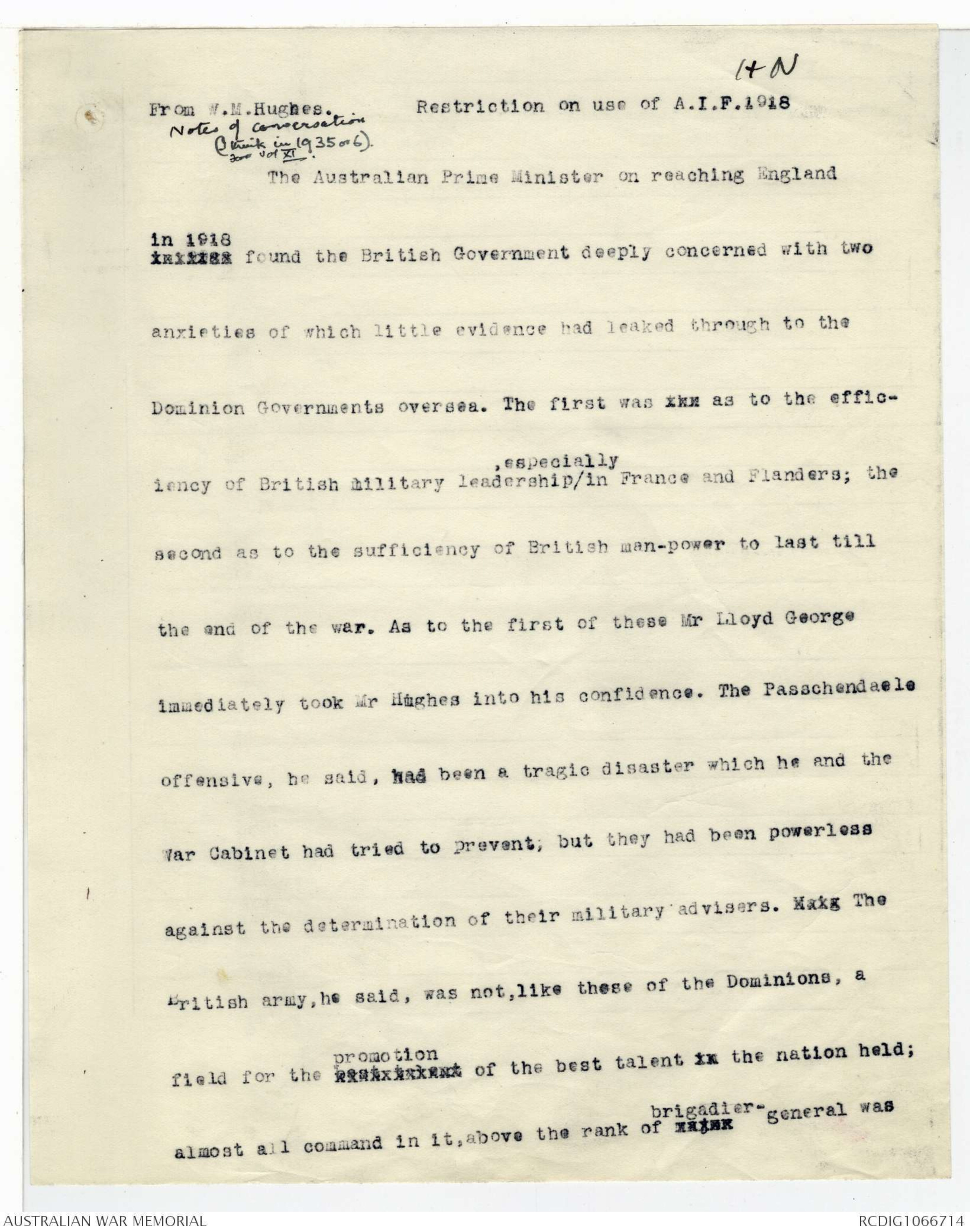
From W.M.Hughes Restriction on use of A.I.F.1918
Notes on conversation
(I think in 1935 or 6)
For Vol XI
The Australian Prime Minister on reaching Englandin 19xx in 1918 found the British Government deeply concerned with two
anxieties of which little evidence had leaked through to the
Dominion Governments oversea. The first was xxx as to the efficiency
of British military leadership/, especially in France and Flanders; the
second as to the sufficiency of British man-power to last till
the end of the war. As to the first of these Mr Lloyd George
immediately took Mr Hughes into his confidence. The Passchendaele
offensive, he said, had been a tragic disaster which he and the
War Cabinet had tried to prevent; but they had been powerless
against the determination of their military advisers. Haig The
British army, he said, was not,like those of the Dominions, a
field for the best talent promotion of the best talent in the nation held;
almost all command in it, above the rank of major brigadier-general was
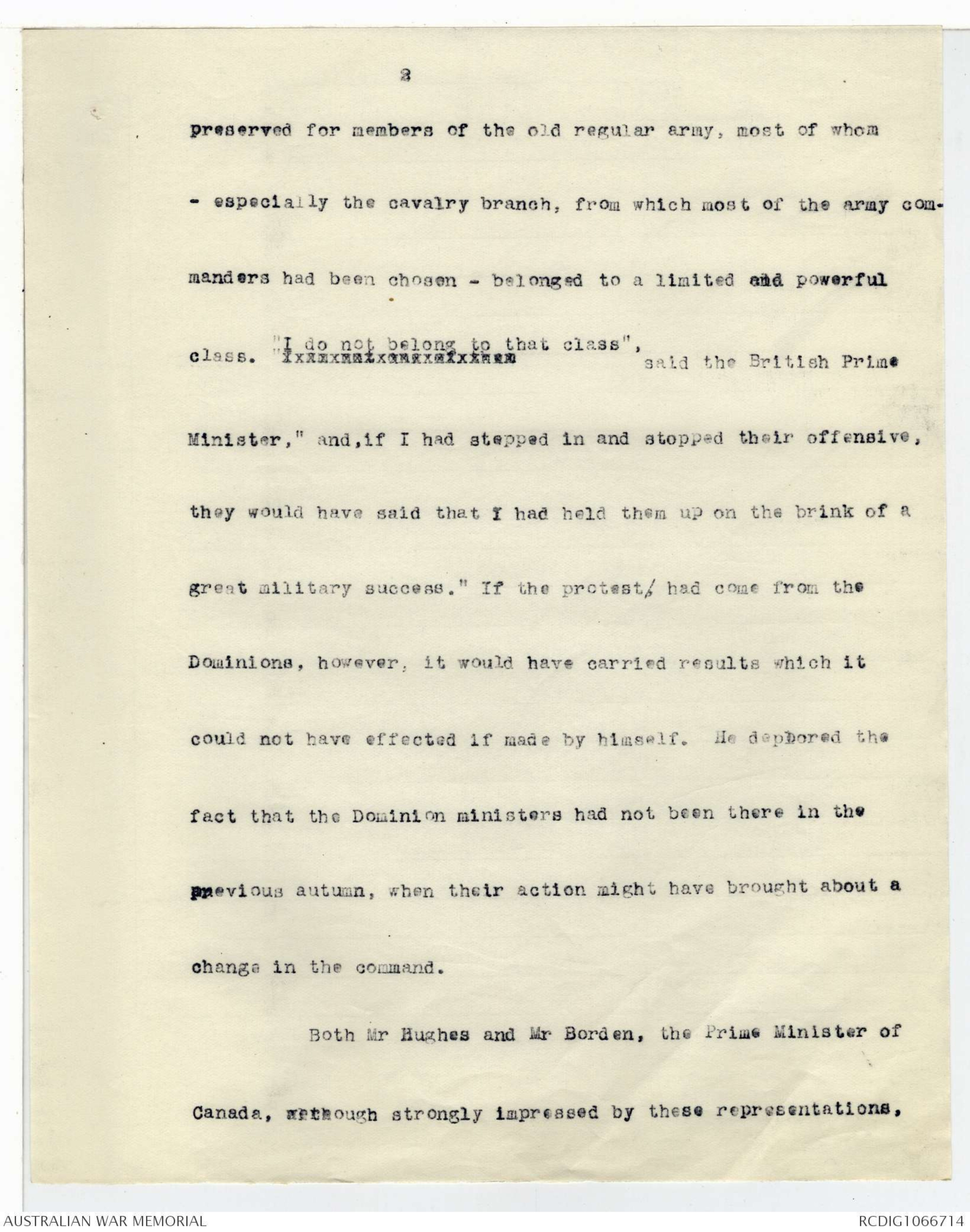
2
preserved for members of the old regular army, most of whom
- especially the cavalry branch, from which most of the army commanders
had been chosen - belonged to a limited and powerful
class. xxxxxxxxxxxxxxxxxxxx "I do not belong to that class", said the British Prime
Minister," and, if I had stepped in and stopped their offensive,
they would have said that I had held them up on the brink of a
great military success." If the protest/, had come from the
Dominions, however, it would have carried results which it
could not have effected if made by himself. He deplored the
fact that the Dominion ministers had not been there in the
previous autumn, when their action might have brought about a
change in the command.
Both Mr Hughes and Mr Borden, the Prime Minister of
Canada, xxthough strongly impressed by these representations,
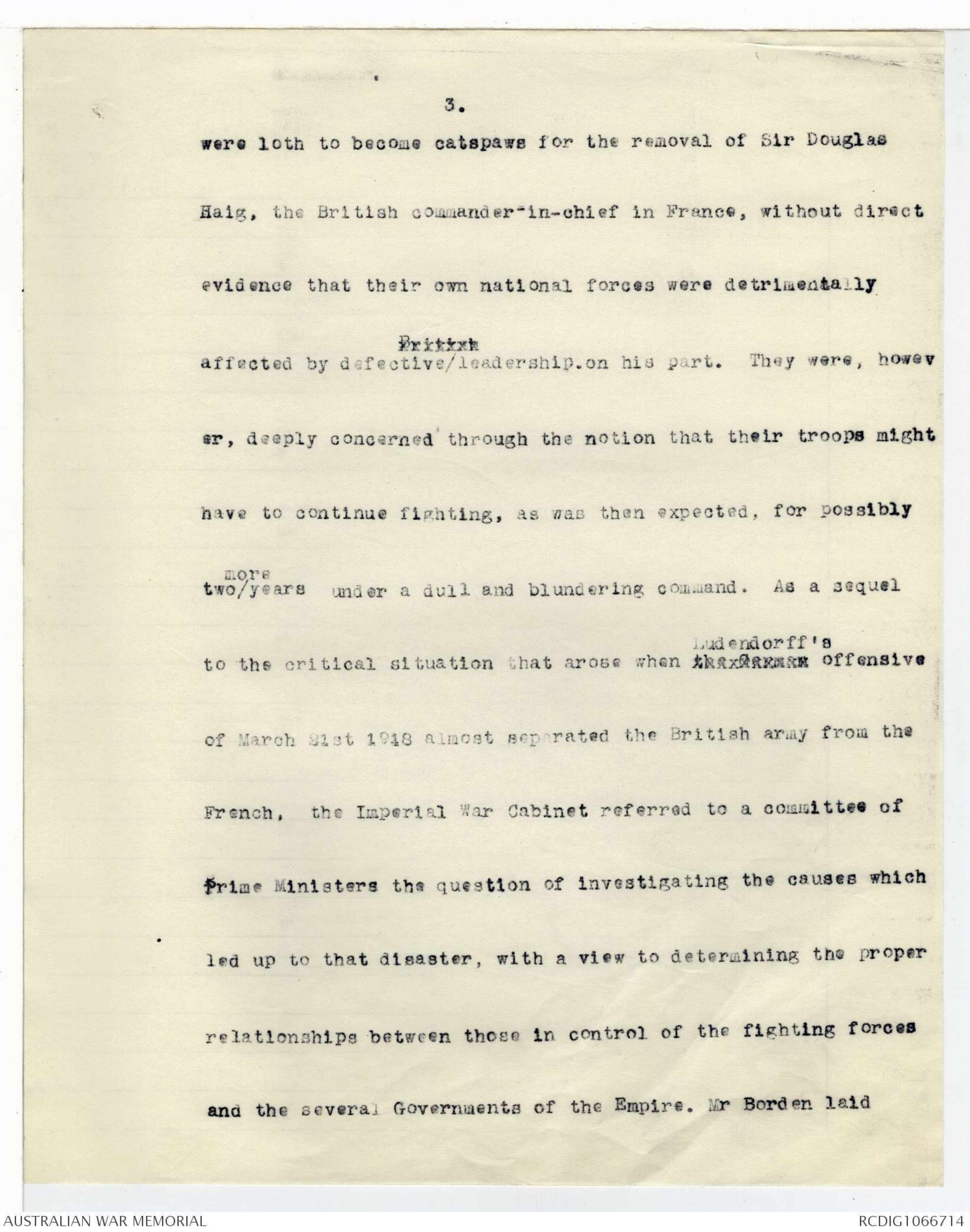
3.
were loth to become catspaws for the removal of Sir Douglas
Haig, the British commander-in-chief in France, without direct
evidence that their own national forces were detrimentally
affected by defective/ British leadership.on his part. They were, however,
deeply concerned through the notion that their troops might
have to continue fighting, as was then expected, for possibly
two/ more years, under a dull and blundering command. As a sequel
to the critical situation that arose when the German Ludendorff's offensive
of March 21st 1918 almost separated the British army from the
French, the Imperial War Cabinet referred to a committee of
Prime Ministers the question of investigating the causes which
led up to that disaster, with a view to determining the proper
relationships between those in control of the fighting forces
and the several Governments of the Empire. Mr Borden laid
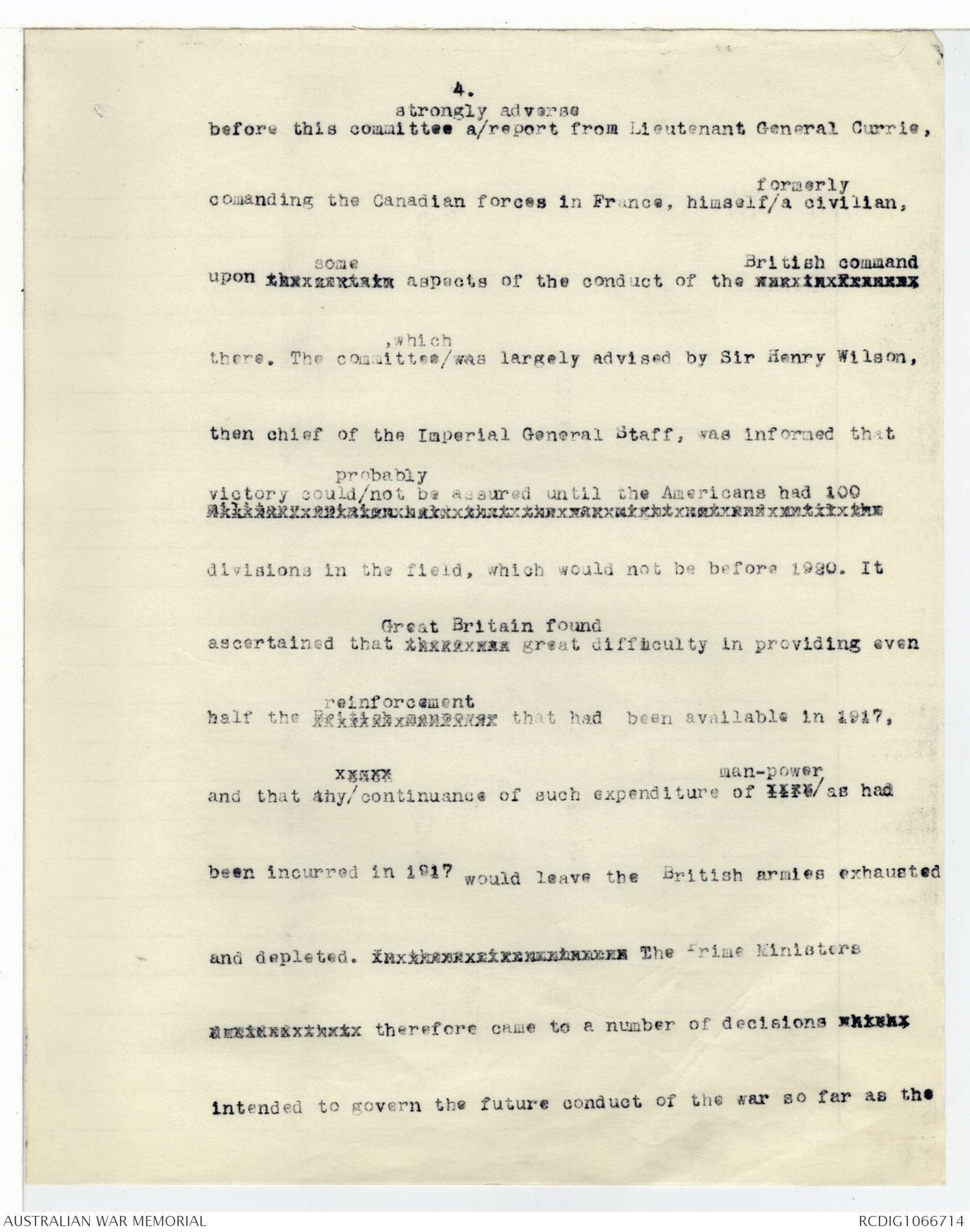
4.
before this committee a/ strongly adverse report from Lieutenant General Currie,
comanding the Canadian forces in France, himself/ formerly a civilian,
upon the certain some aspects of the conduct of the war in France British command
there. The committee/ , which was largely advised by Sir Henry Wilson,
then chief of the Imperial General Staff, was informed that
victory could/ probably not be assured until the Americans had 100military opinion held that the war might not end until the
divisions in the field, which would not be before 1920. It
ascertained that there was Great Britain found great difficulty in providing even
half the Brirtish manpower reinforcement that had been available in 1917,
and that any/ such continuance of such expenditure of life man-power/ as had
been incurred in 1917 would leave the British armies exhausted
and depleted. in these circumstances The Prime Ministersdecided that therefore came to a number of decisions which
intended to govern the future conduct of the war so far as the
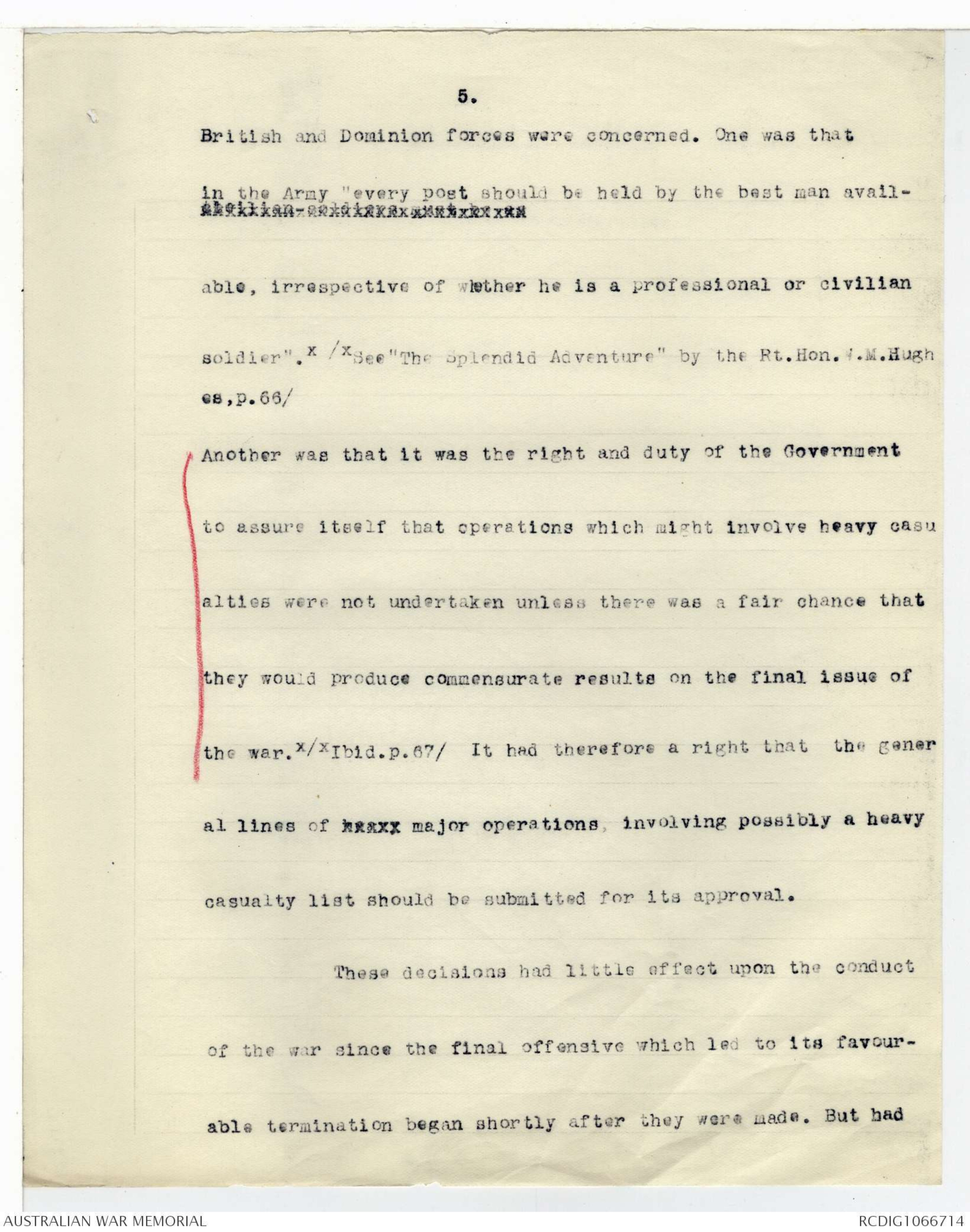
5.
British and Dominion forces were concerned. One was that
in the army "every post should be held by the best man available,civilian soldiers must be an
irrespective of whether he is a professional or civilian
soldier". x /x See "The Splendid Adventure" by the Rt.Hon. W.M.Hughes.
p.66/
Another was that it was the right and duty of the Government
to assure itself that operations which might involve heavy casualties
were not undertaken unless there was a fair chance that
they would produce commensurate results on the final issue of
the war. x/x Ibid.p.67/ It had therefore a right that, the general
lines of heavy major operations, involving possibly a heavy
casualty list should be submitted for its approval.
These decisions had little effect upon the conduct
of the war since the final offensive which led to its favourable
termination began shortly after they were made. But had
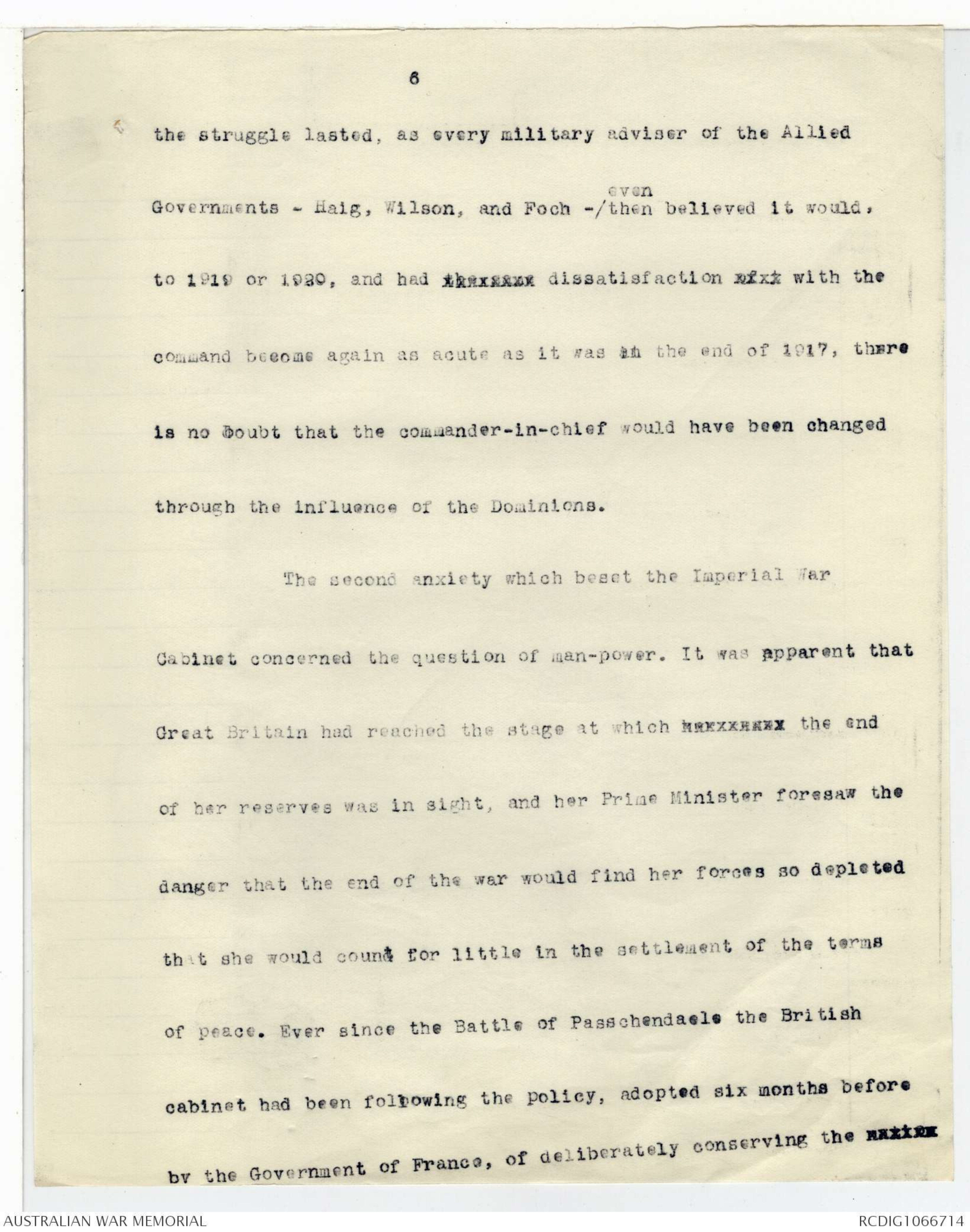
6
the struggle lasted, as every military adviser of the Allied
Governments - Haig, Wilson, and Foch -/ even then believed it would,
to 1919 or 1920, and had the same dissatisfaction oftx with the
command become again as acute as it in was the end of 1917, there
is no doubt that the commander-in-chief would have been changed
through the influence of the Dominions.
The second anxiety which beset the Imperial War
Cabinet concerned the question of man-power. It was apparent that
Great Britain had reached the stage at which her ready the end
of her reserves was in sight, and her Prime Minister foresaw the
danger that the end of the war would find her forces so depleted
that she would count for little in the settlement of the terms
of peace. Ever since the Battle of Passchendaele the British
cabinet had been following the policy, adopted six months before
by the Government of France, of deliberately conserving the xxxxxx
 Deb Parkinson
This transcription item is now locked to you for editing. To release the lock either Save your changes or Cancel.
This lock will be automatically released after 60 minutes of inactivity.