
Diaries of William Edward Peach 1915-1918 - Part 1
INTRODUCTION
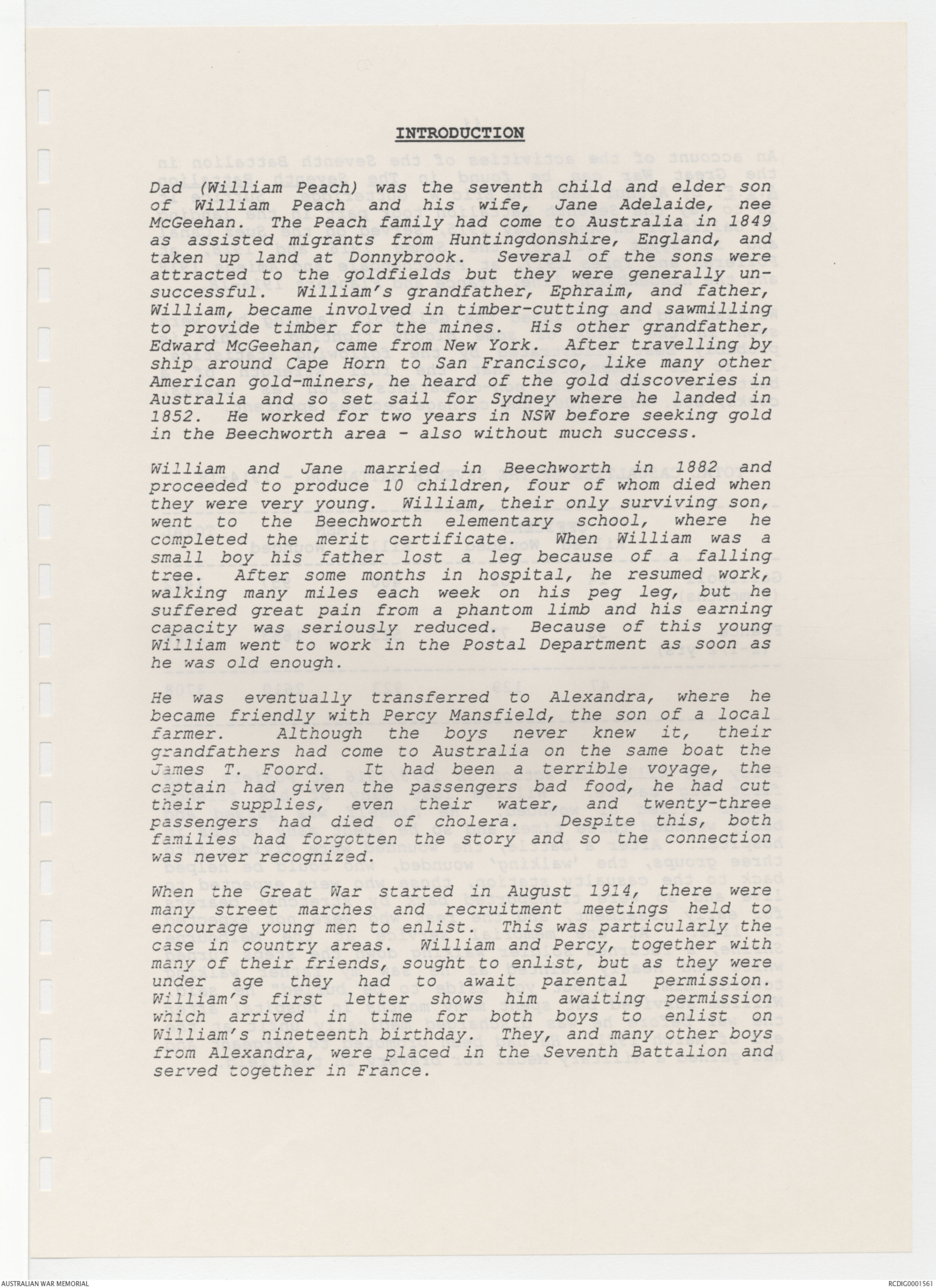
Dad (William Peach) was the seventh child and elder son
of William Peach and his wife, Jane Adelaide, nee
McGeehan. The Peach family had come to Australia in 1849
as assisted migrants from Huntingdonshire, England, and
taken up land at Donnybrook. Several of the sons were
attracted to the goldfields but they were generally unsuccessful.
William's grandfather, Ephraim, and father,
William, became involved in timber-cutting and sawmilling
to provide timber for the mines. His other grandfather,
Edward McGeehan, came from New York. After travelling by
ship around Cape Horn to San Francisco, like many other
American gold-miners, he heard of the gold discoveries in
Australia and so set sail for Sydney where he landed in
1852. He worked for two years in NSW before seeking gold
in the Beechworth area - also without much success.
William and Jane married in Beechworth in 1882 and
proceeded to produce 10 children, four of whom died when
they were very young. William, their only surviving son,
went to the Beechworth elementary school, where he
completed the merit certificate. When William was a
small boy his father lost a leg because of a falling
tree. After some months in hospital, he resumed work,
walking many miles each week on his peg leg, but he
suffered great pain from a phantom limb and his earning
capacity was seriously reduced. Because of this young
William went to work in the Postal Department as soon as
he was old enough.
He was eventually transferred to Alexandra, where he
became friendly with Percy Mansfield, the son of a local
farmer. Although the boys never knew it, their
grandfathers had come to Australia on the same boat the
James T. Foord. It had been a terrible voyage, the
captain had given the passengers bad food, he had cut
their supplies, even their water, and twenty-three
passengers had died of cholera. Despite this, both
families had forgotten the story and so the connection
was never recognized.
When the Great War started in August 1914, there were
many street marches and recruitment meetings held to
encourage young men to enlist. This was particularly the
case in country areas. William and Percy, together with
many of their friends, sought to enlist, but as they were
under age they had to await parental permission.
William's first letter shows him awaiting permission
which arrived in time for both boys to enlist on
William's nineteenth birthday. They, and many other boys
from Alexandra, were placed in the Seventh Battalion and
served together in France.
ii.
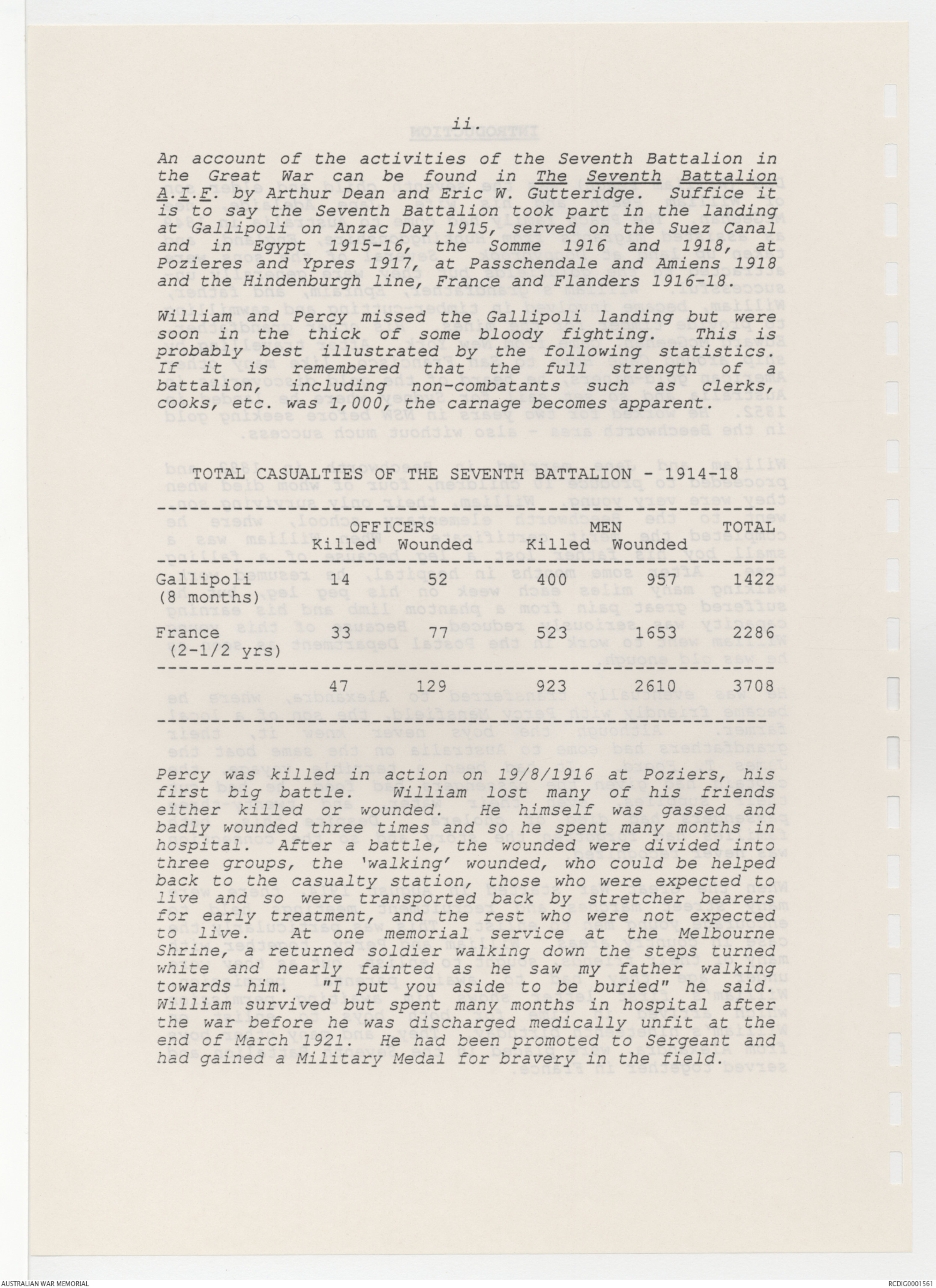
An account of the activities of the Seventh Battalion in
the Great War can be found in The Seventh Battalion
A.I.F. by Arthur Dean and Eric W. Gutteridge. Suffice it
is to say the Seventh Battalion took part in the landing
at Gallipoli on Anzac Day 1915, served on the Suez Canal
and in Egypt 1915-16, the Somme 1916 and 1918, at
Pozieres and Ypres 1917, at Passchendale and Amiens 1918
and the Hindenburgh line, France and Flanders 1916-18.
William and Percy missed the Gallipoli landing but were
soon in the thick of some bloody fighting. This is
probably best illustrated by the following statistics.
If it is remembered that the full strength of a
battalion, including non-combatants such as clerks,
cooks, etc. was 1,000, the carnage becomes apparent.
TOTAL CASUALTIES OF THE SEVENTH BATTALION - 1914-18
OFFICERS MEN TOTAL
Killed Wounded Killed Wounded
Gallipoli 14 52 400 957 1422
(8 months)
France 33 77 532 1653 2286
(2-½ yrs) _____________________________________
47 129 923 2610 3708
Percy was killed in action on 19/8/1916 at Poziers, his
first big battle. William lost many of his friends
either killed or wounded. He himself was gassed and
badly wounded three times and so he spent many months in
hospital. After a battle, the wounded were divided into
three groups, the 'walking' wounded, who could be helped
back to the casualty station, those who were expected to
live and so were transported back by stretcher bearers
for early treatment, and the rest who were not expected
to live. At one memorial service at the Melbourne
Shrine, a returned soldier walking down the steps turned
white and nearly fainted as he saw my father walking
towards him. "I put you aside to be buried" he said.
William survived but spent many months in hospital after
the war before he was discharged medically unfit at the
end of March 1921. He had been promoted to Sergeant and
had gained a Military Medal for bravery in the field.
iii.
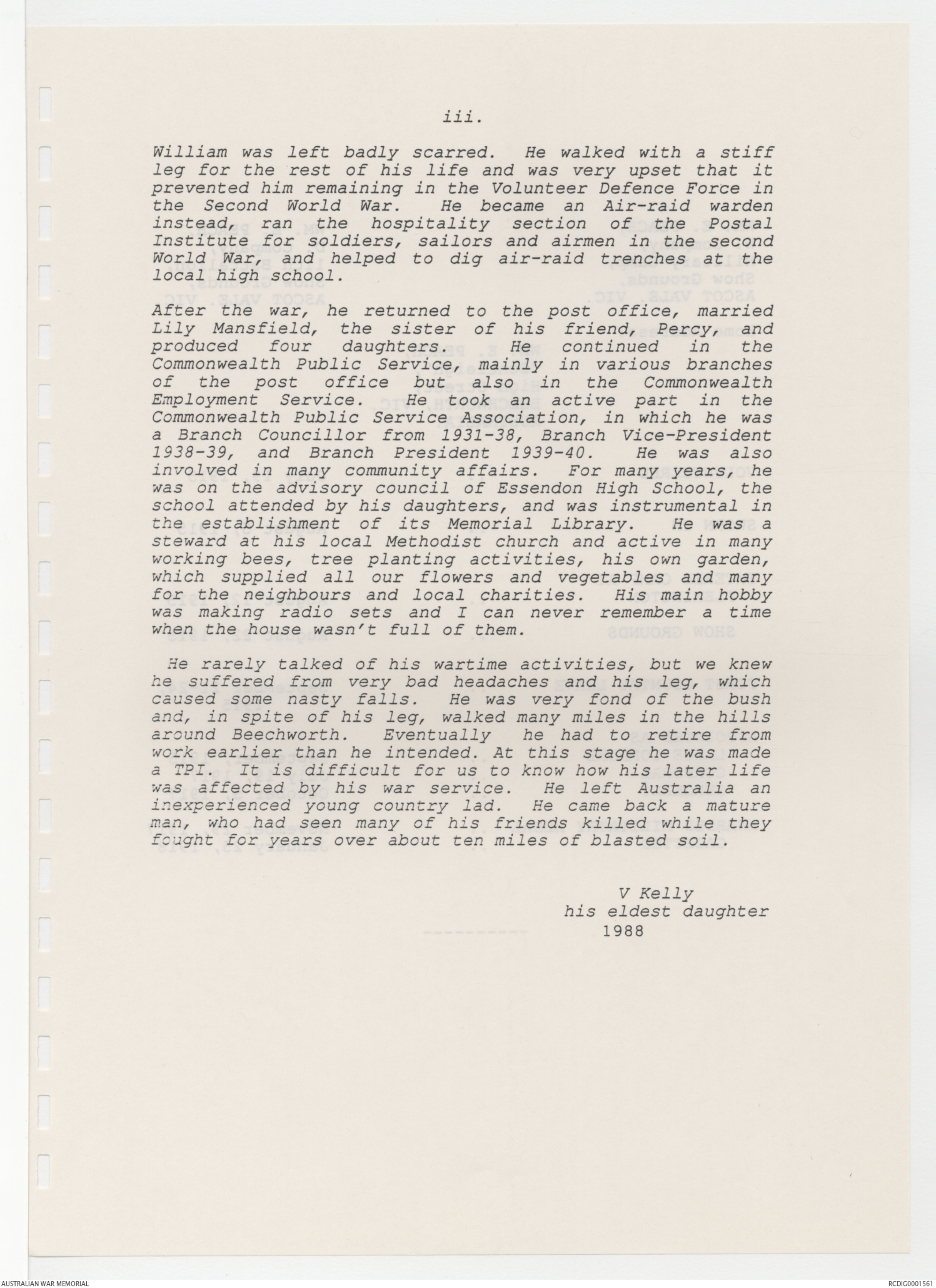
William was left badly scarred. He walked with a stiff
leg for the rest of his life and was very upset that it
prevented him remaining in the Volunteer Defence Force in
the Second World War. He became an Air-raid warden
instead, ran the hospitality section of the Postal
Institute for soldiers, sailors and airmen in the second
World War, and helped to dig air-raid trenches at the
local high school.
After the war, he returned to the post office, married
Lily Mansfield, the sister of his friend, Percy, and
produced four daughters. He continued in the
Commonwealth Public Service, mainly in various branches
of the post office but also in the Commonwealth
Employment Service. He took an active part in the
Commonwealth Public Service Association, in which he was
a Branch Councillor from 1931-38, Branch Vice-President
1938-39, and Branch President 1939-40. He was also
involved in many community affairs. For many years, he
was on the advisory council of Essendon High School, the
school attended by his daughters, and was instrumental in
the establishment of its Memorial Library. He was a
steward at his local Methodist church and active in many
working bees, tree planting activities, his own garden,
which supplied all our flowers and vegetables and many
for the neighbours and local charities. His main hobby
was making radio sets and I can never remember a time
when the house wasn't full of them.
He rarely talked of his wartime activities, but we knew
he suffered from very bad headaches and his leg, which
caused some nasty falls. He was very fond of the bush
and, in spite of his leg, walked many miles in the hills
around Beechworth. Eventually he had to retire from
work earlier than he intended. At this stage he was made
a TPI. It is difficult for us to know how his later life
was affected by his war service. He left Australia an
inexperienced young country lad. He came back a mature
man, who had seen many of his friends killed while they
fought for years over about ten miles of blasted soil.
V. Kelly
his eldest daughter
1988
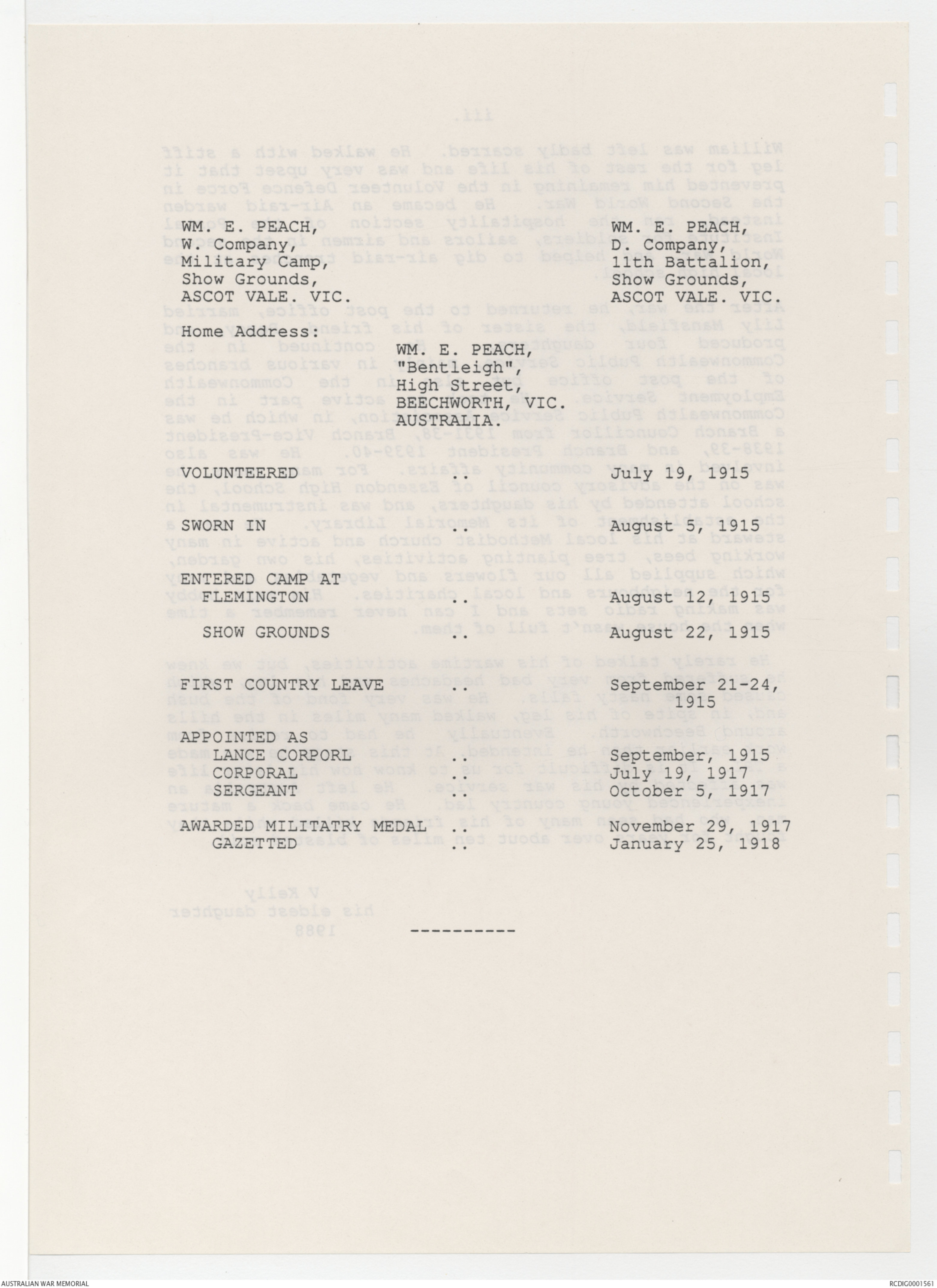
WM. E. PEACH, WM. E. PEACH,
W. Company, D Company,
Military Camp, 11th Battalion,
Show Grounds, Show Grounds,
ASCOT VALE. VIC. ASCOT VALE. VIC.
Home Address:
WM. E. PEACH,
"Bentleigh",
High Street,
BEECHWORTH, VIC.
AUSTRALIA.
VOLUNTEERED .. July 19, 1915
SWORN IN .. August 5, 1915
ENTERED CAMP AT
FLEMINGTON .. August 12, 1915
SHOW GROUNDS .. August 22, 1915
FIRST COUNTRY LEAVE .. September 21 - 24,
1915
APPOINTED AS
LANCE COPORAL .. September, 1915
CORPORAL .. July 19, 1917
SERGEANT .. Octobr 5, 1917
AWARDED MILITARY MEDAL .. November 29, 1917
GAZETTED .. January 25, 1918
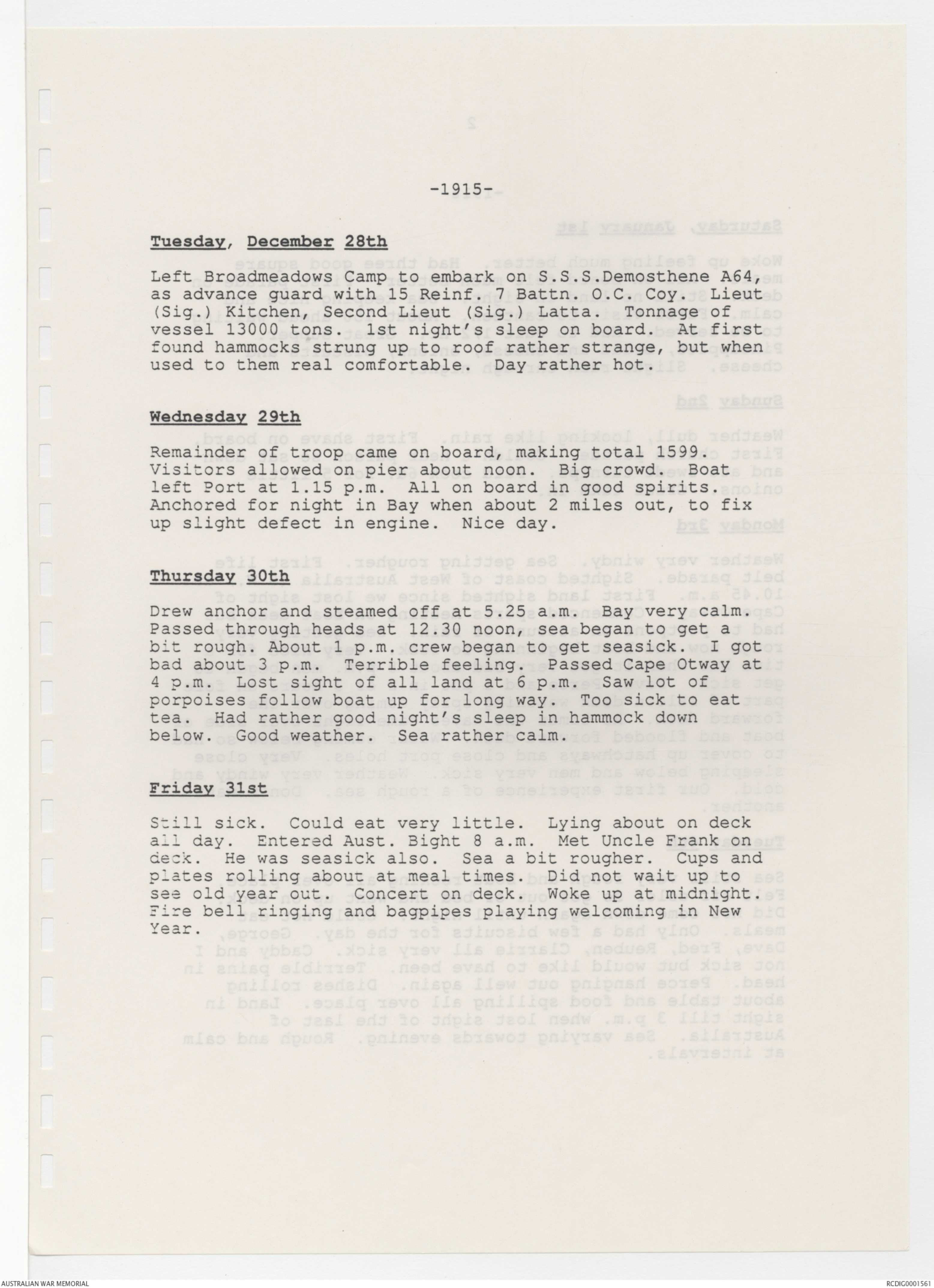
-1915-
Tuesday, December 28th
Left Broadmeadow Camp to embark on S.S.S. Demosthene A64,
as advance guard with 15 Reinf. 7 Battn. O.C. Coy. Lieut
(Sig.) Kitchen, Second Lieut (Sig.) Latta. Tonnage of
vessel 13000 tons. 1st night's sleep on board. At first
found hammocks strung up to roof rather strange, but when
used to them real comfortable. Day rather hot.
Wednesday 29th
Remainder of troop came on board, making total 1599.
Visitors allowed on pier about noon. Big crowd. Boat
left Port at 1.15 p.m. All on board in good spirits.
Anchored for night in Bay when about 2 miles out, to fix
up slight defect in engine. Nice day.
Thursday 30th
Drew anchor and steamed off at 5.25 a.m. Bay very calm.
Passed through heads at 12.30 noon, sea began to get a
bit rough. About 1 p.m. crew began to get seasick. I got
bad about 3 p.m. Terrible feeling. Passed Cape Otway at
4 p.m. Lost sight of all land at 6 p.m. Saw lot of
porpoises follow boat up for long way. Too sick to eat
tea. Had rather good night's sleep in hammock down
below. Good weather. Sea rather calm.
Friday 31st
Still sick. Could eat very little. Lying about on deck
all day. Entered Aust. Bight 8 a.m. Met Uncle Frank on
deck. He was seasick also. Sea a bit rougher. Cups and
plates rolling about at meal times. Did not wait up to
see old year out. Concert on deck. Woke up at midnight.
Fire bell ringing and bagpipes playing welcoming in New
Year.
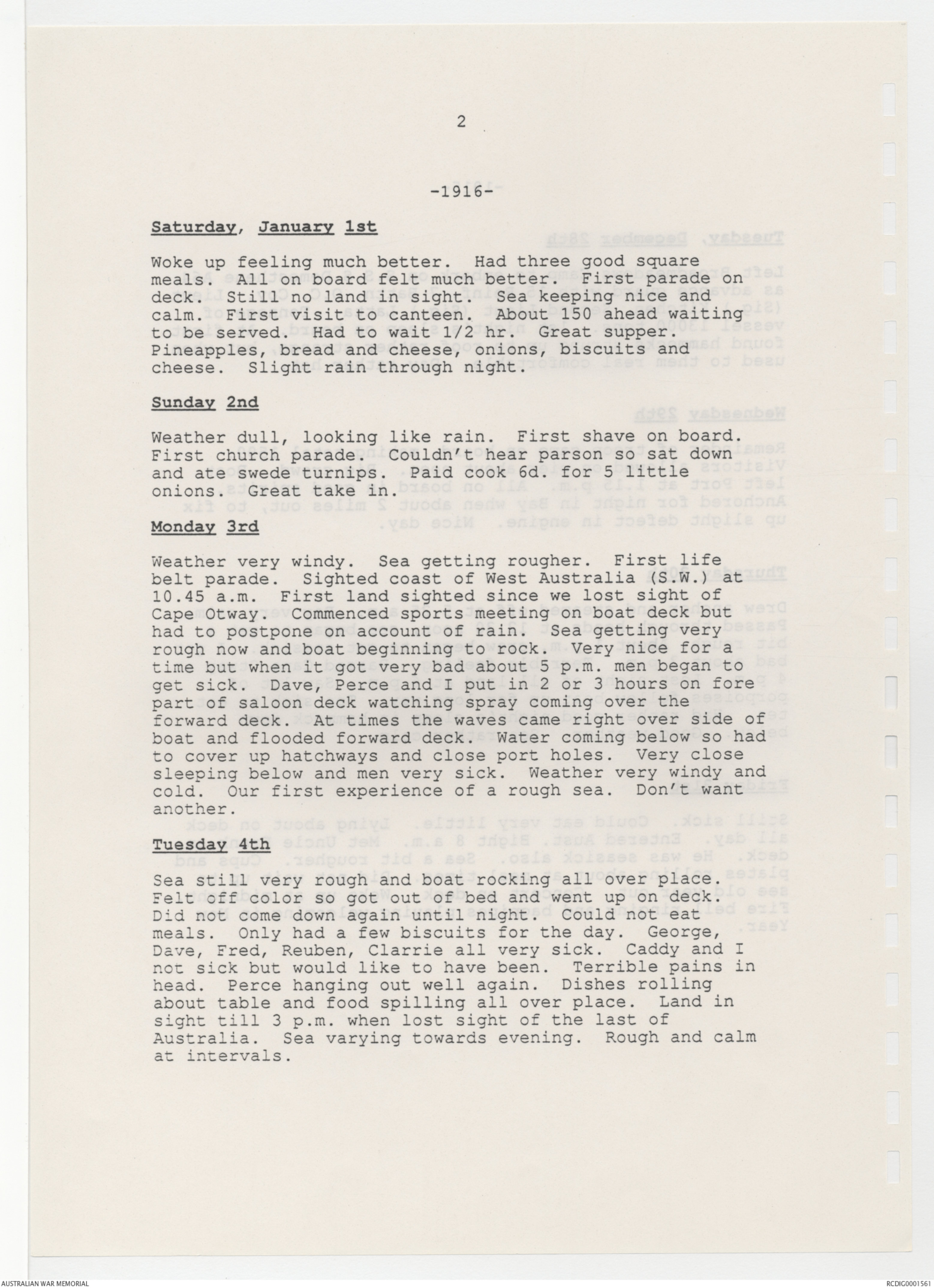
2
-1916-
Saturday, January 1st
Woke up feeling much better. Had three good square
meals. All on board felt much better. First parade on
deck. Still no land in sight. Sea keeping nice and
calm. First visit to canteen. About 150 ahead waiting
to be served. Had to wait ½ hr. Great supper.
Pineapples, bread and cheese, onions, biscuits and
cheese. Slight rain through night.
Sunday 2nd
Weather dull, looking like rain. First shave on board.
First church parade. Couldn't hear parson so sat down
and ate swede turnips. Paid cook 6d. for 5 little
onions. Great take in.
Monday 3rd
Weather very windy. Sea getting rougher. First life
belt parade. Sighted coast of West Australia (S.W.) at
10.45 a.m. First land sighted since we lost sight of
Cape Otway. Commenced sports meeting on boat deck but
had to postpone on account of rain. Sea getting very
rough now and boat beginning to rock. Very nice for a
time but when it got very bad about 5 p.m. men began to
get sick. Dave, Perce and I put in 2 or 3 hours on fore
part of saloon deck watching spray coming over the
forward deck. At times the waves came right over the side of
boat and flooded forward deck. Water coming below so had
to cover up hatchways and close port holes. Very close
sleeping below and men very sick. Weather very windy and
cold. Our first experience of a rough sea. Don't want
another.
Tuesday 4th
Sea still very rough and boat rocking all over place.
Felt off color so got out of bed and went up on deck.
Did not come down again until night. Could not eat
meals. Only had a few biscuits for the day. George,
Dave, Fred, Reuben, Clarrie all very sick. Caddy and I
not sick but would like to have been. Terrible pains in
head. Perce hanging out well again. Dishes rolling
about table and food spilling all over place. Land in
sight till 3 p.m. when lost sight of the last of
Australia. Sea varying towards evening. Rough and calm
at intervals.
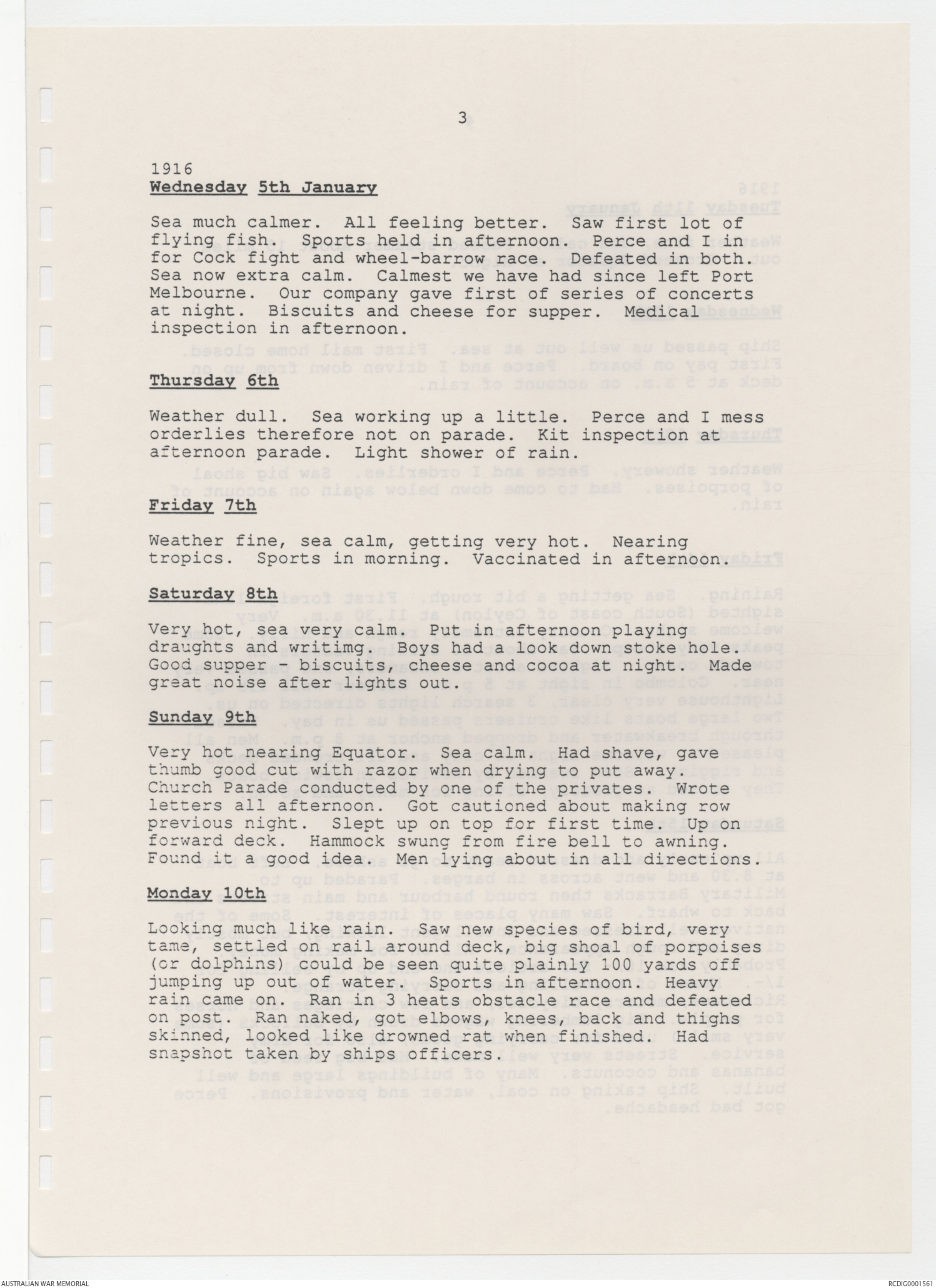
3
1916
Wednesday 5th January
Sea much calmer. All feeling better. Saw first lot of
flying fish. Sports held in afternoon. Perce and I in
for Cock fight and wheel-barrow race. Defeated in both.
Sea now extra calm. Calmest we have had since left Port
Melbourne. Our company gave first of series of concerts
at night. Biscuits and cheese for supper. Medical
inspection in afternoon.
Thursday 6th
Weather dull. Sea working up a little. Perce and I mess
orderlies therefore not on parade. Kit inspection at
afternoon parade. Light shower of rain.
Friday 7th
Weather fine, sea calm, getting very hot. Nearing
tropics. Sports in morning. Vaccinated in afternoon.
Saturday 8th
Very hot, sea very calm. Put in afternoon playing
draughts and writing. Boys had a look down stoke hole.
Good supper - biscuits, cheese and cocoa at night. Made
great noise after lights out.
Sunday 9th
Very hot nearing Equator. Sea calm. Had shave, gave
thumb good cut with razor when drying to put away.
Church parade conducted by one of the privates. Wrote
letters all afternoon. Got cautioned about making row
previous night. Slept up on top for first time. Up on
forward deck. Hammock swung from fire bell to awning.
Found it a good idea. Men lying about in all directions.
Monday 10th
Looking much like rain. Saw new species of bird, very
tame, settled on rail around deck, big shoal of porpoises
(or dolphins) could be seen quite plainly 100 yards off
jumping up out of water. Sports in afternoon. Heavy
rain came on. Ran in 3 heats obstacle race and defeated
on post. Ran naked, got elbows, knees, back and thighs
skinned, looked like drowned rat when finished. Had
snapshot taken by ships officers.
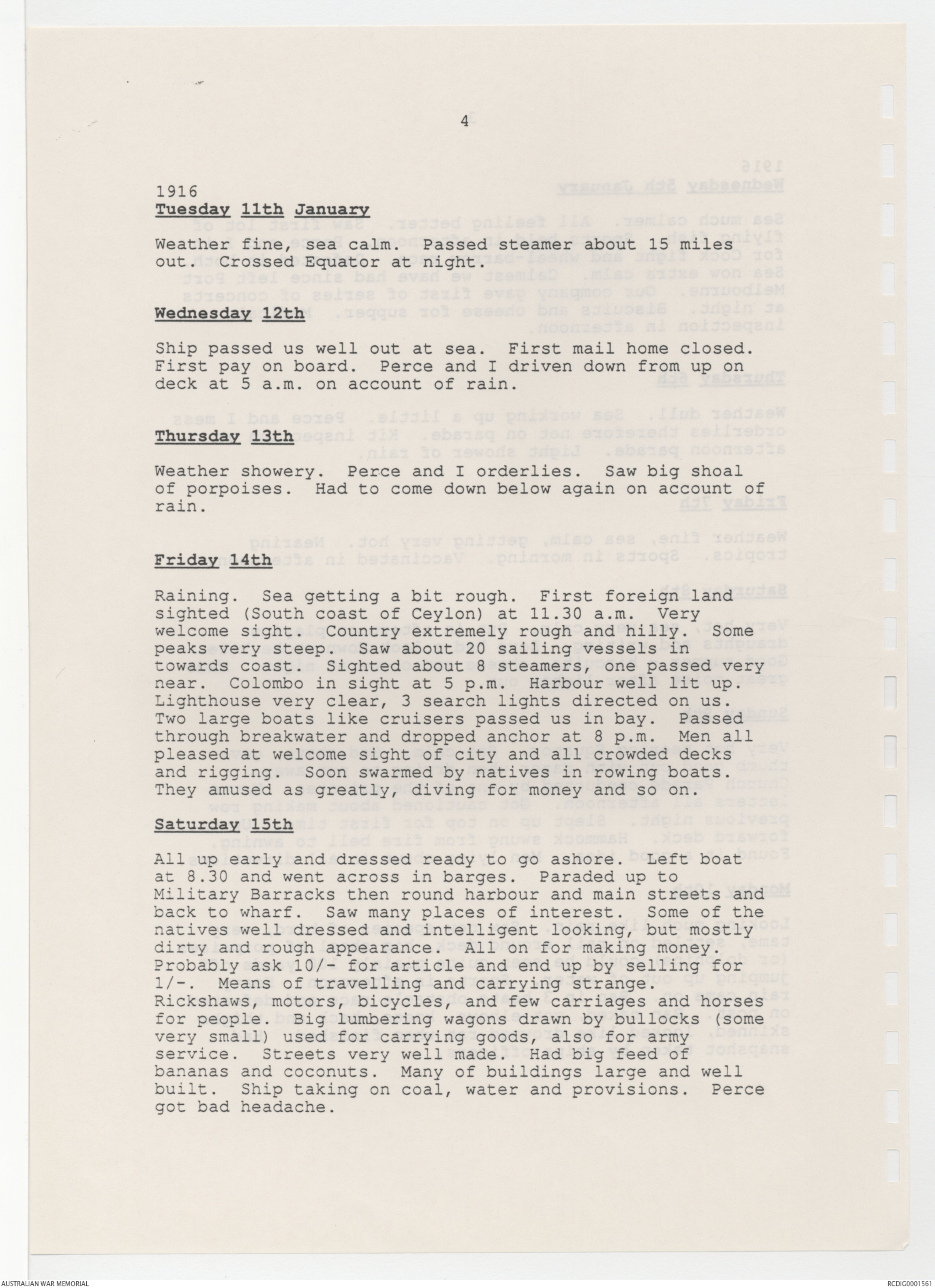
4
1916
Tuesday 11th January
Weather fine, sea calm. Passed steamer about 15 miles
out. Crossed Equator at night.
Wednesday 12th
Ship passed us well out at sea. First mail home closed.
First pay on board. Perce and I driven down from up on
deck at 5 a.m. on account of rain.
Thursday 13th
Weather showery. Perce and I orderlies. Saw big shoal
of porpoises. Had to come down below again on account of
rain.
Friday 14th
Raining. Sea getting a bit rough. First foreign land
sighted (South coast of Ceylon) at 11.30 a.m. Very
welcome sight. Country extremely rough and hilly. Some
peaks very steep. Saw about 20 sailing vessels in
towards coast. Sighted about 8 steamers, one passed very
near. Colombo in sight at 5 p.m. Harbour well lit up.
Lighthouse very clear, 3 search lights directed on us.
Two large boats like cruisers passed us in bay. Passed
through breakwater and dropped anchor at 8 p.m. Men all
pleased at welcome sight of city and all crowded decks
and rigging. Soon swarmed by natives in rowng boats.
They amused as greatly, diving for money and so on.
Saturday 15th
All up early and dressed ready to go ashore. Left boat
at 8.30 and went across in barges. Paraded up to
Military Barracks then round harbour and main streets and
back to wharf. Saw many places of interest. Some of the
natives well dressed and intelligent looking, but mostly
dirty and rough appearance. All on for making money.
Probably ask 10/- for article and end up by selling for
1/-. Means of travelling and carrying strange.
Rickshaws, motors, bicycles, and few carriages and horses
for people. Big lumbering wagons drawn by bullocks (some
very small) used for carrying goods, also for army
service. Streets very well made. Had big feed of
bananas and coconuts. Many of buildings large and well
built. Ship taking on coal, water and provisions. Perce
got bad headache.
5
1916
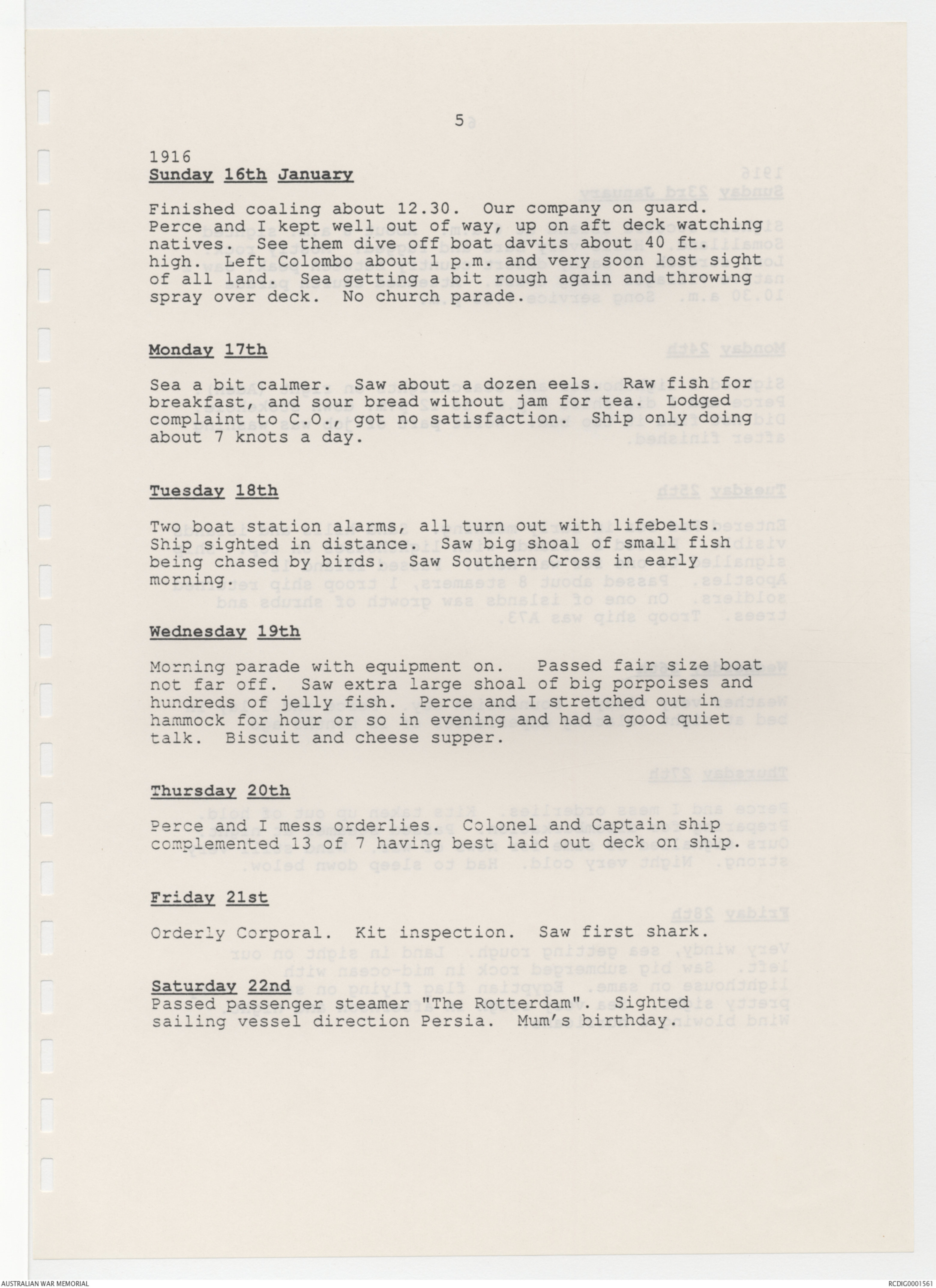
Sunday 16th January
Finished coaling about 12.30. Our company on guard.
Perce and I kept well out of way, up on aft deck watching
natives. See them dive off boat davits about 40 ft.
high. Left Colombo about 1 p.m. and very soon lost sight
of all land. Sea getting a bit rough again and throwing
spray over deck. No church parade.
Monday 17th
Sea a bit calmer. Saw about a dozen eels. Raw fish for
breakfast, and sour bread without jam for tea. Lodged
complaint to C.O., got no satisfaction. Ship only doing
about 7 knots a day.
Tuesday 18th
Two boat station alarms, all turn out with lifebelts.
Ship sighted in distance. Saw big shoal of small fish
being chased by birds. Saw Southern Cross in early
morning.
Wednesday 19th
Morning parade with equipment on. Passed fair size boat
not far off. Saw extra large shoal of big porpoises and
hundreds of jelly fish. Perce and I stretched out in
hammock for hour or so in evening and had a good quiet
talk. Biscuit and cheese supper.
Thursday 20th
Perce and I mess orderlies. Colonel and Captain ship
complemented 13 of 7 having best laid out deck on ship.
Friday 21st
Orderly Corporal. Kit inspection. Saw first shark.
Saturday 22nd
Passed passenger steamer "The Rotterdam". Sighted
sailing vessel direction Persia. Mum's birthday.
6
1916
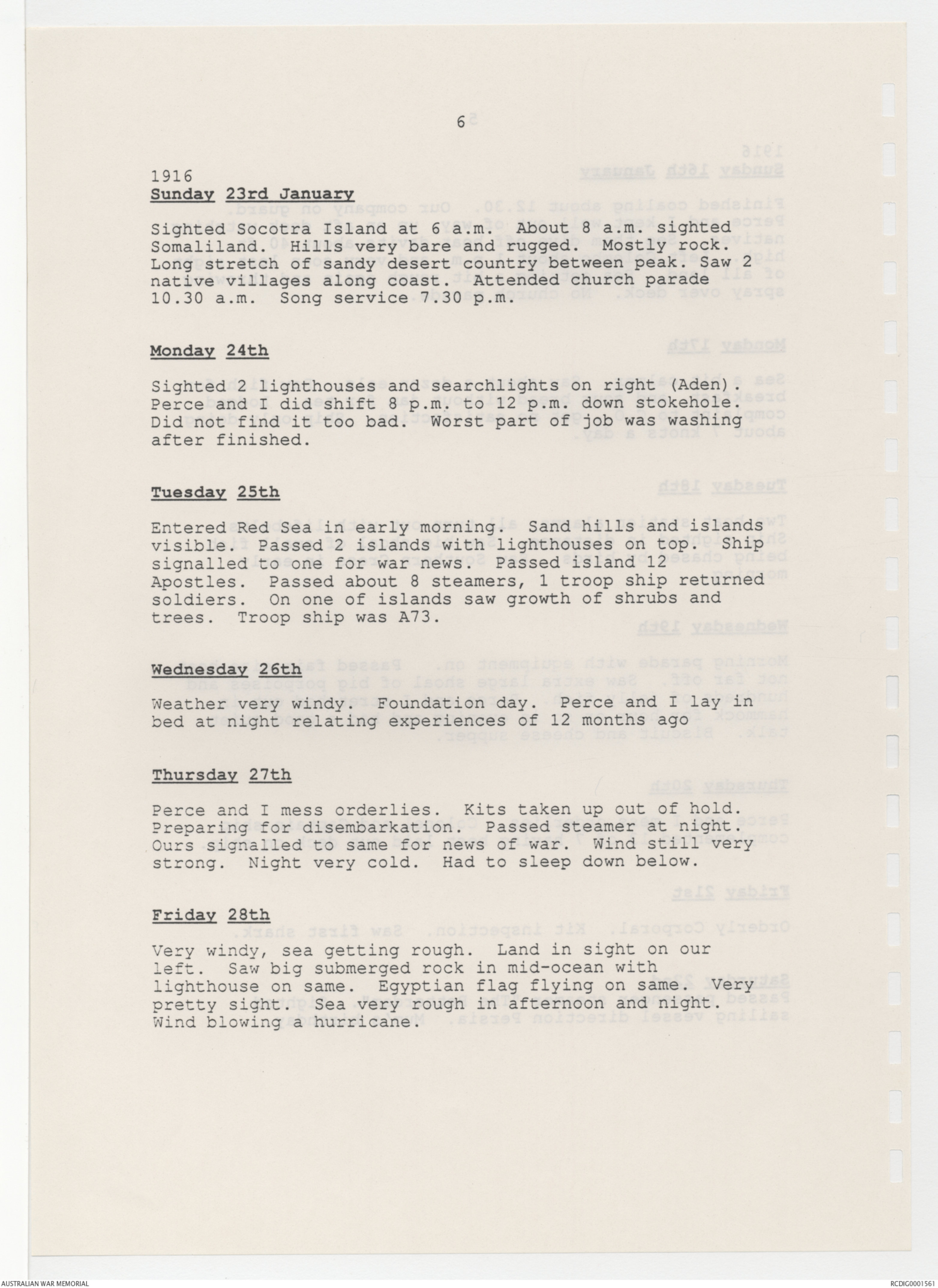
Sunday 23rd January
Sighted Socotra Island at 6 a.m. About 8 a.m. sighted
Somaliland. Hills very bare and rugged. Mostly rock.
Long stretch of sandy desert country between peak. Saw 2
native villages along coast. Attended church parade
10.30 a.m. Song service 7.30 p.m.
Monday 24th
Sighted 2 lighthouses and searchlights on right (Aden).
Perce and I did shift 8 p.m. to 12 p.m. down stokehole.
Did not find it too bad. Worst part of job was washing
after finished.
Tuesday 25th
Entered Red Sea in early morning. Sand hills and islands
visible. Passed 2 islands with lighthouses on top. Ship
signalled to one for war news. Passed island 12
Apostles. Passed about 8 steamers, 1 troop ship returned
soldiers. On one of islands saw growth of shrubs and
trees. Troop ship was A73.
Wednesday 26th
Weather very windy. Foundation day. Perce and I lay in
bed at night relating experiences of 12 months ago
Thursday 27th
Perce and I mess orderlies. Kits taken up out of hold.
Preparing for disembarkation. Passed steamer at night.
Ours signalled to same for news of war. Wind still very
strong. Night very cold. Had to sleep down below.
Friday 28th
Very windy, sea getting rough. Land in sight on our
left. Saw big submerged rock in mid-ocean with
lighthouse on same. Egyptian flag flying on same. Very
pretty sight. Sea very rough in afternoon and night.
Wind blowing a hurricane.
 Marisa Bortolotto
This transcription item is now locked to you for editing. To release the lock either Save your changes or Cancel.
This lock will be automatically released after 60 minutes of inactivity.