
Typescript copies of letters from Hector Roy McLarty, 18 November 1914 to 7 August 1918 - Part 9
- 81 -
letters we have had are 9th August.
Miss Missingham is to give Grace a photo of Viv
Ogilvie for me. Please keep it. It is a splendid photo
of Viv and you will see what a bonny looking chap he is.
At present Viv and I are sleeping together. We have a
very happy tent-full - Mick Robinson, Bob Murray, Viv
and myself - all original 8th Battery fellows. Every
night under the influence of a bright fire, and a tot
of rum, we have a singsong, and life is dressed in a
merry garb for a few hours. Bauny went to the guns to-day.
I am still with the horses.
Belgium.
2nd December, 1917.
Your two letters of 17th August and 6th
September reached me a few days ago. They were apparently
held up by the Strike.
A parcel of socks, scarf, and cap comforter
arrived from you today. They came just at the right
time, for we are having a very cold spell just at
present.
I am enclosing a few snaps of Jim's grave,
which please hand round to the people whose names I
have placed on the back. I have sent half a dozen to
Mrs. Linton.
I am now the Sergeant Major of the Battery
and it is a good job. I just sit back and order
everybody about - suits me. I shall therefore be mainly at
the Wagon Lines in future, and the only time I go to
the guns is when ammunition is required.
4th December, 1917.
I have heard today that Macguire and Cusack
will be returning to the Battery in a few days. I shall
be very glad for they are two of my best pals.
We are having some very fine evenings at present.
We have a gramaphone and a very good collection of records,
and on those evenings when we are not on the roads carting
- 82 -
ammunition to the guns, we get a big fire going, let
the gramaphone ripand sit round playing cards. Tonight
is such a night, snow on the ground outside, but inside
the "Humpy" is comfy and warm; the gramaphone is going
and the boys are playing Poker. What a life of contrasts
this is. In an hour's time we may all be up on
those hellish roads - who knows - however, a man always
lives for the present and never looks ahead at this game.
It wouldn't do.
Murray and I made a trip to the guns a few
days ago with ammunition. We left at 2 a.m. and for once
the weather was beautiful. I quite enjoyed the trip in
the hazy twilight. When we approached the guns, the
track became almost impassable, and at one time we had
seven horses bogged. Fritz, at this period, began to
be playful and throw gas shells at us. On the return
trip five Taubes flying low began to play their machine
guns along the road. I had a very bad moment. It is
no uproarous joke to see a plane diving at you playing
Home Sweet Home on his machine gun. By some miraculous
means we escaped, and again later we got through a bit
of heavy shelling. I got a clout on the arm, but otherwise
escaped injury. I can assure you I was glad to get
home. We are to leave the Line in two days time, and
are going out for a spell, so expect to have a good time.
We await with interest the verdict of the
people on Conscription. The Soldiers' vote, I think,
will go against. Peculiar isn’t it? But the Australian
Army in the Field in very discontented. They have been
doing far more than their share of the fighting.
Personally, I think the ONLY way to win the War is by
Conscription of men, money, and foods.
I was told tonight that I am to be recommended
for a Commission at once, so it should not be long before
I get to England.
- 83 -
France
18th December, 1917.
I have just returned from four days leave to PARIS
and have never crowded more fun and joy and sightseeing
into so short a time before.
A peerless City, ever to be remembered with
pleasure. I was only told a few hours before I had to
leave, so with much haste we left the Line and rode to
Bailleul. At 8 a.m. our train started and ran to Calais.
There we caught the Paris express - a further journey
of eight hours. On the way I had dinner in the dining
car with two English officers - one I found to be an
artist in civil life, the other a student of Economics.
We arrived in Paris at 8 p.m., and driving
through the streets I had my first glimpse of this lovely
city. We were very tired and turned in early. At the
hotel we picked up a gem of a chap who consented to act
as our Guide, Philosopher and Friend" for the four days.
He wa s an excitable little fellow, with the real
Parisian knack of getting fun out of life.
Early next morning we started out sightseeing,
the crowd consisting of the Guide (nicknamed "Bolo"),
Quartermaster Allen, Sergeant King, Corporal Hardwick
and myself - all from the 8th Battery. King is a
special pal of mine, a little chap full of mischief
and merriment; fun fairly bubbles out of him.
We saw "Notre Dame" which is perhaps the most
famous church in Europe. I wish I could describe to
you the glory of the stained windows and the grandeur
of the architecture. In one corner on an altar, I saw
about a thousand candles burning and women praying before
them. You know of course the Catholic custom of burning
candles in memory of their dead. They were relatives of
soldiers who had just died. Next we saw the Tomb of
Napoleon - I think the most impressive sight in Paris.
The tomb is of pure marble and the building is quite as
large as the Perth Museum and Art Gallery. From a
- 84 -
gallery you look down on the actual tomb, surrounded
with statues of all his famous Generals. The roof is
lofty and grand, and both it and the walls are inset with
a stained blue glass. The light reflects from the glass
to the marble, and this soft ethereal blue color casts
a magic over everything. The effect is so beautiful
that one cannot but be speechless while under its spell.
The Boulevards are wonderful, fully a
quarter of a mile in width, garden in the centre and
down the sides, and everywhere you see statuary. The
"Champs Elysses" is the finest Boulevard in the world.
We saw 'Faust' played at the Grand Opera House, and it
was a dream. The Orchestra consisted of two hundred
professional musicians. The singing was superb.
I like the people. They are so very kind
and lighthearted, so eager to join in a bit of fun. The
kiddies are LOVELY. I spent most of my time kissing them.
They take to a soldier like a bee to honey.
We spent one afternoon on the Rink, and all
the pretty girls would insist on taking us around. I know
about a dozen words of French and all these people seem
to know about a dozen words of English, so conversation
was strictly limited and mainly carried on by signs. It's
not bad fun either.
24th December, 1917.
I had no sooner returned from Paris than
I received word to proceed to England to the Officers'
Training School. It took me three days to get across
and here I am on Xmas Eve, staying with the Jeffreys.
I have a really happy time with this ideal pair.
I must leave off now, will write further
news later.
Doe, Chris and I are going shopping
tonight to get you all a Xmas Box.
- 85 -
St. John's Wood, London.
19/2/18.
I know I'm an ungrateful devil the way I fail to
answer my correspondence, but knowing your generous forgiving
natures, I take advantage of them and depend a lot on
my home letters being passed on to you, and thus, in a
lazy way, filling the deficiency.
Various parcels of socks, cigarettes, and sweets
have reached me from you, for which I am very grateful.
You are all absolutely tip-top to think of me so regularly
during the stress of the last four years.
I have now been at the School in London two
months, and am doing fairly well. It is a long course,
and lasts until June, but I am not at all sorry to be
away from France, so long as I can keep free from the
beastly English camps. We work very hard here, but I
manage to have quite a gay time with odd nights off, and
Saturday and Sunday afternoons. Have seen most of the
theatre shows, and often spend a delicious three hours at
the grand concerts in the Albert Hall.
5/3/18.
Continued after two weeks of hard study. We
sat for our first examination yesterday, and I did rather
well. The next examination comes in a month's time, and
then another in two months' time.
Tonight I am sitting beside a fire in a cosy
little room which we have rented for study purposes. I
am doing nothing except gazing into the fire and building
"castles in Spain" in the light of the glowing coals.
Moore is playing the gramaphone - a lovely thing called
"Under the Stars" and I think of you all under the
glorious stars of the South. Outside, it is snowing, and
a freezing wind is blowing, making inside seem more cosy
and homelike.
I am getting four days' holiday from Friday
next, and am going down to Wiltshire to see Longie Henderson.
Maybe afterwards I shall run over to Wales.
- 86 -
I have been very upset this week over the tragic
death of one of my pals. You may know him, Eric Munro of
Claremont, a great pal of the Hughes' of Claremont. He
was one of the finest men God ever put into this world,
and a very lovable chap. He had just become engaged to
an English girl (I know her too) and they were spending
a holiday in London. I spent an evening with them at one
of the shows, and I have rarely seen two people so happy,
so obviously meant for each other. Three nights afterwards
they were both killed in an Air Raid. They were
found lying on the footpath. Isn't it dreadful? I don't
know how poor Mrs. Munro will take it. Eric was the third
son, the other two have been killed in the War.
I am sending you a photo of a friend of mine
who is going out to Perth in a fortnight's time on account
of health. Give him a good greeting. Stan Jeffrey is his
name.
Thank you once again for acting the Santa Clause
so often.
London.
11th March, 1918.
I left the School last Friday on four days'
holiday after passing my first examination. The first
thing I did was to go down to Warminster and see Longie.
He is looking splendid, and I don't think he stopped talking
for one second all the time I was there.
You will have heard the dreadful news about
Eric Munro. Such a splendid chap. I was only out with
him and his girl two nights before they were both killed
in the air raid. I must write to Mrs. Munro about him,
and if possible visit his grave.
The last news I had of Bauny he was doing alright
and seemed happy.
- 87 -
R.H. & R.F.A. School,
Shreburynen, England.
26/5/1918.
You will see from the address I have passed my
London Exams., and am down here for the last month. I have
been working rather hard of late, and in consequence had
little time to write.
I had a couple of days leave before coming down,
which I spent with those charming people, the Jeffreys. I
only arrived here today, so do not know what the course is
like. The town is a pretty little place, resting on the
side of a hill looking out to sea, on the East coast of
England. The greenery is simply lovely. England at
present, is showing herself in the garb of Spring, and
the whole countryside is ablaze with colour.
During my five months in London, I saw about six
air raids, but always managed to escape danger. The rations
for the civilian folk are improving. They have been very
poor for three or four months. I suppose you, too, are
feeling the pinch.
In the Highlands,
Oban, Scotland.
2nd July, 1918.
You will see by the above that I am on my last
leave, and for the first time in Scotland.
I don't think I told you the results of the final
examination. I passed with eightyfive per cent to my
credit. We then had two days' shooting at Larkhill to
finish, and I need hardly recall to your memory that
dismal hole. On the 26th June, the Course was over and
I became a "temporary gentleman" by order of the King.
We had a wild night to end up, and I was in
London next day with the "PIPS" up.
That night I left for Scotland on twelve days
leave, and a ten hours' trip by express landed me in
Glasgow. I had a peculiar feeling of satisfaction and
expectancy on reaching this land of my Fathers.
While breakfasting in the hotel, a dear little
girl ran up to me calling me "Dadda" to the amusement of
- 88 -
the crowd, and would insist that I WAS her "Dadda", although
I tried to convince her that it was not so. That, you must
admit was a fairly good start.
Glasgow is a dirty city, and busy as the devil.
The trams are its redeeming feature - millions of 'em
apparently and cheap - a 3 miles trip costs ½d.
I like the people and they do talk so prettily.
I always imagined the Scotch brogue was hard and unpleasant
until I came here, but to tell you/the truth, the
girls talk like the angels. They resemble their Hills too,
rather wonderfully; stubborn and proud at a distance, yte
when you came to them, friendly, homelike and generous.
I stayed in Glasgow two days, and to show you
how small the world is, I must tell you that while walking
down the main street one day, I bumped into Mr. D. Of
course we had a long yarn.
That afternoon I left for the Highlands, and
how can I ever describe them to you. An hour up from
Glasgow we came to Stirling, and having a four hours' wait,
I had a look over the Castle built about 1100, where most
of the Scottish Kings have lived and loved and slept and
murdered and died etc. etc. Afterwards I paid my homage
at the Mecca of all Scotchmen - the grave of Wallace.
'Twas evening as we entered the Highlands and
the beauty of them was as soothing as the grace of God.
Range after range of lofty hills and the most delightful
dainty lakes placed between them.
The country has not the Fairy touch of Southern
France, nor the greatness and splendour of the Blue
Mountains of New South Wales, but its beauty impresses
one more keenly than these, by its very homeliness. I
never felt so soothed and quieted, every sense seemed to
know it was home, every breath welcomed you.
We travelled along the fringe of the lakes,
each seemingly more beautiful than the last, yet each
as you gazed at it was the fulfilment of all beauty.
- 89 -
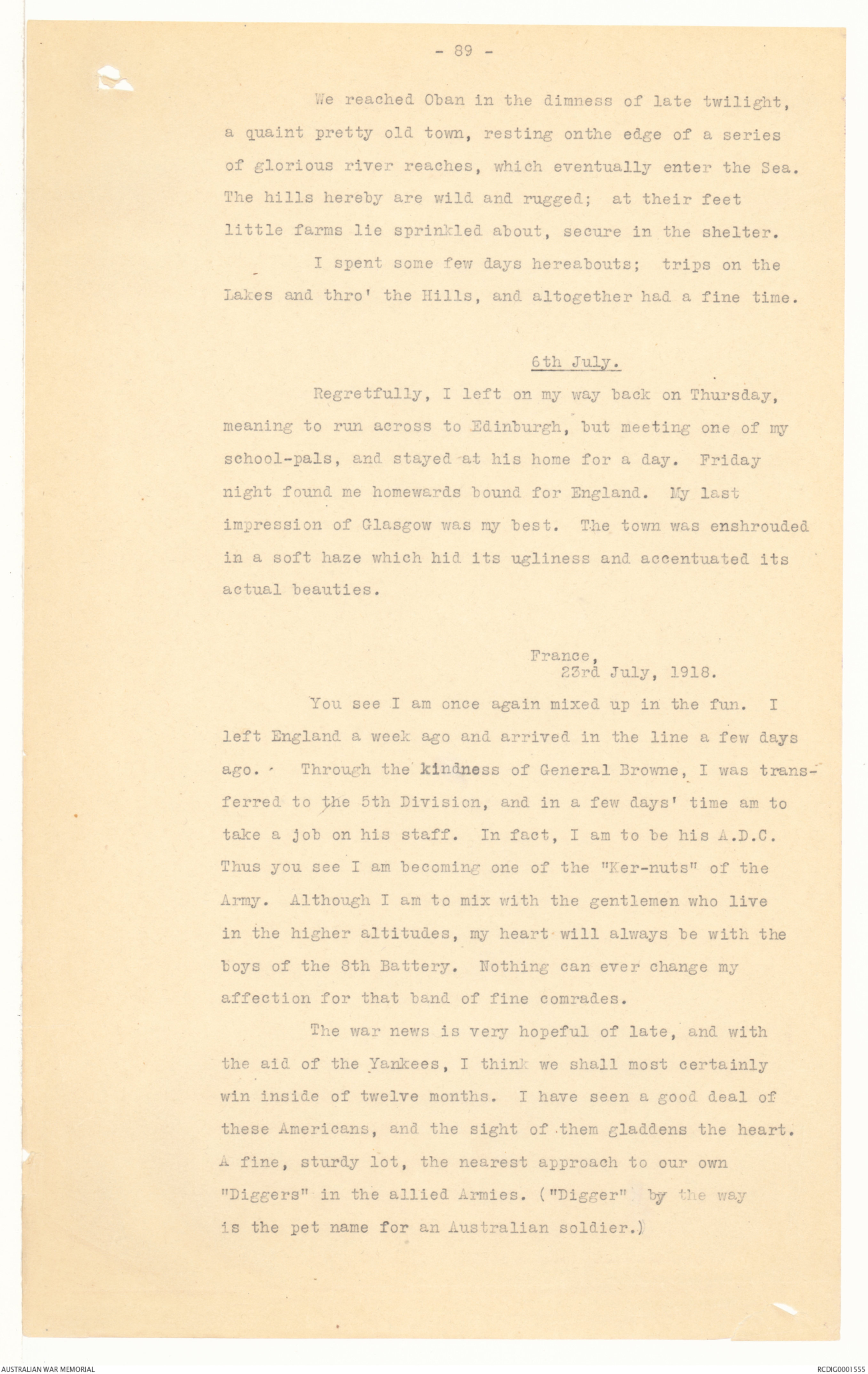
We reached Oban in the dimness of late twilight,
a quaint pretty old town, resting on the edge of a series
of glorious river reaches, which eventually enter the Sea.
The hills hereby are wild and rugged; at their feet
little farms lie sprinkled about, secure in the shelter.
I spent some few days hereabouts; trips on the
Lakes and thro' the Hills, and altogether had a fine time.
6th July.
Regretfully, I left on my way back on Thursday,
meaning to run across to Edinburgh, but meeting one of my
school-pals, and stayed at his home for a day. Friday
night found me homewards bound for England. My last
impression of Glasgow was my best. The town was enshrouded
in a soft haze which hid its ugliness and accentuated its
actual beauties.
France,
23rd July, 1918.
You see I am once again mixed up in the fun. I
left England a week ago and arrived in the line a few days
ago. Through the kindness of General Browne, I was transferred
to the 5th Division, and in a few days' time am to
take a job on his staff. In fact, I am to be his A.D.C.
Thus you see I am becoming one of the "Ker-nuts" of the
Army. Although I am to mix with the gentlemen who live
in the higher altitudes, my heart will always be with the
boys of the 8th Battery. Nothing can ever change my
affection for that band of fine comrades.
The war news is very hopeful of late, and with
the aid of the Yankees, I think we shall most certainly
win inside of twelve months. I have seen a good deal of
these Americans, and the sight of them gladdens the heart.
A fine, sturdy lot, the nearest approach to our own
"Diggers" in the allied Armies. ("Digger") by the way
is the pet name for an Australian soldier.)
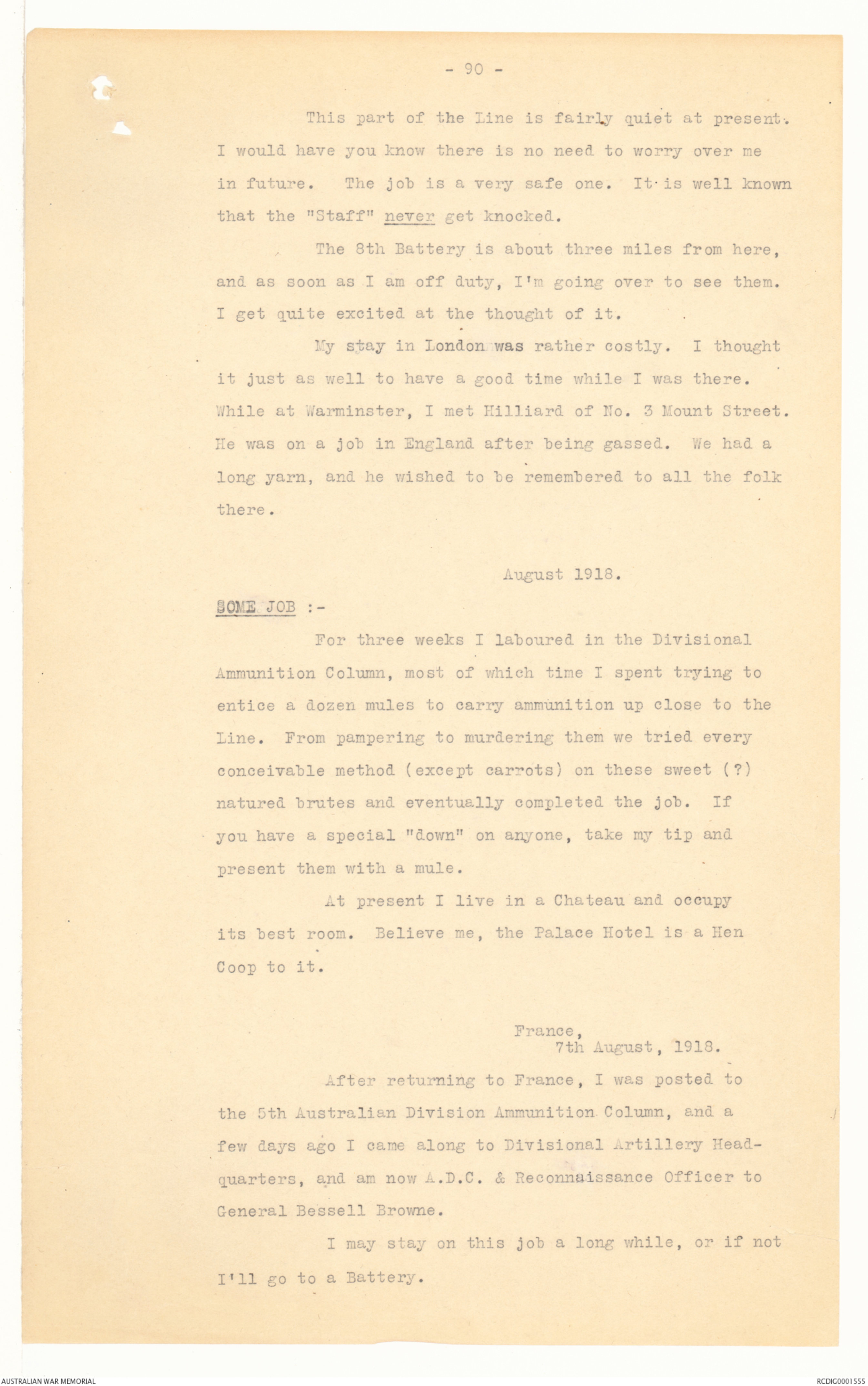
- 90 -
This part of the Line is fairly quiet at present.
I would have you know there is no need to worry over me
in future. The job is a very safe one. It is well known
that the "Staff" never get knocked.
The 8th Battery is about three miles from here,
and as soon as I am off duty, I'm going over to see them.
I get quite excited at the thought of it.
My stay in London was rather costly. I thought
it just as well to have a good time while I was there.
While at Warminster, I met Hilliard of No. 3 Mount Street.
He was on a job in England after being gassed. We had a
long yarn, and he wished to be remembered to all the folk
there.
August 1918.
SOME JOB:-
For three weeks I laboured in the Divisional
Ammunition Column, most of which time I spent trying to
entice a dozen mules to carry ammunition up close to the
Line. From pampering to murdering them we tried every
conceivable method (except carrots) on these sweet (?)
natured brutes and eventually completed the job. If
you have a special "down" on anyone, take my tip and
present them with a mule.
At present I live in a Chateau and occupy
its best room. Believe me, the Palace Hotel is a Hen
Coop to it.
France,
7th August, 1918.
After returning to France, I was posted to
the 5th Australian Division Ammunition Column, and a
few days ago I came along to Divisional Artillery Headquarters,
and am now A.D.C. & Reconnaissance Officer to
General Bessell Browne.
I may stay on this job a long while, or if not
I'll go to a Battery.
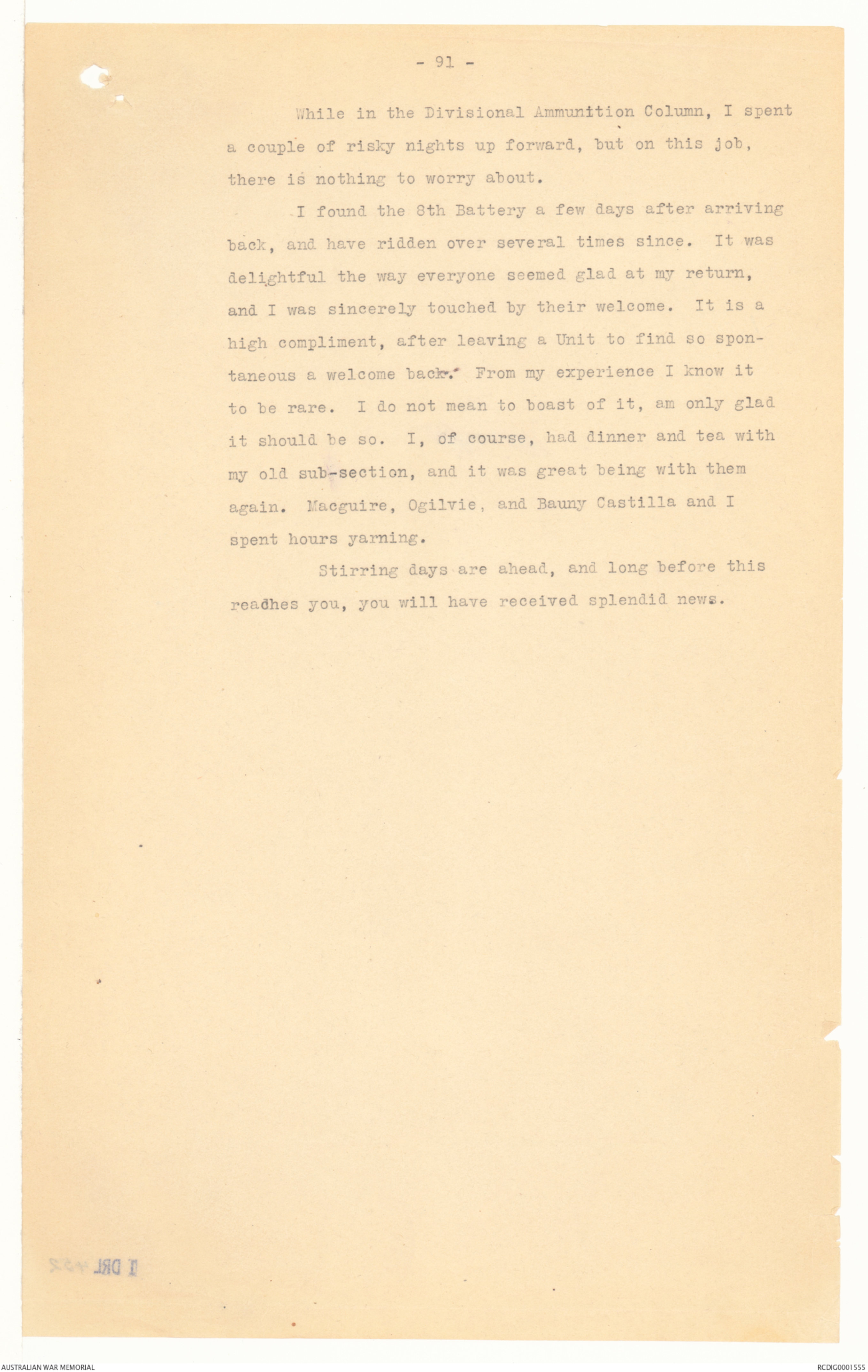
- 91 -
While in the Divisional Ammunition Column, I spent
a couple of risky nights up forward, but on this job,
there is nothing to worry about.
I found the 8th Battery a few days after arriving
back, and have ridden over several times since. It was
delightful the way everyone seemed glad at my return,
and I was sincerely touched by their welcome. It is a
high compliment, after leaving a Unit to find so spontaneous
a welcome back. From my experience I know it
to be rare. I do not mean to boast of it, am only glad
it should be so. I, of course, had dinner and tea with
my old sub-section, and it was great being with them
again. Macguire, Ogilvie, and Bauny Castilla and I
spent hours yarning.
Stirring days are ahead, and long before this
reaches you, you will have received splendid news.
 Transcriber 206
This transcription item is now locked to you for editing. To release the lock either Save your changes or Cancel.
This lock will be automatically released after 60 minutes of inactivity.