
Typescript copies of letters from Hector Roy McLarty, 18 November 1914 to 7 August 1918 - Part 7
- 61 -
Somewhere in B-----
6th September, 1916.
I have written very little of late, but we have
been meandering through France like restless Arabs for the
last two months or so, and I have had little opportunity
of writing. Now I think we have come to a rest for a while,
and I hope to make amends in that way.
We are in a rather noted part of the line. If
you remember a ruined city famous for its Cloth Hall you
will guess where we are.
The place has been under constant shell fire for
two years and it is in total ruins. I do not think anything
since the beginning of the War has impressed me so much as
this awful spectacle. You can form no conception of the
feeling of utter desolation one has on seeing so much beauty
laid waste wantonly, and this City was beautiful, in its age.
its wonderful traditions, its architecture, its slumbering
memories.
Of the thousands of houses and buildings, I did
not see one that was not a wreck. So hurried was the exit
of most of these people, the furniture still stands as in
everyday life, and seems to welcome one with a sort of
wistful appeal. It is pathetic to see it so. We take what
little we want - odd trifles - a lamp, a chair, a bed -
suchlike things.
I have not found Jimmy yet, although I saw him
en route. Jimmy, with his exceptional temperament, treats
this portion of his life as a sort of pilgrimage and in all
our wanderings he takes his pleasure in seeking out the
beauty spots. He never fails to see all the Churches within
miles of our Bivouac and talks most interestingly of them.
I regret to say I am utterly indifferent to such things now -
I mean the beauties of the City - the incomparable beauty of
the country still holds the same grip on me.
The winter is approaching and I rather dread the
thought of seeing it through. It would not be so bad if they
would leave us in the one position, but it seems to be one
- 62 -
of the maxims of the Army never to allow one to get
settled down or become comfortably housed. We are forever
on the move.
At present we are in splendid gun pits. Mine
is like an enormous cellar. We of course sleep by the gun,
and can commence firing at any second during the night or
day. We have garnered odd bits of furniture - 5 chairs, one
table, 2 old stretchers, and one of those complete school
desks, taken from a destroyed Reformatory School near by.
I am writing on it now. The mob are playing cards or chewing
lollies.
Belgium.
24th September, 1916.
Two of us fellows usually take French leave of
an evening (why shouldn’t we in France) and walk into a
large Belgium town near by. There we meet the "bloods"
of the town, have a few drinks, see the sights, and at 8
o'clock when "Curfew" doth ring and the town melts into
silence, we go to a little fruit shop where again (in our
wanderings) we have found a home. It is kept by two old
ladies (Mother and Auntie) and a daughter (Marie). It was
quite by accident that we found what gentle kindly folk they
were. One evening while we were sheltering in the shop from
the rain, they asked us if "we would take coffee with them".
From thence our acquaintance has strengthened into friendship
and they appear to be very fond of us. Their history
is rather pathetic. Well-to-do farmers before the War,
their place was devastated during the first rush on Ypres,
and they escaped barely with their lives. The only boy
who was at school in Brussels has disappeared and no trace
can be found in Germany, nor amongst the refugees in England.
Three small girls are at school in Paris, but owing to the
strict Military regulations, the Mother cannot get to them.
The girl - Marie - is about 17, has been educated
at College and can speak English in a quaint delightful
sort of way. Other than this she is fat and of very bad
- 63 -
figure. The two old ladies are fat, always smiling and
bubbling over with good nature. They tell me that I resemble
a boy they knew in the years gone by, and evidently the sight
of me resuscitates a slumbering love affair in the heart of
"Auntie" for I catch her at times beaming on me with a far
away look in her eyes. We wile away many a delightful hour
in their cosy kitchen sitting over our coffee and bread and
butter.
Belgium.
10th October, 1916.
There is a saying that "the road to Hell is paved
with good intentions". If that is so, then I am a good way
on the road. I have been going to answer your two interesting
letters for a long while, but somehow I have neglected
you all of late.
We have lately been resting for a while, so I
took the opportunity of going into hospital for two weeks
to get rid of a rather troublesome skin disease, which
thrives under the classical name of "Scabies". I would have
you know, Monsieur and Madame that this is the first time I
have called in the "Quacks" since starting on my pleasure
tour round the world. We were forbidden to leave hospital,
yet each afternoon after tea, I would find myself well out
of bounds on the road to a large town a few miles distant
from the "Scabies Factory". In P----- I became acquainted
with a very nice family of Belgians, and there spent many a
happy evening.
However, after having a really good time, I once
again took up the serious business of eating three meals a
day in a gun pit and firing a gun occasionally and HERE I am.
We are stationed just/outside of Y----. The gun
pits are hidden in the ruins of a once stately palace. In
places, the Firing Line is but 1000 yards away, but it winds
and twists in such an extraordinary way that no matter in
which direction you gaze at night you are sure to see the
glow of a star shell.
- 64 -
It is rumoured - and I believe it is true -
that this crumbling ruin was the country residence of the
late King Leopold of infamous memory. He may have been an
immoral old gentleman, but while I am his guest (as it were),
I will not speak ill of him. The Palace is surrounded by a
pretty moat, and an old-fashioned drawbridge leads you to
the Palace entrance. A most beautiful old garden extended
over - I should say - 20 acres, has run wild and frets under
the scars of a thousand shell wounds. The trees are torn
about terribly, but the garden itself is filled with a
myraid of blossoms. Here and there pretty statues add
further charm to the place. One I noticed has come under
the tender care of some wag who has dressed it in the
clothes of a soldier. In peace times this Lady would charm
your eye, standing in graceful robes, sythe in hand, looking
out on her garden, but now with a disreputable tin hat,
slanted jauntily over her head, a Scotch plaid tied round
her amidships, and a rusty knive in her hand, she is by/no
means a vision of beauty. I gather each day a bunch of
roses and adorn the gun pit with them.
While out of the line I had the pleasure of
meeting Cliff Burridge. He is in the 11th Battalion. We
meandered into a village close by, and while eating fried
eggs with a knive, I made him tell me all the news. I was
so eager for news that I had him perspiring in the end
answering questions. He went to the trenches next day, so
I will not see him for a while.
Jimmy Linton is only just across the way. I
was down to see him tonight. We had a long yarn and I
smoked all his cigarettes - dear Jimmy - he still trys to
smoke, but as old, chews tobacco instead.
11th November, 1916.
I cannot find words to express my disgust at
the attitude of Australia over Conscription. Many thousands
of heroic souls have died out here to make glorious the
- 65 -
beginnings of her traditions, and now the majority of
her population have besmirched her name and thrown
contempt on her glorious dead. I saw a chap buried today
(by the way a man is very lucky to be buried decently
here - about 1 in 40 get it I suppose). He was knocked
about badly, but his face was composed. It was a fine
firm face - a good face. I looked at him and thought
"Well you have died for your Country, I wonder if you
know with what contempt your countrymen treat you" OH!
the dirty despicable cold-footed, snug-faced swines, if
God played the game He’d turn the Huns loose on 'em.
For the last three weeks we have been in
the mud and slush of the Somme once again and the conditions
this time are really awful. Ceaseless rain,
bitterly cold weather, mud up to our thighs, little food,
less sleep and fight, fight, fight, day and night.
Thank God one gets into a kind of stupor and is numb to
feeling. The horses are dying in thousands, and it it
heart-breaking to see these poor docile creatures work
until they drop dead of exhaustion.
You will be sorry to hear that Laurie Clarke
was severely wounded a few days ago. He had his foot
practically blown off by a piece of shell and is certain
to lose it. He has been doing fine work since we came to
France. He was a good soldier, cheerful, painstaking and
conscientious. He took his crack like a man, and a very
brave one at that. Not a murmur while they were bandaging
it up and it took almost an hour. The only question
he put to the Doctor was "Am I only going to lose my
foot, Doctor?" Not bad eh! You might ask his mother
and sister to accept my sympathy, and tell them they
should be very proud of him. You might tell the circumstances
to the Office chaps too.
I came away from the guns a week ago and am
at the wagon lines with the horses for a fortnight. It
is not so bad here except that every second night I have
a nightmare of a trip up to the guns with Ammunition.
- 66 -
It is about seven miles across pathless country, studded
with millions of deep shell holes and miles of trenches all
filled with thick slimy mud. The nights are dark and often
a thick fog envelopes everything. We rarely get through
without the loss of a horse, sometimes legs are broken,
else a horse gets in a shell hole filled with mud and
suffocates. Drivers and horses are often killed by shell
fire. Oh! it's a blithering trip - takes about 10 hours.
If you ever hear of me as "missing believed sunk" you’ll
know I'm rusticating in a shell hole.
Tim is going good; he runs a Battery Canteen
and does the Grocer act to a nicety. You know the style
"I have an excellent line of stewed peas at 1/2" or "No
we have no pig’s ear but why not try a drop of rum old
dear."
If I ever hear an argument in the lines I know
Tim is there. We have only one man who can beat him, a
chap named Hooper, who, according to rumour, talked for
36 hours once without taking breath, only stopped then to
drink a beer.
France.
18th December, 1916.
Here’s a little picture in contrasts for you.
Outside it is as dark as the uttermost chambers of Hell.
The temperature is 10 degrees below freezing point. The
ground, which this afternoon was soft mud, is now frozen
so hard that a horse's hoof would make no impression on it.
The intermittant bursting of a few shells or the flash of
a gun firing, allows the eye for an instant to gaze on this
dreadful country, pitted with shell holes, dead trees and
a myriaaid of graves, and accentuates the horror of the
darkness which follows.
Inside the gun pit a warm cheery fire is burning.
For the last four hours a phonograph has been enthralling
us. The pit is an inviting spot. The gun in the centre,
her breech and brass gears gleaming in the reflection of
- 67 -
the fire. Hundreds of shells lie on the shelves to one
side and little rivulets of light play on their brass
cases. A bed on each side, the phonograph on one. Round
one side sit six soldiers, drinking in the music as if it
were the strains of a Celestial Band - to them it is. The
glow of the fire reflects each face. Their appearance is
not prepossessing, for dirt has seamed their faces and
their ragged mud-splashed clothes are wonderful to behold.
Each face has its different characteristics, but all, for
the moment, bear that far away look which indicates thoughts
of home.
Personally, I am enthralled. The phonograph
has taken hold of my heart strings. You see we have been
on the Somme for a long while. It has been pretty rough.
I hope I never see another eight weeks like it. We are
tired and just about at the end of our strength and a touch
of music sends me half mad.
France.
About 21st April, 1917.
As you know the Huns began a big retreat some
three weeks ago, since when we have been busy chasing him.
After hurriedly crossing "No Man’s Land" we entered a new
country - a country of exceptional charm. What a change it
is to get away from the devasted country of the last
offensive. But for the shattered villages through which
we pass, the scenery is beautiful. Green fields and the
trees just clothed in their new leaves. Gone is the
stagnant life; once again we move continuously. It is a
fine life too. If it were not for the wretched weather,
it would be wholly delightful.
You have heard, of course, that Fritz poisons
the water as he goes back, and leaves all sorts of delightful
traps for us to investigate. We have been strictly
ordered not to touch odd bottles of wine etc. which are
to be found in the villages. A rather amusing incident
happened because of this. To begin with the boys have
- 68 -
not sniffed a beer for at least four months, and if
asked to express their feelings in biblical language
I would say "As the Hart desireth the waterbrooks, so
longeth our souls after Wine, O Lord." Well, to get
on with the story. While wandering through the ruins
of a village one of the Sergeants discovered a sealed
bottle of Absinthe. Have you ever tasted Absinthe? NO.
Then you have yet to taste the Nectar of the Gods. He
brought it home in great glee. We placed it on a table,
and silently sat around it. Who was to taste it? Who
was to take the chance? A brilliant idea crept into Kierath's
head. Why not have a hand at cards to provide the
martyr? Right-O round went the cards and -- Dowling lost.
With due ceremony the cork was withdrawn, Dowling lifts
the cup to his lips, we rise and wish him luck. He
drinks and Lo a heavenly smile lights up his face. HERE,
the joke comes in. Before the poison could possibly
affect him (if it had been poisoned) every man jack had
grasped the bottle and taken a nip. We laughed about it
afterwards.
Hal Warren, one of the old Battery boys, and
one of my greatest pals during the last two and a half
years, left us at Christmas time to go to a Flying School
in England. He was killed a few days ago while flying.
Even in this land of dead, it is hard for me to realise
his bright face and ardent spirit has gone. Aged 23,
splendidly educated, a brilliant mind, and a most
loveable disposition. Dead - for England.
I notice I have told you of something trivial
and of something which is sublime. So are the grave and
gay sides of life mixed here.
1st June, 1917.
We had a most tragic day today. The Huns
began shelling at dawn, and continued all the morning.
His shells to start with were not actually close, but
just enough to keep us alert. About 8 a.m. we were
- 69 -
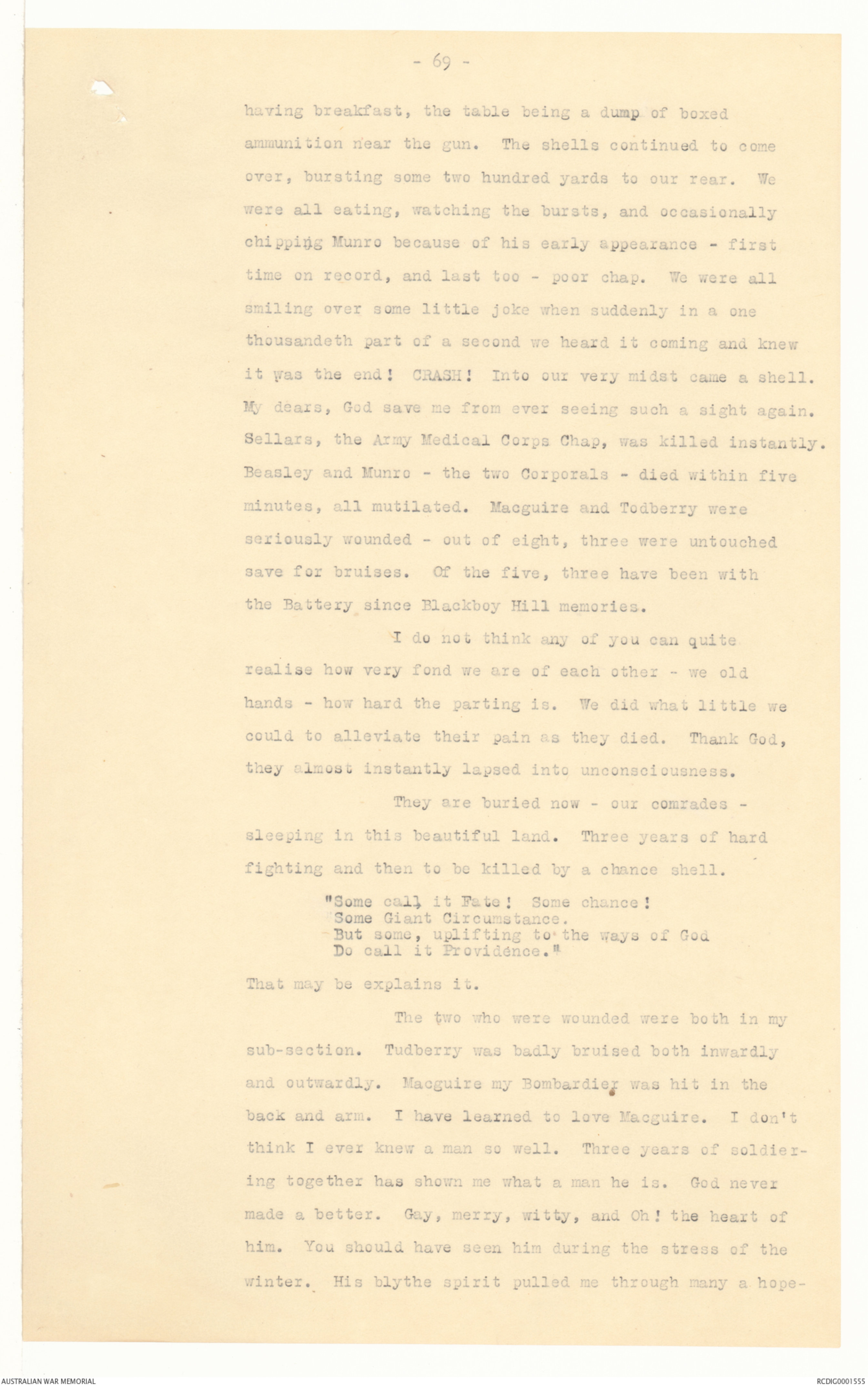
having breakfast, the table being a dump of boxed
ammunition near the gun. The shells continued to come
over, bursting some two hundred yards to our rear. We
were all eating, watching the bursts, and occasionally
chipping Munro because of his early appearance - first
time on record, and last too - poor chap. We were all
smiling over some little joke when suddenly in a one
thousandeth part of a second we heard it coming and knew
it was the end! CRASH! Into our very midst came a shell.
My dears, God save me from ever seeing such a sight again.
Sellars, the Army Medical Corps Chap, was killed instantly.
Beasley and Munro - the two Corporals - died within five
minutes, all mutilated. Macguire and Todberry were
seriously wounded - out of eight, three were untouched
save for bruises. Of the five, three have been with
the Battery since Blackboy Hill memories.
I do not think any of you can quite
realise how very fond we are of each other - we old
hands - how hard the parting is. We did what little we
could to alleviate their pain as they died. Thank God,
they almost instantly lapsed into unconsciousness.
They are buried now - our comrades -
sleeping in this beautiful land. Three years of hard
fighting and then to be killed by a chance shell.
"Some call it Fate! Some chance!
Some Giant Circumstance.
But some, uplifting to the ways of God
Do call it Providence."
That may be explains it.
The two who were wounded were both in my
sub-section. Tudberry was badly bruised both inwardly
and outwardly. Macguire my Bombardier was hit in the
back and arm. I have learned to love Macguire. I don't
think I ever knew a man so well. Three years of soldiering
together has shown me what a man he is. God never
made a better. Gay, merry, witty, and Oh! the heart of
him. You should have seen him during the stress of the
winter. His blythe spirit pulled me through many a hopeless
- 70 -
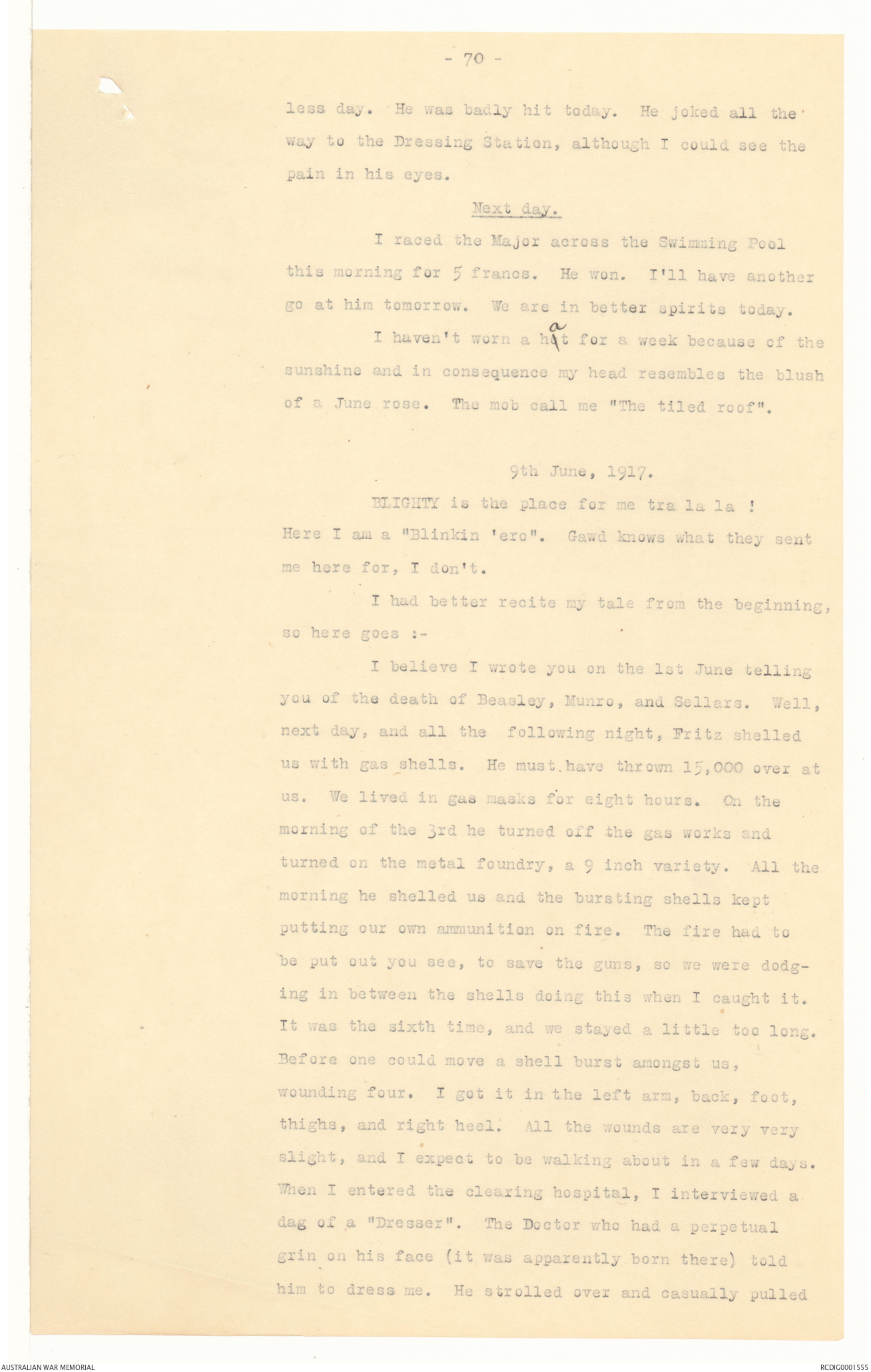
day. He was badly hit today. He joked all the
way to the Dressing Station, although I could see the
pain in his eyes.
Next day.
I raced the Major across the Swimming Pool
this morning for 5 francs. He won. I'll have another
go at him tomorrow. We are in better spirits today.
I haven't worn a heat for a week because of the
sunshine and in consequence my head resembles the blush
of a June rose. The mob call me "The tiled roof".
9th June, 1917.
BLIGHTY is the place for me tra la la !
Here I am a "Blinkin 'ero". Gawd knows what they sent
me here for, I don’t.
I had better recite my tale from the beginning,
So here goes :-
I believe I wrote you on the 1st June telling
you of the death of Beasley, Munro, and Sellars. Well,
next day, and all the following night, Fritz shelled
us with gas shells. He must have thrown 15,000 over at
us. We lived in gas masks for eight hours. On the
morning of the 3rd he turned off the gas works and
turned on the metal foundry, a 9 inch variety. All the
morning he shelled us and the bursting shells kept
putting our own ammunition on fire. The fire had to
be put out you see, to save the guns, so we were dodging
in between the shells doing this when I caught it.
It was the sixth time, and we stayed a little too long.
Before one could move a shell burst amongst us,
wounding four. I got it in the left arm, back, foot,
thighs, and right heel. All the wounds are very very
slight, and I expect to be walking about in a few days.
When I entered the clearing hospital, I interviewed a
dag of a "Dresser". The Doctor who had a perpetual
grin on his face (it was apparently born there) told
him to dress me. He strolled over and casually pulled
 Jenny B
This transcription item is now locked to you for editing. To release the lock either Save your changes or Cancel.
This lock will be automatically released after 60 minutes of inactivity.