
Typescript copies of letters from Hector Roy McLarty, 18 November 1914 to 7 August 1918 - Part 6
- 51 -
All the banks along the line are spread with
blooming primroses - exquisite country!
The people turn out at each station and the lovely
bright-eyed kiddies implore one for "Souvenir if you
please Soldier", and the women call us "their brave
defenders". It is very nice after the niggers of Egypt.
The womenfolk are very beautiful, especially the country
girls, with their cheeks like blushing roses. It is
really an exception to see an ugly woman and their manners.
are perfect.
19th April, 1916.
France.
Am writing this in an old broken-down house some
two thousand yards behind the firing line. Once it must
have been a charming house, with its faultless little
garden, and its shady fruit trees, but it is now the last
thing in desolation. We have, however, mended it up a
bit, made some furniture and are now fairly comfortable.
Our gun pits are close by. My last letter to you I wrote
from Harve, which town we left that day in teeming rain.
Thence we came by train through many famous towns, until
the dull booming of the guns told us we were not far from
the front. We detrained in the rain and proceeded to our
billet - an old farmhouse - and strange to say left quite
undisturbed by the Germans after their sojourn of six days.
We reached this place about midnight, frozen to the very
bones, and were allowed to shelter in a barn. We slept
dreamlessly until morning in the clean warm straw.
After the absence of habitation at Anzac, it is
very strange to find these people living on their farms
and carrying on their every-day work right under the nose
of the guns. It proves to be a veritable god-send to us
though. One can always get coffee, fresh eggs and bread.
After a two days spell we moved right up into action, where
we are now.
- 52 -
The night before reaching here, we billeted in a
most charming farm. A bonny rosy-cheeked girl of about
seventeen met us at the gate and bad up welcome. She could
speak English with a delightful French accent, and talked
all the evening. Such a gay evening we had to be sure.
All in love with her, we sat in the cosy dining room for
hours, drinking good French beer, and telling her funny
stories, until the tears streamed from her eyes with
laughter; while we roared when she tried to give "Ducky"
Day (the Sergeant Major and a regular trick) a lesson in
French. It will be many a day before I forget her merry
vivacious little face as she beamed on us from her seat
by the fireside.
The village to our right, and about half a mile away,
has been almost battered to pieces, and in the early days
the British drove the Germans from it at the point of the
bayonet, yet a lot of people still live here.
One can fire a few rounds from the guns, then stroll
into the village for a beer; of course, should they concentrate
an attack here it will be lively.
22/4/16 - Easter Sunday.
It is a most beautiful day, and I am sitting in what
remains of this fine old garden. Overhead, at least
twenty aeroplanes are roaming about, some ours, some German.
One could watch them all day, so exquisite are they, and so
amazingly agile. One adventuring beggar has gone over the
German lines, and I have already counted two hundred shots
fired at him, but devil a bit does he care.
The apple trees are all abloom, and the May looks
proud and sweet clothed in the year's new leaves. The
country is a perfect picture.
Have received no mail since we left Harve, so
there must be a lot somewhere. I have written to the
A.M.P. London, asking them to arrange to have my May and
June salary paid there as I never know when I may get over
there. I believe we are getting a week's holiday to visit
- 53 -
England - that is - a few at a time.
I am making persistent enquiries about Keith
and the Black Watch, but so far have gathered nothing.
We are a good way from Loos, and it is very hard to get
definite news.
24th May, 1916.
France.
Since writing you I have been to England for
8 days, mainly to see if I could get any definite news of
Keith. From the papers I saw at the Agent General's
Office there is no doubt that he was killed in the Battle
of Hill 70 (near Loos) on about 23rd October last. I have
since met a Scotchman who was in the same battle and he
told me that the Black Watch by their very impetuosity
got ahead of the rest and suffered very heavily. They took
the Hill but owing to lack of reinforcements were later
driven back. I am trying to get information from the
Adjutant of his Regiment.
I can imagine that it is the way he would have
wished to die - in the mad wild rush of the charge.
I have had a glorious holiday in London during
my eight days. It took me only 22 hours to travel from
the Firing Line right to the heart of London. On arrival
at 2.a.m. we were met by a band of ladies and entertained
at a delicious supper. The English people are absolutely
charming and they simply cannot do enough for an Australian
soldier.
You have all heard of the marvellous way the
traffic is managed, the buses, and the wonders of the
underground railways. These have to be seen to be appreciated.
I did not do much sight-seeing really, but
better than any visiting of Palaces and Churches, is to
stand in the streets and watch the passers-by - a never
ending scene of absorbing interest.
The womenfolk are awfully pretty with their
high coloring and gracious ways, and dress charmingly.
- 54 -
The people in general are extraordinarily kind, and so
very pleased if one will only just speak to them. If
you happen to be an "Anzac" you simply walk on air.
Everywhere I had meals, people would insist on paying
for them, and quite half a dozen fellows I met casually,
asked me to go and stay with them.
I stayed at the Regent Palace Hotel for 4
days, a rather fashionable Hotel in Piccadilly Circus,
but enjoyed it after "Trench Life". The last 3 days I
stayed with people whom I was introduced to from France.
They were intensely kind and happened to be a newly
married couple with a delicious little home.
I spent one day out of London, went to
Bournemouth mainly to get an air flight, and secondly
to see the country. The first I missed, the second -
the English Country scenery - is beyond my powers of
description.
Am going to close now. You will notice
that I am becoming slack with my letter writing. In
the first vivid impressions of the war everything was
so easy to write about, but now that events are dulled
by familiarity and are so ordinary, I find it very hard to
write.
France,
12th June, 1916.
Have just returned from a visit to Jimmy
Linton, he, as you know, is in the 23rd Battery, and is
situated some two miles to our left. The pathway over
led me through some delightful meadows. The country
after three days rain is radiant from the kiss of a
generous sun. Jim is splendid, and has taken to
soldiering as a navvy takes to beer, he simply revels
in it. I, who am somewhat of an old "sweat", view these
symptoms with disdain. We had a long chat with him.
Our Battery has been out "resting" (save the word) for
a fortnight about ten miles behind the trenches. While
- 55 -
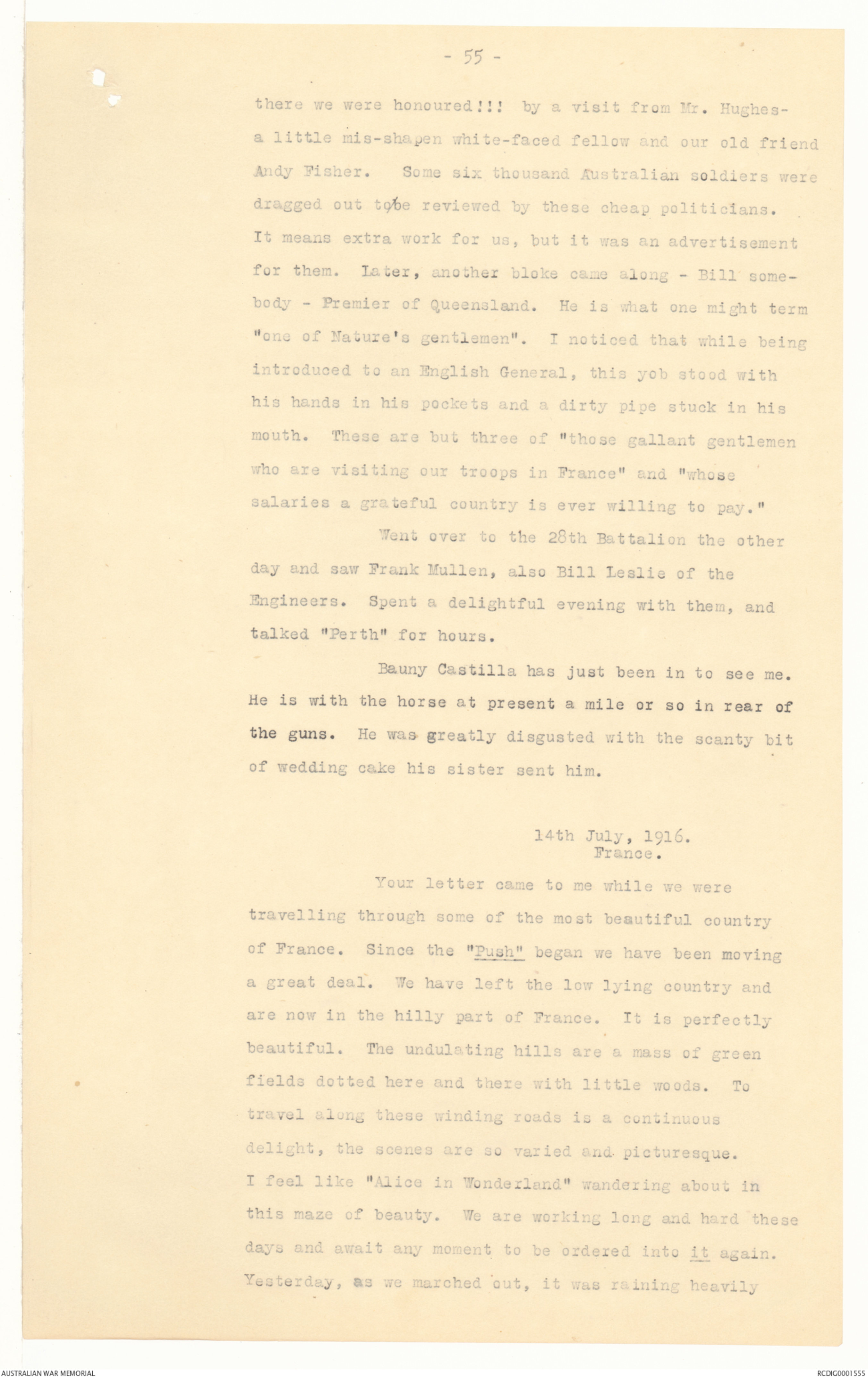
there we were honoured!!! by a visit from Mr. Hughes-
a little mis-shapen white-faced fellow and our old friend
Andy Fisher. Some six thousand Australian soldiers were
dragged out to be reviewed by these cheap politicians.
It means extra work for us, but it was an advertisement
for them. Later, another bloke came along - Bill somebody
- Premier of Queensland. He is what one might term
"one of Nature's gentlemen". I noticed that while being
introduced to an English General, this yob stood with
his hands in his pockets and a dirty pipe stuck in his
mouth. These are but three of "those gallant gentlemen
who are visiting our troops in France" and "whose
salaries a grateful country is ever willing to pay.'
Went over to the 28th Battalion the other
day and saw Frank Mullen, also Bill Leslie of the
Engineers. Spent a delightful evening with them, and
talked "Perth" for hours.
Bauny Castilla has just been in to see me.
He is with the horse at present a mile or so in rear of
the guns. He was greatly disgusted with the scanty bit
of wedding cake his sister sent him.
14th July, 1916.
France.
Your letter came to me while we were
travelling through some of the most beautiful country
of France. Since the "Push" began we have been moving
a great deal. We have left the low lying country and
are now in the hilly part of France. It is perfectly
beautiful. The undulating hills are a mass of green
fields dotted here and there with little woods. To
travel along these winding roads is a continuous
delight, the scenes are so varied and picturesque.
I feel like "Alice in Wonderland" wandering about in
this maze of beauty. We are working long and hard these
days and await any moment to be ordered into it again.
Yesterday, as we marched out, it was raining heavily
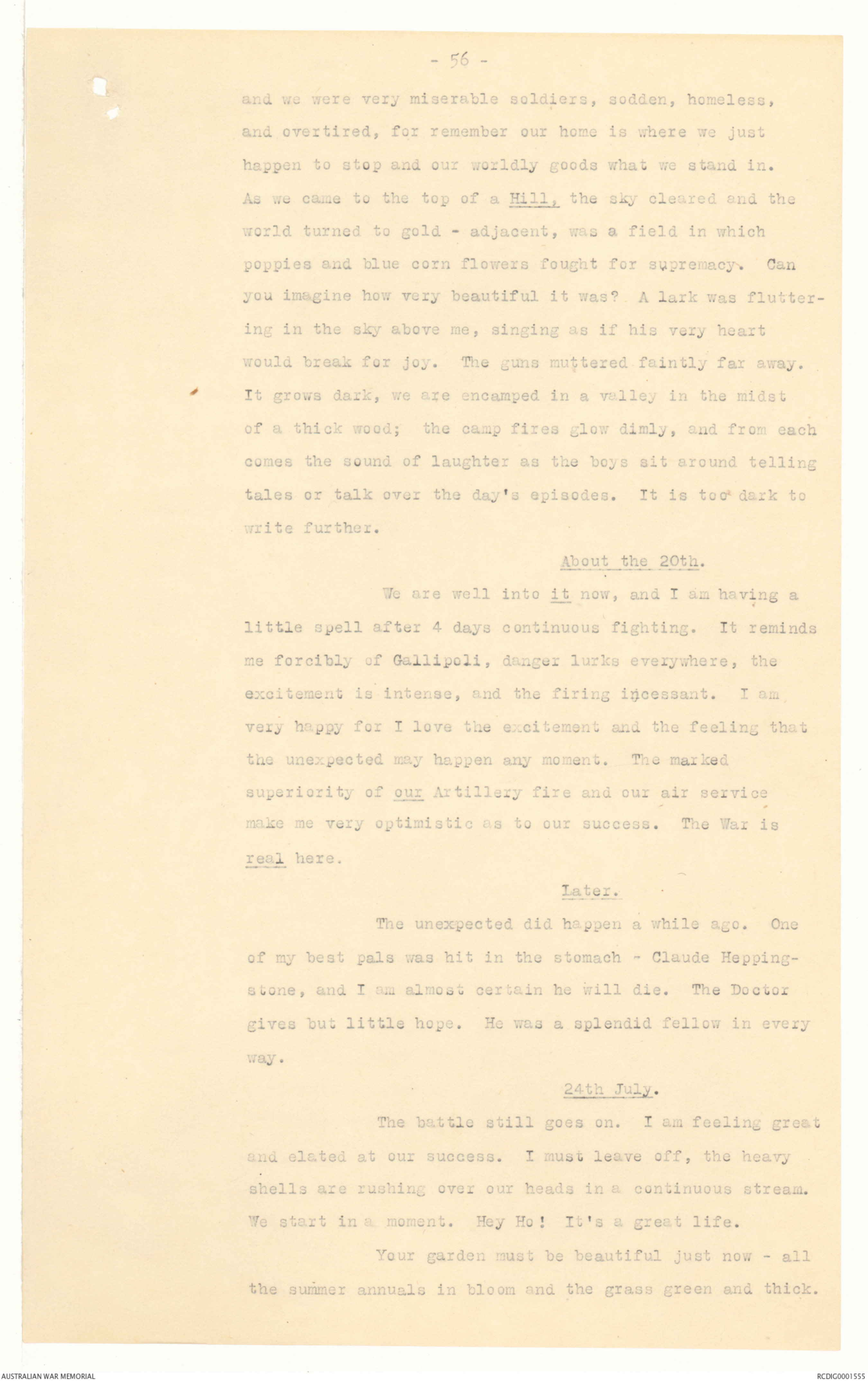
- 56 -
and we were very miserable soldiers, sodden, homeless,
and overtired, for remember our home is where we just
happen to stop and our worldly goods what we stand in.
As we came to the top of a Hill, the sky cleared and the
world turned to gold - adjacent, was a field in which
poppies and blue corn flowers fought for supremacy. Can
you imagine how very beautiful it was? A lark was fluttering
in the sky above me, singing as if his very heart
would break for joy. The guns muttered faintly far away.
It grows dark, we are encamped in a valley in the midst
of a thick wood; the camp fires glow dimly, and from each
comes the sound of laughter as the boys sit around telling
tales or talk over the day's episodes. It is too dark to
write further.
About the 20th.
We are well into it now, and I am having a
little spell after 4 days continuous fighting. It reminds
me forcibly of Gallipoli, danger lurks everywhere, the
excitement is intense, and the firing incessant. I am
very happy for I love the excitement and the feeling that
the unexpected may happen any moment. The marked
superiority of our Artillery fire and our air service
make me very optimistic as to our success. The War is
real here.
Later.
The unexpected did happen a while ago. One
of my best pals was hit in the stomach - Claude Heppingstone,
and I am almost certain he will die. The Doctor
gives but little hope. He was a splendid fellow in every
way.
24th July.
The battle still goes on. I am feeling great
and elated at our success. I must leave off, the heavy
shells are rushing over our heads in a continuous stream.
We start in a moment. Hey Ho! It's a great life.
Your garden must be beautiful just now - all
the summer annuals in bloom and the grass green and thick.
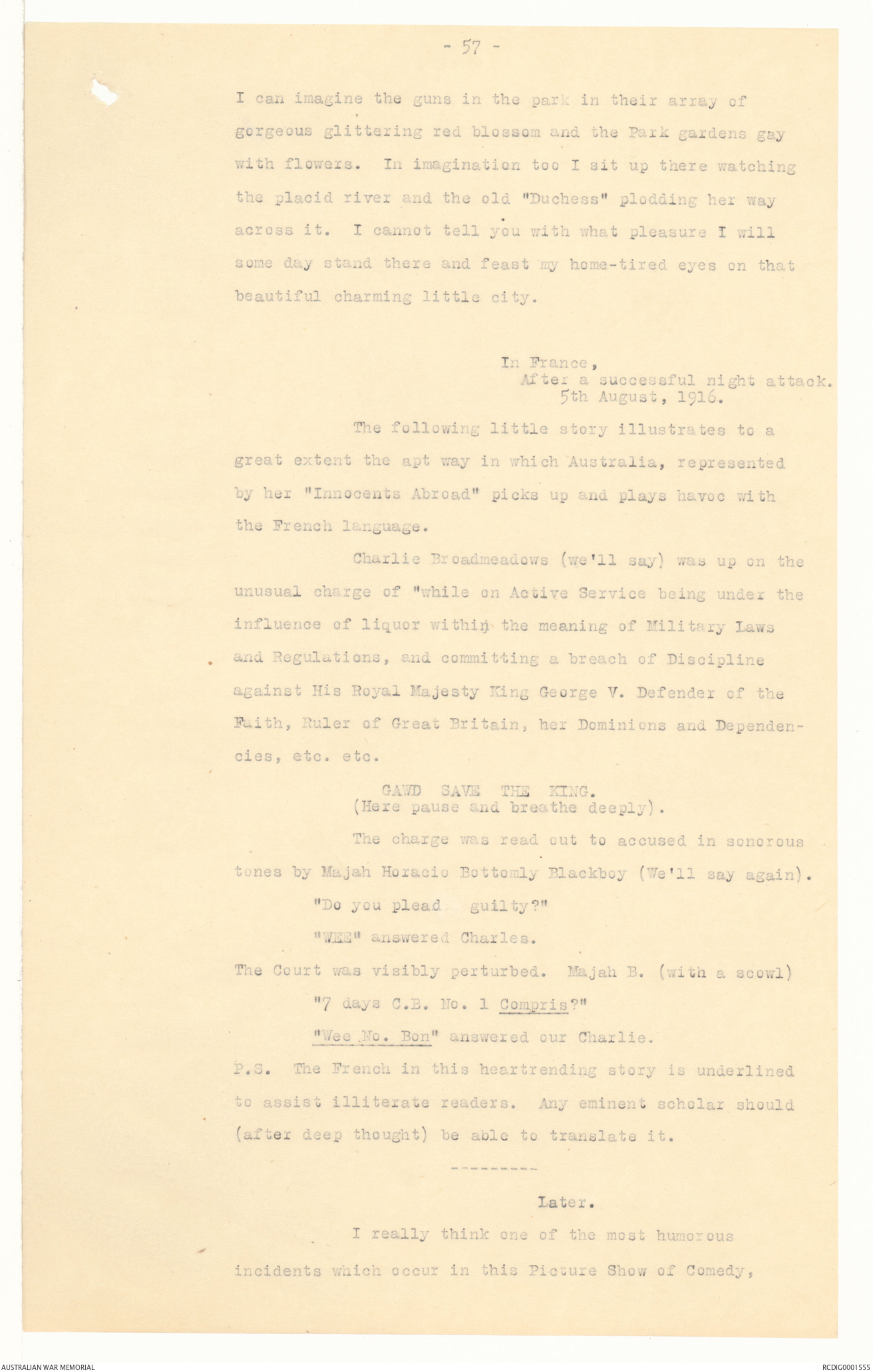
- 57 -
I can imagine the guns in the park in their array of
gorgeous glittering red blossom and the Park gardens gay
with flowers. In imagination too I sit up there watching
the placid river and the old "Duchess" plodding her way
across it. I cannot tell you with what pleasure I will
some day stand there and feast my home-tired eyes on that
beautiful charming little city.
In France,
After a successful night attack.
5th August, 1916.
The following little story illustrates to a
great extent the apt way in which Australia, represented
by her "Innocents Abroad" picks up and plays havoc with
the French language.
Charlie Broadmeadows (we'll say) was up on the
unusual charge of "while on Active Service being under the
influence of liquor within the meaning of Military Laws
and Regulations, and committing a breach of Discipline
against His Royal Majesty King George V. Defender of the
Faith, Ruler of Great Britain, her Dominions and Dependencies,
etc. etc.
GAWD SAVE THE KING.
(Here pause and breathe deeply).
The charge was read out to accused in sonorous
tones by Majah Horacio Bottomly Blackboy (We'll say again).
"Do you plead guilty?"
"WEE" answered Charles.
The Court was visibly perturbed. Majah B. (with a scowl)
"7 days C.B. No. 1 Compris?"
"Wee No. Bon" answered our Charlie.
P.S. The French in this heartrending story is underlined
to assist illiterate readers. Any eminent scholar should
(after deep thought) be able to translate it
Later.
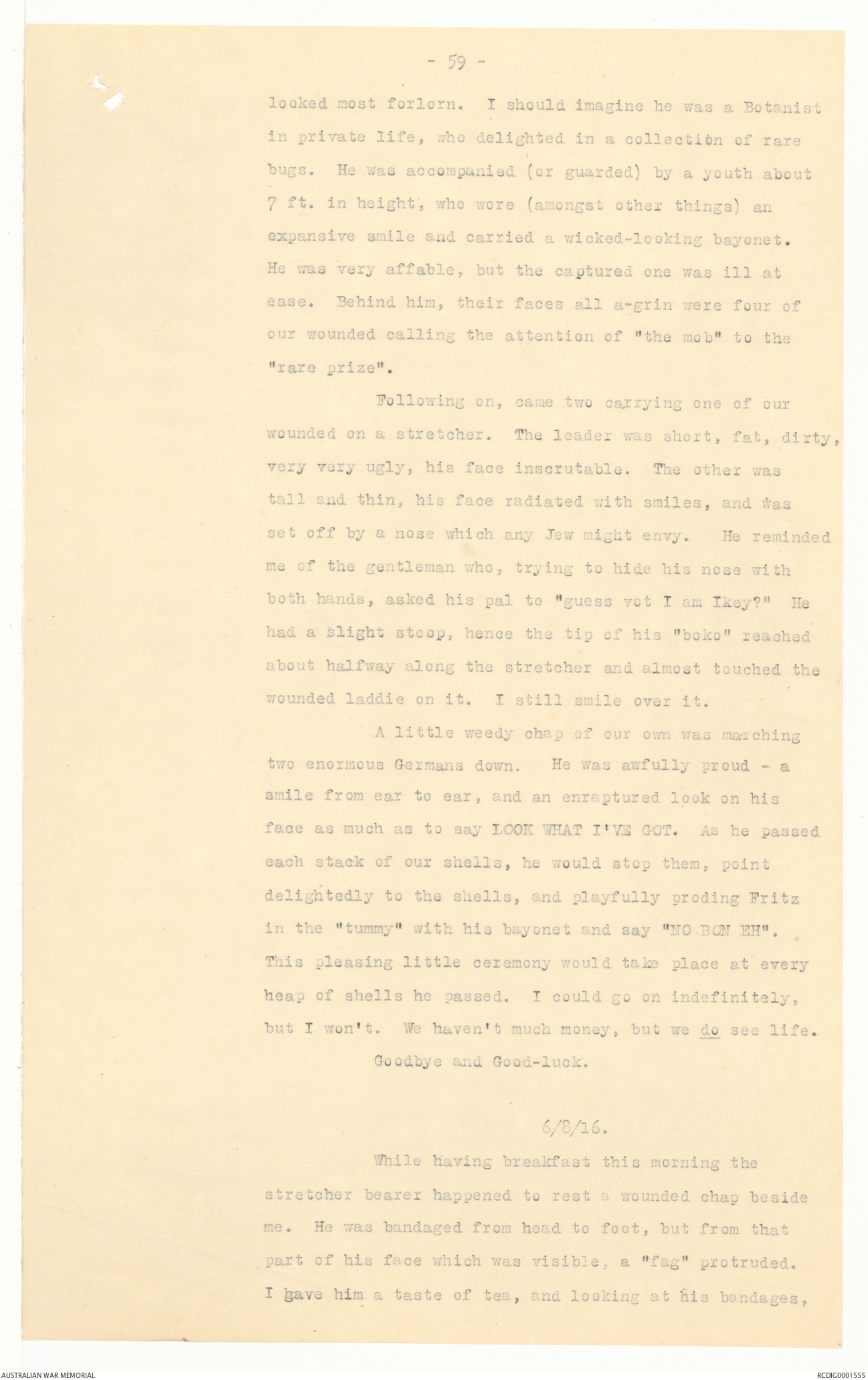
I really think one of the most humorous
incidents which occur in this Picture Show of Comedy,
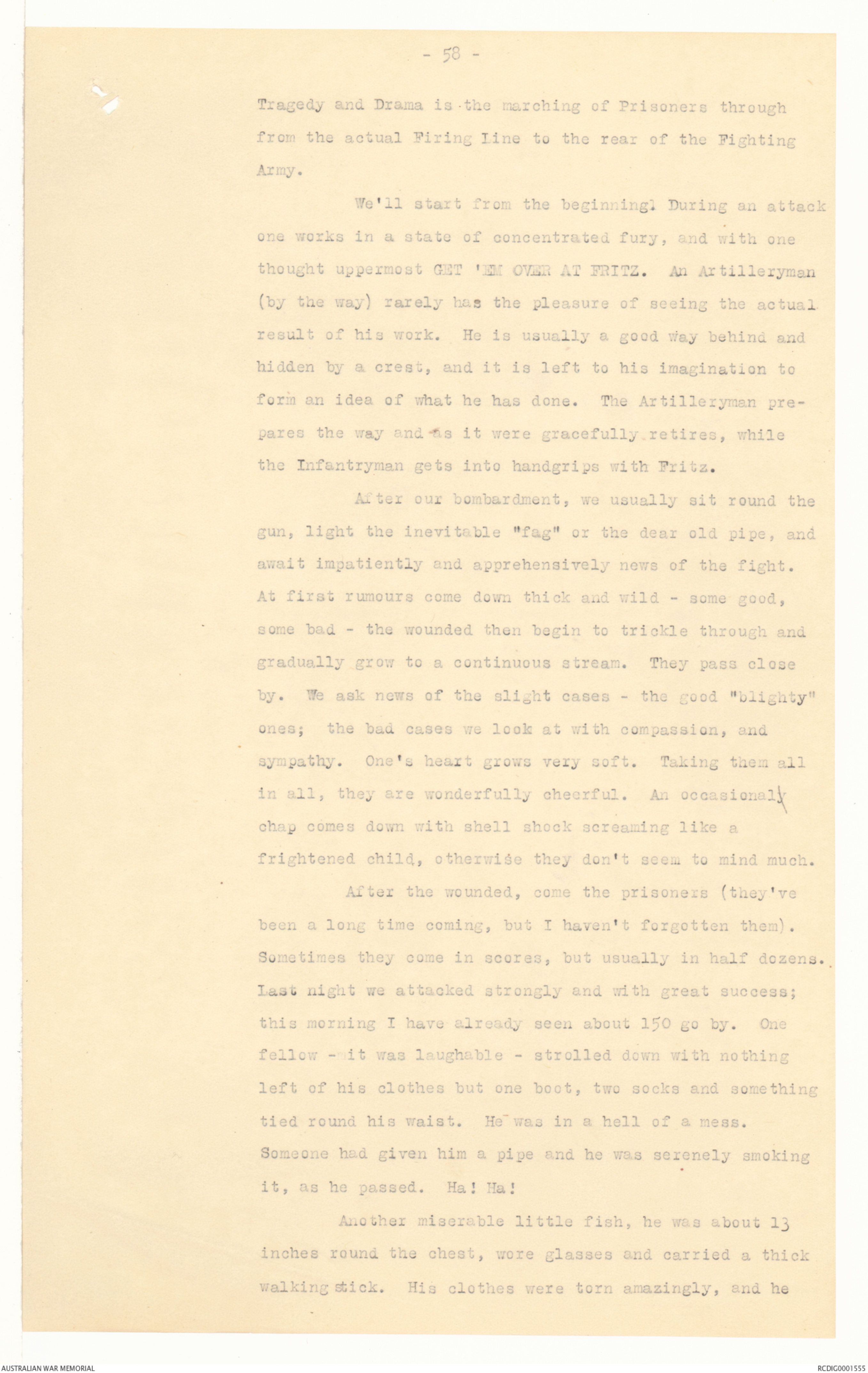
- 58 -
Tragedy and Drama is the marching of Prisoners through
from the actual Firing Line to the rear of the Fighting
Army.
We'll start from the beginning! During an attack
one works in a state of concentrated fury, and with one
thought uppermost GET 'EM OVER AT FRITZ. An Artilleryman
(by the way) rarely has the pleasure of seeing the actual
result of his work. He is usually a good way behind and
hidden by a crest, and it is left to his imagination to
form an idea of what he has done. The Artilleryman prepares
the way and as it were gracefully retires, while
the Infantryman gets into handgrips with Fritz.
After our bombardment, we usually sit round the
gun, light the inevitable "fag" or the dear old pipe, and
await impatiently and apprehensively news of the fight.
At first rumours come down thick and wild - some good,
some bad - the wounded then begin to trickle through and
gradually grow to a continuous stream. They pass close
by. We ask news of the slight cases - the good "blighty"
ones; the bad cases we look at with compassion, and
sympathy. One's heart grows very soft. Taking them all
in all, they are wonderfully cheerful. An occasionaly
chap comes down with shell shock screaming like a
frightened child, otherwise they don't seem to mind much.
After the wounded, come the prisoners (they've
been a long time coming, but I haven't forgotten them).
Sometimes they come in scores, but usually in half dozens.
Last night we attacked strongly and with great success;
this morning I have already seen about 150 go by. One
fellow - it was laughable - strolled down with nothing
left of his clothes but one boot, two socks and something
tied round his waist. He was in a hell of a mess.
Someone had given him a pipe and he was serenely smoking
it, as he passed. Ha! Ha!
Another miserable little fish, he was about 13
inches round the chest, wore glasses and carried a thick
walking stick. His clothes were torn amazingly, and he
- 59 -
looked most forlorn. I should imagine he was a Botanist
in private life, who delighted in a collection of rare
bugs. He was accompanied (or guarded) by a youth about
7 ft. in height, who wore (amongst other things) an
expansive smile and carried a wicked-looking bayonet.
He was very affable, but the captured one was ill at
ease. Behind him, their faces all a-grin were four of
our wounded calling the attention of "the mob" to the
"rare prize".
Following on, came two carrying one of our
wounded on a stretcher. The leader was short, fat, dirty,
very very ugly, his face inscrutable. The other was
tall and thin, his face radiated with smiles, and was
set off by a nose which any Jew might envy. He reminded
me of the gentleman who, trying to hide his nose with
both hands, asked his pal to "guess vot I am Ikey?" He
had a slight stoop, hence the tip of his "boko" reached
about halfway along the stretcher and almost touched the
wounded laddie on it. I still smile over it.
A little weedy chap of our own was marching
two enormous Germans down. He was awfully proud - a
smile from ear to ear, and an enraptured look on his
face as much as to say LOOK WHAT I'VE GOT. As he passed
each stack of our shells, he would stop them, point
delightedly to the shells, and playfully proding Fritz
in the "tummy" with his bayonet and say "NO BON EH".
This pleasing little ceremony would take place at every
heap of shells he passed. I could go on indefinitely,
but I won't. We haven't much money, but we do see life.
Goodbye and Good-luck.
6/8/16.
While having breakfast this morning the
stretcher bearer happened to rest a wounded chap beside
me. He was bandaged from head to foot, but from that
part of his face which was visible, a "fag" protruded.
I gave him a taste of tea, and looking at his bandages,
- 60 -
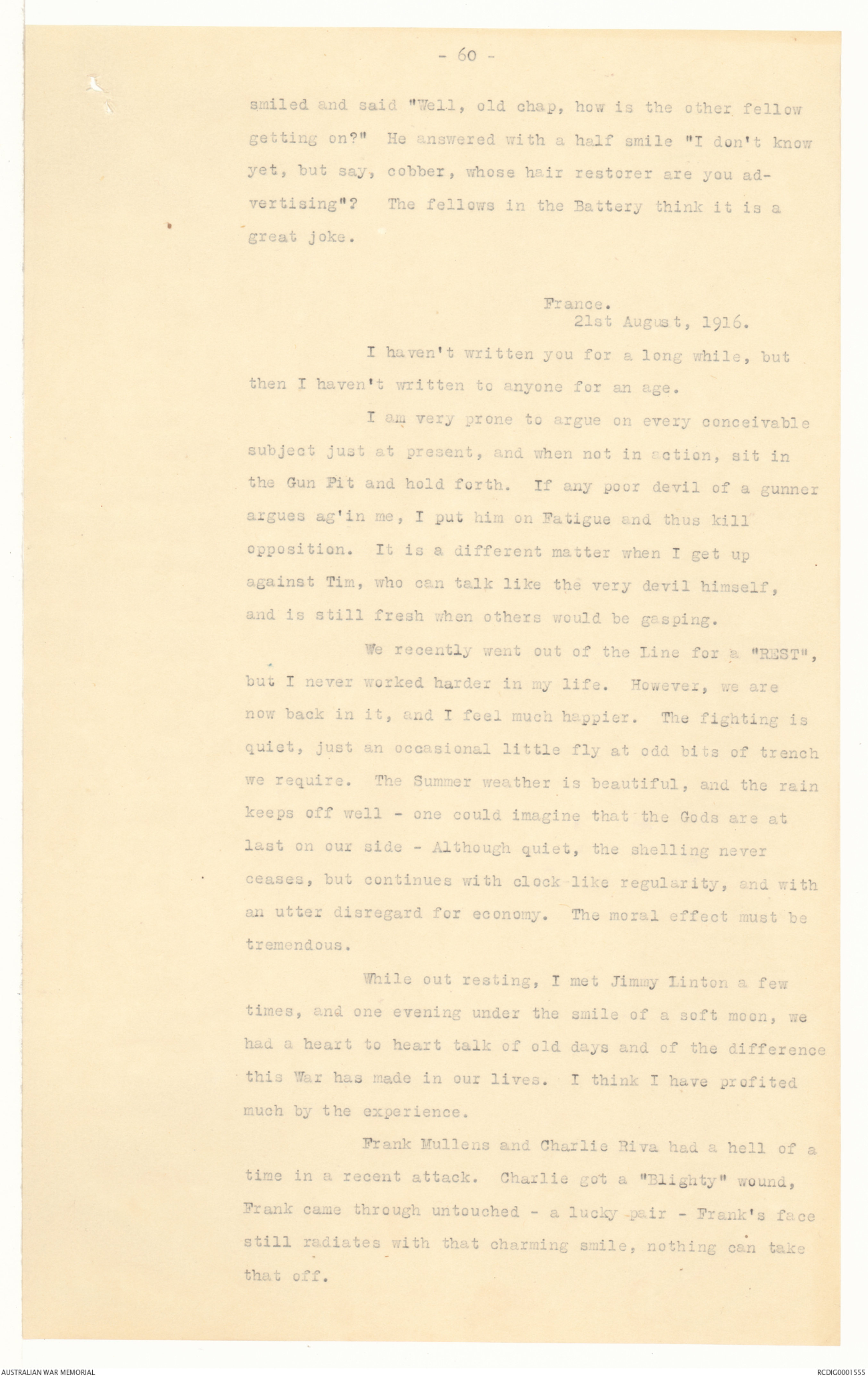
smiled and said "Well, old chap, how is the other fellow
getting on?" He answered with a half smile "I don't know
yet, but say, cobber, whose hair restorer are you advertising"?
The fellows in the Battery think it is a
great joke.
France.
21st August, 1916.
I haven't written you for a long while, but
then I haven't written to anyone for an age.
I am very prone to argue on every conceivable
subject just at present, and when not in action, sit in
the Gun Pit and hold forth. If any poor devil of a gunner
argues ag'in me, I put him on Fatigue and thus kill
opposition. It is a different matter when I get up
against Tim, who can talk like the very devil himself,
and is still fresh when others would be gasping.
We recently went out of the Line for a "REST",
but I never worked harder in my life. However, we are
now back in it, and I feel much happier. The fighting is
quiet, just an occasional little fly at odd bits of trench
we require. The Summer weather is beautiful, and the rain
keeps off well - one could imagine that the Gods are at
last on our side - Although quiet, the shelling never
ceases, but continues with clock like regularity, and with
an utter disregard for economy. The moral effect must be
tremendous.
While out resting, I met Jimmy Linton a few
times, and one evening under the smile of a soft moon, we
had a heart to heart talk of old days and of the difference
this War has made in our lives. I think I have profited
much by the experience.
Frank Mullens and Charlie Riva had a hell of a
time in a recent attack. Charlie got a "Blighty" wound,
Frank came through untouched - a lucky pair - Frank's face
still radiates with that charming smile, nothing can take
that off.
 Ray Stenhouse
This transcription item is now locked to you for editing. To release the lock either Save your changes or Cancel.
This lock will be automatically released after 60 minutes of inactivity.