
Typescript copies of letters from Hector Roy McLarty, 18 November 1914 to 7 August 1918 - Part 2
- 11 -
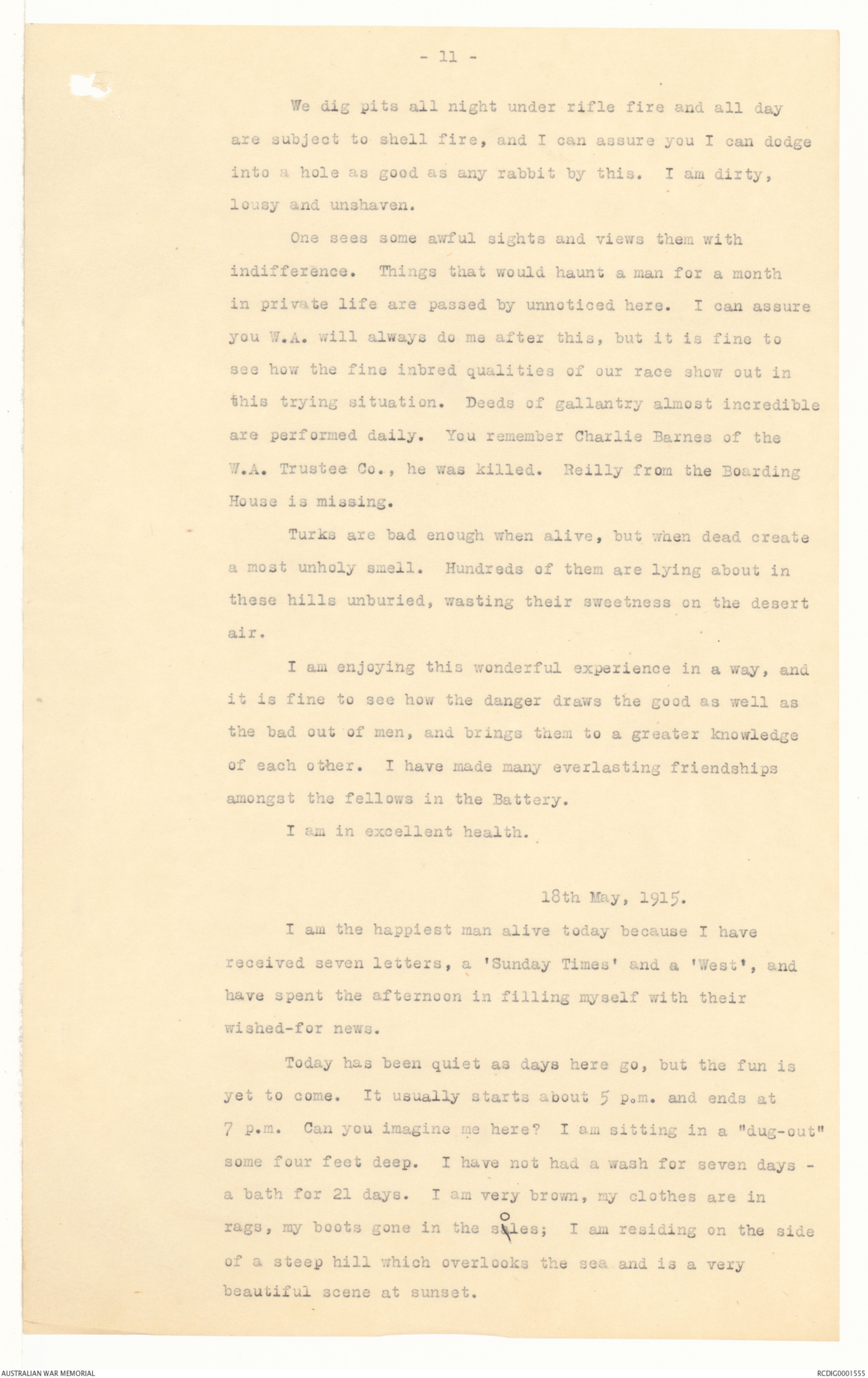
We dig pits all night under rifle fire and all day
are subject to shell fire, and I can assure you I can dodge
into a hole as good as any rabbit by this. I am dirty,
lousy and unshaven.
One sees some awful sights and views them with
indifference. Things that would haunt a man for a month
in private life are passed by unnoticed here. I can assure
you W.A. will always do me after this, but it is fine to
see how the fine inbred qualities of our race show out in
this trying situation. Deeds of gallantry almost incredible
are performed daily. You remember Charlie Barnes of the
W.A. Trustee Co., he was killed. Reilly from the Boarding
House is missing.
Turks are bad enough when alive, but when dead create
a most unholy smell. Hundreds of them are lying about in
these hills unburied, wasting their sweetness on the desert
air.
I am enjoying this wonderful experience in a way, and
it is fine to see how the danger draws the good as well as
the bad out of men, and brings them to a greater knowledge
of each other. I have made many everlasting friendships
amongst the fellows in the Battery.
I am in excellent health.
18th May, 1915.
I am the happiest man alive today because I have
received seven letters, a 'Sunday Times' and a 'West', and
have spent the afternoon in filling myself with their
wished-for news.
Today has been quiet as days here go, but the fun is
yet to come. It usually starts about 5 p.m. and ends at
7 p.m. Can you imagine me here? I am sitting in a "dug-out"
some four feet deep. I have not had a wash for seven days -
a bath for 21 days. I am very brown, my clothes are in
rags, my boots gone in the saoles; I am residing on the side
of a steep hill which overlooks the sea and is a very
beautiful scene at sunset.
- 12 -
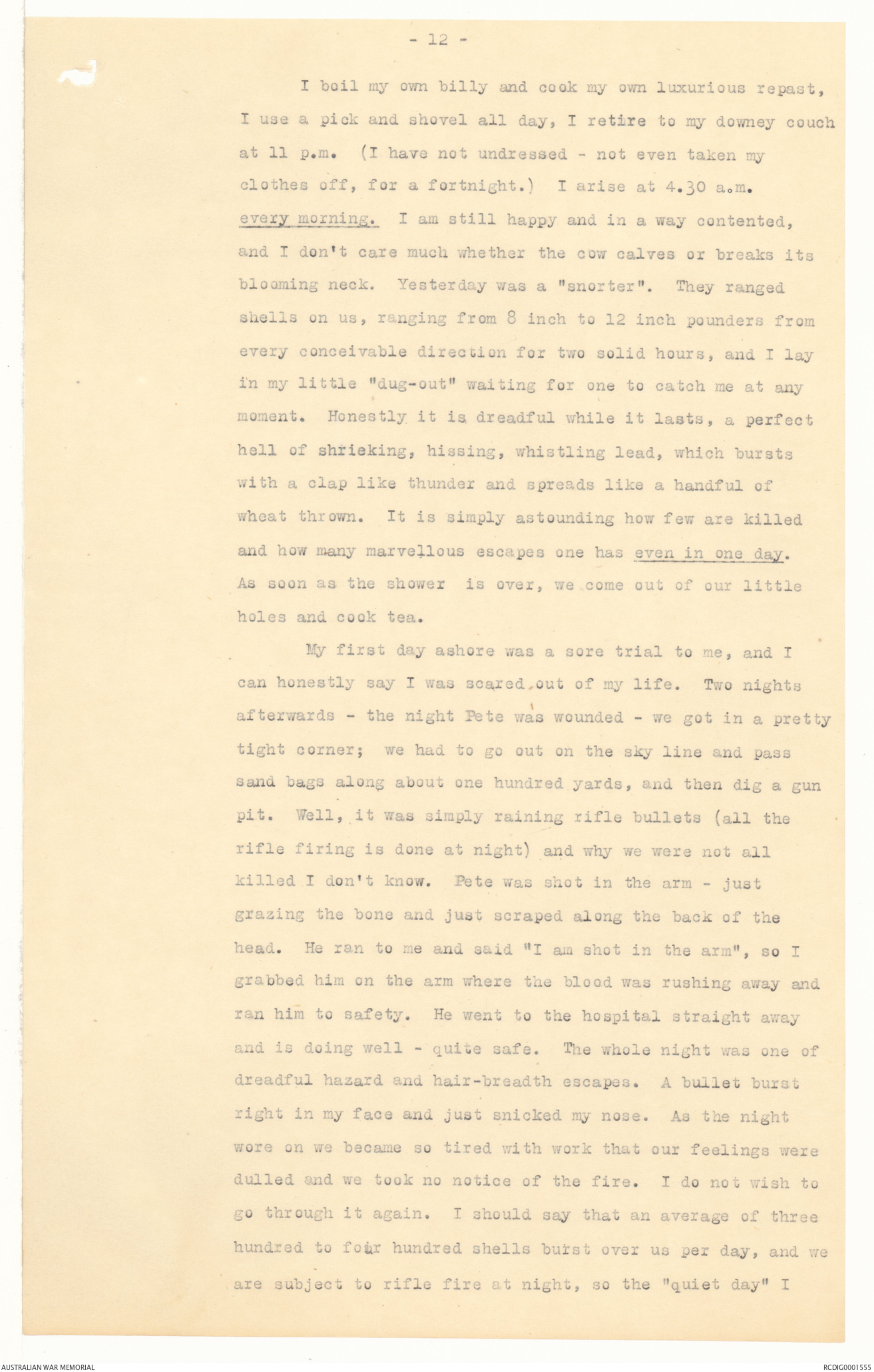
I boil my own billy and cook my own luxurious repast,
I use a pick and shovel all day, I retire to my downey couch
at 11 p.m. (I have not undressed - not even taken my
clothes off, for a fortnight.) I arise at 4.30 a.m.
every morning. I am still happy and in a way contented,
and I don't care much whether the cow calves or breaks its
blooming neck. Yesterday was a "snorter". They ranged
shells on us, ranging from 8 inch to 12 inch pounders from
every conceivable direction for two solid hours, and I lay
in my little "dug-out" waiting for one to catch me at any
moment. Honestly it is dreadful while it lasts, a perfect
hell of shrieking, hissing, whistling lead, which bursts
with a clap like thunder and spreads like a handful of
wheat thrown. It is simply astounding how few are killed
and how many marvellous escapes one has even in one day.
As soon as the shower is over, we come out of our little
holes and cook tea.
My first day ashore was a sore trial to me, and I
can honestly say I was scared out of my life. Two nights
afterwards - the night Pete was wounded - we got in a pretty
tight corner; we had to go out on the sky line and pass
sand bags along about one hundred yards, and then dig a gun
pit. Well, it was simply raining rifle bullets (all the
rifle firing is done at night) and why we were not all
killed I don't know. Pete was shot in the arm - just
grazing the bone and just scraped along the back of the
head. He ran to me and said "I am shot in the arm", so I
grabbed him on the arm where the blood was rushing away and
ran him to safety. He went to the hospital straight away
and is doing well - quite safe. The whole night was one of
dreadful hazard and hair-breadth escapes. A bullet burst
right in my face and just snicked my nose. As the night
wore on we became so tired with work that our feelings were
dulled and we took no notice of the fire. I do not wish to
go through it again. I should say that an average of three
hundred to four hundred shells burst over us per day, and we
are subject to rifle fire at night, so the "quiet day" I
- 13 -
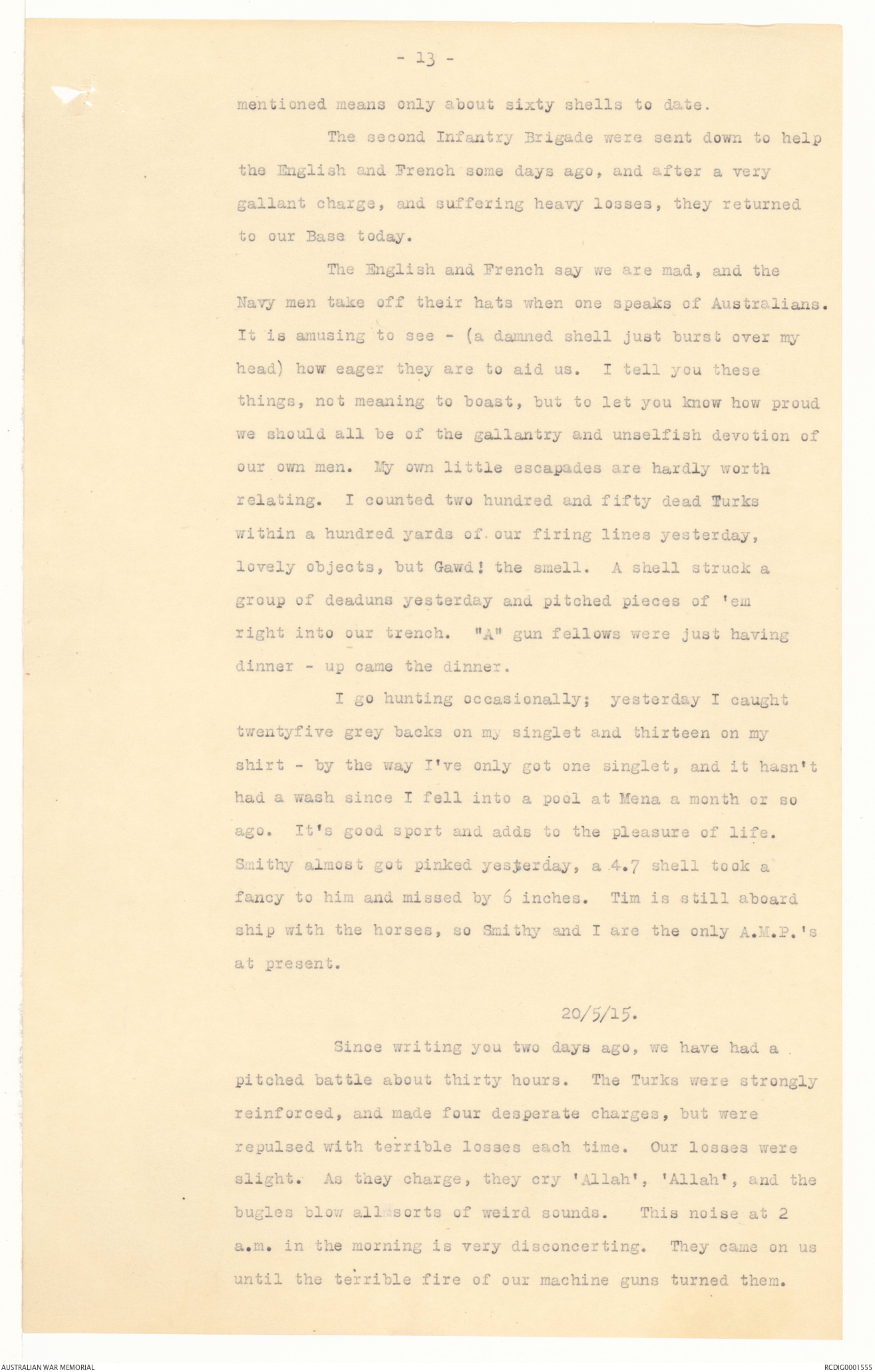
mentioned means only about sixty shells to date.
The second Infantry Brigade were sent down to help
the English and French some days ago, and after a very
gallant charge, and suffering heavy losses, they returned
to our Base today.
The English and French say we are mad, and the
Navy men take off their hats when one speaks of Australians.
It is amusing to see - (a damned shell just burst over my
head) how eager they are to aid us. I tell you these
things, not meaning to boast, but to let you know how proud
we should all be of the gallantry and unselfish devotion of
our own men. My own little escapades are hardly worth
relating. I counted two hundred and fifty dead Turks
within a hundred yards of our firing lines yesterday,
lovely objects, but Gawd! the smell. A shell struck a
group of deaduns yesterday and pitched pieces of 'em
right into our trench. "A" gun fellows were just having
dinner - up came the dinner.
I go hunting occasionally; yesterday I caught
twentyfive grey backs on my singlet and thirteen on my
shirt - by the way I've only got one singlet, and it hasn't
had a wash since I fell into a pool at Mena a month or so
ago. It’s good sport and adds to the pleasure of life.
Smithy almost got pinked yesterday, a 4.7 shell took a
fancy to him and missed by 6 inches. Tim is still aboard
ship with the horses, so Smithy and I are the only A.M.P.'s
at present.
20/5/15.
Since writing you two days ago, we have had a
pitched battle about thirty hours. The Turks were strongly
reinforced, and made four desperate charges, but were
repulsed with terrible losses each time. Our losses were
slight. As they charge, they cry 'Allah', 'Allah', and the
bugles blow all sorts of weird sounds. This noise at 2
a.m. in the morning is very disconcerting. They came on us
until the terrible fire of our machine guns turned them.
- 14 -
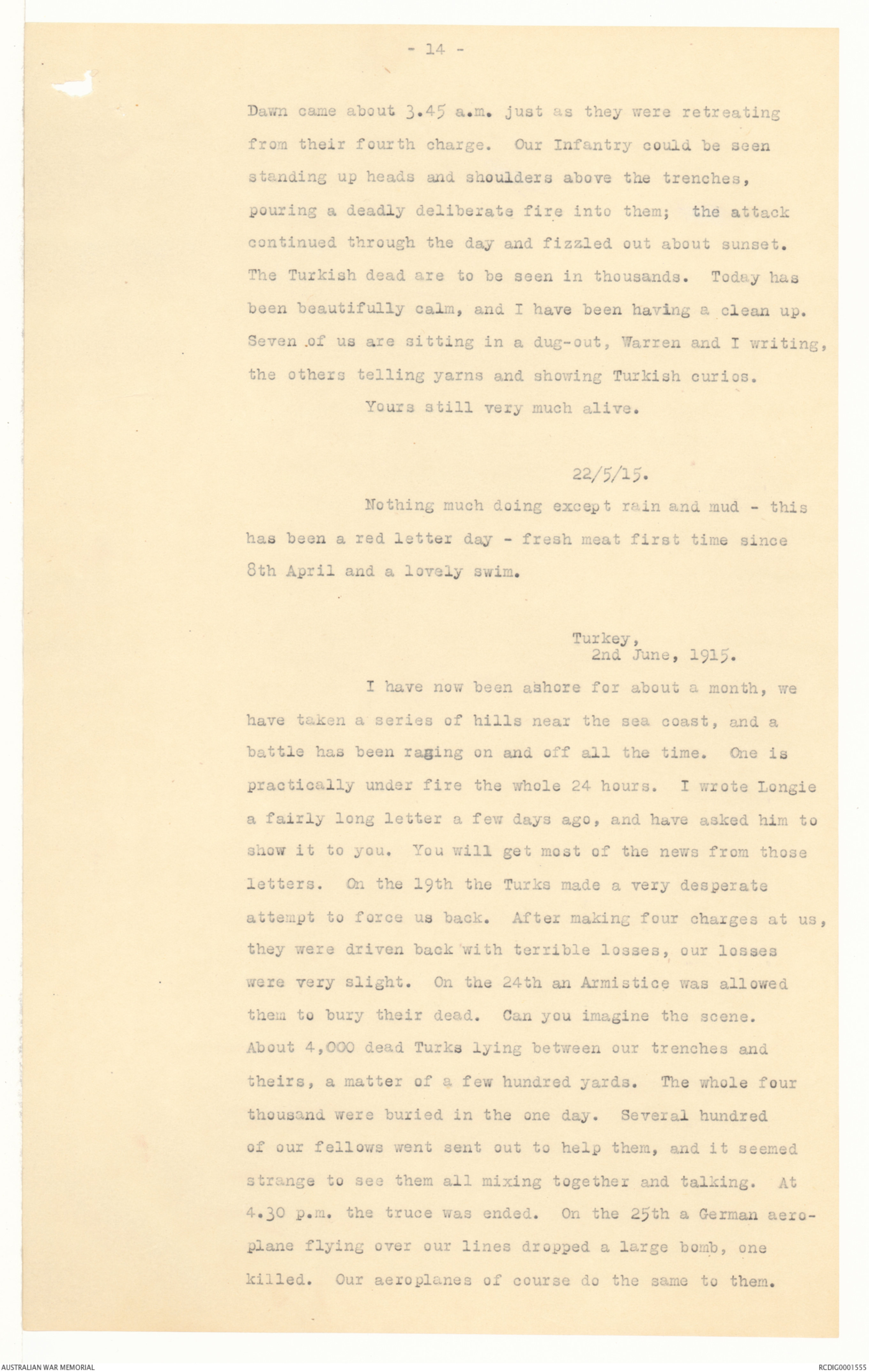
Dawn came about 3.45 a.m. just as they were retreating
from their fourth charge. Our Infantry could be seen
standing up heads and shoulders above the trenches,
pouring a deadly deliberate fire into them; the attack
continued through the day and fizzled out about sunset.
The Turkish dead are to be seen in thousands. Today has
been beautifully calm, and I have been having a clean up.
Seven of us are sitting in a dug-out, Warren and I writing,
the others telling yarns and showing Turkish curios.
Yours still very much alive.
22/5/15.
Nothing much doing except rain and mud - this
has been a red letter day - fresh meat first time since
8th April and a lovely swim.
Turkey
2nd June, 1915.
I have now been ashore for about a month, we
have taken a series of hills near the sea coast, and a
battle has been raging on and off all the time. One is
practically under fire the whole 24 hours. I wrote Longie
a fairly long letter a few days ago, and have asked him to
show it to you. You will get most of the news from those
letters. On the 19th the Turks made a very desperate
attempt to force us back. After making four charges at us,
they were driven back with terrible losses, our losses
were very slight. On the 24th an Armistice was allowed
them to bury their dead. Can you imagine the scene.
About 4,000 dead Turks lying between our trenches and
theirs, a matter of a few hundred yards. The whole four
thousand were buried in the one day. Several hundred
of our fellows went sent out to help them, and it seemed
strange to see them all mixing together and talking. At
4.30 p.m. the truce was ended. On the 25th a German aeroplane
flying over our lines dropped a large bomb, one
killed. Our aeroplanes of course do the same to them.
- 15 -
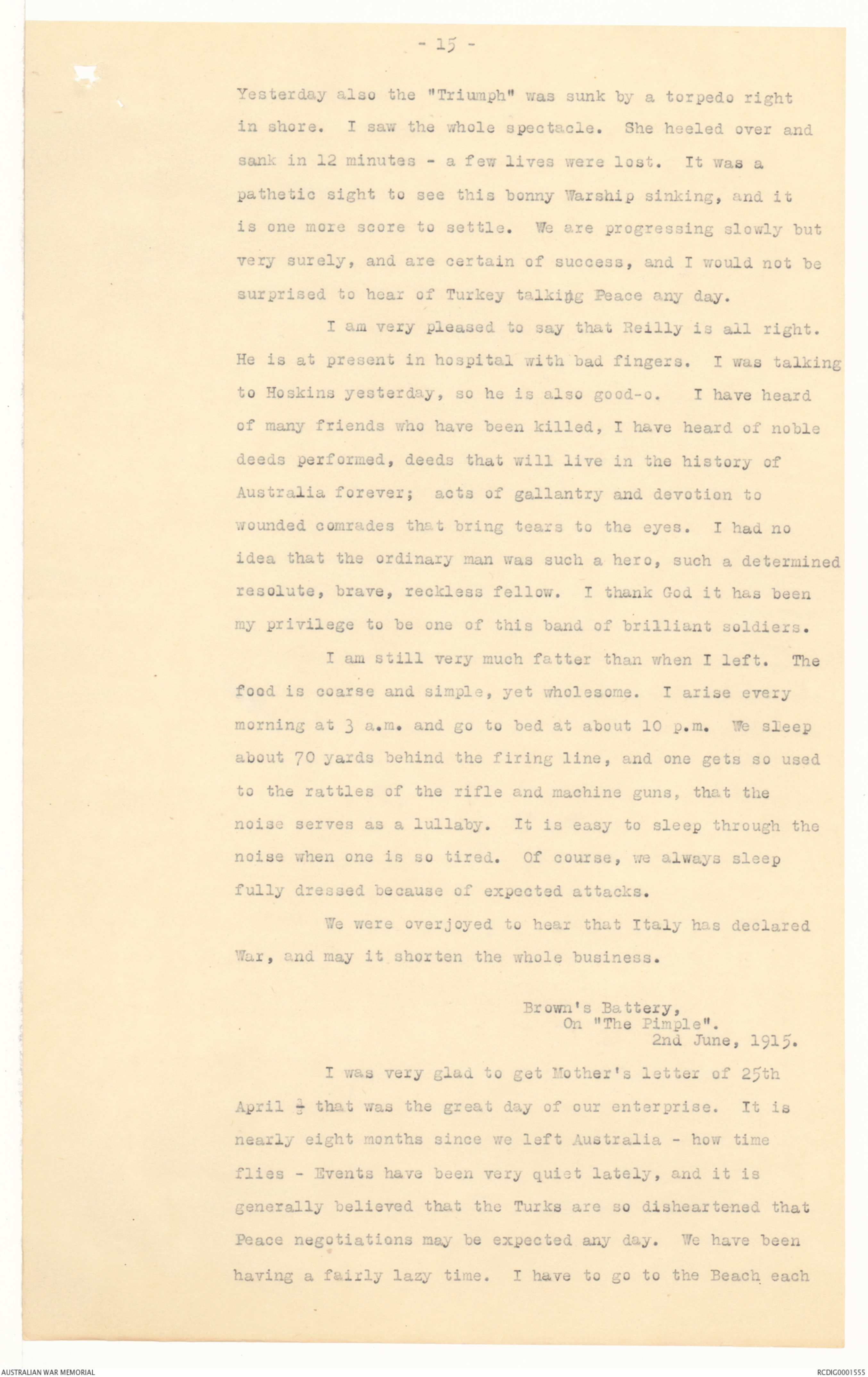
Yesterday also the "Triumph" was sunk by a torpedo right
in shore. I saw the whole spectacle. She heeled over and
sank in 12 minutes - a few lives were lost. It was a
pathetic sight to see this bonny Warship sinking, and it
is one more score to settle. We are progressing slowly but
very surely, and are certain of success, and I would not be
surprised to hear of Turkey talking Peace any day.
I am very pleased to say that Reilly is all right.
He is at present in hospital with bad fingers. I was talking
to Hoskins yesterday, so he is also good-o. I have heard
of many friends who have been killed, I have heard of noble
deeds performed, deeds that will live in the history of
Australia forever; acts of gallantry and devotion to
wounded comrades that bring tears to the eyes. I had no
idea that the ordinary man was such a hero, such a determined
resolute, brave, reckless fellow. I thank God it has been
my privilege to be one of this band of brilliant soldiers.
I am still very much fatter than when I left. The
food is coarse and simple, yet wholesome. I arise every
morning at 3 a.m. and go to bed at about 10 p.m. We sleep
about 70 yards behind the firing line, and one gets so used
to the rattles of the rifle and machine guns, that the
noise serves as a lullaby. It is easy to sleep through the
noise when one is so tired. Of course, we always sleep
fully dressed because of expected attacks.
We were overjoyed to hear that Italy has declared
War, and may it shorten the whole business.
Brown's Battery,
On "The Pimple".
2nd June, 1915.
I was very glad to get Mother's letter of 25th
April 3-8 that was the great day of our enterprise. It is
nearly eight months since we left Australia - how time
flies - Events have been very quiet lately, and it is
generally believed that the Turks are so disheartened that
Peace negotiations may be expected any day. We have been
having a fairly lazy time. I have to go to the Beach each
- 16 -
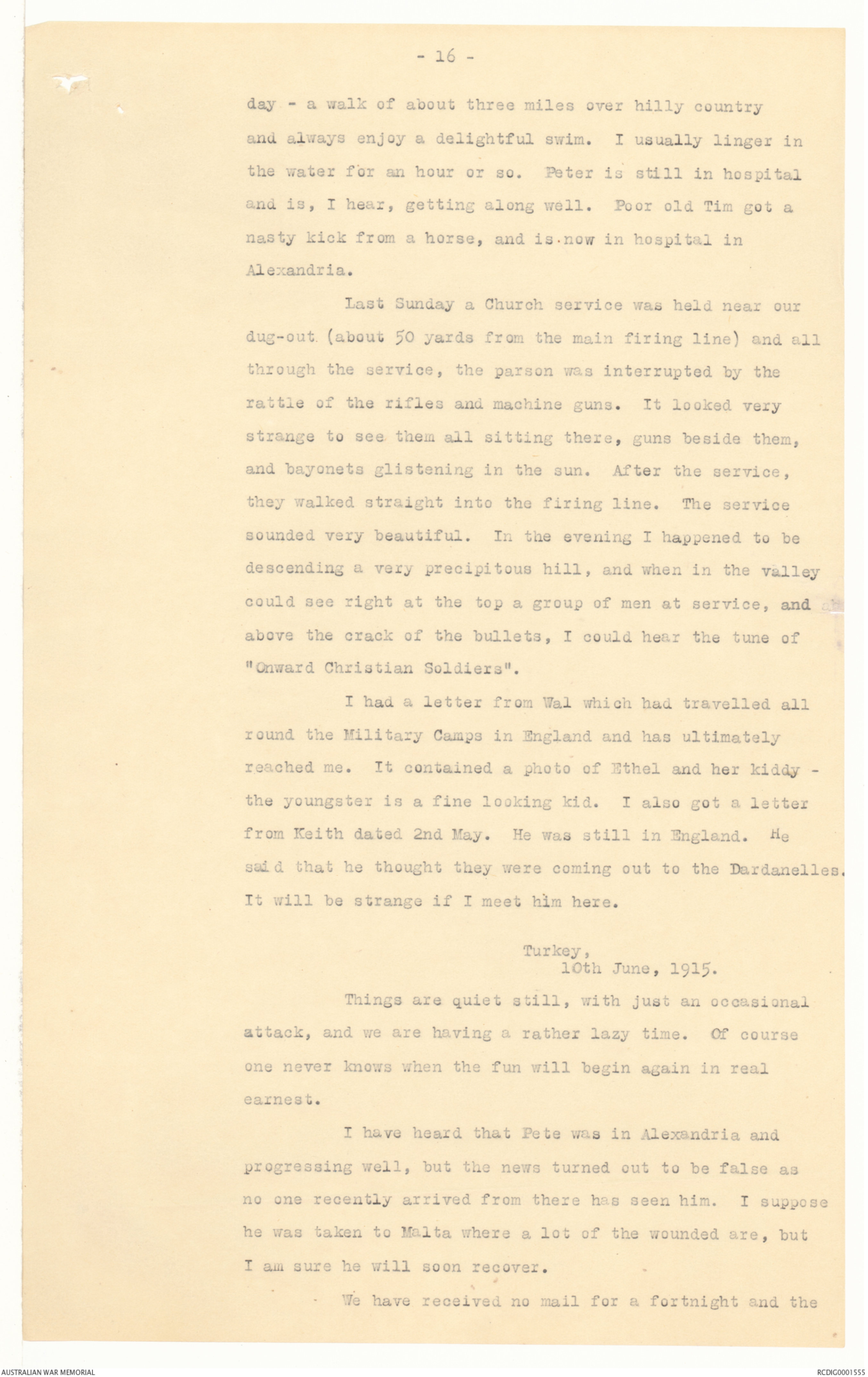
day - a walk of about three miles over hilly country
and always enjoy a delightful swim. I usually linger in
the water for an hour or so. Peter is still in hospital
and is, I hear, getting along well. Poor old Tim got a
nasty kick from a horse, and is. now in hospital in
Alexandria.
Last Sunday a Church service was held near our
dug-out (about 50 yards from the main firing line) and all
through the service, the parson was interrupted by the
rattle of the rifles and machine guns. It looked very
strange to see them all sitting there, guns beside them,
and bayonets glistening in the sun. After the service,
they walked straight into the firing line. The service
sounded very beautiful. In the evening I happened to be
descending a very precipitous hill, and when in the valley
could see right at the top a group of men at service, and
above the crack of the bullets, I could hear the tune of
"Onward Christian Soldiers".
I had a letter from Wal which had travelled all
round the Military Camps in England and has ultimately
reached me. It contained a photo of Ethel and her kiddy -
the youngster is a fine looking kid. I also got a letter
from Keith dated 2nd May. He was still in England. He
said that he thought they were coming out to the Dardanelles.
It will be strange if I meet him here.
Turkey,
10th June, 1915.
Things are quiet still, with just an occasional
attack, and we are having a rather lazy time. Of course
one never knows when the fun will begin again in real
earnest.
I have heard that Pete was in Alexandria and
progressing well, but the news turned out to be false as
no one recently arrived from there has seen him. I suppose
he was taken to Malta where a lot of the wounded are, but
I am sure he will soon recover.
We have received no mail for a fortnight and the
- 17 -
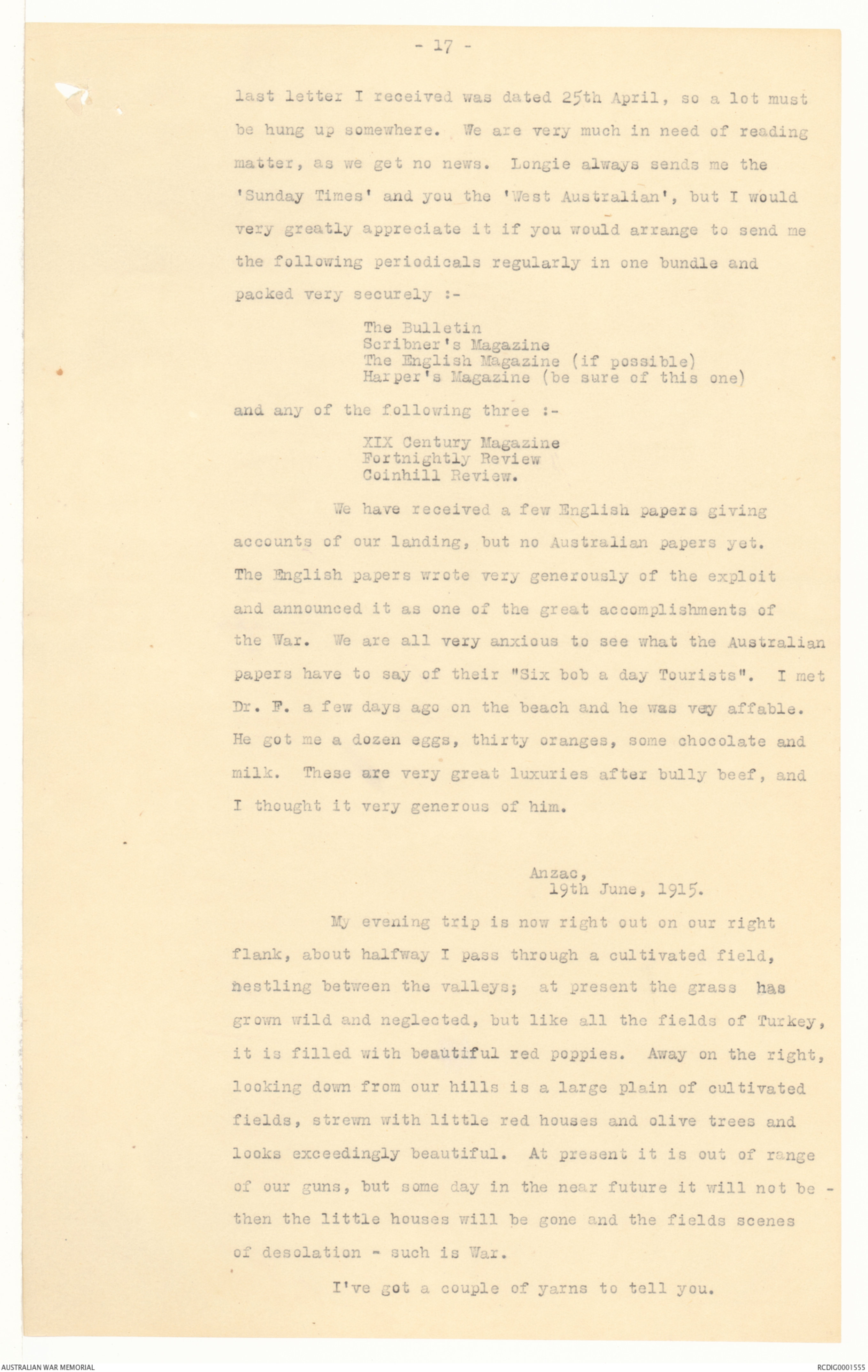
last letter I received was dated 25th April, so a lot must
be hung up somewhere. We are very much in need of reading
matter, as we get no news. Longie always sends me the
'Sunday Times' and you the 'West Australian', but I would
very greatly appreciate it if you would arrange to send me
the following periodicals regularly in one bundle and
packed very securely :-
The Bulletin
Scribner's Magazine
The English Magazine (if possible)
Harpers Magazine (be sure of this one)
and any of the following three :-
XIX Century Magazine
Fortnightly Review
Coinhill Review.
We have received a few English papers giving
accounts of our landing, but no Australian papers yet.
The English papers wrote very generously of the exploit
and announced it as one of the great accomplishments of
the War. We are all very anxious to see what the Australian
papers have to say of their "Six bob a day Tourists". I met
Dr. F. a few days ago on the beach and he was very affable.
He got me a dozen eggs, thirty oranges, some chocolate and
milk. These are very great luxuries after bully beef, and
I thought it very generous of him.
Anzac,
19th June, 1915.
My evening trip is now right out on our right
flank, about halfway I pass through a cultivated field,
nestling between the valleys; at present the grass has
grown wild and neglected, but like all the fields of Turkey,
it is filled with beautiful red poppies. Away on the right,
looking down from our hills is a large plain of cultivated
fields, strewn with little red houses and olive trees and
looks exceedingly beautiful. At present it is out of range
of our guns, but some day in the near future it will not be -
then the little houses will be gone and the fields scenes
of desolation - such is War.
I've got a couple of yarns to tell you.
- 18 -
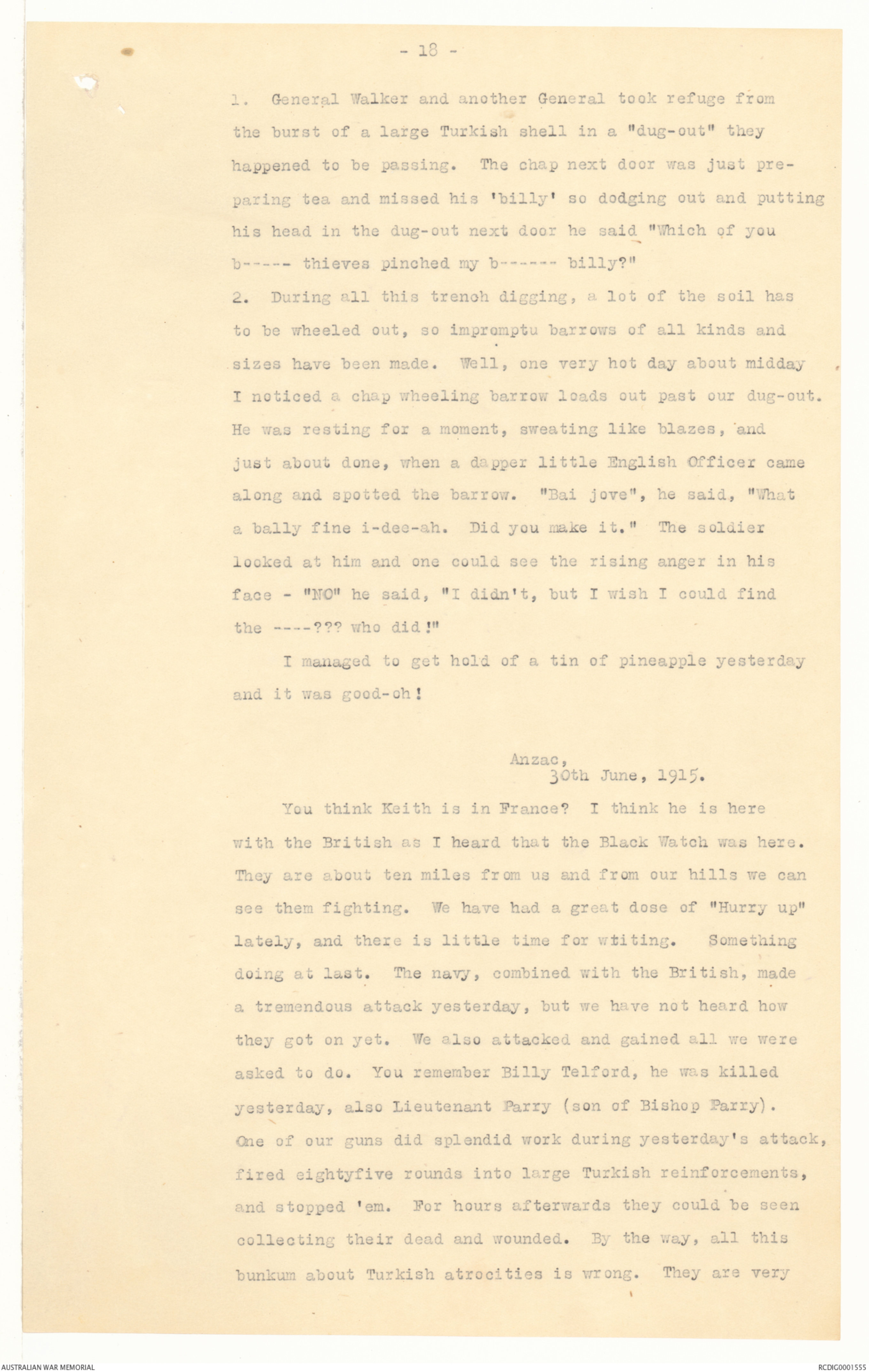
1. General Walker and another General took refuge from
the burst of a large Turkish shell in a "dug-out" they
happened to be passing. The chap next door was just preparing
tea and missed his 'billy' so dodging out and putting
his head in the dug-out next door he said "Which of you
b----- thieves pinched my b------ billy?"
2. During all this trench digging, a lot of the soil has
to be wheeled out, so impromptu barrows of all kinds and
sizes have been made. Well, one very hot day about midday
I noticed a chap wheeling barrow loads out past our dug-out.
He was resting for a moment, sweating like blazes, and
just about done, when a dapper little English Officer came
along and spotted the barrow. "Bai jove", he said, "What
a bally fine i-dee-ah. Did you make it." The soldier
looked at him and one could see the rising anger in his
face - "NO" he said, "I didn't, but I wish I could find
the ----??? who did!"
I managed to get hold of a tin of pineapple yesterday
and it was good-oh!
Anzac
30th June, 1915.
You think Keith is in France? I think he is here
with the British as I heard that the Black Watch was here.
They are about ten miles from us and from our hills we can
see them fighting. We have had a great dose of "Hurry up"
lately, and there is little time for wtiting. Something
doing at last. The navy, combined with the British, made
a tremendous attack yesterday, but we have not heard how
they got on yet. We also attacked and gained all we were
asked to do. You remember Billy Telford, he was killed
yesterday, also Lieutenant Parry (son of Bishop Parry).
One of our guns did splendid work during yesterday's attack,
fired eightyfive rounds into large Turkish reinforcements,
and stopped 'em. For hours afterwards they could be seen
collecting their dead and wounded. By the way, all this
bunkum about Turkish atrocities is wrong. They are very
- 19 -
fair fighters and very brave. Of course, in isolated
instances there is often dirty work done.
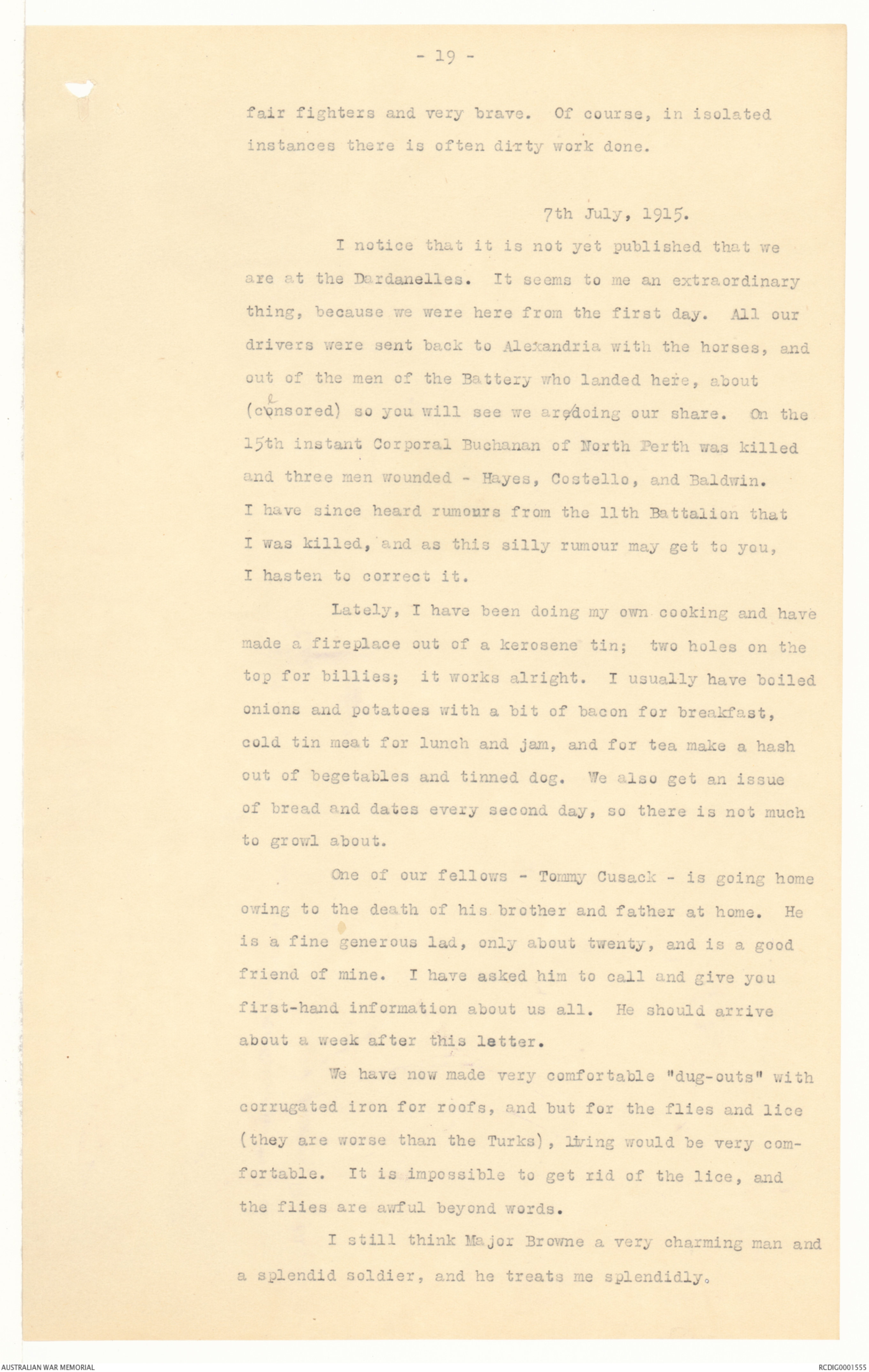
7th July, 1915.
I notice that it is not yet published that we
are at the Dardanelles. It seems to me an extraordinary
thing, because we were here from the first day. All our
drivers were sent back to Alexandria with the horses, and
out of the men of the Battery who landed here, about
(coensored) so you will see we/are doing our share. On the
15th instant Corporal Buchanan of North Perth was killed
and three men wounded - Hayes, Costello, and Baldwin.
I have since heard rumours from the 11th Battalion that
I was killed, and as this silly rumour may get to you,
I hasten to correct it.
Lately, I have been doing my own cooking and have
made a fireplace out of a kerosene tin; two holes on the
top for billies; it works alright. I usually have boiled
onions and potatoes with a bit of bacon for breakfast,
cold tin meat for lunch and jam, and for tea make a hash
out of begetables and tinned dog. We also get an issue
of bread and dates every second day, so there is not much
to growl about.
One of our fellows - Tommy Cusack - is going home
owing to the death of his brother and father at home. He
is a fine generous lad, only about twenty, and is a good
friend of mine. I have asked him to call and give you
first-hand information about us all. He should arrive
about a week after this letter.
We have now made very comfortable "dug-outs" with
corrugated iron for roofs, and but for the flies and lice
(they are worse than the Turks), living would be very comfortable.
It is impossible to get rid of the lice, and
the flies are awful beyond words.
I still think Major Browne a very charming man and
a splendid soldier, and he treats me splendidly.
- 20 -
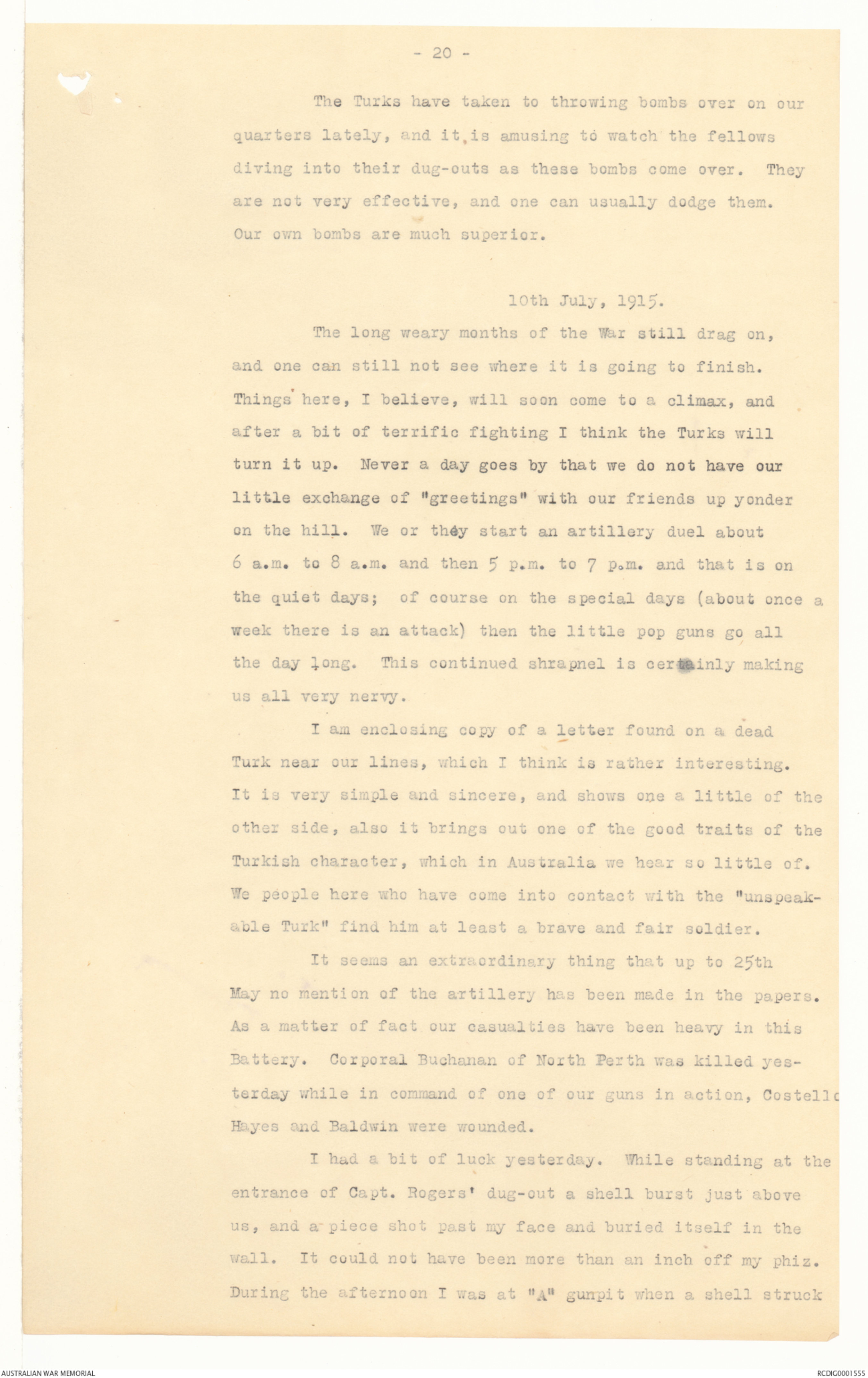
The Turks have taken to throwing bombs over on our
quarters lately, and it is amusing to watch the fellows
diving into their dug outs as these bombs come over. They
are not very effective, and one can usually dodge them.
Our own bombs are much superior.
10th July, 1915.
The long weary months of the War still drag on,
and one can still not see where it is going to finish.
Things here, I believe, will soon come to a climax, and
after a bit of terrific fighting I think the Turks will
turn it up. Never a day goes by that we do not have our
little exchange of "greetings" with our friends up yonder
on the hill. We or they start an artillery duel about
6 a.m. to 8 a.m. and then 5 p.m. to 7 p.m. and that is on
the quiet days; of course on the special days (about once a
week there is an attack) then the little pop guns go all
the day long. This continued shrapnel is certainly making
us all very nervy.
I am enclosing copy of a letter found on a dead
Turk near our lines, which I think is rather interesting.
It is very simple and sincere, and shows one a little of the
other side, also it brings out one of the good traits of the
Turkish character, which in Australia we hear so little of.
We people here who have come into contact with the "unspeakable
Turk" find him at least a brave and fair soldier.
It seems an extraordinary thing that up to 25th
May no mention of the artillery has been made in the papers.
As a matter of fact our casualties have been heavy in this
Battery. Corporal Buchanan of North Perth was killed yesterday
while in command of one of our guns in action, Costello
Hayes and Baldwin were wounded.
I had a bit of luck yesterday. While standing at the
entrance of Capt. Rogers' dug-out a shell burst just above
us, and a piece shot past my face and buried itself in the
wall. It could not have been more than an inch off my phiz.
During the afternoon I was at "A" gunpit when a shell struck
 Sandy Mudie
This transcription item is now locked to you for editing. To release the lock either Save your changes or Cancel.
This lock will be automatically released after 60 minutes of inactivity.