
Typescript copies of letters from Hector Roy McLarty, 18 November 1914 to 7 August 1918 - Part 1
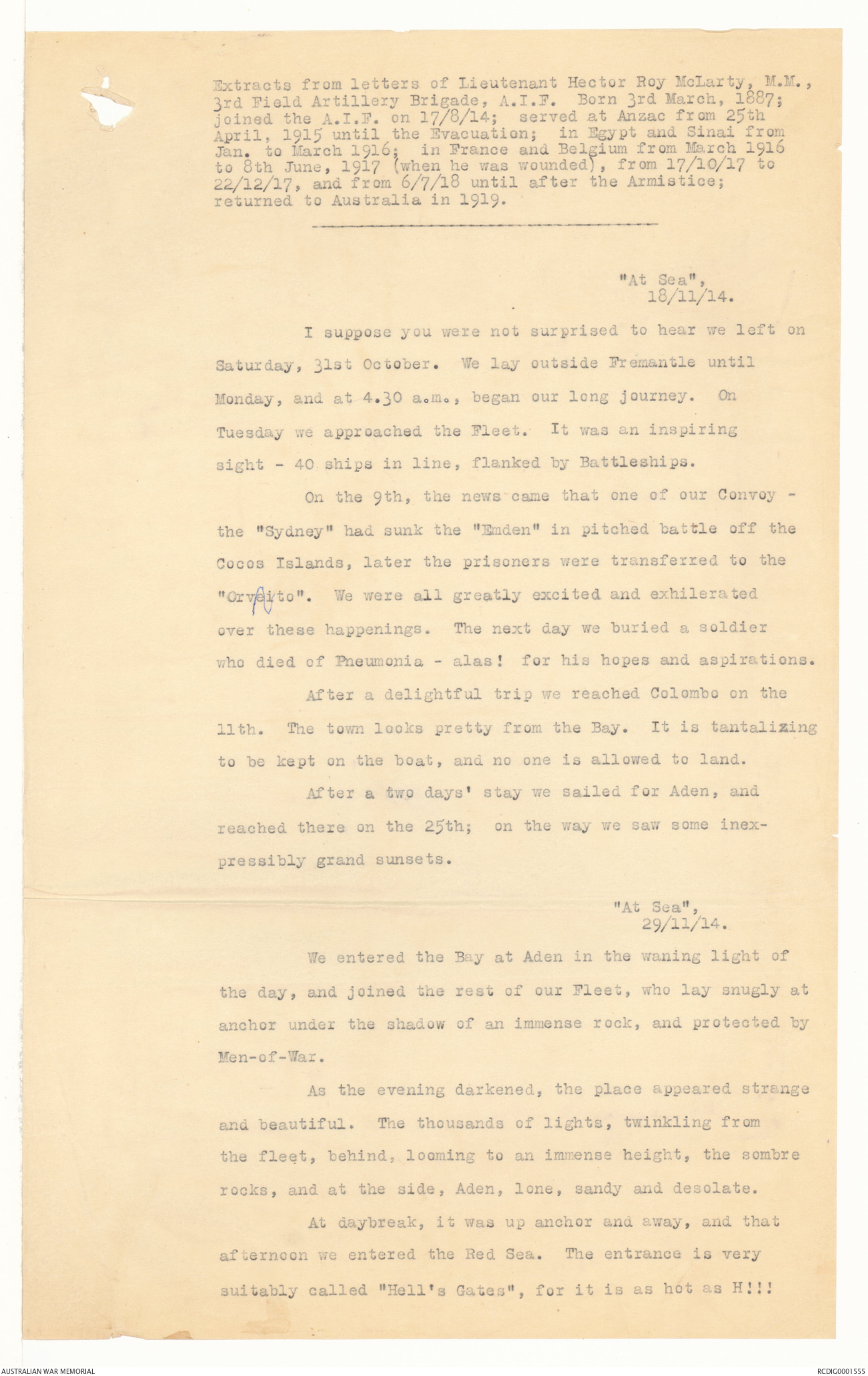
Extracts from letters of Lieutenant Hector Roy McLarty, M.M.,
3rd Field Artillery Brigade, A.I.F. Born 3rd March, 1887;
joined the A.I.F. on 17/8/14; served at Anzac from 25th
April, 1915 until the Evacuation; in Egypt and Sinai from
Jan. to March 1916; in France and Belgium from March 1916
to 8th June, 1917 (when he was wounded), from 17/10/17 to
22/12/17, and from 6/7/18 until after the Armistice;
returned to Australia in 1919.
"At Sea"
18/11/14.
I suppose you were not surprised to hear we left on
Saturday, 31st October. We lay outside Fremantle until
Monday, and at 4.30 a.m., began our long journey. On
Tuesday we approached the Fleet. It was an inspiring
sight - 40 ships in line, flanked by Battleships.
On the 9th, the news came that one of our Convoy -
the "Sydney" had sunk the "Emden" in pitched battle off the
Cocos Islands, later the prisoners were transferred to the
"Orveito". We were all greatly excited and exhilerated
over these happenings. The next day we buried a soldier
who died of Pneumonia - alas! for his hopes and aspirations.
After a delightful trip we reached Colombo on the
11th. The town looks pretty from the Bay. It is tantalizing
to be kept on the boat, and no one is allowed to land.
After a two days' stay we sailed for Aden, and
reached there on the 25th; on the way we saw some inexpressibly
grand sunsets.
"At Sea"
29/11/14.
We entered the Bay at Aden in the waning light of
the day, and joined the rest of our Fleet, who lay snugly at
anchor under the shadow of an immense rock, and protected by
Men-of-War.
As the evening darkened, the place appeared strange
and beautiful. The thousands of lights, twinkling from
the fleet, behind, looming to an immense height, the sombre
rocks, and at the side, Aden, lone, sandy and desolate.
At daybreak, it was up anchor and away, and that
afternoon we entered the Red Sea. The entrance is very
suitably called "Hell's Gates", for it is as hot as H!!!
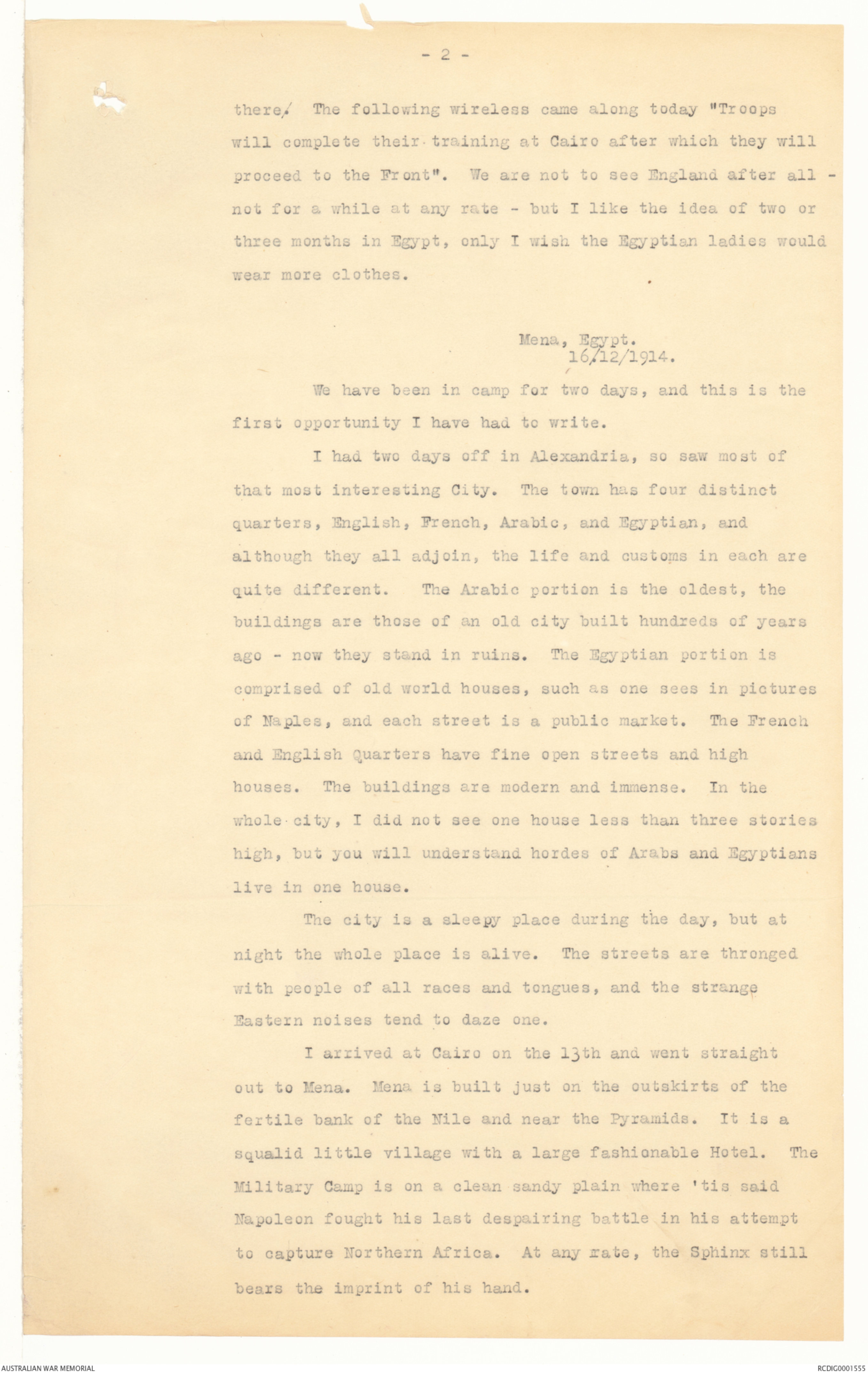
- 2 -
there/. The following wireless came along today "Troops
will complete their training at Cairo after which they will
proceed to the Front". We are not to see England after all -
not for a while at any rate - but I like the idea of two or
three months in Egypt, only I wish the Egyptian ladies would
wear more clothes.
Mena, Egypt.
16/.12/1914.
We have been in camp for two days, and this is the
first opportunity I have had to write.
I had two days off in Alexandria, so saw most of
that most interesting City. The town has four distinct
quarters, English, French, Arabic, and Egyptian, and
although they all adjoin, the life and customs in each are
quite different. The Arabic portion is the oldest, the
buildings are those of an old city built hundreds of years
ago - now they stand in ruins. The Egyptian portion is
comprised of old world houses, such as one sees in pictures
of Naples, and each street is a public market. The French
and English Quarters have fine open streets and high
houses. The buildings are modern and immense. In the
whole city, I did not see one house less than three stories
high, but you will understand hordes of Arabs and Egyptians
live in one house.
The city is a sleepy place during the day, but at
night the whole place is alive. The streets are thronged
with people of all races and tongues, and the strange
Eastern noises tend to daze one.
I arrived at Cairo on the 13th and went straight
out to Mena. Mena is built just on the outskirts of the
fertile bank of the Nile and near the Pyramids. It is a
squalid little village with a large fashionable Hotel. The
Military Camp is on a clean sandy plain where 'tis said
Napoleon fought his last despairing battle in his attempt
to capture Northern Africa. At any rate, the Sphinx still
bears the imprint of his hand.
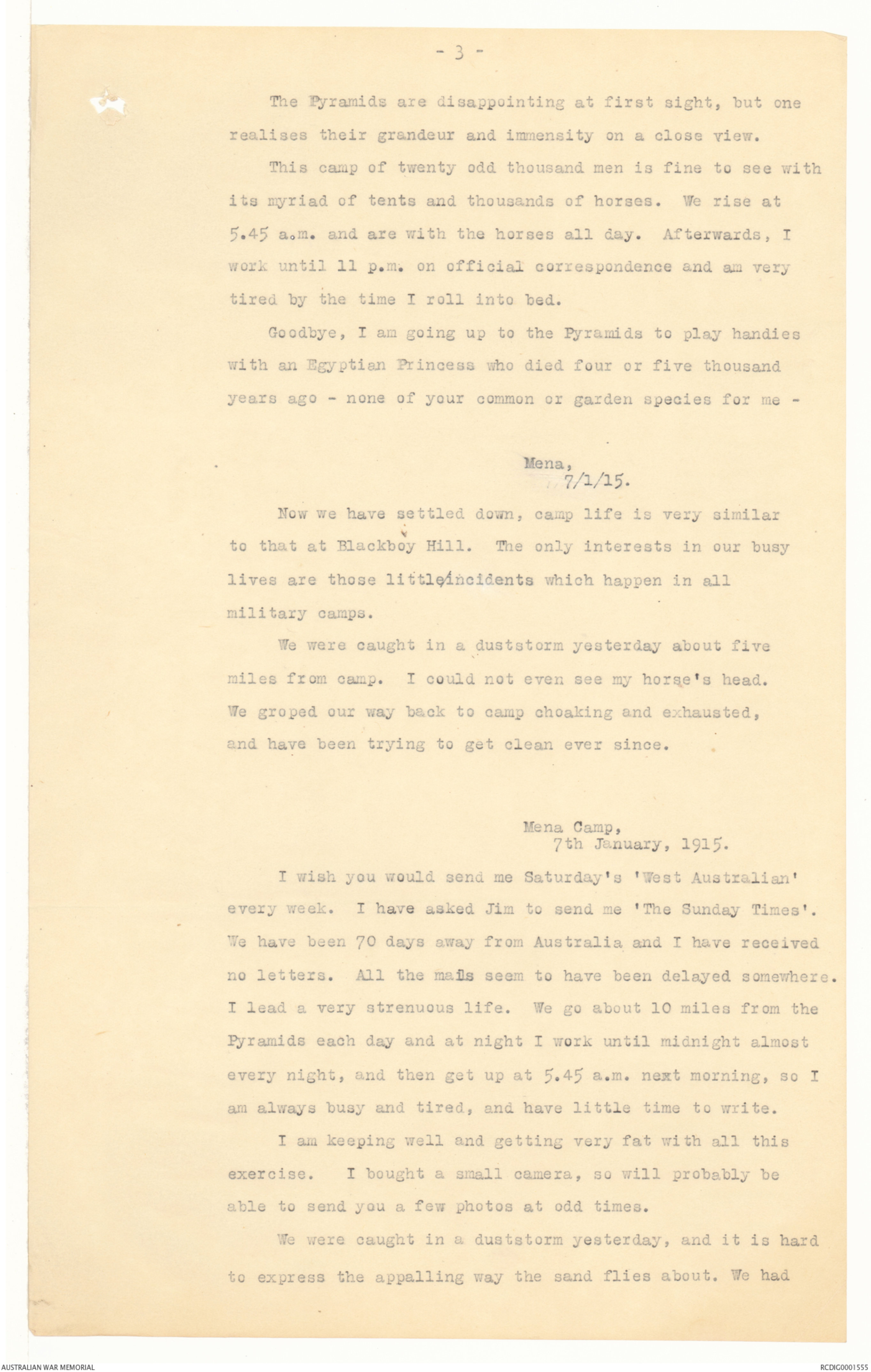
- 3 -
The Pyramids are disappointing at first sight, but one
realises their grandeur and immensity on a close view.
This camp of twenty odd thousand men is fine to see with
its myriad of tents and thousands of horses. We rise at
5.45 a.m. and are with the horses all day. Afterwards, I
work until 11 p.m. on official correspondence and am very
tired by the time I roll into bed.
Goodbye, I am going up to the Pyramids to play handies
with an Egyptian Princess who died four or five thousand
years ago - none of your common or garden species for me -
Mena,
7/1/15.
Now we have settled down, camp life is very similar
to that at Blackboy Hill. The only interests in our busy
lives are those little/incidents which happen in all
military camps.
We were caught in a duststorm yesterday about five
miles from camp. I could not even see my horse's head.
We groped our way back to camp choaking and exhausted,
and have been trying to get clean ever since.
Mena Camp,
7th January, 1915.
I wish you would send me Saturday's 'West Australian'
every week. I have asked Jim to send me 'The Sunday Times'.
We have been 70 days away from Australia and I have received
no letters. All the mails seem to have been delayed somewhere.
I lead a very strenuous life. We go about 10 miles from the
Pyramids each day and at night I work until midnight almost
every night, and then get up at 5.45 a.m. next morning, so I
am always busy and tired, and have little time to write.
I am keeping well and getting very fat with all this
exercise. I bought a small camera, so will probably be
able to send you a few photos at odd times.
We were caught in a duststorm yesterday, and it is hard
to express the appalling way the sand flies about. We had
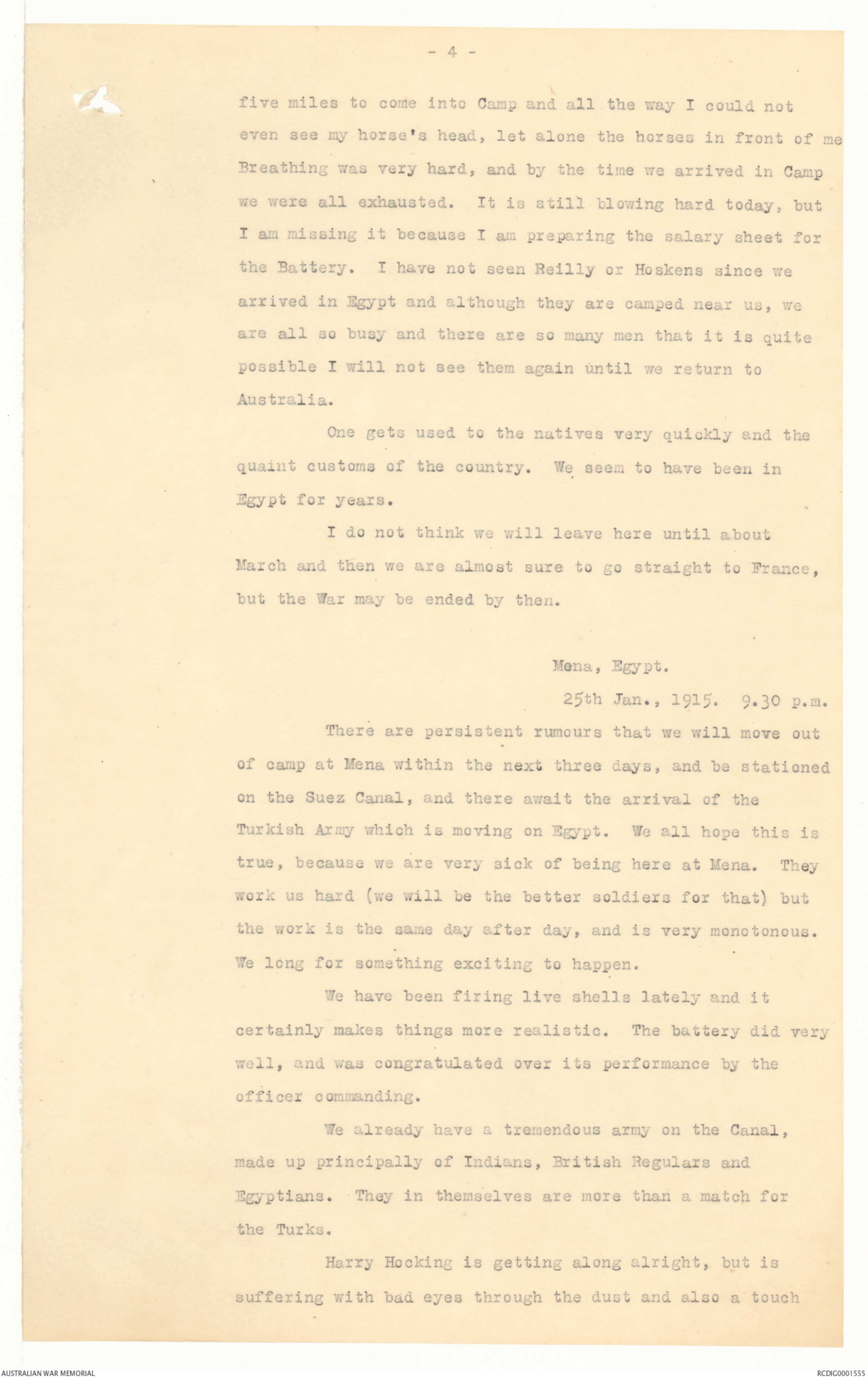
- 4 -
five miles to come into Camp and all the way I could not
even see my horse's head, let alone the horses in front of me
Breathing was very hard, and by the time we arrived in Camp
we were all exhausted. It is still blowing hard today, but
I am missing it because I am preparing the salary sheet for
the Battery. I have not seen Reilly or Hoskens since we
arrived in Egypt and although they are camped near us, we
are all so busy and there are so many men that it is quite
possible I will not see them again until we return to
Australia.
One gets used to the natives very quickly and the
quaint customs of the country. We seem to have been in
Egypt for years.
I do not think we will leave here until about
March and then we are almost sure to go straight to France,
but the War may be ended by then.
Mena, Egypt.
25th Jan., 1915. 9.30 p.m.
There are persistent rumours that we will move out
of camp at Mena within the next three days, and be stationed
on the Suez Canal, and there await the arrival of the
Turkish Army which is moving on Egypt. We all hope this is
true, because we are very sick of being here at Mena. They
work us hard (we will be the better soldiers for that) but
the work is the same day after day, and is very monotonous.
We long for something exciting to happen.
We have been firing live shells lately and it
certainly makes things more realistic. The battery did very
well, and was congratulated over its performance by the
officer commanding.
We already have a tremendous army on the Canal,
made up principally of Indians, British Regulars and
Egyptians. They in themselves are more than a match for
the Turks.
Harry Hocking is getting along alright, but is
suffering with bad eyes through the dust and also a touch
- 5 -
of influenza.
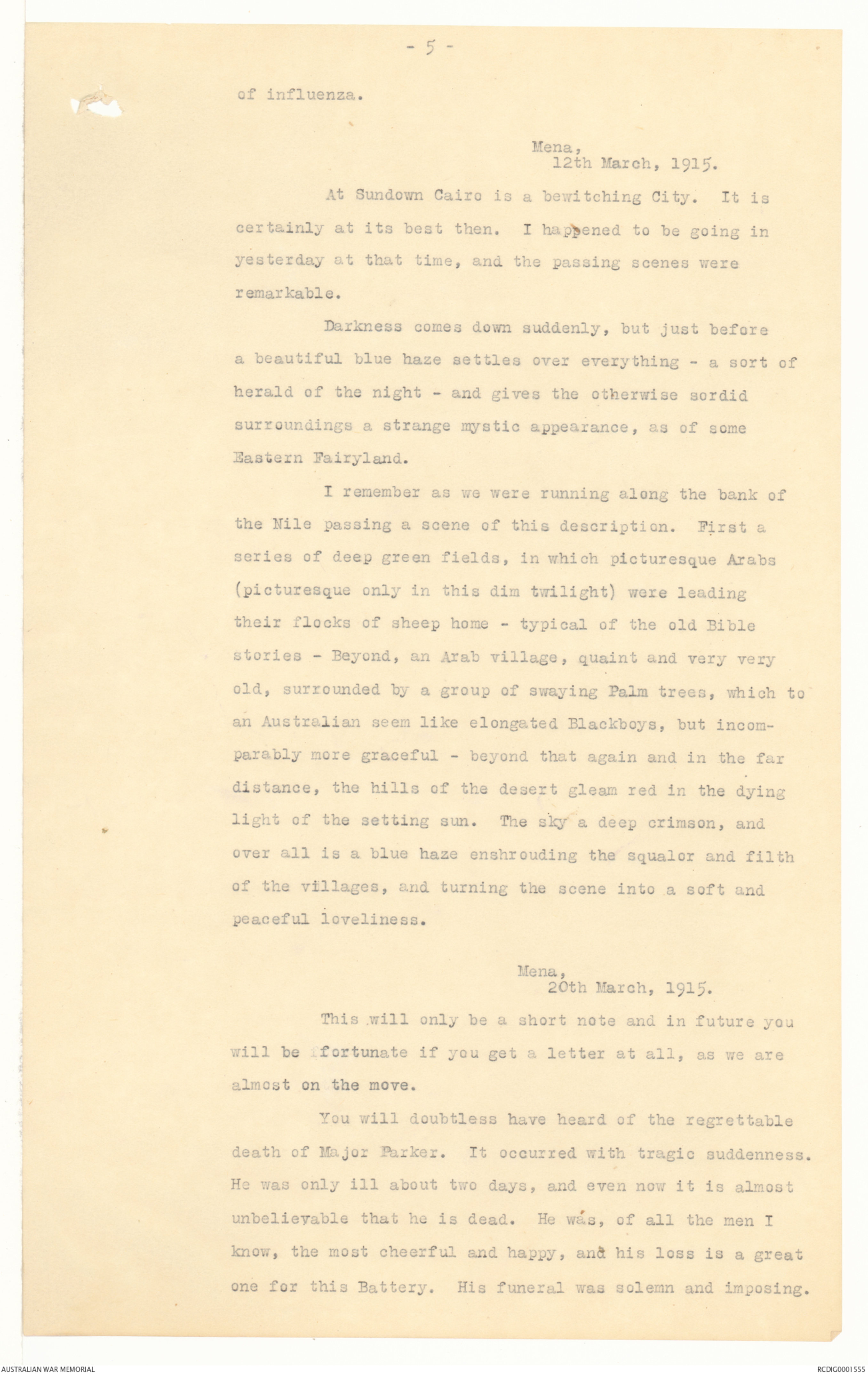
Mena,
12th March, 1915.
At Sundown Cairo is a bewitching City. It is
certainly at its best then. I happened to be going in
yesterday at that time, and the passing scenes were
remarkable.
Darkness comes down suddenly, but just before
a beautiful blue haze settles over everything - a sort of
herald of the night - and gives the otherwise sordid
surroundings a strange mystic appearance, as of some
Eastern Fairyland.
I remember as we were running along the bank of
the Nile passing a scene of this description. First a
series of deep green fields, in which picturesque Arabs
(picturesque only in this dim twilight) were leading
their flocks of sheep home - typical of the old Bible
stories - Beyond, an Arab village, quaint and very very
old, surrounded by a group of swaying Palm trees, which to
an Australian seem like elongated Blackboys, but incomparably
more graceful - beyond that again and in the far
distance, the hills of the desert gleam red in the dying
light of the setting sun. The sky a deep crimson, and
over all is a blue haze enshrouding the squalor and filth
of the villages, and turning the scene into a soft and
peaceful loveliness.
Mena,
20th March, 1915.
This will only be a short note and in future you
will be ffortunate if you get a letter at all, as we are
almost on the move.
You will doubtless have heard of the regrettable
death of Major Parker. It occurred with tragic suddenness.
He was only ill about two days, and even now it is almost
unbelievable that he is dead. He was, of all the men I
know, the most cheerful and happy, and his loss is a great
one for this Battery. His funeral was solemn and imposing.
- 6 -
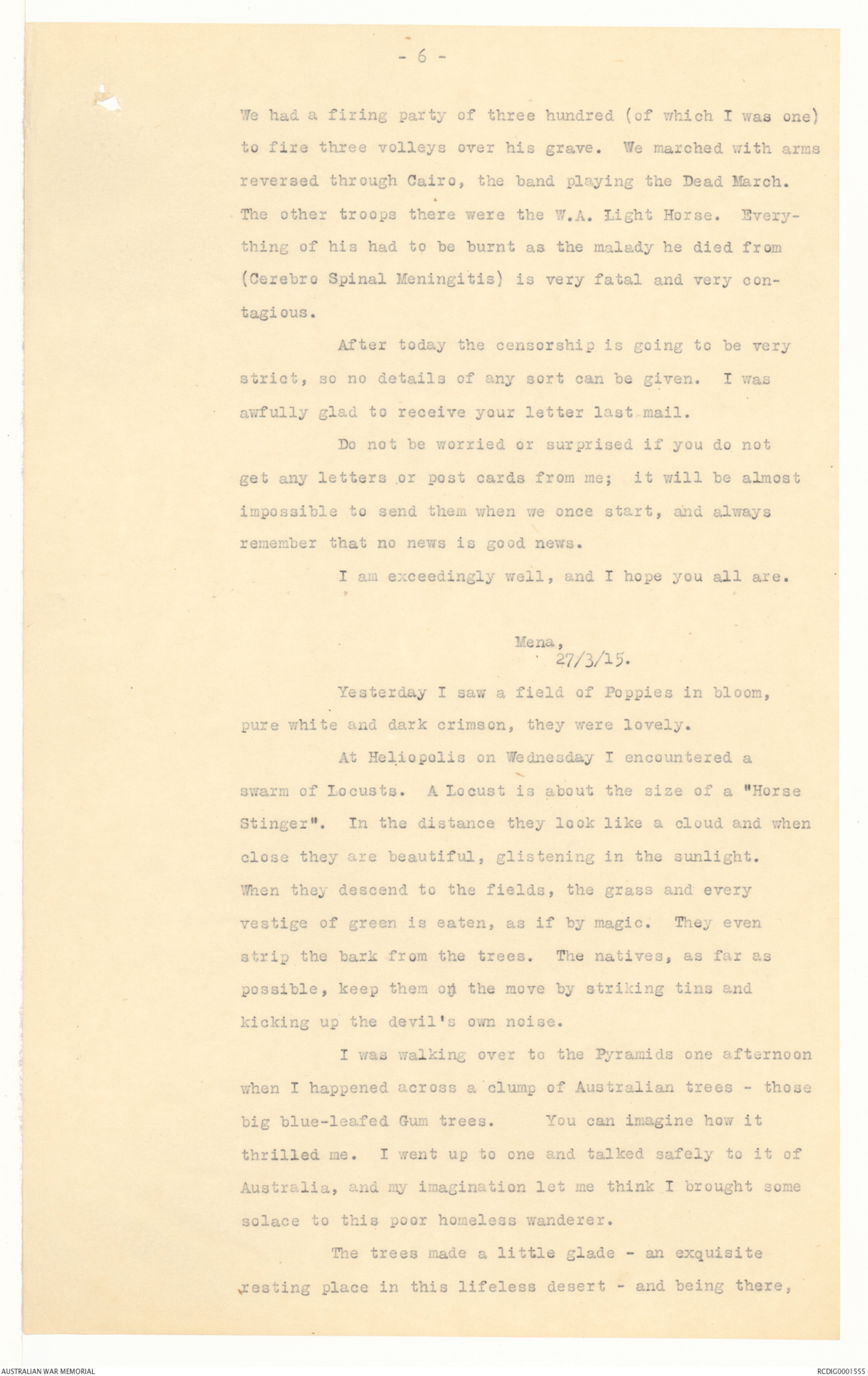
We had a firing party of three hundred (of which I was one)
to fire three volleys over his grave. We marched with arms
reversed through Cairo, the band playing the Dead March.
The other troops there were the W.A. Light Horse. Everything
of his had to be burnt as the malady he died from
(Cerebro Spinal Meningitis) is very fatal and very contagious.
After today the censorship is going to be very
strict, so no details of any sort can be given. I was
awfully glad to receive your letter last mail.
Do not be worried or surprised if you do not
get any letters or post cards from me; it will be almost
impossible to send them when we once start, and always
remember that no news is good news.
I am exceedingly well, and I hope you all are.
Mena
27/3/15.
Yesterday I saw a field of Poppies in bloom,
pure white and dark crimson, they were lovely.
At Heliopolis on Wednesday I encountered a
swarm of Locusts. A Locust is about the size of a "Horse
Stinger". In the distance they look like a cloud and when
close they are beautiful, glistening in the sunlight.
When they descend to the fields, the grass and every
vestige of green is eaten, as if by magic. They even
strip the bark from the trees. The natives, as far as
possible, keep them on the move by striking tins and
kicking up the devil's own noise.
I was walking over to the Pyramids one afternoon
when I happened across a clump of Australian trees - those
big blue-leafed Gum trees. You can imagine how it
thrilled me. I went up to one and talked safely to it of
Australia, and my imagination let me think I brought some
solace to this poor homeless wanderer.
The trees made a little glade - an exquisite
resting place in this lifeless desert - and being there,
- 7 -
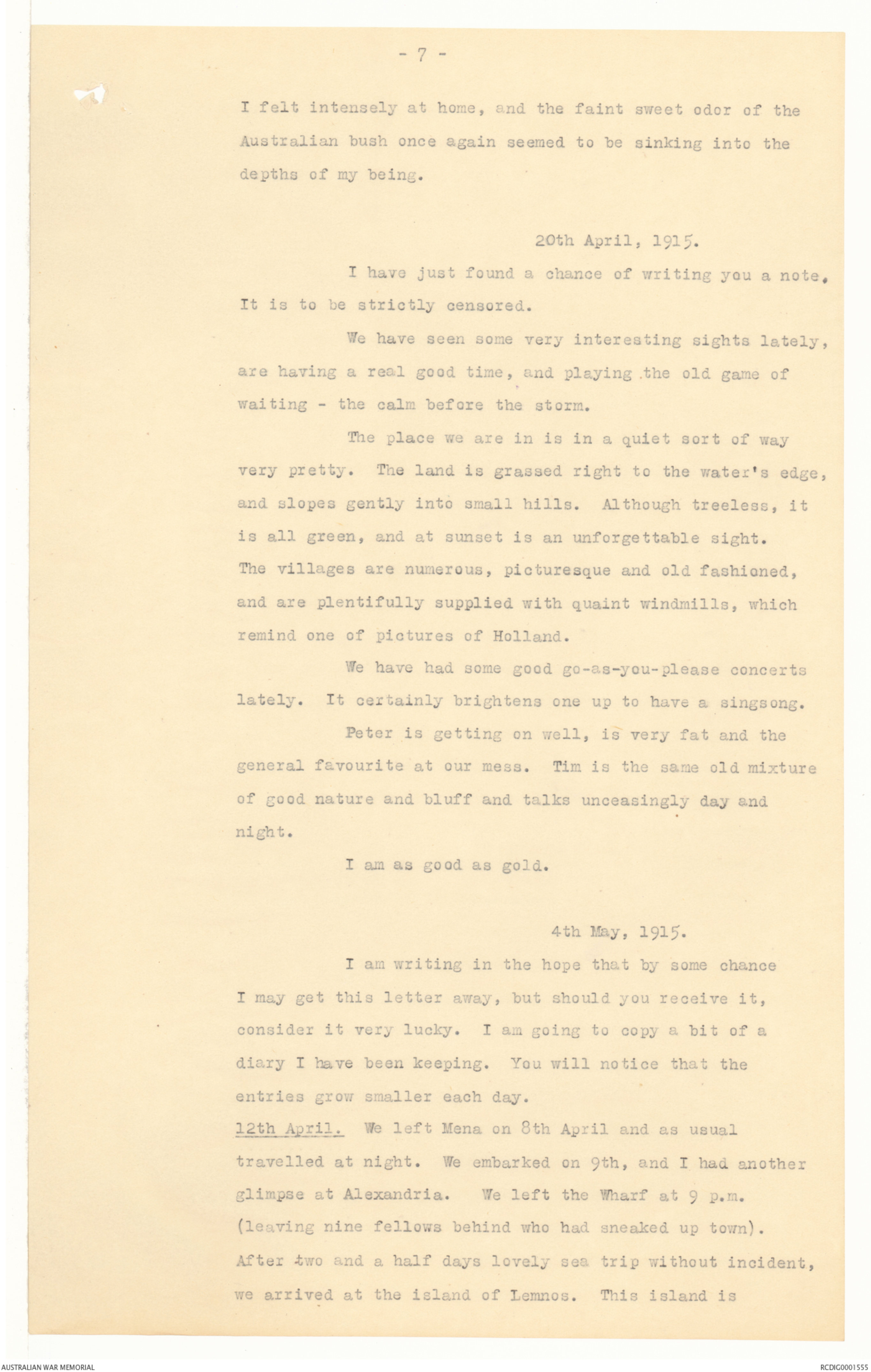
I felt intensely at home, and the faint sweet odor of the
Australian bush once again seemed to be sinking into the
depths of my being.
20th April, 1915.
I have just found a chance of writing you a note.
It is to be strictly censored.
We have seen some very interesting sights lately,
are having a real good time, and playing the old game of
waiting - the calm before the storm.
The place we are in is in a quiet sort of way
very pretty. The land is grassed right to the water's edge,
and slopes gently into small hills. Although treeless, it
is all green, and at sunset is an unforgettable sight.
The villages are numerous, picturesque and old fashioned,
and are plentifully supplied with quaint windmills, which
remind one of pictures of Holland.
We have had some good go-as-you-please concerts
lately. It certainly brightens one up to have a singsong.
Peter is getting on well, is very fat and the
general favourite at our mess. Tim is the same old mixture
of good nature and bluff and talks unceasingly day and
night.
I am as good as gold.
4th May, 1915.
I am writing in the hope that by some chance
I may get this letter away, but should you receive it,
consider it very lucky. I am going to copy a bit of a
diary I have been keeping. You will notice that the
entries grow smaller each day.
12th April. We left Mena on 8th April and as usual
travelled at night. We embarked on 9th, and I had another
glimpse at Alexandria. We left the Wharf at 9 p.m.
(leaving nine fellows behind who had sneaked up town).
After two and a half days lovely sea trip without incident,
we arrived at the island of Lemnos. This island is
- 8 -
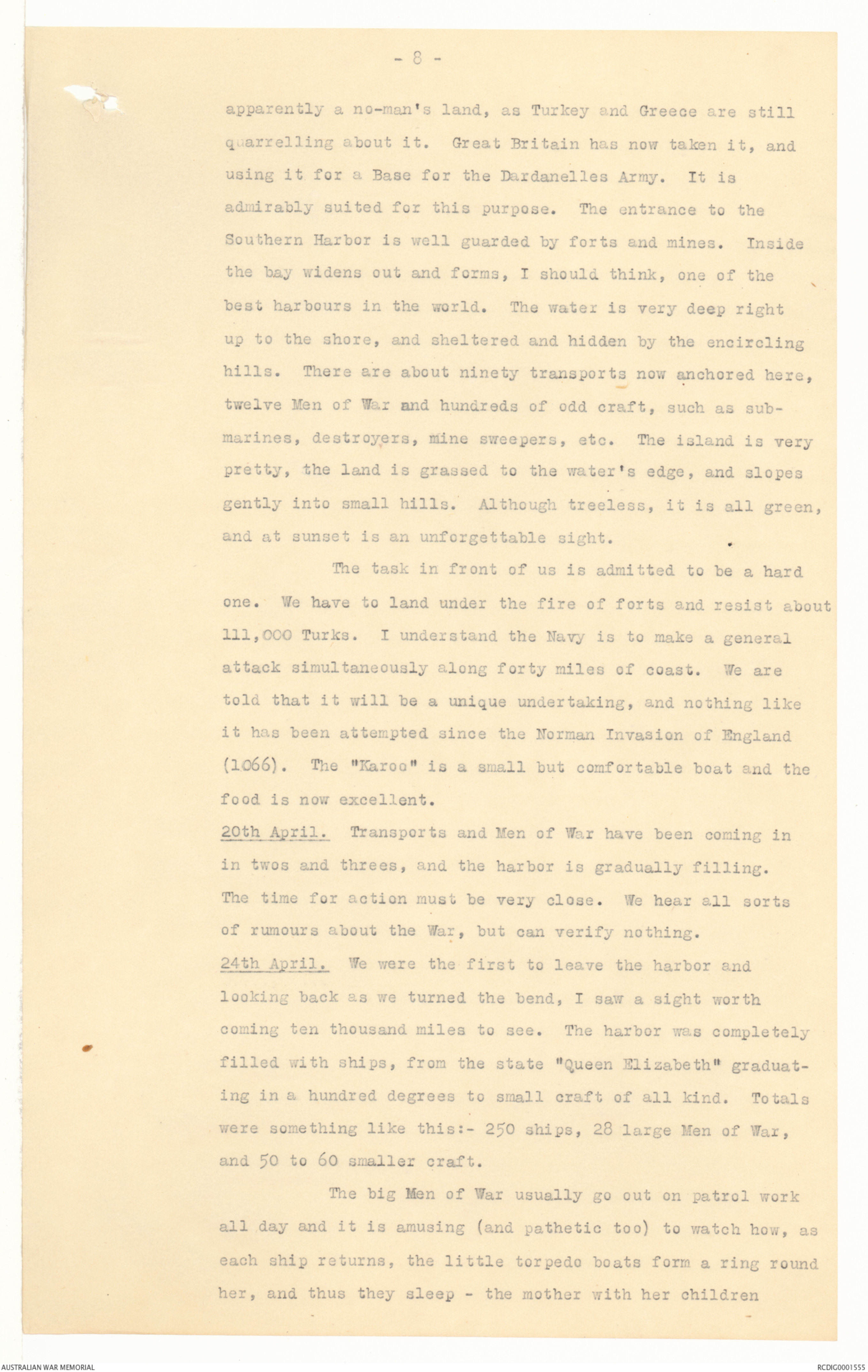
apparently a no-man's land, as Turkey and Greece are still
quarrelling about it. Great Britain has now taken it, and
using it for a Base for the Dardanelles Army. It is
admirably suited for this purpose. The entrance to the
Southern Harbor is well guarded by forts and mines. Inside
the bay widens out and forms, I should think, one of the
best harbours in the world. The water is very deep right
up to the shore, and sheltered and hidden by the encircling
hills. There are about ninety transports now anchored here,
twelve Men of War and hundreds of odd craft, such as submarines,
destroyers, mine sweepers, etc. The island is very
pretty, the land is grassed to the water's edge, and slopes
gently into small hills. Although treeless, it is all green,
and at sunset is an unforgettable sight.
The task in front of us is admitted to be a hard
one. We have to land under the fire of forts and resist about
111,000 Turks. I understand the Navy is to make a general
attack simultaneously along forty miles of coast. We are
told that it will be a unique undertaking, and nothing like
it has been attempted since the Norman Invasion of England
(1066). The "Karoo" is a small but comfortable boat and the
food is now excellent.
20th April. Transports and Men of War have been coming in
in twos and threes, and the harbor is gradually filling.
The time for action must be very close. We hear all sorts
of rumours about the War, but can verify nothing.
24th April. We were the first to leave the harbor and
looking back as we turned the bend, I saw a sight worth
coming ten thousand miles to see. The harbor was completely
filled with ships, from the state "Queen Elizabeth" graduating
in a hundred degrees to small craft of all kind. Totals
were something like this:- 250 ships, 28 large Men of War,
and 50 to 60 smaller craft.
The big Men of War usually go out on patrol work
all day and it is amusing (and pathetic too) to watch how, as
each ship returns, the little torpedo boats form a ring round
her, and thus they sleep - the mother with her children
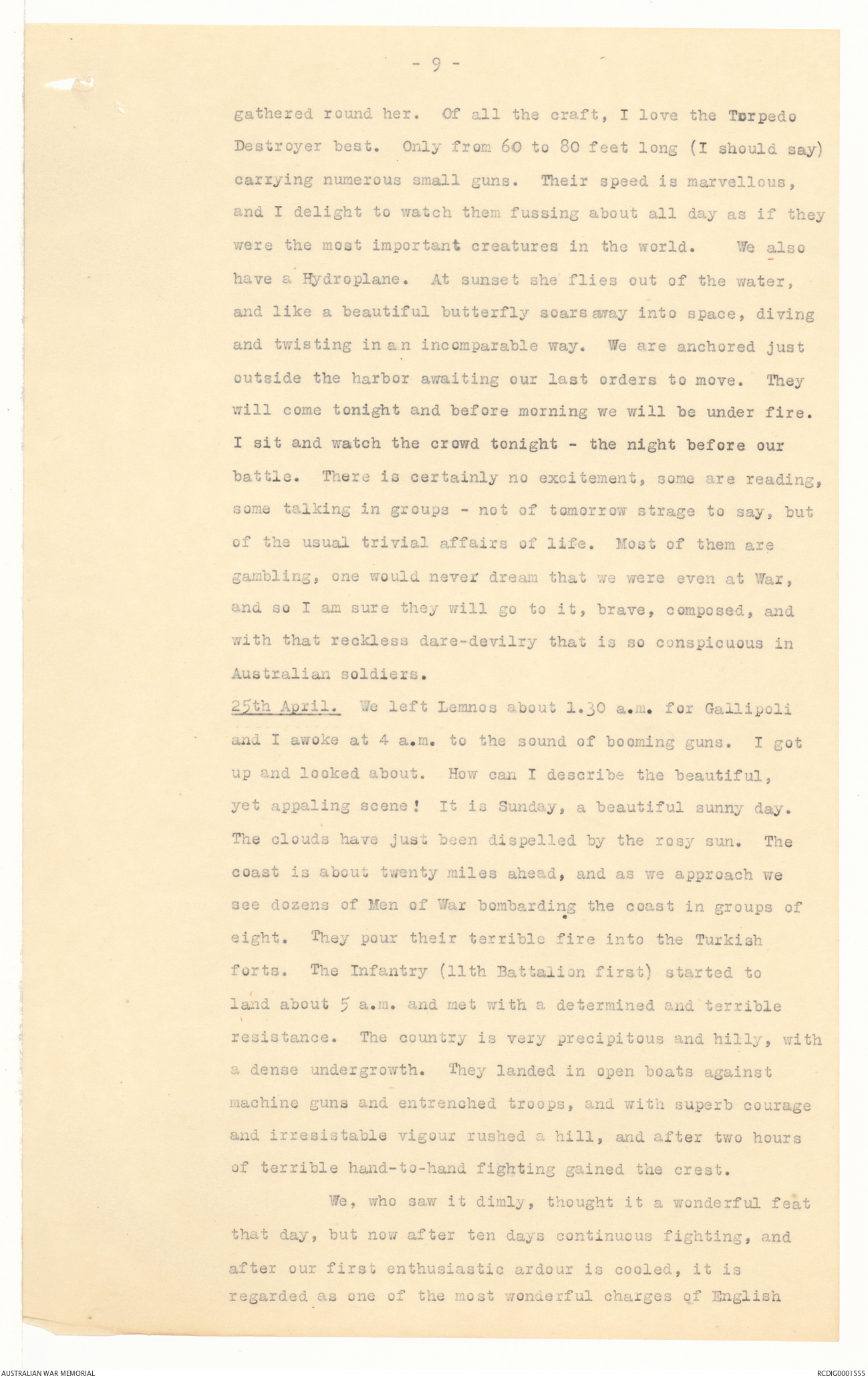
- 9 -
gathered round her. Of all the craft, I love the Torpedo
Destroyer best. Only from 60 to 80 feet long (I should say)
carrying numerous small guns. Their speed is marvellous,
and I delight to watch them fussing about all day as if they
were the most important creatures in the world. We also
have a Hydroplane. At sunset she flies out of the water,
and like a beautiful butterfly soars away into space, diving
and twisting in an incomparable way. We are anchored just
outside the harbor awaiting our last orders to move. They
will come tonight and before morning we will be under fire.
I sit and watch the crowd tonight - the night before our
battle. There is certainly no excitement, some are reading,
some talking in groups - not of tomorrow strage to say, but
of the usual trivial affairs of life. Most of them are
gambling, one would never dream that we were even at War,
and so I am sure they will go to it, brave, composed, and
with that reckless dare-devilry that is so conspicuous in
Australian soldiers.
25th April. We left Lemnos about 1.30 a.m. for Gallipoli
and I awoke at 4 a.m. to the sound of booming guns. I got
up and looked about. How can I describe the beautiful,
yet appaling scene! It is Sunday, a beautiful sunny day.
The clouds have just been dispelled by the rosy sun. The
coast is about twenty miles ahead, and as we approach we
see dozens of Men of War bombarding the coast in groups of
eight. They pour their terrible fire into the Turkish
forts. The Infantry (11th Battalion first) started to
land about 5 a.m. and met with a determined and terrible
resistance. The country is very precipitous and hilly, with
a dense undergrowth. They landed in open boats against
machine guns and entrenched troops, and with superb courage
and irresistable vigour rushed a hill, and after two hours
of terrible hand-to-hand fighting gained the crest.
We, who saw it dimly, thought it a wonderful feat
that day, but now after ten days continuous fighting, and
after our first enthusiastic ardour is cooled, it is
regarded as one of the most wonderful charges of English
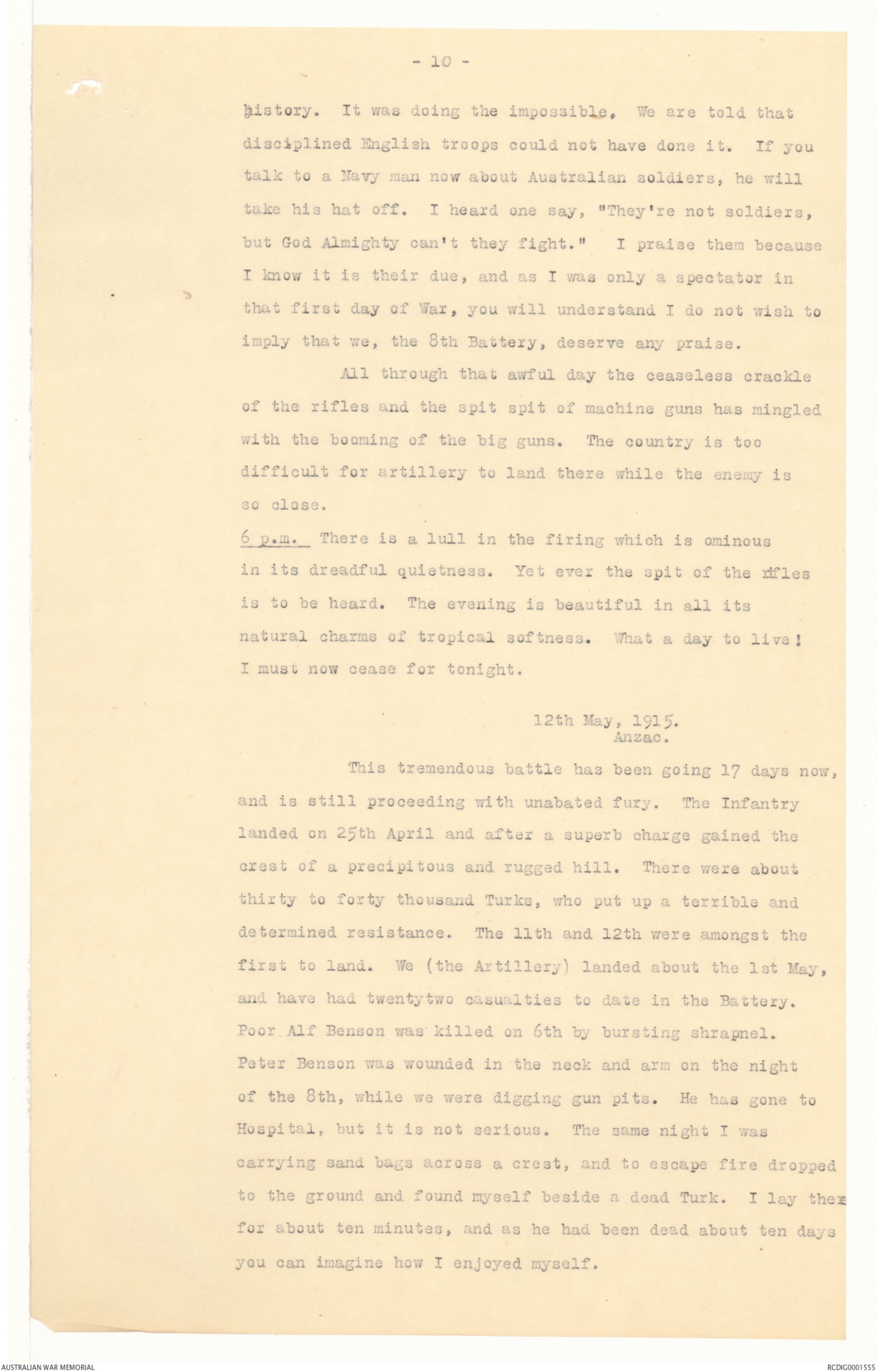
- 10 -
history. It was doing the impossible. We are told that
disciplined English troops could not have done it. If you
talk to a Navy man now about Australian soldiers, he will
take his hat off. I heard one say, "They're not soldiers,
but God Almighty can't they fight." I praise them because
I know it is their due, and as I was only a spectator in
that first day of War, you will understand I do not wish to
imply that we, the 8th Battery, deserve any praise.
All through that awful day the ceaseless crackle
of the rifles and the spit spit of machine guns has mingled
with the booming of the big guns. The country is too
difficult for artillery to land there while the enemy is
so close.
6 p.m. There is a lull in the firing which is ominous
in its dreadful quietness. Yet ever the spit of the rifles
is to be heard. The evening is beautiful in all its
natural charms of tropical softness. What a day to live!
I must now cease for tonight.
12th May, 1915.
Anzac.
This tremendous battle has been going 17 days now,
and is still proceeding with unabated fury. The Infantry
landed on 25th April and after a superb charge gained the
crest of a precipitous and rugged hill. There were about
thirty to forty thousand Turks, who put up a terrible and
determined resistance. The 11th and 12th were amongst the
first to land. We (the Artillery) landed about the 1st May,
and have had twentytwo casualties to date in the Battery.
Poor Alf Benson was killed on 6th by bursting shrapnel.
Peter Benson was wounded in the neck and arm on the night
of the 8th, while we were digging gun pits. He has gone to
Hospital, but it is not serious. The same night I was
carrying sand bags across a crest, and to escape fire dropped
to the ground and found myself beside a dead Turk. I lay ther[[e]]
for about ten minutes, and as he had been dead about ten days
you can imagine how I enjoyed myself.
 Sandy Mudie
This transcription item is now locked to you for editing. To release the lock either Save your changes or Cancel.
This lock will be automatically released after 60 minutes of inactivity.