
Thomas James Richards, Diaries, Transcript Vol. 4, 9 November 1916 - 31 May 1918 - Part 11
-95-
and that instead of a German attack they are actually retiring
all along the line. News from the wounded says that our patrols
last night entered the German trenches and found them empty. So
that a big sensation has been created and we are all living at
high tension wondering what the next move is likely to be.
Rumour has it that the Germans are going back quite 20 miles to
the village of Cambria but strong rearguard actions will be
fought right back to the new position. This news is reported
from a German prisoner. Anyhow, our artillery horses and
limber have been going pass Bazantine all day for the front line.
The 4th Battalion came post haste right from Bresle to Bazantine
and the 2nd Division have gone forward before their time to
return, the 1st Battalion is ready to move up and have already
given consideration to open warfare tactics. But to follow
these crafty Germans back will be difficult and dangerous work.
The kind of work which the Australian would enjoy before the
close trench stuff. But we want good rifle shots now for there
is sure to be lots of sniping going on; yet as far as I can see
this will be hard as our men have not been trained to shoot
straight not one man in 60 knows whether his rifle is correct
or not and if the men could shoot before the war, they may not
now as they have had no practice lately.
February 26th. Monday.
Last night a message came through about Bennett and myself
going to a Divisional school for one month. So at 10 a.m. to-day
we reported into Battalion and are now awaiting orders.
There is very little news from the front; but it is said
that the 3rd Brigade has had 10% casualities and that the officers
are being badly picked off by the hidden snipers.
The sun has been shining fairly well to-day, and the days
are warming up considerable.
-96 -
February 27th Tuesday.
Captain Watson was in here Fricourt Farm, at lunch time.
He says that our men have advanced well during the night and
have taken the two smaller villages in front of Thilloy; La Basque
and Ligny Thilloy. Snippers are troublesome and are
killing a lot of officers off. One sniper was discovered up in
a hollow tree. Our scouting parties are doing great work. The
above officer is from Brigade Hdqs and say that a small Australian
party captured 6 Germans and according to instructions
some prisoners had to be sent back to Hdqs to, if possible,
drag information from him. Well, there were 6 Germans and the
party could only afford to let one of their men go back as
escort, so that it would hardly be safe to take more than one
prisoner. It was a hard and difficult position to be in, and
the only way to settle it was to make the Germans draw numbers
to choose the prisoner that was to be taken into our lines; the
remaining five Germans were despacthed. This I am told is
often the case. In a round up from a "tank" raid some time ago
I am informed there were 70 prisoners taken and as only a few
could be taken back a machine gun was turned onto them and they
were thinned out.
I find now that Bennett and I have to return to Bazintine
and await orders concerning the school.
Capt. Watson also said that on the sector that our
Battalion are moving up to to-night they will not be allow to
go further than Thrilloy as both the right and left flank are
some distance behind already.
We have gone back to Bazantine Camp and we 3 officers
with 8 N.C.O.s will have to stay here and await orders; which
will be either for school or for the front. I really hope is
will be for the front as the fighting up there now has developed
a very interesting form. It is not like sitting tight in a
trench waiting for a big shell to blow you to "kingdom come."
There will be some good scouting work to be done, and I rather
like myself as a scout with a small party of men. I've heard
-97-
and quite beleive it, that a German machine gun had been giving
our men a bad time, killing several, and then when they were
cornered an officer jumped up with his hands in the air surrendering.
Now, that would any man in the conquering party do?
Naturally, they shot him and the gun crew also. There is one
good point about the present form of war too, that is pleasing
the wounds are all clean bullets wounds so that a fellow either
gets knocked right out or gets a real good "Blighty" out of it.
It is nasty shell wounds that make a fellow think, bullets are
alright.
February 28th. Wednesday.
I have done nothing at all to-day. I find that we have to
wait over to-morrow also and go to School on Friday morning. I
slept in until after 9 o'clock and quite enjoyed it. I commenced
to write, but with very little success. To-night I did write
Blaxland and Madge Davies cousins from Cairns. I got a letter
from Mr. and Mrs. Bostock Smith from Bristol; they forward me
a very earnest invitation to stay with them at any time. I
would indeed have a good time as they have a lovely home and
live very well.
We have been living very well too of late due entirely to
the goods we buy as the food issued is distinctly short. I
cant understand the shortage at all. If it were not that the
men are well paid they would not be able to get along at all.
We can get plenty of whiskey amongst the officers. When living
at the Cough Drop I got a case of it and found it good stuff.
Though I am frightened of the stuff frightened that I might
get to like it. I can drink it without water now. I can drink
rum too, but always pull unpleasant faces afterwards. I smoke
a pipe too. I don't know quite where I will end up if this
war continues!!!
I hear that our men are still doing good work.
March 1st. Thursday.
Today has been rather marked, not particularly exciting
-98 -
though I have been through an exciting zone.
At mid-day Lieut. Bennett & I set off from Bazantine to
have a look around the newly taken villages of La Basque, Ligny
Thilloy and Thilloy. I went a walk of fully 6 miles through
Factory Corner over our old front line trenches at Yarra Bank
onto Bayonet trench to the right of the Maze where our 2nd
Australian Division got knocked about some two months ago.
There were bodies of Australians lying thickly about of the
ground some of them in most remarkable positions. One was
huddled up on his hands and knees as though in the act of
crawling away out of the shell hole in which I saw him. Another
fellow make a gallant picture lying flat down with his chin
resting on the ground looking straight ahead and his rifle with
bayonet fixed, still griped in his left hand and at his side.
He died some 8 weeks ago, but from the position as I saw him he
might have been alive and eager for fight still. I should have
photographed him he looked so business like and brave. Just
near there was a sorry sight. This tall and well set up
Australian was lying on his back in a large shell hole; his
legs were spread apart, his body reclining in a comfortable
position with the head resting on the high slope of the hole.
He appears to have been placed there by a comrade, or was he
only wounded and crawled away into this hole, made himself comfortable
and waited for assistance that never came. It made my
heart bleed to see all these fine young fellow lying out there.
The cold weather had preserved the bodies and made the scene all
the more weird. We passed on to Bayonet trench which was badly
knocked about and very muddy indeed. In the trench built in
the correct patron viz:- Hand drawn diagram. See original there were several
deep dugouts and the sides revetted with timber. The trench
was quite 7 ft. deed with fire steps risen up 18 inches to
shoot from. The trench was betterly built and stronger than
ours were, but this, of course, would be due to his German
being on the defensive while we were the attacking force. We
passed out of Bayonet trench down over the shell churned ground
to the Yellow Cut and into La Basque. On the maps issued to
-99 -
us are the names of roads and the position as well as names
to all of his trenches. I find also that these maps are fairly
accurate. The Yellow Cut was a sunken road (Sunken Roads are
very common in this country) and all along it the Germans have
had good deep dugouts; all of which they blew up before leaving
them. The damage however as mostly confined to the mouth of them
and can be easily reclaimed but here the difficult is going to
be with German shell fire, as the dugout mouths are open to
their gun fire.
It is just as well there was a rough line of duckboards
along this Yellow Cut as it was feet deep in water and mud. In
the village of La Basque there was desolation and ruin. It was
a great surprise to see the houses so badly knocked about, our
guns have played havoc with the other villages too. A German
prisoner states that Bapaume is also in ruins. The country
behind the German lines is badly torn up; there were some very
large shells used there, judging by the huge shell craters about.
A big well I saw in La Basque had the top of it blown in. But
whether the wells had been poisoned or not I don’t know, I
certainly expect this to be so and perhaps the shell holes will
be poisoned also.
It seems to me from the number of recently built dugouts
and those in the course of construction that the German made up
his mind to evacuate rather suddenly. There was a large quantity
of bombs left behind right through his trenches back to La
Basque. Ive heard that a large dump of materials was left at
Warlencourt Butte. The sunken roads Blue and Yellow Cut were
extremely muddy and water logged.
There was a whole lot of shelling going on all the time we
were out, chiefly big "crumpts" and shrapnel. This German move
is going to make the geting of ammunition and materials into the
front line a terrible task. The blue metal now used on the roads
around Bazantine comes from England so how they will ever get
enough across to built these new roads beats me. Of cause
the small railway will ease the trouble somewhat but there
must be roads.
- 100-
March 2nd. Friday.
I dull day again to-day I should not really say again
because yesterday was a beautiful day and last night was both
moonlight and starlight. We certainly have been having more than
we would like of dull weather; and to-day is just one of those
dull days. I went down to the 1st Field Ambulance this afternoon
and found some letters there for me. I learnt also that Colonel
William had been up looking around the front and was shot through
the body by a shrapnel pellet and there is little hope for his
recovery. This seems particularly hard as the Colonel very
seldom went into the shrapnel zone. It shows at any rate that
a person is never safe and that his first trip up is as likely
to be his last as any other trip.
March 3rd. Saturday.
I am in Albert to-night and sleeping in a room having come
up from Bazantine to Fricourt this morning and on to Albert this
afternoon.
I am at the officers club, I had a fair dinner there tonight
but there was no butter this I miss as it is five days
now since I have tasted butter.
I met at the table, and continued after dinner a chat with
an elderly Englishman, whom I believe is a press representative,
he kept me talking a whole lot on Australia and of cause I was
busy showing him to advantages of Australia in as quite a way
as possible and I take it upon myself in saying that he will in
future look at Australia in a more easy light in future. I dont
think I spoilt my work in talking over much, as I had my wits
about me alright and weighed my points carefully. My greatest
difficulty was in explaining away the queer temperament and
wild characterists of the Australia.
Anyhow, I enjoyed his company very much indeed. I went to
the local Bonza picture show at 5 p.m. with Bennett and found
that a film was already started showing Robt. W. Service's story
"The Shooting of Dan McGrew." It was very fine indeed and I
enjoyed it immensely.
- 101 -
March 4th. Sunday.
Up at 7.30 a.m. out of a good warm bed, a real single
bed with four iron post legs on it. It was delightful. I
could turn over without hearing the wire netting creak as is
usual in case in our billet in improvised beds. I missed the
difficulty in turning over when sleeping on the hard floor too,
and had a very comfortable nights rest. We got a decent breakfast
in the building (an old mansion now an Officers Club controled
by the Y.M.C.A.) but the lack of porridge was a little
disappointing. The feeding the troops should have a supply of
porridge in the rations. It is cheap and good; A shame. We
got around to the camp at Belleview Farm and all the party got
into 6 big motor waggons and set off for Tirancourt arriving
there, 25 miles distant, by 1 o'clock. We (the lst Battalion
representatives Sampson, Bennett, and self) went into the village
of Picquigny ten minutes distance and got a good dinner and a
little wine. This village is one of the best I have been in;
it has a variety of shops and will be a break for us in the
evenings.
There was nothing doing at the school in the evening
and we went to bed early.
March 5th. Monday. School.
Revielle at 7 a.m. Up and shaved, breakfasted and on
parade by 8.40. A trip to the baths in the village was welcome
and a good wash resulted. The officers march in fours, there
being some 47 or so, and on return to the school we were taken
onto a parade ground and taught first the main points to be concerned
in standing to "attention." Then followed the detail
and correct way to turn to the "right," the "left" and "about."
This was jolly good instruction for myself and I studied it
closely but for the ^officers men who themselves are instructors it must
have been trying.
In the afternoon we went back onto the ground and/were told
how to salute correctly and do it by numbers. "Forming fours"
- 102 -
was also laid upon with stress and officers were called out of
the squad to give detail, and I was in a flurry lest I be called
out to drill the squad. At 5 o'clock a lecture was given on
"Discipline" by Capt. Campbell. He was very good and brought
his points home with force and clearness. A report I am doing
up in my school diary. X
At dinner Col. Stephens had some remarks to made on the mess
and its etteiqte. He also stated that General Walker has asked
him to be strict on discipline and more on saluting than anything
as it ment good training and reflected the whole of the
work of their units. He mentioned that "Dreadnought" were
on sale in the School, as venereal was prevailent all around
here. He stated that in one month there were 170 case of venereal
in the 4th Army and 120 of them were Australians. There was a
heavy fall of snow last night. The Chateau looked a pretty
picture.
X (The diary referred to will be found in the Appendix.)
March 6th. Tuesday.
The snow of yesterday was soon dispersed by the warm sun
light that followed.
The instructor has already found out that I have a chronic
complaint in the form of a bent knee. He tried to get my toes
at an angle of 45 degrees too. He's a jolly good man and I like
him for noticing my position the first time on parade. I can see
this month of schooling getting me a whole lot of worry. And
if they can make a soldier of me I will be as much surprised as
I will be delighted.
A lecture of map reading was followed by the drawing of a
sketch by each officer. At 5 o'clock there was a lecture on
"Trench Warfare" by Major Harris.
Dinner, a rather formal kind of affair, at 6.30. By 8
o'clock Bennett Sampson and I were in Picquigny shopping. The
"boozers" close at 8.30 we were back by 9 p.m.
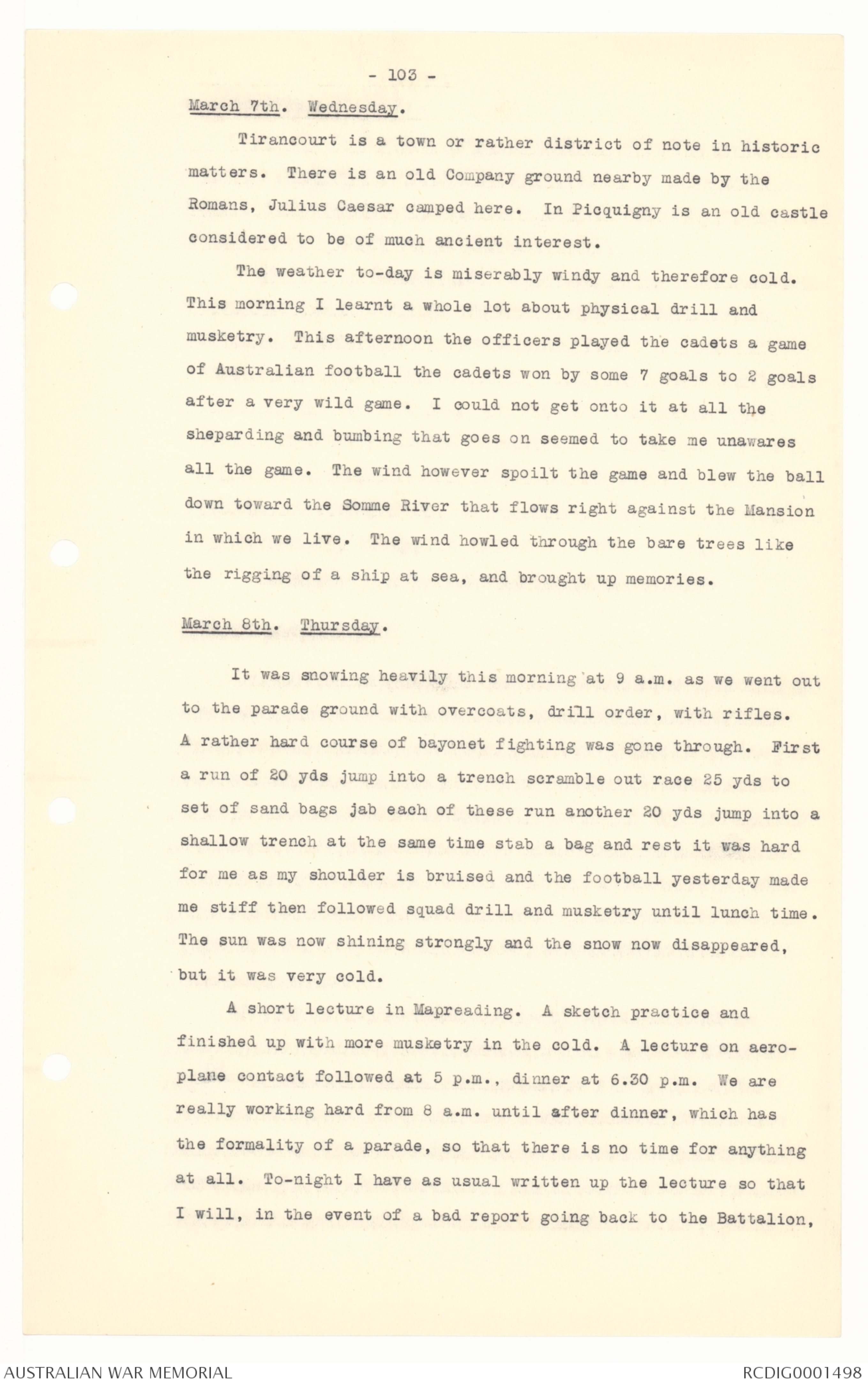
-103-
March 7th. Wednesday.
Tirancourt is a town or rather district of note in historic
matters. There is an old Company ground nearby made by the
Romans, Julius Caesar camped here. In Picquigny is an old castle
considered to be of much ancient interest.
The weather to-day is miserably windy and therefore cold.
This morning I learnt a whole lot about physical drill and
musketry. This afternoon the officers played the cadets a game
of Australian football the cadets won by some 7 goals to 2 goals
after a very wild game. I could not get onto it at all the
sheparding and bumbing that goes on seemed to take me unawares
all the game. The wind however spoilt the game and blew the ball
down toward the Somme River that flows right against the Mansion
in which we live. The wind howled through the bare trees like
the rigging of a ship at sea, and brought up memories.
March 8th. Thursday.
It was snowing heavily this morning at 9 a.m. as we went out
to the parade ground with overcoats, drill order, with rifles.
A rather hard course of bayonet fighting was gone through. First
a run of 20 yds jump into a trench scramble out race 25 yds to
set of sand bags jab each of these run another 20 yds jump into a
shallow trench at the same time stab a bag and rest it was hard
for me as my shoulder is bruised and the football yesterday made
me stiff then followed squad drill and musketry until lunch time.
The sun was now shining strongly and the snow now disappeared,
but it was very cold.
A short lecture in Mapreading. A sketch practice and
finished up with more musketry in the cold. A lecture on aeroplane
contact followed at 5 p.m., dinner at 6.30 p.m. We are
really working hard from 8 a.m. until after dinner, which has
the formality of a parade, so that there is no time for anything
at all. To-night I have as usual written up the lecture so that
I will, in the event of a bad report going back to the Battalion,
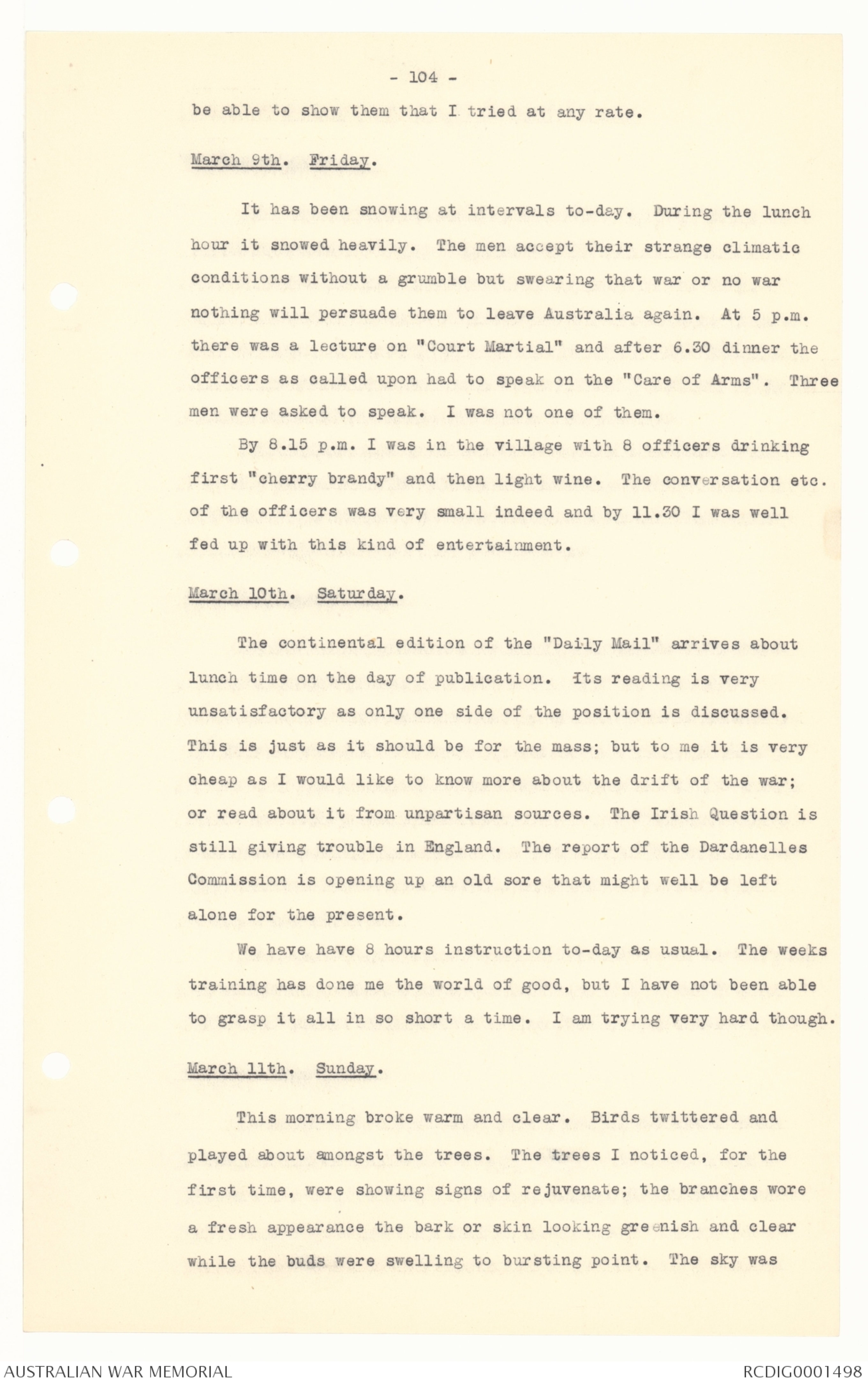
- 104 -
be able to show them that I tried at any rate.
March 9th. Friday.
It has been snowing at intervals to-day. During the lunch
hour it snowed heavily. The men accept their strange climatic
conditions without a grumble but swearing that war or no war
nothing will persuade them to leave Australia again. At 5 p.m.
there was a lecture on "Court Martial" and after 6.30 dinner the
officers as called upon had to speak on the "Care of Arms". Three
men were asked to speak. I was not one of them.
By 8.15 p.m. I was in the village with 8 officers drinking
first "cherry brandy" and then light wine. The conversation etc.
of the officers was very small indeed and by 11.30 I was well
fed up with this kind of entertainment.
March 10th. Saturday.
The continental edition of the "Daily Mail" arrives about
lunch time on the day of publication. Its reading is very
unsatisfactory as only one side of the position is discussed.
This is just as it should be for the mass; but to me it is very
cheap as I would like to know more about the drift of the war;
or read about it from unpartisan sources. The Irish Question is
still giving trouble in England. The report of the Dardanelles
Commission is opening up an old sore that might well be left
alone for the present.
We have have 8 hours instruction to-day as usual. The weeks
training has done me the world of good, but I have not been able
to grasp it all in so short a time. I am trying very hard though.
March 11th. Sunday.
This morning broke warm and clear. Birds twittered and
played about amongst the trees. The trees I noticed, for the
first time, were showing signs of rejuvenate; the branches wore
a fresh appearance the bark or skin looking greenish and clear
while the buds were swelling to bursting point. The sky was
 Sam scott
This transcription item is now locked to you for editing. To release the lock either Save your changes or Cancel.
This lock will be automatically released after 60 minutes of inactivity.