
Diary transcript of Reginald Harriman Heywood, 1917 - Part 9
- 81 -
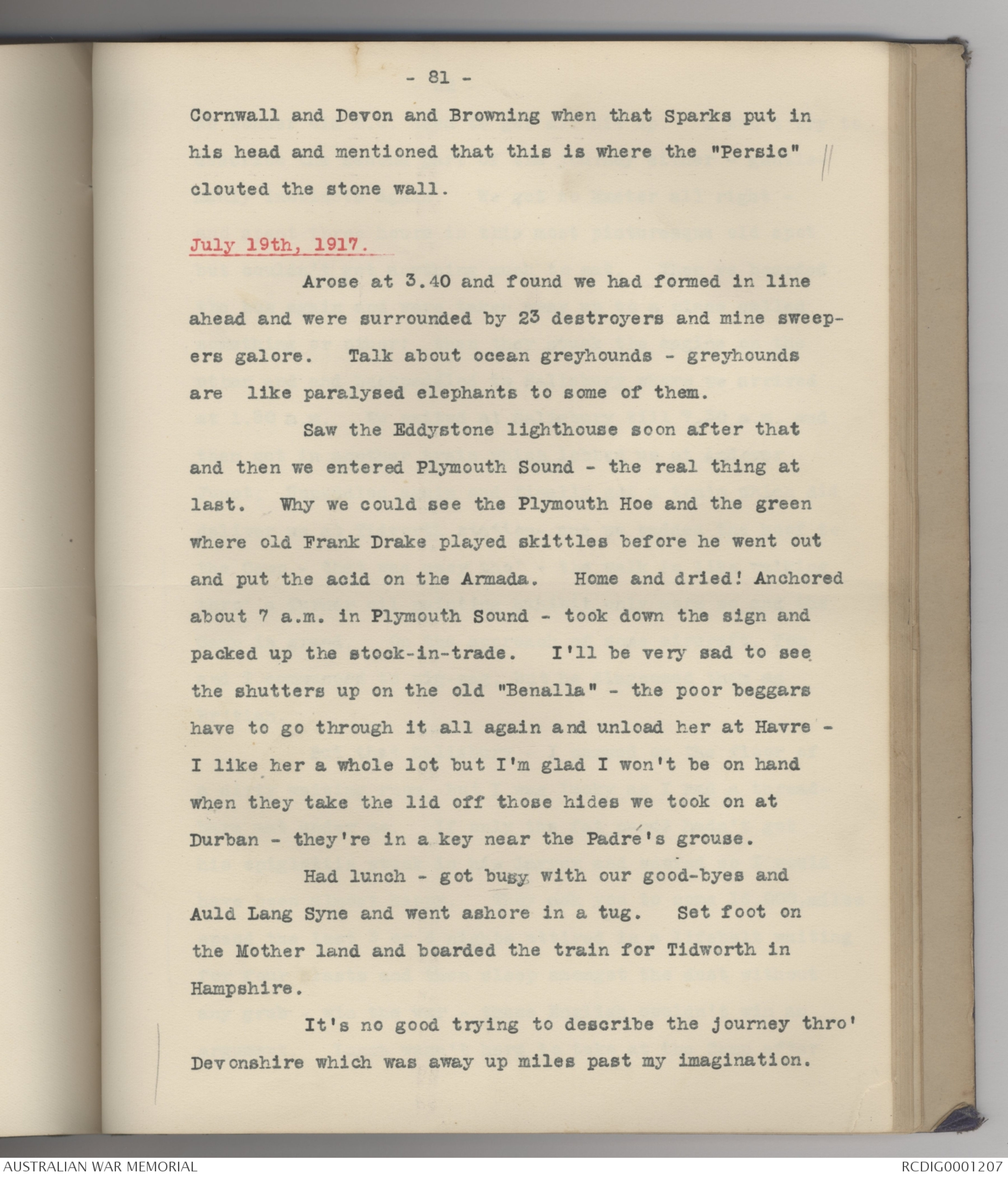
Cornwall and Devon and Browning when that Sparks put in
his head and mentioned that this is where the "Persic"
clouted the stone wall.
July 19th, 1917.
Arose at 3.40 and found we had formed in line
ahead and were surrounded by 23 destroyers and mine sweepers
galore. Talk about ocean greyhounds - greyhounds
are like paralysed elephants to some of them.
Saw the Eddystone lighthouse soon after that
and then we entered Plymouth Sound - the real thing at
last. Why we could see the Plymouth Hoe and the green
where old Frank Drake played skittles before he went out
and put the acid on the Armada. Home and dried! Anchored
about 7 a.m. in Plymouth Sound - took down the sign and
packed up the stock-in-trade. I'll be very sad to see
the shutters up on the old "Benalla" - the poor beggars
have to go through it all again and unload her at Havre -
I like her a whole lot but I'm glad I won't be on hand
when they take the lid off those hides we took on at
Durban - they're in a key near the Padre's grouse.
Had lunch - got busy with our good-byes and
Auld Lang Syne and went ashore in a tug. Set foot on
the Mother land and boarded the train for Tidworth in
Hampshire.
It's no good trying to describe the journey thro'
Devonshire which was away up miles past my imagination.
- 82 -
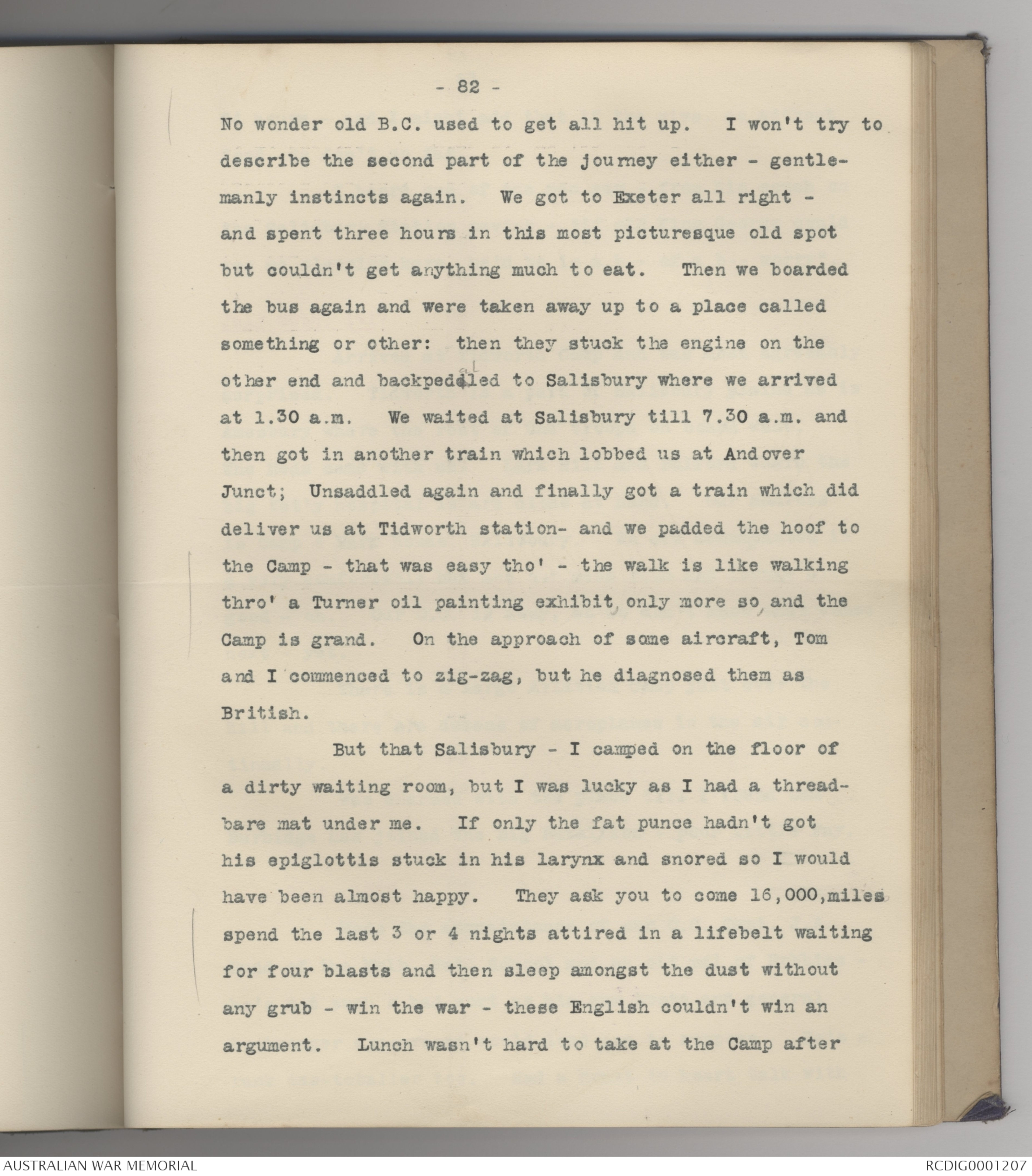
No wonder old B.C. used to get all hit up. I won't try to
describe the second part of the journey either - gentlemanly
instincts again. We got to Exeter all right -
and spent three hours in this most picturesque old spot
but couldn't get anything much to eat. Then we boarded
the bus again and were taken away up to a place called
something or other: then they stuck the engine on the
other end and backpeddaled to Salisbury where we arrrived
at 1.30 a.m. We waited at Salisbury till 7.30 a.m. and
then got in another train which lobbed us at Andover
Junct; Unsaddled again and finally got a train which did
deliver us at Tidworth station - and we padded the hoof to
the Camp - that was easy tho' - the walk is like walking
thro' a Turner oil painting exhibit, only more so, and the
Camp is grand. On the approach of some aircraft, Tom
and I commenced to zig-zag, but he diagnosed them as
British.
But that Salisbury - I camped on the floor of
a dirty waiting room, but I was lucky as I had a threadbare
mat under me. If only the fat punce hadn't got
his epiglottis stuck in his larynx and snored so I would
have been almost happy. They ask you to come 16,000, miles
spend the last 3 or 4 nights attired in a lifebelt waiting
for four blasts and then sleep amongst the dust without
any grub - win the war - these English couldn't win an
argument. Lunch wasn't hard to take at the Camp after
- 83 -
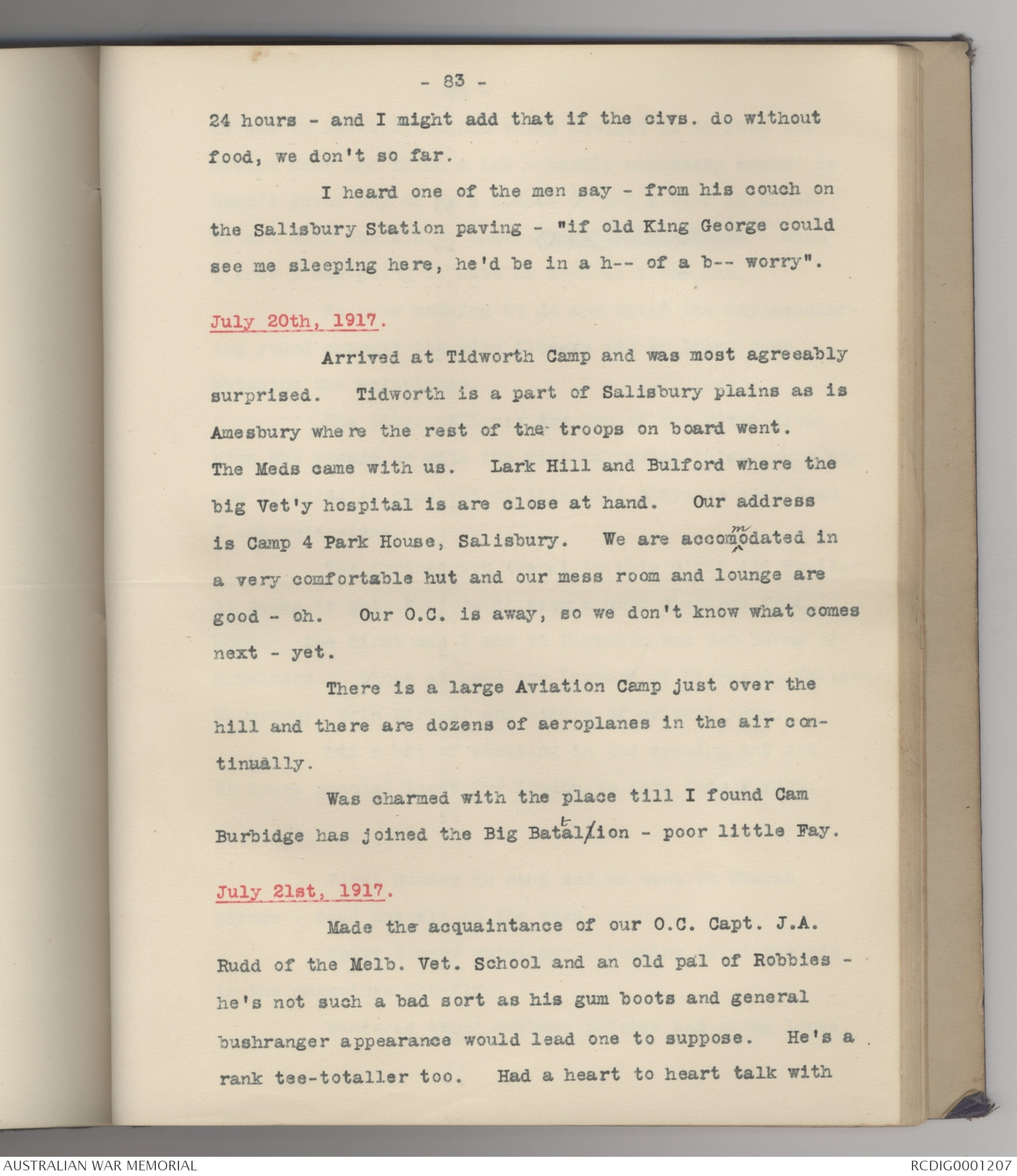
24 hours - and I might add that if the civs. do without
food, we don't so far.
I heard one of the men say - from his couch on
the Salisbury Station paving - "if old King George could
see me sleeping here, he'd be in a h-- of a b-- worry".
July 20th, 1917.
Arrived at Tidworth Camp and was most agreeably
surprised. Tidworth is a part of Salisbury plains as is
Amesbury where the rest of the troops on board went.
The Meds came with us. Lark Hill and Bulford where the
big Vet'y hospital is are close at hand. Our address
is Camp 4 Park House, Salisbury. We are accom^modated in
a very comfortable hut and our mess room and lounge are
good - oh. Our O.C. is away, so we don't know what comes
next - yet.
There is a large Aviation Camp just over the
hill and there are dozens of aeroplanes in the air continually.
Was charmed with the place till I found Cam
Burbridge has joined the Big Bat^tallion - poor little Fay.
July 21st, 1917.
Made the acquaintance of our O.C. Capt. J.A.
Rudd of the Melb. Vet. School and an old pal of Robbies -
he's not such a bad sort as his gum boots and general
bushranger appearance would lead one to suppose. He's a
rank tee-totaller too. Had a heart to heart talk with
- 84 -
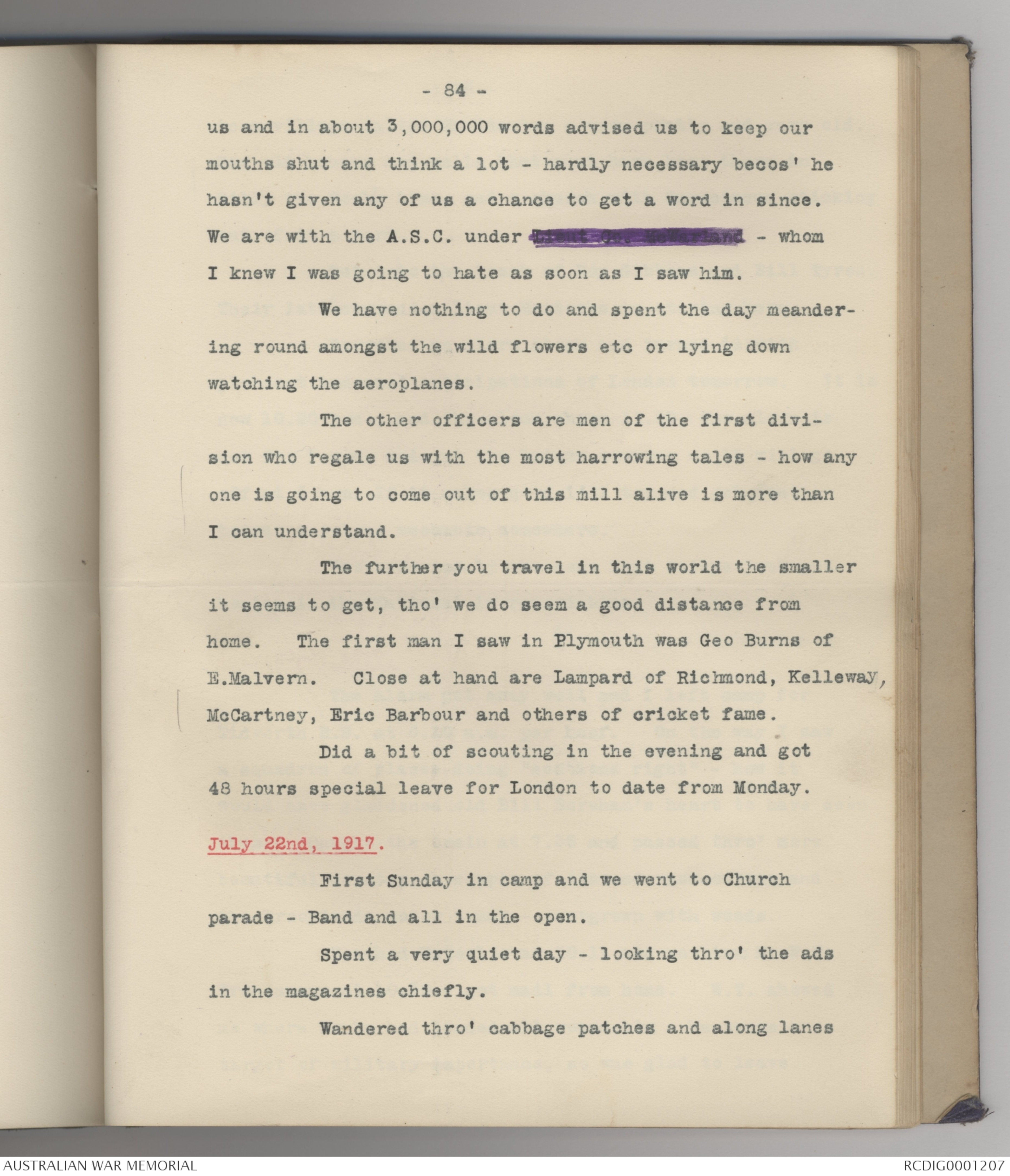
us and in about 3,000,000 words advised us to keep our
mouths shut and think a lot - hardly necessary becos' he
hasn't given any of us a chance to get a word in since.
We are with the A.S.C. under Lieut Co. McWarland - whom
I knew I was going to hate as soon as I saw him.
We have nothing to do and spent the day meandering
round amongst the wild flowers etc or lying down
watching the aeroplanes.
The other officers are men of the first division
who regale us with the most harrowing tales - how any
one is going to come out of this mill alive is more than
I can understand
The further you travel in this world the smaller
it seems to get, tho' we do seem a good distance from
home. The first man I saw in Plymouth was Geo Burns of
E. Malvern. Close at hand are Lampard of Richmond, Kelleway,
McCartney, Eric Barbour and others of cricket fame.
Did a bit of scouting in the evening and got
48 hours special leave for London to date from Monday.
July 22nd, 1917.
First Sunday in camp and we went to Church
parade - Band and all in the open.
Spent a very quiet day - looking thro' the ads
in the magazines chiefly.
Wandered thro' cabbage patches and along lanes
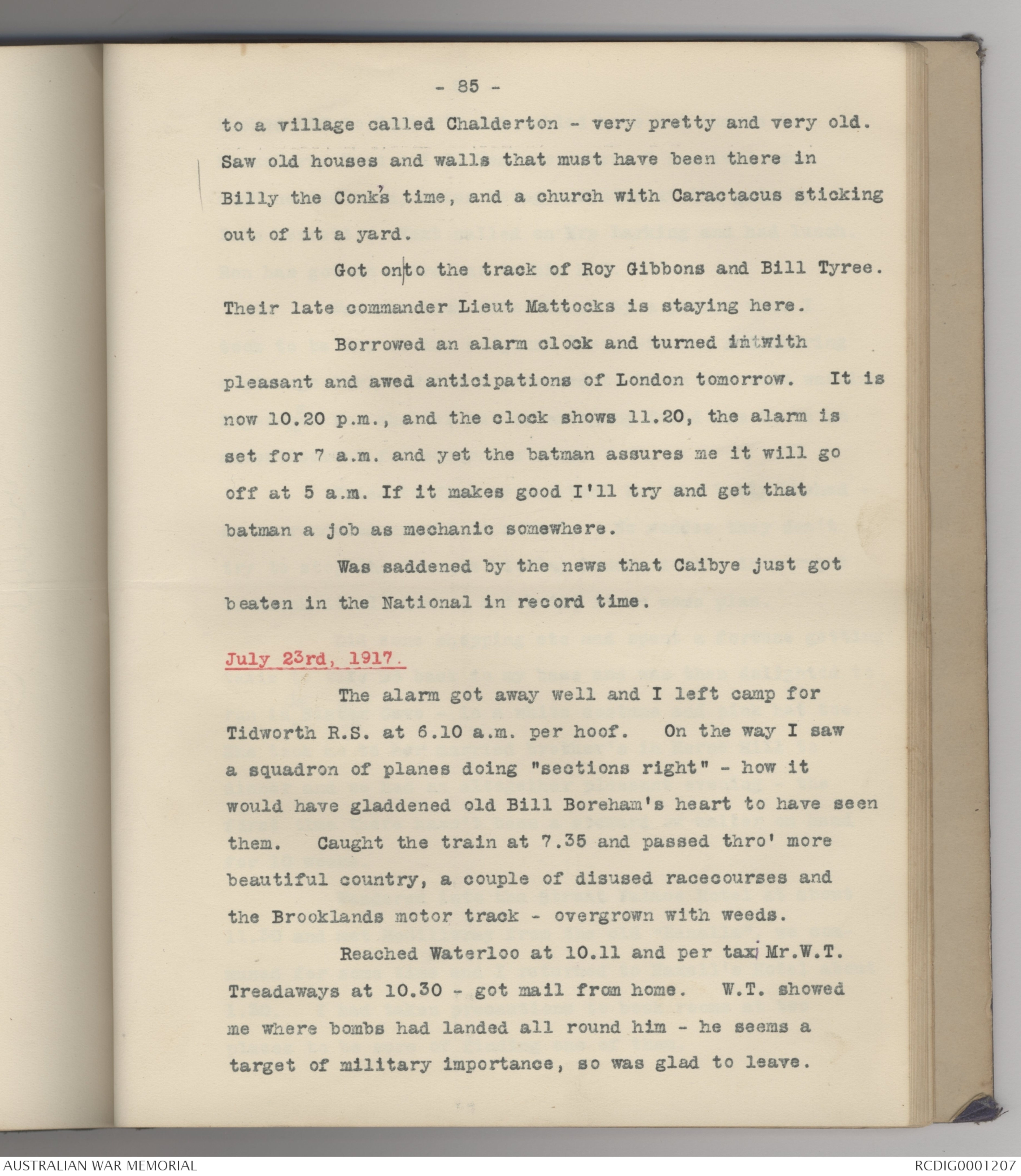
- 85 -
to a village called Chalderton - very pretty and very old.
Saw old houses and walls that must have been there in
Billy the Conk's time, and a church with Caractacus sticking
out of it a yard.
Got on to the track of Roy Gibbons and Bill Tyree.
Their late commander Lieut Mattocks is staying here.
Borrowed an alarm clock and turned in with
pleasant and awed anticipations of London tomorrow. It is
now 10.20 p.m., and the clock shows 11.20, the alarm is
set for 7 a.m., and yet the batman assures me it will go
off at 5 a.m. If it makes good I'll try and get that
batman a job as a mechanic somewhere.
Was saddened by the news that Caibye just got
beaten in the National in record time.
July 23rd, 1917.
The alarm got away well and I left camp for
Tidworth R.S. at 6.10 a.m. per hoof. On the way I saw
a squadron of planes doing "sections right" - how it
would have gladdened old Bill Boreham's heart to have seen
them. Caught the train at 7.35 and passed thro' more
beautiful country, a couple of disused racecourses and
the Brooklands motor track - overgrown with weeds.
Reached Waterloo at 10.11 and per taxi Mr. W.T.
Treadaways at 10.30 - got mail from home. W.T. showed
me where bombs had landed all round him - he seems a
target of military importance, so was glad to leave.
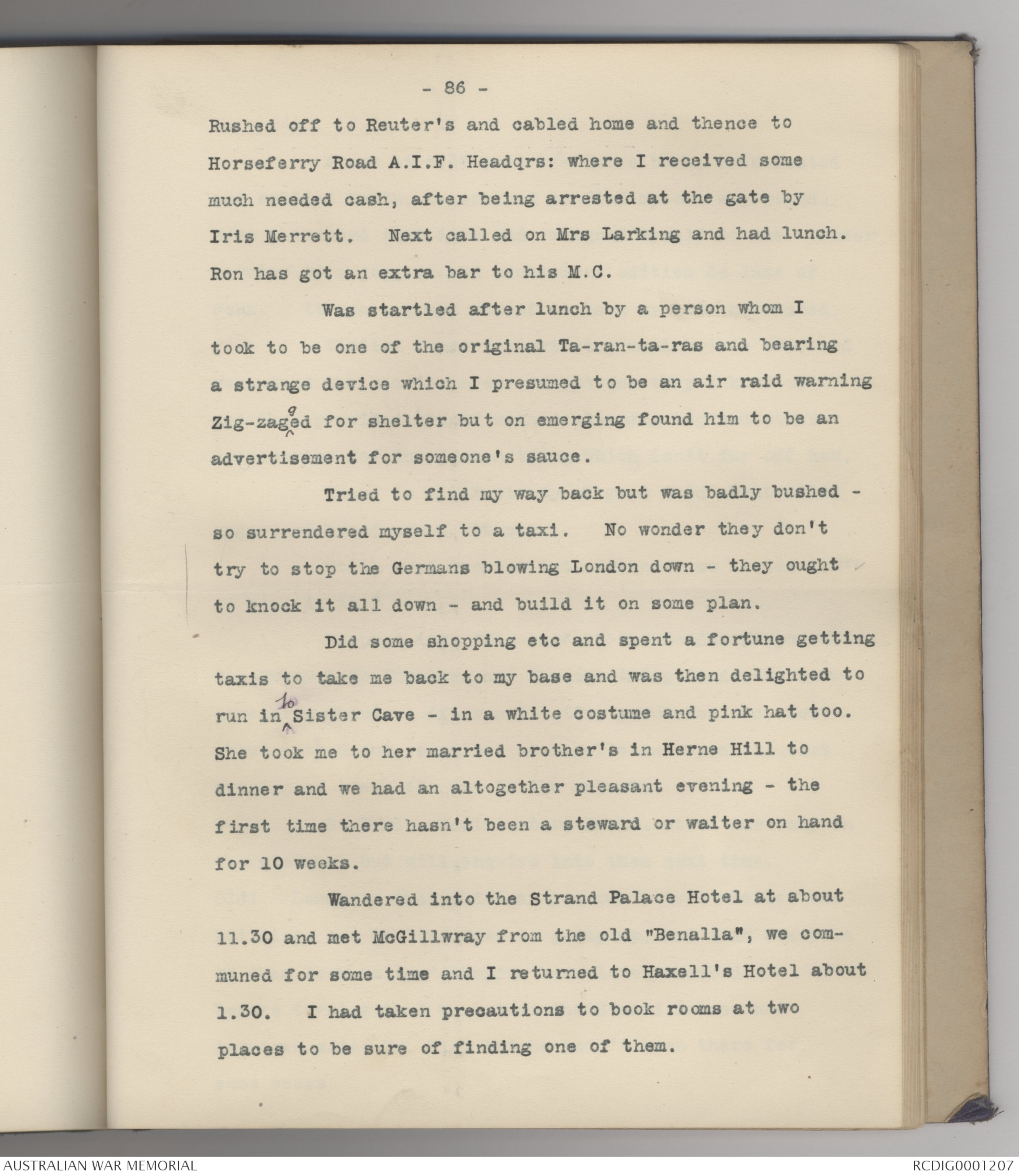
- 86 -
Rushed off to Reuter's and cabled home and thence to
Horseferry Road A.I.F. Headqrs: where I received some
much needed cash, after being arrested at the gate by
Iris Merrett. Next called on Mrs Larking and had lunch.
Ron has got an extra bar to his M.C.
Was startled after lunch by a person whom I
took to be one of the original Ta-ran-ta-ras and bearing
a strange device which I presumed to be an air raid warning
Zig-zag^ged for shelter but on emerging found him to be an
advertisement for someone's sauce.
Tried to find my way back but was badly bushed -
so surrendered myself to a taxi. No wonder they don't
try to stop the Germans blowing London down - they ought
to knock it all down - and build it on some plan.
Did some shopping etc and spent a fortune getting
taxis to take me back to my base and was then delighted to
run in ^to Sister Cave - in a white costume and pink hat too.
She took me to her married brother's in Herne Hill to
dinner and we had an altogether pleasant evening - the
first time there hasn't been a steward or waiter on hand
for 10 weeks.
Wandered into the Strand Palace Hotel at about
11.30 and met McGillwray from the old "Benalla", we communed
for some time and I returned to Haxell's Hotel about
1.30. I had taken precautions to book rooms at two
places to be sure of finding one of them.
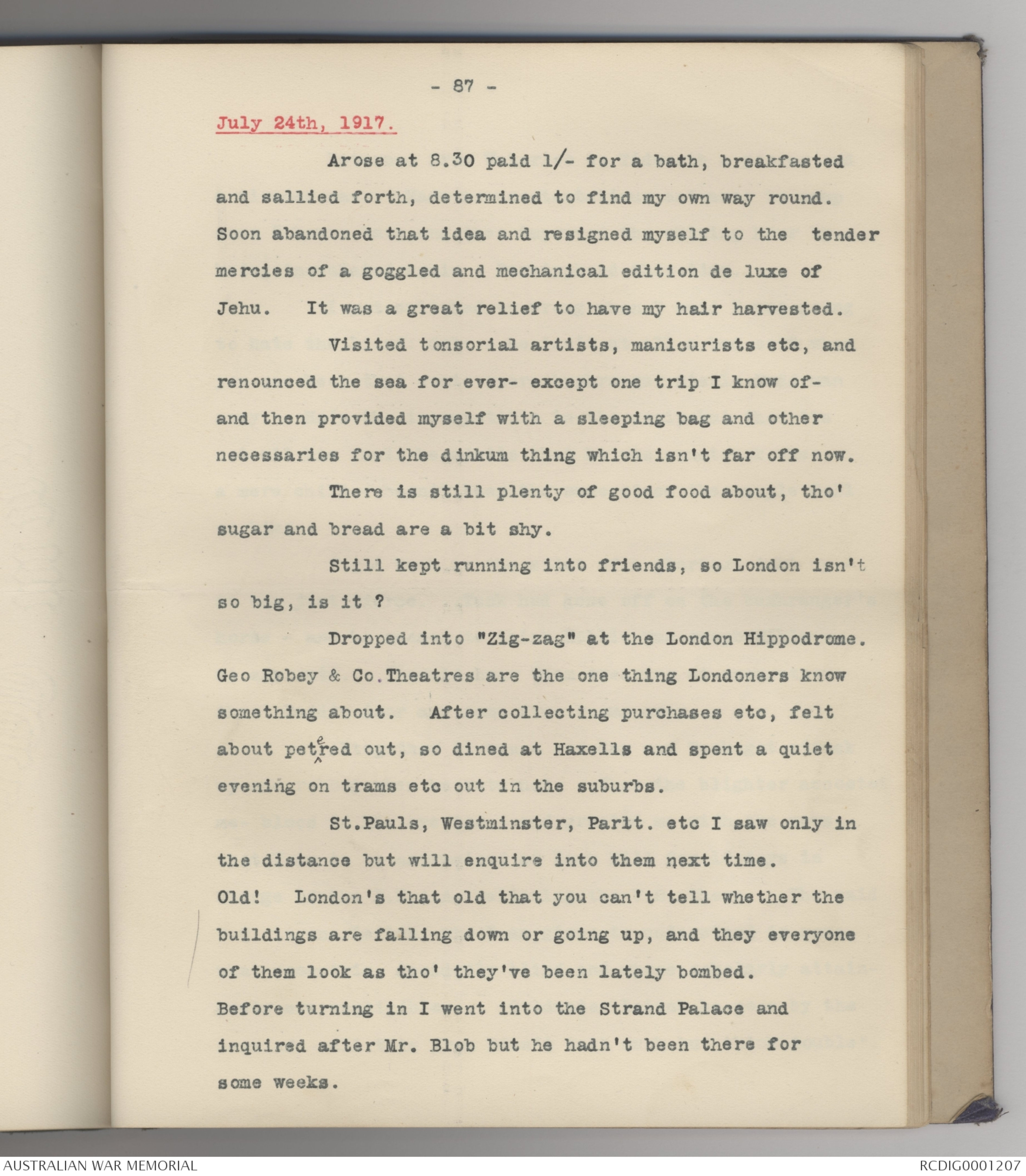
- 87 -
July 24th, 1917.
Arose at 8.30 paid 1/- for a bath, breakfasted
and sallied forth, determined to find my own way round.
Soon abandoned that idea and resigned myself to the tender
mercies of a goggled and mechanical edition de luxe of
Jehu. It was a great relief to have my hair harvested.
Visited tonsorial artists, manicurists etc, and
renounced the sea for ever - except one trip I know of -
and then provided myself with a sleeping bag and other
necessaries for the dinkum thing which isn't far off now.
There is still plenty of good food about, tho'
sugar and bread are a bit shy.
Still kept running into friends, so London isn't
so big, is it?
Dropped into "Zig-zag" at the London Hippodrome.
Geo Robey & Co. Theatres are the one thing Londoners know
something about. After collecting purchases etc, felt
about pet^ered out, so dined at Haxells and spent a quiet
evening on trams etc out in the suburbs.
St. Pauls, Westminster, Parlt. etc I saw only in
the distance but will enquire into them next time.
Old! London's that old that you can't tell whether the
buildings are falling down or going up, and they everyone
of them look as tho' they've been lately bombed.
Before turning in I went into the Strand Palace and
inquired after Mr. Blob but he hadn't been there for
some weeks.
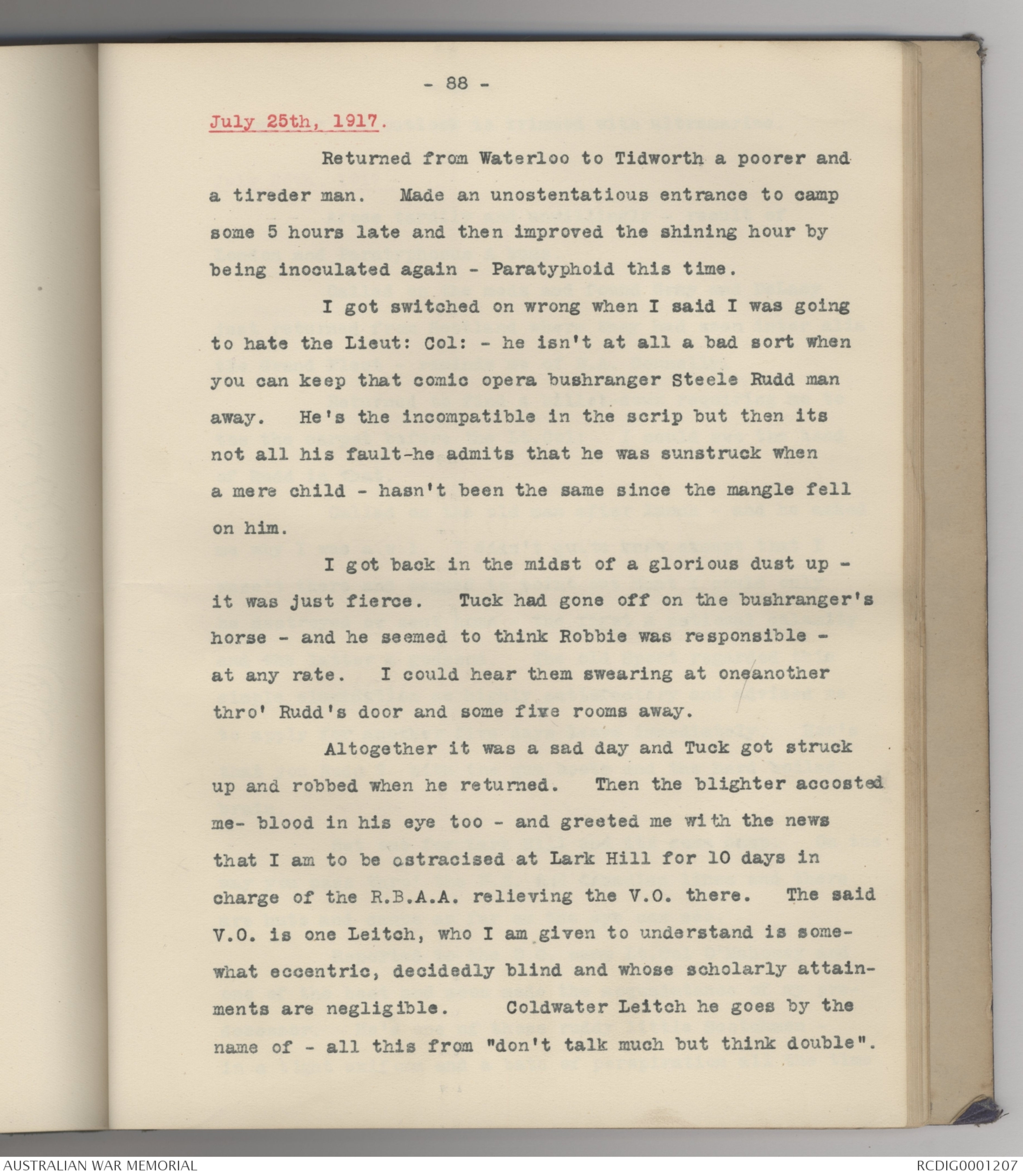
- 88 -
July 25th, 1917.
Returned from Waterloo to Tidworth a poorer and
a tireder man. Made an unostentatious entrance to camp
some 5 hours late and then improved the shining hour by
being inoculated again - Paratyphoid this time.
I got switched on wrong when I said I was going to
hate the Lieut: Col: - he isn't at all a bad sort when
you can keep that comic opera bushranger Steele Rudd man
away. He's the incompatible in the scrip but then its
not all his fault-he admits that he was sunstruck when
a mere child - hasn't been the same since the mangle fell
on him.
I got back in the midst of a glorious dust up -
it was just fierce. Tuck had gone off on the bushranger's
horse - and he seemed to think Robbie was responsible -
at any rate. I could hear them swearing at one another
thro' Rudd's door and some five rooms away.
Altogether it was a sad day and Tuck got struck
up and robbed when he returned. Then the blighter accosted
me- blood in his eye too - and greeted me with the news
that I am to be ostracised at Lark Hill for 10 days in
charge of the R.B.A.A. relieving the V.O. there. The said
V.O. is one Leitch, who I am given to understand is somewhat
eccentric, decidedly blind and whose scholarly attainments
are negligible. Coldwater Leitch he goes by the
name of - all this from "don't talk much but think double".
- 89 -
Altogether the outlook is trimmed with ultramarine.
July 26th, 1917.
Arose tardily and unwillingly - result of
London and Paratyphosus A bugs.
Called on the meds and found Gary and DeLacy
just returned from Scotland where they had seen inter alia
the Grand Fleet - reminds me of E.A. Connelly.
Returned to find a billet-doux requiring me to
toe the carpet before the Lt.Col: I could see the hand
of Rudd in that.
Called on the old man after lunch - and he asked
me why I was a.w.l. I didn't quite know except that I
wasn't there and begged to point out that I could only
be destroyed or sent home - the first a national calamity
and the latter a godsend. The old Sport regarded this
simple elucidation as highly satisfactory and advised me
to apply for another five days leave immediately. How's
that you Rudd? with the gum boots and the hard boiled
brain.
Set out for Lark Hill and its some camp. On the
way you pass thro' the N.Z. and Canadian lines and there
are huts and camps as far as the eye can see.
Reported to the O.C. camp Lt. Col O'Mahoney and
one of the best and soon made the acquaintance of my predecessor.
He's one of those ruddy little Scotchmen -
in a tight uniform and a bath of perspiration all the time
- 90 -
and I'd rather have a whole pond of him than one Rudd.
It took him 10 minutes to explain how simple everything is -
only about 800 horses, no drugs - no instruments - no men
no nothing but mange and sore heels etc, and then he buzzed
off with a large brown paper parcel under his arm and his
immense camera round his neck - for Scotland.
My sway extends over the R.B.A.A. here, the A.S.C
at Durrington and the A.S.C. at Rolestone. Business was
brisk and I was called at once to a case which I take to
be a fracture of the tuber-ischii.
Had dinner in the mess with about 50 other
officers - wrote some letters and turned in.
Coldwater is evidently a man of discriminating
habits and has comfy quarters and a good library which
I shall patronize largely.
July 27th, 1917.
It's good to have something to do for one's
living again and I ran thro' the horses this morn and
packed one or two off to the hospital.
This afternoon the Col. kindly placed one of his
horses at my disposal and I ran up to Rolestone and
Durrington. The said mount is a game showy little chestnut
and has all the generous eagerness which is a horse's
crowning glory and makes me regard him as God's kindest
gift to man.
You ought to see the groom tho' - one Micky
 Marisa Bortolotto
This transcription item is now locked to you for editing. To release the lock either Save your changes or Cancel.
This lock will be automatically released after 60 minutes of inactivity.