
Memoir of John Shakespear Bartley, 1916-1919 - Part 1
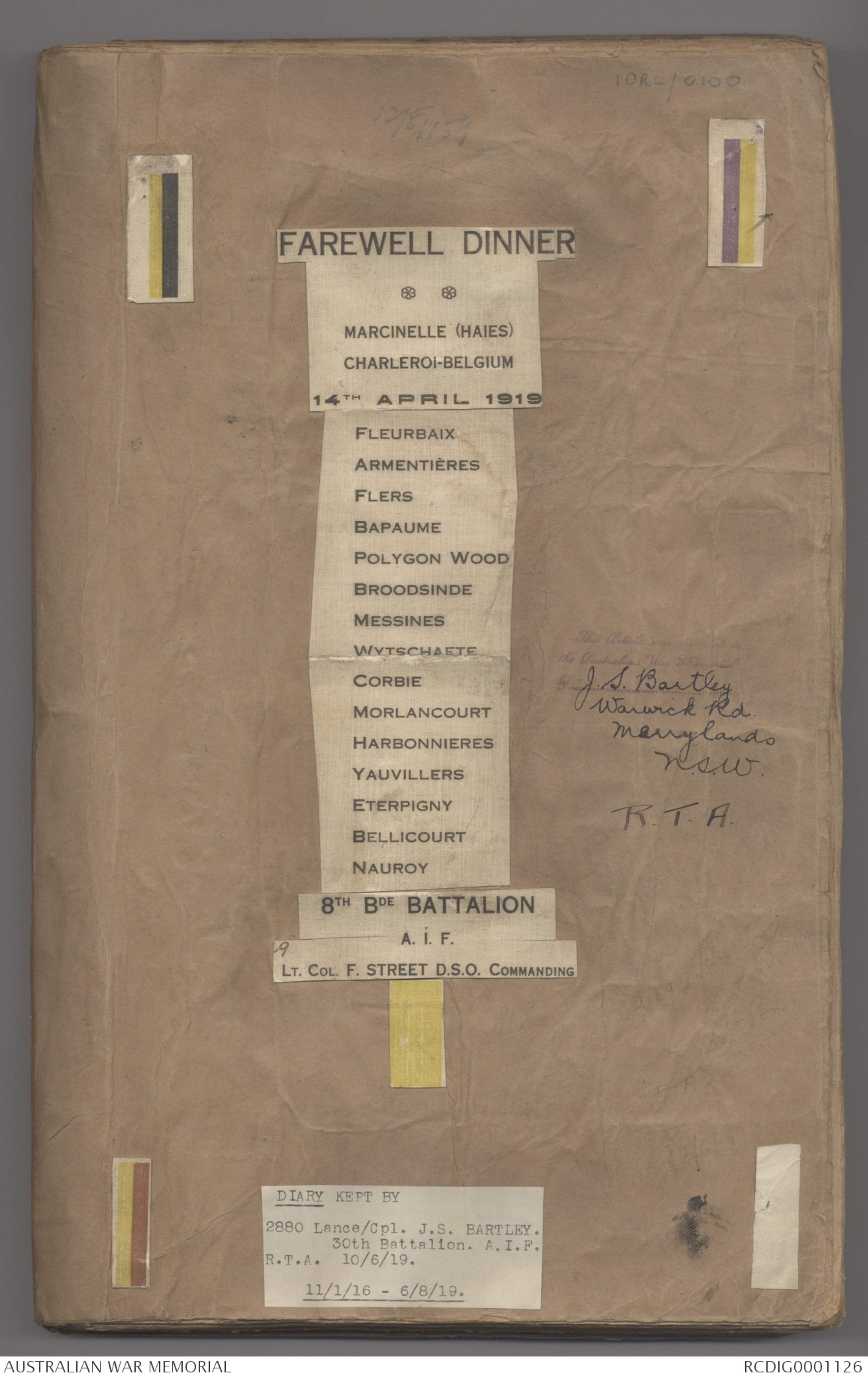
FAREWELL DINNER
MARCINELLE (HAIES)
CHARLEROI-BELGIUM
14TH APRIL 1919
FLEURBAIX
ARMENTIERES
FLERS
BAPAUME
POLYGON WOOD
BROODSINDE
MESSINES
WYTSCHAETE
CORBIE
MORLANCOURT
HARBONNIERES
Y AUVILLERS
ETERPIGNY
BELLICOURT
NAUROY
8TH BDE BATTALION
A.I.F.
9
LT. COL F. STREET D.S.O. COMMANDING
DIARY KEPT BY
2880 Lance/Cpl. J.S. BARTLEY
30th Battalion. A.I.F
R.T.A. 10/6/19.
11/1/16 - 6/8/19.
[*This Article was [[?]] to
the Australian War Memorial
by J.S. Bartley
Warwick Rd
Merrylands
N.S.W.
R.T.A.*]
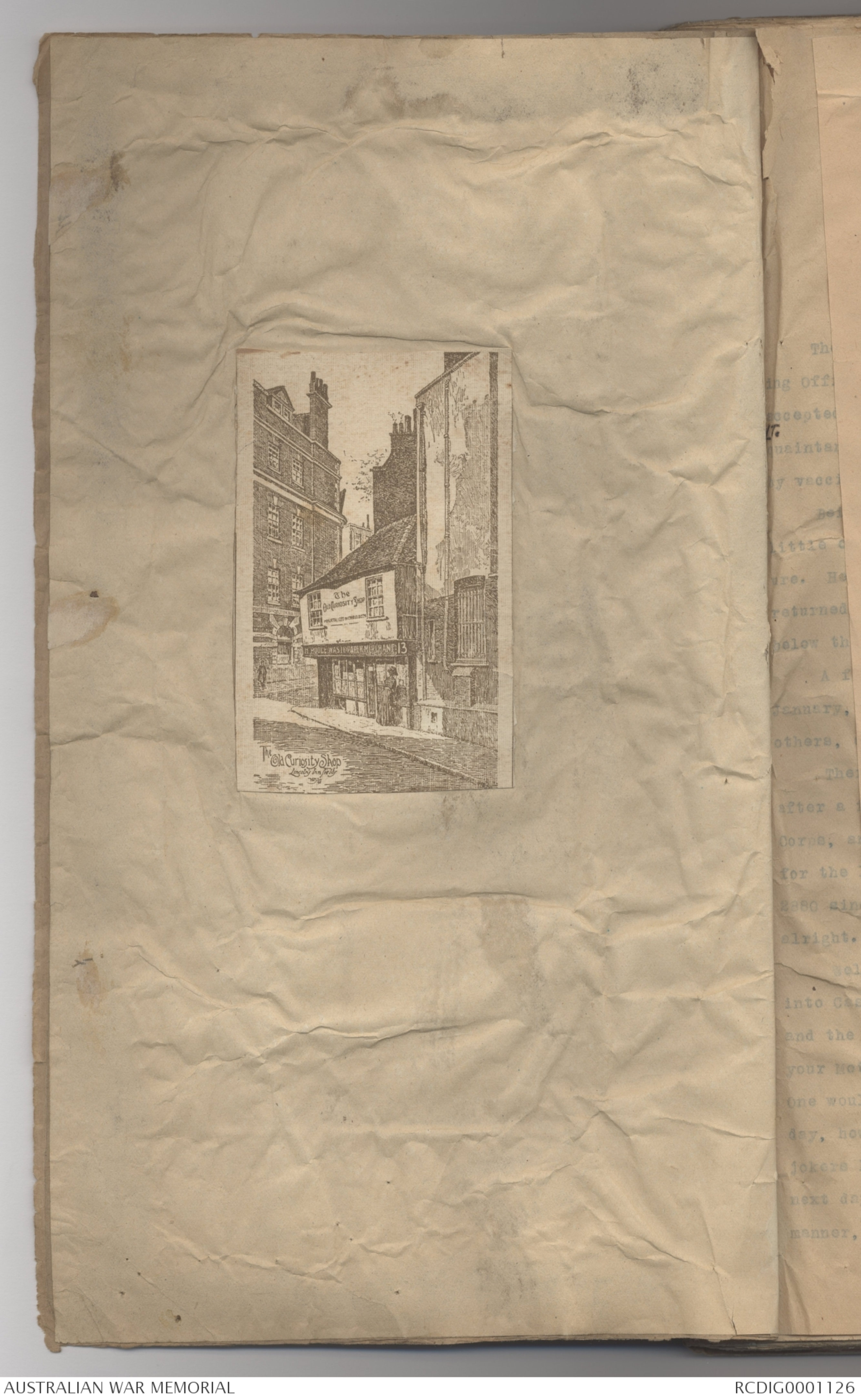
Drawing - see original document
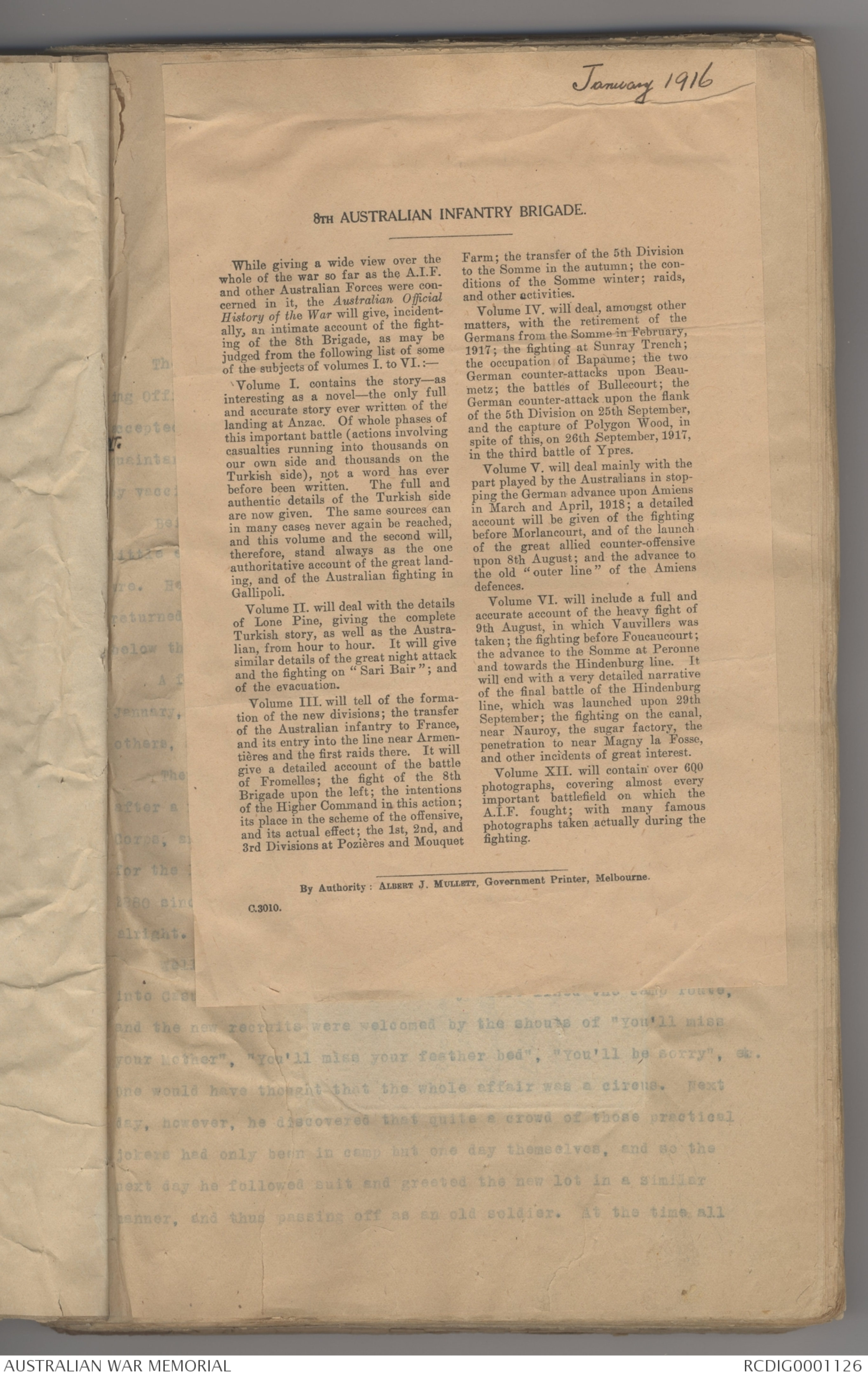
January 1916
8TH AUSTRALIAN INFANTRY BRIGADE.
______________________________
|
While giving a wide view over the whole of the war so far as the A.I.F and other Australian Forces were History of the War will give, incidentally, judged from the following list of some Volume I. contains the story—as interesting as a novel—the only full and accurate story ever written of the this important battle (actions involving our own side and thousands on the Turkish side), not a word has ever |
Farm; the transfer of the 5th Division |
By Authority: ALBERT J. MULLET, Government Printer, Melbourne
G3010.
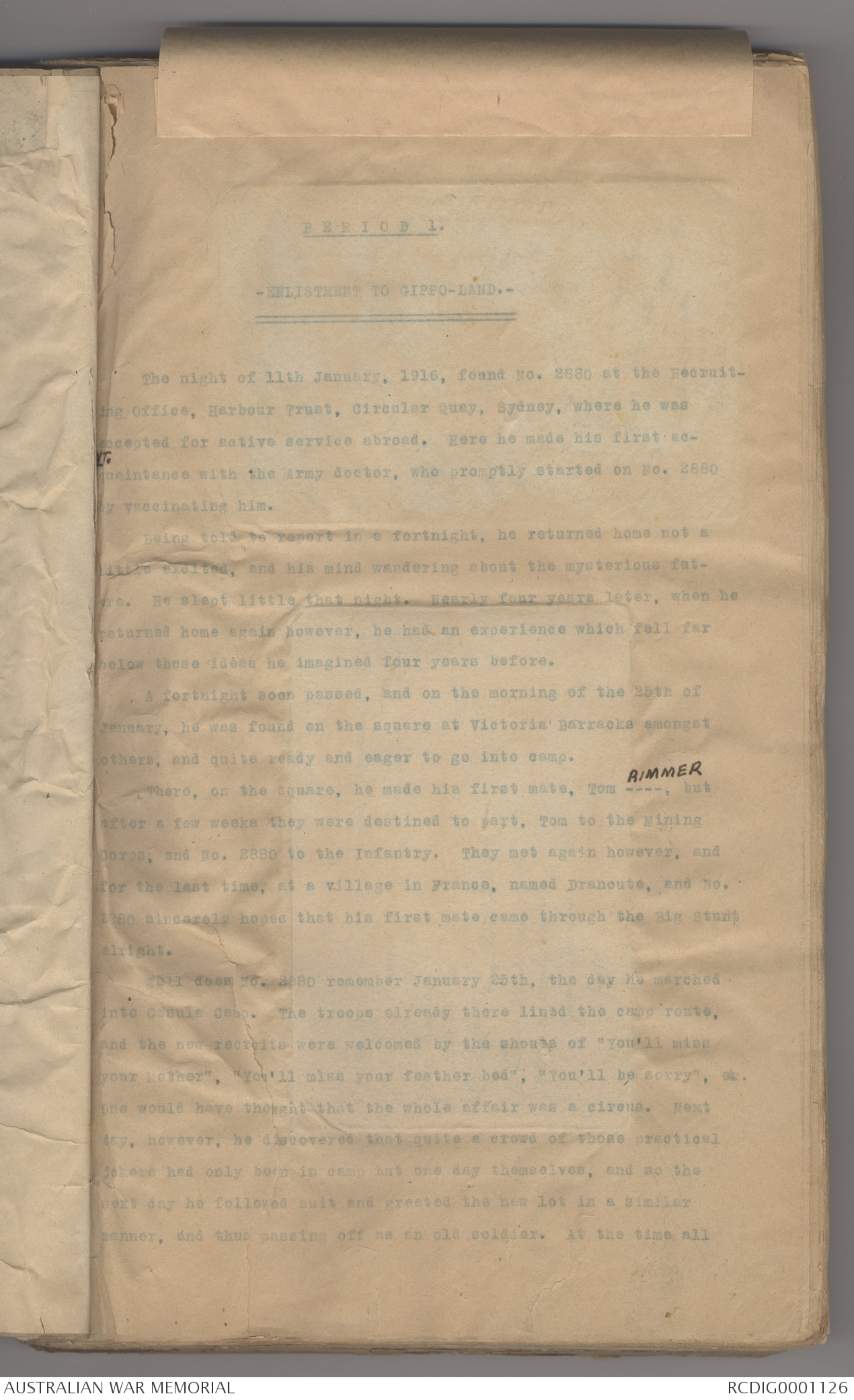
PERIOD 1.
ENLISTMENT TO GIPPO-LAND.-
=============================
The night of 11th January, 1916, found No. 2880 at the Recruiting
Office, Harbour Trust, Circular Quay, Sydney, where he was
accepted for active service abroad. Here he made his first acquaintance
[[*LT.*]]
with the Army doctor, who promptly started on No. 2880
by vaccinating him.
Being told to report in a fortnight, he returned home not a
little excited, and his mind wandering about the mysterious future.
He slept little that night. Nearly four years later, when he
returned home again however, he had an experience which fell far
below those ideas he imagined four years before.
A fortnight soon passed, and on the morning of the 25th of
January, he was found on the square at Victoria Barracks amongst
others, and quite ready and eager to go into camp.
There, on the square, he made his first mate, Tom AIMMER, but
after a few weeks they were destined to part. Tom to the Mining
Corps, and No. 2880 to the Infantry. They met again however, and
for the last time, at a village in France, named Dranoute, and No.
2880 sincerely hopes that his first mate came through the Big Stunt
alright.
Well does No. 2880 remember January 25th, the day he marched
into Casula Ca,p. The troops already there lined the camp route,
and the new recruits were welcomed by the shouts of "You'll miss
your Mother". "You'll miss your feather bed", "You'll be sorry", etc.
One would have thought that the whole affair was a circus. Next
day, however, he discovered that quite a crowd of those practical
jokers had only been in camp but one day themselves, and so the
next day he followed suit and greeted the new lot in a similar
manner, and thus passing off as an old soldier. At the time all
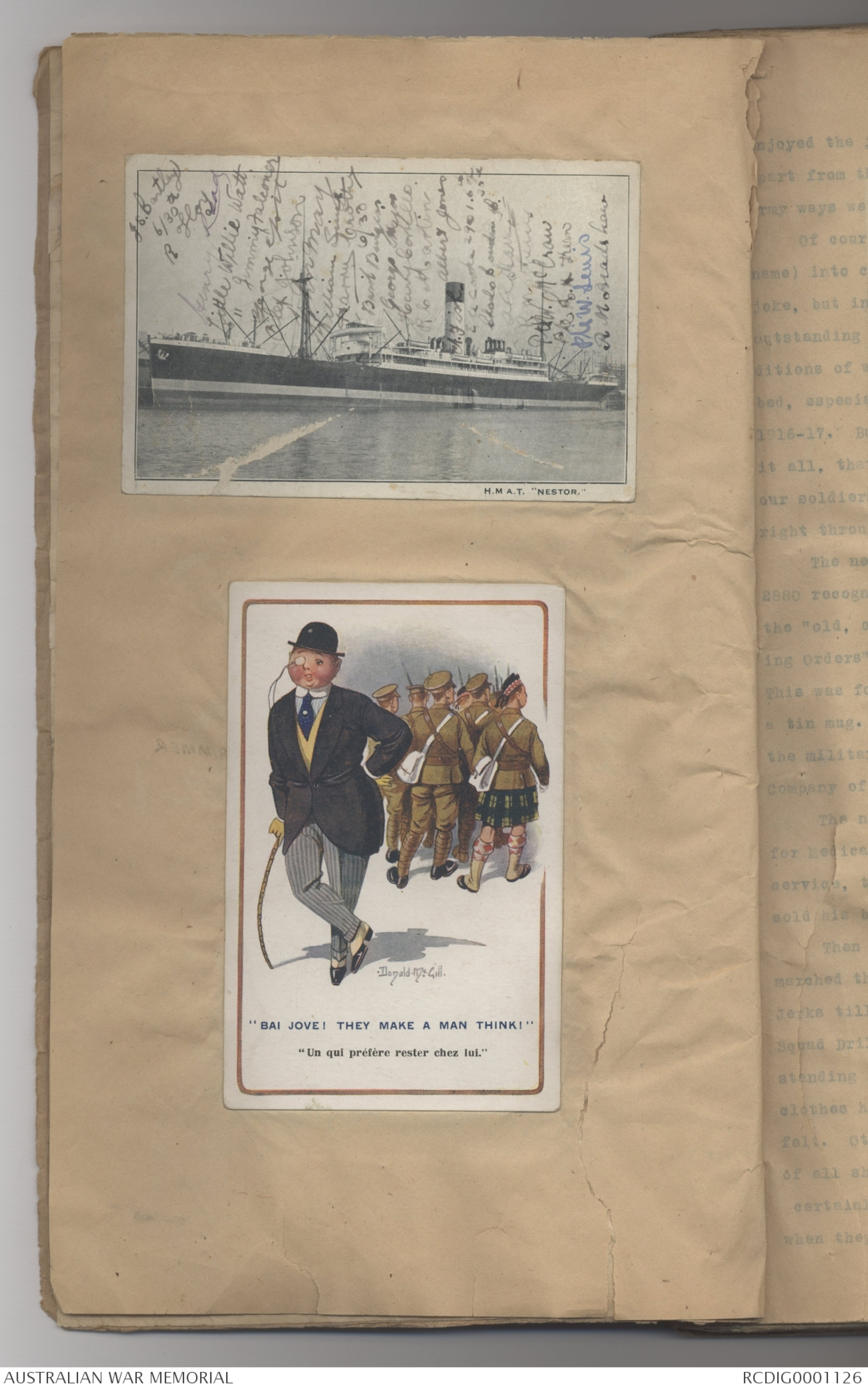
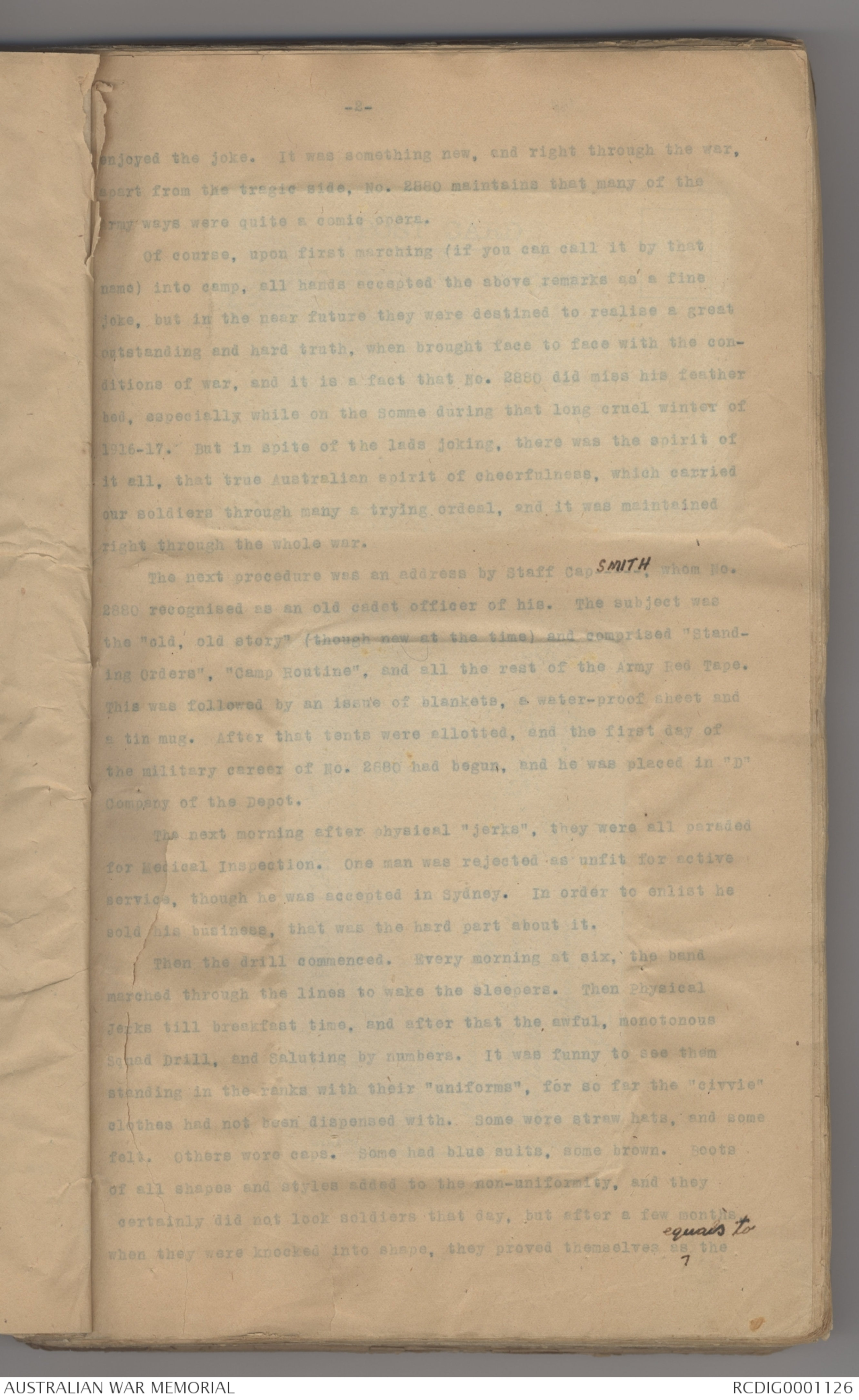
2 Pictures - see original document
Picture 1 H.M.A.T "NESTOR"
Picture 2 Donald McGill.
"BAI JOVE! THEY MAKE A MAN I THINK!'
"Un qui prėfėre rester chez lui."
-2-
enjoyed the joke. It was something new, and right through the war,
apart from the tragic side, No. 2880 maintains that many of the
army ways were quite a comic opera.
Of course, upon first marching (if you can call it by that
name) into camp, all hands accepted the above remarks as a fine
joke, but in the ear future they were destined to realise a great
outstanding and hard truth, when brought face to face with the
conditions of war, and it is a fact that No. 2880 did miss his feather
bed, especially while on the Somme during that long cruel winter
of 1916-1917. But in spite of the lads joking, there was the spirit of
it all, that true Australian spirit of cheerfulness, which carried
our soldiers through many a trying ordeal, and it was maintained
right through the whole war.
The next procedure was an address by Staff Cap SMITH, whom No.
2880 recognised as an old cadet officer of his. The subject was
the "old, old story" (though new at the time) and comprised "Standing
Orders". "Camp Routine", and all the rest of the Army Red Tape.
This was followed by an issue of blankets, a water-proof sheet and
a tin mug. After that tents were allotted, and the first day of
the military career of No. 2880 had begun, and he was placed in "D"
Company of the Depot.
The next morning after physical "jerks", they were all paraded
for Medical Inspection. One man was rejected as unfit for active
service, though he was accepted in Sydney. In order to enlist he
sold his business, that was the hard part about it.
Then the drill commenced. Every morning at six, the band
marched through the lines to wake the sleepers. Then Physical
Jerks till breakfast time, and after that the awful, monotonous
Squad Drill, and Saluting by numbers. It was funny to see them
standing in the ranks with their "uniforms", for so far the "civvie"
clothes had not been dispensed with. Some wore straw hats, and some
felt. Others wore caps. Some had blue suits, some brown. Boots
of all shapes and styles added to the non-uniformity, and they
certainly did not look soldiers that day, but after a few months
when they were knocked into shape, they proved themselves as ^equals to the
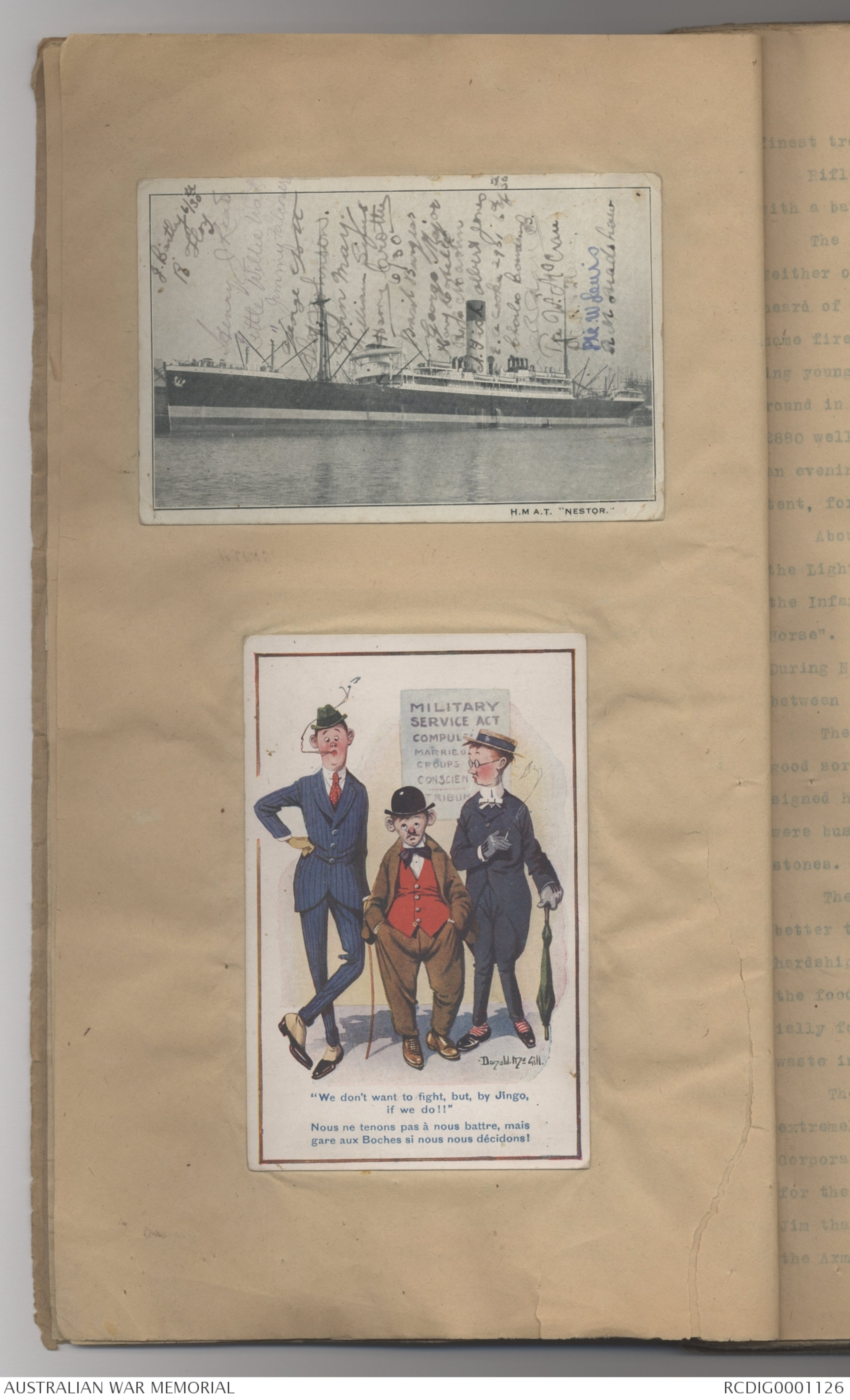
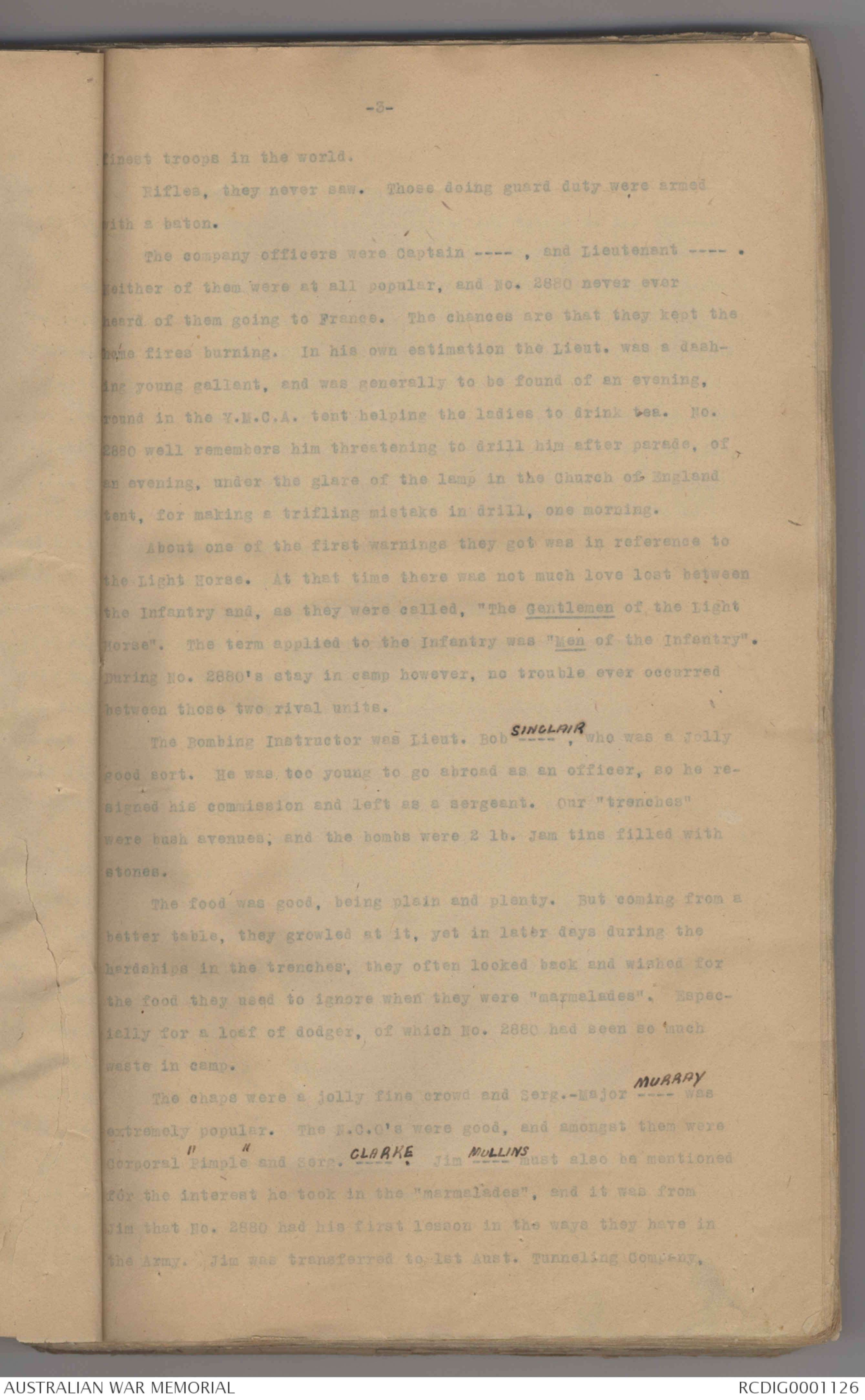
Two Pictures - see original document
Picture 1 H.M.A.T "NESTOR"
Picture 2 Donald McGill.
MILITARY
SERVICE ACT
COMPULS
MARRIED
GROUPS
CONSGIEN
TRIBUN
"We don't want to fight, but by Jingo,
if we do!!"
Nous ne tenons pas ă nous battre, mais
gare aux Boches si nous nous dėcidons!
-3-
finest troops in the world.
Rifles they never saw. Those doing guard duty were armed
with a baton.
The company officers were Captain ---- , and Lieutenant ---- .
Neither of them were at all popular, and No. 2880 never ever
herd of them going to France. The chances are that they kept the
home fires burning. In his own estimation the Lieut. was a dashing
young gallant and was generally to be found of an evening
around in the Y.M.C.A. tent helping the ladies to drink tea. No.
2880 well remembers him threatening to drill him after parade, of
an evening, under the glare of the lamp in the Church of England
tent, for making a trifling mistake in drill, one morning.
About one of the first warnings they got was in reference to
the Light Horse. At that time there was not much love lost between
the Infantry and, as they were called, “The Gentlemen of the Light
Horse”. The term applied to the Infantry was “Men of the Infantry”.
During No. 2880’s stay in camp however, no trouble ever occurred
between those two rival units.
The Bombing Instructor was Lieut. Bob SINCLAIR, who was a jolly
good sort. He was too young to go abroad as an officer, so he resigned
his commission and left as a sergeant. Our “trenches”
were bush avenues, and the bombs were 2 lb. Jam tins filled with
stones.
The food was good, being plain and plenty. But coming from a
better table, they growled at it, yet in later days during the
hardships of the trenches, they often looked back and wished for
the food they used to ignore when they were “marmalades”. Especially
for a loaf of dodger, of which No. 2880 had seen so much
waste in camp.
The chaps were a jolly fine crowd and Serg.-Major MURRAY was
extremely popular. The N.C.O’s were good, and amongst them were
Corporal “Pimple” and Serg. CLARKE. Jim MULLINS must also be mentioned
for the interest he took in the “marmalades”, and it was from
Jim that No. 2880 had his first lesson in the ways they have in
the Army, Jim was transferred to 1st Tunneling Company
-4-
and a long time afterward No. 2880 met him at Sandhill, near Warminster,
England.
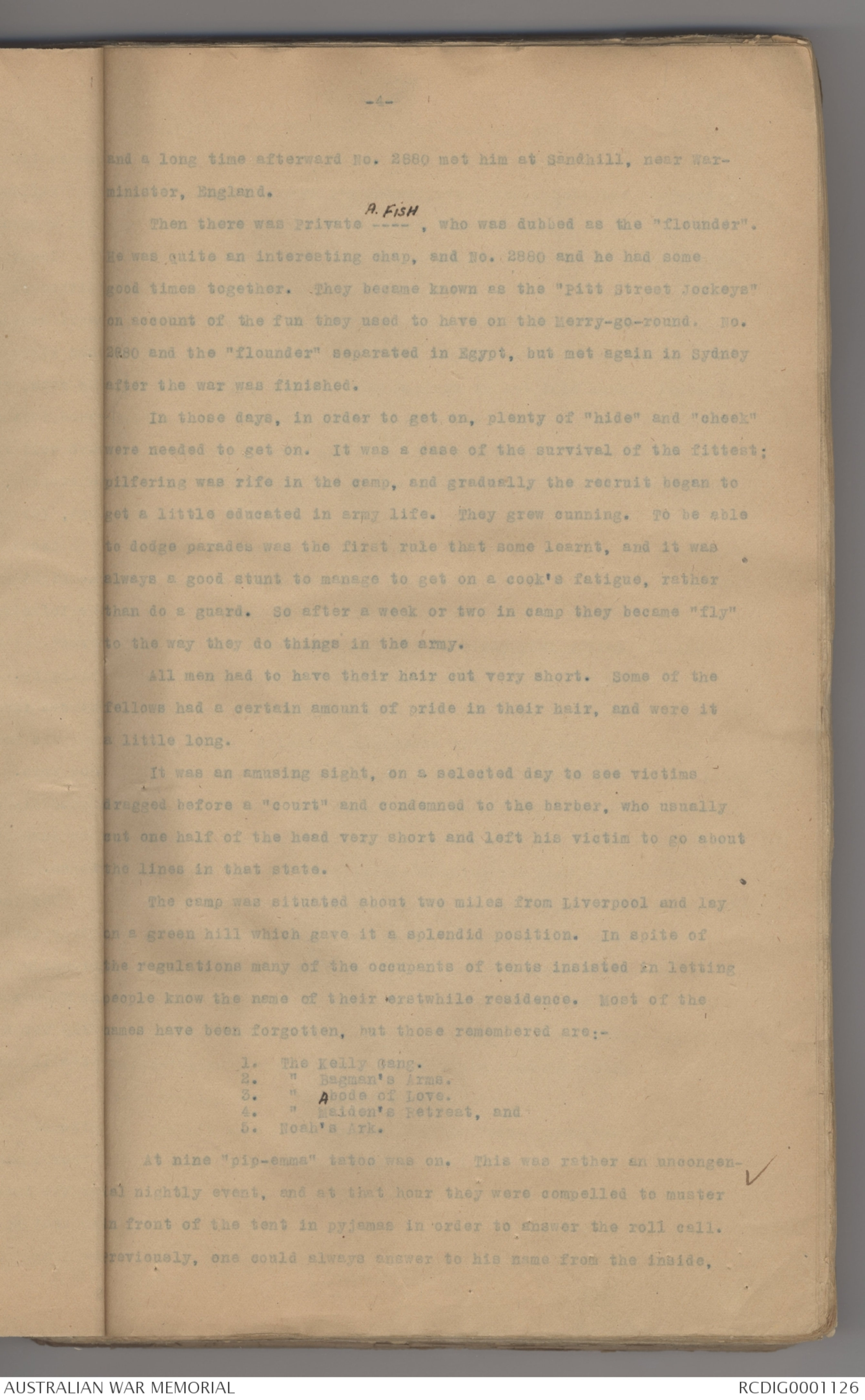
Then there was Private A FISH, who was dubbed the “flounder”.
He was quite an interesting chap, and No. 2880 and he had some
good times together. They became known as the “Pitt Street Jockeys”
on account of fun they used to have on the Merry-go-round. No.
2880 and the “flounder” separated in Egypt, but met again in Sydney
after the was finished.
In those days, in order to get on, plenty of “hide” and “cheek”
were needed to get on. It was a case of the survival of the fittest
pilfering was rife in the camp, and gradually the recruit began to
get a little educated in army life. They grew cunning. To be able
to dodge parades was the first rule that some learnt, and it was
always a good stunt to manage to get on a cook’s fatigue, rather
than do a guard. So after a week or two in camp they became “fly
to the way they do things in the army.
All men had to have their hair cut very short. Some of the
fellows had a certain amount of pride in their hair, and wore it
a little long.
It was an amusing sight, on a selected day to see victims
dragged before a ”court” and condemned to the barber, who usually
cut one half of the head very short and left his victim to go about
the lines in that state.
The camp was situated about two miles from Liverpool and lay
on a green hill which gave it a splendid position. In spite of
the regulations many of the occupants of tents insisted on letting
people know the name of their erstwhile residence. Most of the
names have been forgotten, but those remembered are:-
1. The Kelly Gang,
2. “ Bagman’s Arms,
3. “ Abode of Love,
4. “ Maiden’s Retreat, and
5. Noah’s Ark.
At nine “pip-emma” tatoo was on. This was rather an uncongenial
[*√*]
nightly event, and at that hour they were compelled to muster
in front of the tent in pyjamas in order to answer the roll call.
Previously. One could always answer to his name from the inside,
-5-
but fellows used to answer for one another, and at times they would
rig up a dummy man who slept in the place where the absent man
usually occupied” “That’s Brown”, they would tell the sergeant,
don’t wake him up, as he has just come off guard”. But the joke
didn’t always come off, and the absent one sometimes found himself
warned for Orderly Room next day.
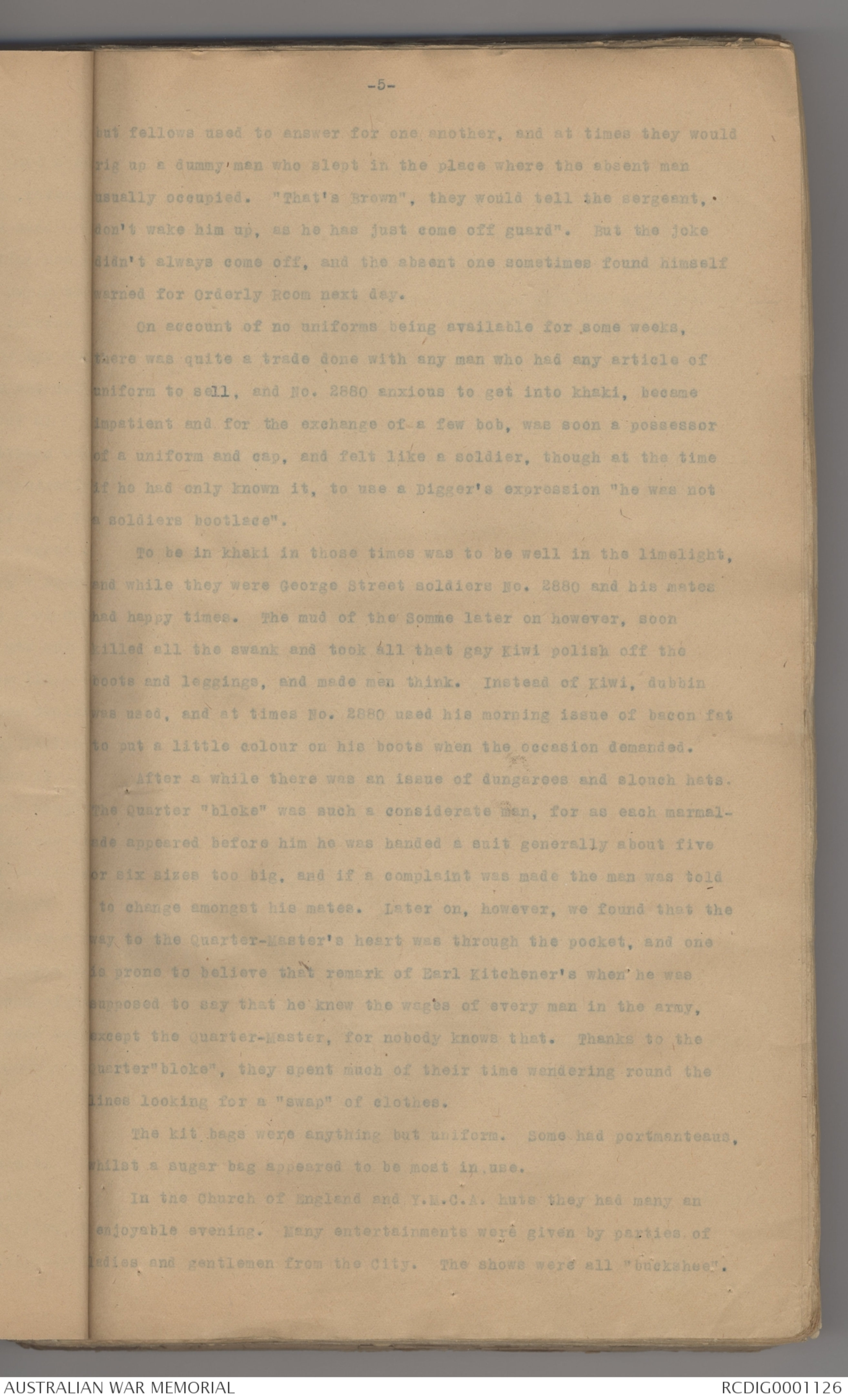
On account of no uniforms being available for some weeks,
there was quite a trade done with any man who had any article of
uniform to sell, and No. 2880 anxious to get into khaki, became
impatient and for the exchange of a few bob, was soon a possessor
of a uniform and cap, and felt like a soldier, though at the time
if he had only known it, to use a Digger’s expression “he was not
a soldiers bootlace”.
To be in khaki in those times was to be well in the limelight,
and while they were George Street soldiers No. 2880 and his mates
had happy times. The mud of the Somme later on however, soon
killed all the swank and took all that gay Kiwi polish off the
boots and leggings, and made men think. Instead of Kiwi, dubbin
was used, and at times No. 2880 used his morning issue of bacon fat
to put a little colour on his boots when the occasion demanded.
After a while there was an issue of dungarees and slouch hates.
The Quarter “bloke” was such a considerate man, for as each marmalade
appeared before him he was handed a suit generally about five
or six sizes too big, and if a complaint was made the man was told
to change amongst his mates. Later on, however, we found that the
way to the Quarter-Master’s heart was through his pocket, and one
is prone to believe that remark of Earl Kitchener’s when he was
supposed to say that he knew the wages of every man in the army,
except the Quarter-Master, for nobody knows that. Thanks to the
Quarter”bloke”, they spent much of their time wandering round the
lines looking for a “swap” of clothes.
The kit bag was anything but uniform. Some had portmanteaus,
whilst a sugar bag appeared to be most in use.
In the Church of England and Y.M.C.A. huts they had many an
enjoyable evening. Many entertainments were given by parties of
ladies and gentlemen from the City. The shows were all “buckshee”.
 D Coates
This transcription item is now locked to you for editing. To release the lock either Save your changes or Cancel.
This lock will be automatically released after 60 minutes of inactivity.