
Notebook 2 of Vivian Agincourt Spence Little, 1914- Part 3
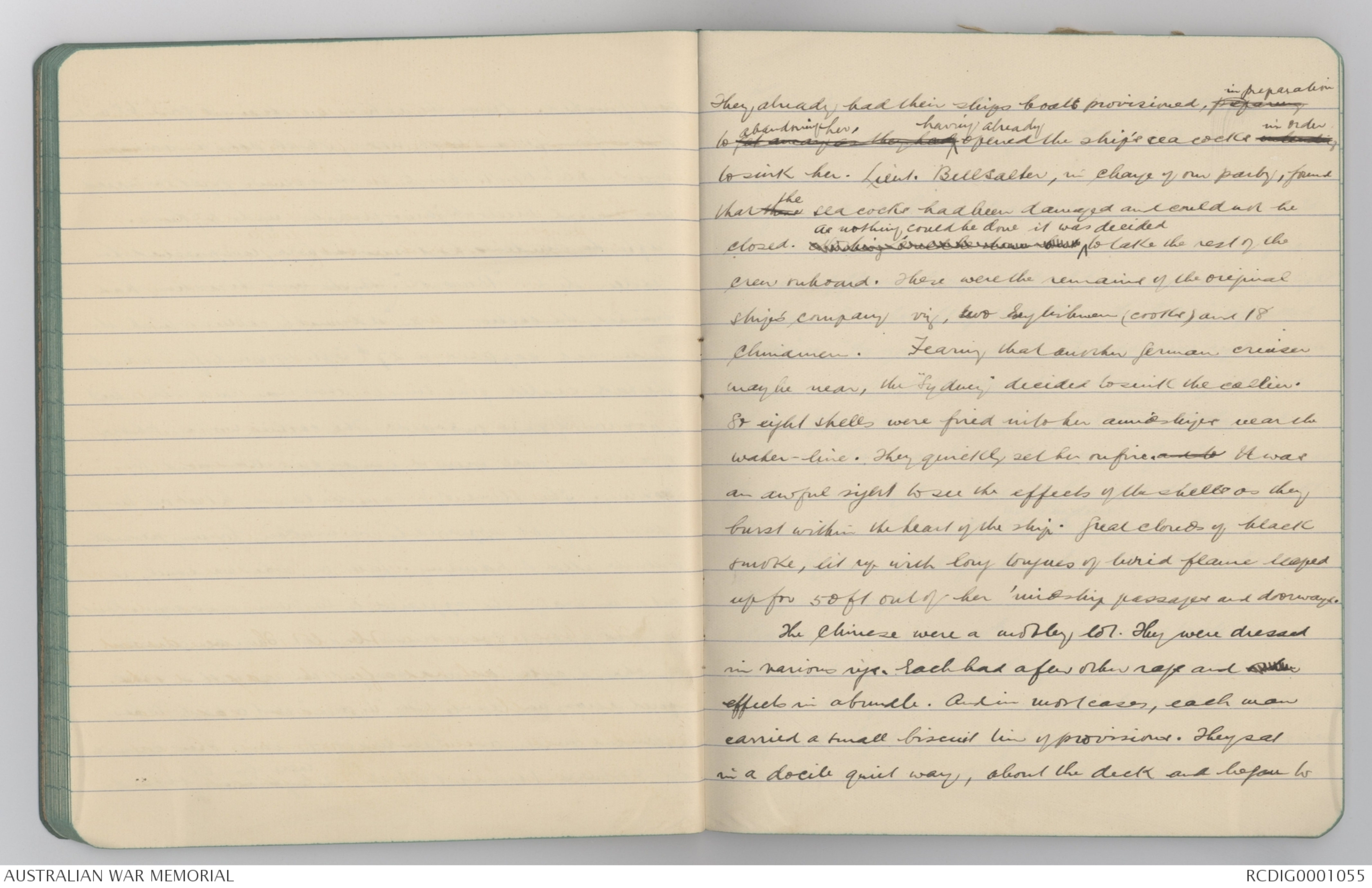
They already had their ships boats provisioned, preparing in preparation
to get away as they had abandoning her, ^having already opened the ship's sea cocks intending in order
to sink her. Lieut. Bill Salter, in charge of our party, found
that there the sea cocks had been damaged and could not be
closed. Nothing could be done about As nothing could be done it was decided to take the rest of the
crew onboard. Those were the remains of the original
ship's company viz, two Englishmen (cooks) and 18
Chinamen. Fearing that another German cruiser
may be near, the "Sydney" decided to sink the collier.
So eight shells were fired into her amidships near the
water-line. They quickly set her on fire. and to It was
an awful sight to see the effects of the shells as they
burst within the heart of the ship. Great clouds of black
smoke, lit up with long tongues of lurid flame leaped
up for 50 ft out of her 'midship passages and doorways.
The Chinese were a motley lot. They were dressed
in various rigs. Each had a few other rags and xxx
effects in a bundle. And in most cases, each man
carried a small biscuit tin of provisions. They sat
in a docile quiet way, about the deck and began to
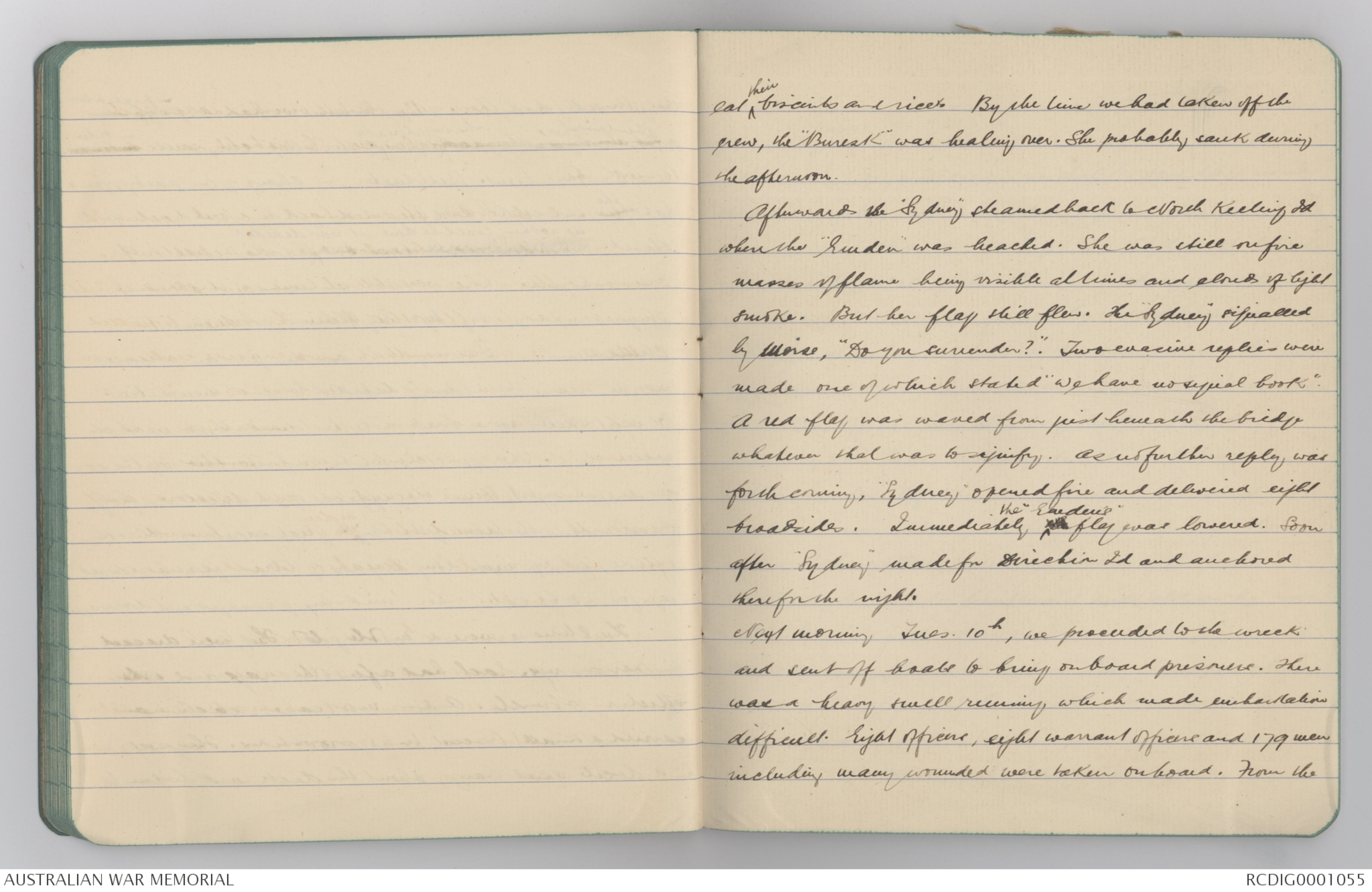
eat ^their biscuits and rice. By the time we had taken off the
crew, the "Bursek" was healing over. She probably sank during
the afternoon.
Afterwards the "Sydney" steamed back to North Keeling Id
where the "Emden" was beached. She was still on fire
masses of flame being visible at times and clouds of light
smoke. But her flag still flew. The "Sydney" signalled
by Morse, "Do you surrender?" Two evasive replies were
made one of which stated "We have no signal book".
A red flag was waved from just beneath the bridge
whatever that was to signify. A no further reply was
forthcoming, "Sydney" opened fire and delivered eight
broadsides. Immediately her the "Emden's" flag was lowered. Soon
after "Sydney" made for Direction Id and anchored
there for the night.
Next morning Tues. 10th, we proceeded to the wreck
and sent off boats to bring on board prisoners. There
was a heavy swell running which made embarkation
difficult. Eight officers, eight warrant officers and 179 men
including many wounded were taken onboard. From the
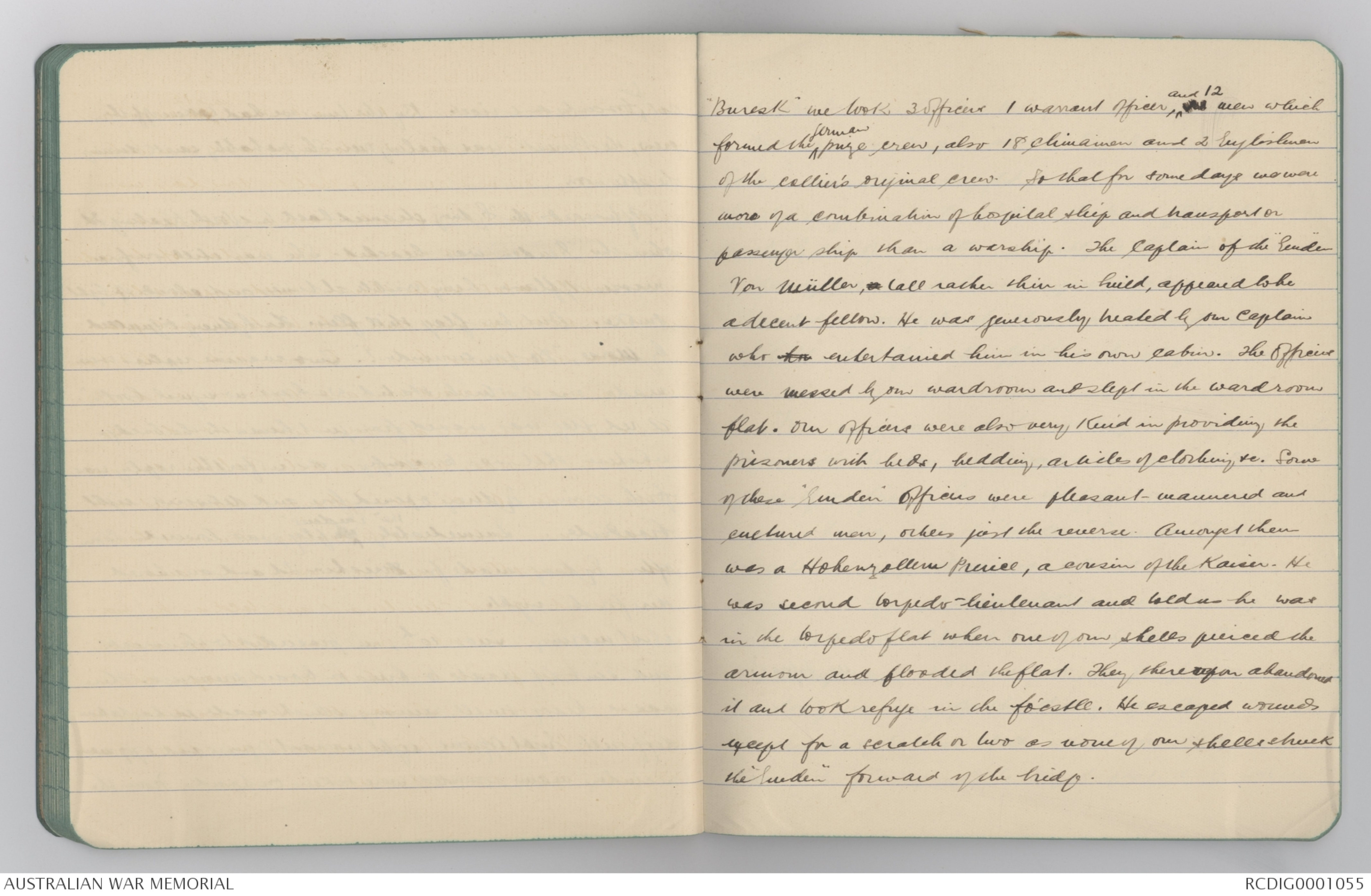
"Buresk" we took 3 officers 1 warrant officer, ^and 12 12 men which
formed the ^German prize crew, also 18 Chinamen and 2 Englishmen
of the collier's original crew. So that for some days we were
more of a combination of hospital ship and transport or
passenger ship than a warship. The Captain of the "Emden"
Von Müller, a tall rather thin in build, appeared to be
a decent fellow. He was generously healed by our captain
who xx entertained him in his own cabin. The officers
were messed by our wardroom and slept in the wardroom
flat. Our officers were also very kind in providing the
prisoners with beds, bedding, articles of clothing &c. Some
of these "Emden" officers were pleasant-mannered and
cultured men, others just the reverse. Amongst them
was a Hohenzollern Prince, a cousin of the Kaiser. He
was second torpedo-lieutenant and told us he was
in the torpedo flat when one of our shells pierced the
armour and flooded the flat. They therefore abandoned
it and took refuge in the fo'cstle. He escaped wounds
except for a scratch or two as none of our shells struck
the "Emden" forward of the bridge.
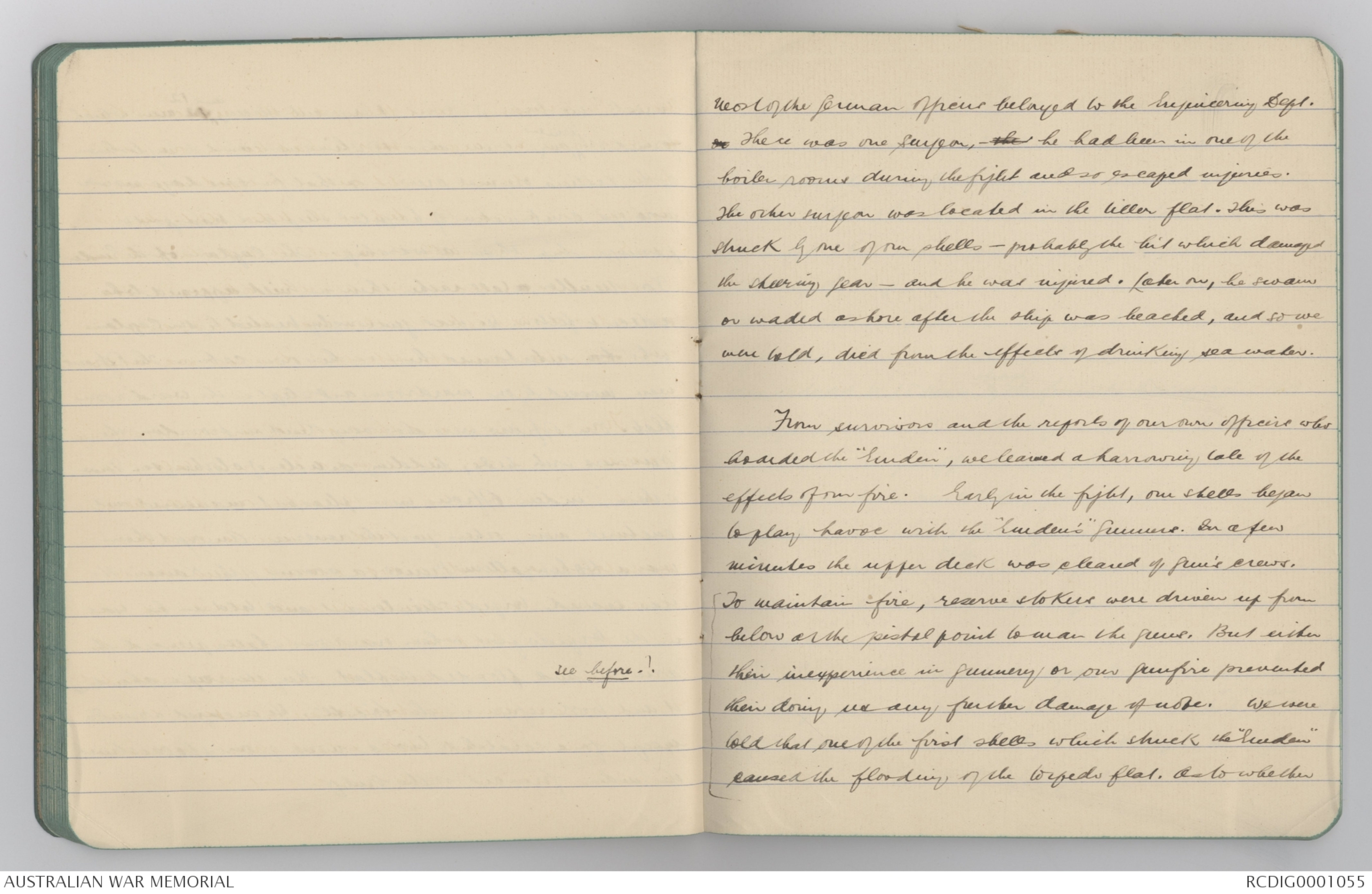
Most of the German officers belonged to the Engineering Dept.
on There was one surgeon, the he had been in one of the
boiler rooms during the fight and so escaped injuries.
The other surgeon was located in the tiller flat. This was
struck by one of our shells - probably the hit which damaged
the steering gear - and he was injured. Later on, he swam
or waded ashore after the ship was beached, and so we
were told, died from the effects of drinking sea water.
From survivors and the reports of our own officers who
boarded the "Emden", we learned a harrowing tale of the
effects of our fire. Early in the fight, our shells began
to play havoc with the "Emden's" Gunners. In a few
minutes the upper deck was cleared of gun's crews.
[To maintain fire, reserve stokers were driven up from
[below at the pistol point to man the guns. But either
[* see before.! *] [their inexperience in gunnery or our gunfire prevented
[their doing us any further damage of note. We were
[told that one of the first shells which struck the "Emden"
[caused the flooding of the torpedo flat. As to whether
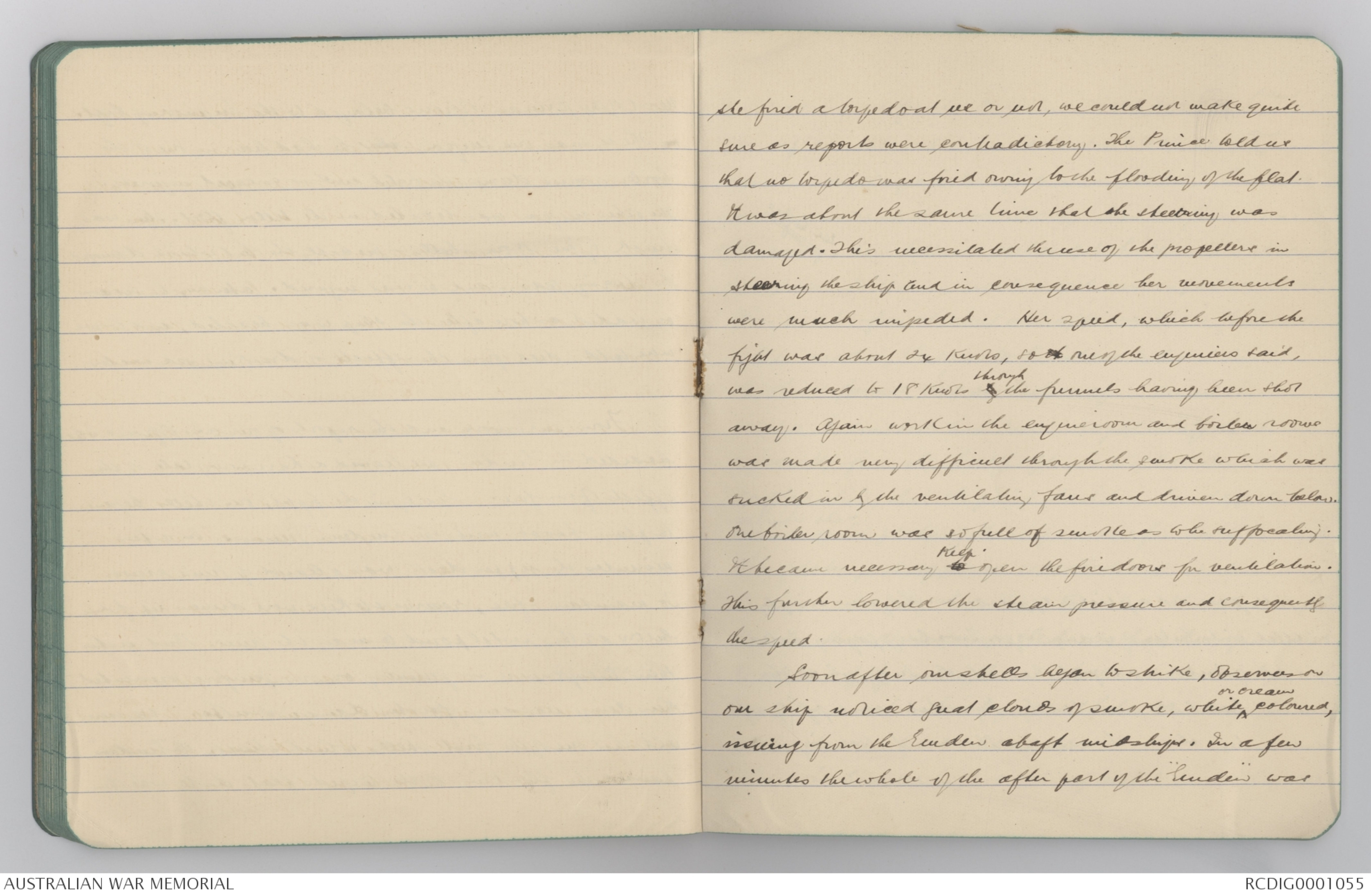
she fired a torpedo at us or not, we could not make quite
sure as reports were contradictory. The Prince told us
that no torpedo was fired owing to the flooding of the flat.
It was about the same time that the steering was
damaged. This necessitated the use of the propellers in
steering the ship and in consequence her movements
were much impeded. Her speed, which before the
fight was about 24 Knots, so it one of the engineers said,
was reduced to 18 Knots by through the funnels having been shot
away. Again work in the engine room and boiler rooms
was made very difficult through the smoke which was
sucked in by the ventilating fans and driven down below.
One boiler room was so full of smoke as to be suffocating.
It became necessary to keep open the fire doors for ventilation.
This further lowered the steam pressure and consequently
the speed.
Soon after our shells began to strike, observers on
our ship noticed great clouds of smoke, white ^or cream coloured,
issuing from the Emden abaft midships. In a few
minutes the whole of the after part of the "Emden" was
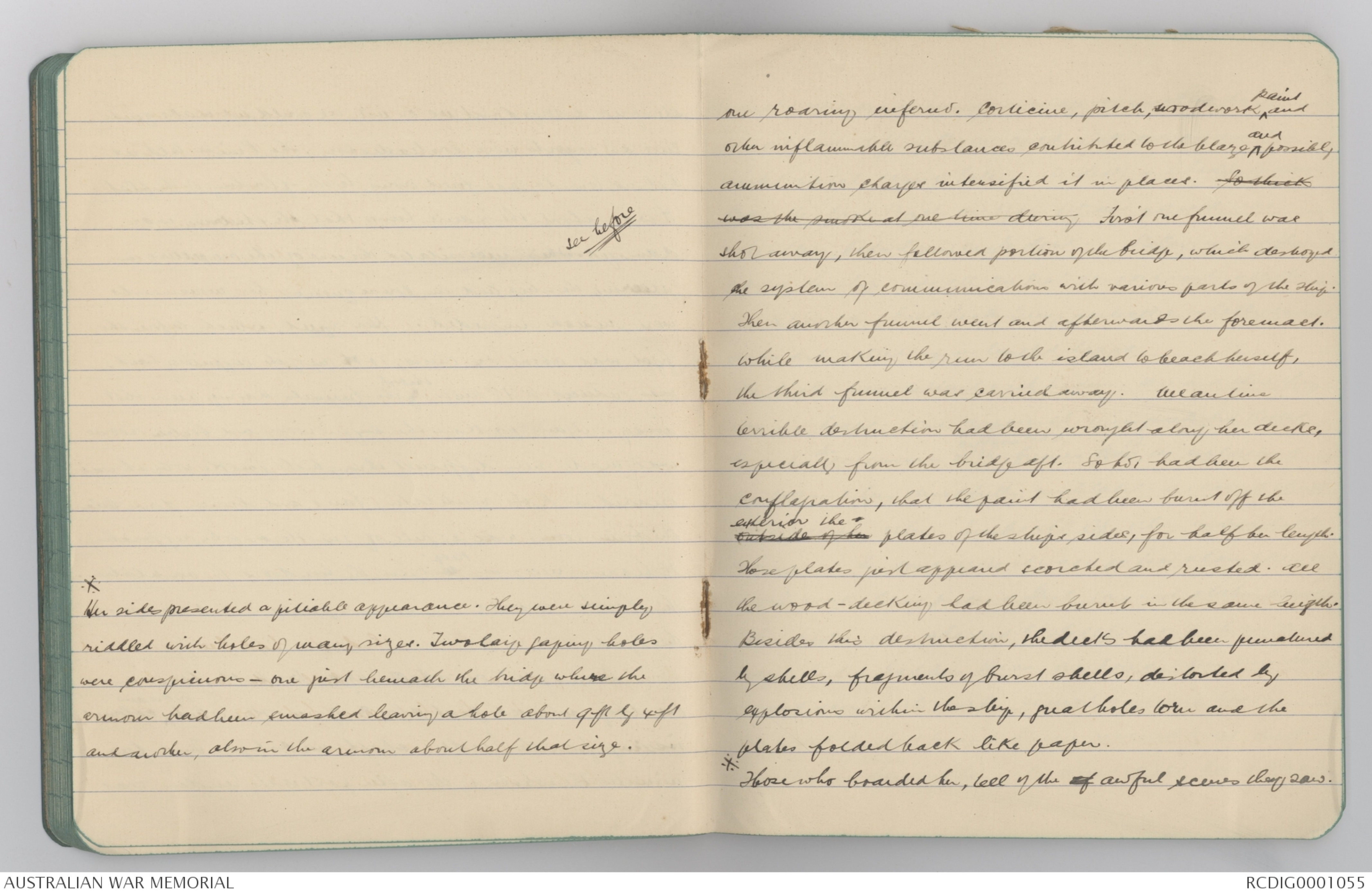
one roaring inferno. Corticine, pitch, woodwork ^paint and
other inflammable substances contributed to the blaze ^and possibly
ammunition charges intensified it in places. So thick
[*see before*] was the smoke at one time during First one funnel was
shot away, then followed portion of the bridge, which destroyed
the system of communication with various parts of the ship.
Then another funnel went and afterwards the foremast.
While making the run to the island to beach herself,
the third funnel was carried away. Meantime
terrible destruction had been wrought along her decks,
especially from the bridge aft. So hot had been the
conflagration, that the paint had been burnt off the
outside of her exterior the plates of the ships sides, for half her length.
Those plates just appeared scorched and rusted. All
the wood-decking had been burnt in the same length.
Besides this destruction, the decks had been punctured
by shells, fragments of burst shells, distorted by
explosions within the ship, great holes torn and the
plates folded back like paper.
※Those who boarded her, tell of the af awful scars they saw.
[*※Her sides presented a pitiable appearance. They were simply
riddled with holes of many sizes. Two huge gaping holes
were conspicuous - one just beneath the bridge where the
armour had been smashed leaving a hole about 9ft by 4ft
and another, also in the armour about half that size.*]
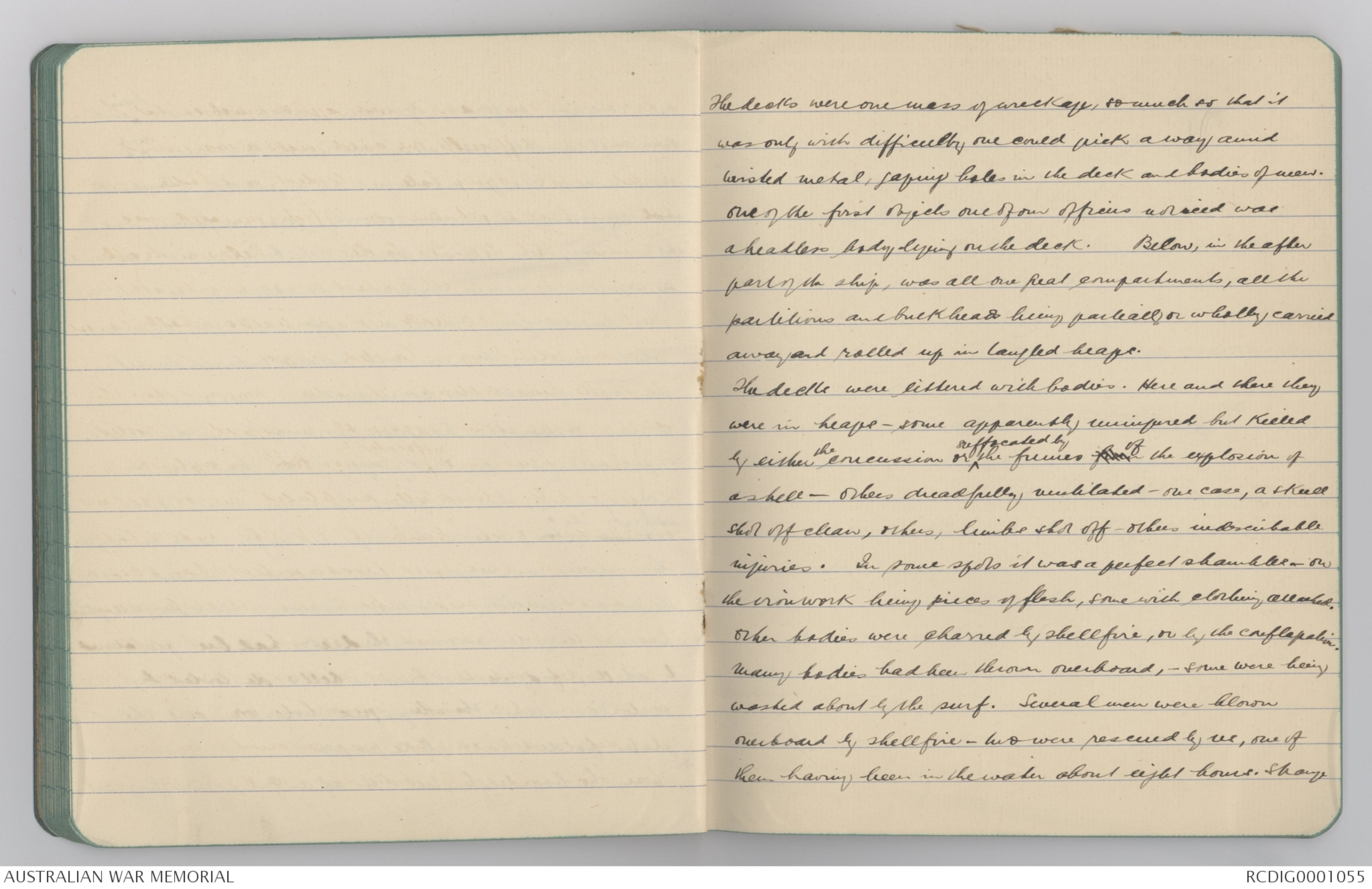
The decks were one mess of wreckage, so much so that it
was only with difficulty one could pick a way amid
twisted metal, gaping holes in the deck and bodies of men.
One of the first objects one of our officers noticed was
a headless body lying on the deck. Below, in the after
part of the ship, was all one great compartments, all the
partitions and bulkheads being partially or wholly carried
away and rolled up in tangled heaps.
The decks were littered with bodies. Here and there they
were in heaps - some apparently uninjured but killed
by either the concussion or ^suffocated by the fumes from of the explosion of
a shell - others dreadfully mutilated - one case, a skull
shot off clean, others, limbs shot off - others indescribable
injuries. In some spots it was a perfect shambles - on
the iron work being pieces of flesh, some with clothing attached.
other bodies were charred by shellfire, or by the conflagration.
Many bodies had been thrown overboard, - some were being
washed about by the surf. Several men were blown
overboard by shellfire - two were rescued by us, one of
them having been in the water about eight hours. Strange
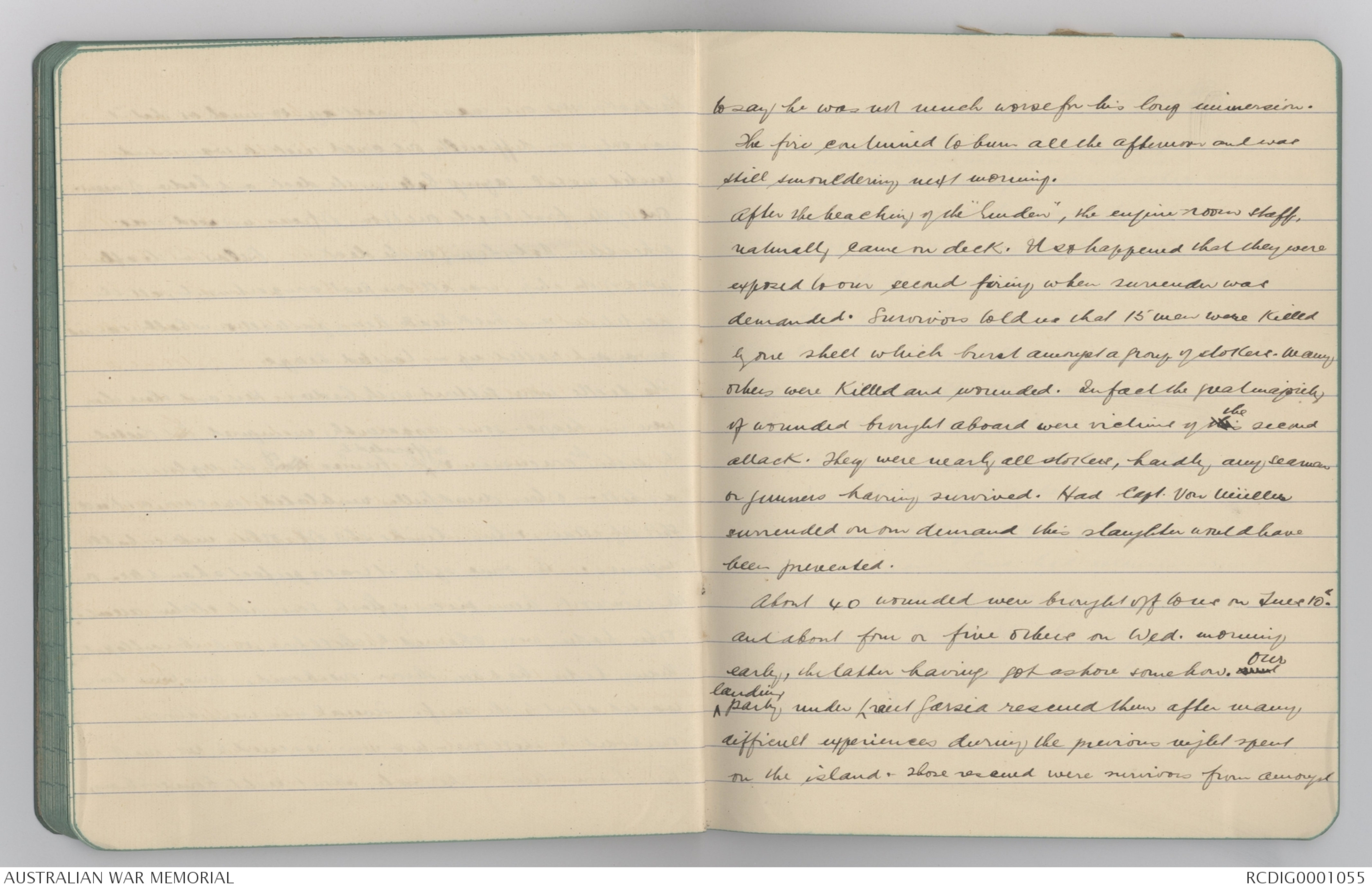
to say he was not much worse for his long immersion.
The fire continued to burn all the afternoon and was
still smouldering next morning.
After the beaching of the "Emden", the engine room staff,
naturally came on deck. It so happened that they were
exposed to our second firing when surrender was
demanded. Survivors told us that 15 men were killed
by one shell which burst amongst a group of stokers. Many
others were killed and wounded. In fact the great majority
of wounded brought aboard were victims of this the second
attack. They were nearly all stokers, hardly any seamen
or gunners having survived. Had Capt. Von Müller
surrendered on our demand this slaughter would have
been prevented.
About 40 wounded were brought off to us on Tues 10th.
and about four or five others on Wed. morning
early, the latter having got ashore somehow. and Our
^landing party under Lieut Garsia rescued them after many
difficult experiences during the previous night spent
on the island. Those rescued were survivors from amongst
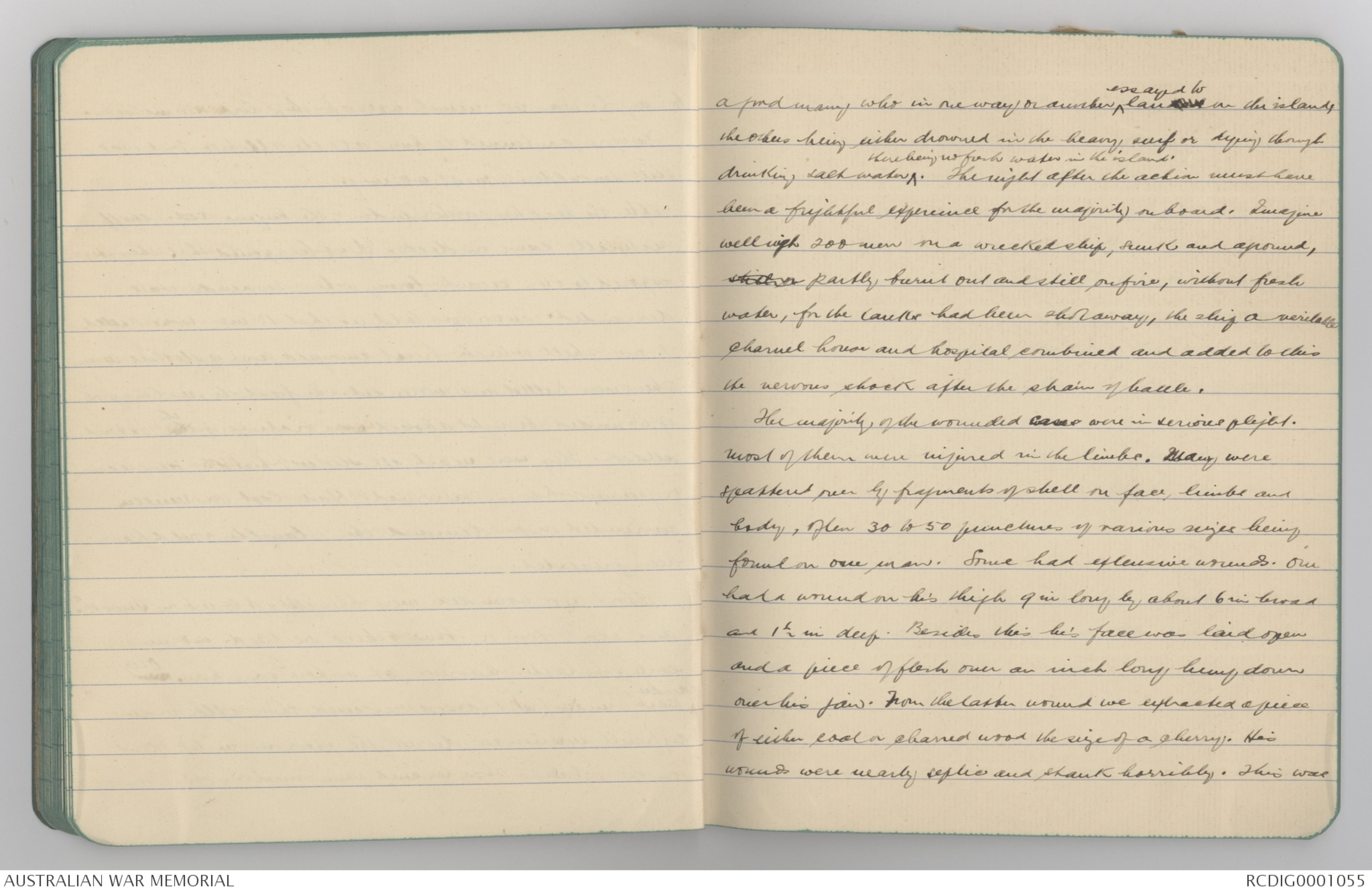
a good many who in one way or another ^escaped to landed on the island,
the others being either drowned in the heavy surf or dying through
drinking sea water ^there being no fresh water in the island. The night after the action must have
been a frightful experience for the majority on board. Imagine
well nigh 200 men on a wrecked ship, sunk and aground,
still on partly burnt out and still on fire, without fresh
water, for the tanks had been shot away, the ship a veritable
charnel house and hospital combined and added to this
the nervous shock after the strain of battle.
The majority of the wounded cases were in serious plight.
Most of them were injured in the limbs. Many were
scattered over by fragments of shell on face, limbs and
body, often 30 to 50 punctures of various sizes being
found on one man. Some had extensive wounds. One
had a wound on his thigh 9in long by about 6in broad
and 1½in deep. Besides this his face was laid open
and a piece of flesh over an inch long hung down
over his jaw. From the latter wound we extracted a piece
of either coal or charred wood the size of a cherry. His
wound was nearly septic and stank horribly. This was
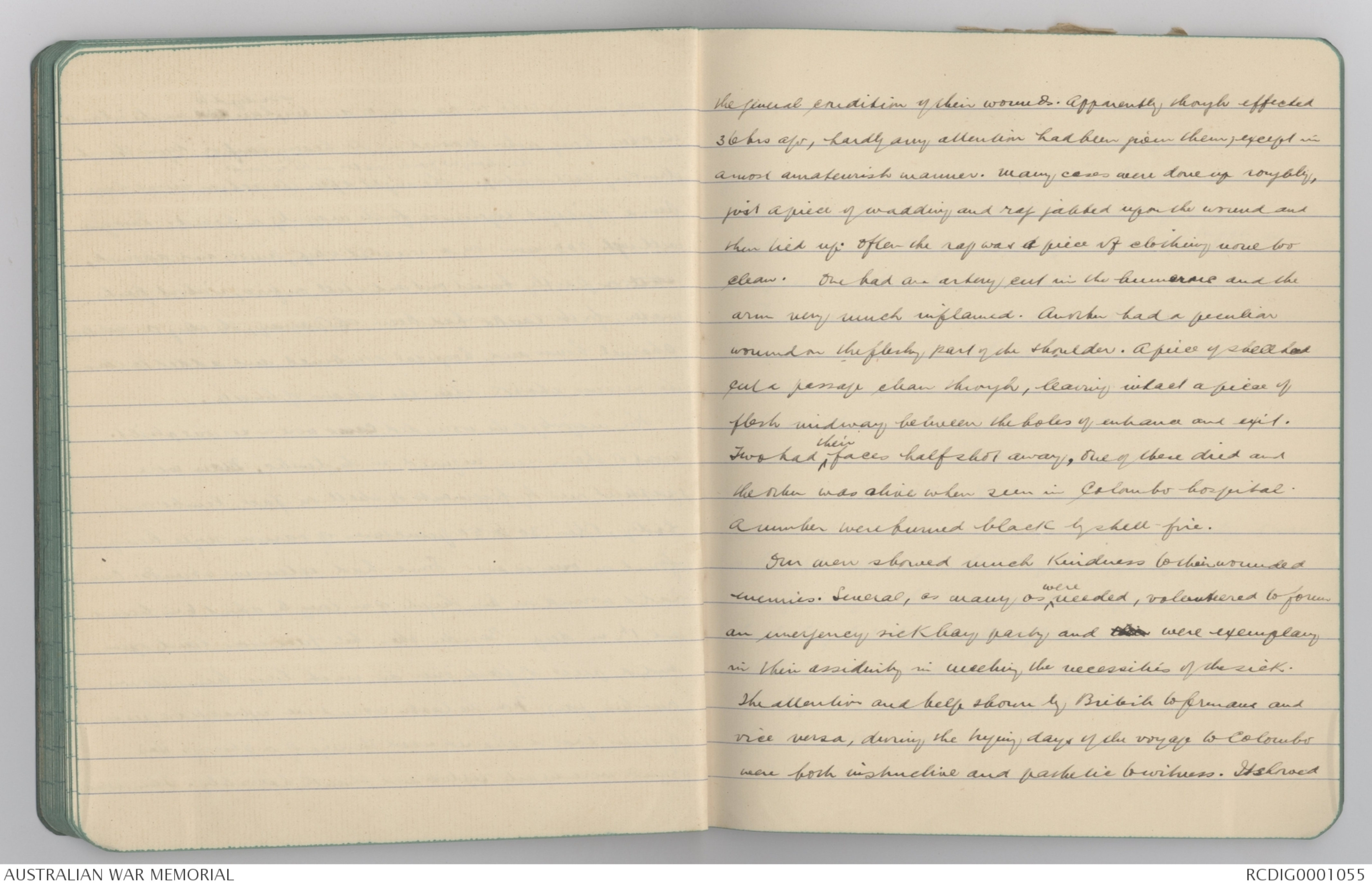
the general condition of their wounds. Apparently though effected
36 hrs ago, hardly any attention had been given them, except in
a most amateurish manner. Many cases were done up roughly,
just a piece of wadding and rag jabbed upon the wound and
then tied up. Often the rag was a piece of clothing none too
clean. One had an artery cut in the humerus and the
arm very much inflamed. Another had a peculiar
wound on the fleshy part of the shoulder. A piece of shell had
cut a passage clean through, leaving intact a piece of
flesh midway between the holes of entrance and exit.
Two had ^their faces half shot away, one of these died and
the other was alive when seen in Colombo hospital.
A number were burned black by shell-fire.
Our men showed much kindness to their wounded
enemies. Several, as many as ^were needed, volunteered to form
an emergency sickbay party and their were exemplary
in their assiduity in meeting the necessities of the sick.
The attention and help shown by British to Germans and
vice versa, during the trying days of the voyage to Colombo
were both instructive and pathetic to witness. It showed
 D Coates
This transcription item is now locked to you for editing. To release the lock either Save your changes or Cancel.
This lock will be automatically released after 60 minutes of inactivity.