
Notebook 2 of Vivian Agincourt Spence Little, 1914- Part 2
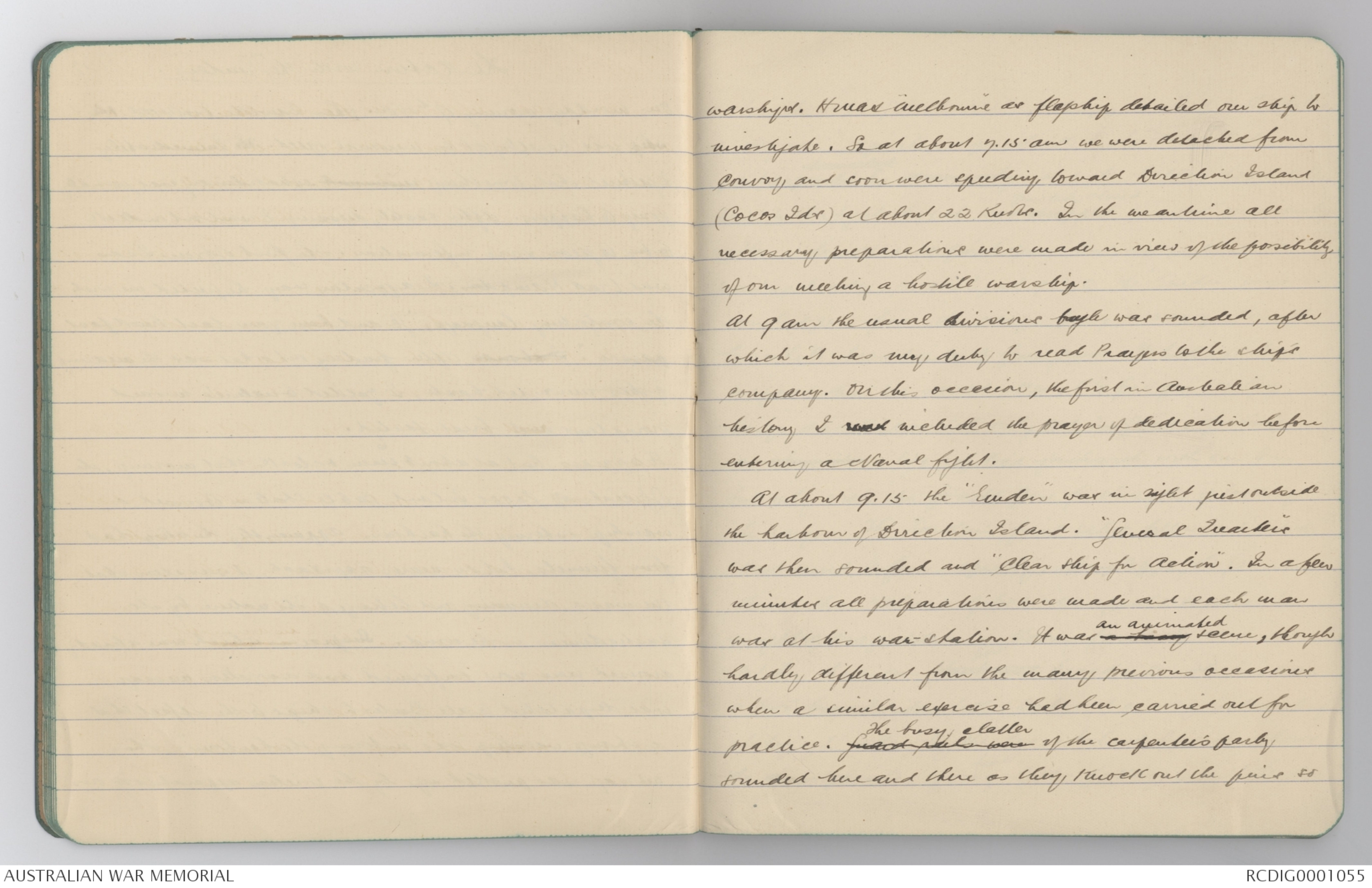
warships.HMAS Melbourne as flagship debailed our ship to
investigate. So at about 7.15 am we were detached from
convoy and soon were speeding toward Direction Island
(Cocos Ids) at about 22 Knots. In the meantime all
necessary preparations were made in view of the possibility
of our meeting a hostile warship.
At 9 am the usual divisions bugle was sounded,after
which it was my duty to read Prayers to the ships
company.On this occasion, the first in Australian
history I read included the prayer of dedication before
entering a Naval fight.
At about 9.15 the "Emden" was in sight just outside
the harbour of Direction Island. "General Quarters"
was then sounded and "clear ship for action". In a few
minutes all preparations were made and each man
was at his war-station. It was a brisq an animated scene, though
hardly different from the many previous occasions
when a similar exercise had been carried out for
practice. guard rails rails The busy clatter of the carpenter's party
sounded here and there as they knock out the pins so
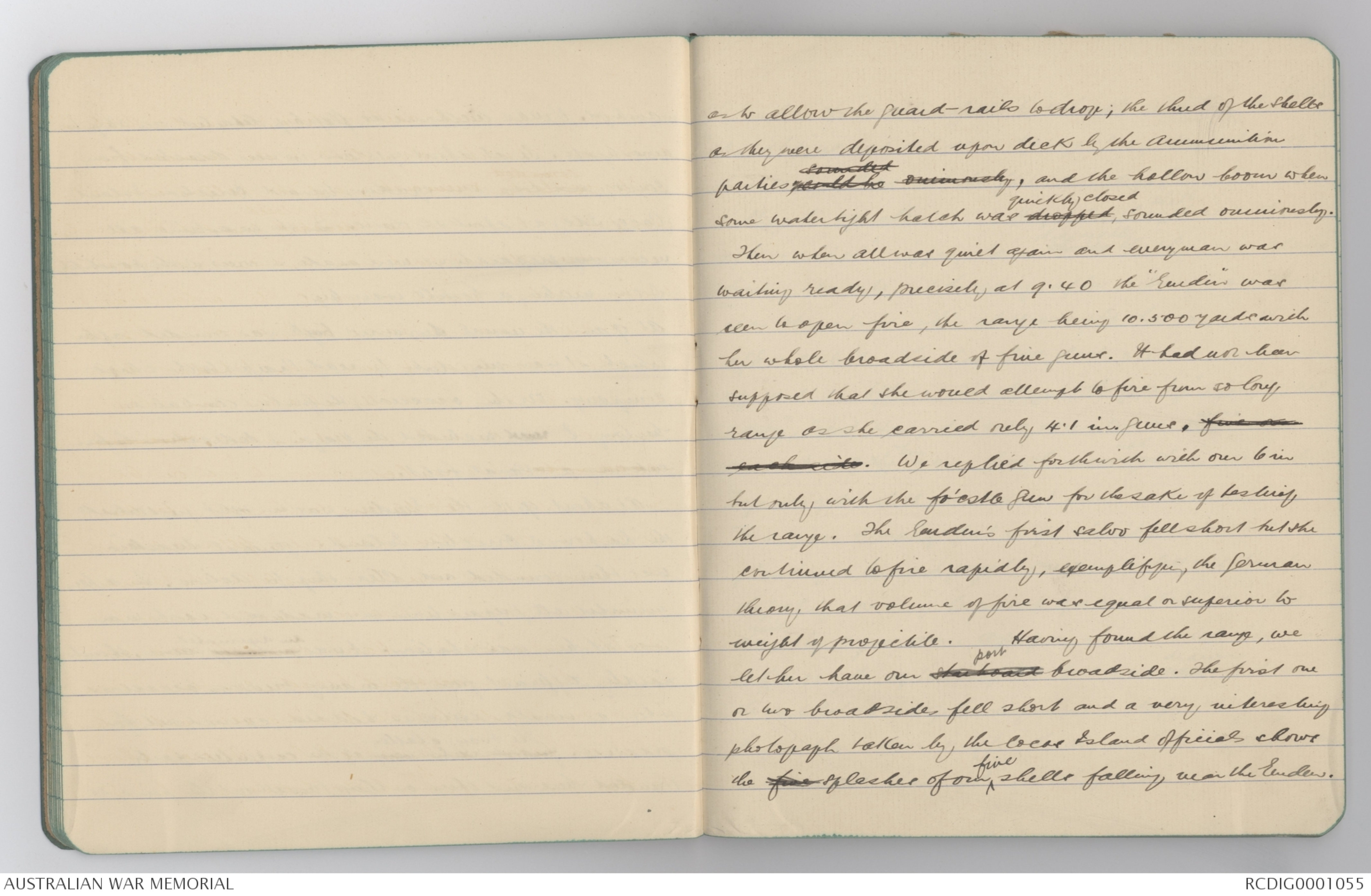
as to allow the guard-rails to drop; the thud of the shells
as they were deposited upon deck by the amunition
parties sounded could be ominously, and the hollow boom when
some water tight hatch was dropped quickly closed, sounded ominously.
Then when all was quiet again and every man was
waiting ready, precisely at 9.40 the "Emden" was
seen to open fire, the range being 10,500 yards with
her whole broadside of fire power. It had not been
supposed that she would attempt to fire from so long
range as she carried only 4.1 in. guns, fire on
each side. We replied forthwith with our 6 in
but only with the fo'cstle gun for the sake of testing
the range. The Emden's first salvo fell short but she
continued to fire rapidly, exemplifying the German
theory that volume of fire was equal or superior to
weight of projectile. Having found the range, we
let her have our starboard port broadside.The first one
or two broadsides fell short and a very interesting
photograph taken by the Cocos Island officials shows
the fire splashes of our ^fire shells falling near the Emden.
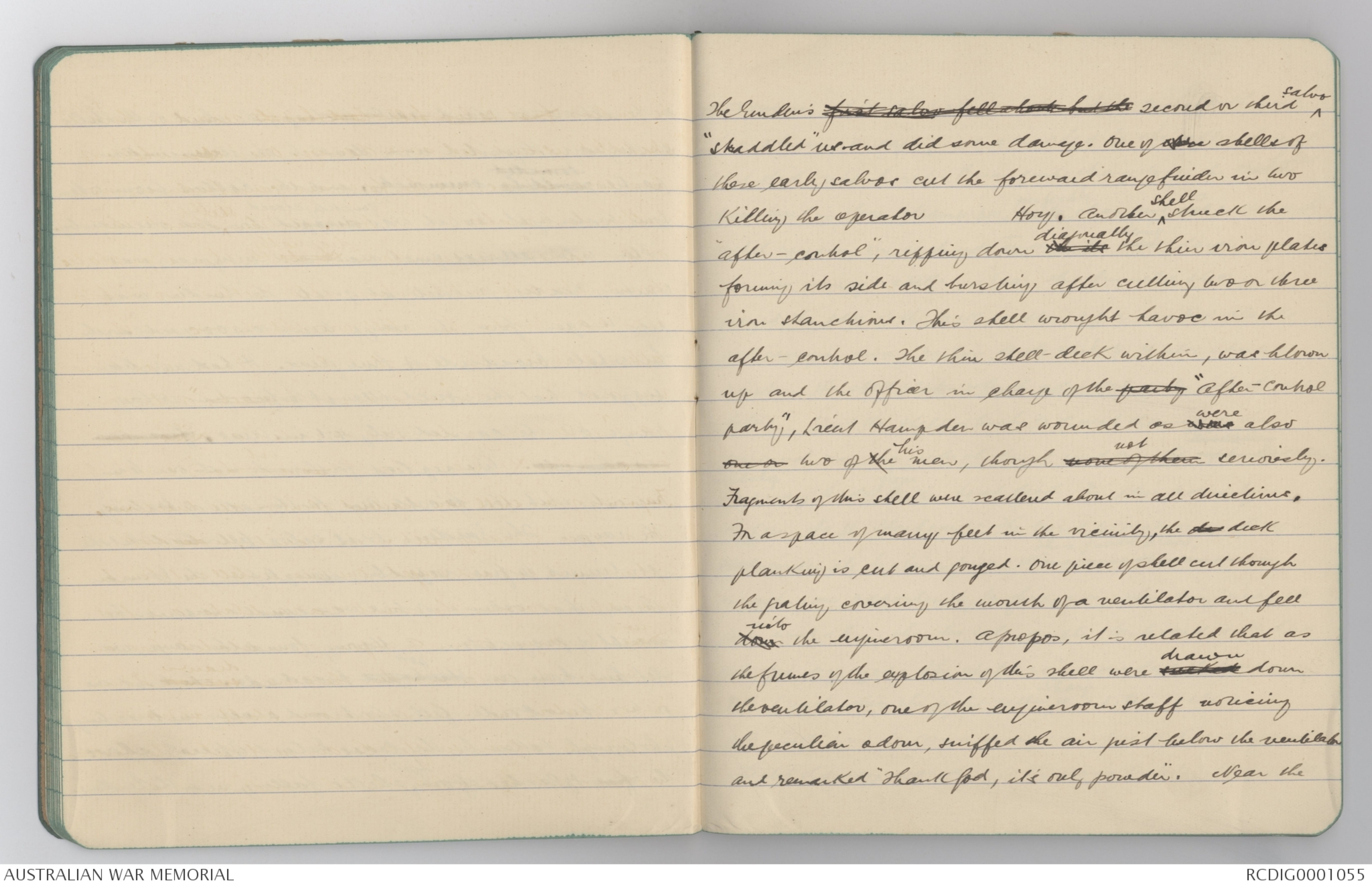
The Emden's first salvo fell short but the second or third ^ salvo
"straddled" us and did dome damage. One of [[?]] shells of
those early salvos cut the forward range finder in two
killing the operator Hoy. Another ^ shell struck the
"after-control", ripping down the its diagnally the thin iron plates
forming its side and bursting after cutting two or three
iron stanchions. This shell wrought havoc in the
after-control. The thin shell-deck within, was blown
up and the officer in charge of the party "after-control
party", Lieut Hampden was wounded as were were alsoone or two of the his men, though none of them not seriously.
Fragments of this shell were scattered about in all directions.
In a space of many feet in the vicinity, the dec deck
planking is cut and gouged. One piece of steel cut through
the grating covering the mouth of a ventilator and felldown into the engine room. A propos, it is relared that as
the fumes of the explosion of this shell were sucked drawn down
the ventilator, one of the engine room staff noticing
the peculiar odour, sniffed the air just below the ventilator
and remarked "Thank God, it's only powder". Near the
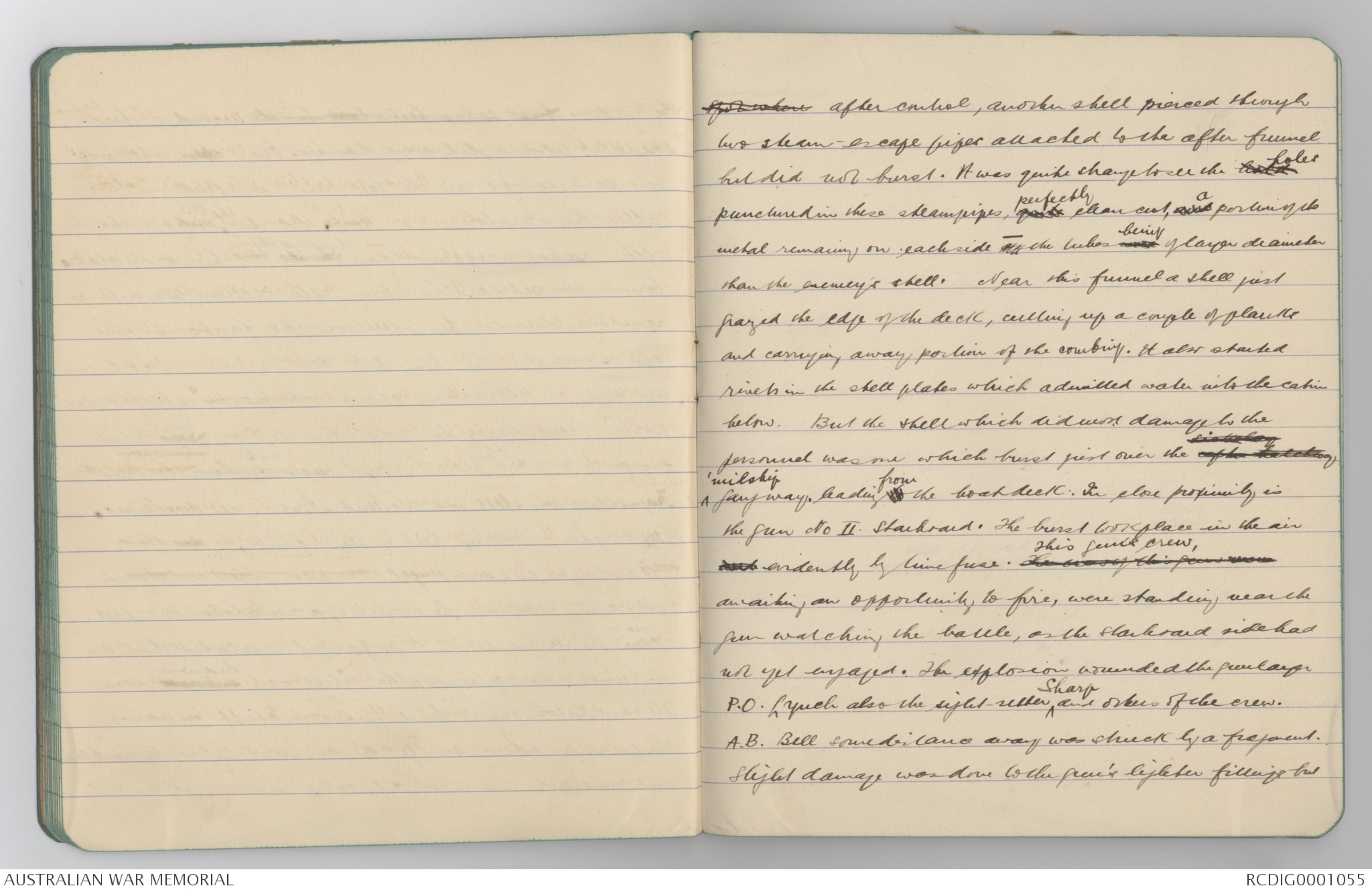
spot where after control, another shell pierced through
two steam-escape pipes attached to the after funnel
but did not burst. It was quite strange to see the hold holes
punctured in these steampipes, quite perfectly clean cut, and a portion of its
metal remaining on each side xx - the tubes were being of larger diameter
than the enemy's shell. Near this funnel a shell just
grazed the edge of the deck, cutting up a couple of planks
and carrying away portion of the combing. It also started
rivets in the shell plates which admitted water into the cabin
below. But the shell which did most damage to the
personnel was one which burst just over the sick bay after hatchway
^ midship gangway. leading to from the boat deck. In close proximity is
the gun No II. Starboard. The burst took place in the air
and evidently by line fuse. The crew of this gun were This gun's crew,
awaiting an opportunity to fire, were standing near the
gun watching the battle, as the starboard side had
not yet engaged. The explosion wounded the gunlayer
P.O. Lynch also the sight-setter ^Sharp and others of the crew.
A.B. Bell some distance away was struck by a fragment.
Slight damage was done to the gun's lighter fillings but
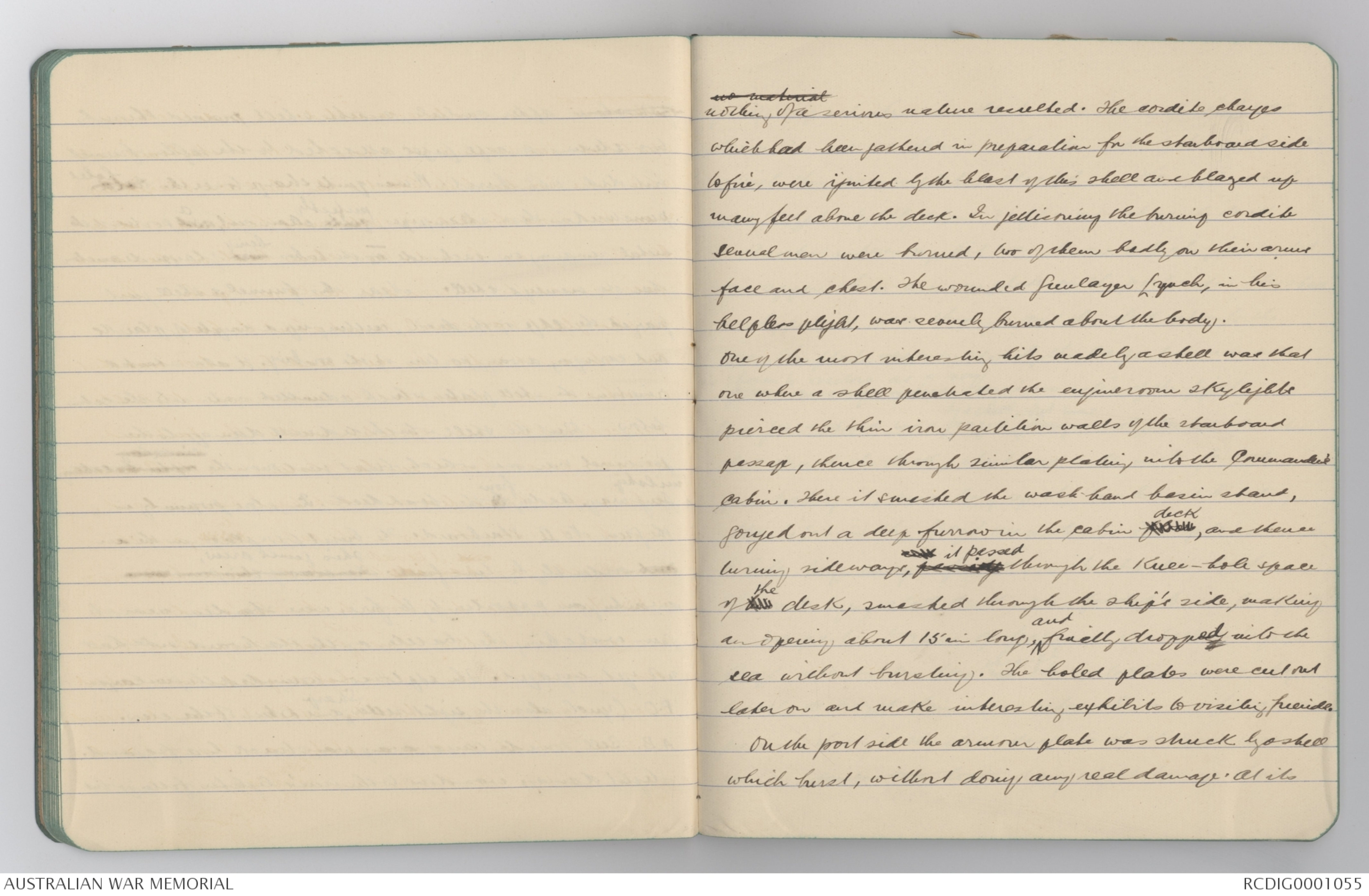
no material nothing of a serious nature resulted. The cordite charges
which had been gathered in preparation for the starboard side
to fire, were ignited by the blast of this shell and blazed up
many feet above the deck. In jettisoning the burning cordite
several men were burnt, two of them badly on their arms
face and chest. The wounded gunlayer Lynch, in his
helpers plight, was severely burned about the body.
One of the most interesting hits made by a shell was that
one where a shell penetrated the engine room skylights
pierced the thin iron partition walls of the starboard
passage, thence through similar plating into the Commander's
cabin. There it smashed the wash hand basin stand,
gouged out a deep furrow in the cabin floor deck, and thence
turning sideways, and passing it passed through the knee-hole space
of his the desk, smashed through the ship's side, making
an opening about 15 in long, and finally dropped into the
sea without bursting. The holed plated were cut out
later on and make interesting exhibits to visiting friends.
On the port side the armour plate was struck by a shell
which burst, without doing any real damage. At its
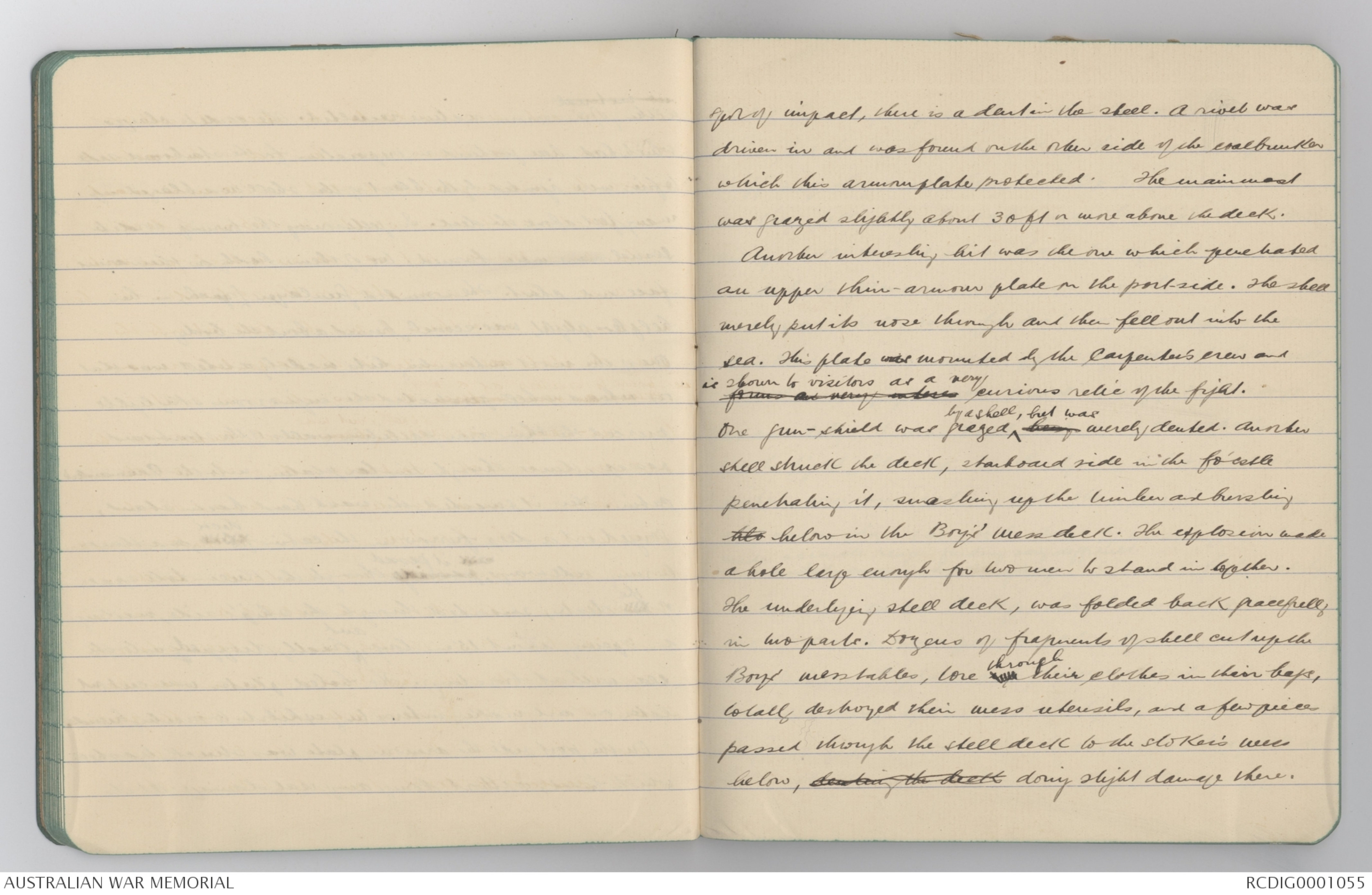
spot of impact, there is a dent in the steel. A rivet was
driven in and was found on the steer side of the coal bunker
which this armour plate protected. The main mast
was grazed slightly about 30 ft or more above the deck.
Another interesting hit was the one which penetrated
an upper thin-armour plate on the portside. The shell
merely put its nose through and then fell out into the
sea.This plate was mounted by the carpenter's crew andforms a very interes is shown to visitors as a very curious relic of the fight.
One gun-shield was grazed ^ by a shell, but was being merely dented. Another
shell struck the deck, starboard side in the fo'cstle
penetrating it, smashing up the timber and burstingblo below in the Boy's mess deck.The explosion made
a hole large enough for two men to stand in together.
The underlying shell deck, was folded back gracefully,
in two parts.Dozens of fragments of shell cut up the
Boy's mess tables, tore in through their clothes in their bags,
totally destroyed their mess utensils, and a few pieces
passed through the shell deck to the stoker's mess
below, denting the deck doing slight damage there.
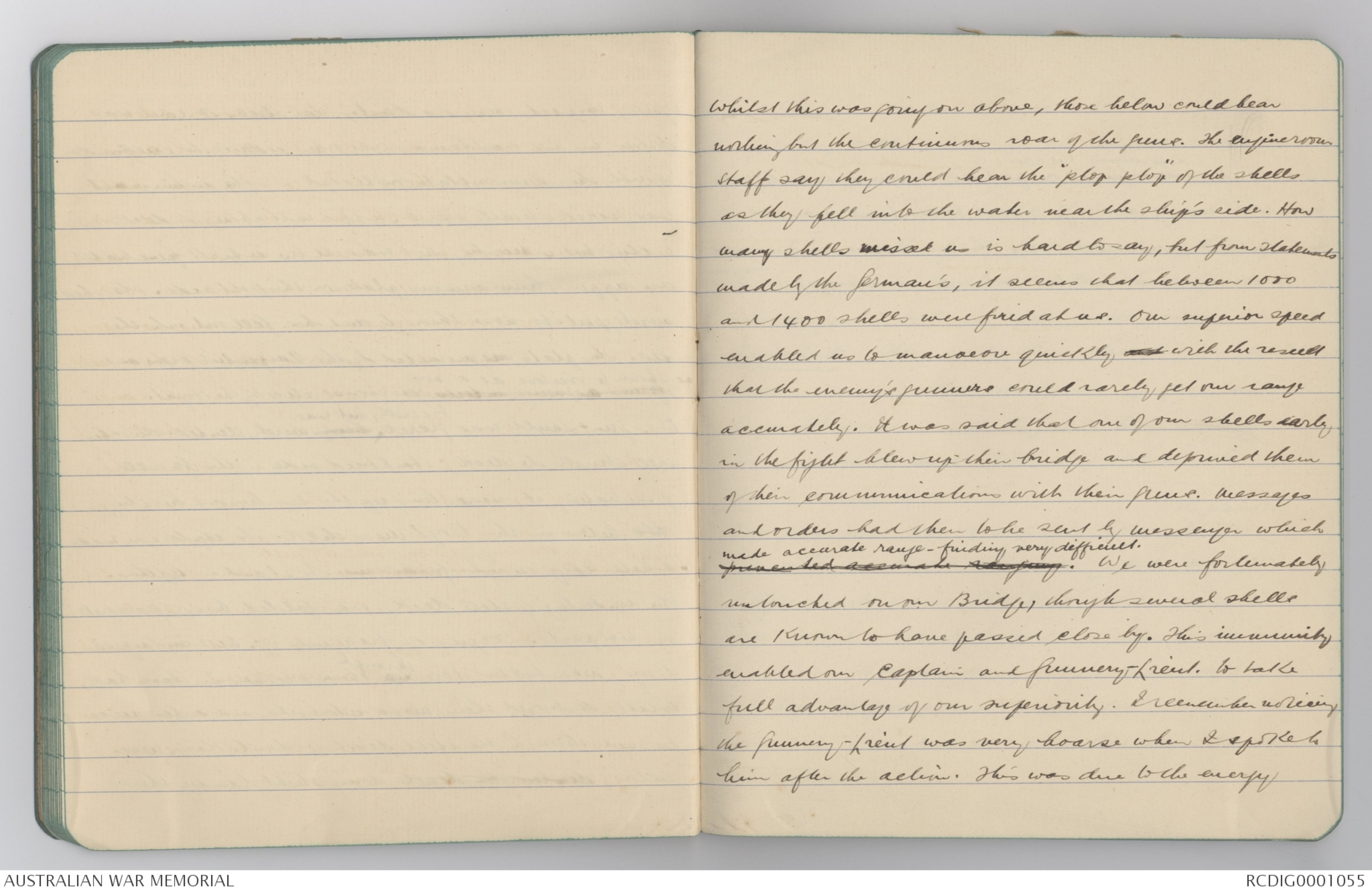
Whilst this was going on above, those below could hear
nothing but the continuous roar of the guns.The engine room
staff say they could hear the "plop plop" of the shells
as they fell into the water near the ship's side.How
many shells missed us is hard to say, but from statements
made by the German's, it seems that between 1000
and 1400 shells were fired at us.Our superior speed
enabled us to manoevre quickly and with the result
that the enemy's gunners could rarely get our range
accurately. It was said that one of our shells early
in the fight blew up their bridge and deprived them
of their communication with their guns.Messages
and orders had then to be sent by messenger whichprevented accurate ranging made accurate range-finding difficult. We were fortunately
untouched on our Bridge, though several shells
are known to have passed close by. This immunity
enabled our Captain and Gunnery-Lieut. to take
full advantage of our superiority. I remember noticing
the Gunnery-Lieut was very hoarse when I spoke to
him after ther action. This was due to the energy
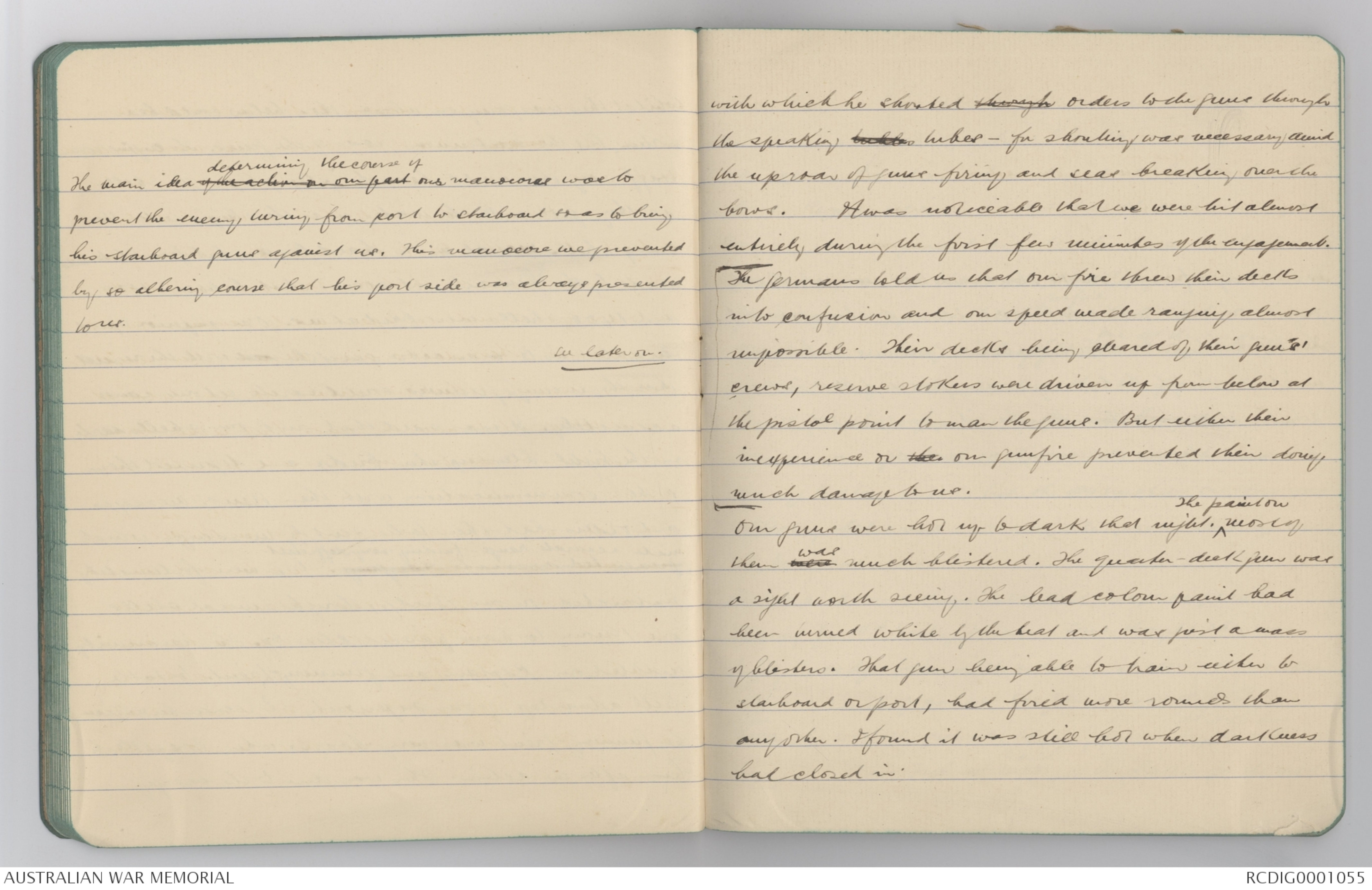
The main idea of the action on our part determining the course of our manoevers was to
prevent the enemy turning from port to starboard so as to bring
his starboard guns against us.This manoevre we prevented
by so altering course that his port side was always presented
to us.
See Later on.
with which he shouted through orders to the guns through
the speaking tubbs tubes - for shouting was necessary amid
the uproar of guns firing and seas breaking over the
bows.It was noticeable that we were hit almost
entirely during the first few minutes of the engagement.
[The Germans told us that our fire threw their decks
[into confusion and our speed made ranging almost
[impossible.Their decks being cleared of their gun's
[crews, reserve stokers were driven up from below at
[the pistol point to man the guns.But either their
[inexperience or the our gunfire prevented their doing
[much damage to us.
Our guns were hot up to dark that night. ^ The paint on most of
them were was much blistered. The quarter-deck gun was
a sight worth seeing. The lead colour paint had
been turned white by the heat and was just a mass
of blisters. That gun being able to train either to
starboard or port, had fired more rounds than
any other. I found it was still hot when darkness
had closed in.
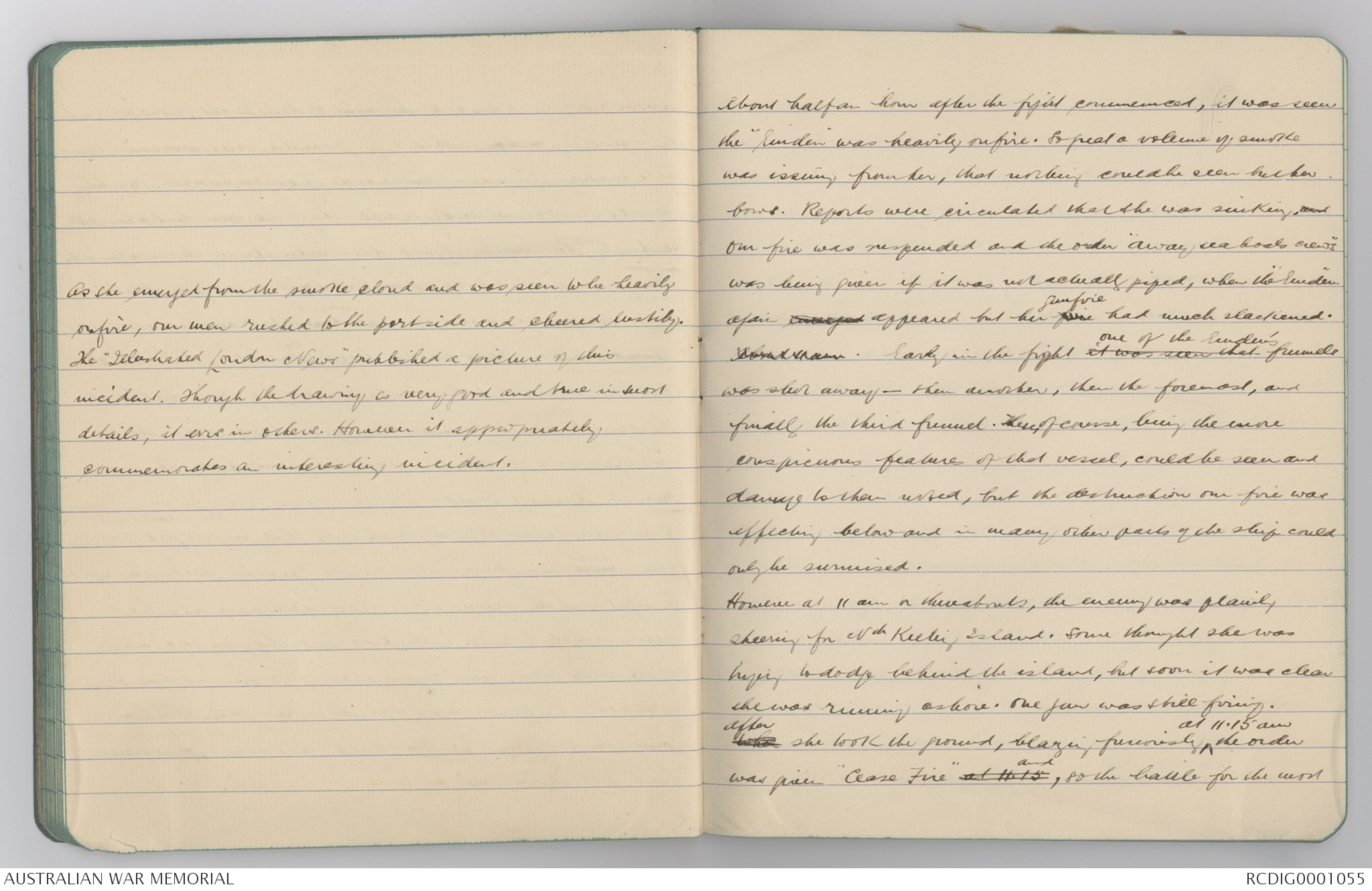
As she emerged from the smoke cloud and was seen whe heavily
on fire, our men rushed to the portside and cheered lustily.
The "Illustrated London News" published a picture of this
incident.Though the drawing is very good and true in most
details, it errs in others. However it appropriately
commemorates an interesting incident.
About half an hour agfter the fight commenced, it was seen
the "Emden" was heavily on fire. So great a volume of smoke
was issuing from her, that nothing could be seen but her
bows. Reports were circulated that she was sinking. and
Our fire was suspended and the order "away sea boats crews"
was being given if it was not actually piped, when the "Emden"
again emerged appeared but her fire gunfire had much slackened.
about then Early in the fight it was seen that one of the Emden's funnels
was shot away - then another, then the foremast, and
finally the third funnel.These,of course, being the more
conspicuous features of that vessel, could be seen and
damage to them noted, but the destruction our fire was
effecting below and in many other parts of the ship could
only be surmised.
However at 11 am or thereabouts, the enemy was plainly
steering for Nth Keeling Island. Some thought she was
trying to dodge behind the island, but soon it was clear
she was running ashore. One gun was still firing.Whe After she took the ground, blazing furiously ^ at 11.15 am the order
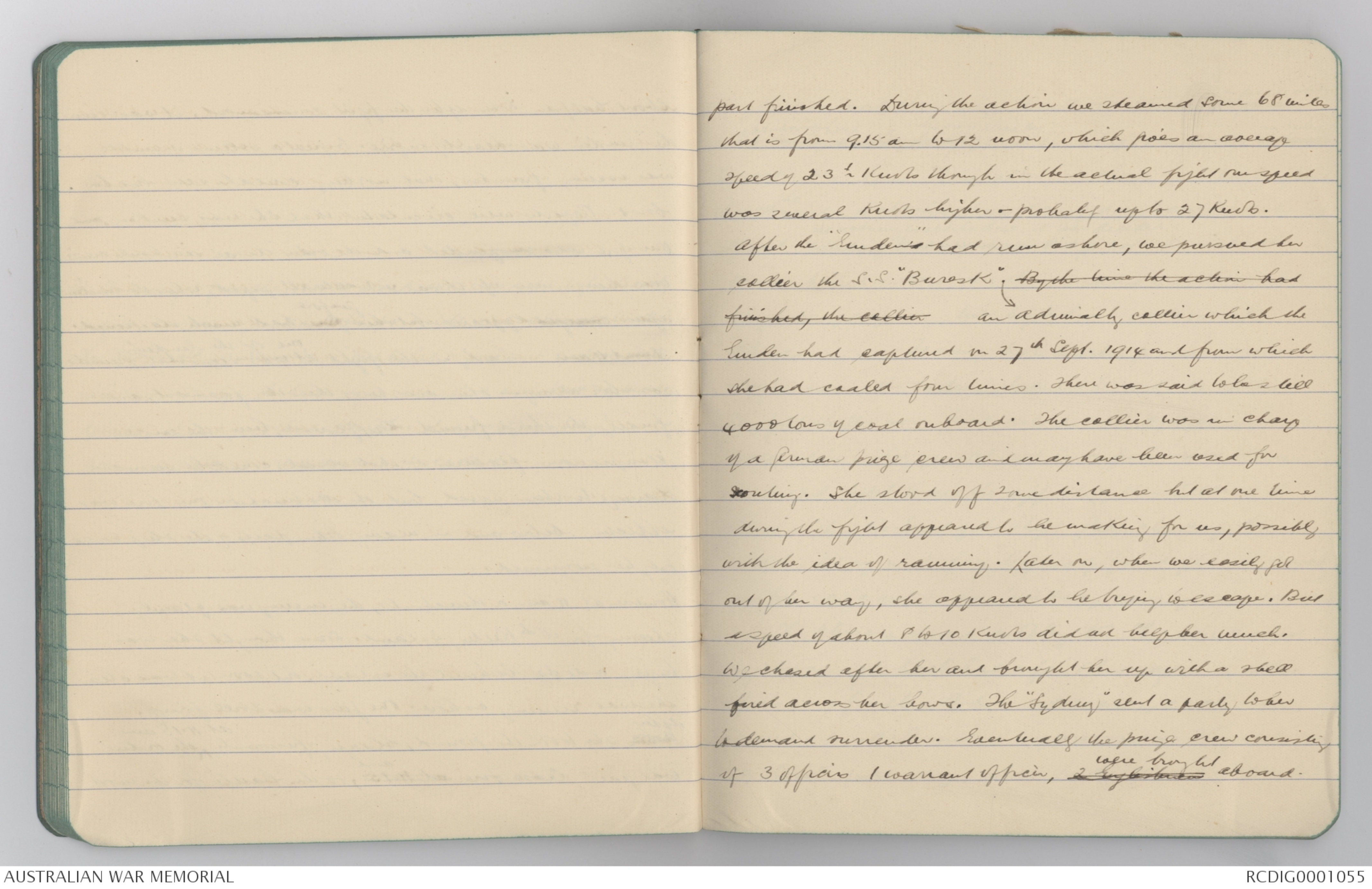
was given "Cease Fire" at 11.15 and, so the battle for the most
part finished. During the action we steamed some 68 miles
that is from 9.15 am to 12 noon, which gives an average
speed of 23½ knots though in the actual fight our speed
was several knots higher - probably up to 27 knots.
After the "Emden" had run ashore, we persued her
collier the S.S. "Buresk" By the time the action hadfinished, the collier an admiralty collier which the
Emden had captured on 27th Sept, 1914 and from which
she had coaled four times.There was said to be still
4000 tons of coal onboard.The collier was in charge
of a German prize crew and may have been used for
scouting. She stood off some distance but at one time
during the fight appeared to be making for us, possibly
with the idea of ramming. Later on, when we easily got
out of her way, she appeared to be trying to escape.But
a speed of about 8 to 10 knots did not help her much.
We chased after her and brought her up with a shell
fired across her bows.The "Sydney" sent a party to her
to demand surrender.Eventually the prize crew consisting
of 3 officers 1 warrant officer, 2 Englishmen were brought aboard.
 Sandy Mudie
This transcription item is now locked to you for editing. To release the lock either Save your changes or Cancel.
This lock will be automatically released after 60 minutes of inactivity.