
Notebook 2 of Vivian Agincourt Spence Little, 1914- Part 1
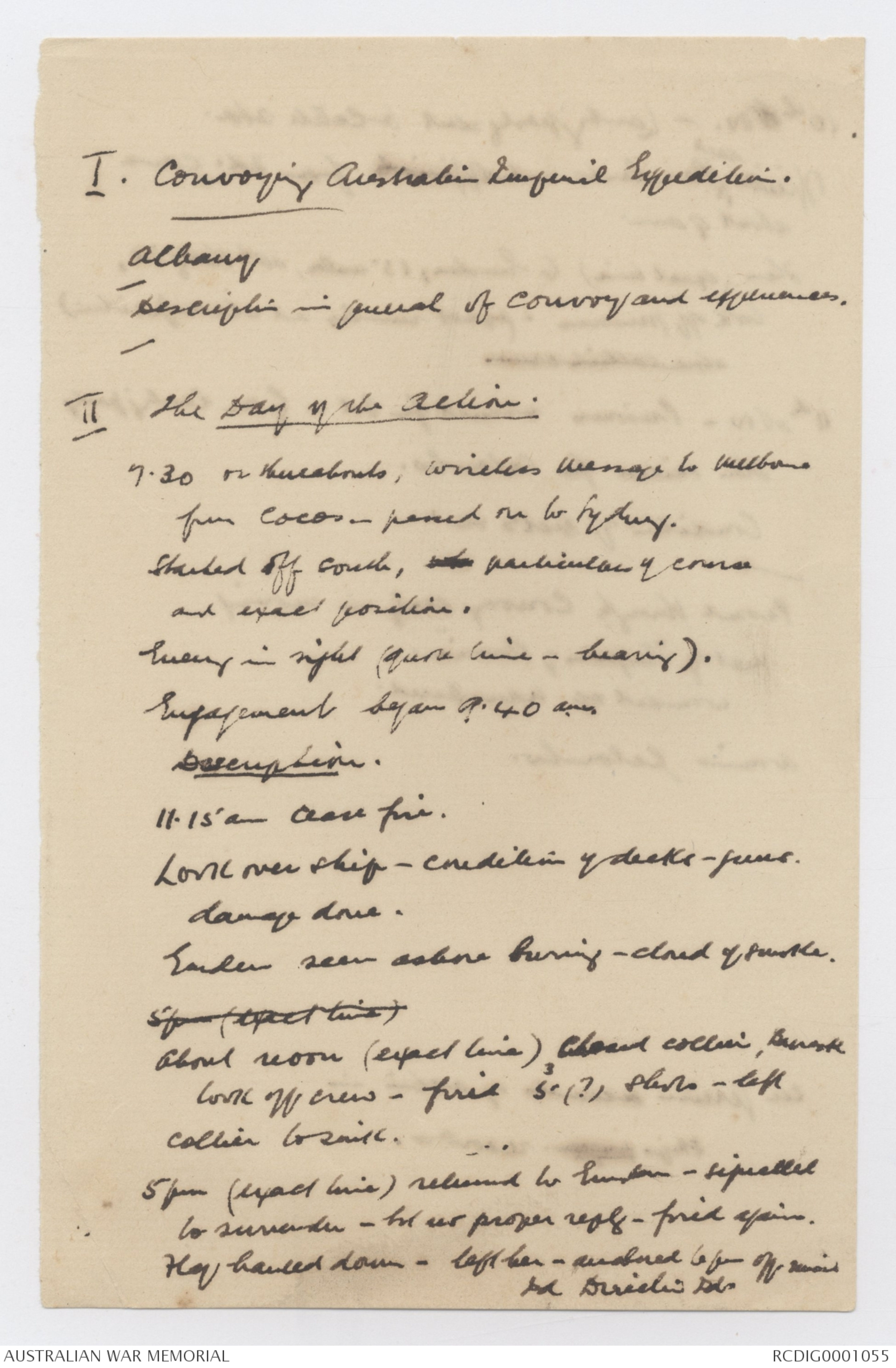
I. Convoying Australian Imperial Expedition.
Albany
Description in general of convoy and experiences
II. The Day of the Action.
7.30 or thereabouts, wireless message to Melbourne
from Cocos - passed on to Sydney.
Started off south, wh particulars of course
and exact position.
Enemy in sight (quote time in bearing)
Engagement began 9.40 a.m.
Description.
11.15am Cease fire.
Look over ship - condition of decks - guns
damage done.
Emden seen ashore burning - cloud of smoke.
5pm (exact line)
About noon (exact time) chased collier, Buresk
took off crew - fired 5 3 (?) shots - left
collier to sink.
5pm (exact time) returned to Emden - signalled
to surrender - but no proper reply - fired again.
They hauled down - left her - anchored 6pm off [[?]]
Id Direction Ids.
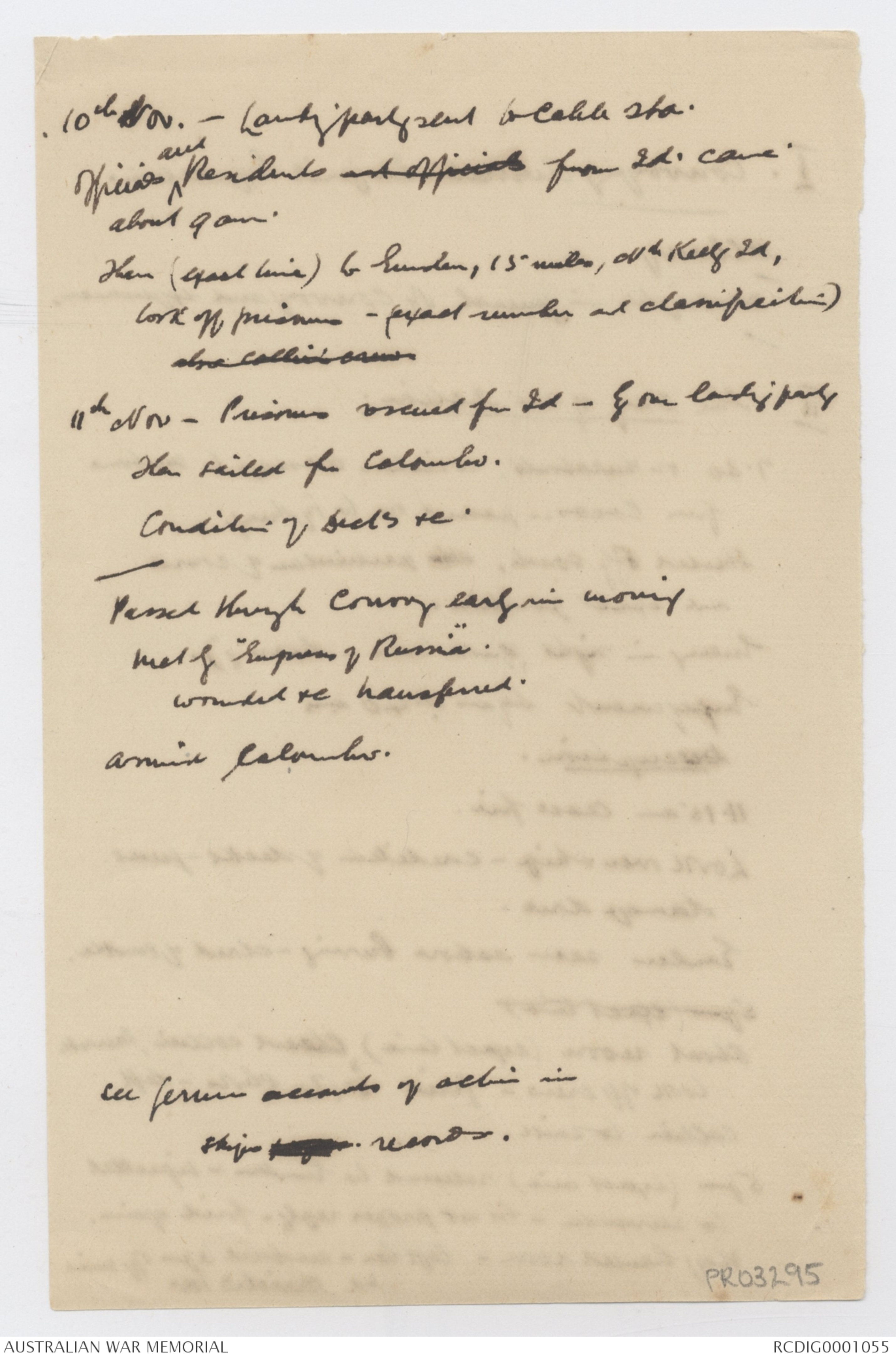
10th Nov. - Landing party sent to cable sta.
officials ^and Residents and officials from Id. came
about 9am.
Then (exact time) to Emden, 15 miles, Nth Keelg Id,
took off prisoners - (exact number and classification)
also collier crew
11th Nov. - Prisoners rescued from Id - & our landing party
Then sailed for Colombo.
Condition of Decks &c.
Passed through Convoy early in morning
Met up "Empress of Russia".
wounded &c transferred.
Arrived Colombo.
see German accounts of action in
ships xxxx records.
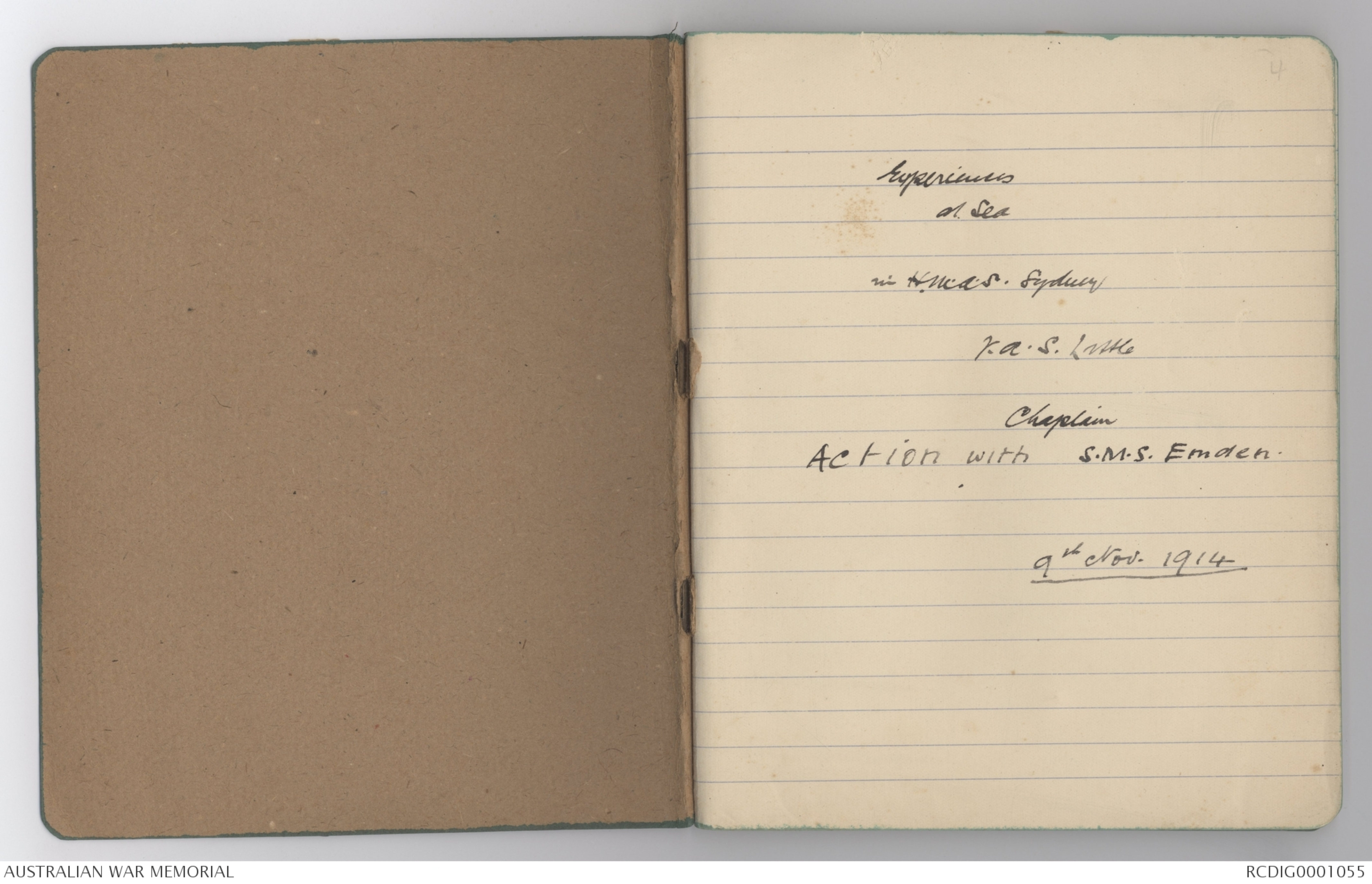
Experiences
at Sea
in H.M.A.S. Sydney
V.A.S. Little
Chaplain
Action with S.M.S. Emden
9th Nov 1914.
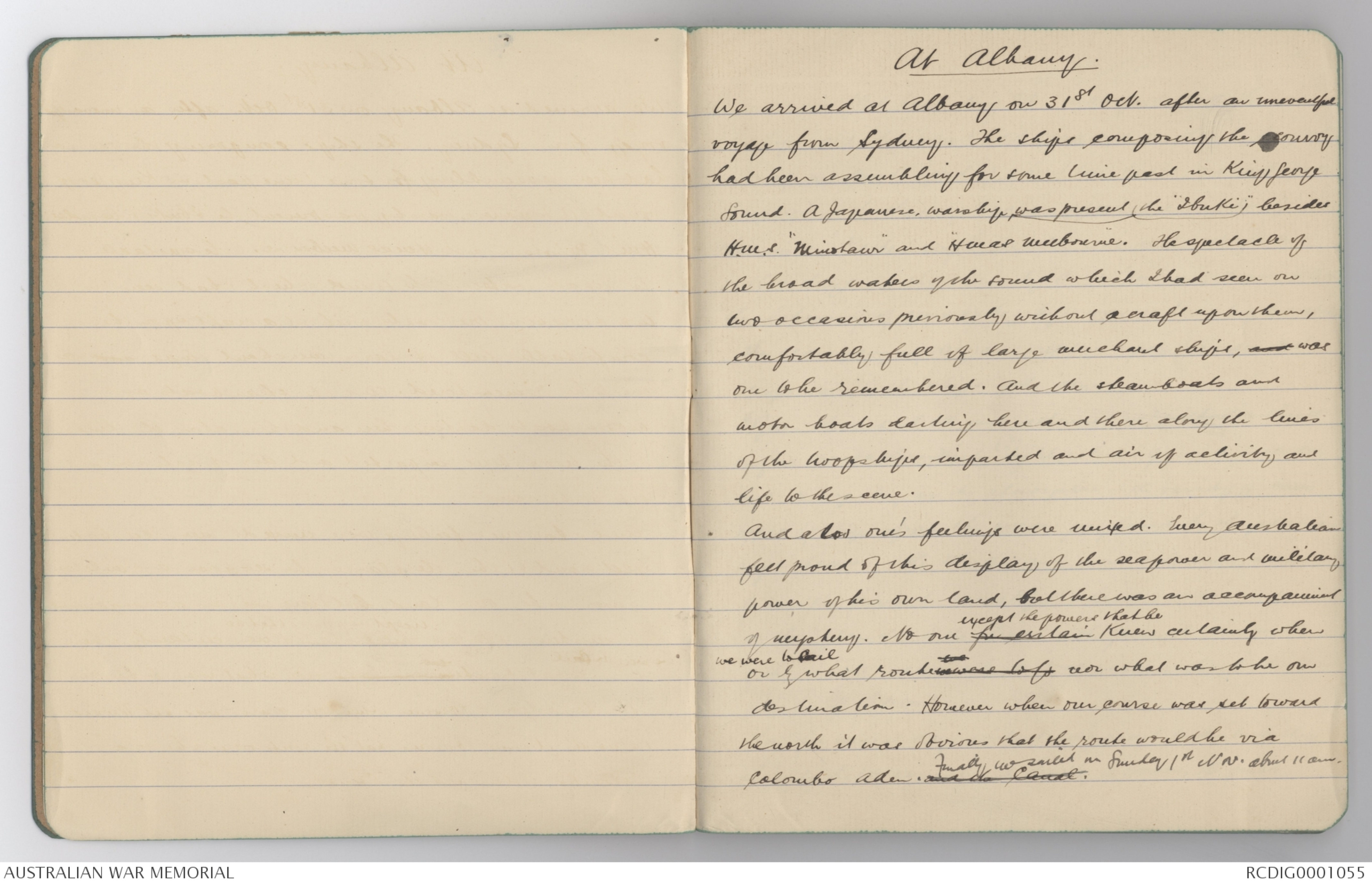
At Albany.
We arrived at Albany on 31st Oct. after an uneventful
voyage from Sydney. The ships composing the convoy
had been assembling for some time past in King George
Sound. A Japanese warship, the "Ibuki", was present besides
H.M.S. "Minotaur" and "HMAS Melbourne". The spectacle of
the broad waters of the sound which I had seen on
two occasions previously without a craft upon them,
comfortably full of large merchant ships, and was
one to be remembered. And the steamboats and
motor boats darting here and there along the lines
of the troop ships, imparted an air of activity and
life to the scene.
And also one's feelings were mixed. Every Australian
felt proud of this display of the seapower and military
power of his own land, but there was an accompaniment
of mystery. No one for certain ^except the powers that be knew certainly when
^we were to sail or by what route we were to go nor what was to be our
destination. However when our course was set toward
the north it was obvious that the route would be via
Colombo Aden and the Canal. ^Finally we sailed on Sunday 1st Nov about 11am.
2.
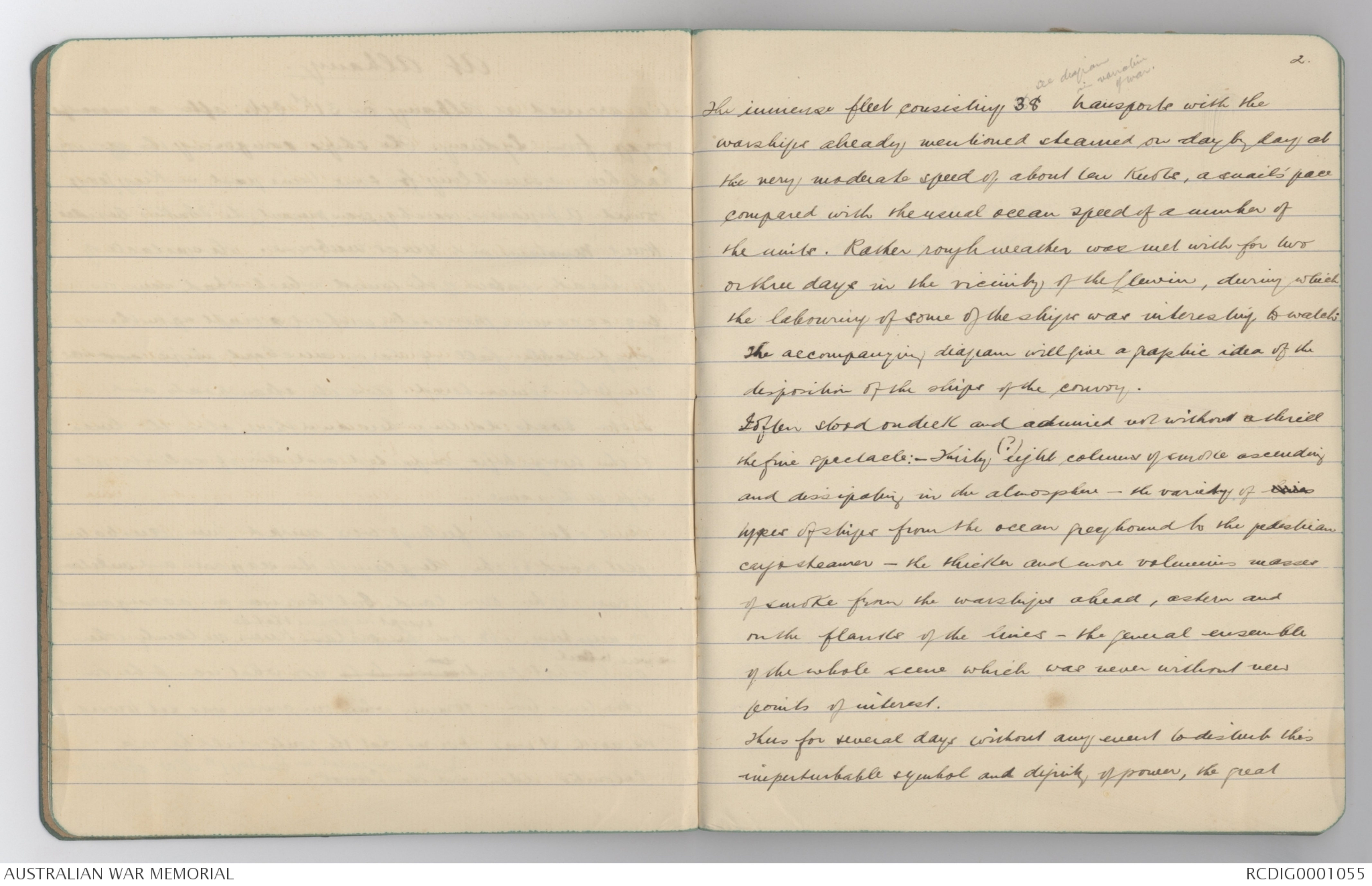
[*see diagram in variation of war.*]
The immense fleet consisting 38 transports with the
warships already mentioned steamed on day by day at
the very moderate speed of about ten Knots, a snail's pace
compared with the usual ocean speed of a number of
the units. Rather rough weather was met with for two
or three days in the vicinity of the Llewin, during which
the labouring of some of the ships was interesting to watch.
The accompanying diagram will give a graphic idea of the
disposition of the ships of the convoy.
I often stood on deck and admired not without a thrill
the fine spectacle: - Thirty (?) eight columns of smoke ascending
and dissipating in the atmosphere - the variety of xxx
types of ships from the ocean greyhound to the pedestrian
cargo steamer - the thicker and more voluminous masses
of smoke from the warships ahead, astern and
on the flanks of the lines - the general ensemble
of the whole scene which was never without new
points of interest.
Thus for several days without any event to disturb this
imperturbable symbol and dignity of power, the great
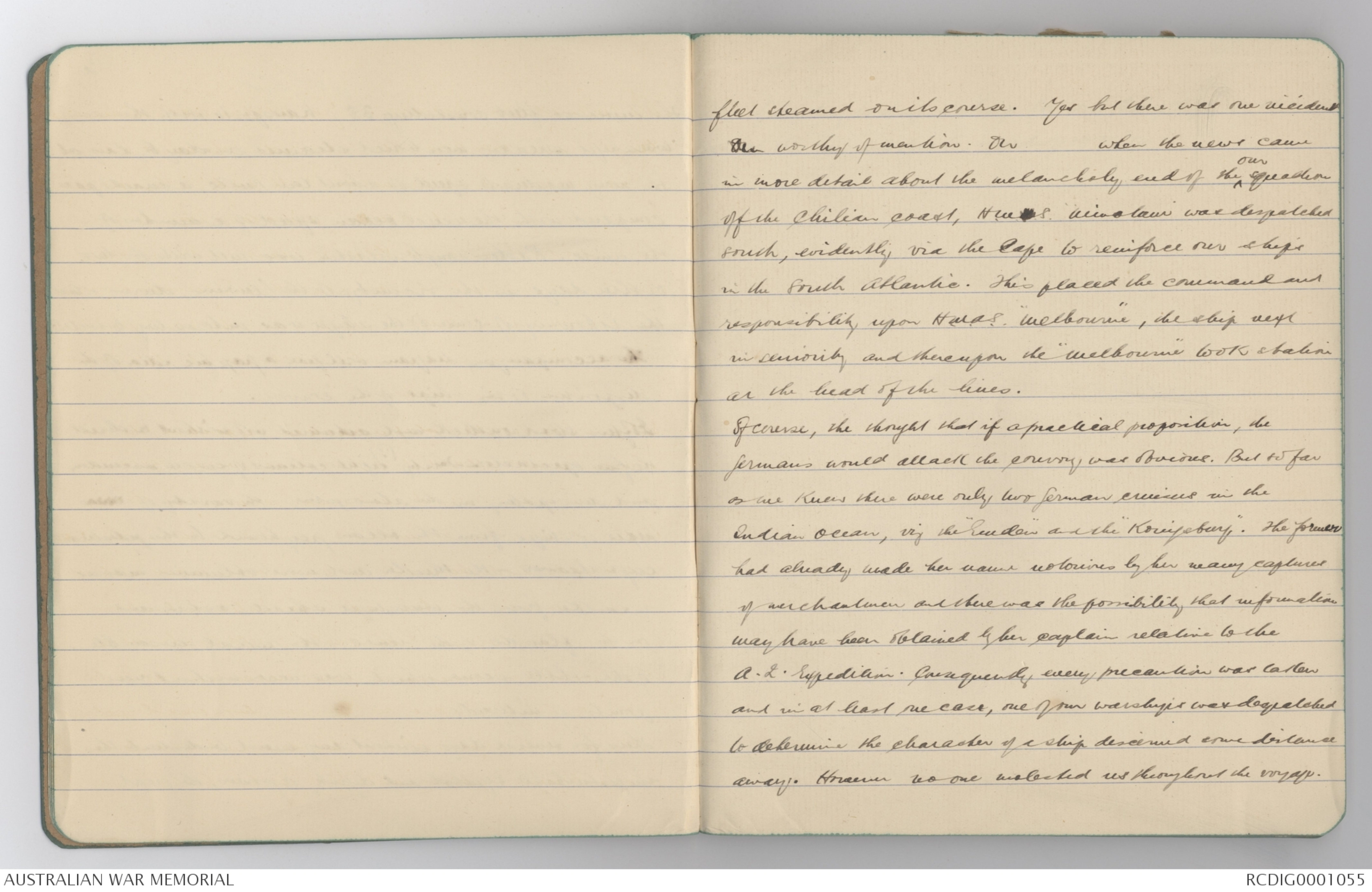
fleet steamed on its course. Yes but there was one incident
xxx worthy of mention. On when the news came
in more detail about the melancholy end of the ^our squadron
off the Chilian coast, H.M.A.S. Minotaur was despatched
south, evidently via the Cape to reinforce our ships
in the South Atlantic. This placed the command and
responsibility upon H.M.A.S. "Melbourne", the ship next
in seniority and thereupon the "Melbourne" took station
as the head of the lines.
Of course, the thought that if a practical proposition, the
Germans would attack the convoy was obvious. But so far
as we knew there were only two German cruisers in the
Indian Ocean, viz the "Emden" and the "Kingsbury". The former
had already made the name notorious by her many captures
of merchantmen and there was the possibility that information
may have been obtained by her captain relative to the
A.I. Expedition. Consequently, every precaution was taken
and in at least one case, one of our warships was despatched
to determine the character of a ship discerned some distance
away. However no one molested us throughout the voyage.
Thus from day to day, a sharp lookout being kept, we steamed
on at the very moderate speed of 10 Knots.
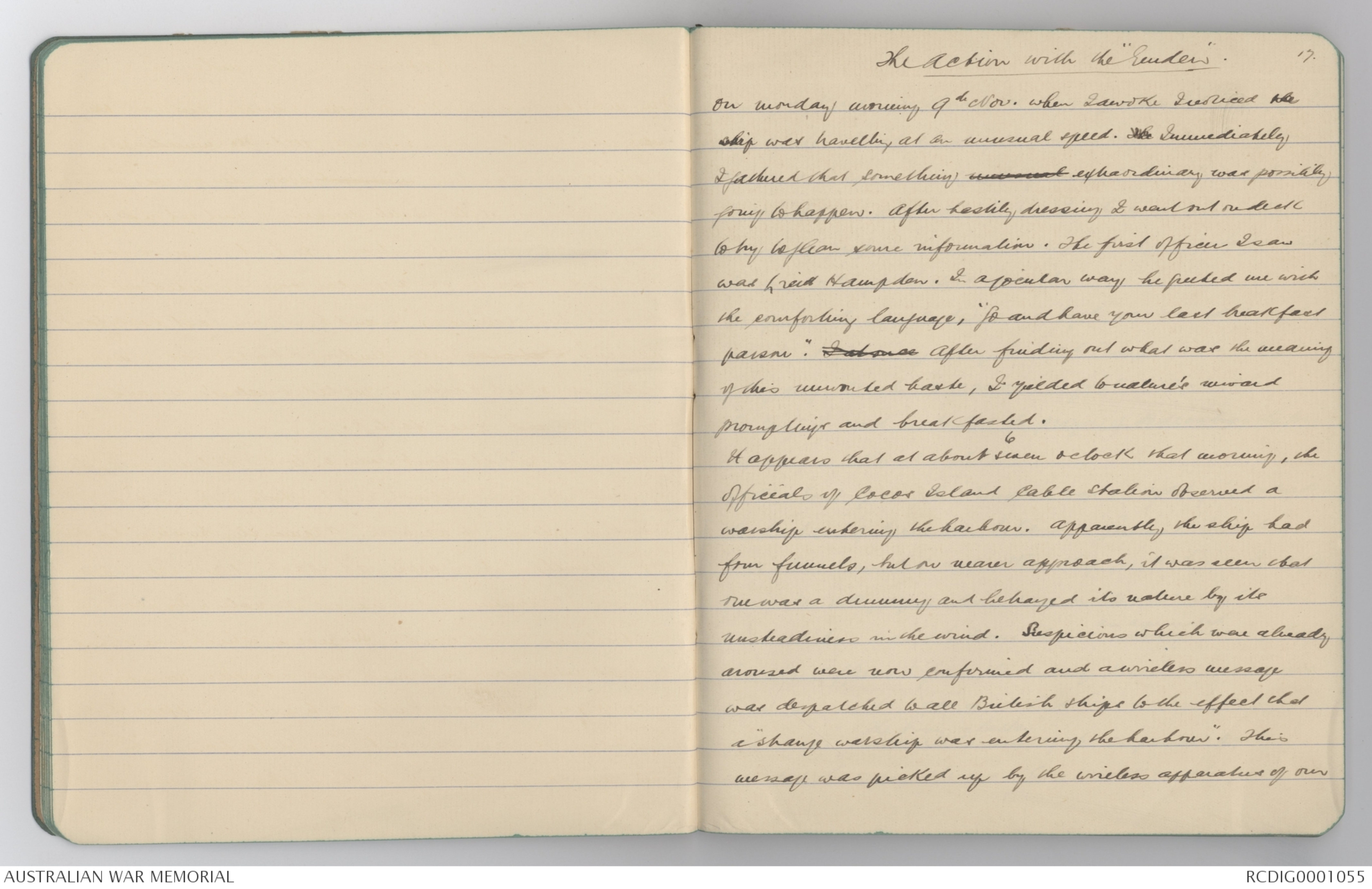
17.
The Action with the "Emden".
On Monday morning 9th Nov. when I awoke I noticed the
ship was travelling at an unusual speed. The Immediately
I gathered that something unusual extraordinary was possibly
going to happen. After hastily dressing I went out on deck
to try to glean some information. The first officer I saw
was Keith Hampden. In a jocular way he greeted me with
the comforting language, "Go and have your last breakfast
parson". I at once After finding out what was the meaning
of this unwanted haste, I yielded to nature's usual
promptings and breakfasted.
It appears that at about seven o'clock that morning, the
officials of Cocos Island Cable station observed a
warship entering the harbour. Apparently the ship had
four funnels, but on nearer approach, it was seen that
one was a dummy and betrayed its nature by its
unsteadiness in the wind. Suspicions which were already
aroused were now confirmed and a wireless message
was despatched to all British ships to the effect that
a "strange warship was entering the harbour". This
message was picked up by the wireless apparatus of our
 D Coates
This transcription item is now locked to you for editing. To release the lock either Save your changes or Cancel.
This lock will be automatically released after 60 minutes of inactivity.