
Notebook 1 of Vivian Agincourt Spence Little, 1914- Part 3
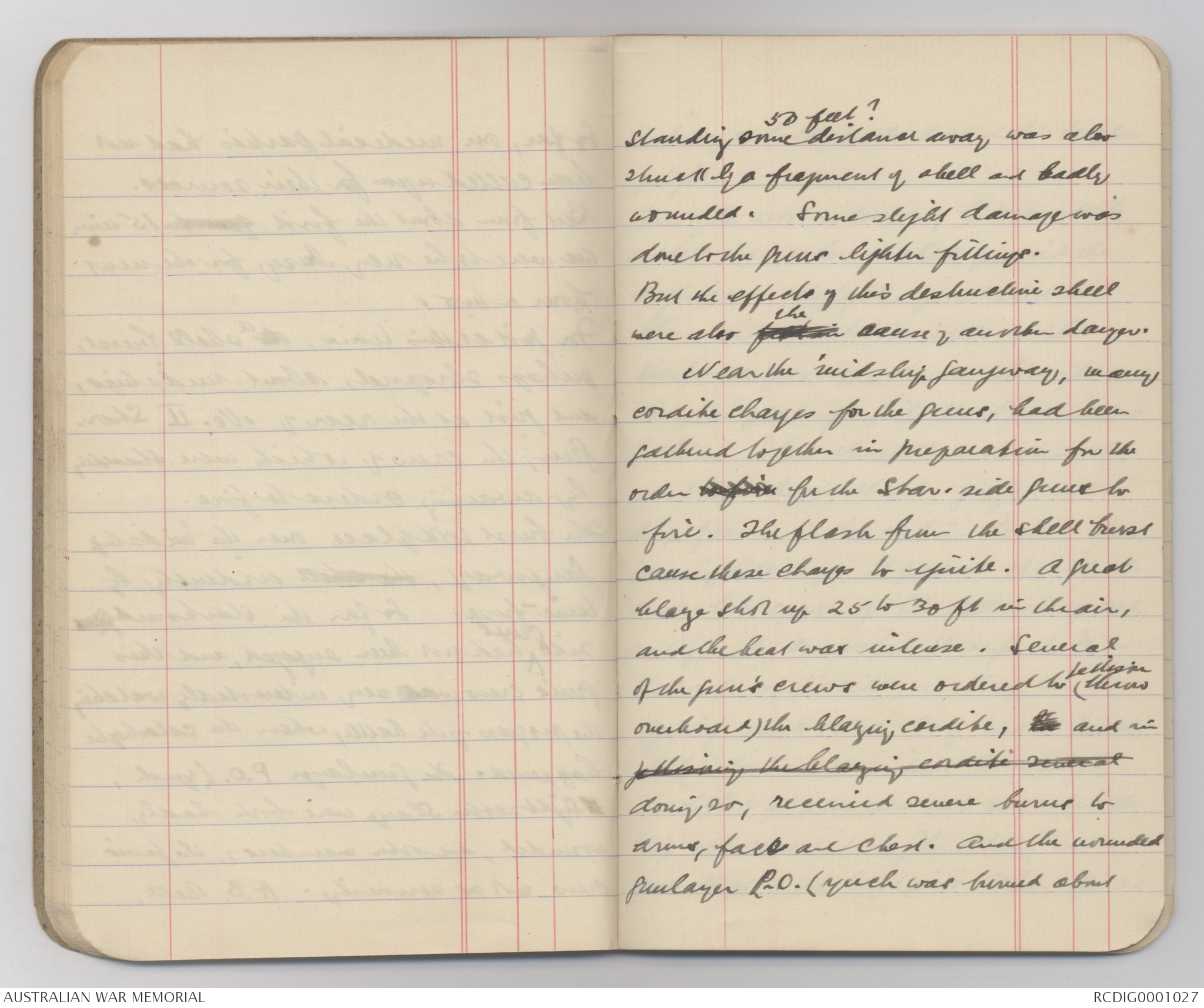
standing some 50 feet? distance away was also
struck by a fragment of shell and badly
wounded. Some slight damage was
done to the guns lighter fittings.
But the effects of this destructive shell
were also felt in the cause of another danger.
Near the 'midship gangway, many
cordite charges for the guns, had been
gathered together in preparation for the
order to fire for the star-side guns to
fire.The flash from the shell burst
cause these charges to ignite. A great
blaze shot up 25 to 30 ft in the air,
and the heat was intense.Several
of the gun's crews were ordered to jettison (throw
overboard) the blazing cordite, the and in
jettisoning the blazing cordite several
doing so, received severe burns to
arms, face and chest. And the wounded
gun layer P.O.Lynch was burned about
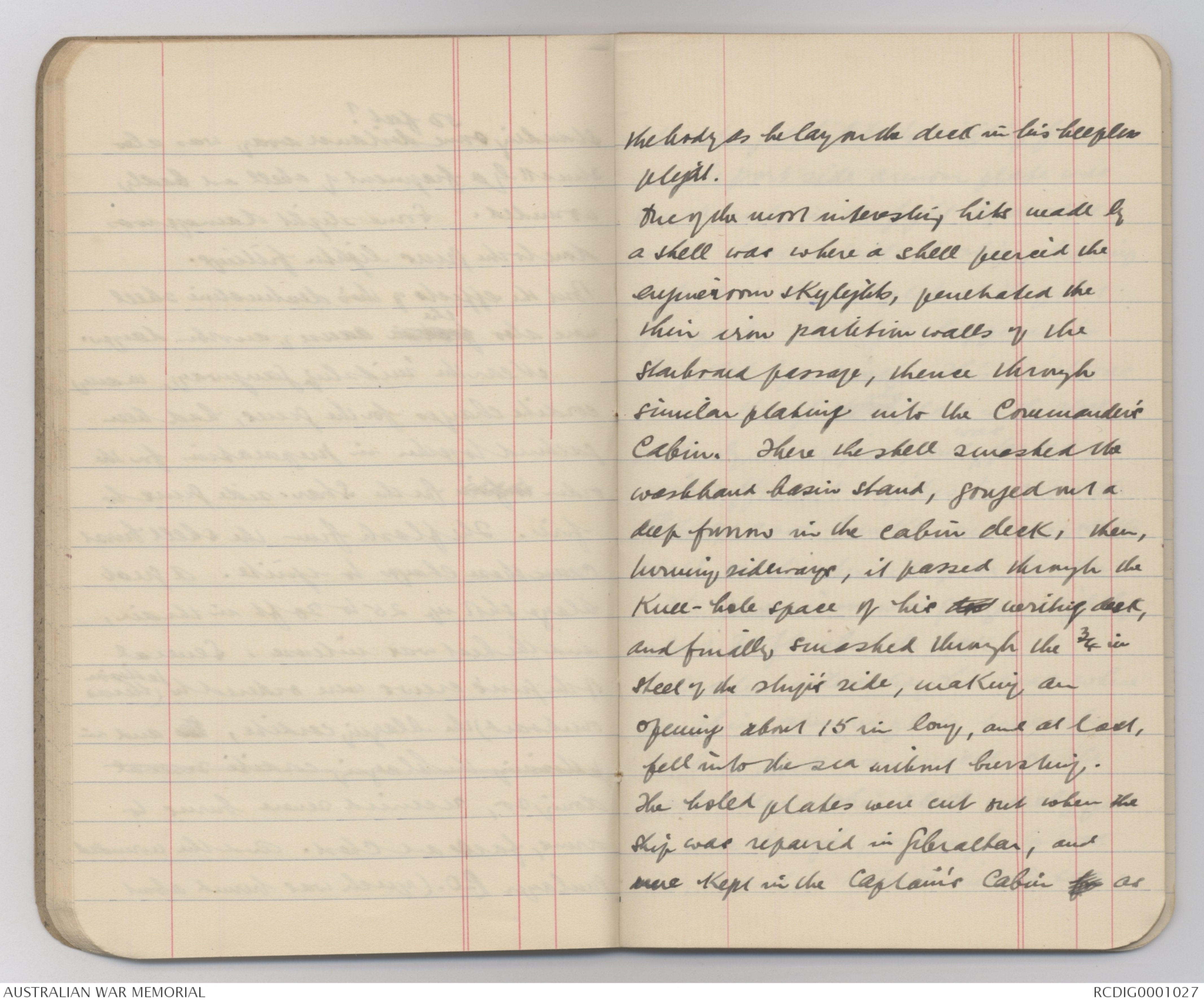
the body as he lay in the deck in his helpless
plight.
One of the most interesting hits made by
a shell was where a shell pierced the
engineroom skylights, penetrated the
thin iron partition walls of the
starboard passage, thence through
similar plating into the Commander's
Cabin.There the shell smashed the
washhand basin stand, gouged out a
deep furrow in the cabin deck, then,
turning sideways, it passed through the
Knee-hole space of his des writing desk,
and finally smashed through the ¾ in
steel of the ship's side, making an
opening about 15 in long, and at last,
fell into the sea without bursting.
The holed plates were cut out when the
ship was repaired in Gibraltar, and
were kept in the Captain's Cabin for as
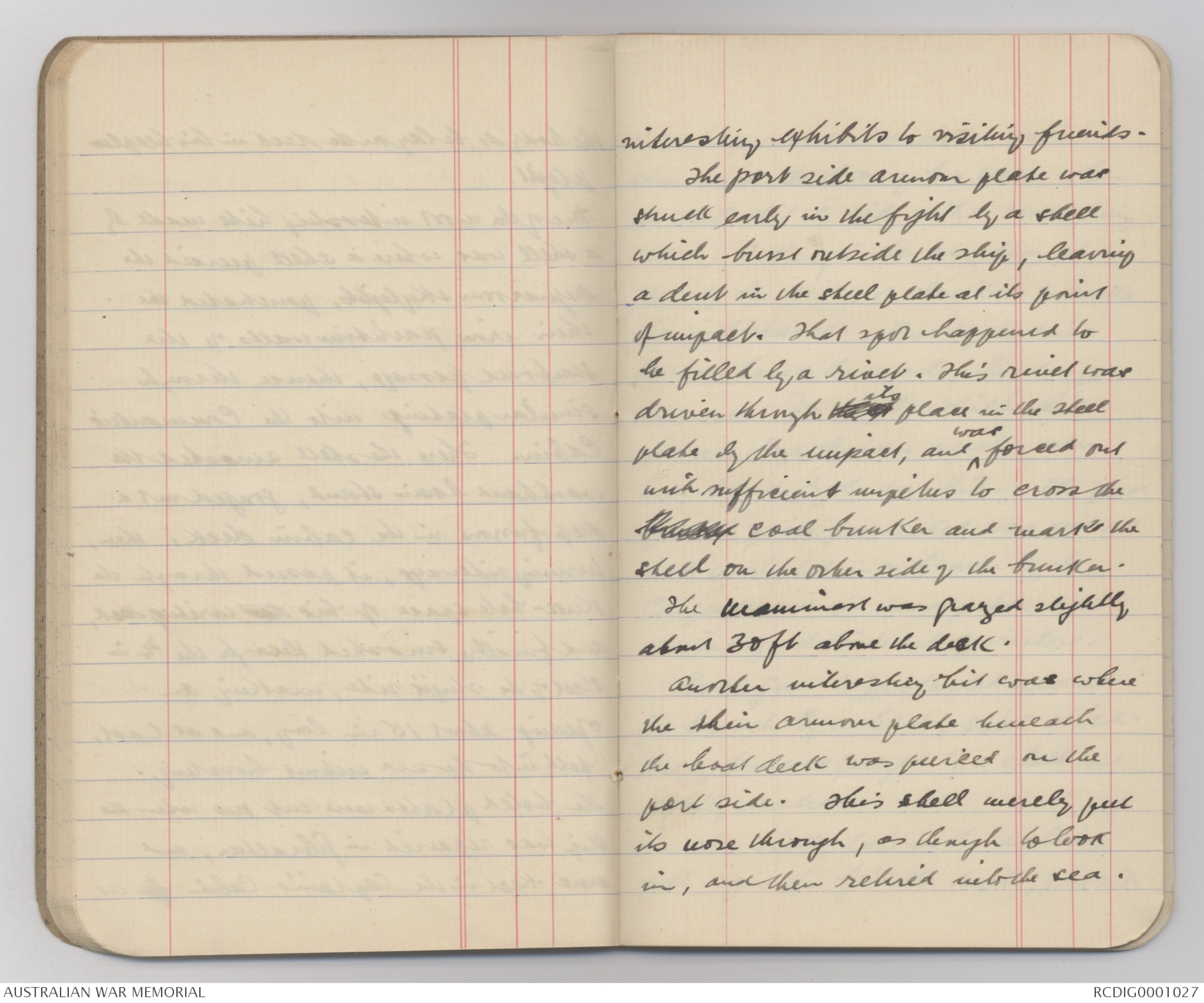
interesting exhibits to visiting friends.
The port side armour plate was
struck early in the fight by a shell
which burst outside the ship, leaving
a dent in the steel plate at its point
of impact.That spot happened to
be filled by a rivet. This rivet was
driven through the st its place in the steel
plate by the impact, and ∧ was forced out
with sufficient impetus to cross the
bunker coal bunker and mark the
steel on the other side of the bunker.
The mainmast was grazed slightly
about 30ft above the deck.
Another interesting bit was where
the thin armour plate beneath
the boat deck was pierced on the
port side.This shell merely put
its nose through, as though to look
in, and then retired into the sea.
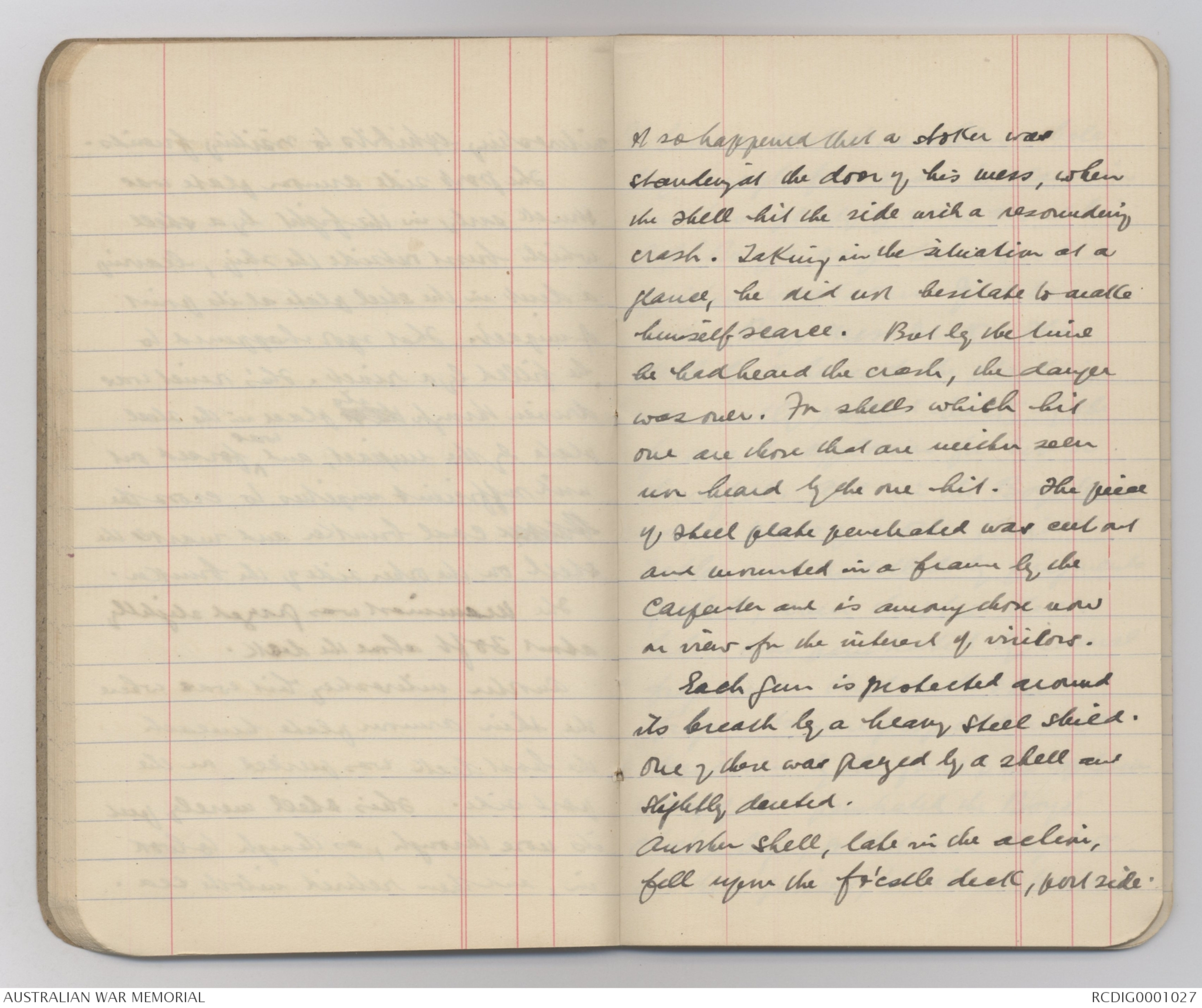
It so happened that a stoker was
standing at the door of his mess, when
the shell hit the side with a resounding
crash.Taking in the situation at a
glance, he did not hesitate to make
himself scarce. But by the time
he had heard the crash, the danger
was over. For shells which hit
one are those that are neither seen
un heard by the one hit. The piece
of shell plate penetrated was cut out
and mounted in a frame by the
carpenter and is among those now
on view for the interest of visitors.
Each gun is protected around
its breach by a heavy steel shield.
One of these was grazed by a shell and
slightly dented.
Another shell, late in the action,
fell upon the fo'cstle deck, port side.
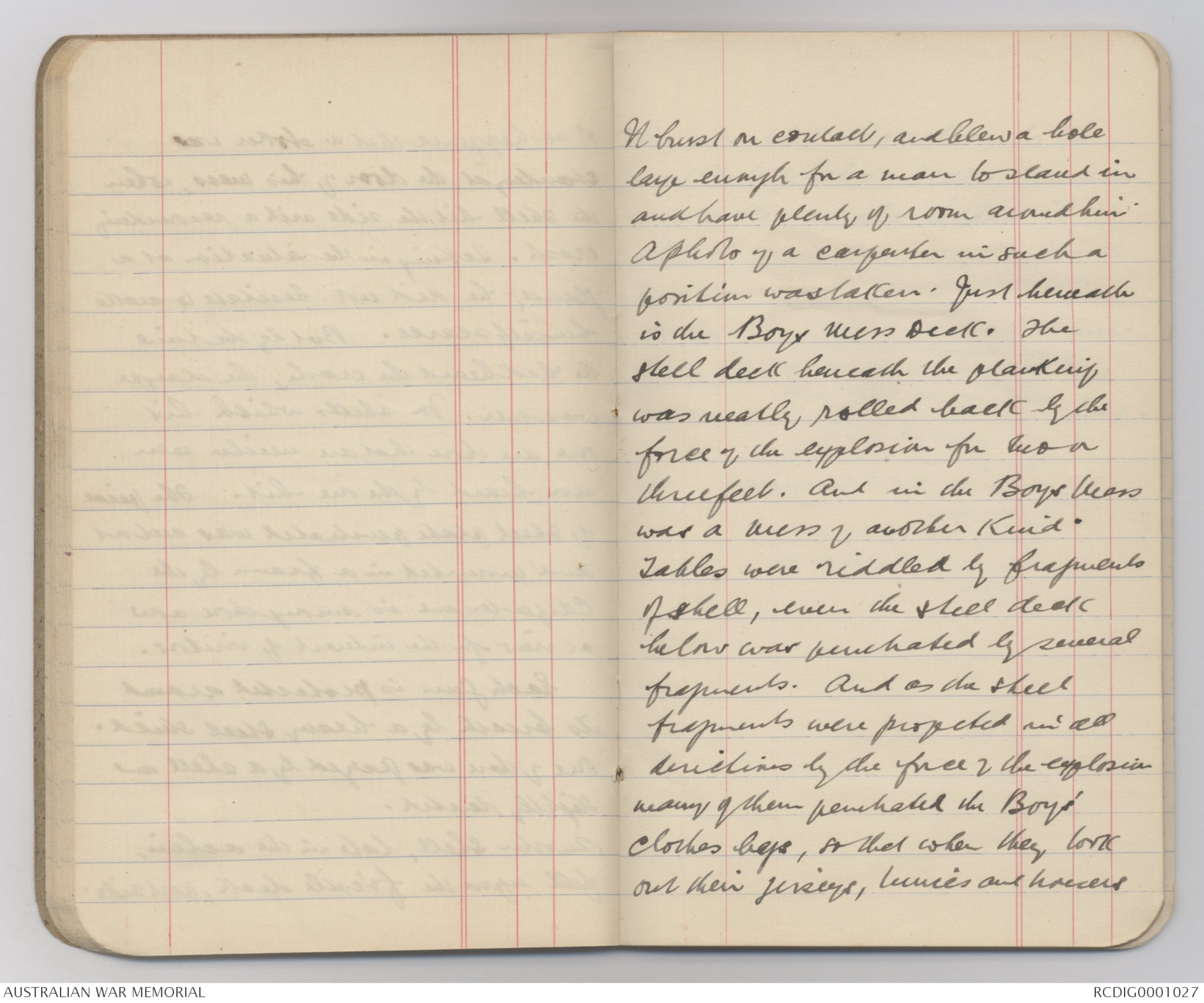
It burst on contact, and blew a hole
large enough for a man to stand in
and have plenty of room around him
A photo of a carpenter in such a
position was taken. Just beneath
is the Boy's Mess Deck. The
steel deck beneath the planking
was neatly rolled back by the
force of the explosion for two or
three feet. And in the Boys Mess
was a mess of another kind.
Tables were riddled by fragments
of shell, even the steel deck
below was penetrated by several
fragments. And as the steel
fragments were projected in all
directions by the force of the explosion
many of them penetrated the Boy's
clothes bags, so that when they took
out their jerseys,tunics and trousers
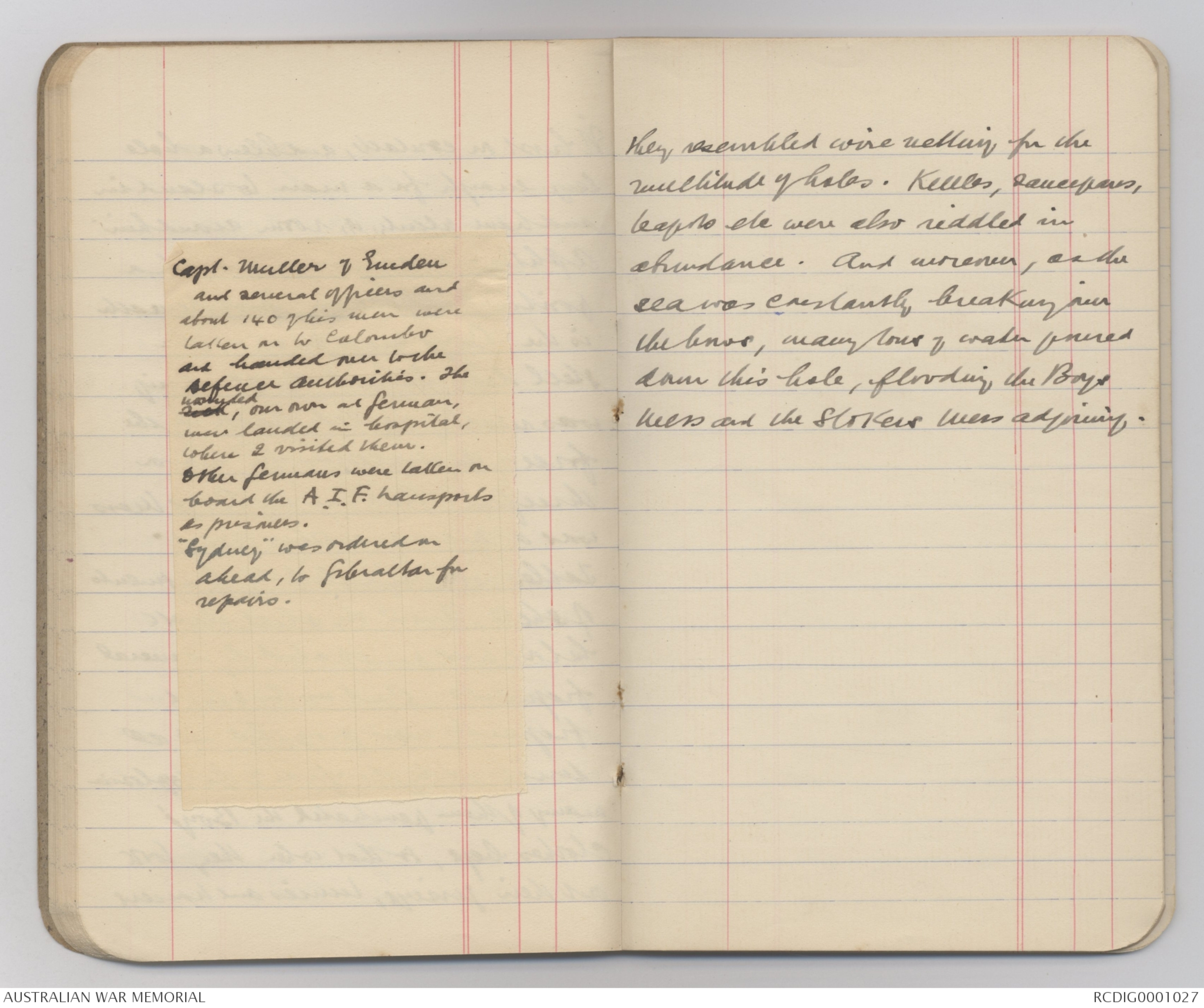
Capt. Muller of Emden
and several officers and
about 140 of his men were
taken on to Colombo
and handed over to the
Defence authorities. The
sick wounded, our own and German,
were landed in hospital
where I visited them.
Other Germans were taken on
board the A.I.F. transports
as prisoners.
"Sydney" was ordered on
ahead, to Gibraltar for
repairs.
they resembled wire netting for the
multitude of holes. Kettles,saucepans,
teapots etc were also riddled in
abundance. And moreover, as the
sea was constantly breaking over
the bows, many tons of water poured
down this hole, flooding the Boys
Mess and the Stokers mess adjoining.
 AW AWM
This transcription item is now locked to you for editing. To release the lock either Save your changes or Cancel.
This lock will be automatically released after 60 minutes of inactivity.