
Notebook 1 of Vivian Agincourt Spence Little, 1914- Part 2
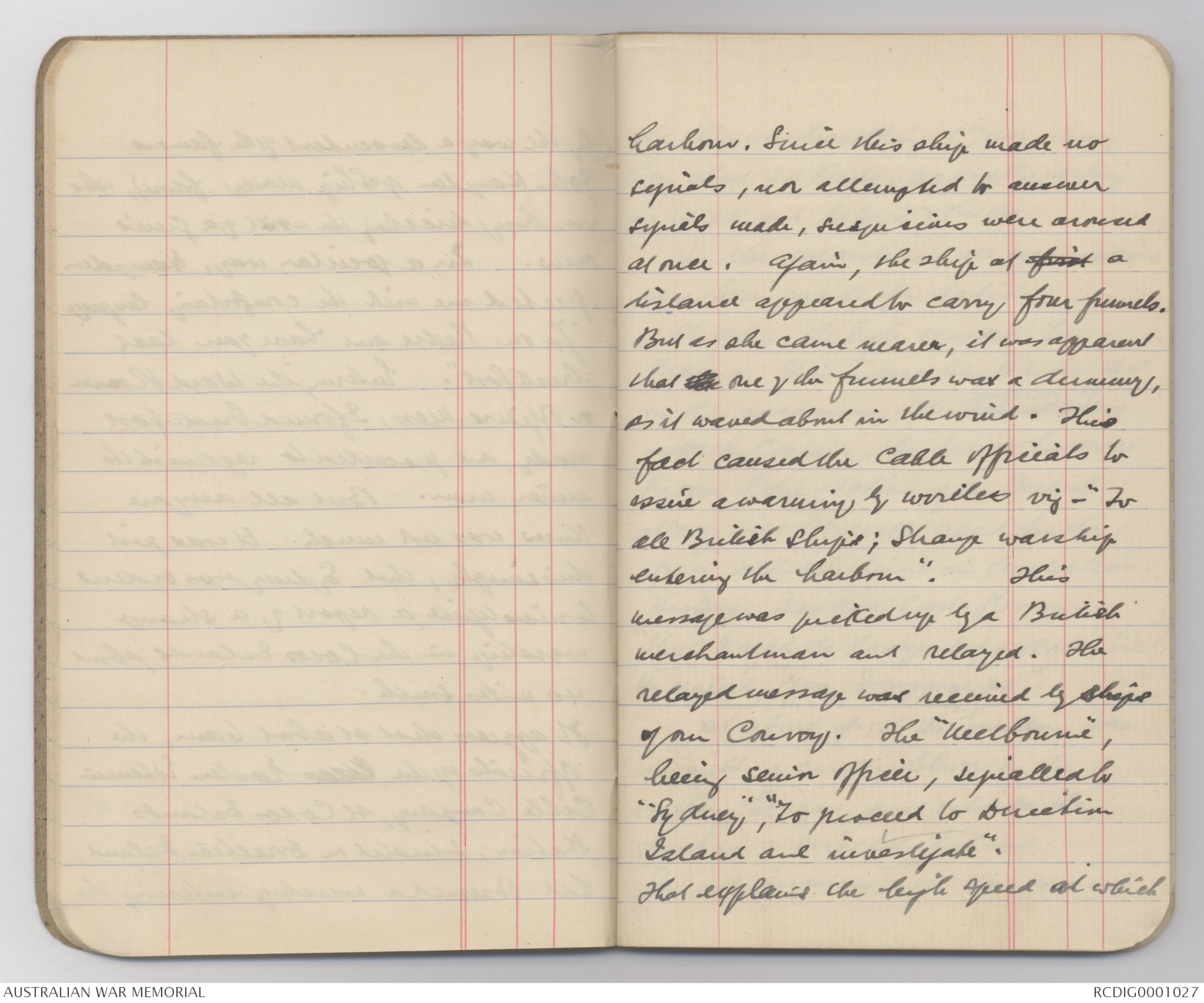
harbour. Since this ship made no
signals, nor attempted to answer
signals made, suspicions were aroused
at once. Again, the ship at first a
distance appeared to carry four funnels.
But as she came nearer, it was apparent
that the one of the funnels was a dummy,
as it waved about in the wind. This
fact caused the cable officials to
issue a warning by wireless viz - " To
all British Ships; Strange warship
entering the harbour". This
message was picked up by a British
merchantman and relayed. The
relayed message was received by ships
of our Convoy. The "Melbourne",
being senior officer, signalled to
"Sydney", "To proceed to Direction
Island and investigate".
That explains the high speed at which
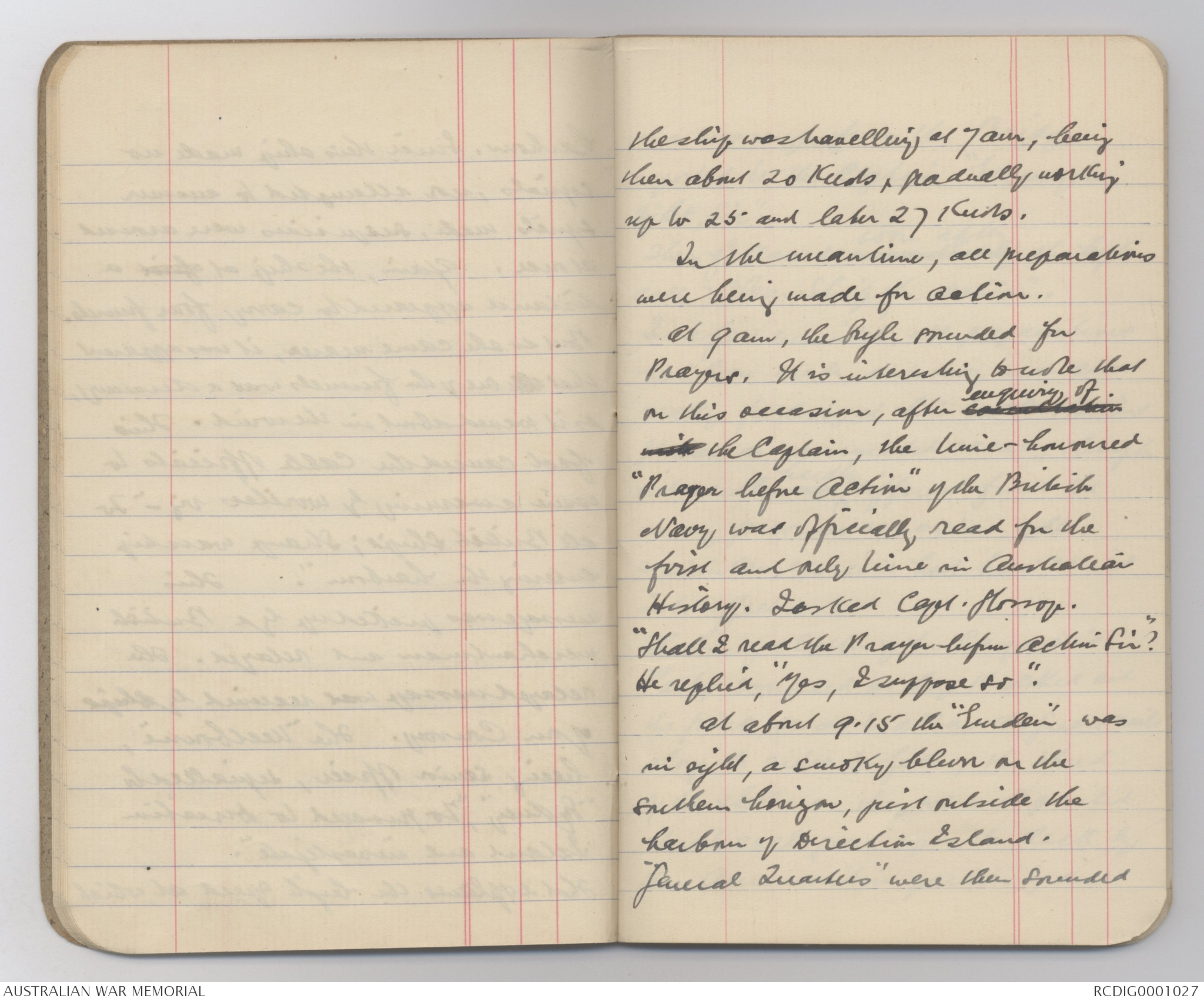
the ship was travelling at 7am, being
then about 20 Knots & gradually working
up to 25 and later 27 Knots.
In the meantime, all preparations
were being made for action.
At 9am, the bugle sounded for
Prayers. It is interesting to note that
on this occasion, after consultation enquiry ofwith the Captain, the time-honoured
"Prayer before Action" of the British
Navy was officially read for the
first and only time in Australian
History. I asked Capt. Glossop.
"Shall I read the Prayer before Action Sir?"
He replied "Yes, I suppose so".
at about 9.15 the "Emden" was
in sight, a smoky blurr on the
southern horizon, just outside the
harbour of Direction Island.
"General Quarters" were then sounded
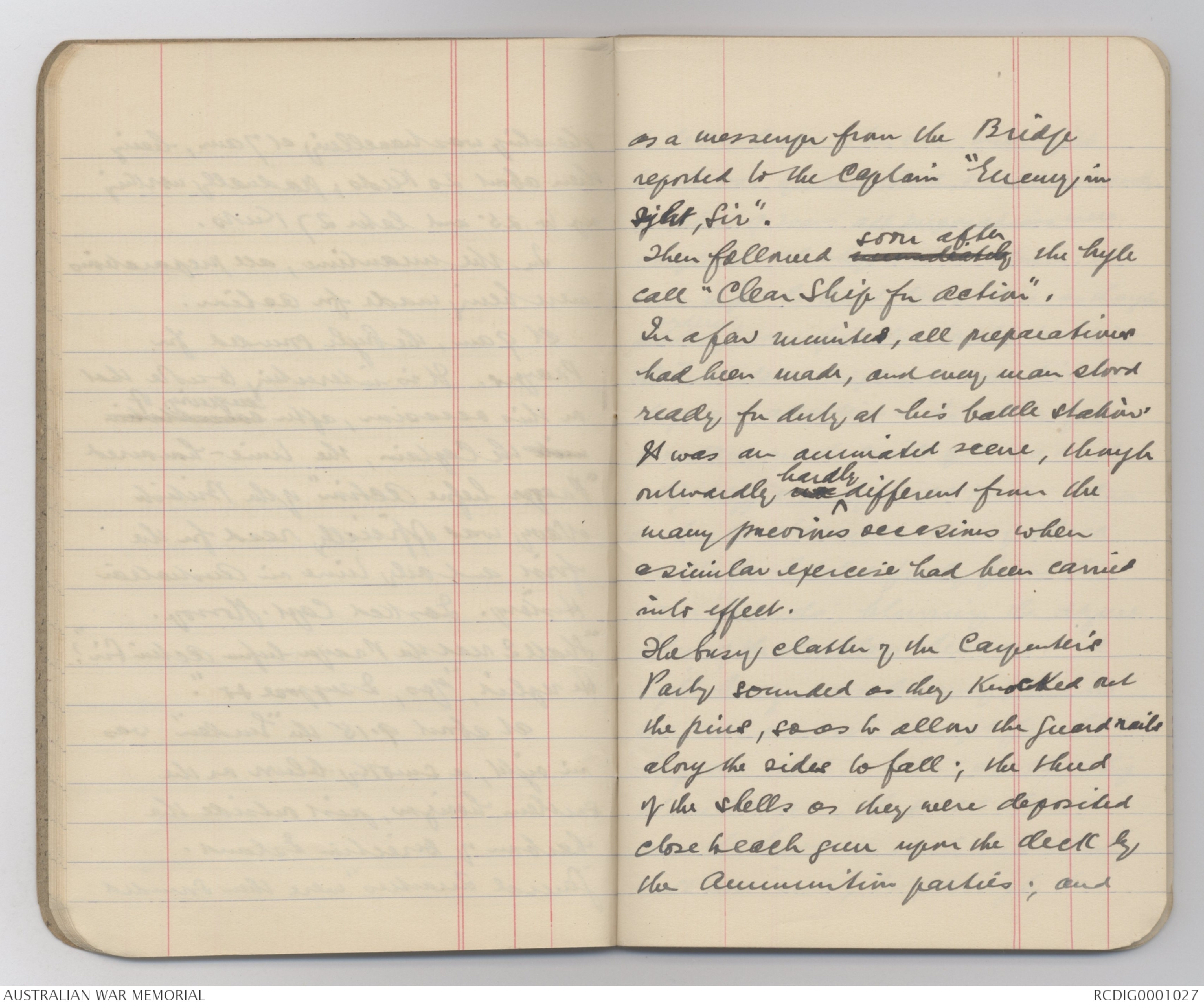
as a messenger from the Bridge
reported to the Captain "Enemy in
sight, Sir".
Then followed immediately soon after the bugle
call "Clear Ship for action".
In a few minutes, all preparations
had been made, and every man stood
ready for duty at his battle station.
It was an animated scene, though
outwardly no ^ hardly different from the
many previous occasions when
a similar exercise had been carried
into effect.
The busy clatter of the Carpenter's
Party sounded as they knocked out
the pins, so as to allow the guard rails
along the sides to fall; the thud
of the shells as they were deposited
close to each gun upon the deck by
the Ammunition parties; and
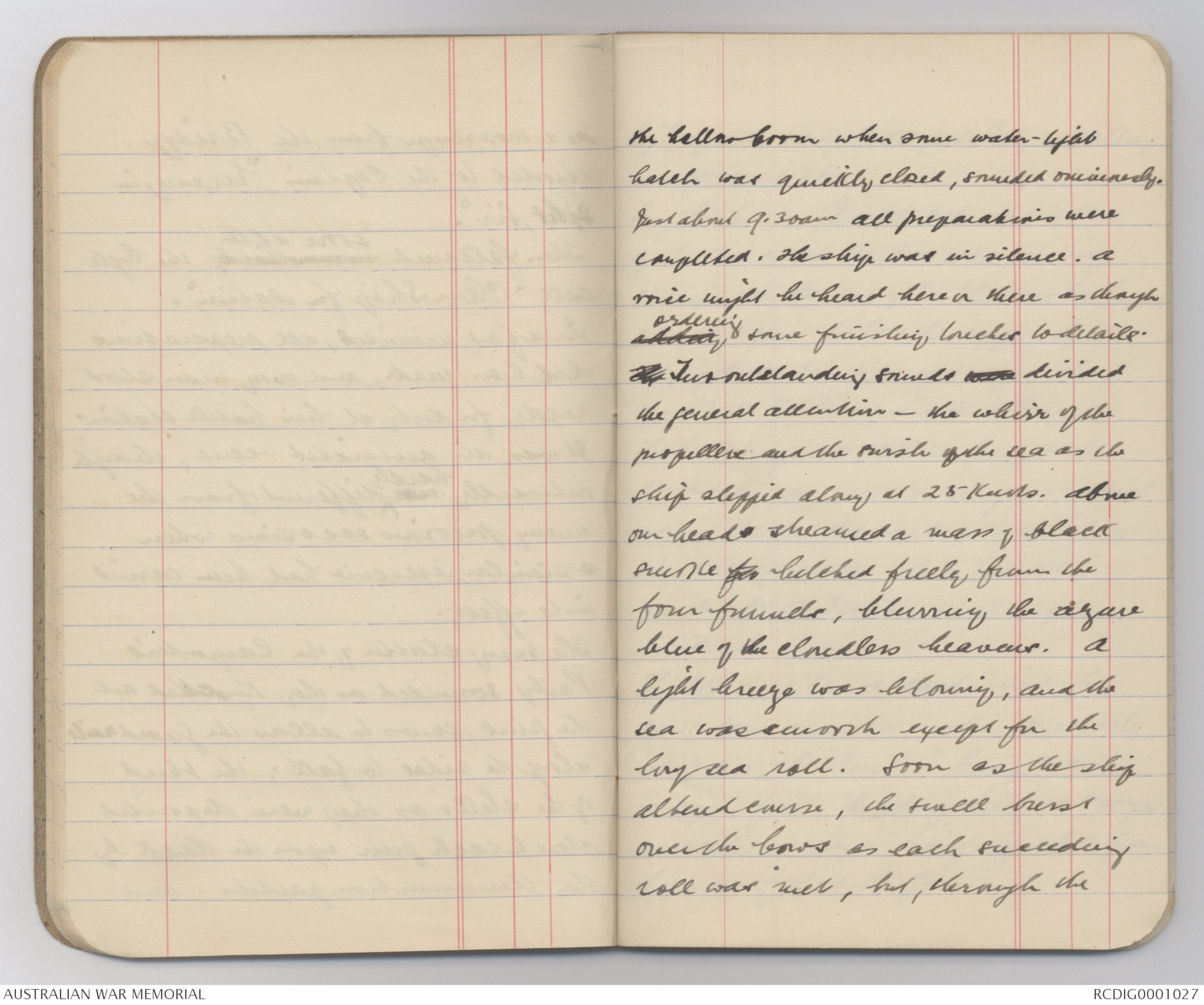
the hollow boom when some water-lifted
hatch was quickly closed, sounded ominously.
Just about 9.30am all preparations were
completed. The ship was in silence. A
voice might be heard here or there as thoughadding ordering some finishing touches to details.Th Two outstanding sounds were divided
the general attention - the whirr of the
propellers and the swish of the sea as the
ship slipped along at 25 knots. Above
our heads streamed a mass of black
smoke fre belched freely from the
four funnels, blurring the azure
blue of the cloudless heavens. A
light breeze was blowing, and the
sea was smooth except for the
long sea roll. Soon as the ship
altered course, the swell burst
over the bows as each suceeding
roll was met, but, through the
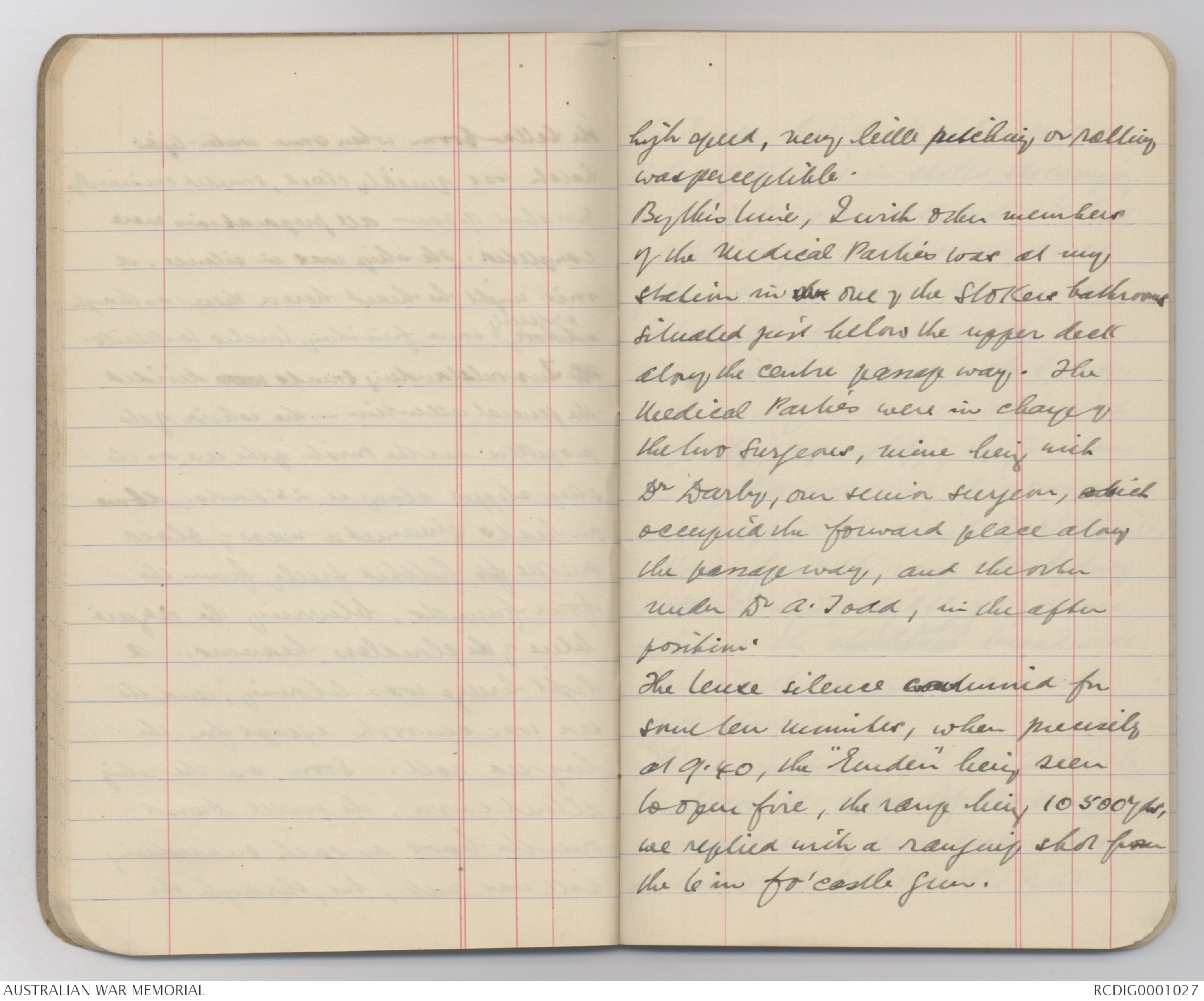
high speed, very little pitching or rolling
was perceptible.
By this time, I with other members
of the Medical Parties was at my
station in the one of the Stokers bathrooms
situated just below the upper deck
along the centre passage way. The
Medical Parties were in charge of
the two surgeons, mine being with
Dr Darby, our senior surgeon, which
occupied the forward place along
the passage way, and the other
under Dr A. Todd, in the after
position.
The tense silence continued for
some ten minutes, when precisely
at 9.40, the "Emden" being seen
to open fire, the range being 10500 yards,
we replied with a ranging shot from
the 6 in fo'castle gun.
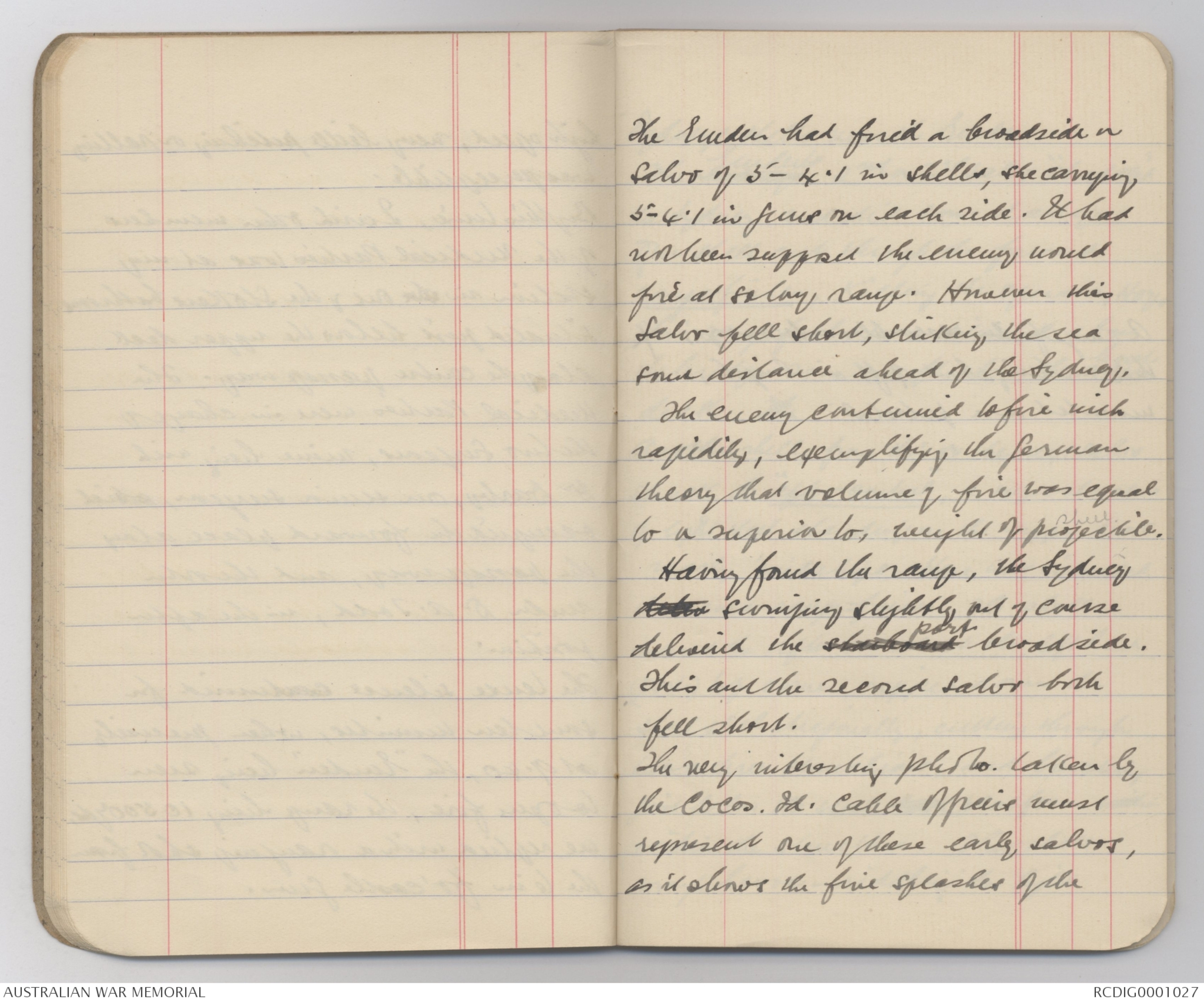
The Emden had fired a broadside or
salvo of 5-4.1 in shells, she carrying
5-4.1 in guns on each side. It had
not been supposed the enemy would
fire at so long range. However this
salvo fell short, striking the sea
some distance ahead of the Sydney.
The enemy continued to fire with
rapidity, exemplifying the German
theory that volume of fire was equal
to a superior to, weight of shell projectile
Having found the range, the Sydney
lobed swinging slightly out of course
delivered the starboard port broadside.
This and the second salvo both
fell short.
The very interesting photo. taken by
the Cocos. Id. Cable Officer must
represent one of these early salvos,
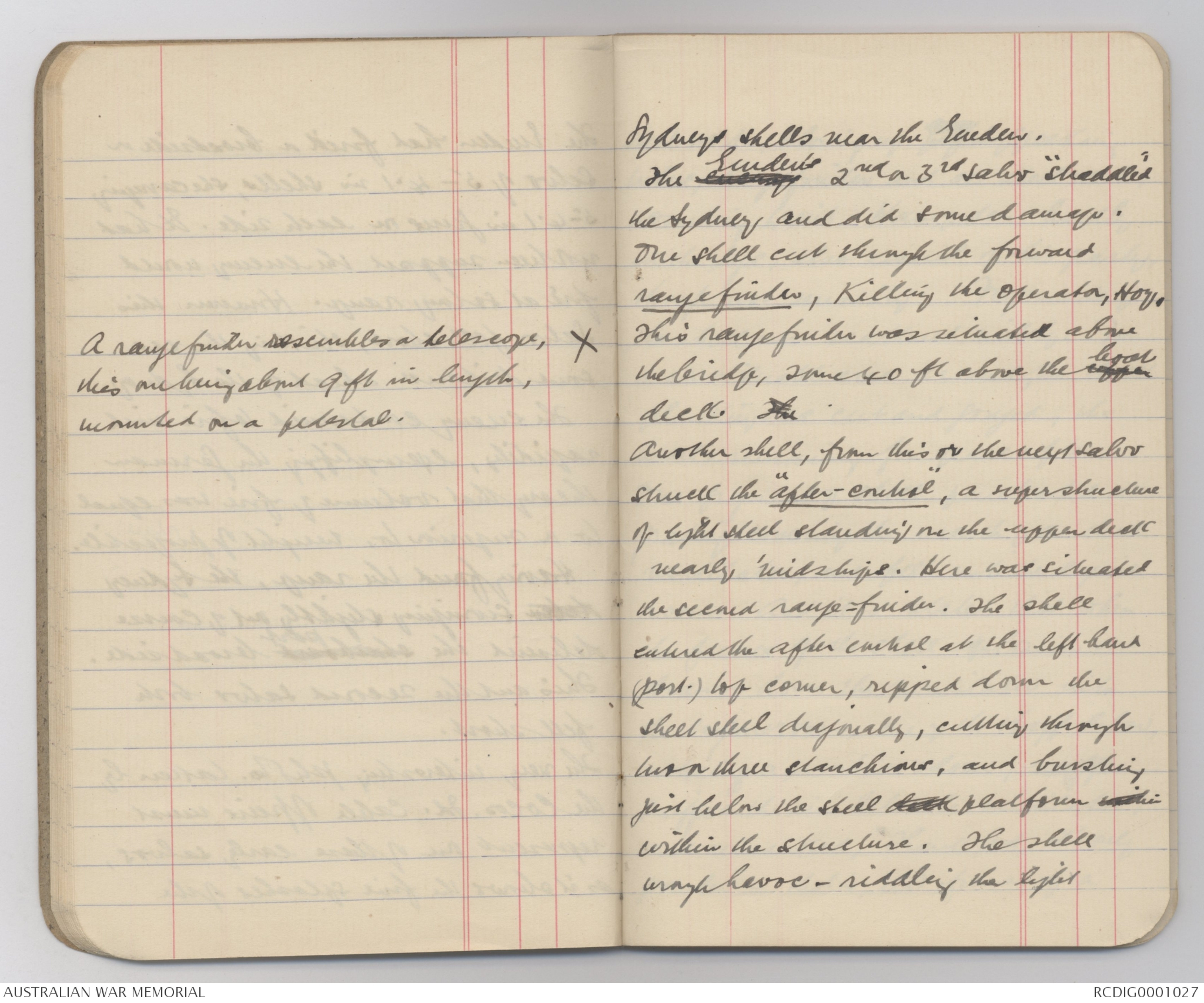
as it shows the five splashes of the
Sydneys shells near the Emden.
The enemys Emden's 2nd or 3rd salvo "straddled"
the Sydney and did some damage.
One shell cut through the forward
rangefinder, killing the operator, Hoy.
[* A rangefinder resembles a telescope, X
this one being about 9 ft in length,
mounted on a pedestal. *]
This rangefinder was situated above
the bridge, some 40 ft above the upper boat
deck. The
Another shell, from this or the next salvo
struck the "after-control", a superstructure
of light steel standing on the upper deck
nearly 'midships. Here was situated
the second range-finder. The shell
entered the after control at the left back
(port) top corner, ripped down the
sheet steel diagonally, cutting through
two or three stanchions, and bursting
just below the steel deck platform within
within the structure. The shell
wrought havoc - riddling the light
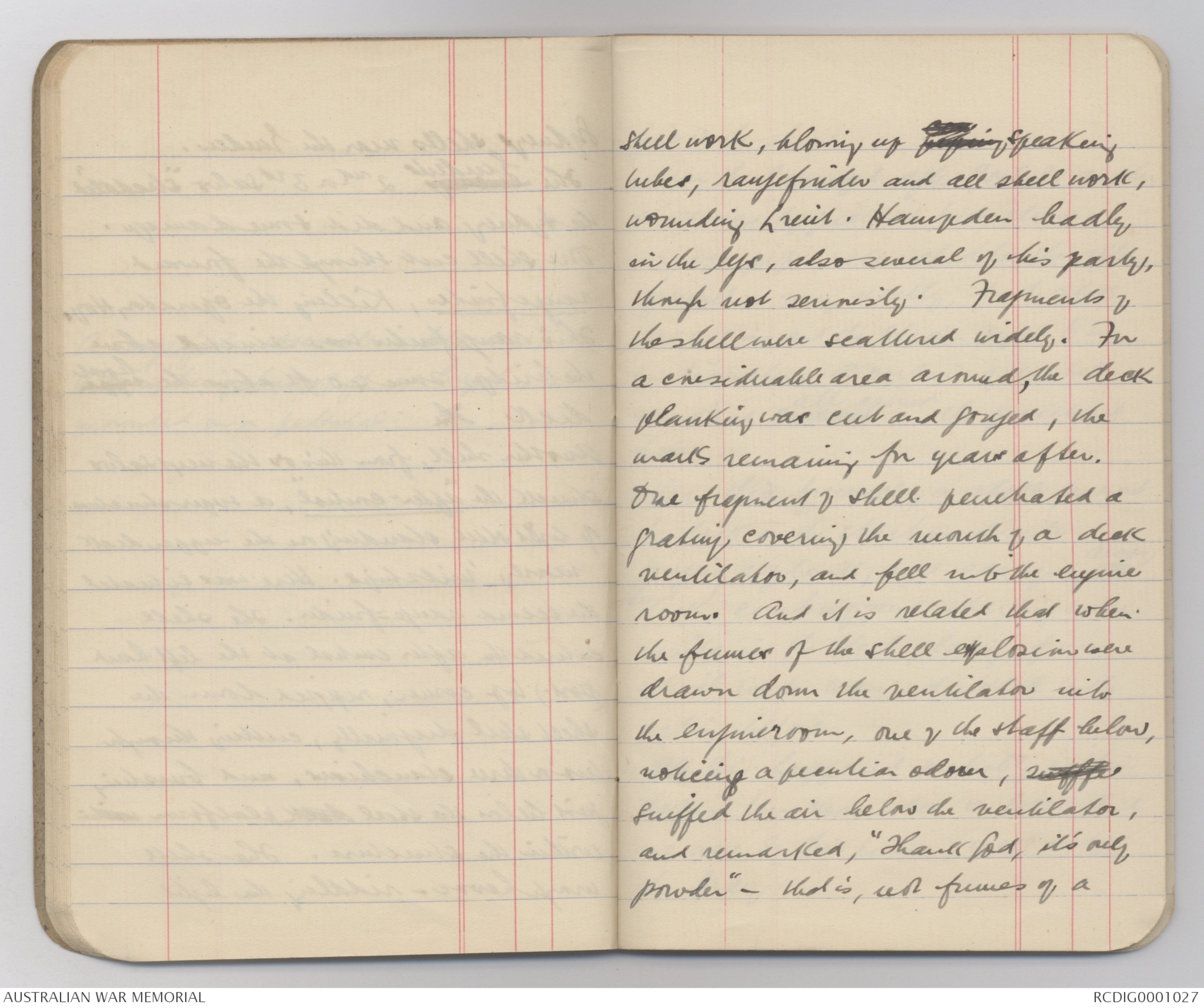
steel work, blowing up con piping speaking
tubes, rangefinder and all steel work,
wounding Lieut. Hampden badly
in the legs, also several of his party,
though not seriously. Fragments of
the shell were scattered widely. For
a considerable area around, the deck
planking was cut and gouged, the
marks remaining for years after.
One fragment of shell penetrated a
grating covering the mouth of a deck
ventilator, and fell into the engine
room. And it is related that when
the fumes of the shell explosion were
drawn down the ventilator into
the engine room, one of the staff below,
noticing a peculiar odour, sniffe
sniffed the air below the ventilator,
and remarked, "Thank God, it's only
powder" - that is, not fumes of a
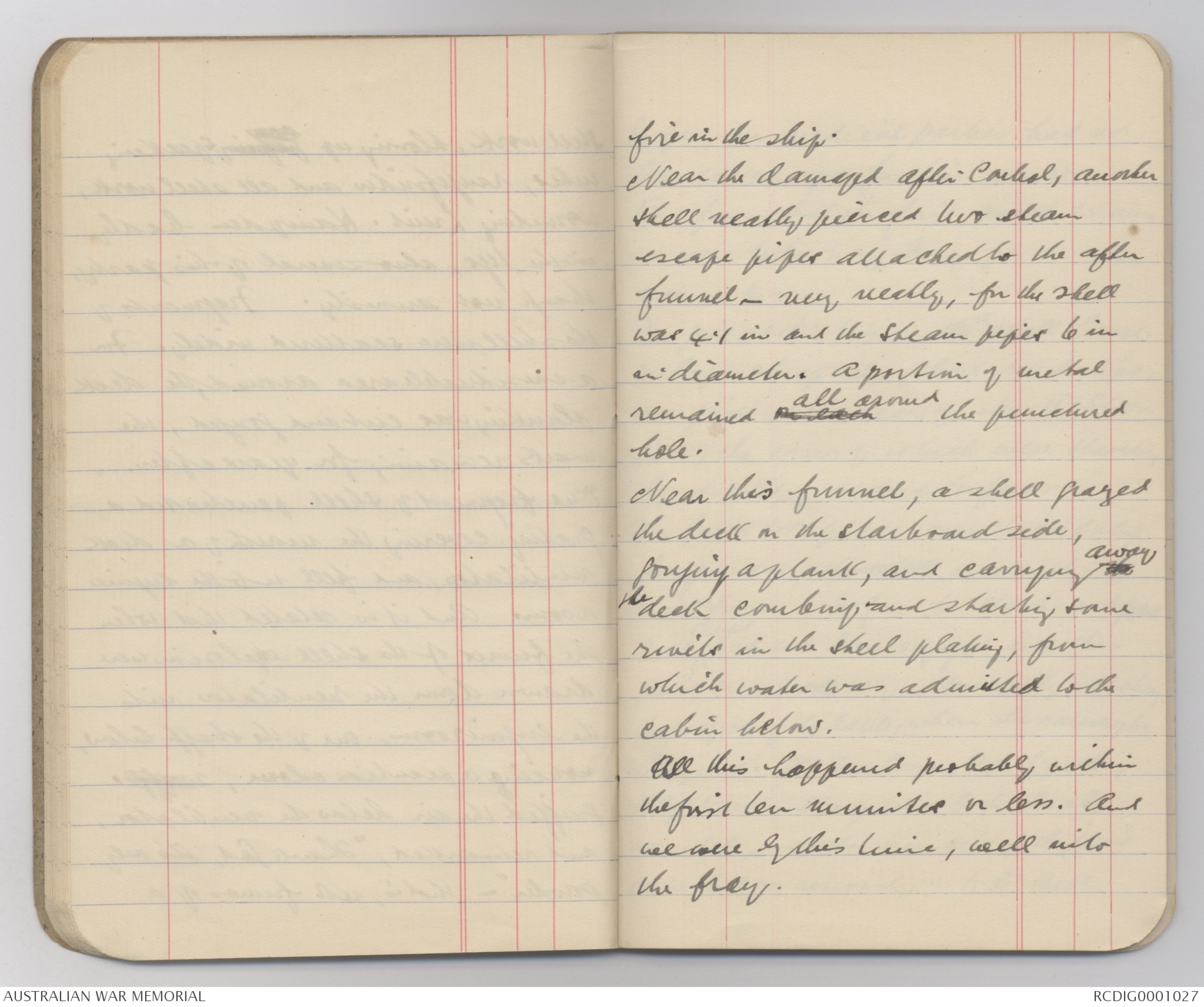
fire in the ship.
Near the damaged after-control, another
shell neatly pierced two steam
escape pipes attached to the after
funnel - very neatly, for the shell
was 4.1 in and the steam pipes 6 in
in diameter. A portion of metal
remained on each all around the punctured
hole.
Near this funnel, a shell grazed
the deck on the starboard side,
gouging a plank, and carrying the away
the deck combing and starking some
rivits in the steel plating, from
which water was admitted to the
cabin below.
All this happened probably within
the first ten minutes or less. But
we were by this time, well into
the fray.
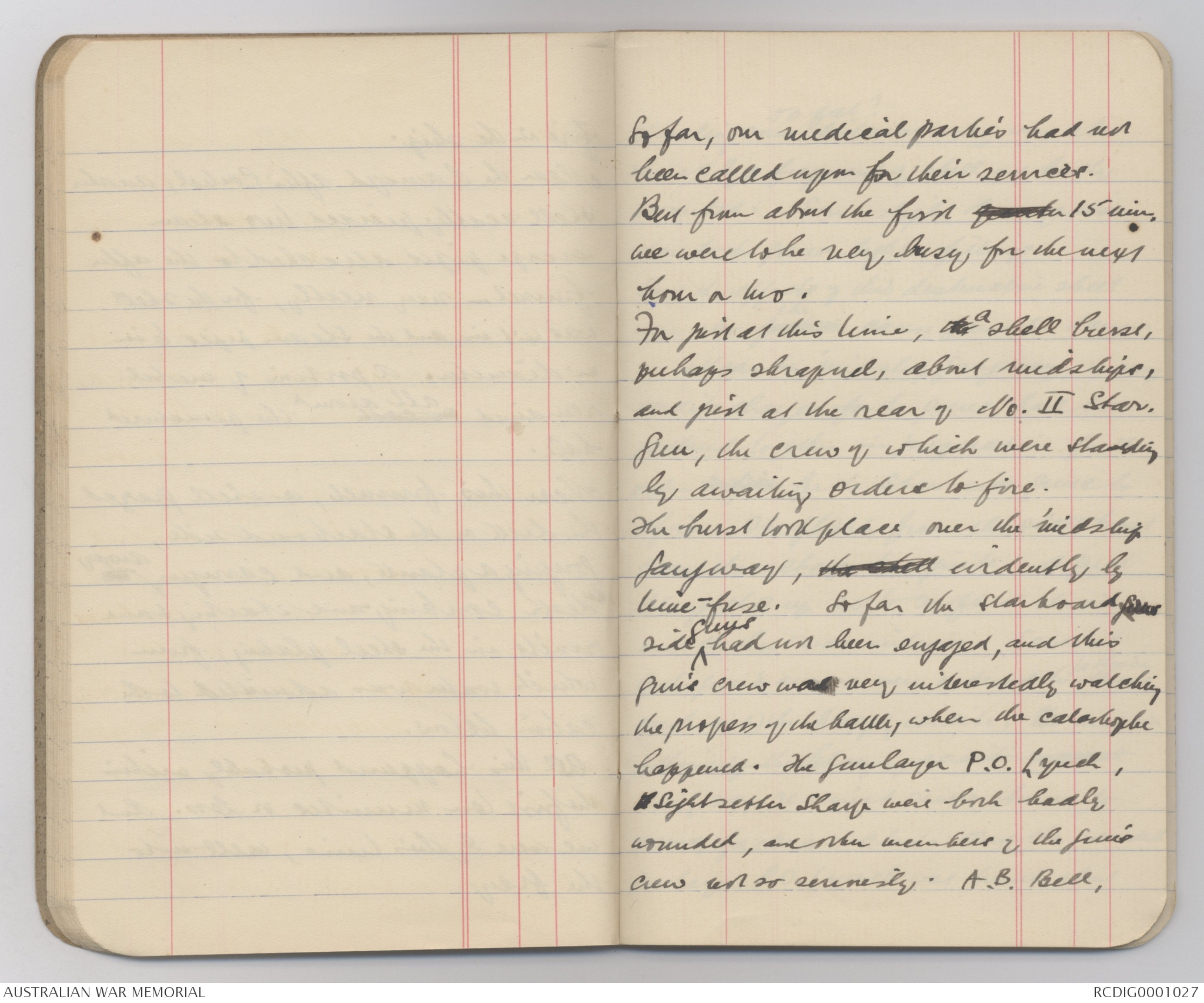
So far, our medical parties had not
been called upon for their services.
But from about the first quarter 15 min,
we were to be very busy for the next
hour or two.
For just at this time, the a shell burst,
perhaps shrapnel, about midships,
and just at the rear of No. II Star.
Gun, the crew of which were standing
by awaiting orders to fire.
The burst took place near the 'midship
gangway, the shell evidently by
time-fuse. So far the starboard guns
side ∧ guns had not been engaged, and this
gun's crew was very interestedly watching
the progress of the battle, when the catastrophe
happened. The fuselayer P.O. Lynch,
Sightsetter Sharp were both badly
wounded, and other members of the gun's
crew not so seriously. A.B. Bell,
 Loretta Corbett
This transcription item is now locked to you for editing. To release the lock either Save your changes or Cancel.
This lock will be automatically released after 60 minutes of inactivity.