
Notebook 1 of Vivian Agincourt Spence Little, 1914- Part 1
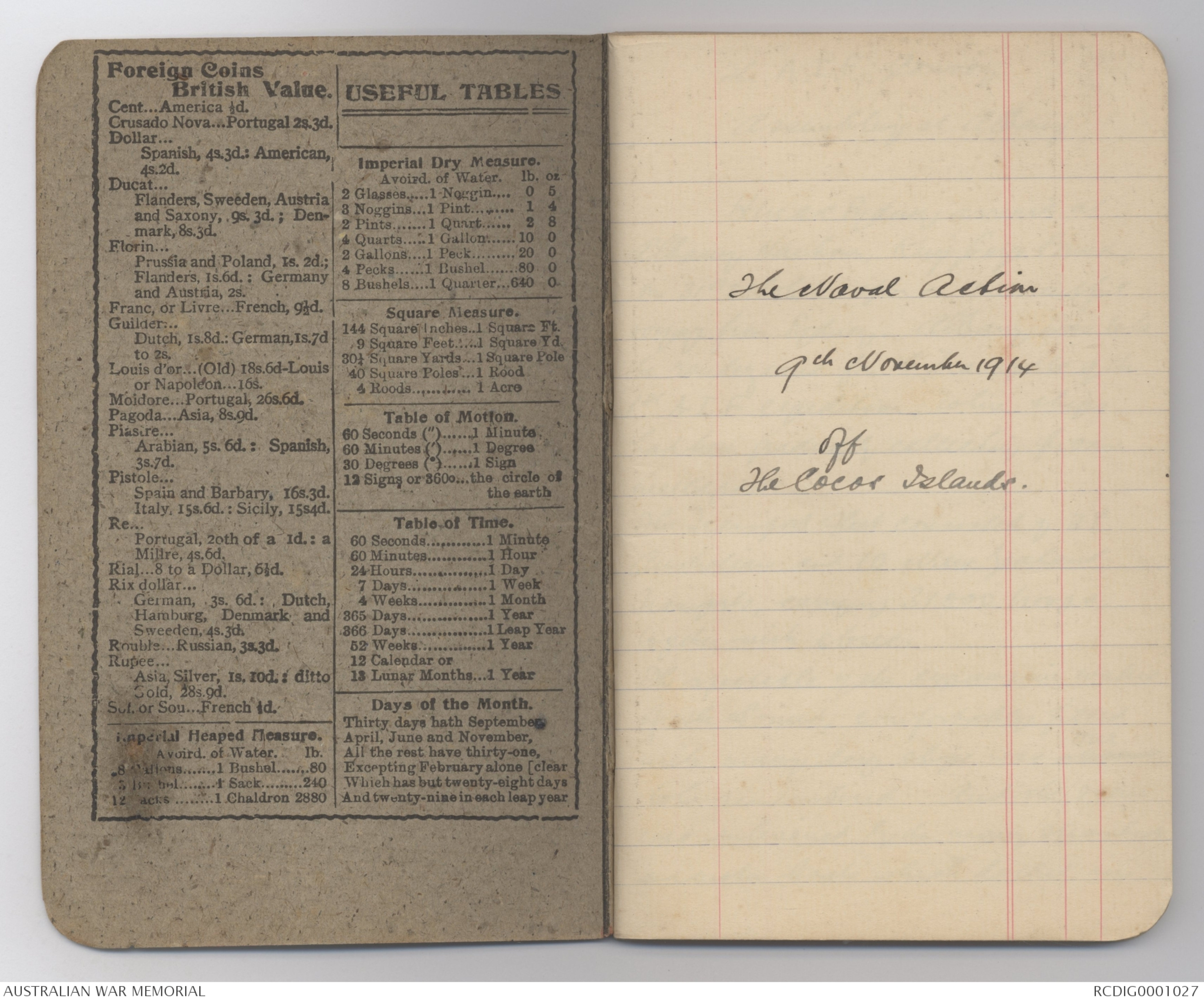
The Naval Action
9th November 1914
off
The Cocos Islands.
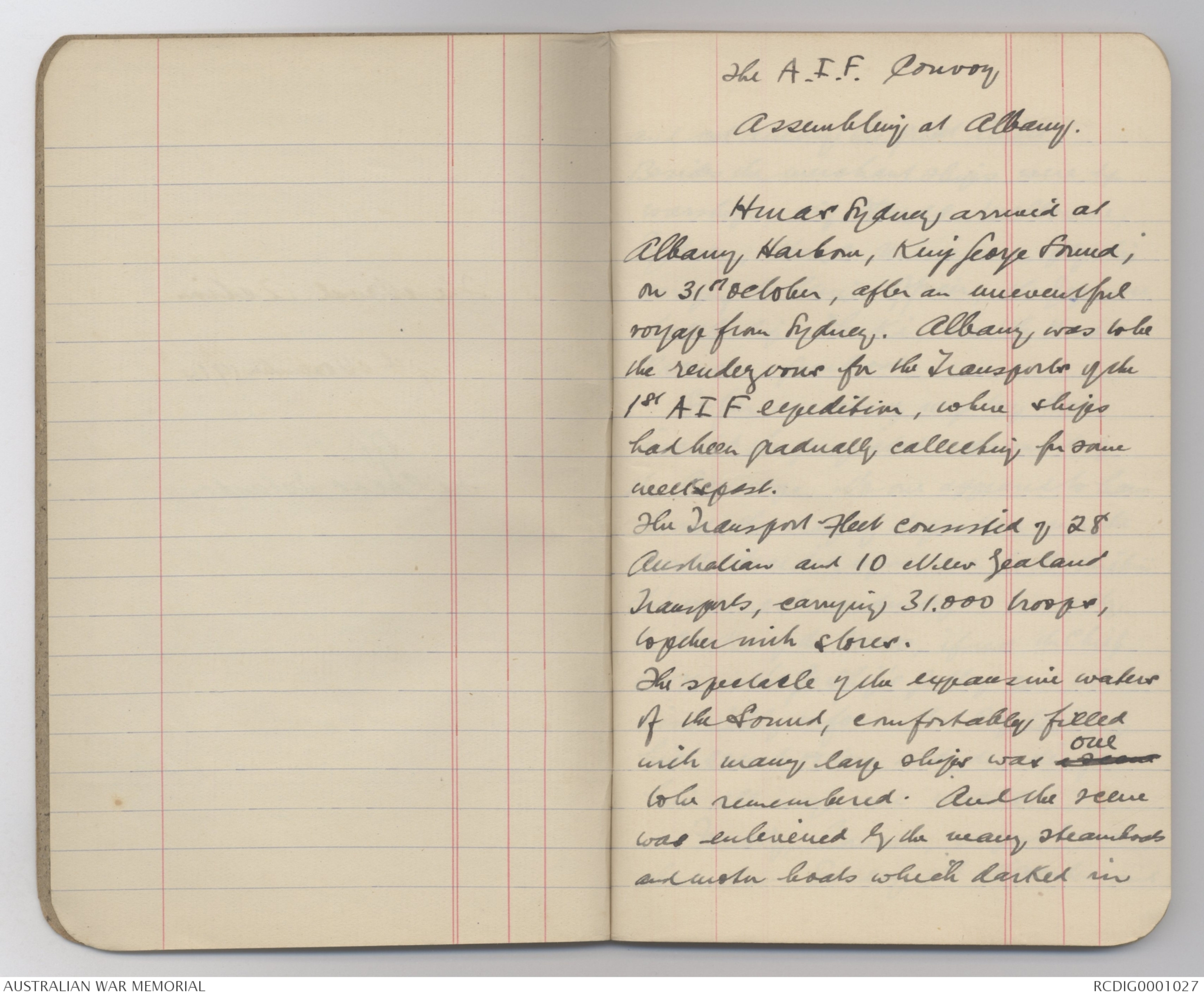
The A.I.F. Convoy
Assembling at Albany.
HMAS Sydney arrived at
Albany Harbour, King George Sound,
on 31st October, after an uneventful
voyage from Sydney. Albany was to be
the rendezvous for the Transports of the
1st AIF expedition, where ships
had been gradually collecting for some
weeks past.
The Transport Fleet consisted of 28
Australian and 10 New Zealand
Transports, carrying 31.000 troops,
together with stores.
The spectacle of the expansive waters
of the Sound, comfortably filled
with many large ships was a decent one
to be remembered. And the scene
was enlivened by the many steamboats
and motor boats which darted in
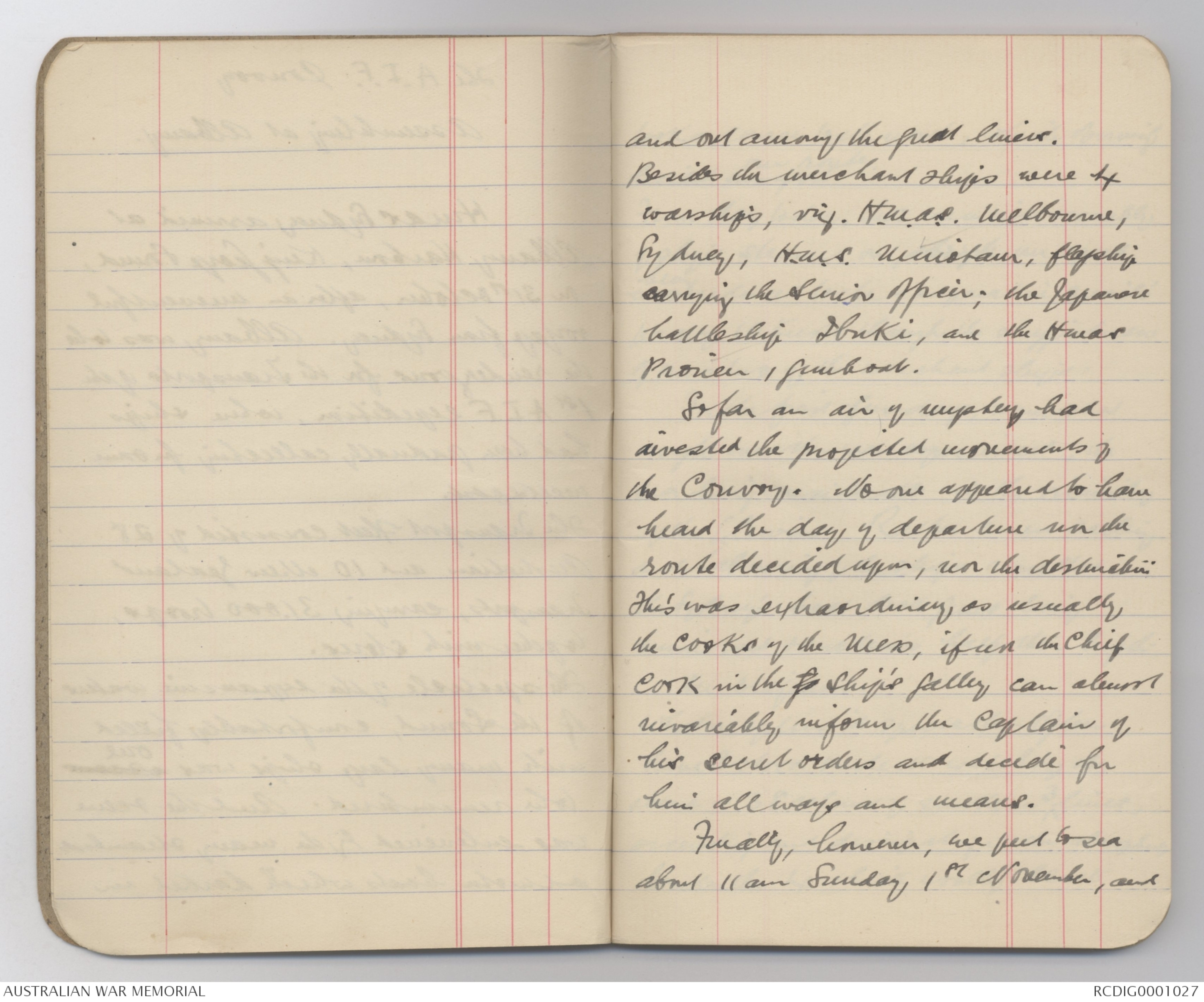
and out among the great liners.
Besides the merchant ships were 4
warships, viz. H.M.A.S. Melbourne,
Sydney, H.M.S. Minotaur, flagship
carrying the Senior Officer; the Japanese
battleship Ibuki, and the HMAS
Pioneer, gunboat.
So far an air of mystery had
invested the projected movements of
the Convoy. No one appeared to have
heard the day of departure nor the
route decided upon, nor the destination.
This was extraordinary as usually
the Cooks of the Mess, if not the Chief
Cook in the g Ship's galley can almost
invariably inform the Captain of
his secret orders and decide for
him all ways and means.
Finally, however, we put to sea
about 11am Sunday 1st November, and
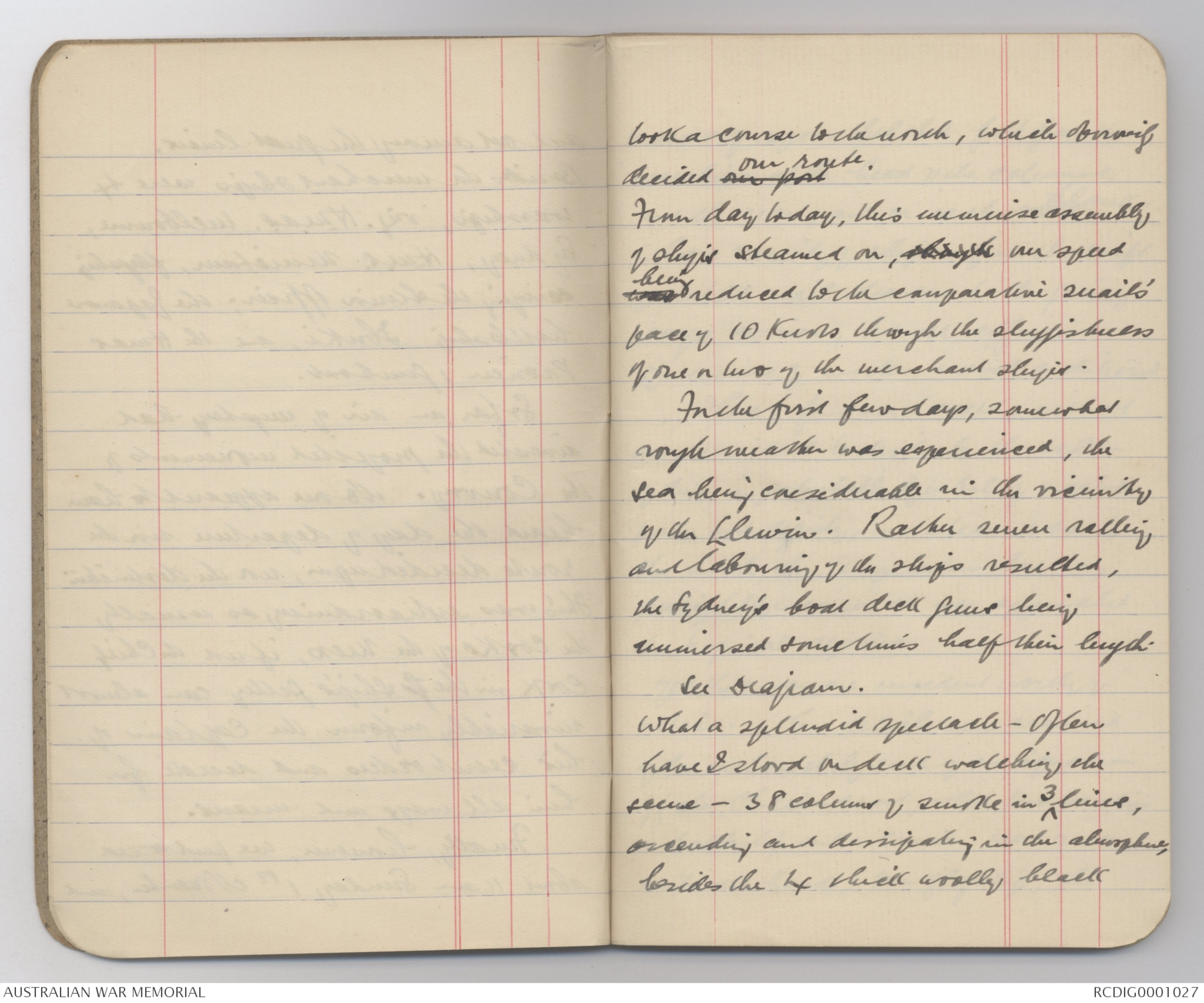
took a course to the north, which obviously
decided our port our route.
Fine day to day, this immense assembly
of ships steamed on, though our speedwas being reduced to the camparative snail's
pace of 10 Knots through the sluggishness
of one or two of the merchant ships.
For the first few days, somewhat
rough weather was experienced, the
sea being considerable in the vicinity
of the Llewin. Rather severe rolling
and labouring of the ships resulted,
the Sydney's boat deck guns being
immersed sometimes half their length
See Diagram.
What a splendid spectacle - Often
have I stood on deck watching the
scene - 38 columns of smoke in ^3 lines,
ascending and dissipating in the atmosphere,
besides the 4 thick woolly black
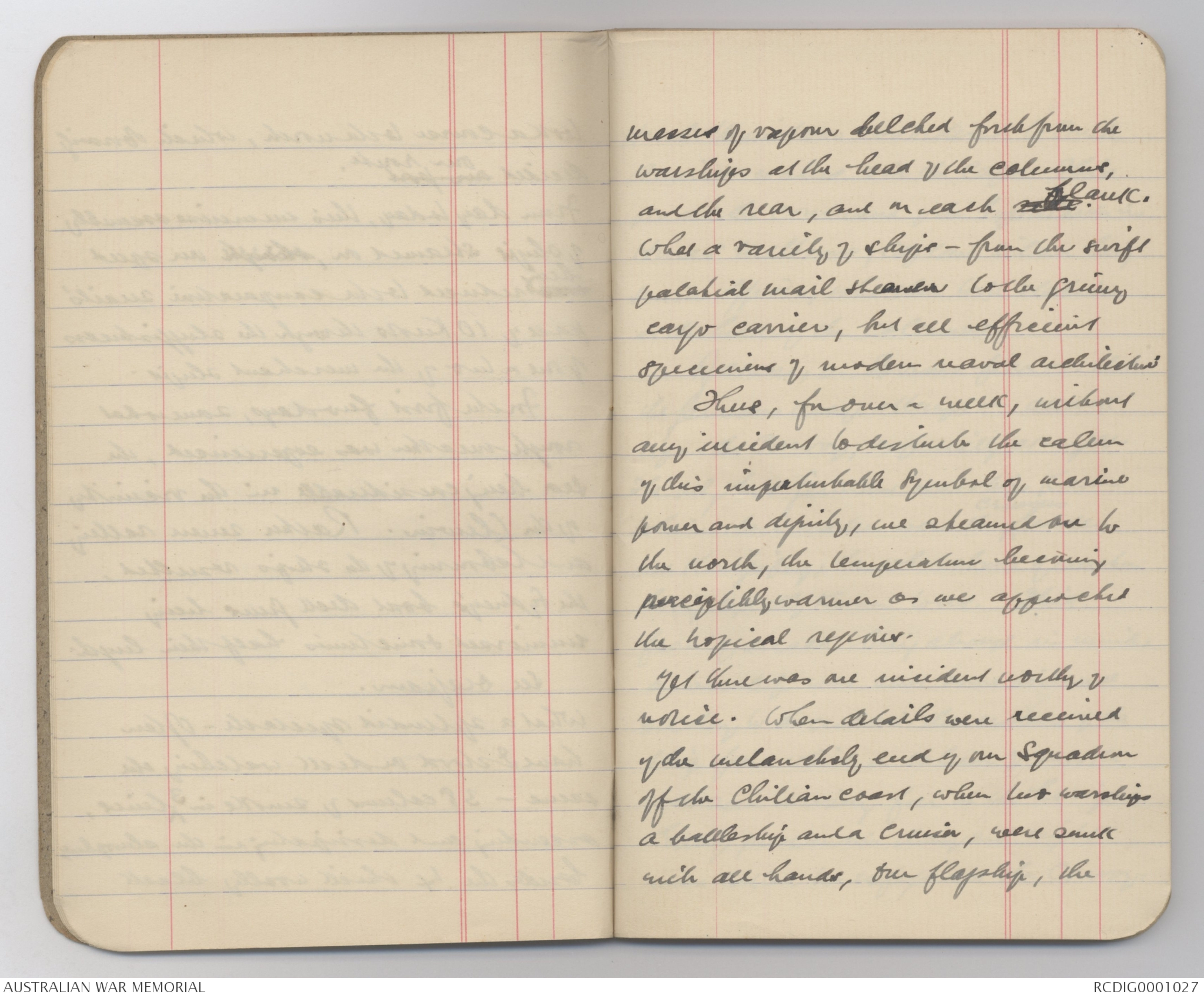
masses of vapour belched forth from the
warships at the head of the columns,
and the rear, and on each side flank.
What a variety of ships - from the swift
palatial mail steamer to the grimy
cargo carrier, but all efficient
specimens of modern naval architecture.
Thus, for over a week, without
any incident to disturb the calm
of this imperturbable symbol of marine
power and dignity, we steamed on to
the north, the temperature becoming
perciptibly warmer as we approached
the tropical regions.
Yet there was an incident worthy of
notice. When details were received
of the melancholy end of our Squadron
off the Chilian coast, when two warships
a battleship and a Cruiser, were sunk
with all hands, our flagship, the
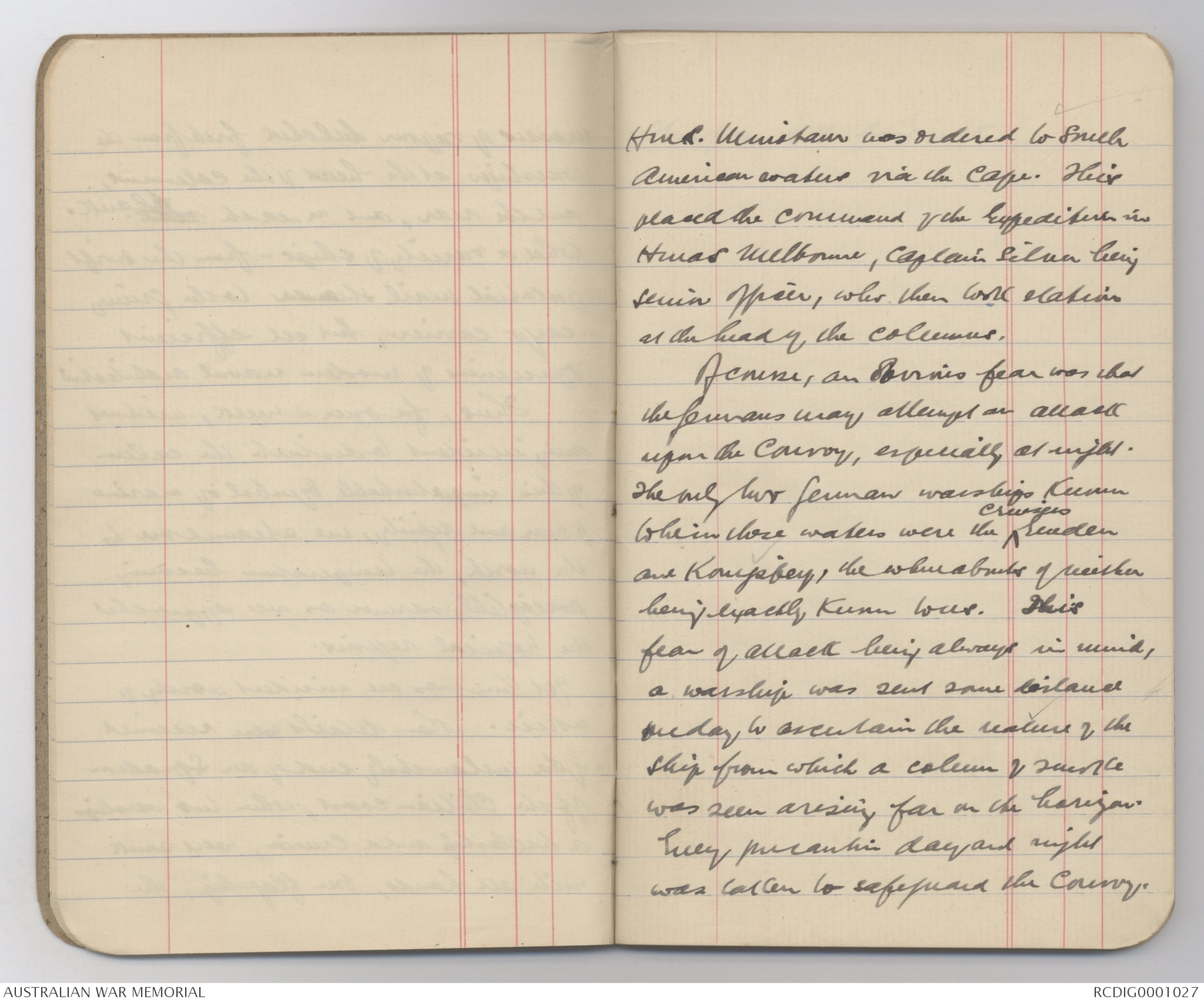
HMS. Minotaur was ordered to South
American waters via the Cape. This
placed the Command of the Expedition in
HMAS Melbourne, Captain Silver being
senior officer, who then took station
at the head of the columns.
Of course, an obvious fear was that
the Germans may attempt an attack
upon the Convoy, especially at night.
The only two German warships known
to be in those waters were the ^Cruisers Emden
and Konigsberg, the whereabouts of neither
being exactly known to us. This
fear of attack being always in mind,
a warship was sent some distance
one day to ascertain the nature of the
ship from which a column of smoke
was seen arising far on the horizon.
Every precaution day and night
was taken to safeguard the Convoy.
Thus passed the first week.
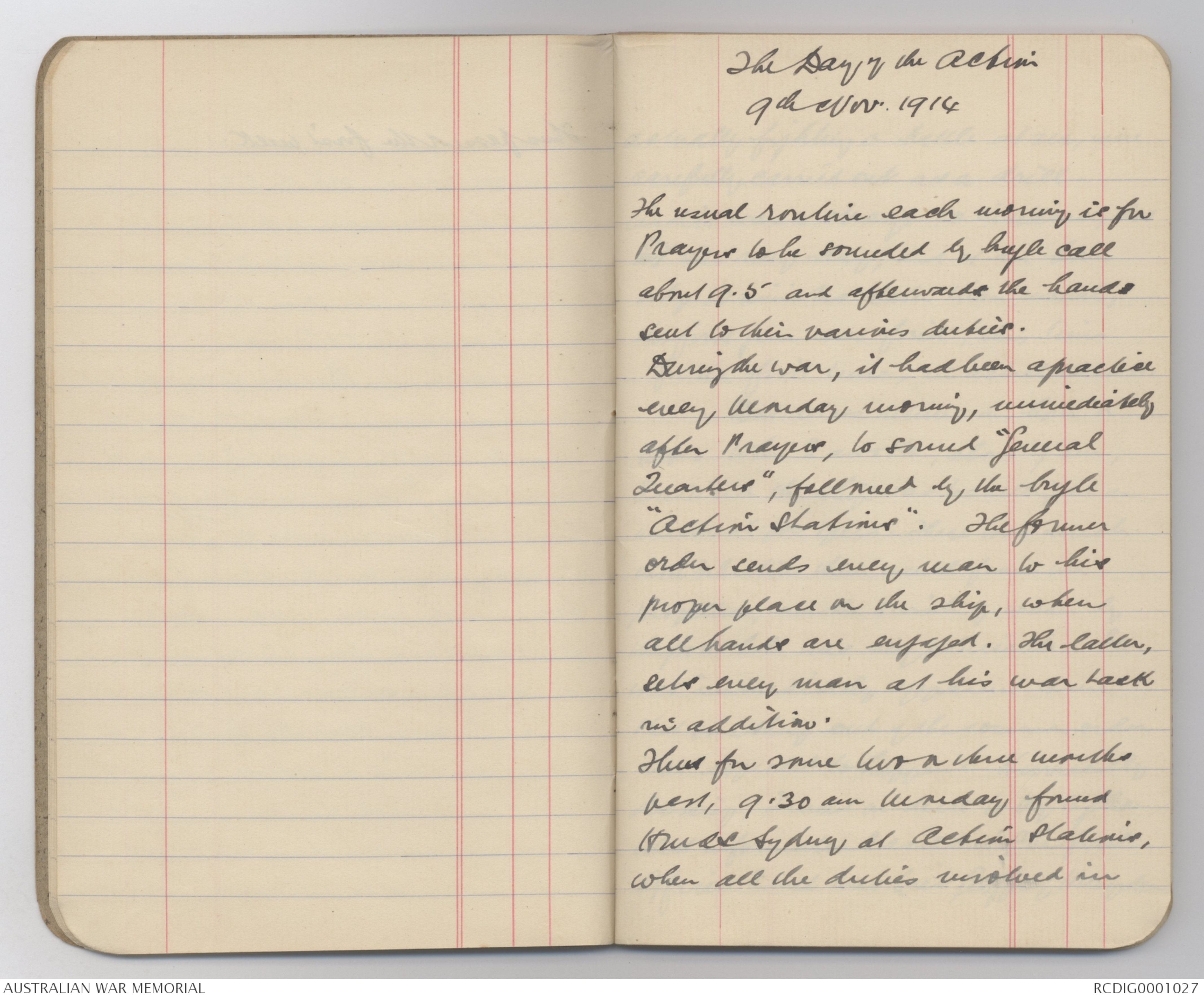
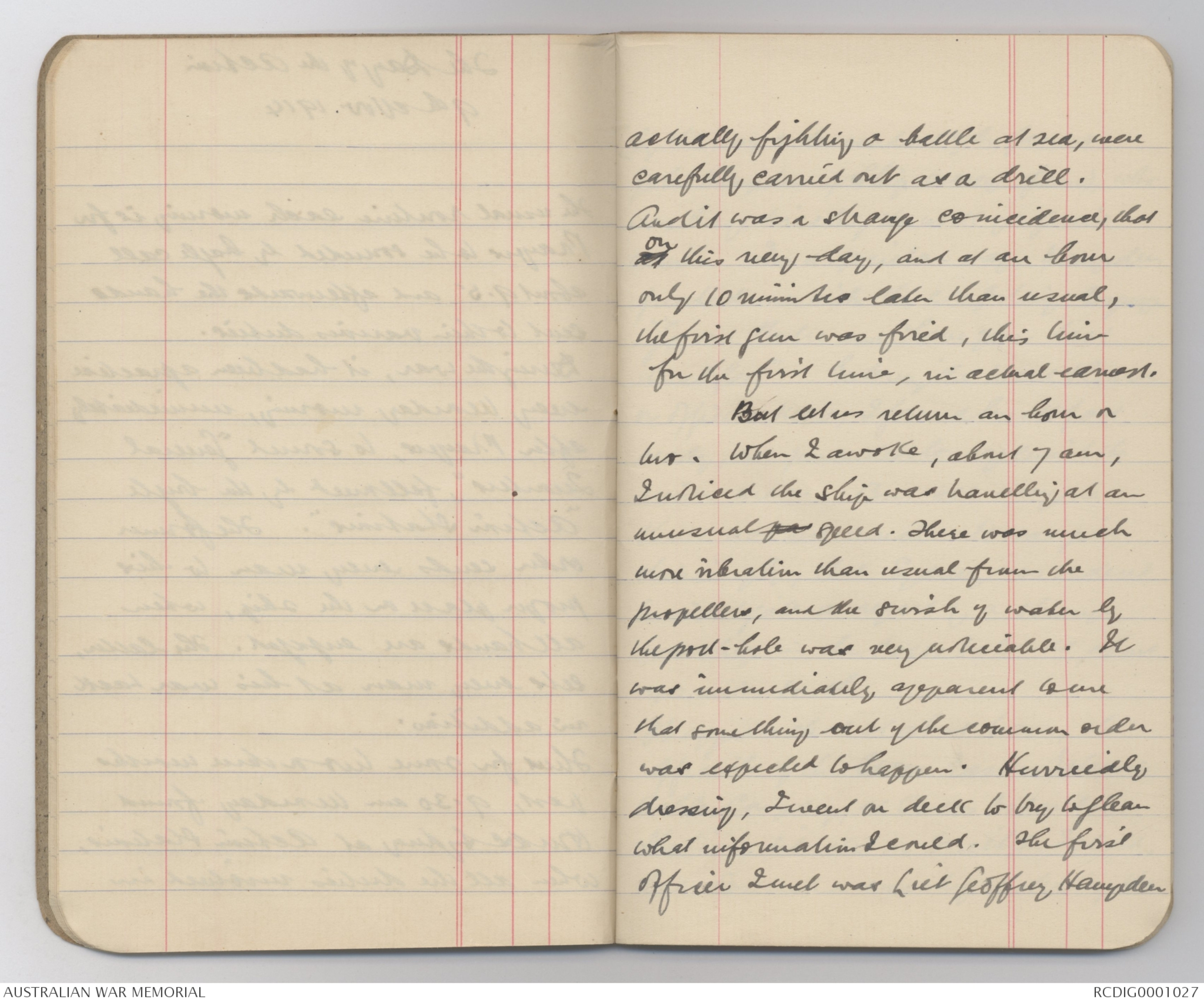
The Day of the Action
9th Nov. 1914
The usual routine each morning is for
Prayers to be sounded by bugle call
about 9.5 and afterwards the hands
sent to their various duties.
During the war, it had been a practise
every Monday morning, immediately
after Prayers, to sound "General
Quarters", followed by the bugle
"Action Stations". The former
order sends every man to his
proper place on the ship, when
all hands are engaged. The latter,
sets every man at his war task
in addition.
Thus for some two or three weeks
next, 9.30 am Monday found
HMAS Sydney at Action Stations,
when all the duties involved in
actually fighting a battle at sea, were
carefully carried out as a drill.
And it was a strange co-incidence, thatas on this very day, and at an hour
only 10 minutes later than usual,
the first gun was fired, this time
for the first time, in actual earnest.
But let us return an hour or
two. When I awoke, about 7 am,
I noticed the ship was travelling at an
unusual pa speed. There was much
more vibration than usual from the
propellers, and the swish of water by
the port-hole was very noticeable. It
was immediately apparent to me
that something out of the common order
was expected to happen. Hurriedly
dressing, I went on deck to try to glean
what information I could. The first
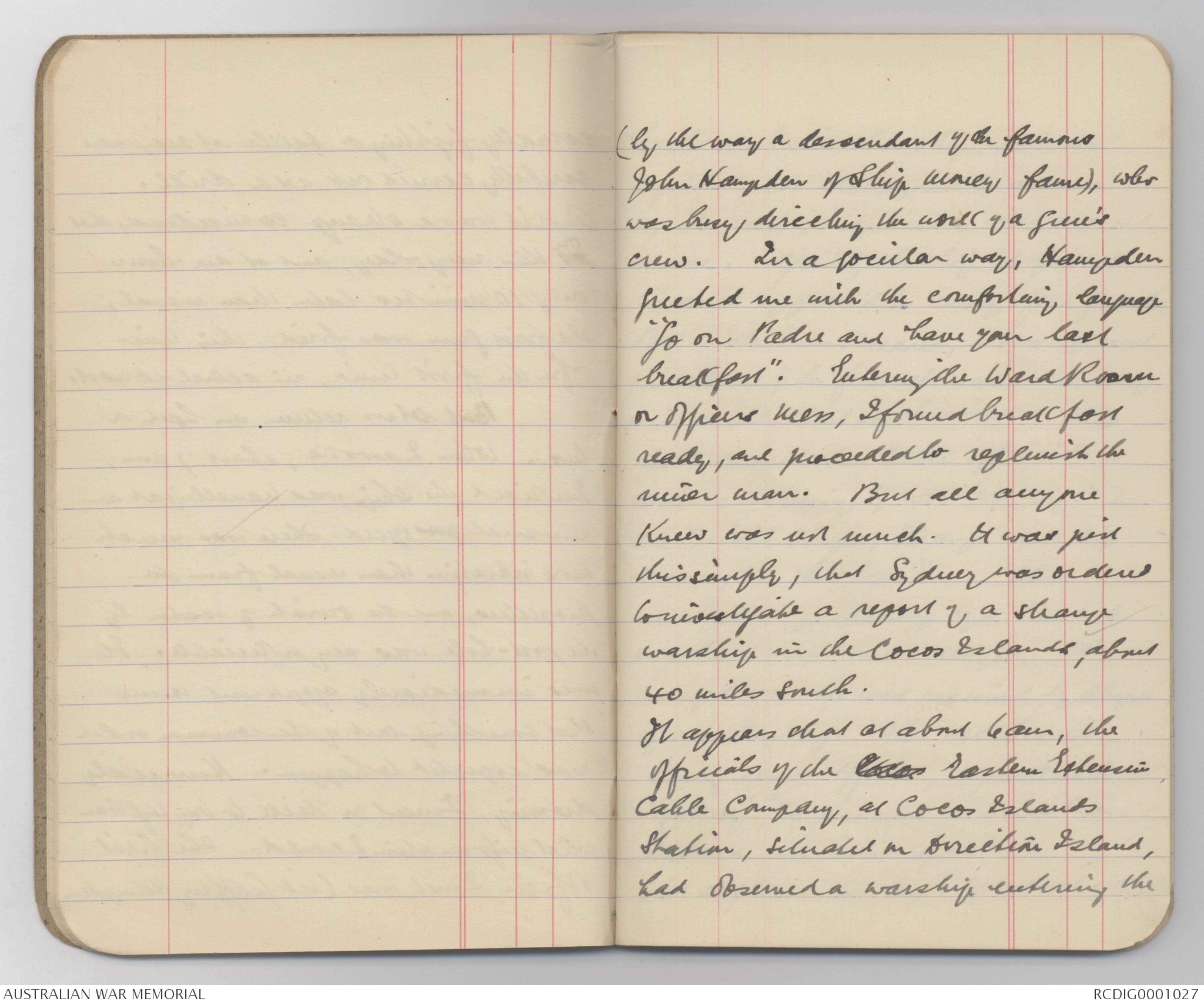
officer I met was Liet Geoffrey Hampden
(by the way a descendant of the famous
John Hampden of Ship Money fame), who
was busy directing the work of a gun's
crew. In a jocular way, Hampden
greeted me with the comforting language
"Go on Padre and have your last
breakfast". Entering the Ward Room
or officers mess, I found breakfast
ready, and proceeded to replenish the
inner man. But all anyone
knew was not much. It was just
this simply, that Sydney was ordered
to investigate a report of a strange
warship in the Cocos Islands, about
40 miles South.
It appears that at about 6 am, the
officials of the Cocos Eastern Extension
Cable Company, at Cocos Islands
Station, situated on Direction Island,
had observed a warship entering the
 Loretta Corbett
This transcription item is now locked to you for editing. To release the lock either Save your changes or Cancel.
This lock will be automatically released after 60 minutes of inactivity.