
Diary of Alice Ross-King, 1917-1919 - Part 8





of woman, English speaking etc
To do this I'm going to outline
the normal healthy functioning
& afterwards speak of the
departures from the normal
what is commonly called - etc
Mensturation, the name
given to the flow discharge
appearing in the healthy
female at regular periods,
usually appears co-incident
with puberty & continues
throughout the fertile
period of life. The age of
commencement in white
women is about 13 or 14 years
The often expressed opinion
that women develop earlier
in hot Climates than in Cold
has no foundation in fact.
Climate has less to do with
early mensturation than
race. The negresses of
a hot country like Somaliland
begin at 16, the women of
the Artic Indians at 12 ½,
but in India & Somoa menst.
begins early & the first pregnancy
often occurs at the age of 12.
Many factors of a general
nature such as nutrition,
surroundings, hereditary
have to be considered - some
advancing, some retarding
the process. The average
age for European races 14
The limits are a good deal
wider 16 is not too late if the
girl is in good health &
12 years not alarmingly early
Each m. period lasts on an
average 4 or 5 days but many
individuals vary both in the
duration & ammount of the
bleeding met with - less than
2 or more than 7 days may
be regarded as abnormal
no definite standard of ammount
can be applied - increase
or diminuition from the
usual in any individual is
more important than the actual
quantity lost. An amount
wh is normal for one woman
wd be excessive for another -
according to her habit. it is not
not a bleeding when large clots
infrequent for M to be suspended
for 24 hrs - After which it returns
& persues its normal course.
The usual cycle averages 28
days but there are variations
in this also - & regularity
is the important - Departure
from the rhythm normal to
the individual is always a
danger signal except during
pregnancy & the climactic
period. From the onset
a year or two frequently elapses
before the rhythmical character
of the processes becomes established
during this time the intervals
are prolonged. x never shorter Some times
the early periods come too
frequently & are profuse &
very painful, needs inquiring into -
for several days preceeding
each period certain pre warning
symptomes are often present -
such as pelvic discomfort
backache & more or less general
tiredness. In some cases excitability
of temper or mental depression
occurs. Sometimes skin eruptions
appear regularly during the
the pre menstrual phase, In
some people no warning is given
for the first two or three days these
symptoms persist & irritability of
the bladder is also not infrequent.
Owing to long years of mistaken
attitude towards M. English
speaking & a great many of
the more civilized nations -
{M is a difficult time for women
{only a small minority appear}
{to pass through the period without}
{some suffering & in many cases
{each menstrual period entails}
{either a day or two semi invalidity}
{or at the least a good deal of}
{restricted activity. It rest in
the hands of women to much improve
the condition
Causes
M. is excited by the activity
of the ovary. The organs of
generation consist of the
uterus or womb - a pear shaped
organ lying in the pelvis, two
ovaries situated, one on each
side of the upper end of the uterus
& two tubes which connect the
ovaries & uterus - The ovaries
are small glands about the
size of almonds & for simplicity
sake may be likened to a
bag of seeds with the seeds on
the outer side of the bag, at
regular periods - about 10
days previous to the flow - some
of these seeds, "Graafian" follicle
ripen & pass into the uterus -
if they meet there with the fertilizing
agent of the male - pregnancy
may occur - if it does not do
so it lies in the wall of the
uterus for 5 or 7 days & the uterus flushes & is
passed out with the menstrual
flow. In adult womenmenstu M. is in temporary abeyance
during pregnance & the
milk forming period.
The due & regular occurance
of M. is undoubtly an indication
of good health, whilst irregularities
quickly affect the general
health. At puberty care
is called for untill the
menstrual function is estab.
& the rythm defined Especially
to be avoided under these
circumstances is over work at
school tasks & physical
fatigue. Such accidents
as long exposure to cold or
immersion in cold water will
sometimes cause sudden arrest
of the haemorrhage followed
by congestion & acute pain.
Many girl students sitting
on hard form or wearing badly fitted
sanitary pads suffer severely
during there period - and we
do not doubt that the day will
come when better seating will
be provided for senior girls.
X Menstruation gen ceases
between the ages of 45 & 50
There are three two modes on whe
the function may cease - It may
terminate suddenly & finally
without any preceeding change
being observed.
or the periods may occur
at irreg & increasing intervals
with gradual reduction
of the ammount of heam,
for some time untill it
finally disappears.This
may extend over several
years & is sometimes interupted
by pregnancy.
In the change of life
accompaning the alteration
certain general disturbances
occur chiefly connected
with the nervous system.
Occasionaly entirely absent
but 4 the majority of women
at the present time the
change of life is a time of
more or less prolonged
ill health. I say at the
present-time, because there
is not any reason to doubt
that this period of life
will be made very much
easier for future generations
though how long a time it
will take to educate women
on these points it is difficult
to say.
The most characteristic &
at the same time most
troublesome sympton is
attacks of flushing.The
woman experiences waves
of heat passing over the
whole body often accompanied
by visible congestion
or redness of the face &
neck or other area of the
body & followed in severe
cases by profuse sweating.
Each flushing may last
from 15 to 30 minutes or
on the other hand be almost
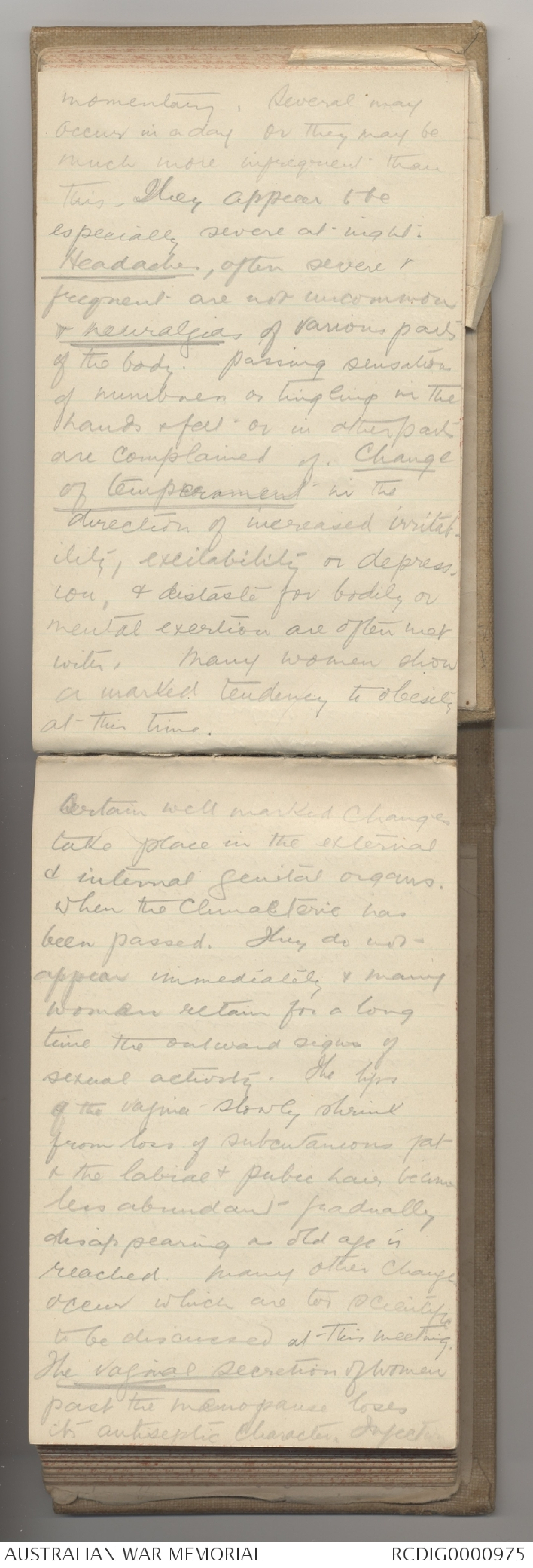
momentary. Several may
occur in a day or they may be
much more infrequent than
this. They appear to be
especially severe at night.
Headaches, often severe &
frequent are not uncommon
& neuralgia of various parts
of the body. passing sensations
of numbness or tingling in the
hands & feet or in other parts
are complained of. Change
of temperament in the
direction of increased irrritablility,
excitability or depression,
& distaste for bodily or
mental exertion are often met
with. Many women show
a marked tendency to obesity
at this time.
Certain well marked changes
take place in the external
& internal genital organs.
when the climacteric has
been passed. They do not
appear immediately & many
women retain for a long
time the outward signs of
sexual activity. The lips
of the vagina slowly shrink
from loss of subcutaneous fat
& the labial & pubic hair becomes
less abundant gradually
disappearing as old age is
reached. Many other changes
occur which are too scientific
to be discussed at this meeting.
The vaginal secretion of women
past the menopause loses
its antiseptic character. Infections
of the secretions is more prone to
occur.
This is the picture of the
menstrual life as it is in
our generation. That is what
we could actually see happening-
but there is another
force that controls menstration
& accompanies woman thro
the whole of the sex active life
& that is the nervous factor.
It is responsible for most
of the pains & discomfort that
limit woman today.
Dr Mary McKenzie, a very clever
medical woman in Scotland
aho has devoted her scientific
life to this branch of study draws
a very interesting sketch of the
progress which woman is
making towards a better &
easier menstrual life. She
describes first the woman in the
reign of Queen Victoria - our
Great-grandmother's time-
heavily loaded with clothes -
prudish to a degree, with a
false sense of modesty. Girls
were not allowed wash their
feet during the menstrual
period & bathing even in warm
water was quite out of the
question. Thick pads of heavy
toweling were used during the
flow & washed by hand afterwds.
It is surprizing how
many of these false conceptions
still persist handed to us by
our Grandmothers & mothers.
Dr McKenzie shows the improvement
which has come about
gradually - & how much the
enforced enlargement of womans
scope on world work, brought
about by the war has improved her
general health. By the women
who undertook munition work,
ambulance work, land work
it was soon discovered that
washing did not affect them at
that time - for years this teaching
had been advocated by medical
women - the importance of the
daily warm bath during
M. but so firmly rooted was
the inbred lesson in the majority
of women, that those advanced
minds who had shed old wives
tales & were trying to spread
the new doctrines were making
little headway. What women
owe to Queen Mary for her
sensible facing of new habits
& encouraging those women
who came with in her influence
to do the same, the average
The present generation will not
realize - but it will undoubtedly
be made mention of in future
medical history. Very shortly
after the war the young girl
realized that the queer warning
about not washing, & of falling the
appalling effects of wet feet at
such time- Since then habits
have improved by leaps & bounds
& already we find a marked improve
in the statistics of the General
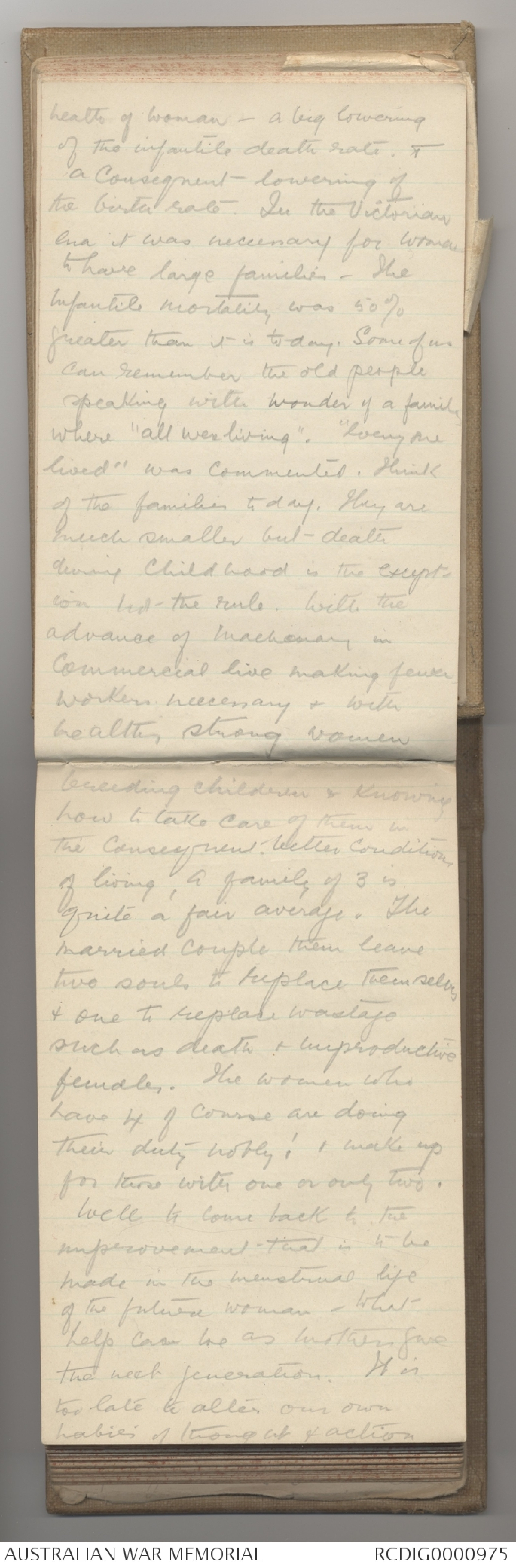
health of woman - a big lowering
of the infantile death rate. &
a consequent lowering of
the birth rate. In the Victorian
era it was necessary for women
to have large families - The
infantile mortality was 50%
greater than it is to-day. Some of us
can remember the old people
speaking with wonder of a family
where "all were living"."Everyone
lived" was commented. Think
of the families today. They are
much smaller but death
during childhood is the exception
not the rule. With the
advance of machinery in
commercial live making fewer
workers necessary & with
healthy strong women
breeding children & knowing
how to take care of them in
the consequent better conditions
of living, a family of 3 is
quite a fair average. The
married couple then leave
two souls to replace themselves
& one to replace wastage
such as death & unproductive
females. The women who
have 4 of course are doing
their duty nobly ! & make up
for those with one or only two.
Well to come back to the
improvement that is to be
made in the menstrual life
of the future woman - What
help can we as mothers give
the next generation. It is
too late to alter our own
habits of thought & action
& our own sufferings will go
on. We may alter our actions
for a time but we will always
revert to what our mothers
taught us. But do let us do
our best for the girls who are
under our care - Once women have [[?]]
when it is our trying duty
to prepare the minds of a young
daughter for the appearance of
the flow, explain the matter
scientifically to her -refrain
from making her nervous-
Instead of saying, now you must
be very careful not to get "wet feet",
not to work too hard or junp
downstairs or play tennis
when you are like that. Say
rather - I don't think you will
have to alter your way of life
Dear, Provide proper fitting
aseptic & deodorant pads - not too large
for the young girl. A dainty
 Loretta Corbett
This transcription item is now locked to you for editing. To release the lock either Save your changes or Cancel.
This lock will be automatically released after 60 minutes of inactivity.