
Diary of Alice Ross-King, 1917-1919 - Part 7


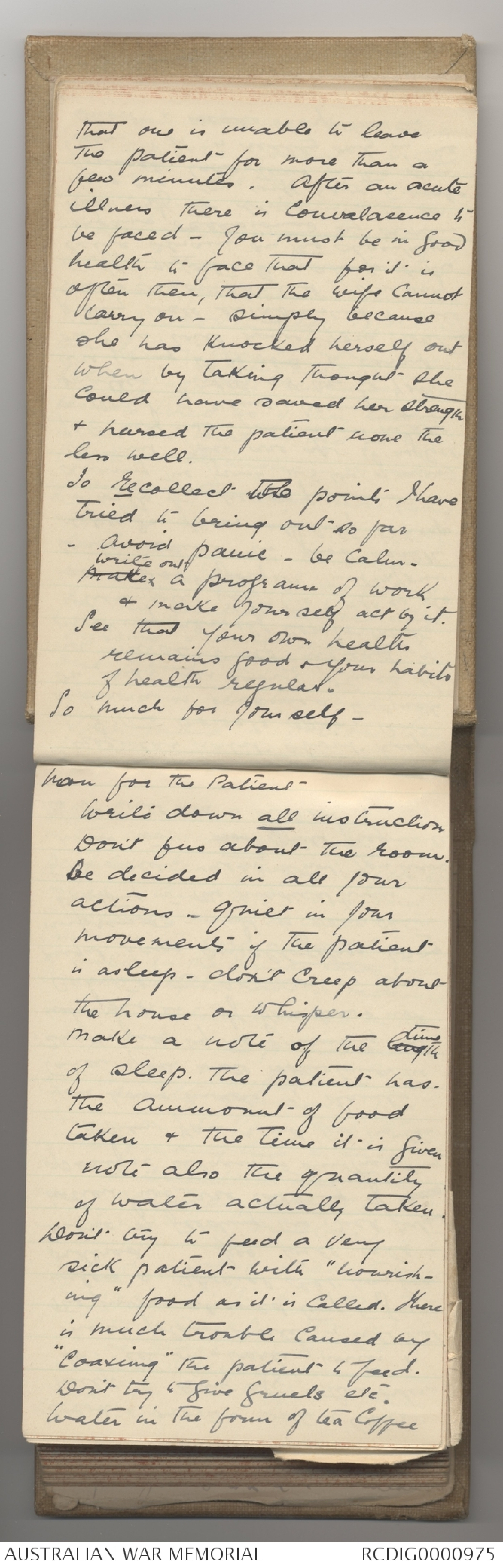


ing of an acute illness must
realize the need of thinking
it all out first. If you
go into a room knowing
exactly what you mean
to do - your movements will
be more decided & worry
the patient far less - He
will not feel that there
is any upset in the house.
This is quite important
if the sick one is the husband
They hate fuss!
Don't try to do everything
yourself. If you
are going to nurse -
do all the nursing yourself
but don't try to do
all the housework too.
The meals you may be
able to manage & the
patients washing (They The pat.
will need clean sheets
& bed garments, each day
at least.) If you can
not get any other help
you must pocket your
dislike to having accepting
help from a neighbour. It
may be that you do not like
a stranger seeing your
house when it is not as
clean & well kept as at
normal times - but that
is part of the price you have
to pay. No woman can
do justice to a sick really
ill patient & do her housework
as usual. But do
not accept help with the
nursing - And do not let the
helper go into the sick room
if it can possibly be avoided -
If the neighbour is a sensible
woman she will not wish
to "see" the patient - If she
is not - all the more reason
for keeping her out of the room.
I am of course speaking of
acute illness - Pneumonia flue
broncitis, Rheumatic fever etc
not of broken leg, sprained
ankle or any of those things.
Most of us who have had children will remember how
visitors tired us if they called
when we were in bed at Childbirth.
Strangers - or outside
people other than those living
in the house must be rigidly
excluded from the sick
room. Whilst I am giving
you this general advice about
nursing I must mention
one point in the care of
your own health. Make up
your mind to follow your
regular habit about keeping
the bowels open. A
woman is inclined to rush
on with her work when she
has much to do instead of
making herself comfortable
when she gets the call to do
so. Don't forget that on your
continuance in good health
depends your ability to keep
on with the nursing. It is
during the first 48 hrs of nursing
that you are apt to neglect
yourself - so you must make
a point of remembering that
matter. After 48 hrs if you
are going to be able to carry
on you will have your routine
pretty well established & will
have accomidated yourself
to doing with less sleep & the
extra strain on the digestive
organs, occasioned by broken
rest. If the illness is to be a
long one you will have to make
yourself take time in the open
air. It is really only in the
short & acute sharp battles
that one is unable to leave
the patient for more than a
few minutes. After an acute
illness there is Convalescence to
be faced - You must be in good
health to face that for it is
often then, that the wife cannot
carry on - simply because
she has knocked herself out
when by taking thought she
could have saved her strength
& nursed the patient none the
less well.
To recollect the points I have
tried to bring out so far
- avoid panic - be calm.Make write out a programme of work
& make yourself act by it.
See that your own health
remains good & your habits
of health regular.
So much for yourself -
Now for the Patient -
Write down all instruction
Don't fuss about the room.
Be decided in all your
actions - quiet in your
movements if the patient
is asleep - don't creep about
the house or whisper.
Make a note of the length time
of sleep.the patient has.
the ammount of food
taken & the time it is given
note also the quantity
of water actually taken.
Don't try to feed a very
sick patient with "nourishing"
food as it is called. There
is much trouble caused by
"coaxing" the patient to feed.
Don't try to give gruels etc.
Water in the form of tea coffee
cocoa & broth - with a little
milk & raw egg when ordered.
lemon & barley water &
much plain water is all that
the nurse should try to give
when a special diet has been
ordered. We will talk
more of the feeding the sick patient
when we are talking of various
specific illnesses another day.
When you read the notes
you have made of drinks
taken you will sometimes be
surprized by the quantity that
has gone in - If you have not
charted the ammounts you
might have an altogether wrong
impression. It is very satsfactory
to the medical man
to be able to read what you have
noted too. Not quite frequently
the Dr will ask a mother - Is the
child - or the patient taking his
drinks well? "pretty well"
is the answer - or "not very well"
people's ideas of "well" differ so
much. And a Dr may find
a stomach much dilated & the
cause be too large a proportion
of milk in the drinks taken Given.
Most people have a measure
marked with ounces in the
house or a cup that holds
½ a pint or a pint. You
can easily estimate the
ammount you put place
in the feeding cup & enter
on the chart what has
been actually swallowed
- about - 2 oz or about - 4 oz
Record is also kept of Bwl
actions. P.U. & most important
sleep. You will
not be worried by the
patients sleeplessness at night
when you count up the doses
had in the day time.
We shall take these matters
in fuller detail when
discussing other nursing
in future lectures.
As there have been a few
cases of diptheria in the
district & some scarlet
fever, Doctor thinks it
might be well if we spoke
of the care that shoud be
taken to prevent - spread
of infection.
All sore throats at present
should be treated as suspect,
& if possible isolated - Certainly
they should be kept away
from the Father or anyone
going to work or other children
going to school. The
latter of course is practically
impossible with childrenbut if you put some CondysCrystals in the nightlyba Once infection
is definitely diagnosed - if
the child is not immediately
sent away all contact
with other folk except
the nurse should cease-
Visitors should not come
into the house nor member
of the household visit. Care
with the milk delivery
etc - bread - meat.
If nursed at home - keep
drinking & feeding utensils
in the bedroom - wash
them there. A tub of Cyllin
just inside the bedroom door
to soak all bed linen etc. Sheet
rung out of Cyllin at doorway
to prevent dinfected dust from
going to other parts of house. Nurse
should wear overall in the room
& dust cap on hair - when going
out of the room must remove
overall & wash hands. dont
touch door handles etc with
infected hands. disinfect
stools & urine. Must practically
live in the room with patient.
When disgranulation olive oil
vaseline etc. When Convalescent
Cyllium or Condys bath for nurse
or patient: hair washed etc.
Bandage -
next lecture Tuesday week
same time. Nursing of
diseases of Respiratory tract
thermometer, pulse taking
etc.
Health, Clean livers,
Conscientiousness, Loyalty
obedience. Good temper
Cheerfulness, observation Economy.
Faults to avoid - noise
The ostentatiously quiet -
The fussy.
2nd lecture in Series of lectures
on "Practical home Nursing"
Emergencies & Nursing
treatment connected with
The Respiratory tract.
My first talk to you had
to cover a lot of ground &
was chiefly a talk about
Nursing in General. Today
I'm going to begin by telling
you of special points in
nursing sick folk at home
& will consider those
illnesses which affect
The Respiratory tract.
You all know the
Anatomy of The Respiratory
organs as far as is necessary
briefly consisting of The
nose nostrils, posterior
nares, phyranx, Larynx & Trachea
Bronchial tubes, Lung cells,
Pleura. Thorax.
Nostrils
The only thing I need
mention about nostrils -
is the care that should
be given to them when
looking after illness of
long standing - paralysis
etc. when sponging put
plegets of cotton wool
dipped in boric lotion or
even clean water - or during
a bout a fever when
herpes form. swab. lotion
& a layer of vaseline gauze.
Nose bleeding - Cold, pressure
encourage pat to breathe thro
mouth. ? lying down.
plugging only to be done by
Med. man.
F.G. in nose - don't poke
posterior nares - Syringing
douching, how to hold
child whilst syringing.
Post-operative Adenoid
& tonsillectomy. follow
direction from Dr. Haem.
from same. pressure.
Sore Throats
Gargles. Care in giving
right strength. Swabbing
tonsils for sore throat.
How to hold child. Avoid
line of fire. Be prepared
for vomitus. Infection.
disinfection, Cup sputum
etc after throat swabbing
own hand. Inhalations
Pharynx - Coughs types
relaxed throat. Spasmodic
reflex. expectorant -
irritant - sound &
sounds of expectorant
Cough linked together ending
with characteristic sound
expectoration entering the
Pharynx. Sounds of
irritated cough on contrary
are independent like separate
blows of hammer.
Whooping Cough contains
elements of both.
The danger of unchecked irritant
cough may induce complication
during the early stage of influenza
spread pleural infection in
pneumonia. - aggravate pain.
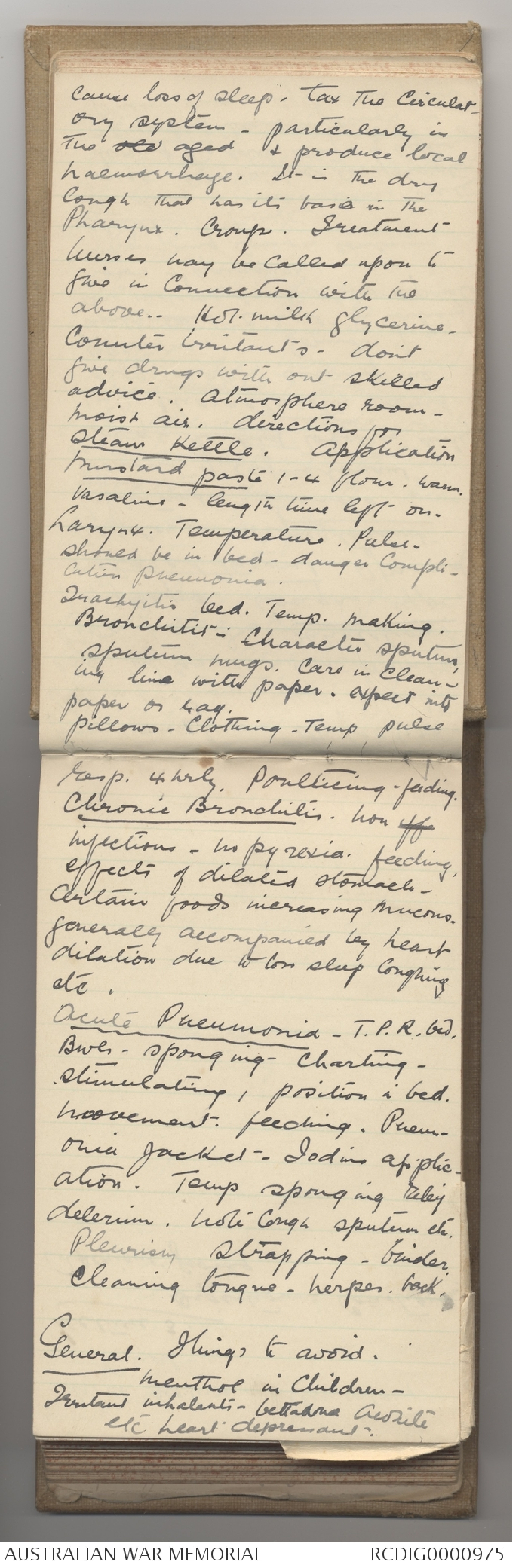
cause loss of sleep. tax The Circulatory
system - particularly in
The old aged & produce local
haemorrhage. It is the dry
cough that has its bark in the
Pharynx. Croup. Treatment
Nurses may be called upon to
give in connection with the
above. - Hot milk glycerine -
Counter Irritants - don't
give drugs with out skilled
advice. Atmosphere room -
moist air. directions for
Steam Kettle. Application
Mustard paste 1 - 4 flour. warm.
vasaline - length time left on
Larynx. Temperature. Pulse.
should be in bed - danger Complication
Pneumonia.
Trachyitis bed. Temp making.
Bronchitis - character sputum,
Sputum mugs. Care in cleaning
line with paper. expect into
paper or bag.
Pillows - Clothing - Temp Pulse
Resp. 4 hrly. Poulticing - feeding.
Chronic Bronchitis. Non inf
infectious - no pyrexia. feeding,
effects of dilated stomach -
Certain foods increasing mucous.
generally accompanied by heart
dilation due to loss sleep coughing
etc.
Acute Pneumonia - T. P. R. bed,
Bwls - sponging - charting -
stimulating, position in bed.
movement. feeding. Pneumonia
jacket - Iodine application.
Temp sponging likely
delirium. Note cough sputum etc.
Pleurisy strapping - binder.
Cleaning tongue - herpes. back.
General. Things to avoid.
Menthol in children -
Irritant inhalants- belladona Aedrite
etc. heart depressant.
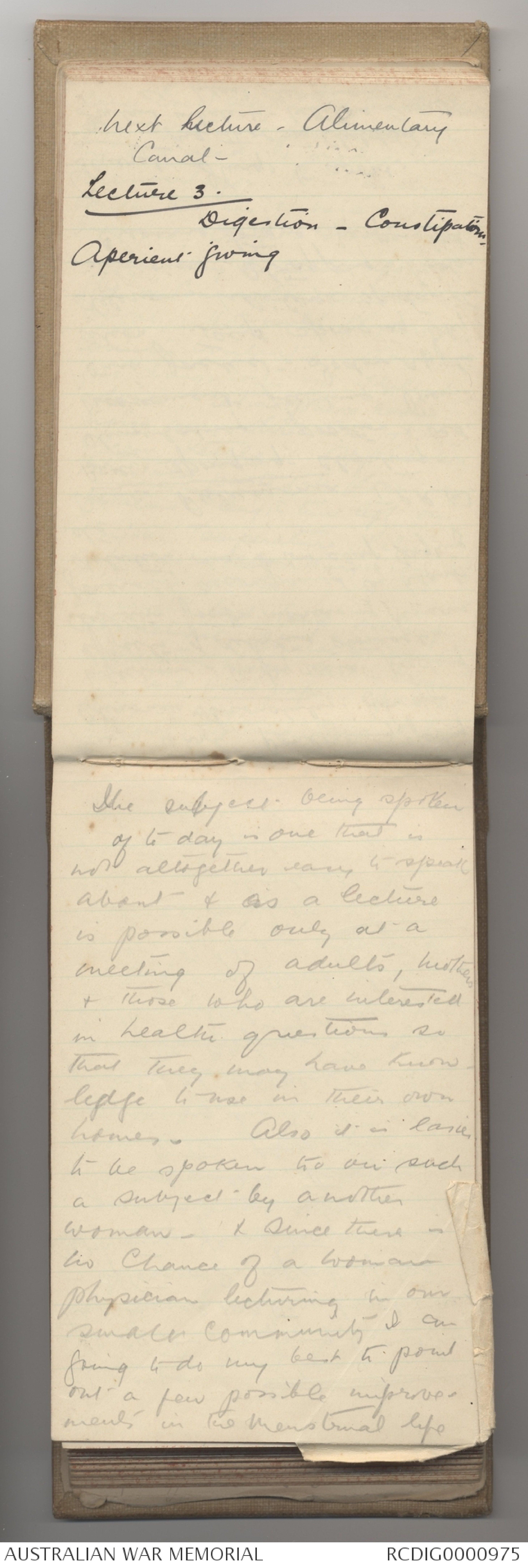
Next lecture - Alimentary
Canal -
Lecture 3.
Digestion - Constipation
Aperient giving.
The subject being spoken
of to day is one that is
not altogether easy to speak
about & as a lecture
is possible only at a
meeting of adults, mothers
& those who are interested
in health questions so
that they might have knowledge
to use in their own
homes. Also it is easier
to be spoken to on such
a subject by another
woman & since there is
no chance of a woman
Physician lecturing in our
small community I am
going to do my best to point
out a few possible improvements
in the Menstrual life.
 Loretta Corbett
This transcription item is now locked to you for editing. To release the lock either Save your changes or Cancel.
This lock will be automatically released after 60 minutes of inactivity.