
Diary of Alice Ross-King, 1917-1919 - Part 6




Captain. F. Brinkley R.A.
He has passed forth into the unknown
light,
And yet what need of unavailing tears?
The book of life God called him to indite
lies nobly finished, Rest is now his Right,
Who toiled unceasing through the darkening
Years.
He buried not his Talent out of sight,
But greatly used these for the world's
delight -
Life welcomes death, as toilers welcome
night.
And since he guarded with a lovers care,
The honor and the glory of this land,
And gave him self that men might understand
All that was pure in her & good & fair,
Let her pay this high tribute to his dust,
Prove herself worthy of his swerveless
trust.
M.K.
Lecture on practical home nursing
- for use in the series to
be given in the Lang Lang School
The funds so raised to be used
in defraying the cost of a Complete
set of Mee's "Children's Encyclopaedia"
for use in the school.
Ladies.
There is no need for me to
spend time just now speaking
of the purpose for which these
lectures are given, beyond
mentioning that the books
in question will be sent
up to Fell's on approval
as soon as this money
donated by you today, is
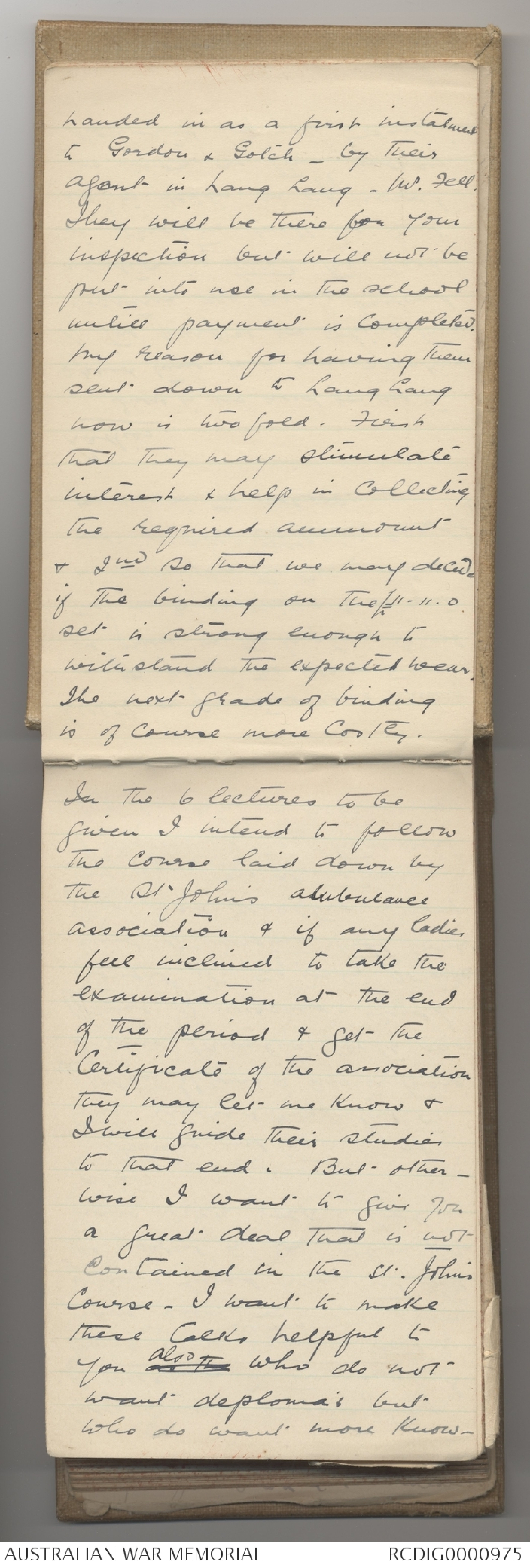
handed in as a first instalment
to Gordon & Gotch - by their
agent in Lang Lang - W. Fell.
They will be there for your
inspection but will not be
put into use in the school
untill payment is completed.
My reason for having them
sent down to Lang Lang
now is two fold. First
that they may stimulate
interest & help in collecting
the required ammount
& 2nd so that we may decide
if the binding on the £11-11-0
set is strong enough to
withstand the expected wear.
The next grade of binding
is of course more costly.
In the 6 lectures to be
given I intend to follow
the course laid down by
the St John's ambulance
association & if any ladies
feel inclined to take the
examination at the end
of the period & get the
Certificate of the association
they may let me know &
I will guide their studies
to that end. But otherwise
I want to give you
a great deal that is not
contained in the St John's
Course. I want to make
these talks helpful to
you as the also who do not
want diploma's but
who do want more knowledge
to use in the emergency
of sickness in the home. I
think there is much that I
have seen in during the 13 years
I have lived here, that will
be useful to you when you
have sick folk to look
after.
During my training at
the Alfred Hospital &
when I was a sister there,
I was familiar with one
phase of nursing - and I
thought it the only possible
kind of nursing that would
give good results. During
my 4½ years at the war
I discovered that there were
possibilities of releiving
suffering & doing much
good work with out
the beautifully equipped
wards, the perfect routine,
the plentiful supply of
everything, that is always
at hand in the large
hospitals of Melbourne -
Then I came to live here
in the Country & I
discovered that there is
another phase of nursing
more difficult than by
far, of acheivement, than
any hospital nurse is
called upon to meet. The
wife or mother struggling
to nurse sickness in the
home - where she lacks
real knowledge of how to
set to work, where she is
with out any of the Conveniences
of for sick nursing. She
has only the urgent - need
in abundance. She must
look after the sick one
herself. The Cost of a trained
nurse must be avoided,
or there is so little room
for one in the house. And
the great desire to keep
the sick one at home -
instead of sending him
away to Hospital.
Quite a number of women
are born nurses. Almost
any woman can learn a
great deal that will be
body & you will only add
worry & expenses to the present
trouble - If you first
calculate your possibilities
& devide your duties
(other than sick nursing)
with whoever you can
get to do them) or if there
is no outside help to be
expected, devide your work
into what must be done
i.e meals & bed making
& what - Can be left -
scrubbing dusting &
The big Monday washing
& ironing - You will
avoid panic. To
illustrate what I mean
let us say that the Dr
has been to see the
sick person & he has told
you " 'Pneumonia" Pleurisy
"Rheumatic fever" or
some such awful thing.
The first thing to do
is to avoid panic in your
mind - That awful feeling
of disaster ^ & dismay which numbs
the mind & makes your
actions confused. Get
an immediate grip of
yourself & push “worry"
detirminedly away -for the
moment at any rate. The
Doctor is thinking at this
moment-"I wonder if they
can run a nurse" - The
expense will be great but
the patient is pretty sick -"
Don't forget it is the Doctor's
responsibility & if he sees
you are not able to grip
events straight off it will"
make him very uneasy about
leaving a seriously ill patient
in untrained hands. But
if you can force yourself
to self control & show
& inteligent willingness to
work under instructions
from the doctor, there are
few medical men who
are unwilling to give you
the Chance of Carrying on
for a few days at any
rate. Quite your best
routine action is to at once
get a writing pad & pencil
& say "What am I to do
for him, Doctor"? & be
7
ready to write down all
instructions. Don't trust
your memory for any thing.
If you do, you will find
that there is some point
you'll feel uncertain upon
after Dr has gone. Also
the fact that you are writing
instructions down at
once, establishes Confidence
in the Dr's mind, that you
are possible as a nurse -
I cannot over emphasize
the importance of pencil
& paper in the sick room.
Needless to say all well
trained professional nurses
chart every instruction given
by the Dr. - later filling in
the time & particulars of its
carrying out.
When the Doctor departs
your first act must be to
go into the patient. If it be
a child - you will of course
go in to see all is well -
but if it be husband or other
adult or senior child, the
patient is always anxious to
hear "what the Dr says"
& I need hardly say how
important it is to avoid
increasing the distress of the
sick one by an artificial
manner. Don't try to be
too bright & make light
of the illness. Any one really
ill, knows that he is ill &
if you say "Dr think it is
nothing much" You at
once shake his confidence
in the Doctor. Much better
is it to say " You have
such & such a disease but
Dr thinks you will be allright.
He has left some treatment
for you & told me exactly
how to do it - He does not
think you need a trained
nurse - when This is a
much wiser Course than
attempting to hide from
the patient the nature of
his illness - (with the one
exception of Cancer) you
then get his co-operation in
the treatment ordered. If
he is really sick you do.
It is only the patient who
is not very ill who resists
treatment.
As shortly soon after
this as possible I strongly
advise you to sit down
for 5 minutes with
your pencil & writing
pad & think out a
plan best working plan.
If it be a child who
is sick draw up your
program to give the
father a share in the
watching at night &
allow yourself a stretch
of at least 2 hrs sleep.
You will probably
get snatches of sleep
besides, but you want
to feel that you can
rest that for time with out
feeling on the alert for
a call from the sick
child ^ early part of night child usually sleeps at his best
being (5hrs)
At this time
too decide what room
will be the best to nurse
the patient in. If it
is at all possible - don't
move the sick one. If
the patient is sharing
a room with other
children - move the
well children in with
the father or into another
room - Any very sick
patient may be 'light-headed"
at night & his
delerium is undoubtly
increased by finding him them
selfves in unfamiliar surroundings
Children -
particularly, are worried
by seeing strange objects
when they open their eyes at
night. You will want need to
have only a small bed
or couch for yourself
next to the patients bed
& as well as the patients bed, in
the room. remove as
much light furniture
as possible from the
room i.e. extra chairs
mats - anything that
Can be done without.
(not of Course heavy
stuff such as a wardrobe
dressing table etc. that
wd alter the character
of the room & be nearly
as bad as moving the
patient. Don't move the
patients bed either as
that alters the land marks
for him. ) Ventilation
your reason for removing
extra furniture is to simplify
the Cleaning of the floor -
floor not swept but cleaned with wet cloth
If it is husband
or adult that is sick
The patient of Course must
have a bed room to
himself with the extra
Couch for Nurse - You
will find it a great help
if you think out your
arrangement of furniture
etc & perhaps write
it down before you begin.
It will help you to go
just quietly to work
without the worried
expression that thinking
the matter out as
work gives to one.
I know you are thinking
it difficult to sit down
& plan ahead like this
but beleive me it will
repay you well to do so.
You all Know What
a difference method
makes to house work -
Careful preparations, to the
results when Cooking -
how much time the expert
dress maker gives to her
measurements & Cutting
out of material Compared
to the Amatuer who
just rushes at the job &
bungles along. Nursinges
needs much training &
teaching - And the house
wife or Mother who is going
to attempt nursing the nurs-
 Transcriber 6897
This transcription item is now locked to you for editing. To release the lock either Save your changes or Cancel.
This lock will be automatically released after 60 minutes of inactivity.