
Typed copy of letters from Frederick William Rowe to his family, 1914-1915 - Part 1
LETTERS OF
FREDERICK WILLIAM ROWE
TO HIS FAMILY
1914 - 1915
Notes to the letters of F. W. Rowe as typed by his
daughter - Mrs. Pamela Rose Vial
The original letters were written by my father (Frederick
William Rowe) mainly to his mother (Mrs. Rosetta Rowe) while
he was on active service with the Australian Imperial Forces
during the First World War (1914-1918). I have typed copies
of the letters so that they may be more easily read. I always
knew my grandmother as Granny Rowe, and she kept the letters
in their original envelopes in a gold cardboard box. After
her death in 1945 they were given to my mother - Mattie Alice
Rowe (nee Mackenzie - 1899 - 1976). After Mother's death they
came into my possession. They have been read by a few people
(including a young historian), and I thought it time to pass
copies on to the writer's grandchildren.
The people mentioned in the letters are -
his parents and your great grandparents - Rosetta and
William Rowe who lived at 85 Eskdale Road, Caulfield
younger brothers Roy and Jack, also living at the same
address
sister Ethel, who was married to Fred Mollard, and the
baby mentioned is Keith (Bill) Mollard, my cousin. The
firm was F.W. Mollard and Co. Pty. Ltd., Mantle Manufact-
urers, which began shortly before the war and where my
father spent most of his working days.
Jean, was Jean Talbot, who was living with Dad's parents
at the time and who later married Dad's cousin, Bert Wilks
and became the mother of Charles Wilks.
Mr. Gillison was the minister of St. George's, Chapel
Street, Windsor, who became a chaplain when the war
commenced. Apparently he was a wonderful preacher and
minister, and a service is still held in the church each
year during August as a memorial to the battalion and to
the man himself.
Many of the words in the letters begin with capitals. In
some cases I have changed this, and in others left it, as
apparently Dad used this form of writing. He also had the
habit of running one sentence into another, and I have also
altered this in some cases.
My father was discharged from the army on 25th March 1916.
He had been admitted to hospital in Heliopolis towards the end
of 1915 and his gall bladder had been removed. He also had a
duodenal ulcer operation which was considered very serious, and
he was very ill for some time. As long as I can remember he
always had to take white medicine before meals, and was affected
by the results of the operation for the remainder of his life.
He was in Caulfield Hospital for a period in 1927, and was cared
for by the Repatriation Department until his death. He worked for
F. W. Mollard & Co. Pty. Ltd. until about 1945 when he was admitted
to Caulfield Hospital again. He was later transferred to Macleod
Sanitorium when it was discovered he had Tuberculosis which was
caused by the effects of prolonged illness. At that time there
was no cure for this disease and when it was found that they could
do no more for him, he returned home and spent the last six weeks
of his life with his family. He died at home on the 21st June
1947, aged 57.
(contd 2)
- 2 -
In typing these letters, it has given me the opportunity to
see Dad more clearly, and understand the pain and suffering he
went through for many years. Life became a struggle for him, and
I wish I had known the young man who came out so clearly in these
letters. However, I do remember the devotion he had for his
Mother, which continued throughout his lifetime.
I want to pass these letters on to all his grandchildren
to give you some idea of what your grandfather was like as a
young man, and the attitude he had towards fighting for his
country. His life was affected, as were the lives of most of
his contemporaries by the horrors of war. In fact all our lives
were affected, firstly by myself and my brother losing our father
at the age of 57, and the fact that none of you had the opportunity
of knowing your grandfather. And so I hope these letters
may open a door for you, and perhaps you may see a little of
yourself in him.
P.R.V.
January 1990
S.S. Shropshire
Sunday
Dear Mother
We have arrived off Albany all right having had a lovely trip
across. Some of the boys have been sea sick but so far I have escaped
& I am feeling splendid. I think I have found my sea legs. Below
I will give you an idea of some of the things that have happened.
After leaving the pier we sailed straight through the bay to
the heads and we passed straight through the heads about 6.15 pm.
The water was like a millpond - there wasn't a ripple on the water.
About 9.00 we were ordered down below to bed. It was funny to see
some of the boys getting into their hammocks they would get half in
then the hammock would turn then the fun would begin.
They soon got into the way and by about 10.00 they were all asleep and
it didn't take me long to go. The hammocks are very comfortable to
sleep in you do not feel the roll of the boat a bit and by tightening
the two outside strands you make them almost impossible to fall out of.
Wednesday morning reveille sounded at 6.00. We had to rise and stow
hammocks then we paraded at 6.30. The drivers turned into stables and
the gunners did physical drill and we were dismissed about 7.30 for
breakfast which was a very fair meal, vis. porridge and meat, butter
and jam. We fell in again at 9.00 the gunners doing gun drill;
dismissed again 9.45 for a smoke; fall in again at 10.00 for lecture;
dismissed again for stables at 11.00, then after stables dinner at
12.00. At 3.00 we paraded again for about 2½ hours and were dismissed
for tea, then we were off for the day. This is about all the drillings
and parading we do so have a little time to ourselves now. We have
gramophone and organ so have plenty of fun and the band also plays
every night. We have to do fire drill. When the bell rings every
man has to fall in at his station. I have to rush to a horse and
keep him quiet. If the alarm goes at night we all have to put on
life belts.
On Wednesday afternoon we ran into a school of whales. Jack
would have liked to see them. They were only about 30 yards off
the ship and kept coming to the surface to spout. It was a great
sight to see. We also ran across porpoises in the hundreds some of
them about 12 feet long. We saw a long shark on Thursday about
22 feet long. It ran right into the side of the ship. Some of the
horses are beginning to feel it and one of them had to be shot today.
It had pneumonia and got down and could not rise again so the Vet
did all he could, but it was no good. Friday night it began to
blow but when we got up on Saturday it was fairly calm again. There
was a bit of excitement on board on Friday caused by a collier
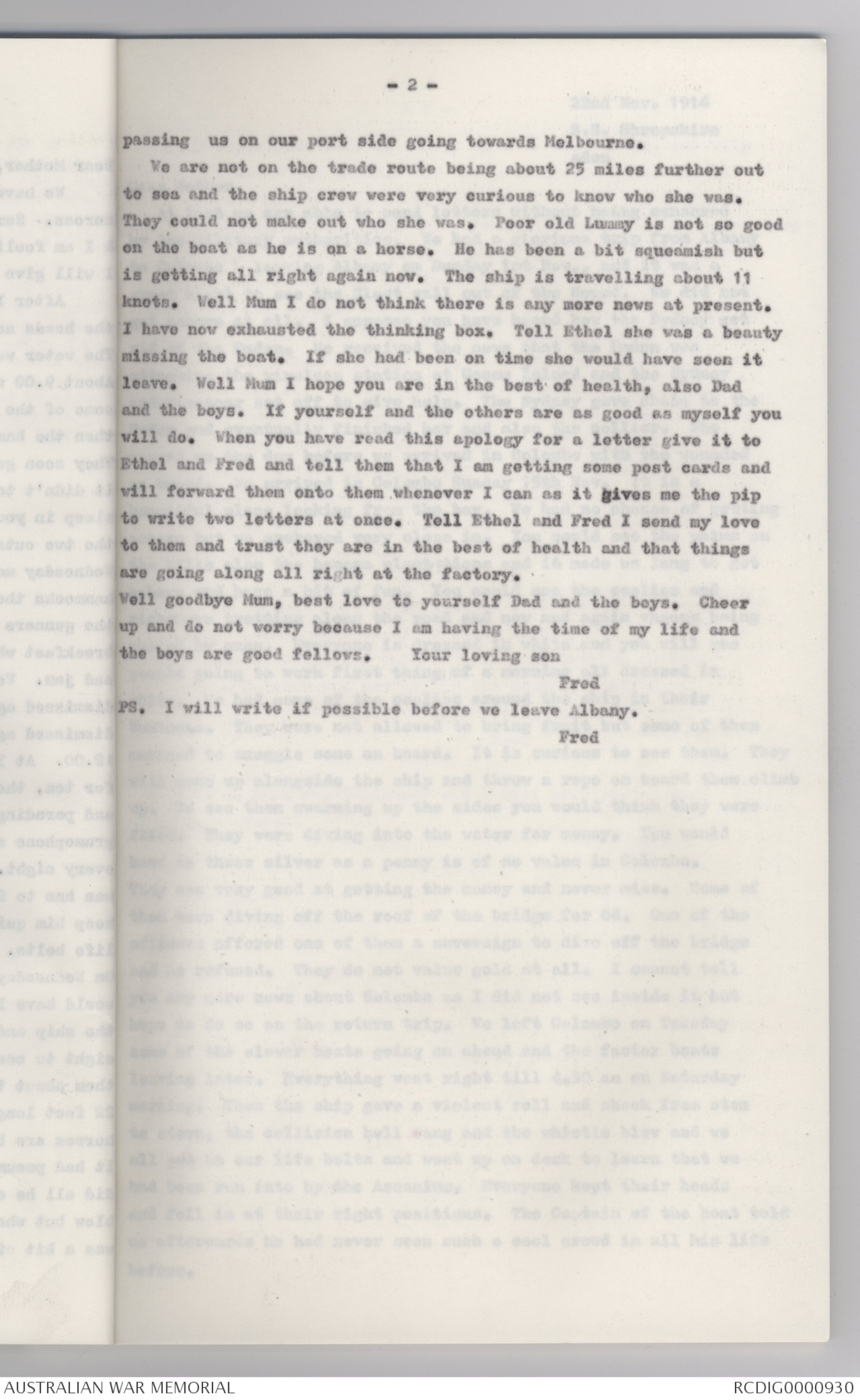
- 2 -
passing us on our port side going towards Melbourne.
We are not on the trade route being about 25 miles further out
to sea and the ship crew were very curious to know who she was.
They could not make out who she was. Poor old Lummy is not so good
on the boat as he is on a horse. He has been a bit squeamish but
is getting all right again now. The ship is travelling about 11
knots. Well Mum I do not think there is any more news at present.
I have now exhausted the thinking box. Tell Ethel she was a beauty
missing the boat. If she had been on time she would have seen it
leave. Well Mum I hope you are in the best of health, also Dad
and the boys. If yourself and the others are as good as myself you
will do. When you have read this apology for a letter give it to
Ethel and Fred and tell them that I am getting some post cards and
will forward them onto them whenever I can as it gives me the pip
to write two letters at once. Tell Ethel and Fred I send my love
to them and trust they are in the best of health and that things
are going along all right at the factory.
Well goodbye Mum, best love to yourself Dad and the boys. Cheer
up and do not worry because I am having the time of my life and
the boys are good fellows. Your loving son
Fred
PS. I will write if possible before we leave Albany.
Fred
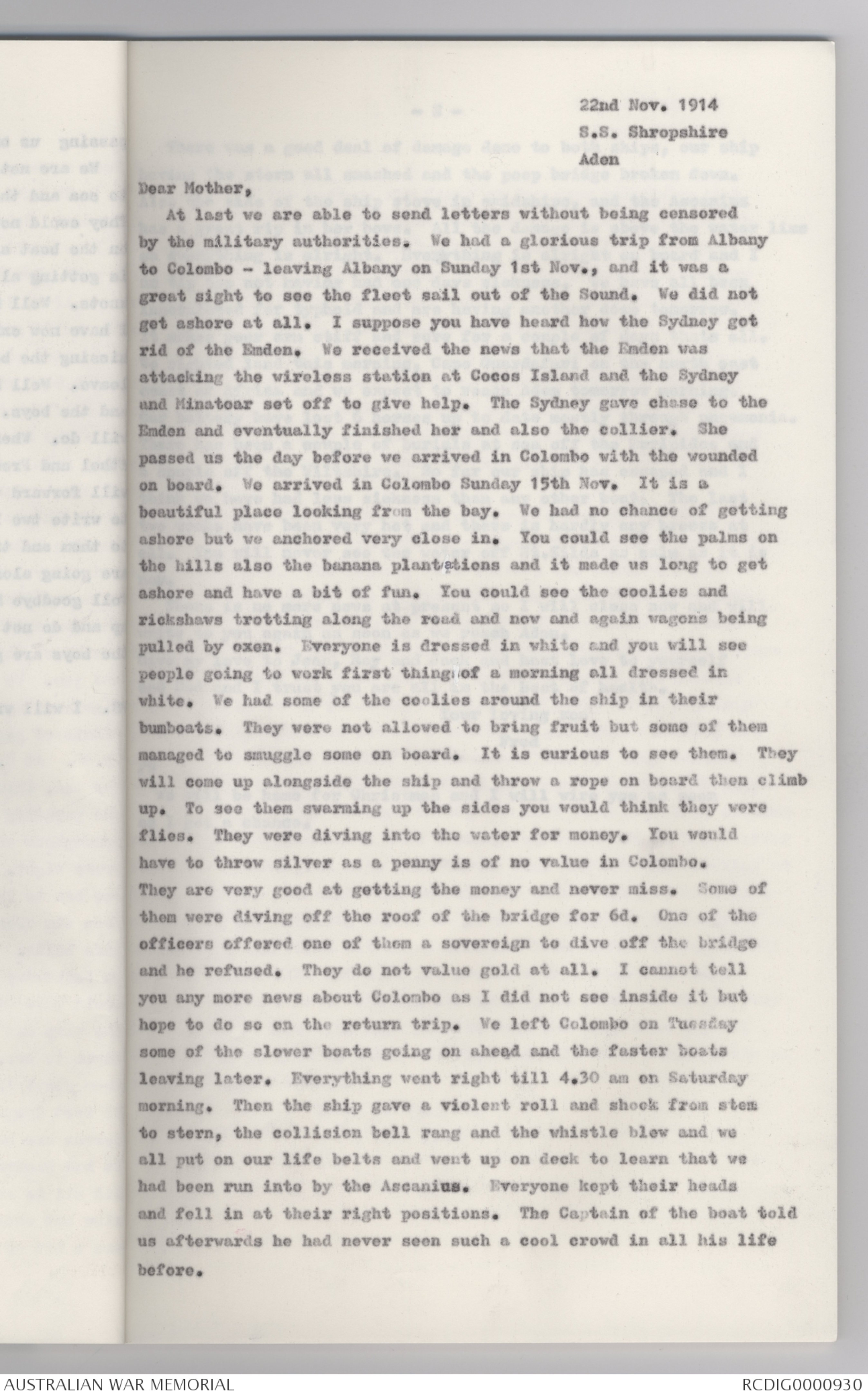
22nd Nov. 1914
S.S. Shropshire
Aden
Dear Mother,
At last we are able to send letters without being censored
by the military authorities. We had a glorious trip from Albany
to Colombo - leaving Albany on Sunday 1st Nov., and it was a
great sight to see the fleet sail out of the Sound. We did not
get ashore at all. I suppose you have heard how the Sydney got
rid of the Emden. We received the news that the Emden was
attacking the wireless station at Cocos Island and the Sydney
and Minatoar set off to give help. The Sydney gave chase to the
Emden and eventually finished her and also the collier. She
passed us the day before we arrived in Colombo with the wounded
on board. We arrived in Colombo Sunday 15th Nov. It is a
beautiful place looking from the bay. We had no chance of getting
ashore but we anchored very close in. You could see the palms on
the hills also the banana plantations and it made us long to get
ashore and have a bit of fun. You could see the coolies and
rickshaws trotting along the road and now and again wagons being
pulled by oxen. Everyone is dressed in white and you will see
people going to work first thing of a morning all dressed in
white. We had some of the coolies around the ship in their
bumboats. They were not allowed to bring fruit but some of them
managed to smuggle some on board. It is curious to see them. They
will come up alongside the ship and throw a rope on board then climb
up. To see them swarming up the sides you would think they were
flies. They were diving into the water for money. You would
have to throw silver as a penny is of no value in Colombo.
They are very good at getting the money and never miss. Some of
them were diving off the roof of the bridge for 6d. One of the
officers offered one of them a sovereign to dive off the bridge
and he refused. They do not value gold at all. I cannot tell
you any more news about Colombo as I did not see inside it but
hope to do so on the return trip. We left Colombo on Tuesday
some of the slower boats going on ahead and the faster boats
leaving later. Everything went right till 4.30 am on Saturday
morning. Then the ship gave a violent roll and shook from stern
to stern, the collision bell rang and the whistle blew and we
all put on our life belts and went up on deck to learn that we
had been run into by the Ascanius. Everyone kept their heads
and fell in at their right positions. The Captain of the boat told
us afterwards he had never seen such a cool crowd in all his life
before.
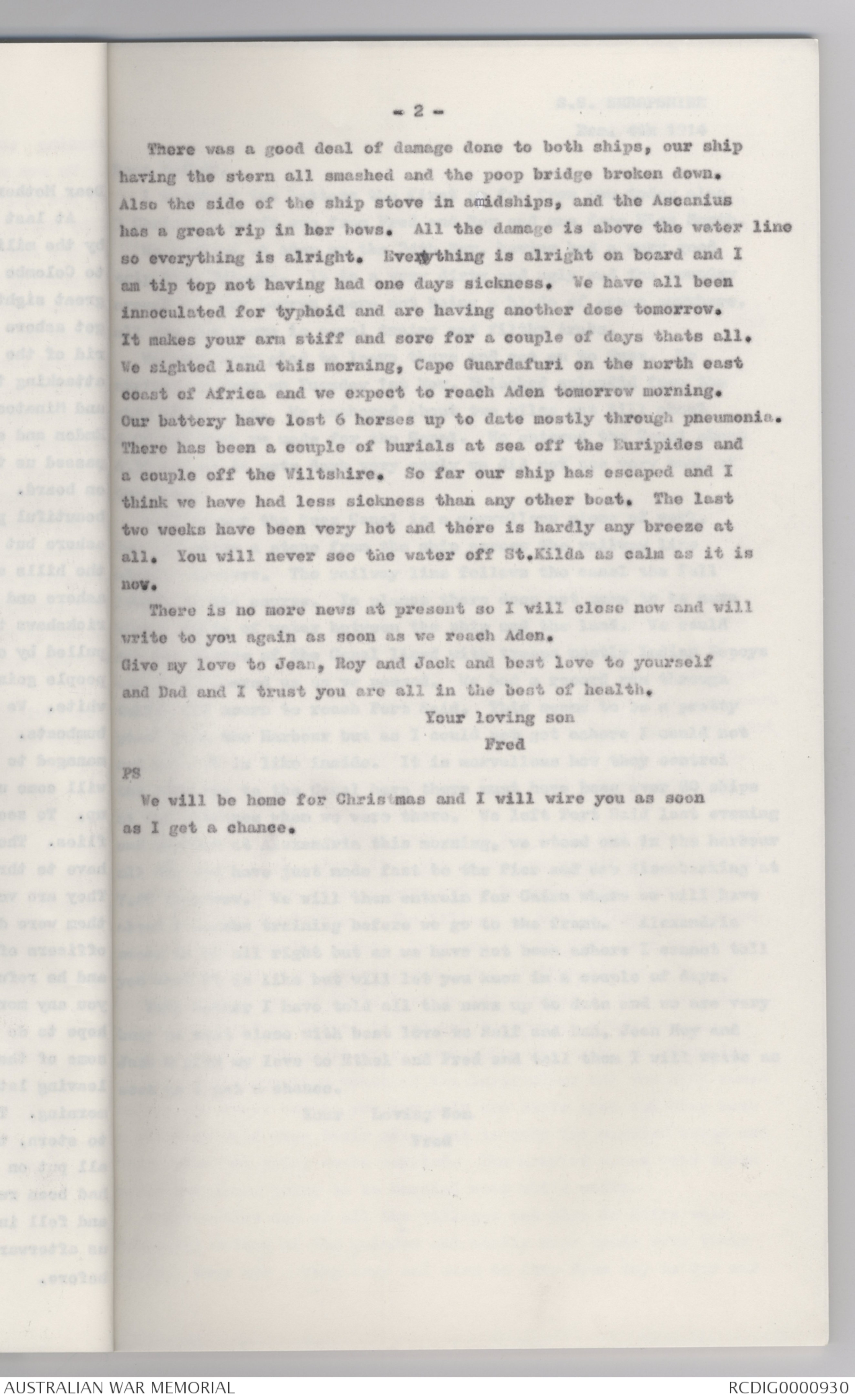
- 2 -
There was a good deal of damage done to both ships, our ship
having the stern all smashed and the poop bridge broken down.
Also the side of the ship stove in amidships, and the Ascanius
has a great rip in her bows. All the damage is above the water line
so everything is alright. Everything is alright on board and I
am tip top not having had one days sickness. We have all been
innoculated for typhoid and are having another dose tomorrow.
It makes your arm stiff and sore for a couple of days thats all.
We sighted land this morning, Cape Guardafuri on the north east
coast of Africa and we expect to reach Aden tomorrow morning.
Our battery have lost 6 horses up to date mostly through pneumonia.
There has been a couple of burials at sea off the Euripides and
a couple off the Wiltshire. So far our ship has escaped and I
think we have had less sickness than any other boat. The last
two weeks have been very hot and there is hardly any breeze at
all. You will never see the water off St. Kilda as calm as it is
now.
There is no more news at present so I will close now and will
write to you again as soon as we reach Aden.
Give my love to Jean, Roy and Jack and best love to yourself
and Dad and I trust you are all in the best of health.
Your loving son
Fred
PS
We will be home for Christmas and I will wire you as soon
as I get a chance.
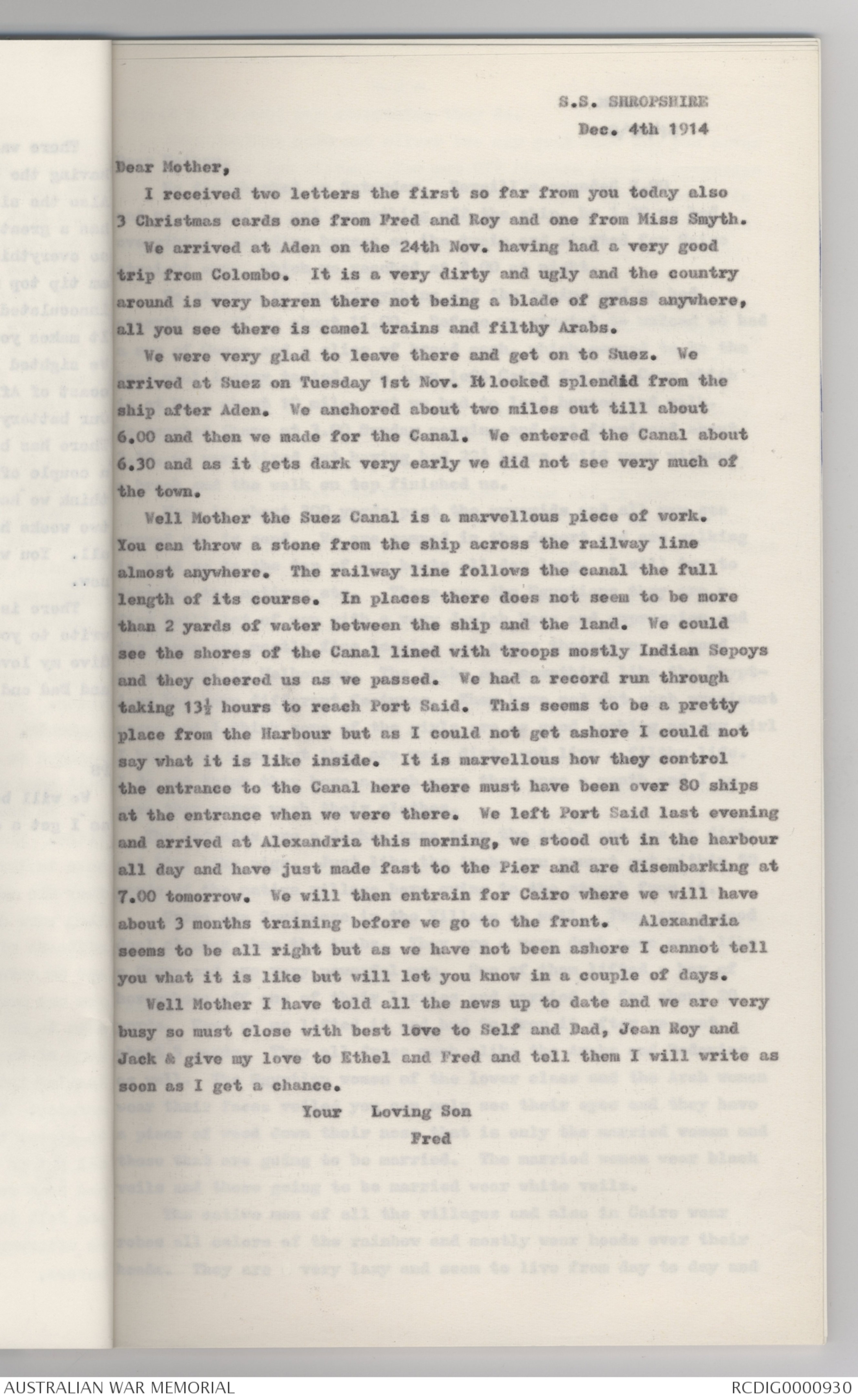
S.S. SHROPSHIRE
Dec. 4th 1914
Dear Mother,
I received two letters the first so far from you today also
3 Christmas cards one from Fred and Roy and one from Miss Smyth.
We arrived at Aden on the 24th Nov. having had a very good
trip from Colombo. It is a very dirty and ugly and the country
around is very barren there not being a blade of grass anywhere,
all you see there is camel trains and filthy Arabs.
We were very glad to leave there and get on to Suez. We
arrived at Suez on Tuesday 1st Nov. It looked splendid from the
ship after Aden. We anchored about two miles out till about
6.00 and then we made for the Canal. We entered the Canal about
6.30 and as it gets dark very early we did not see very much of
the town.
Well Mother the Suez Canal is a marvellous piece of work.
You can throw a stone from the ship across the railway line
almost anywhere. The railway line follows the canal the full
length of its course. In places there does not seem to be more
than 2 yards of water between the ship and the land. We could
see the shores of the Canal lined with troops mostly Indian Sepoys
and they cheered us as we passed. We had a record run through
taking 13½ hours to reach Port Said. This seems to be a pretty
place from the Harbour but as I could not get ashore I could not
say what it is like inside. It is marvellous how they control
the entrance to the Canal here there must have been over 80 ships
at the entrance when we were there. We left Port Said last evening
and arrived at Alexandria this morning, we stood out in the harbour
all day and have just made fast to the Pier and are disembarking at
7.00 tomorrow. We will then entrain for Cairo where we will have
about 3 months training before we go to the front. Alexandria
seems to be all right but as we have not been ashore I cannot tell
you what it is like but will let you know in a couple of days.
Well Mother I have told all the news up to date and we are very
busy so must close with best love to Self and Dad, Jean Roy and
Jack & give my love to Ethel and Fred and tell them I will write as
soon as I get a chance.
Your Loving Son
Fred
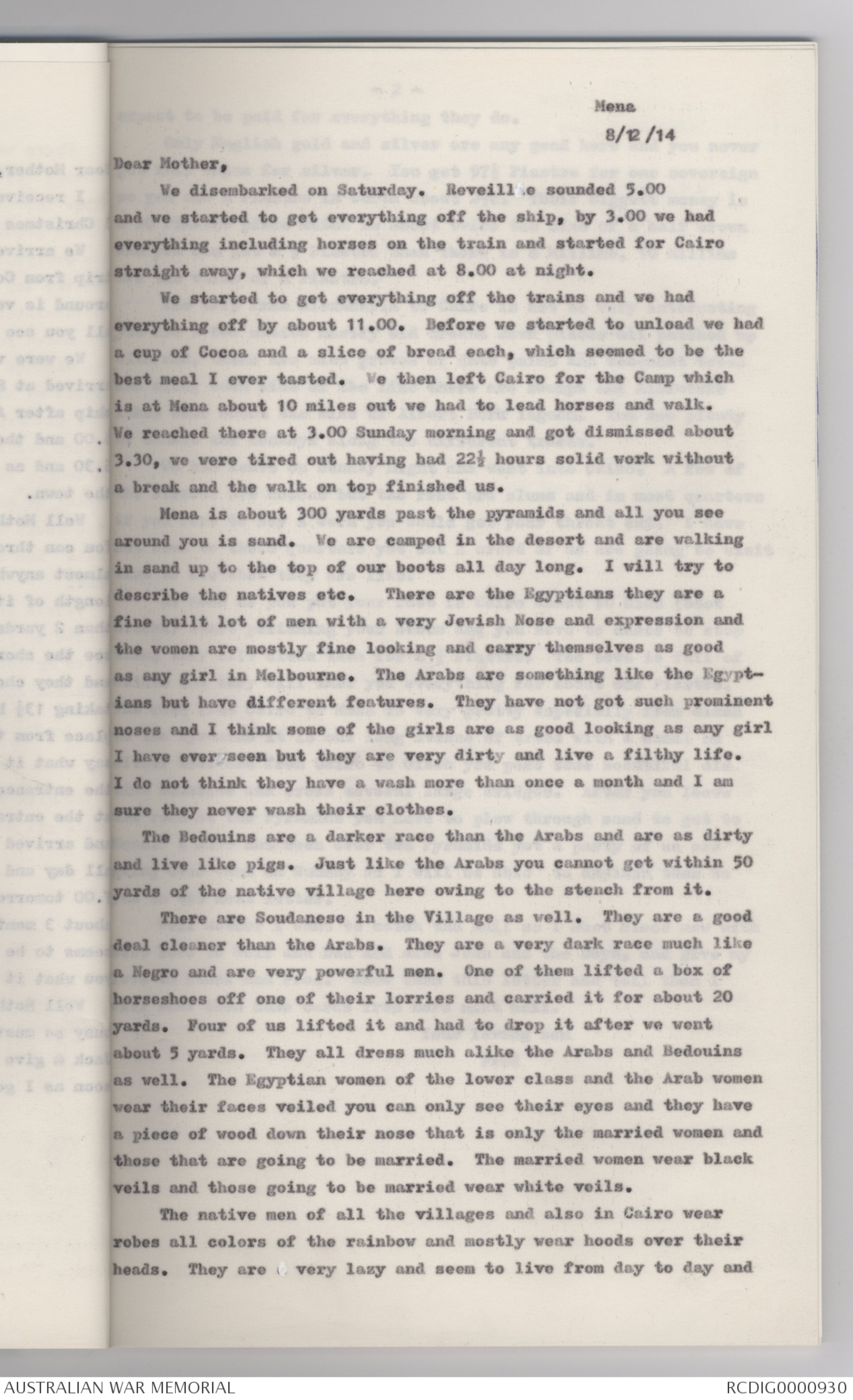
Mena
8/12/I4
Dear Mother,
We disembarked on Saturday. Reveille sounded 5.00
and we started to get everything off the ship, by 3.00 we had
everything including horses on the train and started for Cairo
straight away, which we reached at 8.00 at night.
We started to get everything off the trains and we had
everything off by about 11.00. Before we started to unload we had
a cup of Cocoa and a slice of bread each, which seemed to be the
best meal I ever tasted. We then left Cairo for the Camp which
is at Mena about 10 miles out we had to lead horses and walk.
We reached there at 3.00 Sunday morning and got dismissed about
3.30, we were tired out having had 22½ hours solid work without
a break and the walk on top finished us.
Mena is about 300 yards past the pyramids and all you see
around you is sand. We are camped in the desert and are walking
in sand up to the top of our boots all day long. I will try to
describe the natives etc. There are the Egyptians they are a
fine built lot of men with a very Jewish Nose and expression and
the women are mostly fine looking and carry themselves as good
as any girl in Melbourne. The Arabs are something like the Egyptians
but have different features. They have not got such prominent
noses and I think some of the girls are as good looking as any girl
I have ever seen but they are very dirty and live a filthy life.
I do not think they have a wash more than once a month and I am
sure they never wash their clothes.
The Bedouins are a darker race than the Arabs and are as dirty
and live like pigs. Just like the Arabs you cannot get within 50
yards of the native village here owing to the stench from it.
There are Soudanese in the Village as well. They are a good
deal cleaner than the Arabs. They are a very dark race much like
a Negro and are very powerful men. One of them lifted a box of
horseshoes off one of their lorries and carried it for about 20
yards. Four of us lifted it and had to drop it after we went
about 5 yards. They all dress much alike the Arabs and Bedouins
as well. The Egyptian women of the lower class and the Arab women
wear their faces veiled you can only see their eyes and they have
a piece of wood down their nose that is only the married women and
those that are going to be married. The married women wear black
veils and those going to be married wear white veils.
The native men of all the villages and also in Cairo wear
robes all colors of the rainbow and mostly wear hoods over their
heads. They are very lazy and seem to live from day to day and
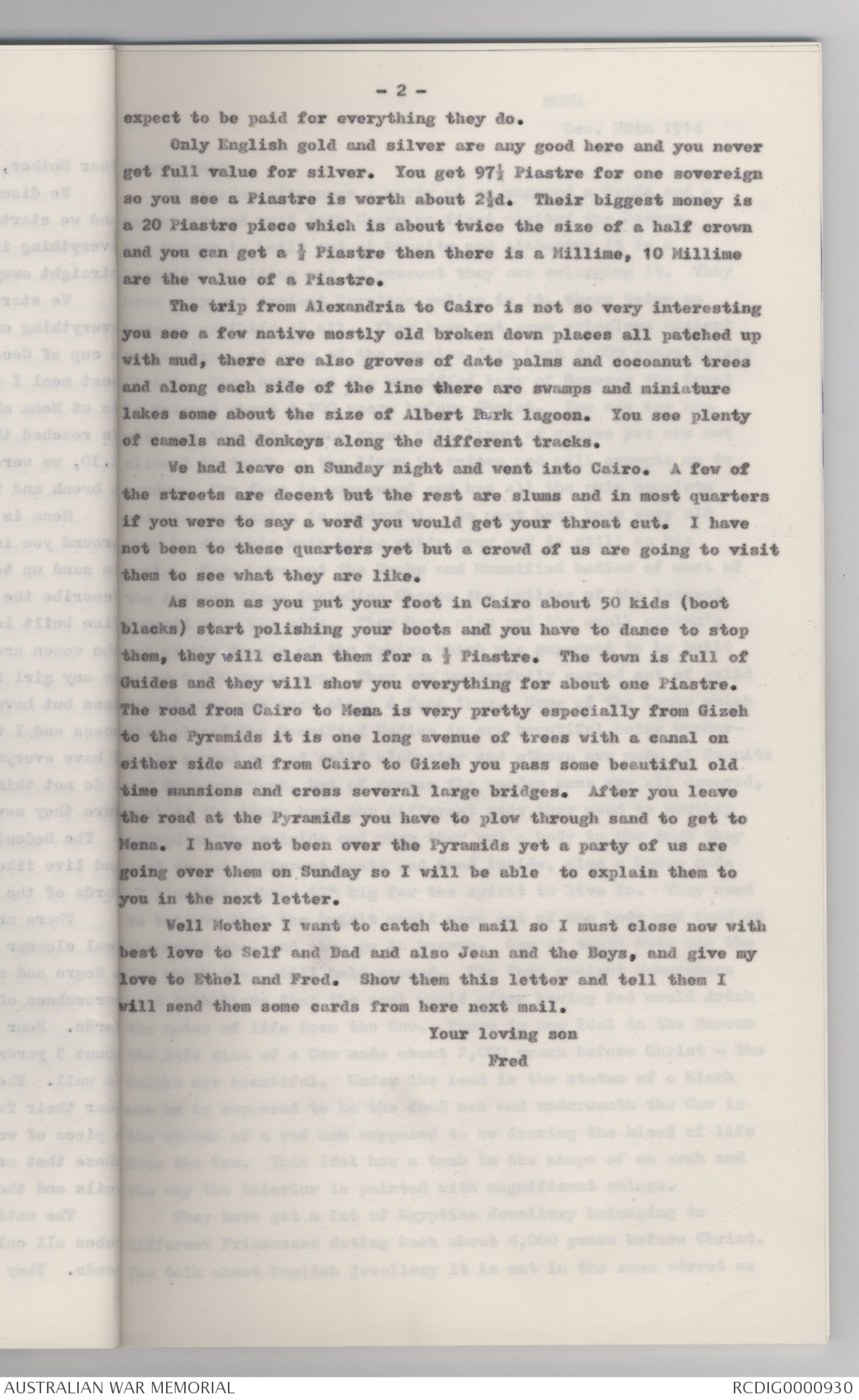
- 2 -
expect to be paid for everything they do.
Only English gold and silver are any good here and you never
get full value for silver. You get 97½ Piastre for one sovereign
so you see a Piastre is worth about 2½d. Their biggest money is
a 20 Piastre piece which is about twice the size of a half crown
and you can get a ½ Piastre then there is a Millime, 10 Millime
are the value of a Piastre.
The trip from Alexandria to Cairo is not so very interesting
you see a few native mostly old broken down places all patched up
with mud, there are also groves of date palms and cocoanut trees
and along each side of the line there are swamps and miniature
lakes some about the size of Albert Park lagoon. You see plenty
of camels and donkeys along the different tracks.
We had leave on Sunday night and went into Cairo. A few of
the streets are decent but the rest are slums and in most quarters
if you were to say a word you would get your throat cut. I have
not been to these quarters yet but a crowd of us are going to visit
them to see what they are like.
As soon as you put your foot in Cairo about 50 kids (boot
blacks) start polishing your boots and you have to dance to stop
them, they will clean them for a ½ Piastre. The town is full of
Guides and they will show you everything for about one Piastre.
The road from Cairo to Mena is very pretty especially from Gizeh
to the Pyramids it is one long avenue of trees with a canal on
either side and from Cairo to Gizeh you pass some beautiful old
time mansions and cross several large bridges. After you leave
the road at the Pyramids you have to plow through sand to get to
Mena. I have not been over the Pyramids yet a party of us are
going over them on Sunday so I will be able to explain them to
you in the next letter.
Well Mother I want to catch the mail so I must close now with
best love to Self and Dad and also Jean and the Boys, and give my
love to Ethel and Fred. Show them this letter and tell them I
will send them some cards from here next mail.
Your loving son
Fred
 Mark & Michele Parsons
 This transcription item is now locked to you for editing. To release the lock either Save your changes or Cancel.
This lock will be automatically released after 60 minutes of inactivity.