
Diary Henry Arthur Goddard 1918 - Part 8
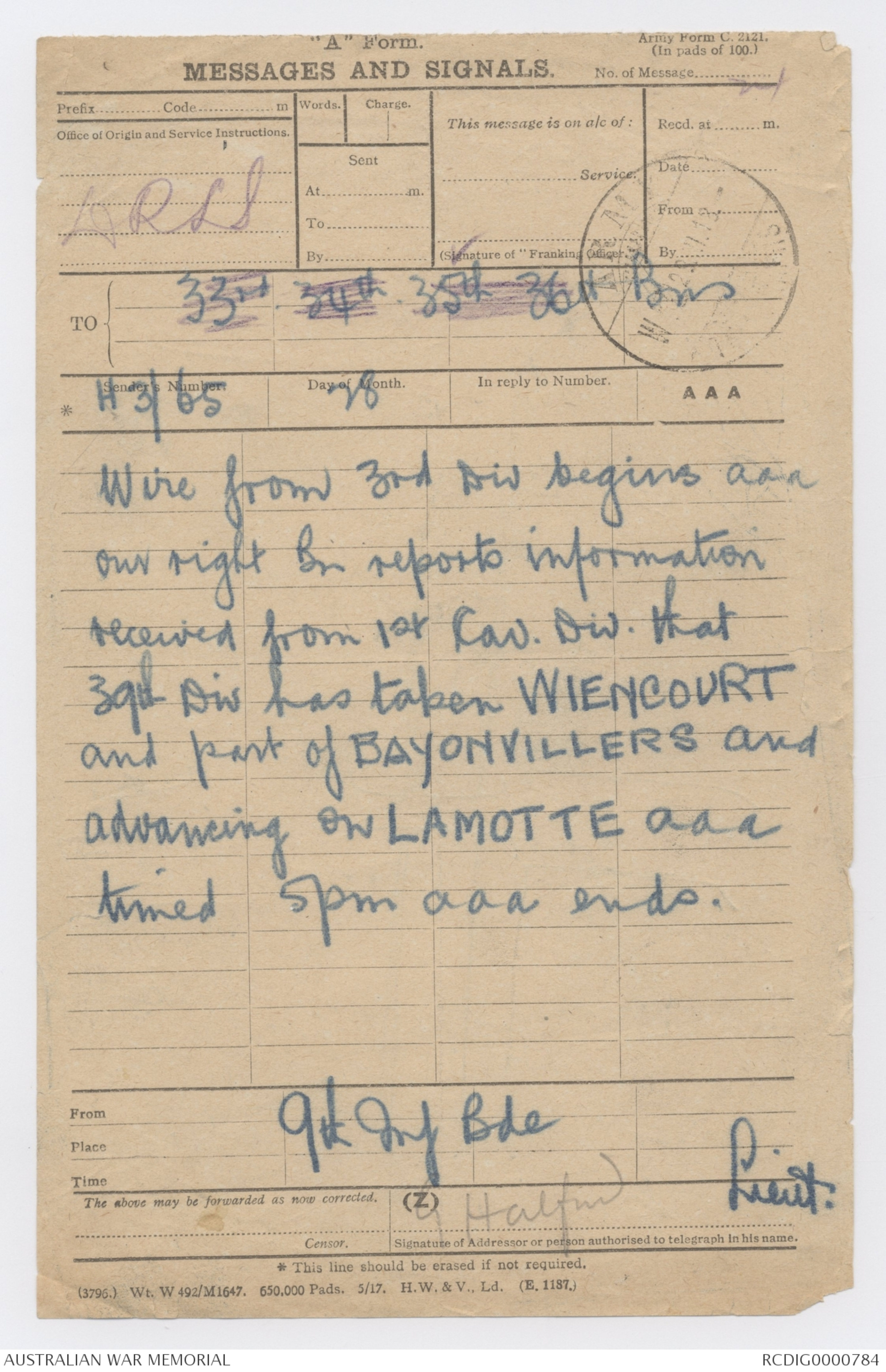
MESSAGES AND SIGNALS
Office of Origin and Service Instructions.
DRLS
TO { 33rd. 34th. 35th. 36th Bns
Sender's Number
H3/65
Day of Month.
28
Wire from 3rd Div begins aaa
our right Bn reports information
received from 1st Cav. Div. that
39th Div has taken WIENCOURT
and part of BAYONVILLERS and
advancing on LAMOTTE aaa
timed 5pm aaa ends.
From
9th Inf Bde
G Halfin Lieut.
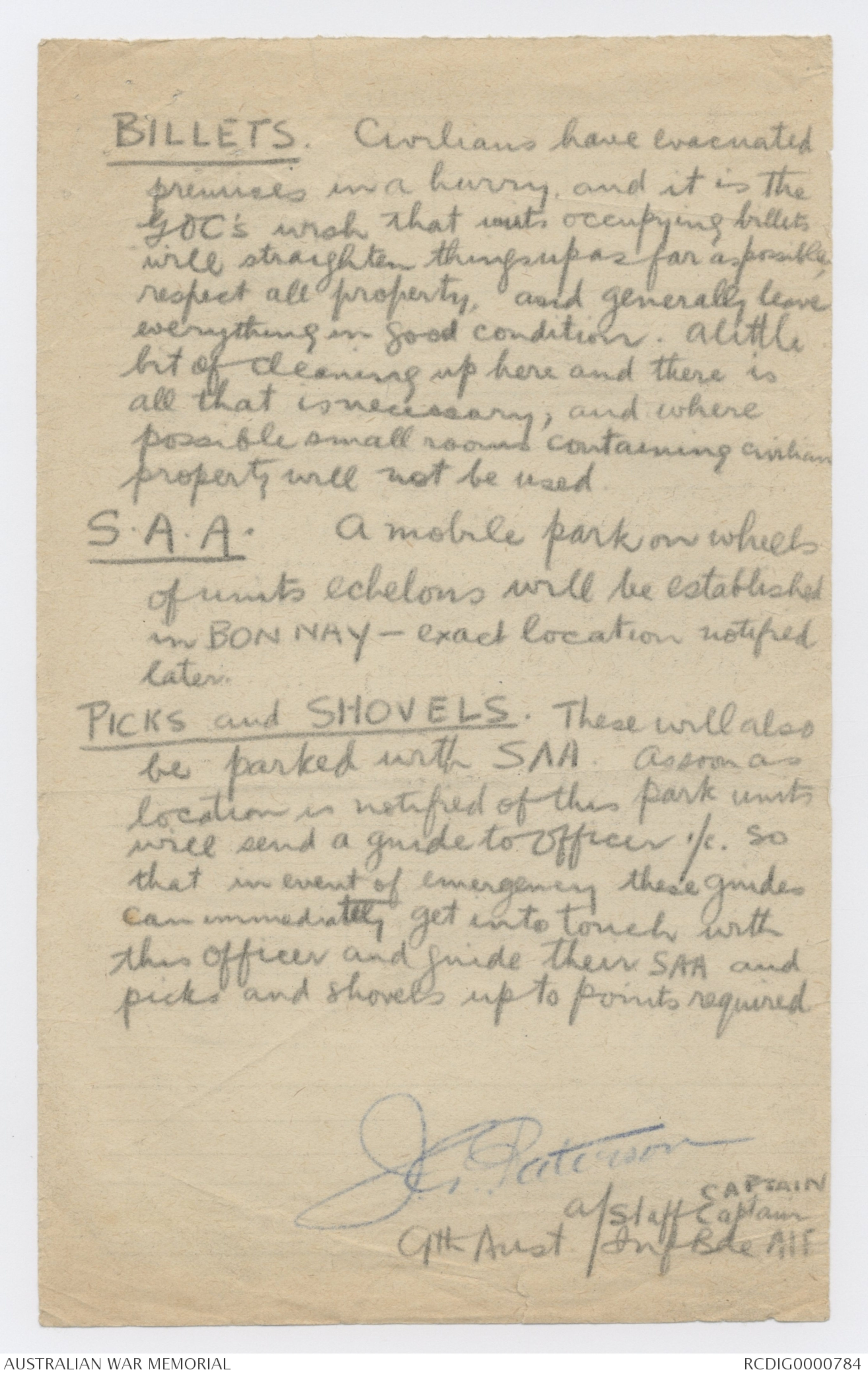
BILLETS. Civilians have evacuated
premises in a hurry, and it is the
GOC's wish that units occupying billets
will straighten things up as far as possible,
respect all property, and generally leave
everything in good condition. A little
bit of cleaning up here and there is
all that is necessary, and where
possible small rooms containing civilian
property will not be used.
S.A.A. A mobile park on wheels
of units echelons will be established
in BONNAY - exact location notified
later.
PICKS and SHOVELS. These will also
be parked with SAA. As soon as
location is notified of this park units
will send a guide to Officer I/c. So
that in event of emergency these guides
can immediately get into touch with
this officer and guide their SAA and
picks and shovels up to points required.
J.C.Paterson
CAPTAIN
a/Staff Captain
9th Aust. Inf Bde AIF
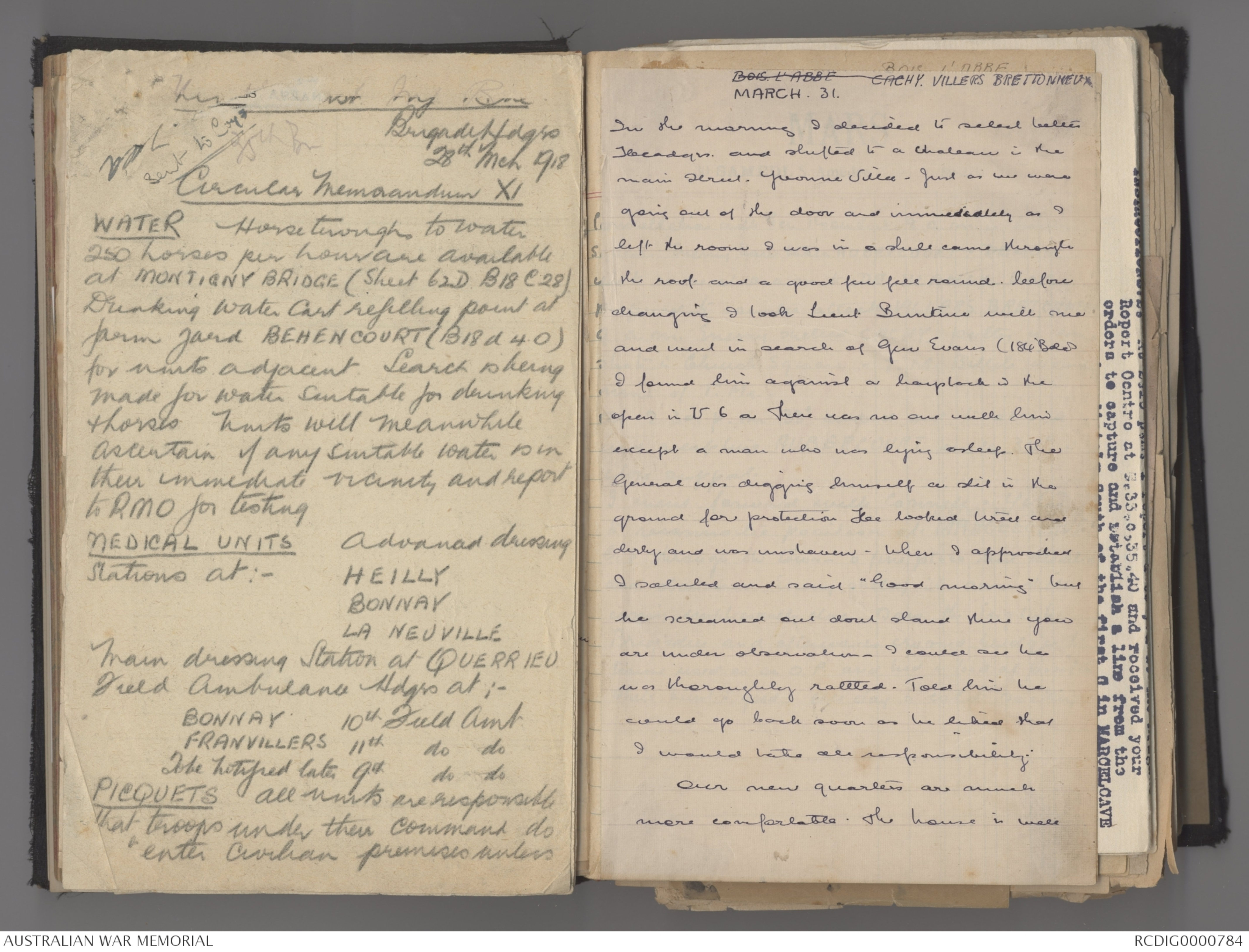
Ninth [[?]]st Inf. Bde.
Brigade Hdqrs
28th Mch 1918
[*Sent to Coys
35th Bn*]
Circular Memorandum XI
WATER Horse troughs to water
250 horses per hour are available
at MONTIGNY BRIDGE (Sheet 62D B18 C28).
Drinking Water Cart refilling point at
farm yard BEHENCOURT (B18 d4.0)
for units adjacent. Search is being
made for water suitable for drinking
& horses. Units will meanwhile
ascertain if any suitable water is in
their immediate vicinity and report
to RMO for testing
MEDICAL UNITS Advanced dressing
Stations at:- HEILLY
BONNAY
LA NEUVILLE
Main dressing Station at QUERRIEU
Field Ambulance Hqrs at:-
BONNAY 10th Field Amb
FRANVILLERS 11th do do
To be notified later 9th do do
PICQUETS All units are responsible
that troops under their command do
t enter civilian premises unless
BOIS L'ABBE CACHY VILLERS BRETTONNEUX
MARCH. 31.
In the morning I decided to select better
Headqrs. and shifted to a Chateau in the
main street. Yvonne Villa. Just as we were
going out of the door and immediately as I
left the room I was in a shell came through
the roof and a good few fell round. before
changing I took Lieut Buntine with me
and went in search of Gen Evans (184th Bde)
I found him against a haystack in the
open in V6 & there was no one with him
except a man who was lying asleep. The
General was digging himself a slit in the
ground for protection. He looked tired and
dirty and was unshaven - When I approached
I saluted and said "Good morning" but
he screamed out dont stand there you
are under observation - I could see he
was thoroughly rattled. Told him he
could go back soon as he liked - that
I would take all responsibility.
Our new quarters are much
more comfortable. The house is well
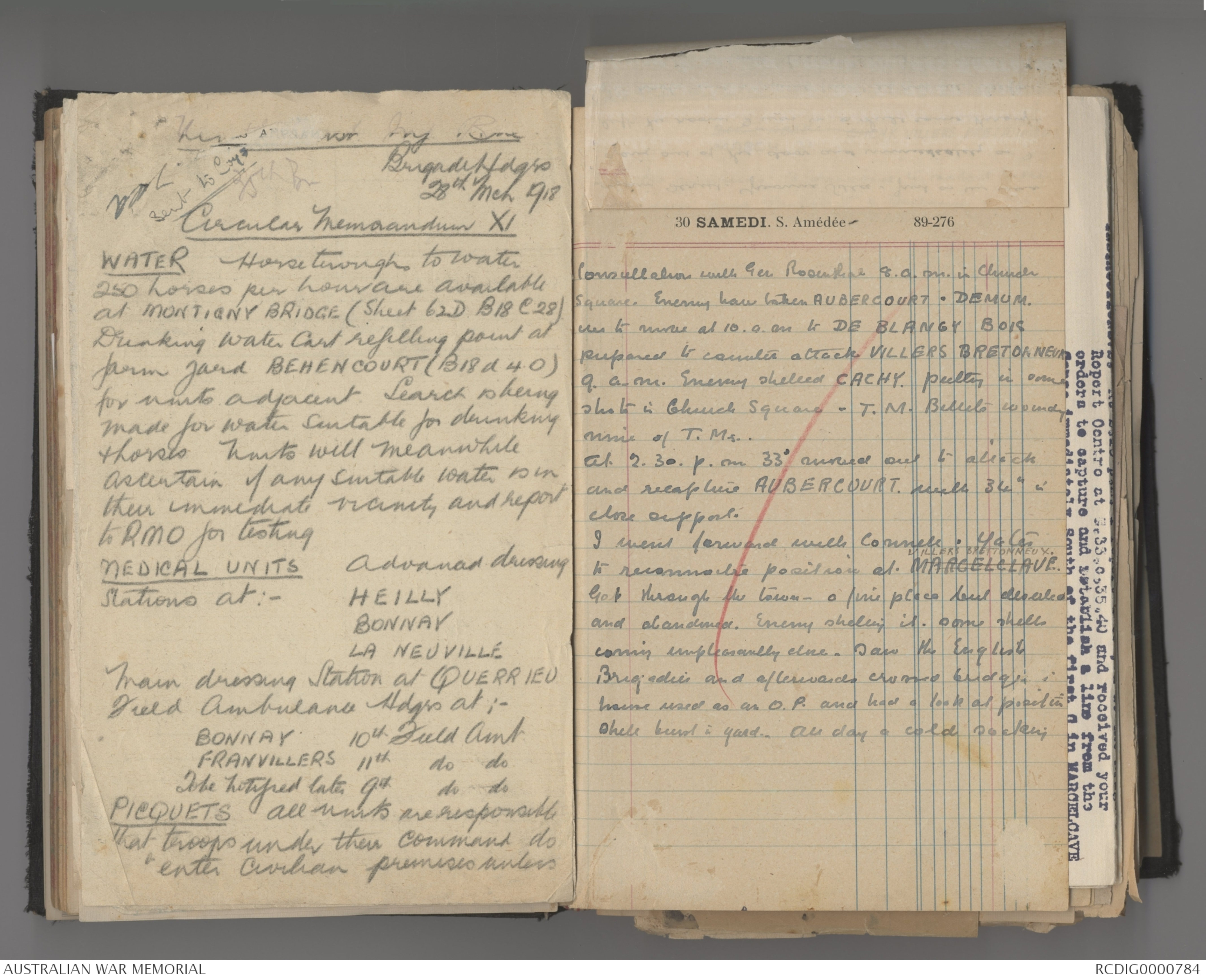
Ninth [[?]]st Inf. Bde
Brigade Hdqrs
28th Mch 1918
[*Sent to Coys
35th Bn*]
Circular Memorandum XI
WATER Horse troughs to water
250 horses per hour are available
at MONTIGNY BRIDGE (Sheet 62D B18 C28).
Drinking water cart refilling point at
farm yard BEHENCOURT (B18d4.0)
for units adjacent. Search being
made for water suitable for drinking
& horses. Units will meanwhile
ascertain if any suitable water is in
their immediate vicinity and report
to RMO for testing
MEDICAL UNITS Advanced dressing
Stations at:- HEILLY
BONNAY
LA NEUVILLE
Main dressing Station at QUERRIEU
Field Ambulance Hqrs at:-
BONNAY 10th Field Amb
FRANVILLERS 11th do do
To be notified later 9th do do
PICQUETS All units are responsible
that troops under their command do
t enter civilian premises unless
30 SAMEDI
Consultation with Gen Rosenthal 8.a.m. in Church
Square. Enemy have taken AUBERCOURT. DEMUM.
Are to move at 10.a.m to DE BLANGY BOIS
Prepared to counter attack VILLERS BRETONNEUX
9. a.m. Enemy shelled CACHY. putting in some
shots in Church Square & T.M. Billets wounding
nine of T.Ms..
At 2.30. p.m 33rd moved out to attack
and recapture AUBERCOURT. with 34th in
close support.
I went forward with Connell & Yates
to reconnoitre position at MARCELCLAVE. VILLERS BRETONNEUX.
Got through the town - a fine place but deserted
and abandoned. Enemy shelling it. some shells
coming unpleasantly close. Saw the English
Brigadier and afterwards crossed bridge
house used as an O.P. and had a look at position
Shell burst in yard. All day a cold soaking
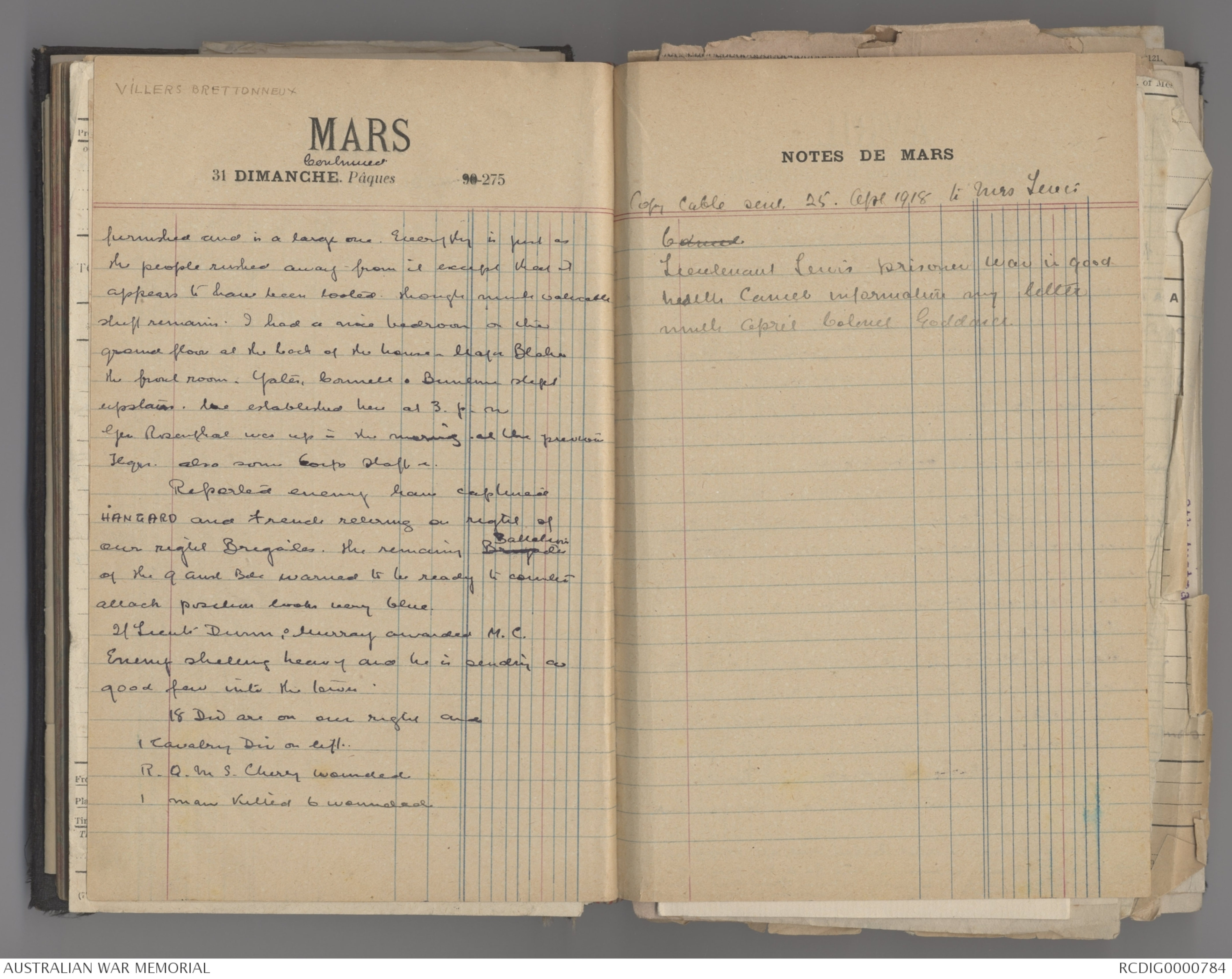
VILLERS BRETTONNEUX
MARS
Continued
31 DIMANCHE
furnished and is a large one. Everything is just as
the people rushed away from it except that it
appears to have been looted. though much valuable
stuff remains. I had a nice bedroom on the
ground floor at the back of the house - Major Blake
the front room. Yates, Connell & Buntine slept
upstairs. We established here at 3. p.m.
Gen Rosenthal was up in the morning - at the previous
Hqrs. also some Corps staff &c.
Reported enemy has captured
HANGARD and French retiring on right of
our right Brigades. the remaining Brigades Battalion
of the 9 Aust Bde warned to be ready to counter
attack position looks very blue.
2/Lieuts Dunn, Murray awarded M.C.
Enemy shelling heavy and he is sending a
good few into the town.
18 Div are on our right and
1 Cavalry Div on left.
R.Q.M.S. Cherry wounded.
1 man killed 6 wounded.
NOTES DE MARS
Copy cable sent 25. Apl. 1918 to Mrs LewisColonel
Lieutenant Lewis prisoner war in good
health Cancel information my letter
ninth April Colonel Goddard.
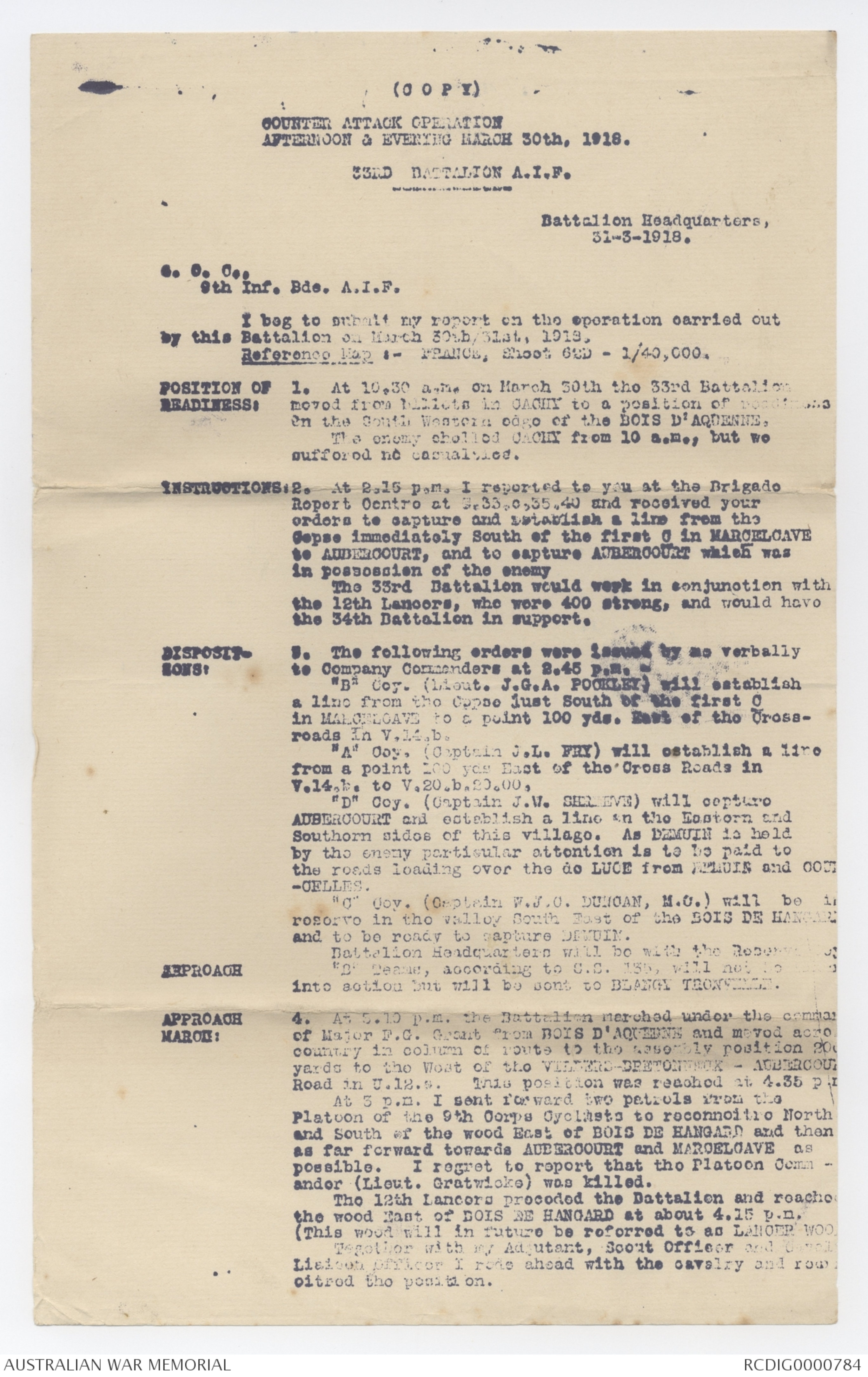
(COPY)
COUNTER ATTACK OPERATION
AFTERNOON & EVENING MARCH 30th, 1918.
33RD BATTALION A.I.F.
Battalion Headquarters,
31-3-1918.
G.O.C.
9th Inf. Bde. A.I.F.
I beg to submit my report on the operation carried out
by this Battalion on March 30th/31st, 1918.
Reference Map :- FRANCE, Sheet 62D - 1/40,000.
POSITION OF
READINESS:
1. At 10.30 a.m. on March 30th the 33rd Battalion
moved from billets in CACHY to a position of positions
on the South Western edge of the BOIS D'AQUENNE.
The enemy shelled CACHY from 10 a.m., but we
suffered no casualties.
INSTRUCTIONS:
2. At 2.15 p.m. I reported to you at the Brigade
Report Centre at 5.33, c,35.40 and received your
orders to capture and establish a line from the
Copse immediately South of the first C in MARCELCAVE
to AUBERCOURT, and to capture AUBERCOURT which was
in possession of the enemy.
The 33rd Battalion would work in conjunction with
the 12th Lancers, who were 400 strong, and would have
the 34th Battalion in support.
DISPOSITIONS:
3. The following orders were issued by me verbally
to Company Commanders at 2.45 p.m.
"B" Coy. (Lieut. J.G.A. POCKLEY) will establish
a line from the Copse just South of the first C
in MARCELCAVE to a point 100 yds. East of the Crossroads
in V.14.b.
"A" Coy (Captain J.L. FRY) will establish a line
from a point 100 yds. East of the Cross Roads in
V.14.b. to V.20 b.20.00.
"D" Coy (Captain J.W. SHREEVE) will capture
AUBERCOURT and establish a line in the Eastern and
Southern sides of this village. As DEMUIN is held
by the enemy particular attention is to be paid to
the roads leading over the de LUCE from DEMUIN and COURCELLES.
"C" Coy. (Captain F.J.C. DUNCAN, M.C.) will be in
reserve in the valley South East of the BOIS DE HANGARD
and to be ready to capture DEMUIN.
Battalion Headquarters will be with the Reserve Coy
APPROACH
"B" Teams, according to S.S. 135, will not be sent
into action but will be sent to BLANGY TRONVILLE.
APPROACH
MARCH:
4. At 5.10 p.m. the Battalion marched under the command
of Major F.G. Grant from BOIS D'AQUENNE and moved across
country in column of route to the assembly position 200
yards to the West of VILLERS-BRETTONNEUX - AUBERCOURT
Road in U.12.s. This position was reached at 4.35 p.m.
At 3 p.m. I sent forward two patrols from the
Platoon of the 9th Corps Cyclists to reconnoitre North
and South of the wood East of BOIS DE HANGARD and then
as far forward towards AUBERCOURT and MARCELCAVE as
possible. I regret to report that the Platoon Commander
(Lieut. Gratwicke) was killed.
The 12th Lancers proceded the Battalion and reached
the word East of BOIS DE HANGARD at about 4.15 p.m.
(This wood will in future be referred to as LANCER WOOD)
Together with my Adjutant, Scout Officer and Cavalry
Liaison Officer I rode ahead with the cavalry and reconnoitred
the position.
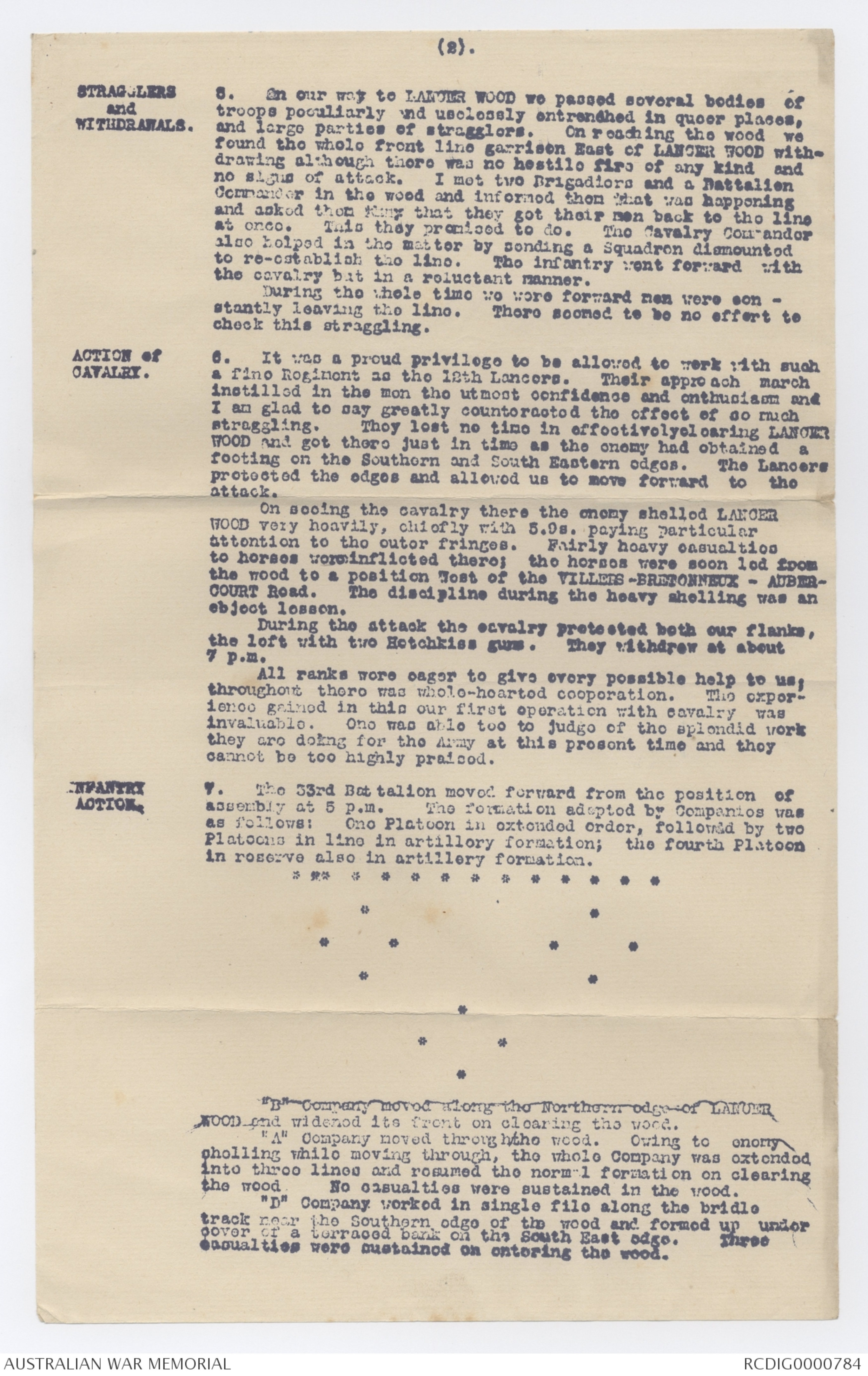
(2).
STRAGGLERS
and
WITHDRAWALS.
5. On our way to LANCER WOOD we passed several bodies of
troops peculiarly and uselessly entrenched in queer places,
and large parties of stragglers. On reaching the wood we
found the whole front line garrison East of LANCER WOOD withdrawing
although there was no hostile fire of any kind and
no signs of attack. I met two Brigadiers and a Battalion
Commander in the wood and informed them what was happening
and asked them kindly that they get their men back to the line
at once. This they promised to do. The Cavalry Commander
also helped in the matter by sending a Squadron dismounted
to re-establish the line. The infantry went forward with
the cavalry but in a reluctant manner.
During the whole time we were forward men were constantly
leaving the line. There seemed to be no effort to
check this straggling.
ACTION of
CAVALRY.
6. It was a proud privilege to be allowed to work with such
a fine Regiment as the 12th Lancers. Their approach march
instilled in the men the utmost confidence and enthusiasm and
I am glad to say greatly counteracted the effect of so much
straggling. They lost no time in effectively clearing LANCER
WOOD and got there just in time as the enemy had obtained a
footing on the Southern and South Eastern edges. The Lancers
protected the edges and allowed us to move forward to the
attack.
On seeing the cavalry there the enemy shelled LANCER
WOOD very heavily, chiefly with 5.9s. paying particular
attention to the outer fringes. Fairly heavy casualties
to horses were inflicted there; the horses were soon led from
the wood to a position West of the VILLERS-BRETONNEUX-AUBERCOURT
Road. The discipline during the heavy shelling was an
object lesson.
During the attack the cavalry protected both our flanks,
the left with two Hotchkiss guns. They withdrew at about
7 p.m.
All ranks were eager to give every possible help to us;
throughout there was whole-hearted cooperation. The experience
gained in this our first operation with cavalry was
invaluable. One was able too to judge of the splendid work
they are doing for the Army at this present time and they
cannot be too highly praised.
INFANTRY
ACTION.
7. The 33rd Battalion moved forward from the position of
assembly at 5 p.m. The formation adopted by Companies was
as follows: One Platoon in extended order, followed by two
Platoons in line in artillery formation; the fourth Platoon
in reserve also in artillery formation.
formation diagram - see original document
"B" Company moved along the Northern edge of LANCER
WOOD and widened its front on clearing the wood.
"A" Company moved through the wood. Owing to enemy
shelling while moving through, the whole Company was extended
into three lines and resumed the normal formation on clearing
the wood. No casualties were sustained in the wood.
"D" Company worked in single file along the bridle
track near the Southern edge of the wood and formed up under
cover of a terraced bank on the South East edge. Three
casualties were sustained on entering the wood.
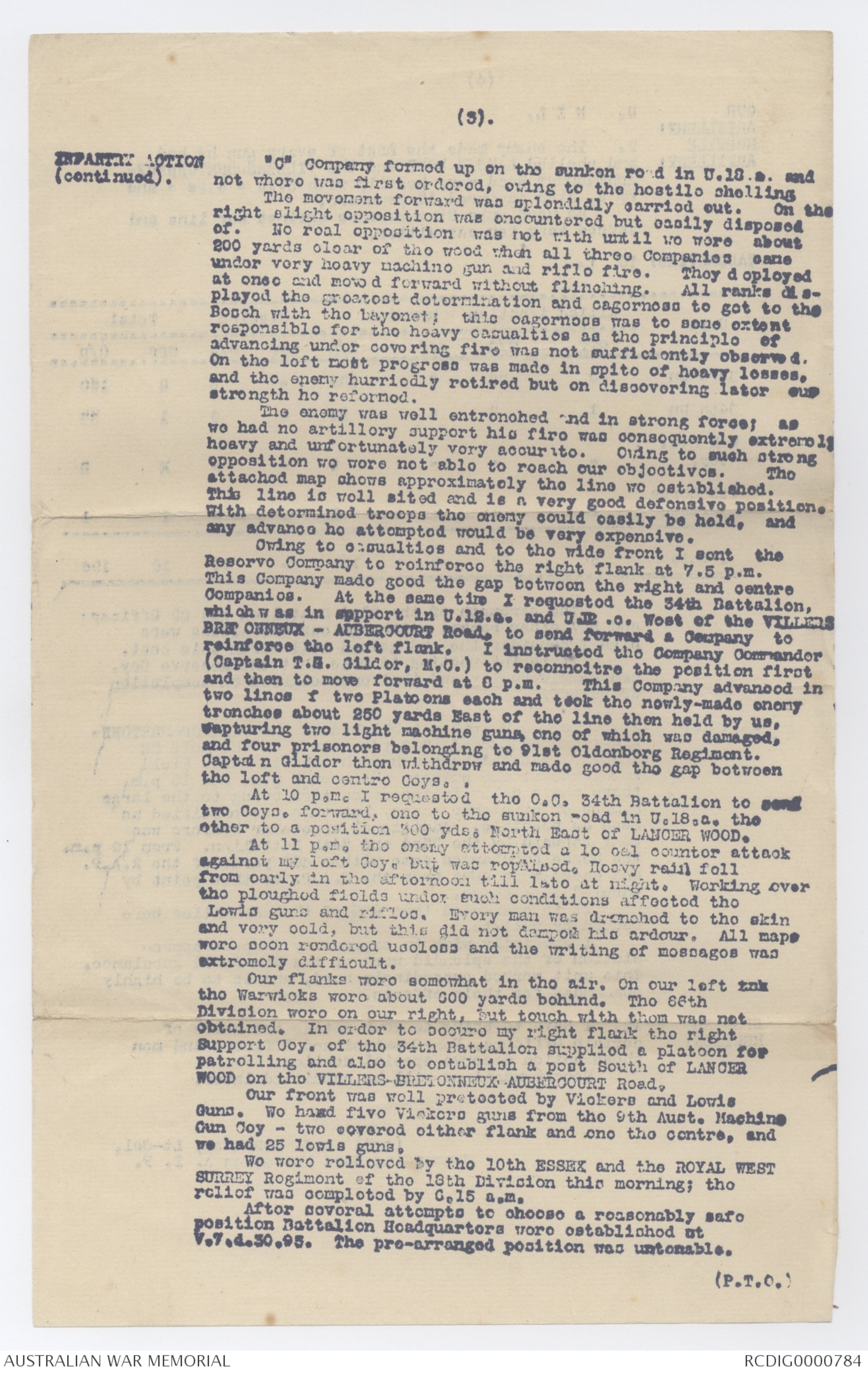
(3).
INFANTRY ACTION
(continued).
"C" Company formed up on the sunken road in U.18.a. and
not where was first ordered, owing to the hostile shelling
The movement forward was splendidly carried out. On the
right slight opposition was encountered but easily disposed
of. No real opposition was met with until we were about
200 yards clear of the wood when all three Companies came
under very heavy machine gun and rifle fire. They deployed
at once and moved forward without flinching. All ranks displayed
the greatest determination and eagerness to get to the
Bosch with the bayonet; this eagerness was to some extent
responsible for the heavy casualties as the principle of
advancing under covering fire was not sufficiently observed.
On the left most progress was made in spite of heavy losses,
and the enemy hurriedly retired but on discovering later our
strength he reformed.
The enemy was well entrenched and in strong force; as
we had no artillery support his fire was consequently extremely
heavy and unfortunately very accurate. Owing to such strong
opposition we were not able to reach our objectives. The
attached map shows approximately the line we established.
This line is well sited and is a very good defensive position.
With determined troops the enemy could easily be held, and
any advance he attempted would be very expensive.
Owing to casualties and to the wide front I sent the
Reserve Company to reinforce the right flank at 7.5 p.m.
This Company made good the gap between the right and centre
Companies. At the same time I requested the 34th Battalion,
which was in support in U.12.a. and U.12.c. West of the VILLERS
BRETTONEUX - ABERCOURT Road, to send forward a Company to
reinforce the left flank. I instructed the Company Commander
(Captain T.E. Gilder, M.C.) to reconnoitre the position first
and then to move forward at 8 p.m. This Company advanced in
two lines of two Platoons each and took the newly-made enemy
trenches about 250 yards East of the line then held by us,
capturing two light machine guns, one of which was damaged,
and four prisoners belong to 91st Oldonborg Regiment.
Captain Gilder then withdrew and made good the gap between
the left and centre Coys.
At 10 p.m. I requested the O.C. 34th Battalion to send
two Coys. forward, one to the sunken road in U.18.a. the
other to a position 300 yds North East of LANCER WOOD.
At 11 p.m. the enemy attempted a local counter attack
against my left Coy. but was repulsed. Heavy rain fell
from early in the afternoon till late at night. Working over
the ploughed fields under such conditions affected the
Lewis guns and rifles. Every man was drenched to the skin
and very cold, but this did not dampen his ardour. All maps
were soon rendered useless and the writing of messages was
extremely difficult.
Our flanks were somewhat in the air. On our left tnk
the Warwicks were about 600 yards behind. The 66th
Division were on our right, but touch with them was not
obtained. In order to secure my right flank the right
Support Coy. of the 34th Battalion supplied a platoon for
patrolling and also to establish a post South of LANCER
WOOD on the VILLERS-BRETONNEUX-ABERCOURT Road.
Our front was well protected by Vickers and Lewis
Guns. We haxd five Vickers guns from the 9th Aust. Machine
Gun Coy - two covered either flank and one the centre, and
we had 25 lewis guns.
We were relieved by the 10th ESSEX and the ROYAL WEST
SURREY Regiment of the 18th Division this morning; the
relief was completed by 6.15 a.m.
After several attempts to choose a reasonably safe
position Battalion Headquarters were established at
V.7.d.30.95. The pre-arranged position was untenable.
(P.T.O.)
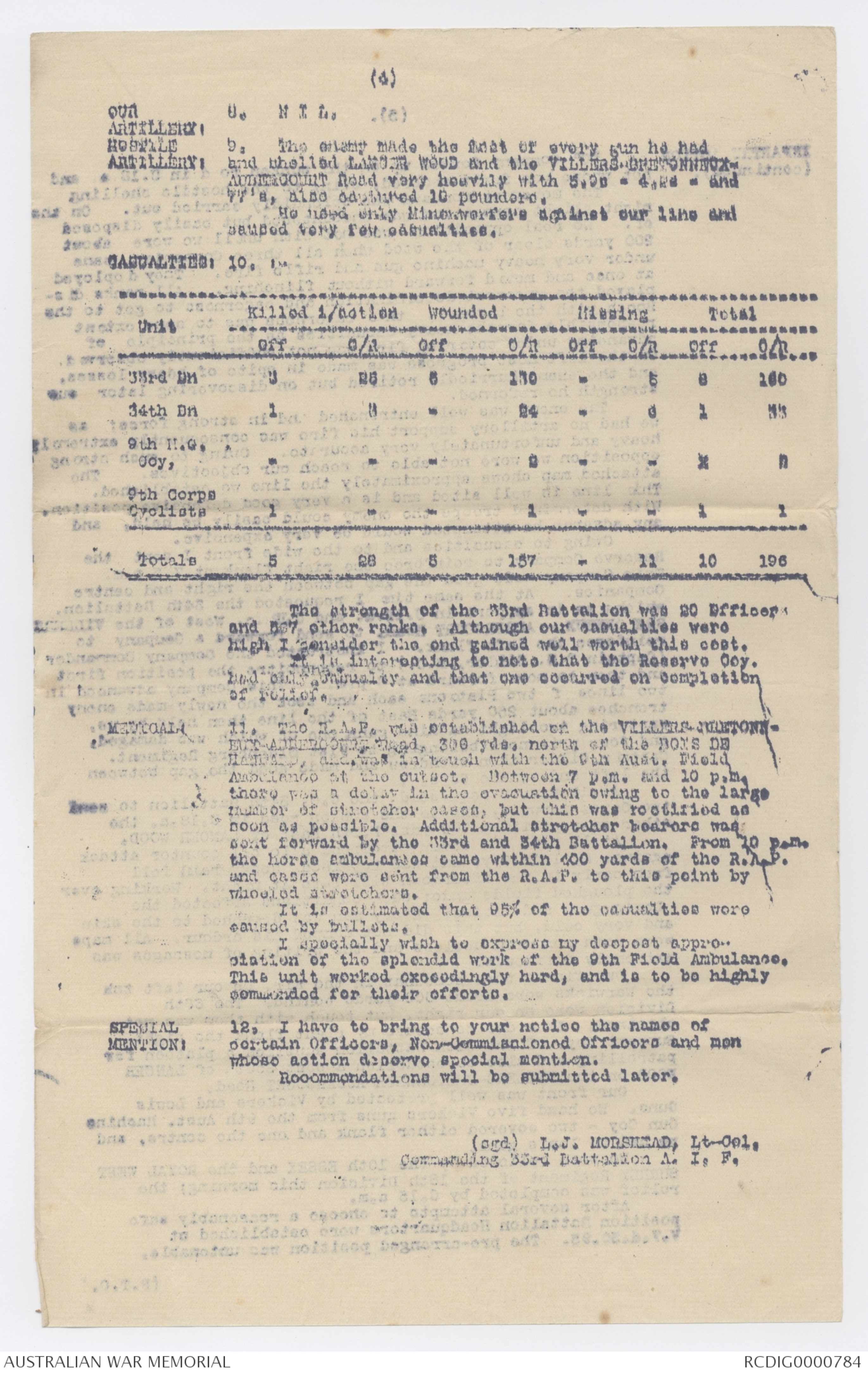
(4)
OUR ARTILLERY: 8. NIL.
HOSTILE ARTILLERY:
9. The enemy made the most of every gun he had
and shelled LANCER WOOD and the VILLERS-BRETONNEUX-
ABERCOURT Road very heavily with 5.9s - 4.2s - and
VV's, also captured 10 pounders.
He had only Minewerfers against our line and
caused very few casualties.
CASUALTIES: 10.
Unit Killed i/action Wounded Missing Total
Off O/R Off O/R Off O/R Off O/R
33rd Bn 3 25 5 130 - 5 8 160
34th Bn 1 3 - 24 - 6 1 33
9th M.G.
Coy, - - - 2 - - X 2
9th Corps
Cyclists 1 - - 1 - - 1 1
Totals 5 28 5 157 - 11 10 196
The strength of the 33rd Battalion was 20 Officers
and 567 other ranks. Although our casualties were
high I consider the end gained well worth this cost.
It is interesting to note that the Reserve Coy.
had only 1 casualty and that one occurred on completion
of relief.
MEDICAL:
11. The R.A.P. was established on the VILLERS-BRETONNEUX-
ABERCOURT Road, 300 yds north of the BOIS DE
HANGARD, and was in touch with the 9th Aust. Field
Ambulance at the outset. Between 7 p.m. and 10 p.m.
there was a delay in the evacuation owing to the large
number of stretcher cases, but this was rectified as
soon as possible. Additional stretcher bearers was
sent forward by the 33rd and 34th Battalion. From 10 p.m.
the horse ambulance came within 400 yards of the R.A.P.
and cases were sent from the R.A.P. to this point by
wheeled stretchers.
It is estimated that 95% of the casualties were
caused by bullets.
I specially wish to express my deepest appreciation
of the splendid work of the 9th Field Ambulance.
This unit worked exceedingly hard, and is to be highly
commended for their efforts.
SPECIAL MENTION:
12. I have to bring to your notice the names of
certain Officers, Non-Commissioned Officers and men
whose action deserve special mention.
Recommendations will be submitted later.
(sgd) L.J. MORSHEAD, Lt-Col.
Commanding 33rd Battalion A.I.F.
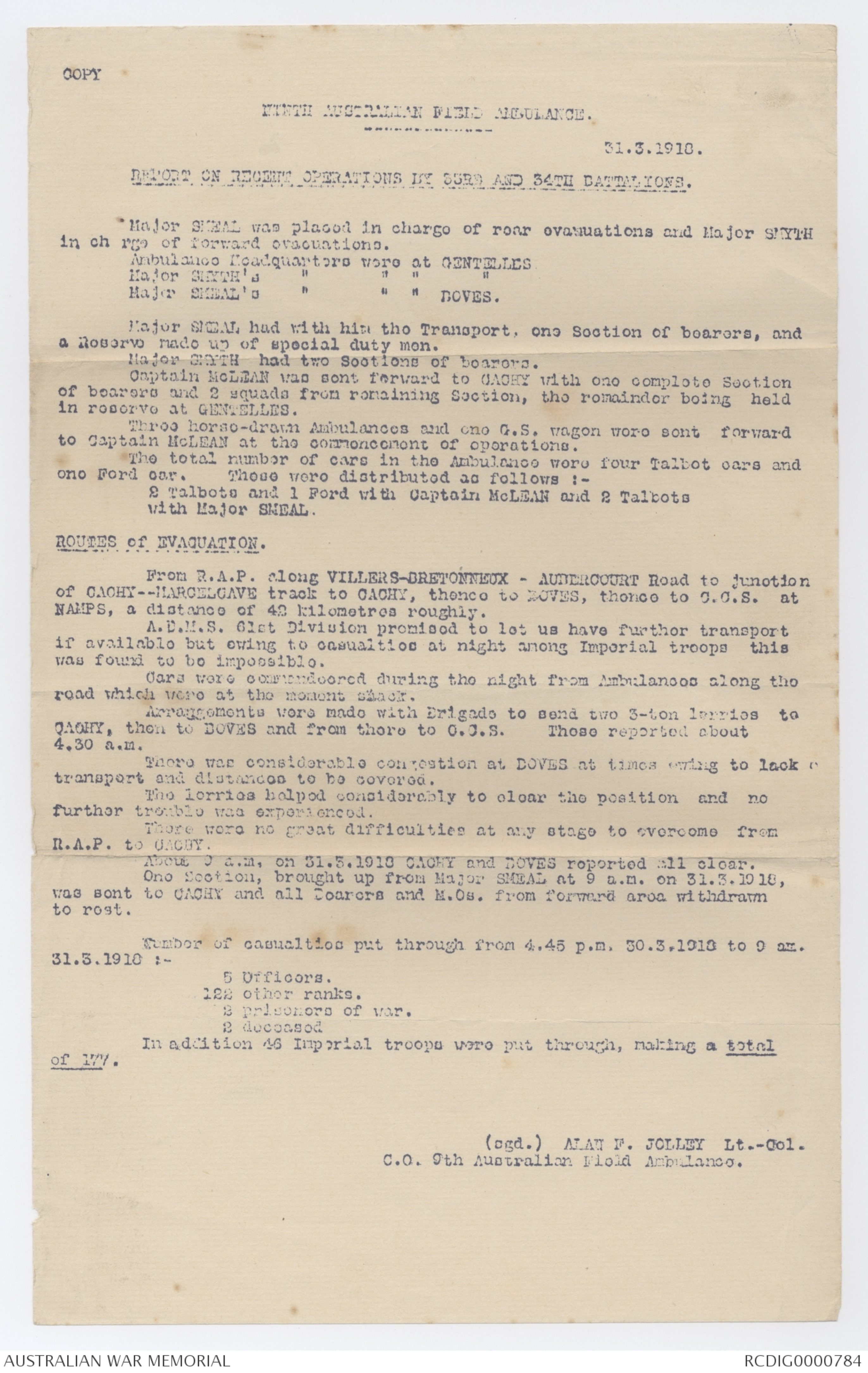
COPY
NINTH AUSTRALIAN FIELD AMBULANCE.
31.3.1918.
REPORT ON RECENT OPERATIONS BY 33RD AND 34TH BATTALIONS.
Major SMEAL was placed in charge of rear evacuations and Major SMYTH
in charge of forward evacuations.
Ambulance Headquarters were at GENTELLES
Major SMYTH's " " " "
Major SMEAL's " " " BOVES.
Major SMEAL had with him the Transport, one Section of bearers, and
a Reserve made up of special duty men.
Major SMYTH had two Sections of bearers.
Captain McLEAN was sent forward to CACHY with one complete Section
of bearers and 2 squads from remaining Section, the remainder being held
in reserve at GENTELLES.
Three horse-drawn Ambulances and one G.S. wagon were sent forward
to Captain McLEAN at the commencement of operations.
The total number of cars in the Ambulance were four Talbot cars and
one Ford car. These were distributed as follows:-
2 Talbots and 1 Ford with Captain McLEAN and 2 Talbots
with Major SMEAL.
ROUTES of EVACUATION.
From R.A.P. along VILLERS-BRETONNEUX - AUBERCOURT Road to junction
of CACHY--MARCELCAVE track to CACHY, thence to BOVES, thence to C.C.S. at
NAMPS, a distance of 42 kilometres roughly.
A.D.M.S. 61st Division promised to let us have further transport
if available but owing to casualties at night among Imperial troops this
was found to be impossible.
Cars were commandeered during the night from Ambulances along the
road which were at the moment slack.
Arrangements were made with Brigade to send two 3-ton lorries to
CACHY, then to BOVES and from there to C.C.S. These reported about
4.30 a.m.
There was considerable congestion at BOVES at times owing to lack of
transport and distances to be covered.
The lorries helped considerably to clear the position and no
further trouble was experienced.
There were no great difficulties at any stage to overcome from
R.A.P. to CACHY.
About 9 a.m. on 31.3.1918 CACY and BOVES reported all clear.
One Section, brought up from Major SMEAL at 9 a.m. on 31.3.1918,
was sent to CACHY and all Bearers and M.Os. from forward area withdrawn
to rest.
Number of casualties put through from 4.45 p.m. 30.3.1918 to 9 am.
31.3.1918 :-
5 Officers.
122 other ranks.
3 prisoners of war.
2 deceased
In addition 46 Imperial troops were put through, making a total
of 177.
(sgd.) ALAN F. JOLLEY Lt.-Col.
C.O. 9th Australian Field Ambulance.
 CMA
CMAThis transcription item is now locked to you for editing. To release the lock either Save your changes or Cancel.
This lock will be automatically released after 60 minutes of inactivity.