
Diary Henry Arthur Goddard 1918 - Part 1
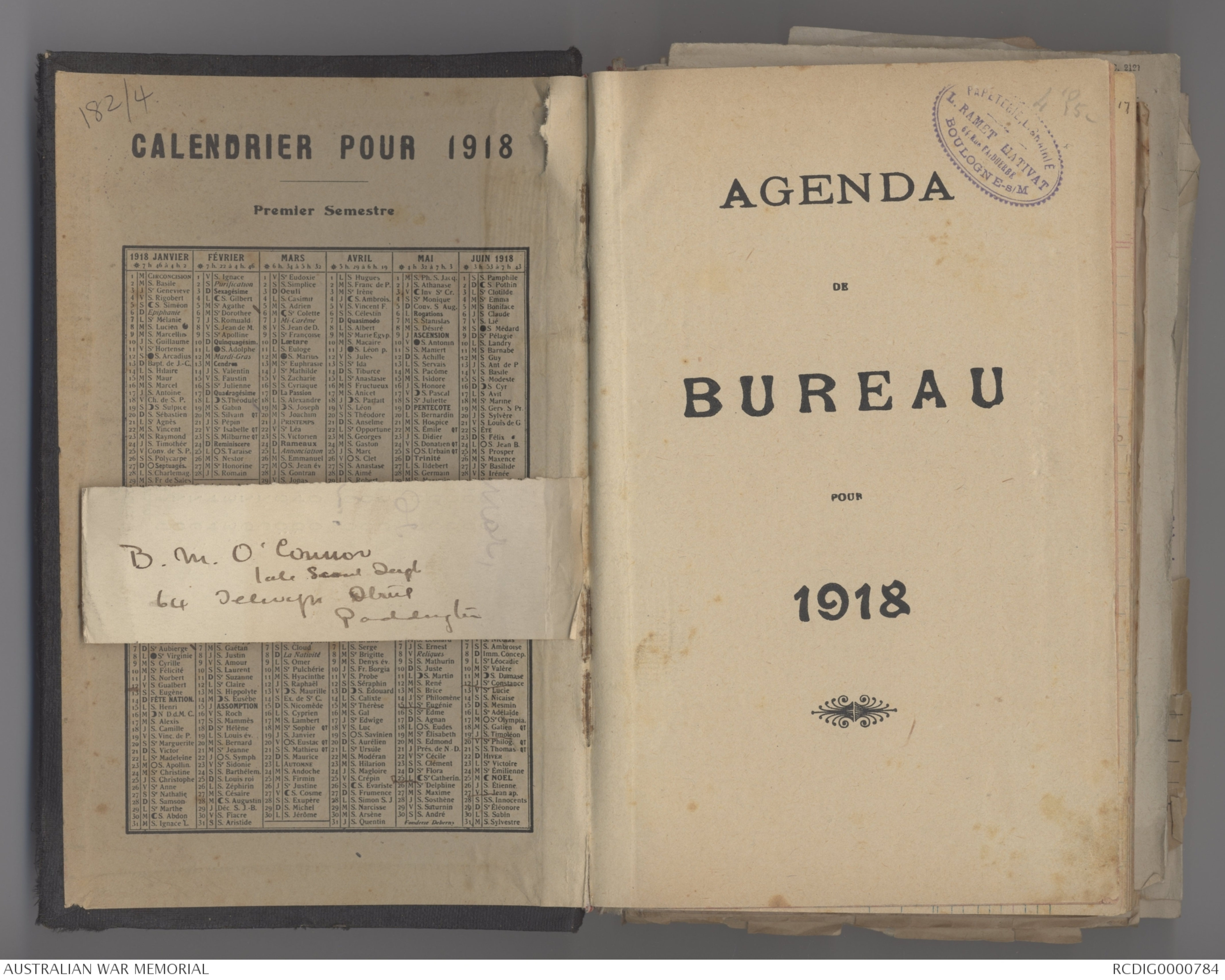
182/4
B.M. O'Connor
late Scout Dept
64 Telwyn Street
Paddington
Front cover of diary ~ see original
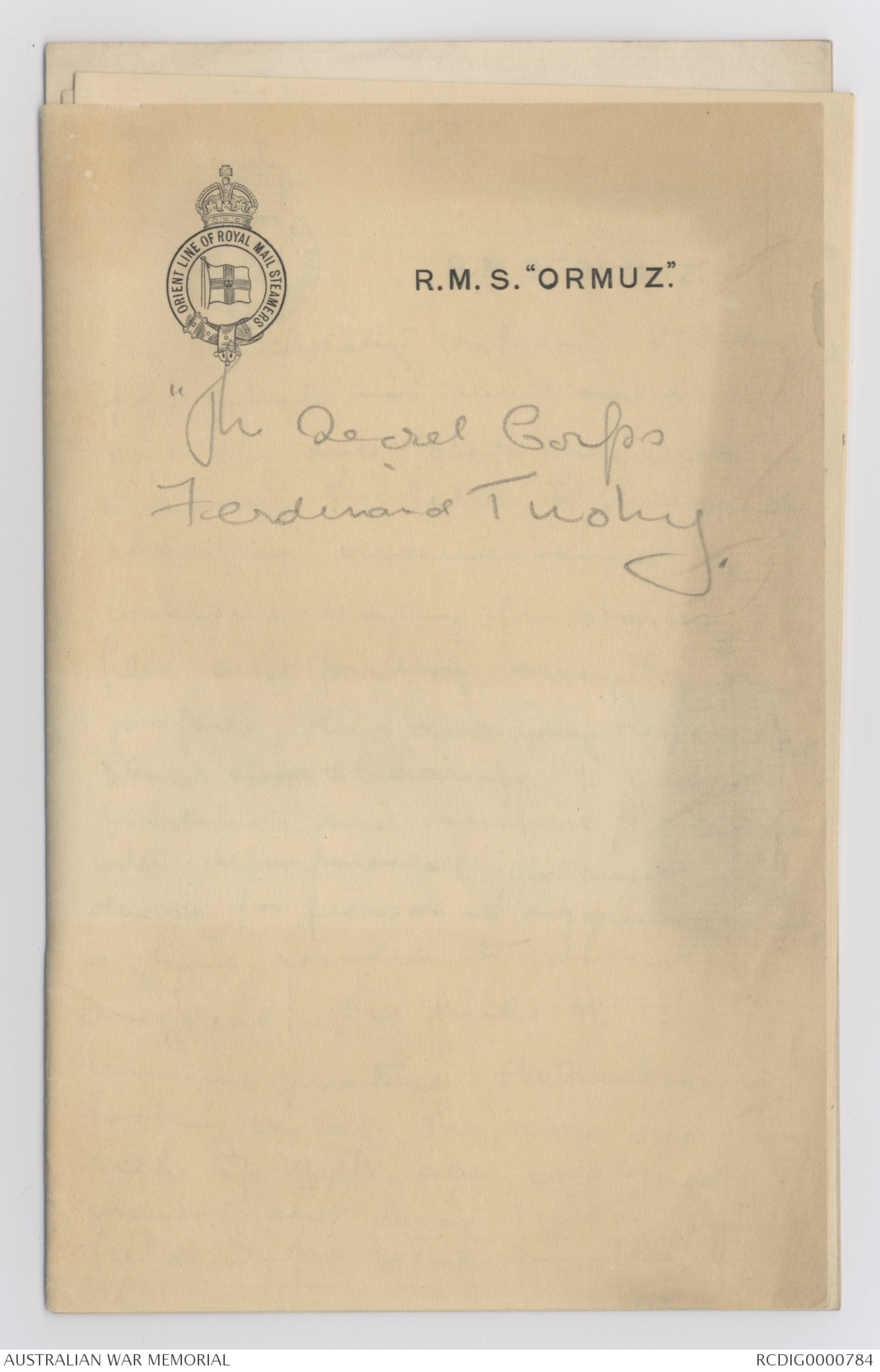
R.M.S. "ORMUZ."
"The Secret Corps
Ferdinand Tuohy.
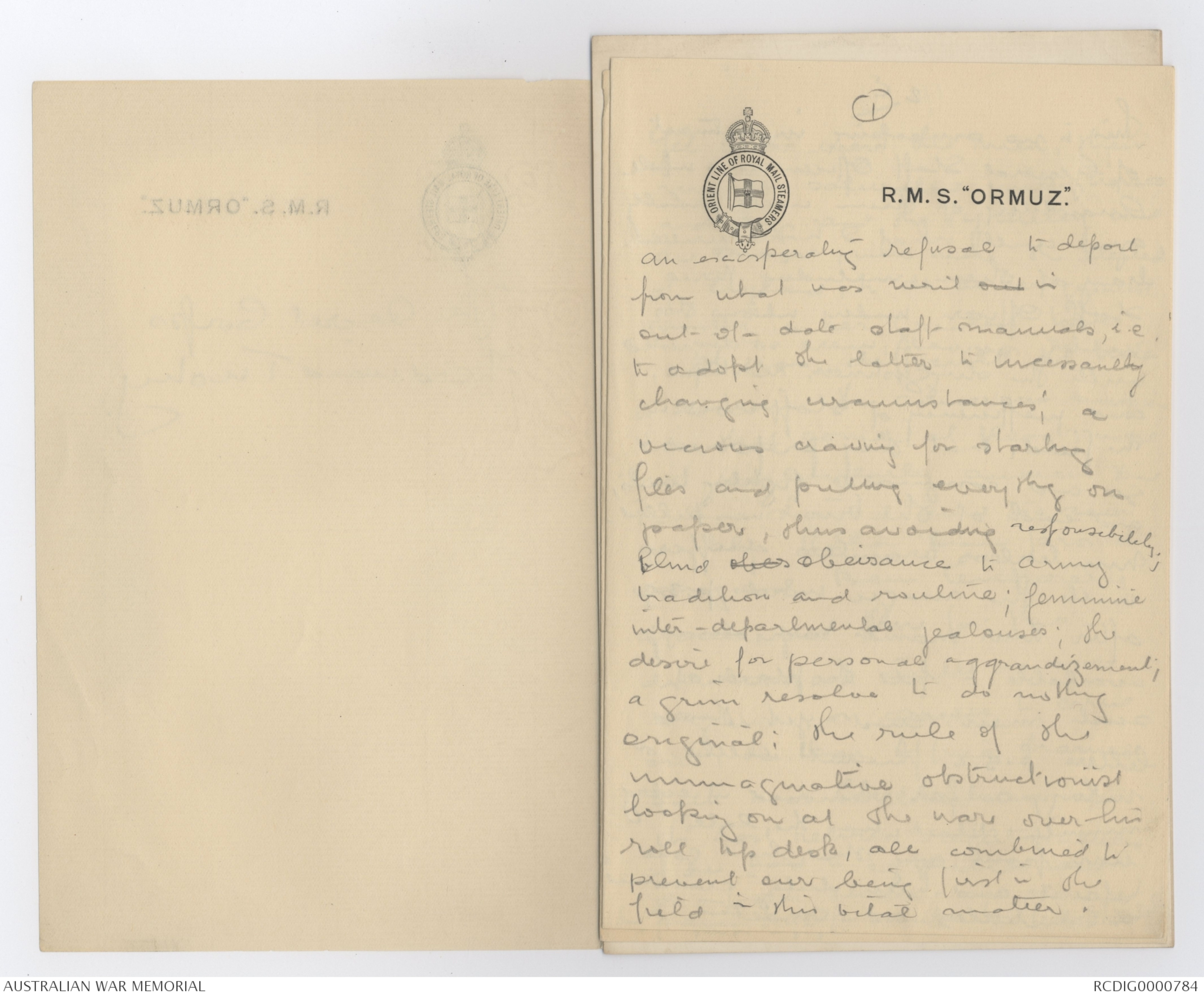
(1)
an exasperating refusal to depart
from what was writ out in
out-of-date staff manuals, i.e. '
to adopt the latter to incessantly
changing circumstances', a
vicious craving for starting
files and putting everything on
paper, thus avoiding responsibility;
blind obes obeisance to Army
tradition and routine; feminine
inter-departmental jealouses; the
desire for personal aggrandizement,
a grim resolve to do nothing
original; the rule of the
unimaginative obstructionist
looking on at the war over his
roll top desk, all combined to
prevent our being first in the
field in this vital matter.
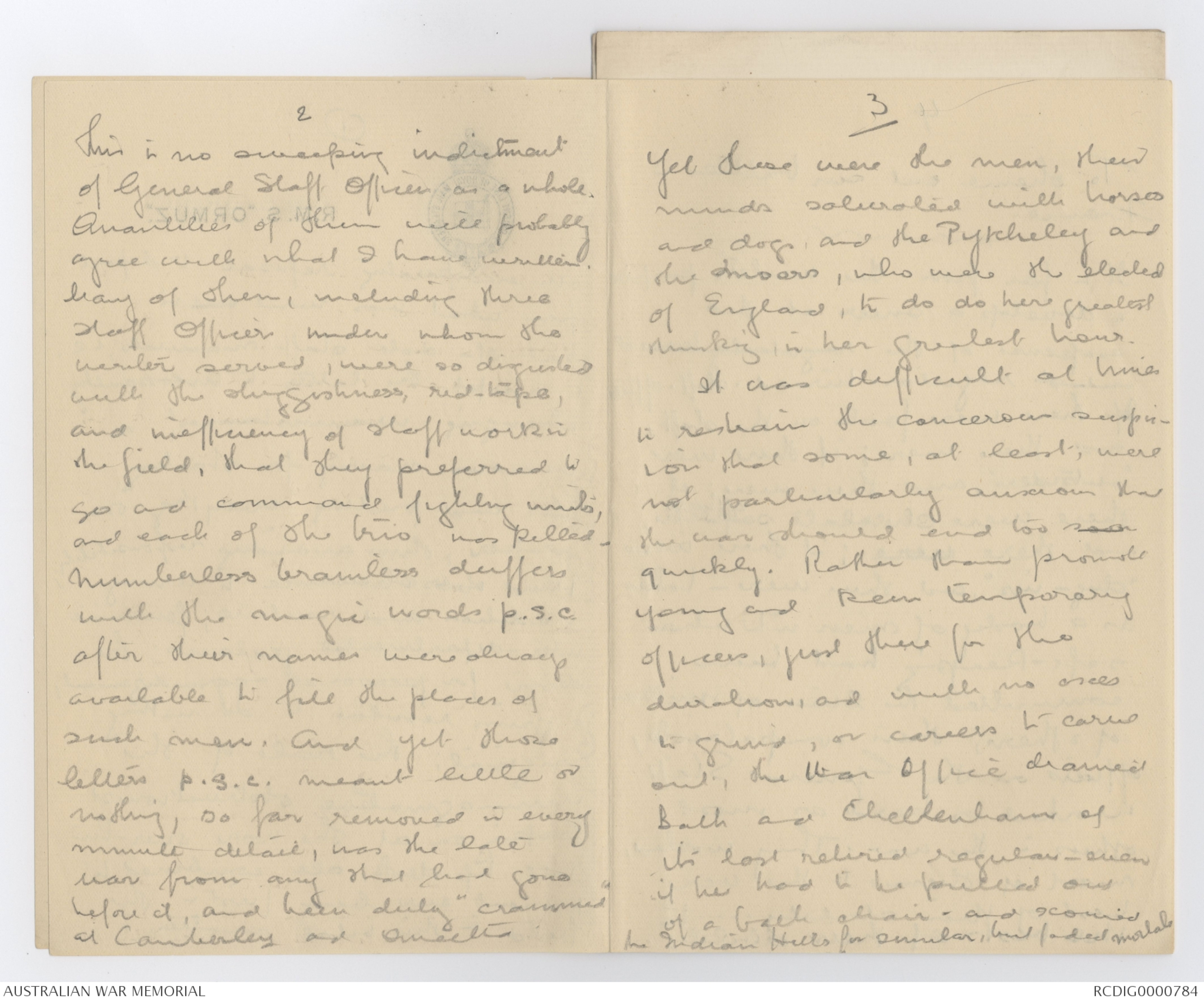
2
This is no sweeping indictment
of General Staff Officers as a whole.
Quantities of them will probably
agree with what I have written.
Many of them, including three
Staff Officers under whom the
writer served, were so disgusted
with the sluggishness, red-tape,
and inefficiency of staff work in
the field, that they preferred to
go and command fighting units;
and each of the trio was killed.
Numberless brainless duffers
with the magic words p.s.c.
after their names were always
available to fill the places of
such men. And yet those
letters p.s.c. meant little or
nothing, so far removed in every
minute detail, was the late
war from any that had gone
before it, and been duly "crammed"
at Camberley and [[?Omaelte]]
3
Yet these were the men, their
minds saturated with horses
and dogs and the Pytcheley and
the Moors, who were the elected
of England, to do do her greatest
thinking in her greatest hour.
It was difficult at times
to restrain the cancerous suspicion
that some, at least, were
not particularly anxious that
the war should end too soon
quickly. Rather than promote
young and keen temporary
officers, just there for the
duration, and with no axes
to grind, or careers to carve
out, the War Office drained
Bath and Cheltenham of
its last retired regulars - even
if he had to be pulled out
of a bath chair - and scoured
the Indian Hills for similar, but faded mortals
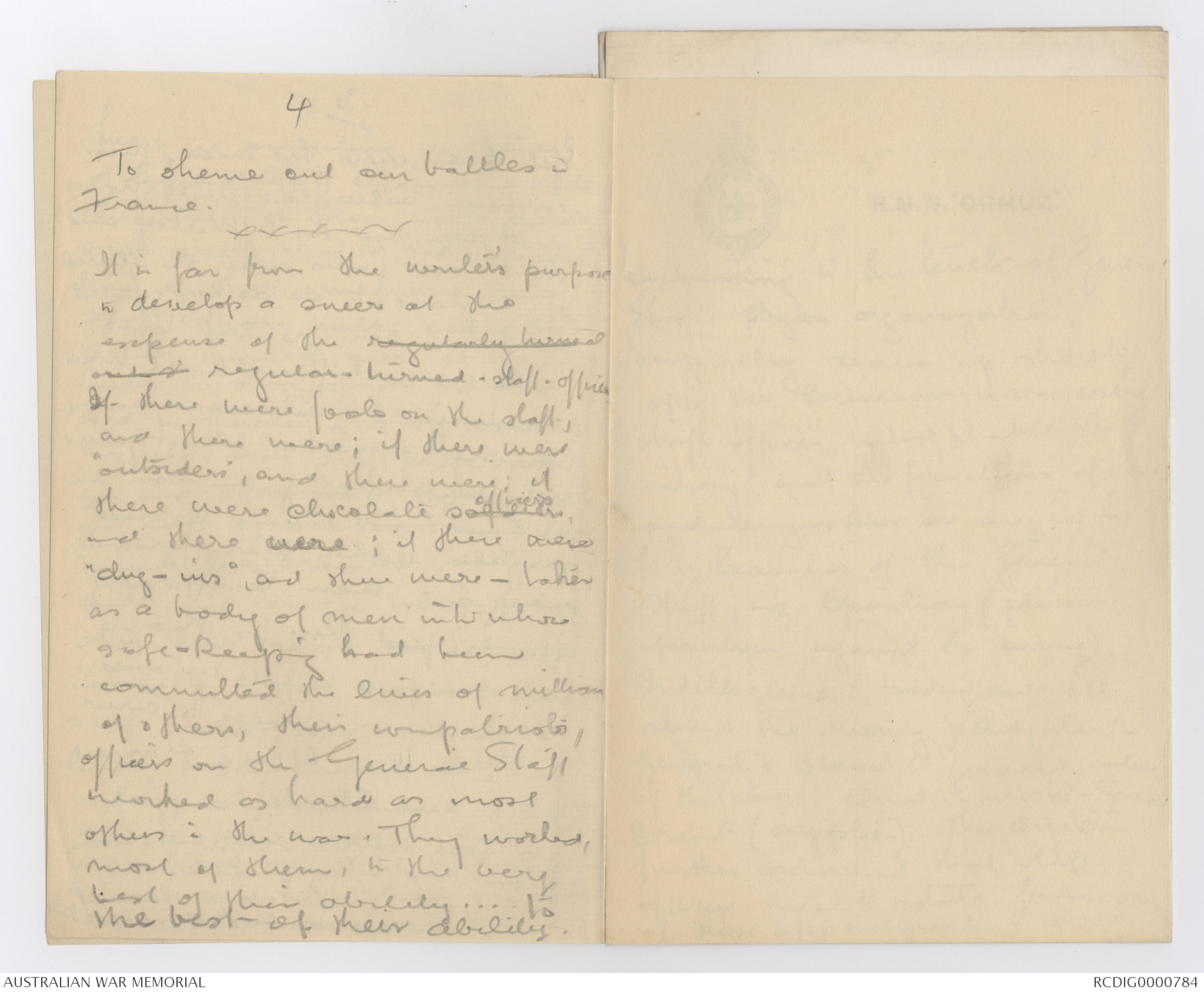
4
to sheme out our battles in
France
x x x x x x
It is far from the writer's purpose
to develop a sneer at the
expense of the regularly turnedout s regular-turned-staff-officer
If there were fools on the staff,
and there were; if there were
"outsiders", and there were; if
there were chocolate soldiers officers,
and there were; if there were
'dug-ins", and there were - taken
as a body of men into whose
safe-keeping had been
committed the lives of millions
of others, their compatriots,
officers on the General Staff
worked as hard as most
others in the war. They worked,
most of them, to the very
best of their ability . . . to
the best of their ability.
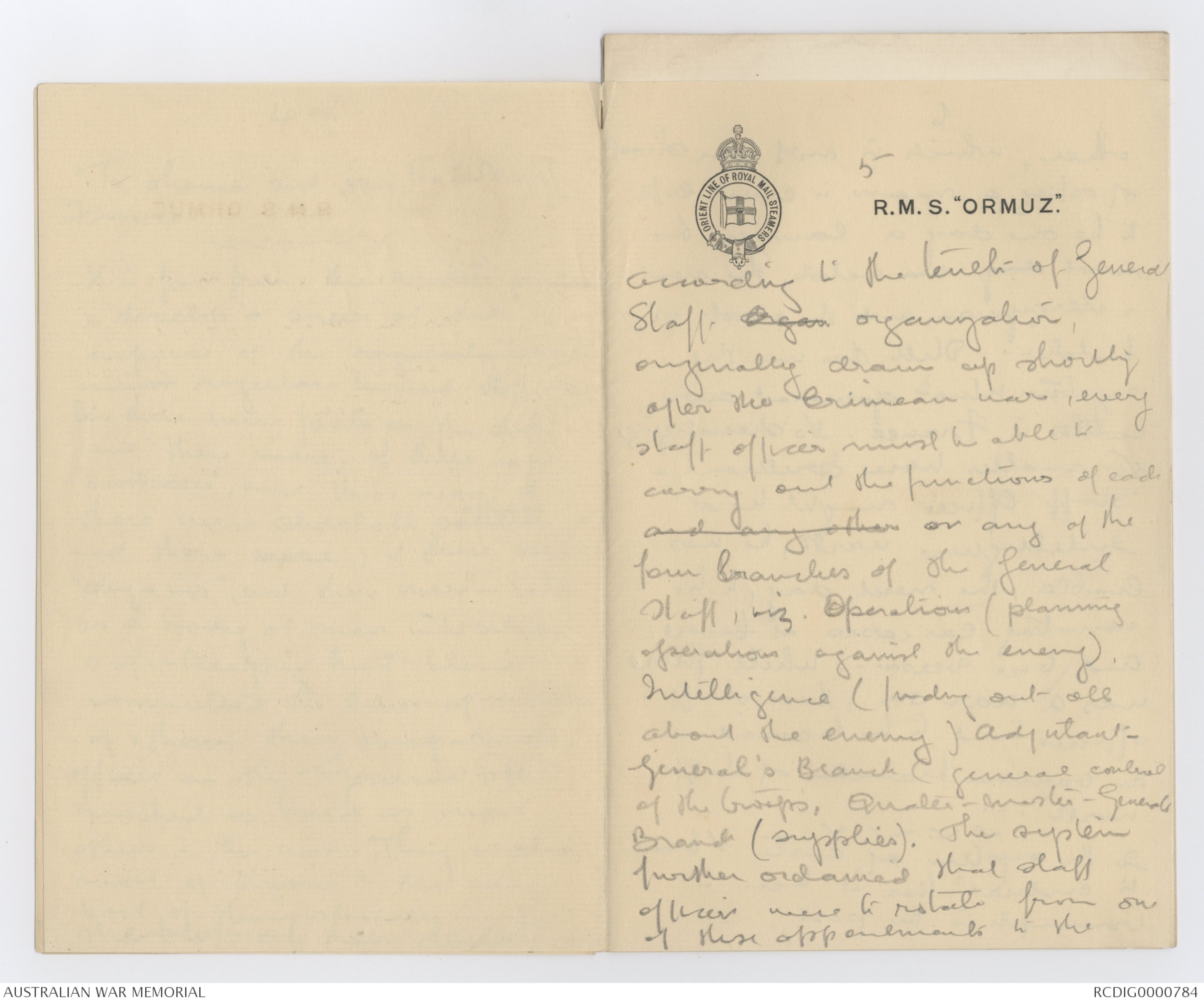
5
according to the tenets of General
Staff Organ organization
originally drawn up shortly
after the Crimean war, every
staff officer must be able to
carry out the functions of each
and any other or any of the
four branches of the General
Staff, viz. Operations (planning
operations against the enemy),
Intelligence (finding out all
about the enemy) Adjutant-
General's Branch (general control
of the troops, Quarter-master-Generals
Branch (supplies). The system
further ordained that staff
officers were to rotate from one
of these appointments to the
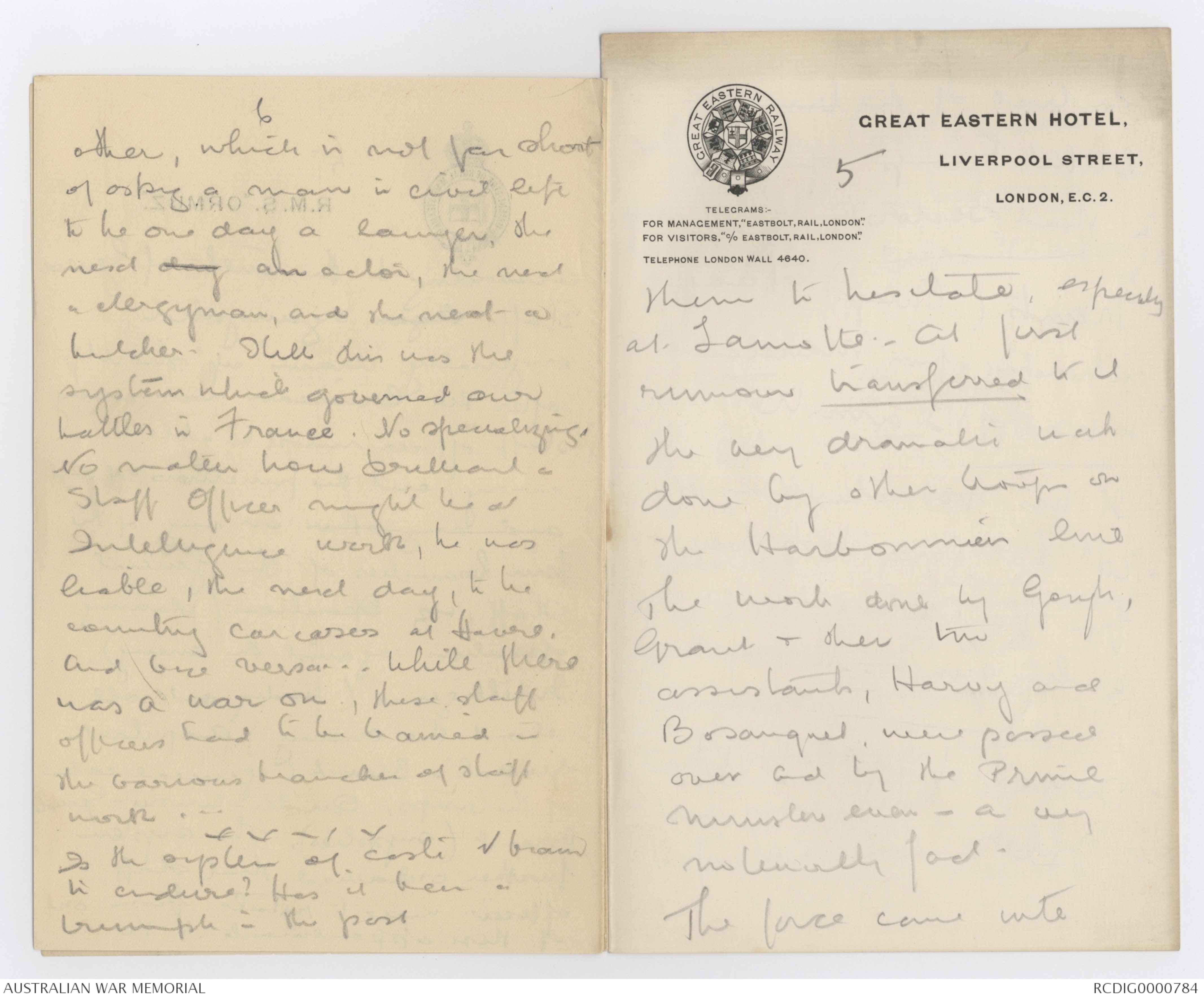
6
other, which is not far short
of asking a man in civil life
to be one day a lawyer, the
next day an actor, the next
a clergyman, and the next a
butcher. Still this was the
system which governed our
battles in France. No specializing.
No matter how brilliant a
Staff Officer might be at
Intelligence work, he was
liable, the next day, to be
counting carcases at Havre
and vice versa. While there
was a war on, these staff
officers had to be trained in
the various branches of staff
work. . .
x x x x x
Is the system of caste V brain
to endure? Has it been a
triumph in the past
5
them to hesitate, especially
at Lamotte - At first
rumour transferred to it
the very dramatic work
done by other troops on
the Harbonnier line
The work done by Gough,
Grant & their two
assistants, Harvey and
Bosanquet, were passed
over and by the Prime
Minister even - a very
noteworthy fact.
The force came into
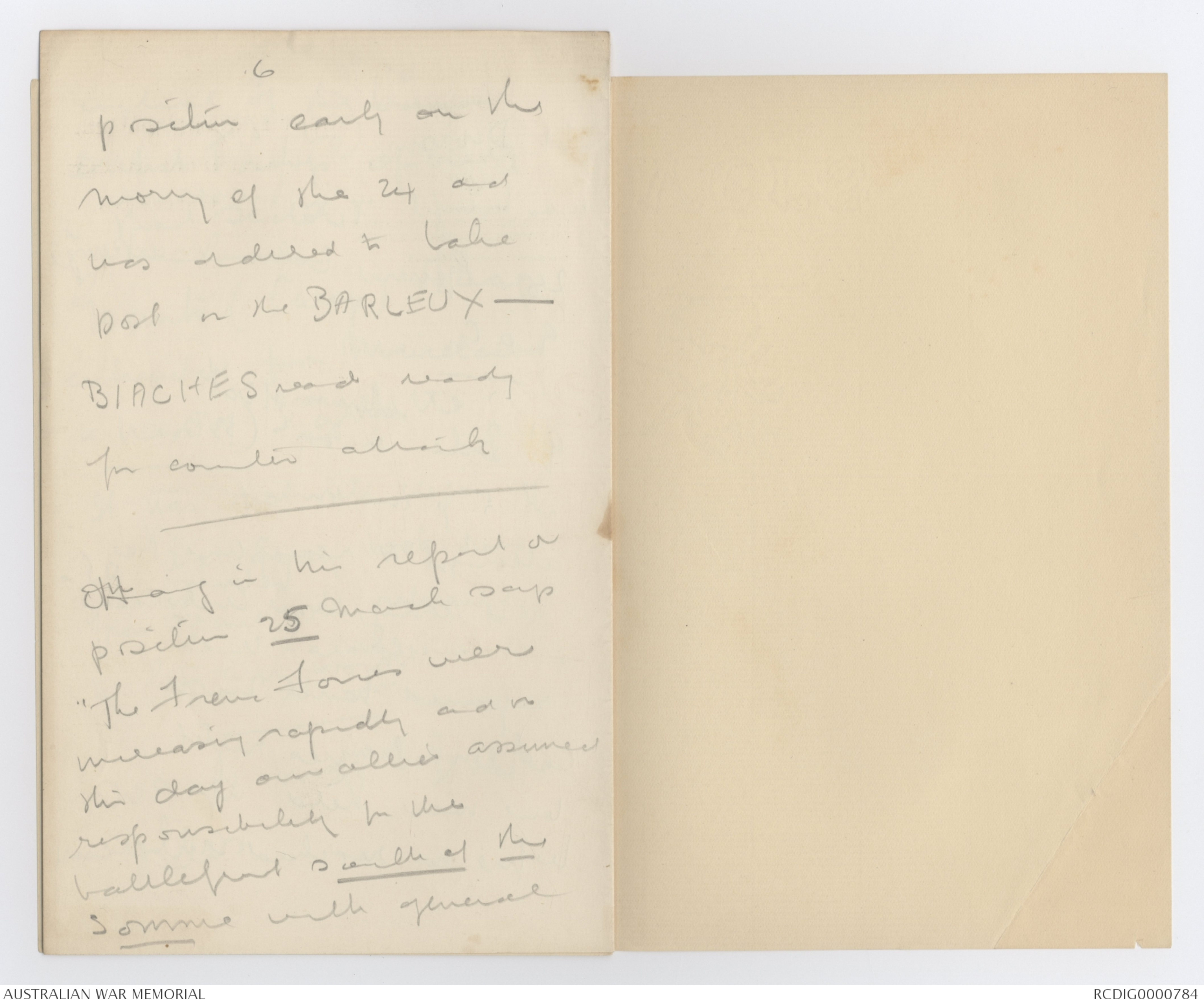
6
position early on the
morning of the 24 and
was ordered to take
post on the BARLEUX-
BIACHES road ready
for counter attack
Gen Haig in his report on
position 25 March says
"The Frenc Forces were
increasing rapidly and on
this day our allies assumed
responsibility for the
battlefield south of the
Somme with general
7
control of the troops
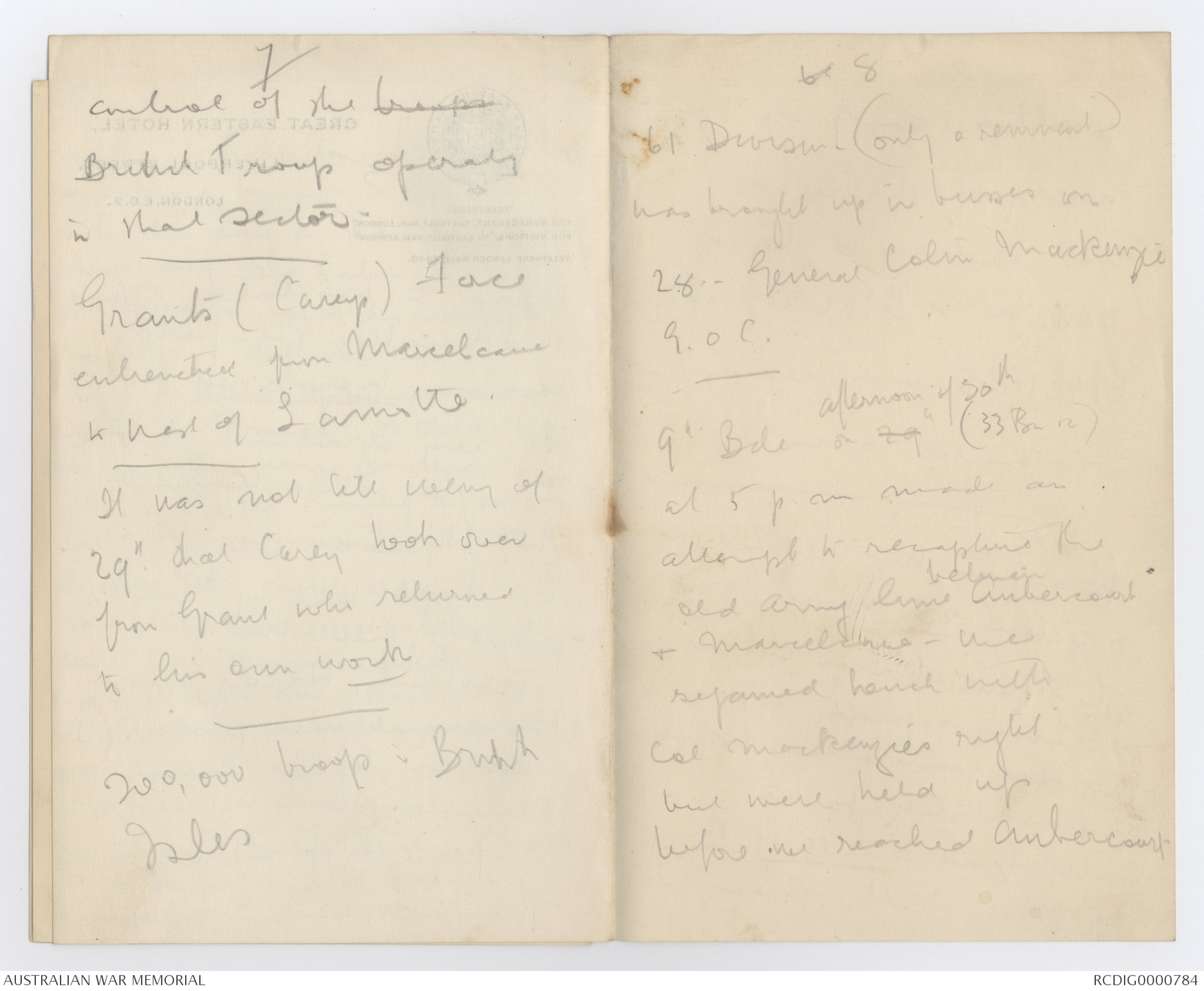
British Troops operating
in that sector.
Grants (Careys) Force
entrenched from Marcelcane
to west of Lamotte
It was not till evening of
29th that Carey took over
from Grant who returned
to his own work
200,000 troops - British
Isles
6 8
61 Division (only a remnant)
was brought up in buses on
28 - General Colin Mackenzie
G.O.C.
9th Bde on ∧ 29th afternoon of 30th (33 Bn)
at 5pm made an
attempt to recapture the
old Army line between belunejr Aubercourt
& Marcelcane - we
reformed hench with
Col McKenzies right
but were held up
before we reached Aubercourt.
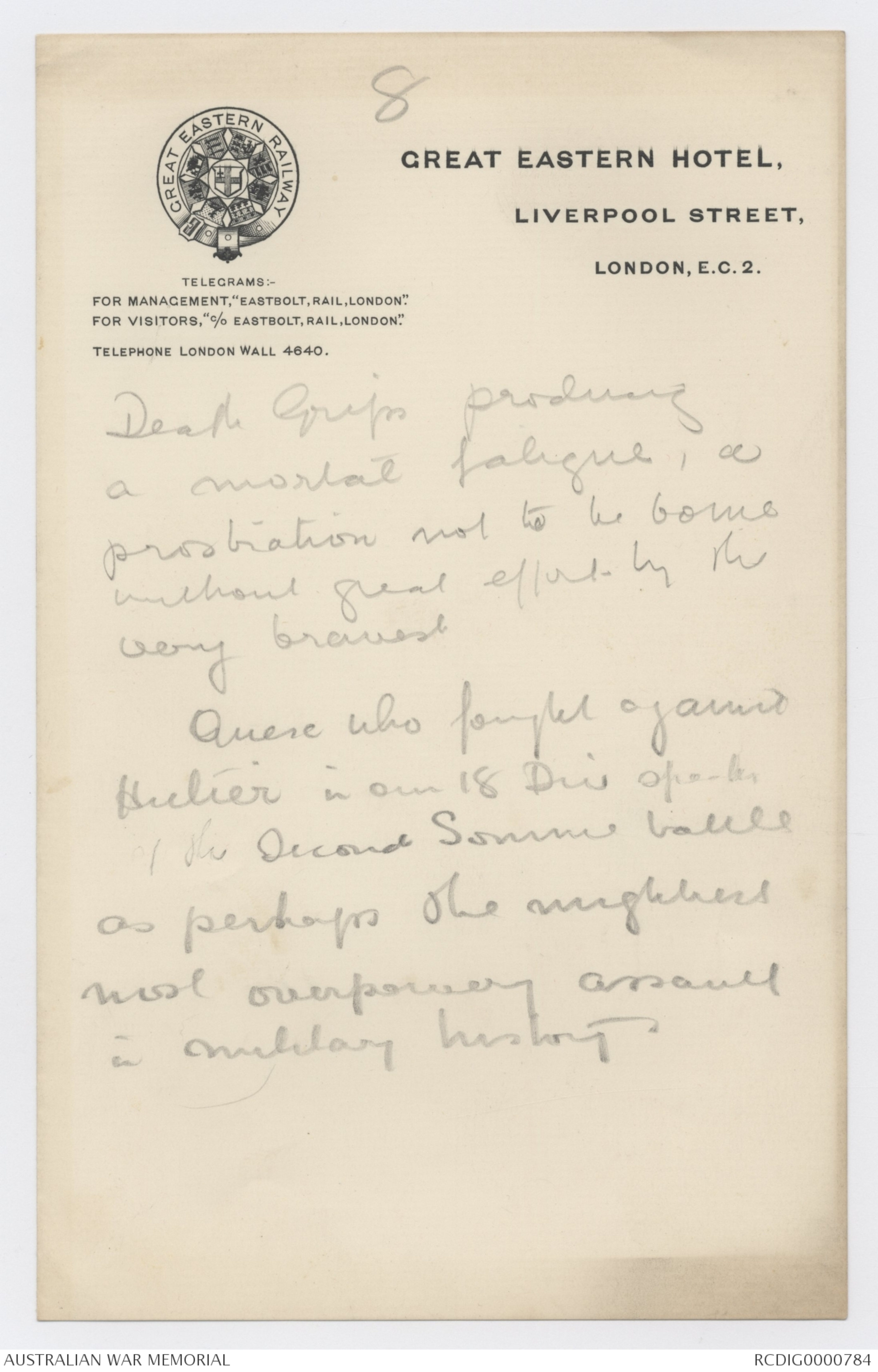
8
Death Grips producing
a mortal fatigue, a
prostration not to be borne
without great effort by the
very bravest
Quese who fought against
Hielier in our 18 Div speak
of the Second Somme battle
as perhaps the mightiest
most overpowering assault
in military history.
 AW AWM
This transcription item is now locked to you for editing. To release the lock either Save your changes or Cancel.
This lock will be automatically released after 60 minutes of inactivity.