
Diary of Verner Gladders Knuckey, 1916 - Part 1



ANZAC VICTORY
The Turks Surprised.
LONDON, Sept. 18.
Newspaper clipping - see original document
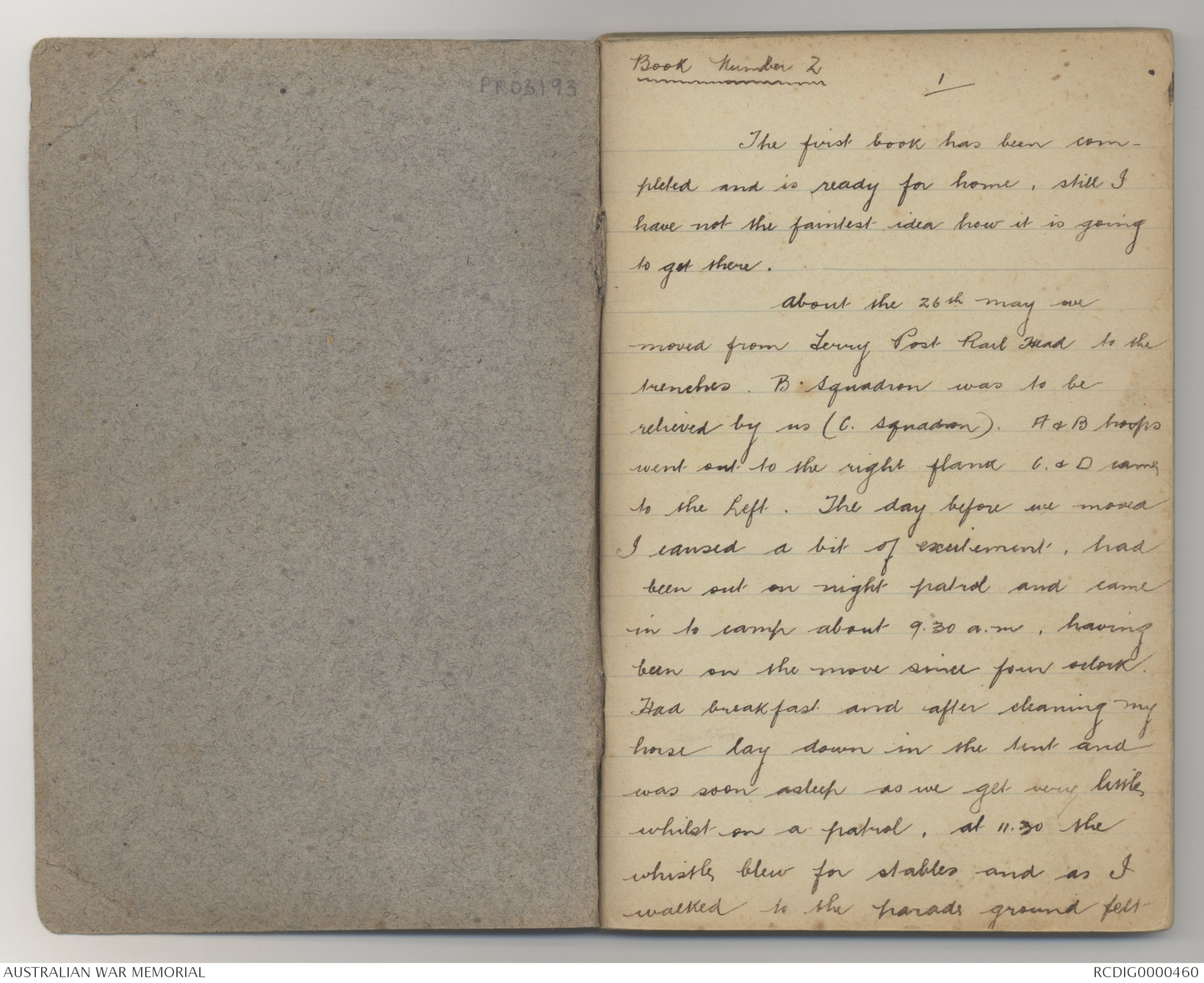
Book Number 2
1
The first book has been completed
and is ready for home, still I
have not the faintest idea how it is going
to get there.
About the 26th May we
moved from Ferry Post Rail Head to the
trenches. B. Squadron was to be
relieved by us (C.Squadron). A & B troops
went out to the right flank C. & D came
to the Left. The day before we moved
I caused a bit of excitement, had
been out on night patrol and came
in to camp about 9.30 a.m, having
been on the move since four o'clock.
Had breakfast and after cleaning my
horse lay down in the tent and
was soon asleep as we get very little
whilst on a patrol, at 11.30 the
whistle blew for stables and as I
walked to the parade ground felt
2
very green, it was a blazing hot sun, one
of our worst, and as I stood in the
ranks had made up my mind to
step back two paces and sit on some
sand bags, that was the last I
remember as I fell right back in a
dead faint. Next thing I remember
was coming to in one of the tents
and Lieut McGrath bending over me.
I did not want to report to the
doctor as the squadron would move
out and I might have to stay back
so I lay in my tent during the
extreme heat and by evening felt
much better. I think the cause
must have been a rush of blood to
the head brought on by coming direct
from my sleep and standing in so
hot a sun. I have been careful
since not to rush out so suddenly
3
nothing has happened since, for a while
I worried about it, but some queer things
happen in this country until we get
used to the climate and one soon
gets hardened to them.
On Monday morning we got an
early start to escape the sun and there
was no rush and confusion, in all
previous camps so much had to be
left till the last moment such as
pulling up the horse lines, striking tents
and packing them on the camels etc.
None of that this time as we left
everything standing for B. squadron to
occupy and they did the same for us
out at the trenches. They had the
best end of the stick for our men had
just the week previous completed fine
stables and out here the work was
in its infancy. It seemed awful
to see our horses tethered out in
4
such a blazing sun as we were nota
getting every day but the carpenters in
C & D troop soon got to work and within
a week much to their credit had a
cover on the stables and the horses
seemed almost human the way they
appreciated it.
And now we had to settle down
to the new camp, every move so far
seemed to take us further out of the
world. Our camp is situated half
a mile behind the trenches which
are manned by the Royal Suffolks,
a Tommy regiment that has seen
service both in France and Gallipoli.
We have nothing to do with the trench
work our duty is to patrol out
on the desert in front of the trenches
for a distance of about eight miles
night and day. The name of this
camp is Duntroon Plateau camp.
5
Four patrols leave every evening at
5.30p.m. each consisting of three men
in charge of a Corporal and the whole
under a Sergt. We camp at our
seperate posts about three miles out
for the night and at daybreak (4a.m)
move out towards the east, every
man is about half a mile from his
right and left flank and within
sight so that our camp provides
about ^an 8 mile line of patrolled country,
Camps on our right and left do
the same and thus the whole of
the canal front is guarded but I
am only dealing with our section of
the country here, we advance
about six miles, searching every
hole and gully and gradually close
in at a point known as Mt. Bole
where we turn for home once more
having completed our night's duty,
arriving in camp at 7.a.m.
6
We have thus examined thoroughly the
whole of the country that the day
party have to pass over. They leave
camp at 7.30a.m. made up of
1 Corporal 5 troopers and two helio
signallers. It is unnecessary for them
to advance in extended order so go
direct to Mt. Bole where one man at
a time keeps watch over a stretch
of country in front of over twelve
miles with a powerful telescope.
Thus a helio message can be flashed
the full length of the canal from
station to station in a few minutes
if necessary or back to any camp
if the enemy is seen at any given
point. They leave Mt. Bole at 4.15p.m .
and meet the night watch on its
way out and report any strange
incident that has been noticed
during the day. I have had all
7
night work until last Saturday June
10th I think, when I had to take out
the day men, it was the worst day's
work I have had at this camp at
the foot of Mt. Bole is a very tempor
shelter erected for the horses but
nothing for the men, to get out of
the blazing sun we had to lay in
amongst the horses feet but a sand
storm was raging and the day's
work was far from pleasant. Only
one man need to be on duty at once,
the rest are at the foot of the hill
with the horses.
Although the night patrol is the
one most sought after it is also the
most dangerous, our men are all
agreed that if Mr Turk did come
and we were lucky enough to be
warned in time it would be odds
on as to being whether we could
get into the trenches without the
8
Tommies shooting us, our instructions
are to gallop back to the camp and
give the signal on approaching the
trenches only we would probably have
bullets buzzing round our heads
long before the signal could be
heard. I cannot understand
these English soldiers, they seem to
be a bundle of nerves even with
their French and Gallipoli experience,
only last week one of their own
officers was going the rounds and
not hearing the challenge was
shot, the poor man lingered for
two days and died. It seems
strange that a mob of them as
there are in the trench shall give
a single man so poor a chance,
especially as they know we are out
in front and the enemy must
alarm us first if they come.
9
Its a good thing for a party of them
that we are on the outposts instead
of their own men. A party of
them were out one day and had
been delayed unknown to our
night patrol. Just at dusk the
Australians saw a party of about
six advancing in extended order
away out on the desert, just the
way an advance party of the enemy
would come, one of our men
wanted badly to shoot but as we
were three and behind a rise
we reckoned we were good enough
to let them come closer, imagine
our disgust to recognise Tommies
not Turks, had it been the other
way about the English would have
fired and done the recognising
part after. In broad daylight
the other day they fired on one
of our officers in the distance.
10
The Australian seems to be a
different nature altogether, we had
received information that an attack
was to be made on the 6th of June,
I was on night patrol on the
5th, nothing happened, on the
evening of the 6th a Tommy came
galloping over the hill to our camp
in a great state of excitement
with the news that a party was
advancing on the horizon, our
officers issued no orders and
knowing our rifles and ammunition
were ready we simply continued
with what we were doing, mainly
lying on the sand smoking.
There was a lot of rushing round
in the other camp for an hour
when our excitable friend once more
galloped over to say it was a
false alarm, he seemed quite
surprised to find us still at our
11
smoking. I think he expected to find
us half way into the canal.
That reminds me of something
that occurred about 40 miles further
along the canal last week, an
enemy aeroplane flew over the New
Zealand camp dropping bombs but
missed them, he next came to
the Light Horse camp, the first shot
destroyed the wireless station, the
next bomb got a number of men
and horses, killing some and
wounding others. On the next day
the enemy attacked the English
camp and the New. Zealanders & L.H.
were sent out to help them, they
met the Tommies rushing back to
meet them. our men went forward
and with very little trouble
drove them ^(the enemy) back and brought in
the Tommies gear. This did not
happen in our part of the country
12
but an eye witness in the shape of
a N.Z. man told me of the incident
himself and I believe it to be perfectly
true. So far we have not
had any of that excitement but
although a great number of us
have so far never been under fire
I have perfect confidence in the
way they will conduct themselves
when their time comes. Our
patrols now and again come
across signs of the enemy and
our aeroplanes tell us there is a
camp of them behind some
hills about 15 miles out from the
Day patrol hill viz. Mt. Bole, a
few days ago we recognised a
column of smoke rise from
just about where they are supposed
to be camped and we want them
to come at it, waiting is killing work
13
June 19th.
Three weeks since we came out
to this camp. Nothing ever is doing
in the shape of a fight and yet
everyone must always be keyed up
to concert pitch as our friends are
not so very far away, they now
and again have a bit of a scrap
at some one of the numerous camps
situated along the canal but so far
we have not been molested in any
way. The one great worry of
our lives now is what is eventually
going to become of us. The Light
Horse (3rd Brigade) are now as far
as I can tell the only Australians
now in this beastly country of
Egypt. The two hundred thousand
of our brothers in the Infantry
are either over in France or
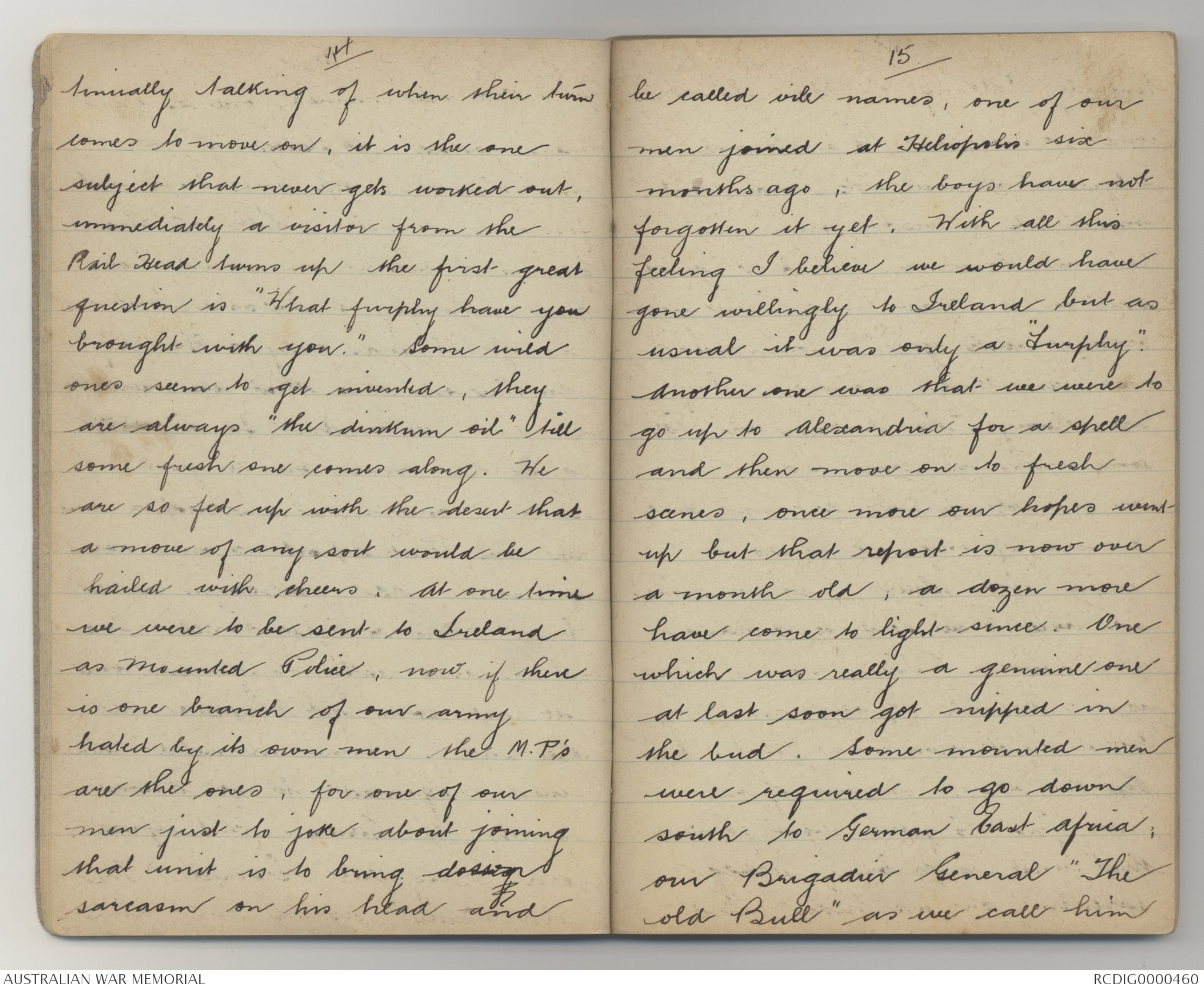
England. Our men are continually
14
talking of when their turn
comes to move on, it is the one
subject that never gets worked out,
immediately a visitor from the
Rail Head turns up the first great
question is "What furphy have you
brought with you." Some wild
ones seem to get invented, they
are always "the dinkum oil" till
some fresh one comes along. We
are so fed up with the desert that
a move of any sort would be
hailed with cheers. At one time
we were to be sent to Ireland
as Mounted Police, now if there
is one branch of our army
hated by its own men the M.P.'s
are the ones, for one of our
men just to joke about joining
that unit is to bring xxxx
sarcasm on his head and
15
be called vile names, one of our
men joined at Heliopolis six
months ago, the boys have not
forgotten it yet. With all this
feeling I believe we would have
gone willingly to Ireland but as
usual it was only a "Furphy".
Another one was that we were to
go up to Alexandria for a spell
and then to move on to fresh
scenes, once more our hopes went
up but that report is now over
a month old, a dozen more
have come to light since. One
which was really a genuine one
at last soon got nipped in
the bud. Some mounted men
were required to go down
south to German East Africa
our Brigadier General "The
old Bull" as we call him
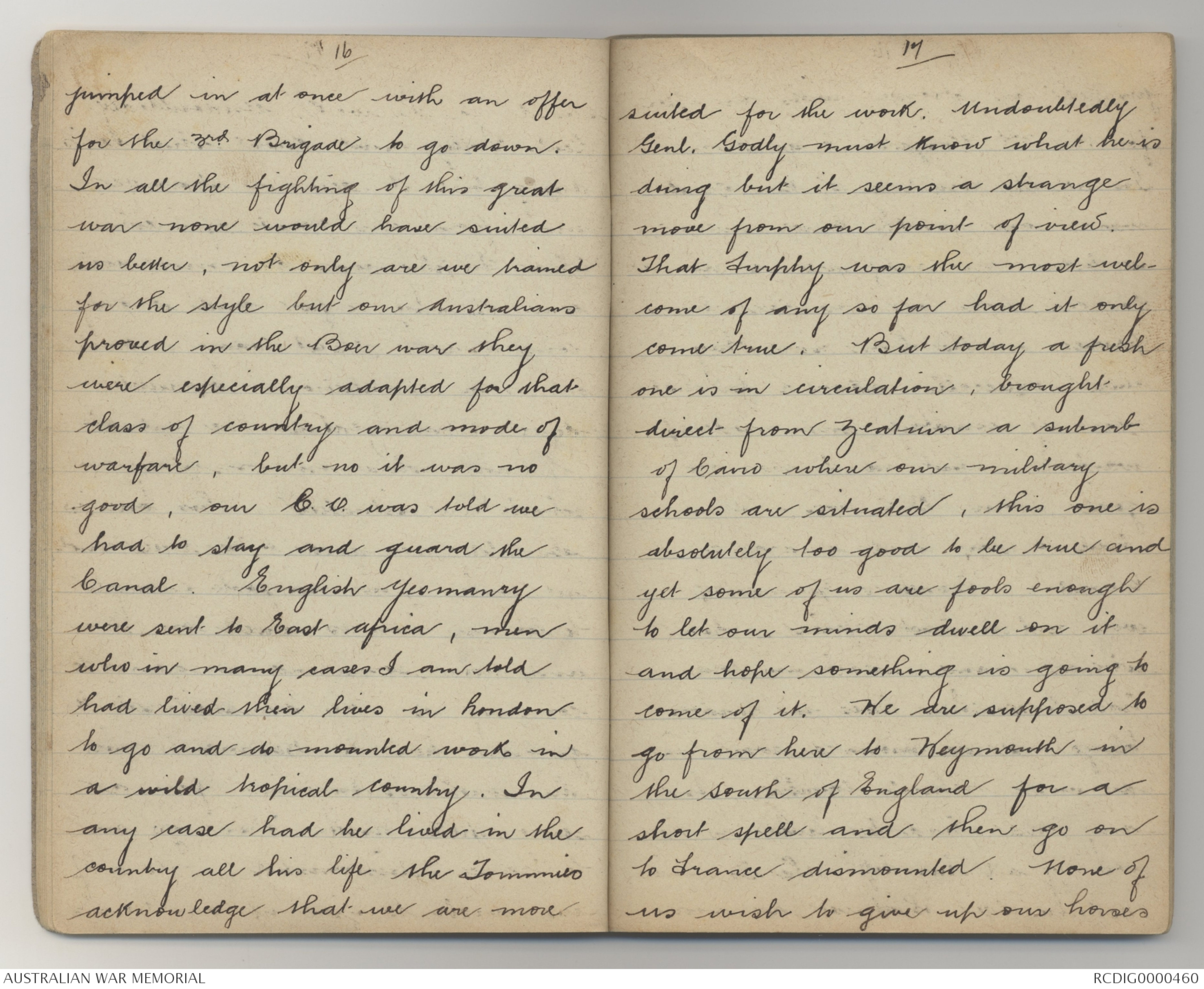
16
jumped in at once with an offer
for the 3rd. Brigade to go down.
In all the fighting of this great
war none would have suited
us better, not only are we trained
for the style but our Australians
proved in the Boer war they
were especially adapted for that
class of country and mode of
warfare, but no it was no
good, our C.O. was told we
had to stay and guard the
Canal. English Yeomanry
were sent to East Africa, men
who in many cases I am told
had lived their lives in London
to go and do mounted work in
a wild tropical country. In
any case had he lived in the
country all his life the Tommies
acknowledge that we are more
17
suited for the work. Undoubtedly
Genl. Godly must know what he is
doing but it seems a strange
move from our point of view.
That Furphy was the most welcome
of any so far had it only
come true. But today a fresh
one is in circulation, bought
direct from Zeatuin a suburb
of Cairo where our military
schools are situated, this one is
absolutely too good to be true and
yet some of us are fools enough
to let our minds dwell on it
and hope something is going to
come of it. We are supposed to
go from here to Weymouth in
the South of England for a
short spell and then go on
to France dismounted. None of
us wish to give up our horses
 Sandy Mudie
This transcription item is now locked to you for editing. To release the lock either Save your changes or Cancel.
This lock will be automatically released after 60 minutes of inactivity.