
Diary of Trooper Ion Llewellyn Idriess-Oct 1916-Part 2
shelter of a ridge.
To our intense surprise
we were told not to go
into the firing line, as
the General had given:
the order to withdraw.
Our Battery was now
pelting the Turkish
redoubts madly but
getting no shells back
in reply. This made
us think the Turks had
no Field Artillery.
The firing away by
the Third Brigade
was very hot now. We
heard afterwards, that
Colonel Roysten, commanding
the third Brigade
had sent round word
6
Turks were thickest
was a haze of shrapnel
smoke, from our guns
The shrapnel would
burst in quick succession
right above the Turks
they would run in all
directions - though some
lay just where they
were. It th seemed
strange, lying where
we were and looking
at our own shrapnel
bursting among the
Turks, with our own
guns blazing behind us.
But we had something
to do. The bushes at the
edge of the flat six
hundred yards away
were alive with
Turks, and their bullets
6
and especially their
machine gun bullets
whipped the sand about
xx us and clipped the
twigs from the bushes
from behind which we
were lying. It was
always four or five
men firing from behind
each mound of sand
and bush, because in
between was bare
spaces of sand, which
was a continual dance
of spurting sand as the
machine guns played
on the bare spaces. Very
soon my ears were
ringing and ringing
and ringing again
from the concussion of
my mates rifles. We
had to hold our rifles
close to one anothers
heads when firing from
that he could take
the position but it
would mean the sacrifice
of an awful lot of men,
as the Turks were very
numerous in strongly
held positions, and
had countless machine
guns. General Chevral
sent back word to
withdraw. By this time:
our own fellows were
coming back from
firing line. Then
"Bang", above our heads,
a little to the right.
The Turks had sneaked
away an anti aircraft
gun somewhere and were
trying to bluff us that
they had artillery. They
7
behind our little mound
Those Turks put up a
good fight, but they
must have had terrible
losses and gradually
they began to retire. We
fired until our rifles
were so hot it burnt
our hands to hold them.
The water in our bottles
burnt our throats to drink
Then we got the order to
advance on to a big
hill a little to the left
and link up with the
New Zealanders. We
occupied the hill quickly,
but it was awful the
heat, the sand, the short
rushes which left a
man gasping for breath
and the bullets which
7
the Turk turned on us
when he saw us in the
open, by jove, he did
send a rain of bullets.
The crown of the hill
was bare sand, there
was no cover until a
little way further on.
The Turkish bullets followed
us right up the hill
and just skimmed the
top, on a line with a
mans stomach. I managed
to reach the top, but
facing that bare patch of
sand was awful. A
mans feet seemed never
to move, the sand rose
up and down, and he
fell behind a bush with
a heaving chest and a
feeling that he would
never move again
even should the very
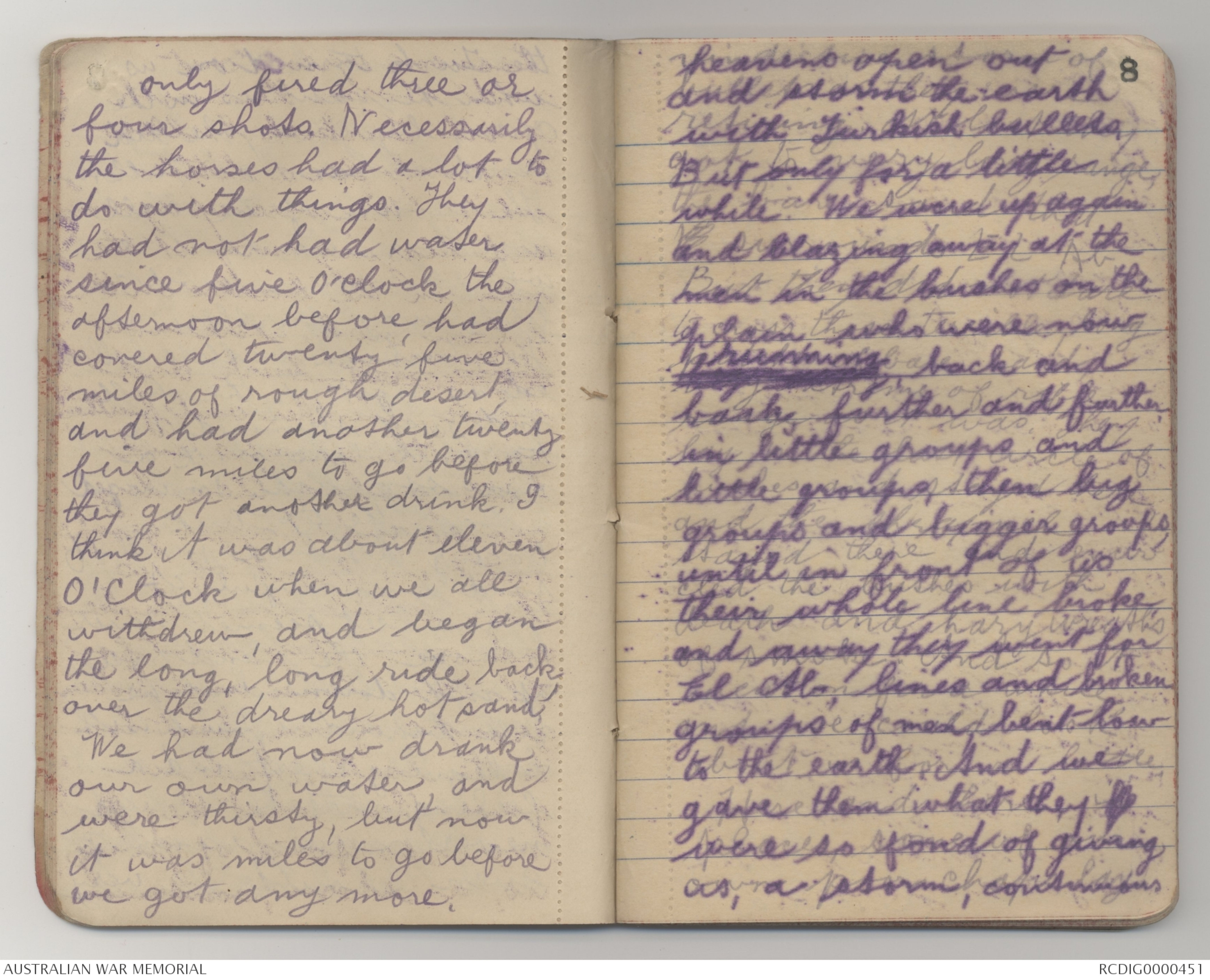
only fired three or
four shots Necessarily
the horses had a lot to
do with things. They
had not had water
since five O'clock the
afternoon before had
covered twenty five
miles of rough desert,
and had another twenty
five miles to go before.
they got another drink. I
think it was about eleven:
O’Clock when we all
withdrew,and began
the long, long ride back,
over the dreary hot san.
We had now drank
our own water and
were thirsty, but now
it was miles to go before
we got any more.
8
heavens open out
and storm the earth
with Turkish bullets.
But only for a little
while. We were up again
and blazing away at the
men in the bushes on the
plain who were now
xxxxx running back and
back, further and further
in little groups and
little groups, then big
groups and bigger groups,
until in front of us
their whole line broke
and away they went for
El Ab, lines and broken
groups of men bent low
to the earth. And we
gave them what they xx
we’re so fond of giving
us, a storm, continuous
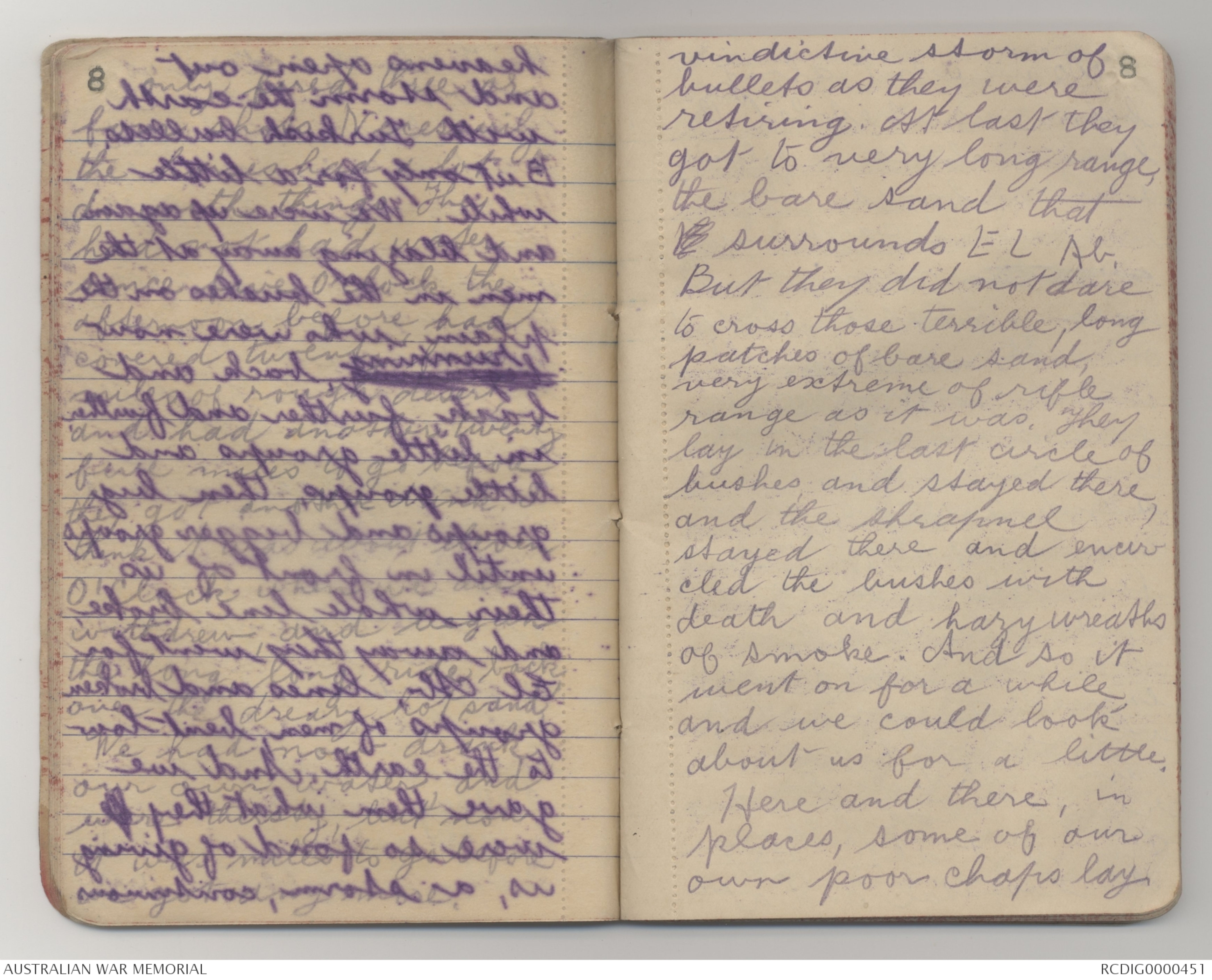
8
vindictive storm of
bullets as they were
retiring. At last they
got to very long range
the bare sand thatE surrounds EL Ab.
But they did not dare
to cross those terrible, long
patches of bare sand,
very extreme of rifle
range as it was. They
lay in the last circle of
bushes; and stayed there,
and the shrapnel
stayed there and encircled
the bushes with
death and hazy wreaths
of smoke. And so it
went on for a while,
and we could look
about us for a little.
Here and there, in
places, some of our
own poor chaps lay
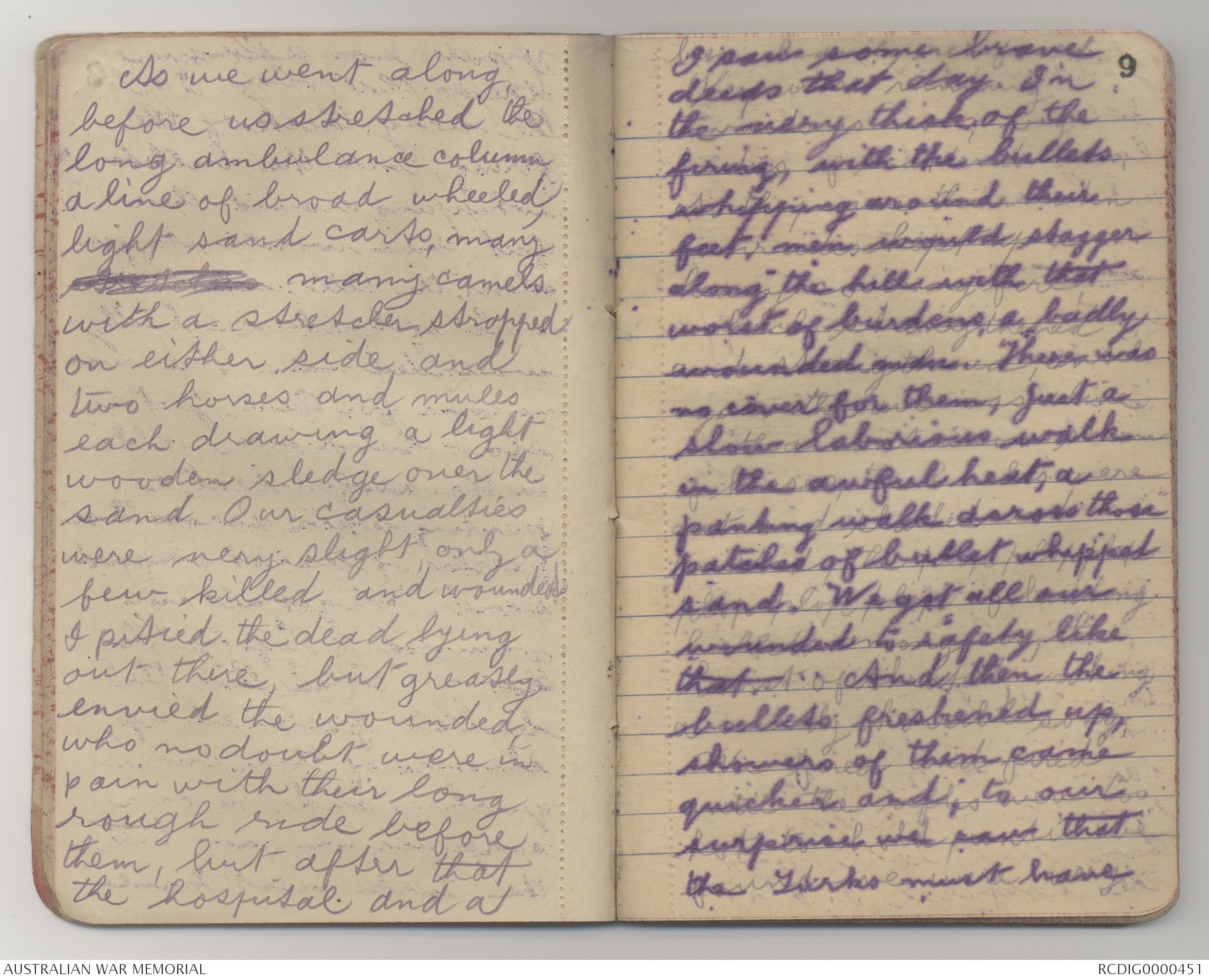
As we went along
before us stretched the
long ambulance column
a line of broad wheeled,
light sand carts manystretcher many camels.
with a stretcher strapped
on either side and
two horses and mules
each drawing a light
wooden sledge over the
sand. Our casualties
were very slight, only a
few killed and wounded.
I pitied the dead lying
out there, but greatly
envied the wounded
who no doubt were in
pain with their long
rough ride before
them, but after that
the hospital and a
9
I saw some brave
deeds that day. In
the very thick of the
firing, with the bullets
whipping around their
feet, men would stagger
along the hills with that
worst of burdens, a badly
wounded man. There was
no cover for them, just a
slow laborious walk
in the awful heat, a
panting walk across those
patches of bullet whipped
sand. We got all our
wounded to safety like
that. And then the
bullets freshened up,
showers of them came
quicker and, to our
surprise we saw that
the Turks must have
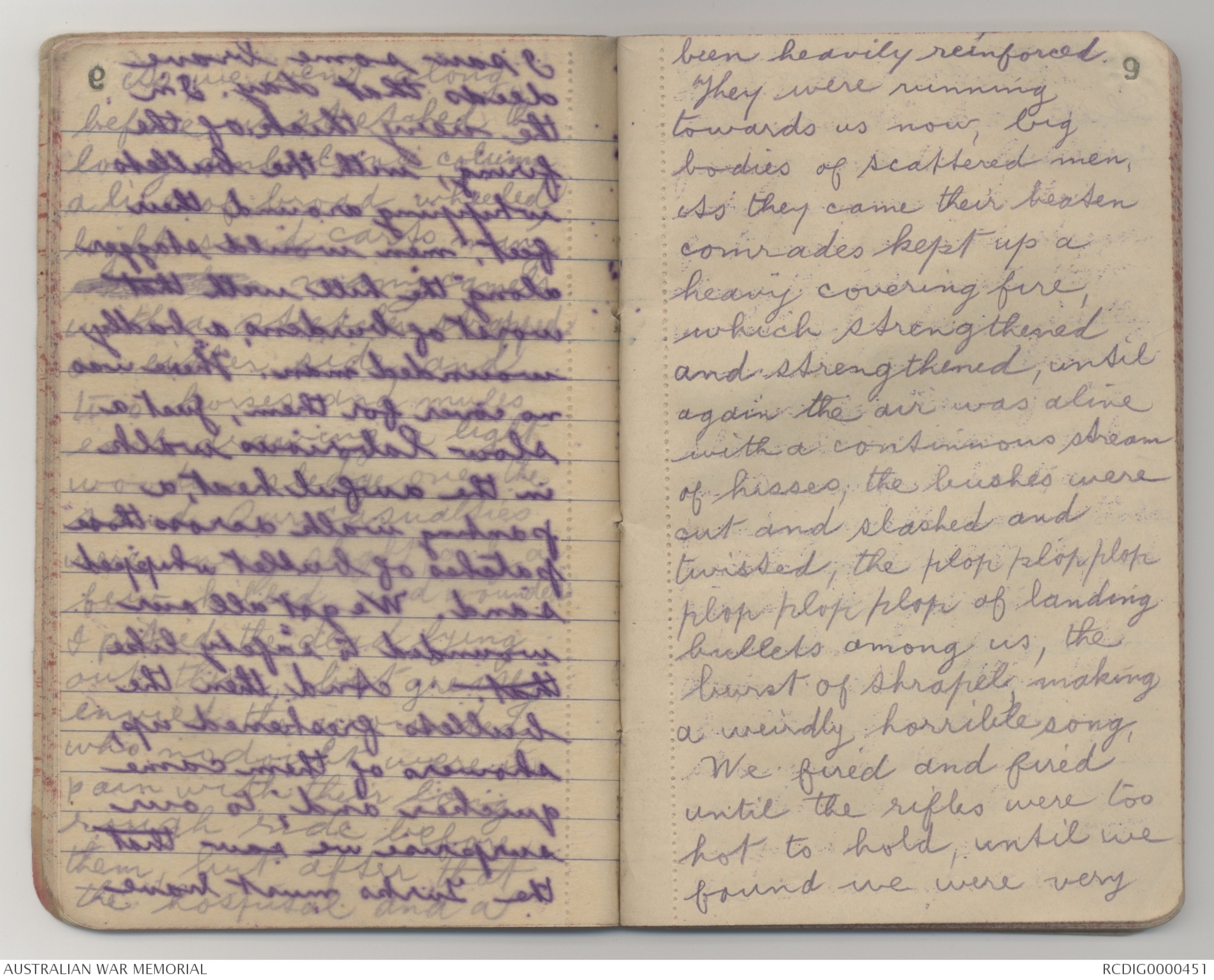
9
been heavily reinforced.
They were running
towards us now, big
bodies of scattered men.
As they came their beaten
comrades kept up a
heavy covering fire,
which strengthened
and strengthened, until
again the air was alive
with a continuous stream
of hisses, the bushes were
cut and slashed and
twisted the plop plop plop
plop plop plop of landing
bullets among us, the
burst of Shrapnel making
a weirdly horrible song,
We fired and fired
until the rifles were too
hot to hold, until we
found we were very
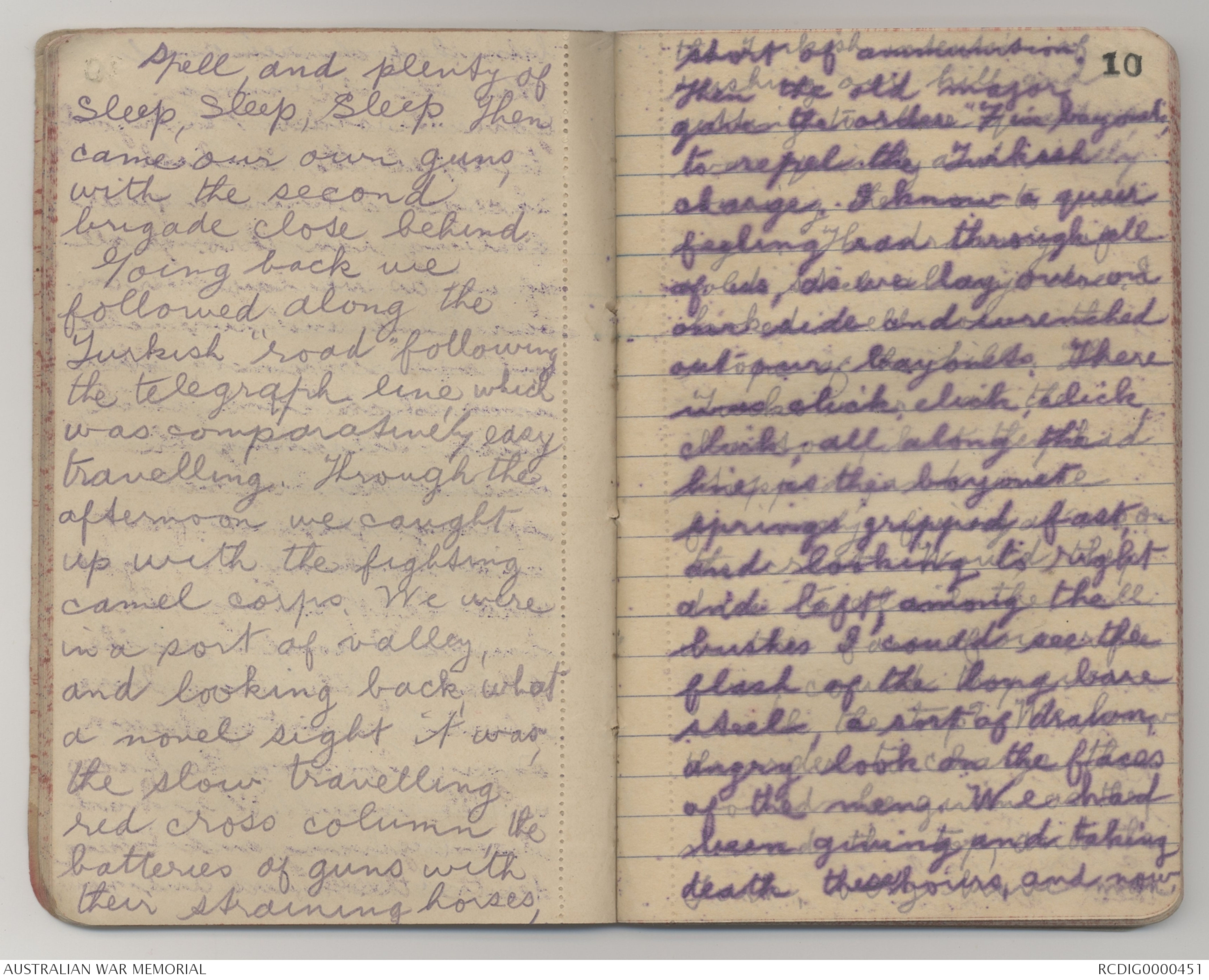
spell, and plenty of
Sleep, Sleep, Sleep. Then
came our own guns
with the second
brigade close behind
Going back we
followed along the
Turkish "road" following
the telegraph line, which
was comparatively easy
travelling. Through the
afternoon we caught
up with the fighting
camel corps. We were.
in a port of valley,
and looking back, what
a novel sight it was,
the slow travelling
red cross column the
batteries of guns with
their straining horses,
10
short of ammunition.
Then the old major
gave the order "Fix bayonets,
to repel the Turkish
charge. I know a queer
feeling ran through all
of us, as we lay over on
our side and wrenched
out our bayonets. There
was click, click, click
click, all along the
line as the bayonet
springs gripped fast
and looking to right
and left, among the
flash of the long bare
steel, a sort of drawn
angry look on the faces
of the men. We had
been giving and taking
death these hours and now
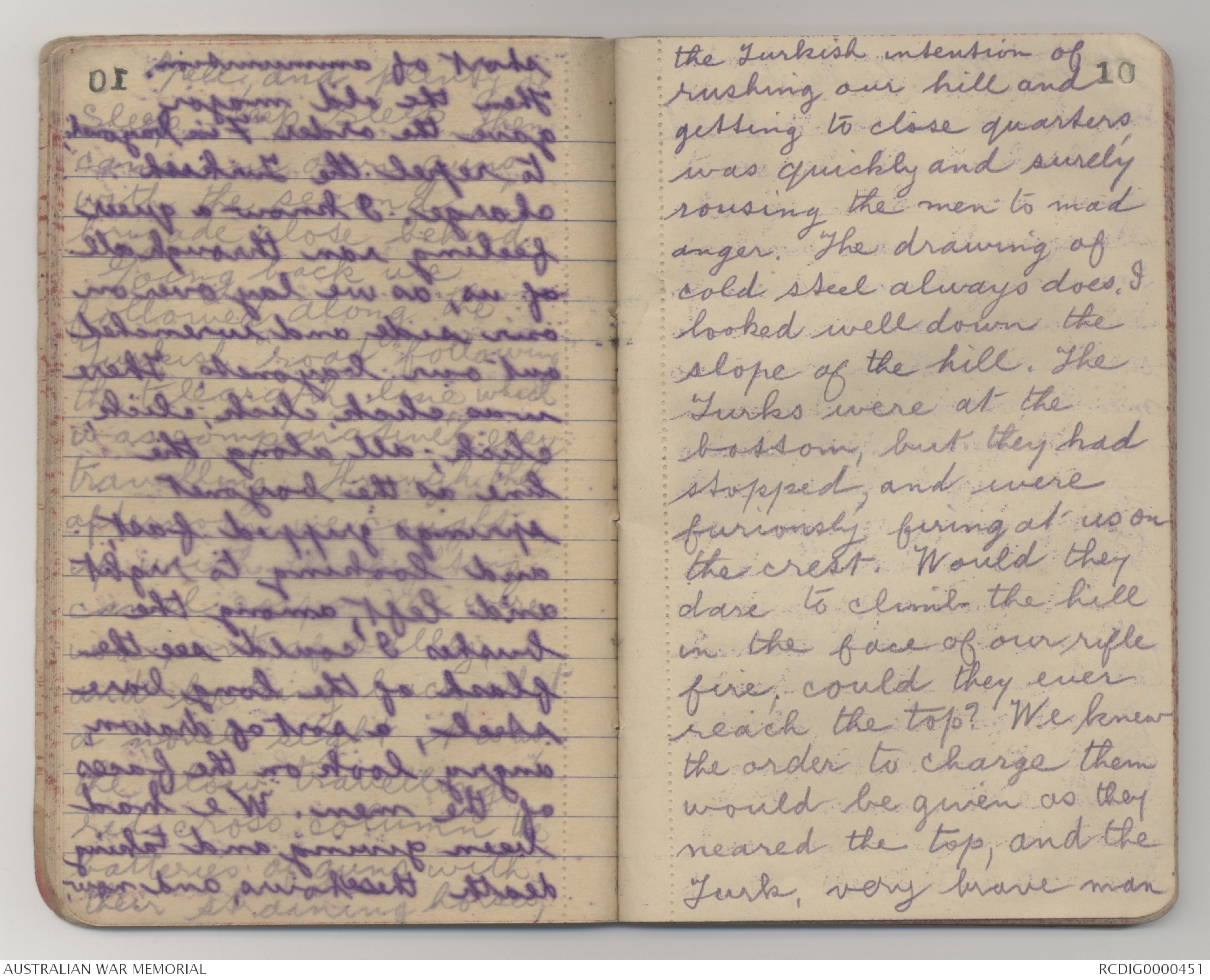
10
the Turkish intention of
rushing our hill and
getting to close quarters,
was quickly and surely
rousing the men to mad
anger. The drawing of
cold steel always does. I
looked well down the
slope of the hill. The
Turks were at the
bottom, but they had
stopped and were
furiously firing at us on
the crest. Would they
dare to climb the hill
in the face of our rifle
fire, could they ever
reach the top? We knew
the order to charge them
would be given as they
neared the top, and the
Turk, very brave man
 D Coates
This transcription item is now locked to you for editing. To release the lock either Save your changes or Cancel.
This lock will be automatically released after 60 minutes of inactivity.