
Letters from Frederick Warren Muir, 1914-1915 - Part 9
12
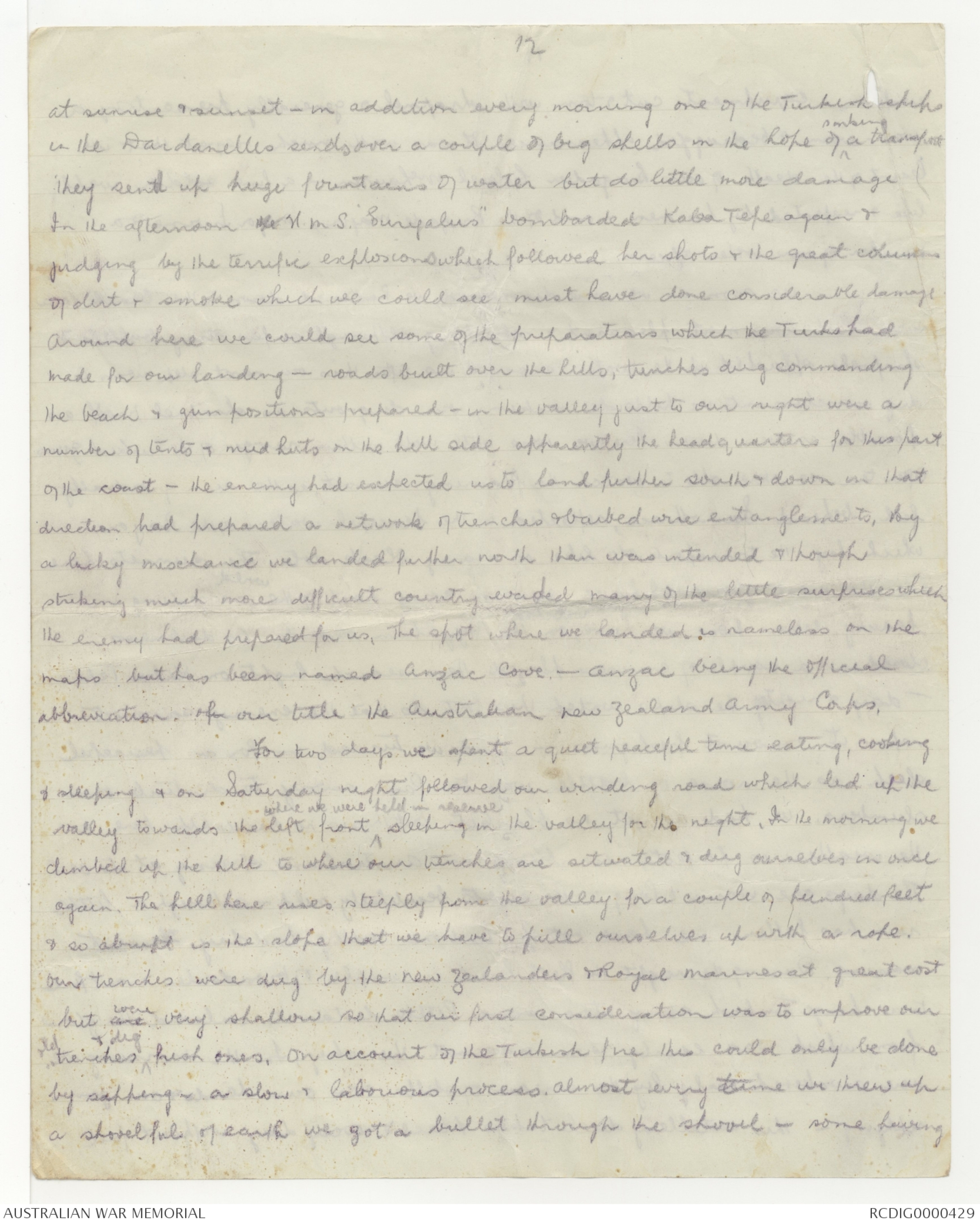
at sunrise & sunset - in addition every morning one of the Turkish ships
in the Dardanelles sends over a couple of big shells in the hope of ^sinking a transport
They send up huge fountains of water but do little more damage
In the afternoon the H.M.S. "Euryalus" bombarded Kaba Tepe again &
judging by the terrific explosions which followed her shots & the great columns
of dirt & smoke which we could see must have done considerable damage
Around here we could see some of the preparations which the Turks had
made for our landing - roads built over the hills, trenches dug commanding
the beach & gun positions prepared - in the valley just to our right were a
number of tents & mud huts on the hill side apparently the headquarters for this part
of the coast - the enemy had expected us to land further south & down in that
direction had prepared a network of trenches & barbed wire entanglements, By
a lucky mischance we landed further north than was intended & though
striking much more difficult country evaded many of the little surprises which
the enemy had prepared for us. The spot where we landed is nameless on the
maps but has been named Anzac Cove - Anzac being the official
abbreviation of our title the Australian New Zealand Army Corps.
For two days we spent a quiet peaceful time eating, cooking
& sleeping & on Saturday night followed our winding road which led up the
valley towards the left front ^where we were held in reserve sleeping in the valley for the night. In the morning we
climbed up the hill to where our trenches are situated & dug ourselves in once
again. The hill here rises steeply from the valley for a couple of hundred feet
& so abrupt is the slope that we have to pull ourselves up with a rope.
Our trenches were dug by the New Zealanders & Royal Marines at great cost
but are were very shallow so that our first consideration was to improve our
old trenches ^& dig fresh ones. On account of the Turkish fire this could only be done
by sapping - a slow & laborious process. Almost every time we threw up
a shovelful of earth we got a bullet through the shovel - some having
13.
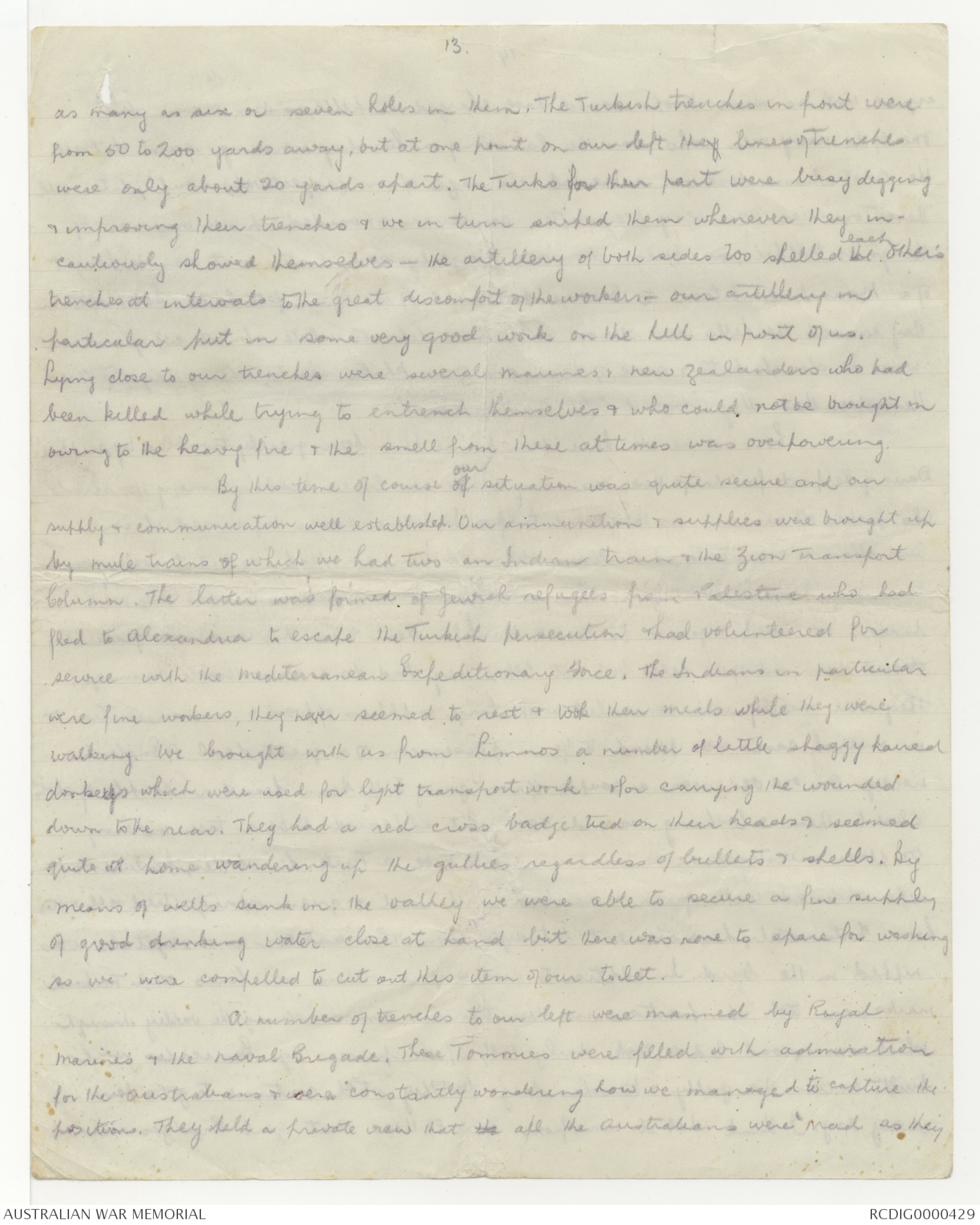
as many as six or seven holes in them. The Turkish trenches in front were
from 50 to 200 yards away, but at one point on our left they lines of trenches
were only about 20 yards apart. The Turks for their part were busy digging
& improving their trenches & we in turn sniped them whenever they incautiously
showed themselves - the artillery of both sides too shelled the each other's
trenches at intervals to the great discomfort of the workers - our artillery in
particular put in some very good work on the hill in front of us.
Lying close to our trenches were several marines & New Zealanders who had
been killed while trying to entrench themselves & who could not be brought in
owing to the heavy fire & the smell from these at times was overpowering.
By the time of course of our situation was quite secure and our
supply & communication well established. Our ammunition & supplies were brought up
by mule trains of which we had two an Indian train & the Zion Transport
Column. The latter was formed of Jewish refugees from Palestine who had
fled to Alexandria to escape the Turkish persecution & had volunteered for
service with the Mediterranean Expeditionary Force. The Indians in particular
were fine workers, they never seemed to rest & took their meals while they were
walking. We brought with us from Lemnos a number of little shaggy haired
donkeys which were used for light transport work & for carrying the wounded
down to the rear. They had a red cross badge tied on their heads & seemed
quite at home wandering up the gullies regardless of the bullets & shells. By
means of wells sunk in the valley we were able to receive a fine supply
of good drinking water close at hand but there was none to spare for washing
so we were compelled to cut out this item of our toilet.
A number of trenches to our left were manned by Royal
Marines & the Naval Brigade. These Tommies were filled with admiration
for the Australians & were constantly wondering how we managed to capture the
positions. They held a private view that the all the Australians were mad as they
14
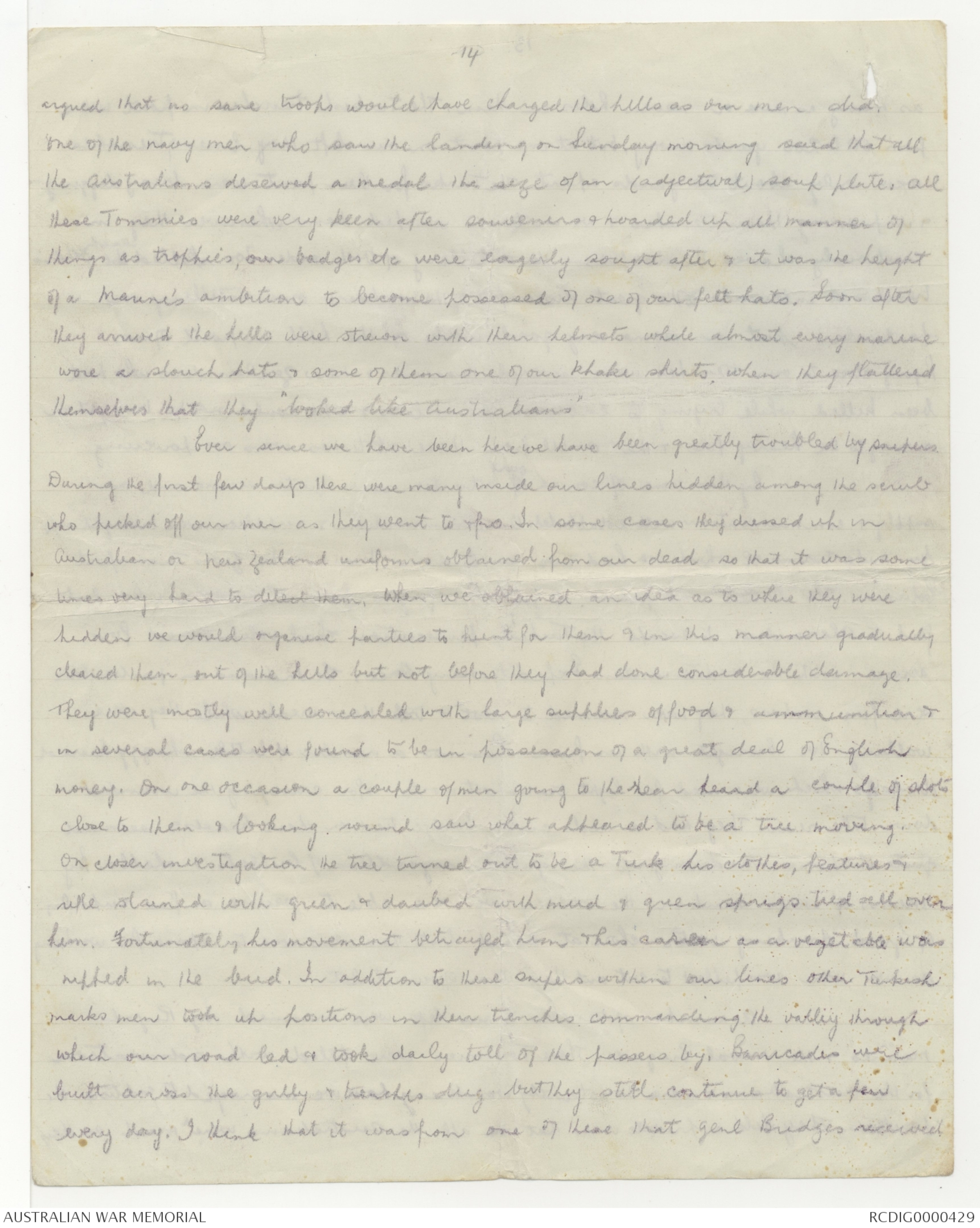
argued that no sane troops would have charged the hills as our men did.
One of the navy men who saw the landing on Sunday morning said that all
the Australians deserved a medal the size of an (adjectival) soup plate. All
these Tommies were very keen after souvenirs & hoarded up with all manner of
things as trophies, our badges etc were eagerly sought after & it was the height
of a Marine's ambition to become possessed of one of our felt hats. Soon after
they arrived the hills were strewn with their helmets while almost every marine
wore a slouch hat & some of them one of our khaki shirts, when they flattered
themselves that they "looked like Australians"
Ever since we have been here we have been greatly troubled by snipers.
During the first few days there were many inside our lines hidden amongst the scrub
who picked off our men as they went to & fro. In some cases they dressed up in
Australian or New Zealand uniforms obtained from our dead so that it was some
times very hard to detect them. When we obtained an idea as to where they were
hidden we would organise parties to hunt for them & in this manner gradually
cleared them out of the hills but not before they had done considerable damage.
They were mostly well concealed with large supplies of food & ammunition &
in several cases were found to be in possession of a great deal of English
money. On one occasion a couple of men going to the rear heard a couple of shots
close to them & looking round saw what appeared to be a tree moving.
On closer investigation the tree turned out to be a Turk. his clothes, features &
rifle stained with green & daubed with mud & green sprigs tied all over
him. Fortunately his movement betrayed him & his career as a vegetable was
nipped in the bud. In addition to these snipers within our lines other Turkish
marks men took up positions in their trenches commanding the valley through
which our road led & took daily toll of the passers by. Barricades were
built across the gully & trenches dug but they still continue to get a few
every day. I think that it was from one of these that Genl Bridges received
15
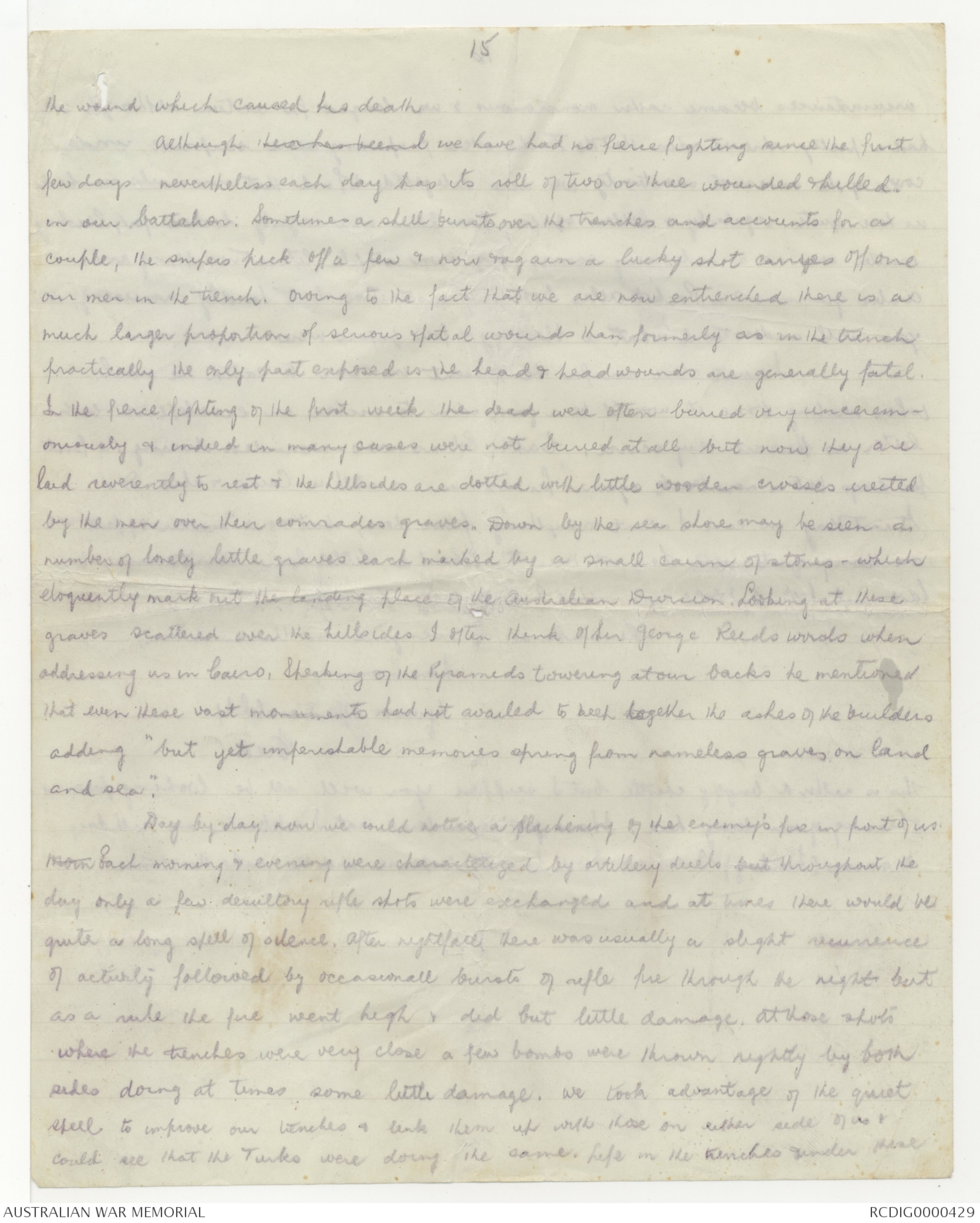
the wound which caused his death.
Although there has been l we have had no fierce fighting since the first
few days nevertheless each day has its roll of two or three wounded & killed.
in our battalion. Sometimes a shell bursts over the trenches and accounts for a
couple, the snipers pick off a few & now & again a lucky shot carries off one
our men in the trench. Owing to the fact that we are now entrenched there is a
much larger proportion of serious & fatal wounds than formerly as in the trench
practically the only part exposed is the head & head wounds are generally fatal.
In the fierce fighting of the first week the dead were often buried very unceremoniously
& indeed in many cases were not buried at all but now they are
laid reverently to rest & the hillsides are dotted with little wooden crosses erected
by the men over their comrades graves. Down by the sea shore may be seen a
number of lovely little graves each marked by a small cairn of stones - which
eloquently mark out the landing place of the Australian Division. Looking at these
graves scattered over the hillsides I often think of Sir George Reids words when
addressing us in Cairo. Speaking of the Pyramids towering at our backs he mentioned
that even these vast monuments had not availed to keep together the ashes of the builders
adding "but yet imperishable memories sprung from nameless graves on land
and sea".
Day by day now we would notice a slackening of the enemy's fire in front of us.
Morn Each morning & evening were characterized by artillery duels but throughout the
day only a few desultory rifle shots were exchanged and at times there would be
quite a long spell of silence. After nightfall there was usually a slight recurrence
of activity followed by occasionall bursts of rifle fire through the night but
as a rule the fire went high & did but little damage. At those spots
where the trenches were very close a few bombs were thrown nightly by both
sides doing at times some little damage. We took advantage of the quiet
spell to improve our trenches & link them up with those on either side of us &
could see that the Turks were doing the same. Life in the trenches under these
16
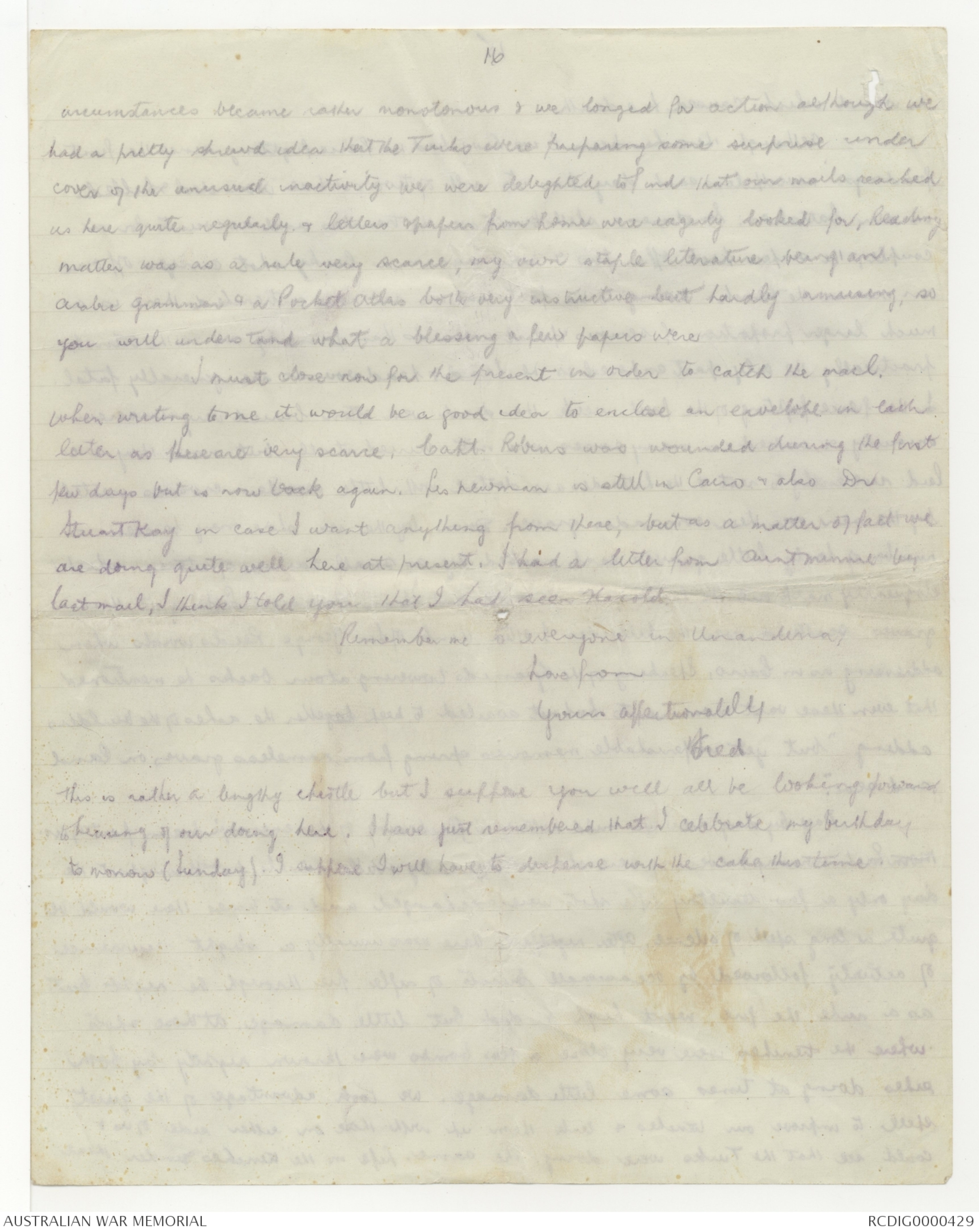
circumstances became rather monotonous & we longed for action although we
had a pretty shrewd idea that the Turks were preparing some surprise under
cover of the unusual inactivity. We were delighted to find that our mails reached
us here quite regularly & letters & papers from home were eagerly looked for. Reading
matter was as a rule very scarce, my own staple literature being an
Arabic Grammer & a Pocket Atlas both very instructive but hardly amusing, so
you will understand what a blessing a few papers were.
I must close now for the present in order to catch the mail.
When writing to me it would be a good idea to enclose an envelope in each
letter as these are very scarce. Capt. Robins was wounded during the first
few days but is now back again. Les Newman is still in Cairo & also Dr
Stuart Kay in case I want anything from there, but as a matter of fact we
are doing quite well here at present. I had a letter from Aunt Minnie by
last mail, I think I told you that I had seen Harold.
Remember me to everyone in Unanderra,
Love from
Yours affectionatelly
Fred
This is rather a lengthy epistle but I suppose you will all be looking forward
to hearing of our doing here. I have just remembered that I celebrate my birthday
tomorrow (Sunday). I suppose I will have to dispense with the cake this time.
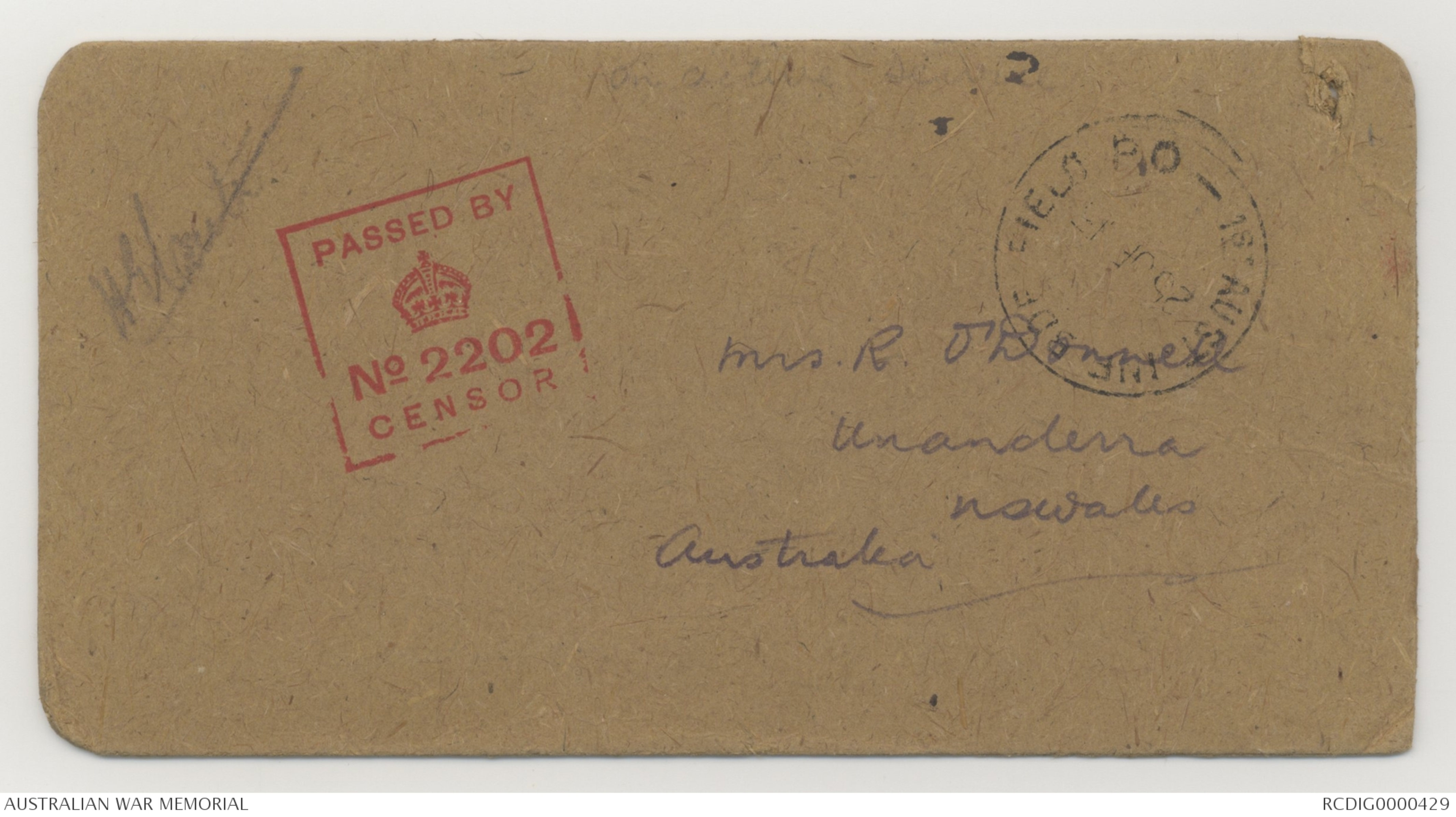
[Envelope]
PASSED BY
No 2202
CENSOR
FIELD P.O - 1st AUSTINF BDE
Mrs R O'Donnell
Unanderra
NSWales
Australia
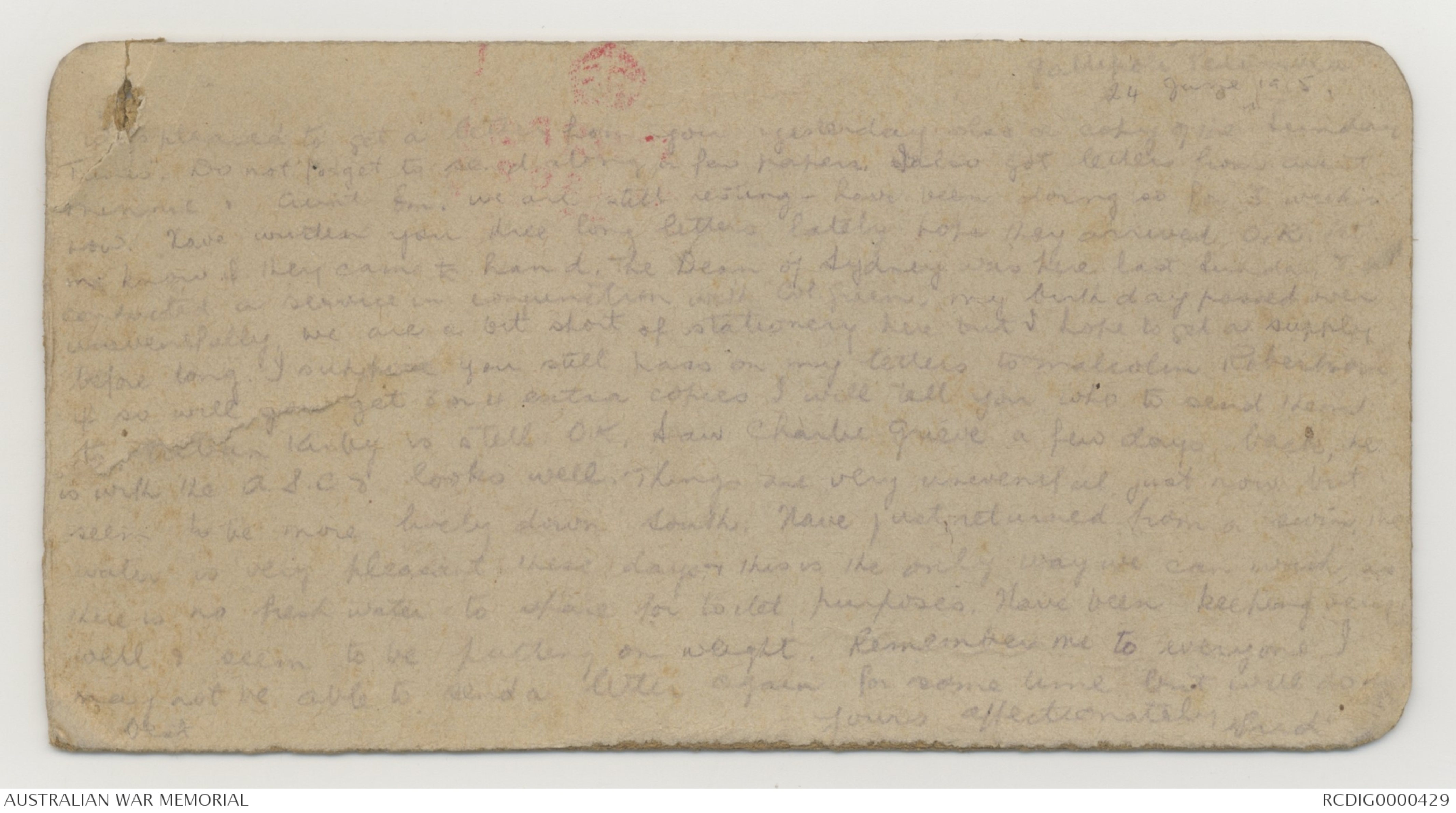
Gallipoli
24 June 1915,
So pleased to get a letter from you yesterday, also a copy of the Sunday
Times. Do not forget to send along a few papers. I also got letters from Aunt
Nenish and Aunt Em. We are still resting - have been doing so for 3 weeks
now. Have written you three long letters lately hope they arrived O.K. Let
me know if they came to hand. The Dean of Sydney was here last Sunday & has
conducted a service in conjunction with Col Green. my birthday passed ever
uneventfully. We are a bit short of stationery here but I hope to geta supply
before long. I suppose you still pass on my letters to Malcom Robertson,
if so will you get 3 or 4 extra copies I will tell you who to send them
to - William Kirby is still O.K. I saw Charlie Grieve a few days back, he
is with the A.S.C & looks well. Things are very uneventful just now but
seem to be more lively down South. Have just returned from a swim, the
water is very pleasant these days & this is the only way we can wash, as
there is no fresh water to spare for toilet purposes. Have been keeping very
well & seem to be putting on weight. Remember me to everyone I
may not be able to send a letter again for some time but will do
my best
Yours affectionately
Fred
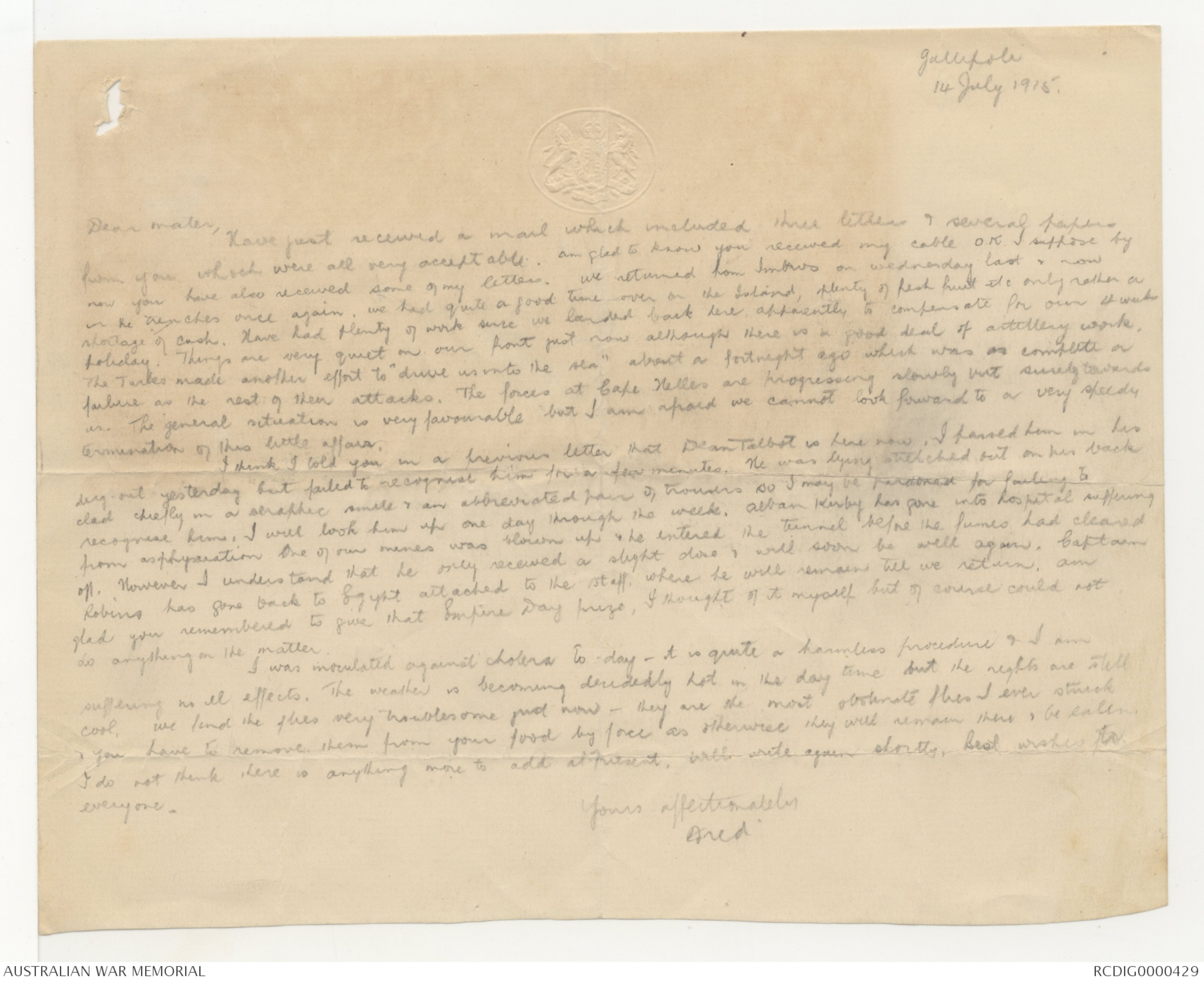
Gallipoli
14 July 1915.
Dear Mater,
Have just received a mail which included three letters & several papers
from you which were all very acceptable. Am glad to know
you received my cable O.K. I suppose by
now you have also received some of my letters. We returned from Imbros on Wednesday last & now
in the trenches once again. We had quite a good time over on the Island, plenty of fresh fruit etc only rather
a shortage of cash. Have had plenty of work since as landed back here apparently to compensate for our 4 weeks
holiday. Things are very quiet on our front just now although there is a good deal of artillery work.
The Turks made another effort to "drive us into the sea" about a fortnight ago which was as complete a
failure as the rest of their attacks. The forces at Cape Helles are progressing slowly but surely towards
us. The general situation is very favourable but I am afraid we cannot look forward to a very speedy
termination of this little affair.
I think I told you in a previous letter that Dean Talbot is here now. I passed him in his
dug-out yesterday but failed to recognise him for a few minutes. He was lying stretched out on his back
clad chiefly in a seraphic smile & an abbreviated pair of trousers so I may be pardoned for failing to
recognise him. I will look him up one day through the week. Allan Kirby has gone into hospital suffering
from asphyxiation. One of our mines was blown up & he entered the tunnel before the fumes had cleared
off. However I understand that he only received a slight dose & will soon be well again. Captain
Robins has gone back to Egypt attached to the staff, where he will remain till we return. Am
glad you remembered to give that Empire Day prize, I thought of it myself but of course could not
do anything on the matter.
I was inoculated against cholera to-day - it is quite a harmless procedure & I am
suffering no ill effects. The weather is becoming decidedly hot in the day time but the nights are still
cool. We find the flies very troublesome just now -they are the most obstinate flies I ever struck
& you have to remove them from your food by force as otherwise they will remain there & be eaten.
I do not think there is anything more to add at present. Will write again shortly, best wishes to everyone.
Yours affectionately
Fred
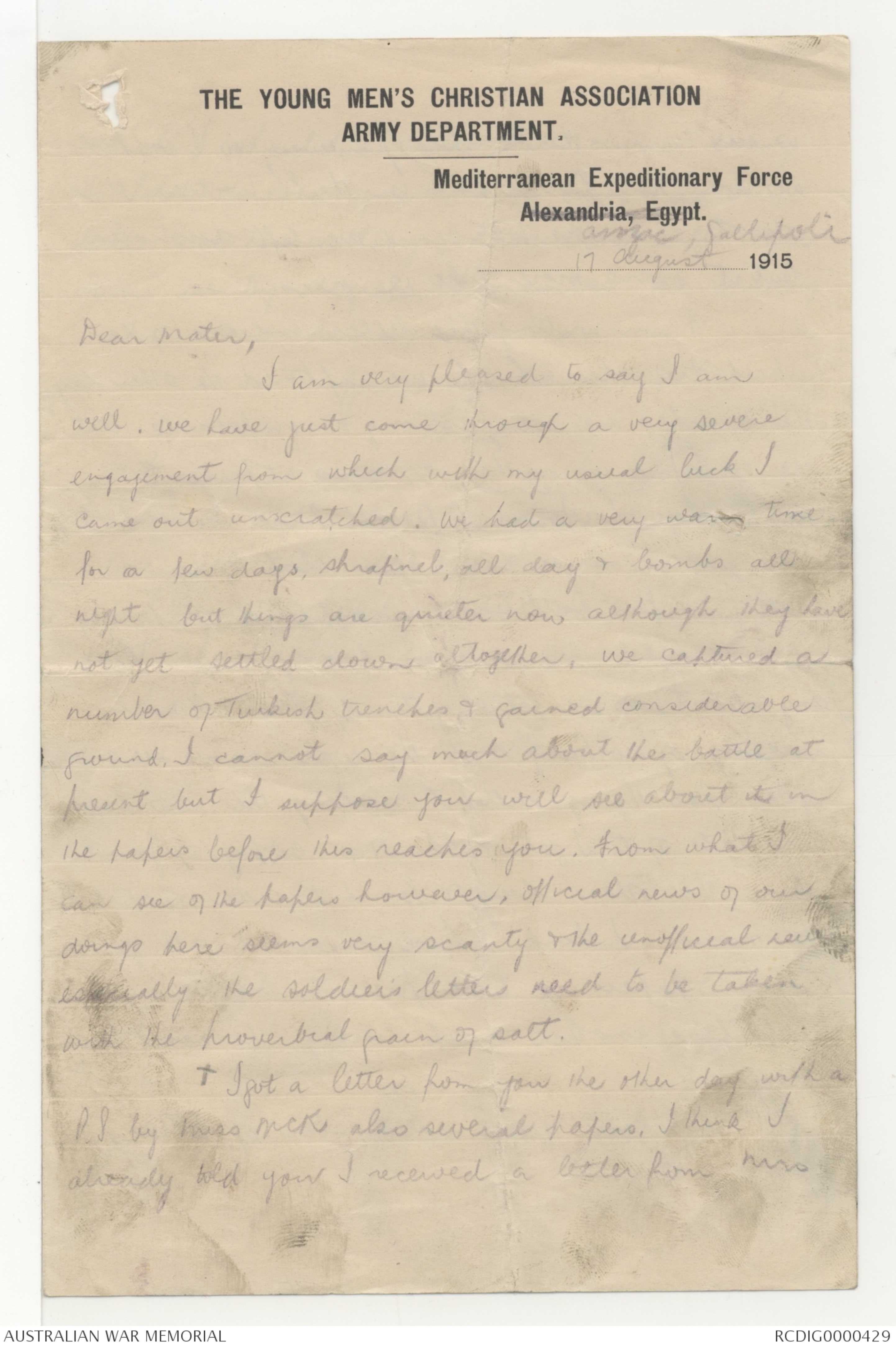
THE YOUNG MEN'S CHRISTIAN ASSOCIATION
ARMY DEPARTMENT.
Mediterranean Expeditionary Force
Alexandria, Egypt.
Anzac, Gallipoli
17 August 1915
Dear Mater,
I am very pleased to say I am
well. We have just come through a very severe
engagement from which with my usual luck I
came out unscratched. We had a very warm time
for a few days, shrapnel, all day & bombs all
night but things are quieter now although they have
not yet settled down altogether. We captured a
number of Turkish trenches & gained considerable
ground. I cannot say much about the battle at
present but I suppose you will see about it in
the papers before this reaches you. From what I
can see in one of the papers, however, official news of our
doings here seems very scanty & the unofficial news
especially the soldier's letters need to be taken
with the proverbial grain of salt.
+ I got a letter from you the other day with a
P.S. by Miss McK also several papers. I think I
already told you I received a letter from Mrs
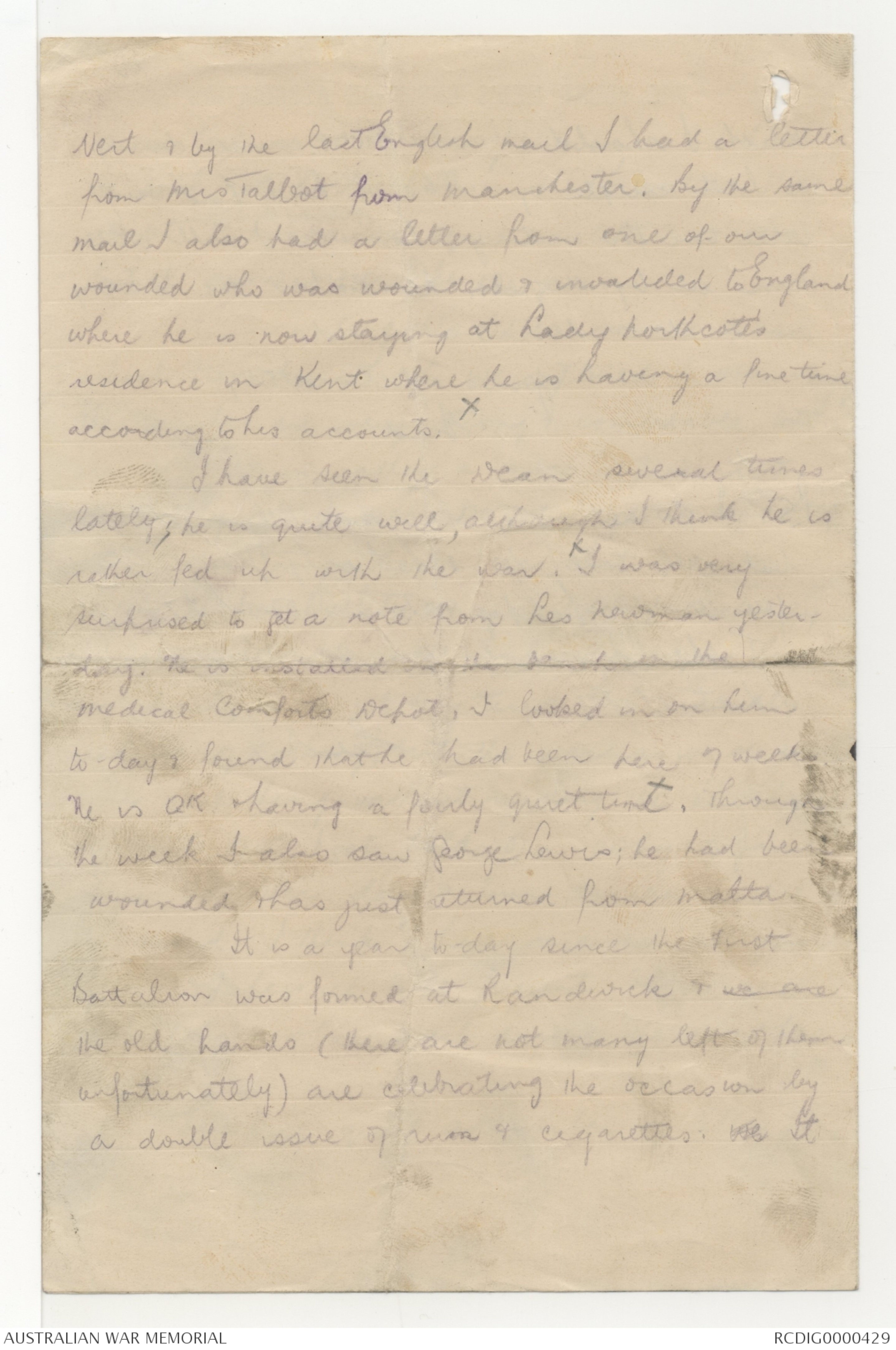
Veit & by the last English mail I had a letter
from Mrs Talbot from Manchester. By the same
mail I also had a letter from one of our
wounded who was wounded & invalided to England
where he is now staying at Lady Northcott's
residence in Kent where he is having a fine time
according to his accounts.
I have seen the Dean several times
lately; he is quite well, although I think he is
rather fed up with the war. I was very
surprised to get a note from Les Newman yesterday.
He is installed on the branch
Medical Comforts Depot, I looked in on him
to-day & found that he had been here 7 weeks
He is OK & having a fairly quiet time. Through
the week I also saw George Lewis & he had been
wounded & has just returned from Malta.
It is a year to-day since the First
Battalion was formed at Randwick & we are
the old hands (there are not many left of them
unfortunately) are celebrating the occasion by
a double issue of rum & cigarettes. We It
 D Coates
This transcription item is now locked to you for editing. To release the lock either Save your changes or Cancel.
This lock will be automatically released after 60 minutes of inactivity.