
Letters from Frederick Warren Muir, 1914-1915 - Part 8
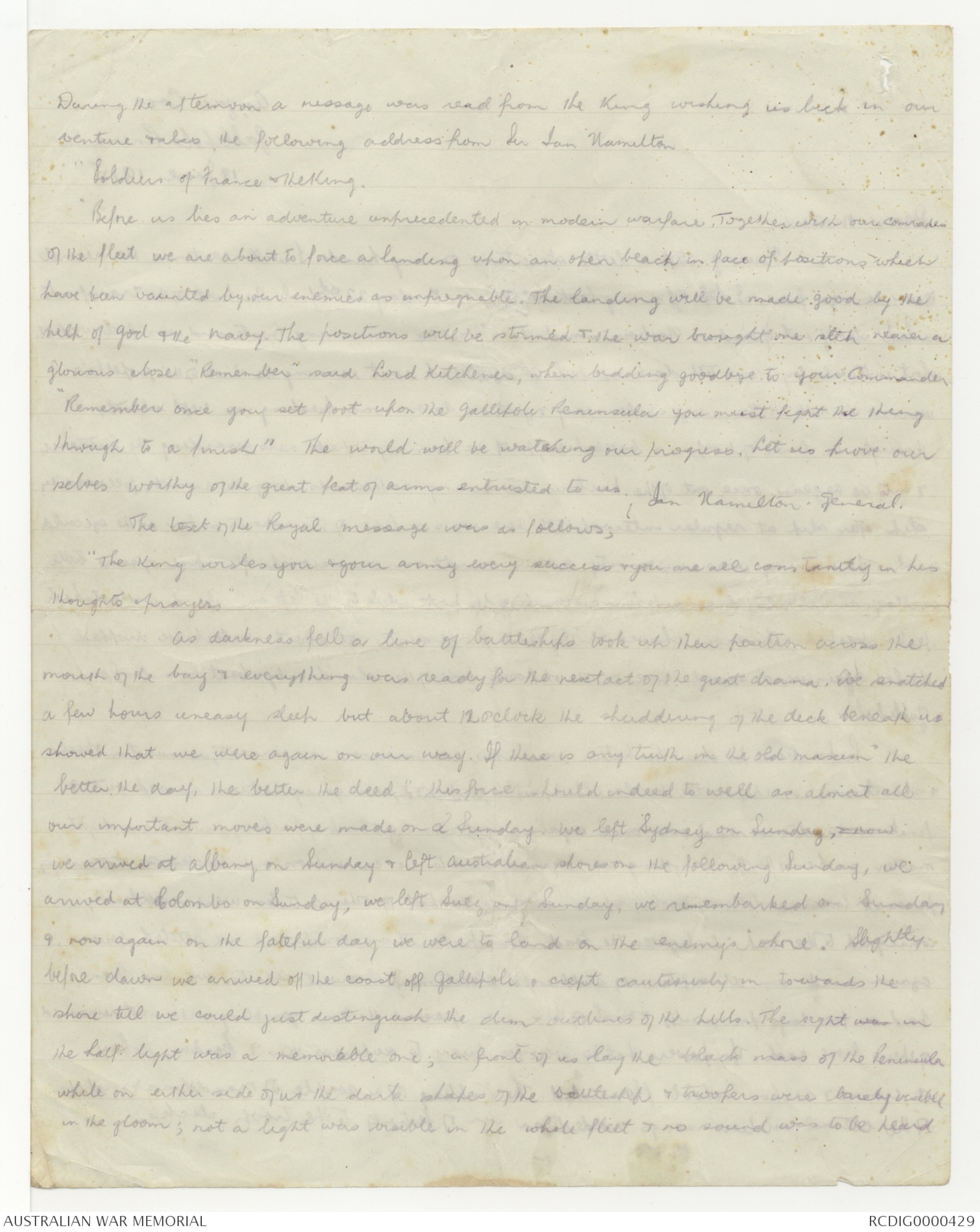
During the afternoon a message was read from the King wishing us luck in our
venture & also the following address from Sir Ian Hamilton.
Soldiers of France & the King.
Before us lies an adventure unprecedented in modern warfare. Together with our comrades
of the fleet we are about to force a landing upon an open beach in face of positions which
have been vaunted by our enemies as impregnable. The landing will be made good by the
help of god the navy. The positions will be stormed & the war brought one step nearer a
glorious close "Remember", said Lord Kitchener, when bidding goodbye to your Commander
"Remember once your set foot upon the Gallipoli Peninsula you must fight the thing
through to a finish" The world will be watching our progress. Let us prove ourselves
worthy of the great feat of arms entrusted to us.
Ian Hamilton. General.
The text of the Royal message was as follows;
The King wishes you and your army every success & you are all constantly in his
thoughts & prayers
As darkness fell a line of battleships took up their position across the
mouth of the bay & everything was ready for the next act of the great drama. We snatched
a few hours uneasy sleep but about 12 o'clock the shuddering of the deck beneath us
showed that we were again on our way. If there is any truth in the old maxim "The
better the day, the better the deed" this force would indeed do well as almost all
our important moves were made on a Sunday. We left Sydney on Sunday, & now
we arrived at Albany on Sunday & left Australian shores on the following Sunday, we
arrived at Colombo on Sunday, we left Suez on Sunday, we reembarked on Sunday
& now again on the fateful day we were to land on the enemy's shore? Slightly
before dawn we arrived off the coast off Gallipoli crept cautiously in towards the
shore till we could just distinguish the dim outlines of the hells. The sight was in
the half light was a memorable one; in front of us lay the black mass of the Peninsula
while on either side of us the dark shapes of the battleships & troopers were barely visible
in the gloom; not a light was visible in the whole fleet & no sound was to be heard
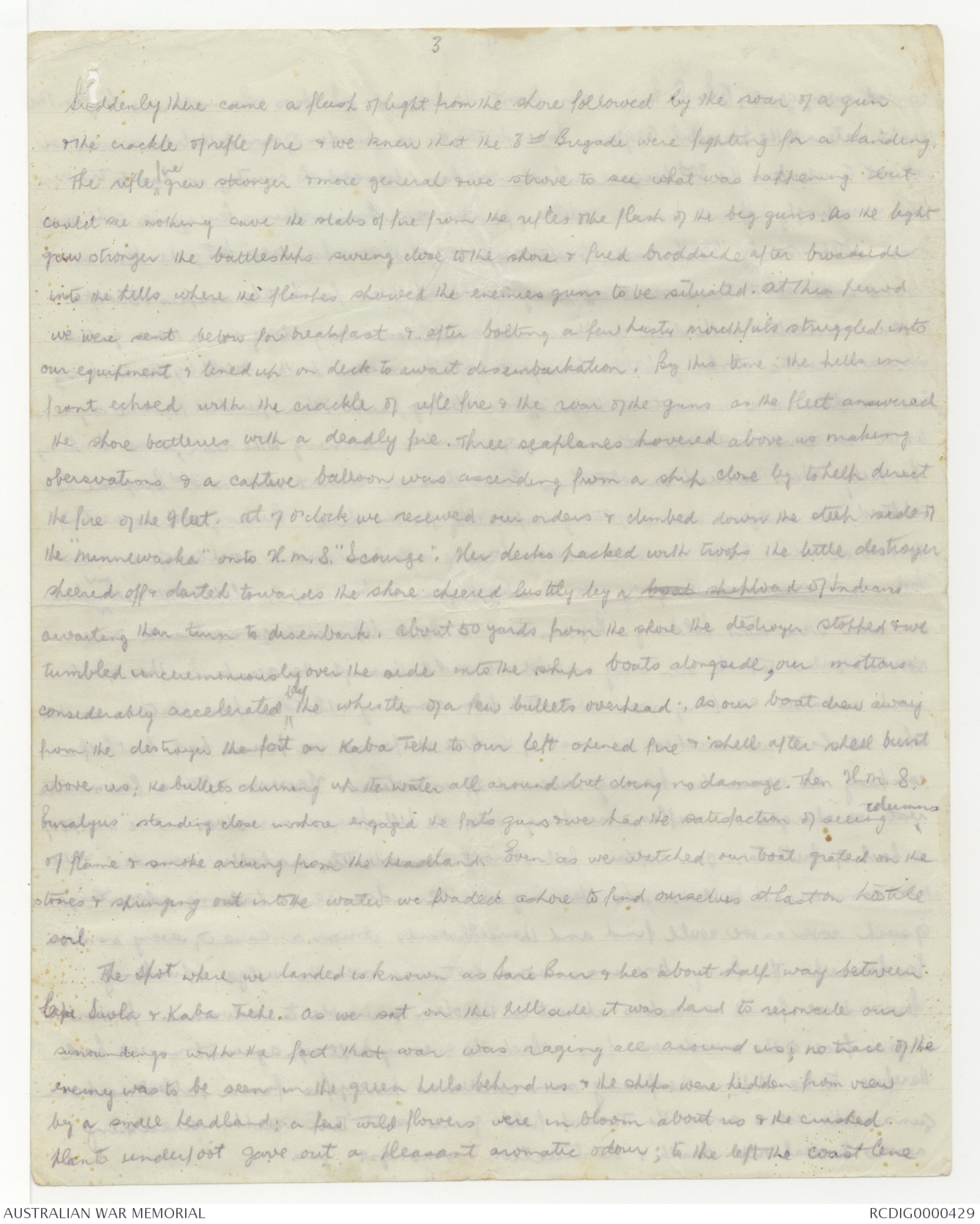
Suddenly there came a flash of light from the shore followed by the roar of a gun
the crackle of rifle fire & we knew that the 3rd Brigade were fighting for a landing.
the rifle ^fire grew stronger & more general & we strove to see what was happening but
could see nothing save the stabs of fire from the rifles & the flash of the big guns. as the light
grew stronger, the battleships swung close to the shore & fired broadside after broadside
into the hills where the flashes showed the enemies guns to be situated. At this period
we were sent below for breakfast & after bolting a few hasty mouthfuls struggled into
our equipment & lined up on deck to await disembarkation. By this time the hills in
front echoed with the crackle of rifle fire & the roar of the guns as the fleet answered
the shore batteries with a deadly fire. Three seaplanes hovered above us making
observations & a captive balloon was ascending from a ship close by to help direct
the fire of the fleet. At 7 o’clock we received our orders & climbed down the steep side of
the "Minnewaska" onto H.M.S. "Scourge". Her decks packed with troops the little destroyer
steered off & darted towards the shore cheered lustily by a boat shipload of Indians
awaiting their turn to disembark. About 50 yards from the shore the destroyer stopped & we
tumbled unceremoniously over the side into the ships boats alongside, our motions
considerably accelerated ^by the whistle of a few bullets overhead. As our boat drew away
from the destroyer the fort or Kaba Tepe to our left opened fire & shell after shell burst
above us; the bullets churning up the water all around but doing no damage. Then H.M.S.
Euryalus standing close in shore engaged the Port's guns & we had the satisfaction of seeing ^columns
of flame & smoke arising from the headland. Even as we watched our boat grated on the
stones & springing out in to the water we waded ashore to find ourselves at last on hostile
soil.
The spot where we landed is known as Sari Bair & lies about half way between
Cape Suvla & Kaba Tepe. As we sat on the hillside it was hard to reconcile our
surroundings with the fact that war was raging all around us; no trace of the
enemy was to be seen in the green hills behind us & the ships, were hidden from view
by a small headland; a few wild flowers were in bloom about us & the crushed
plants underfoot gave out a pleasant aromatic odour; to the left the coastline
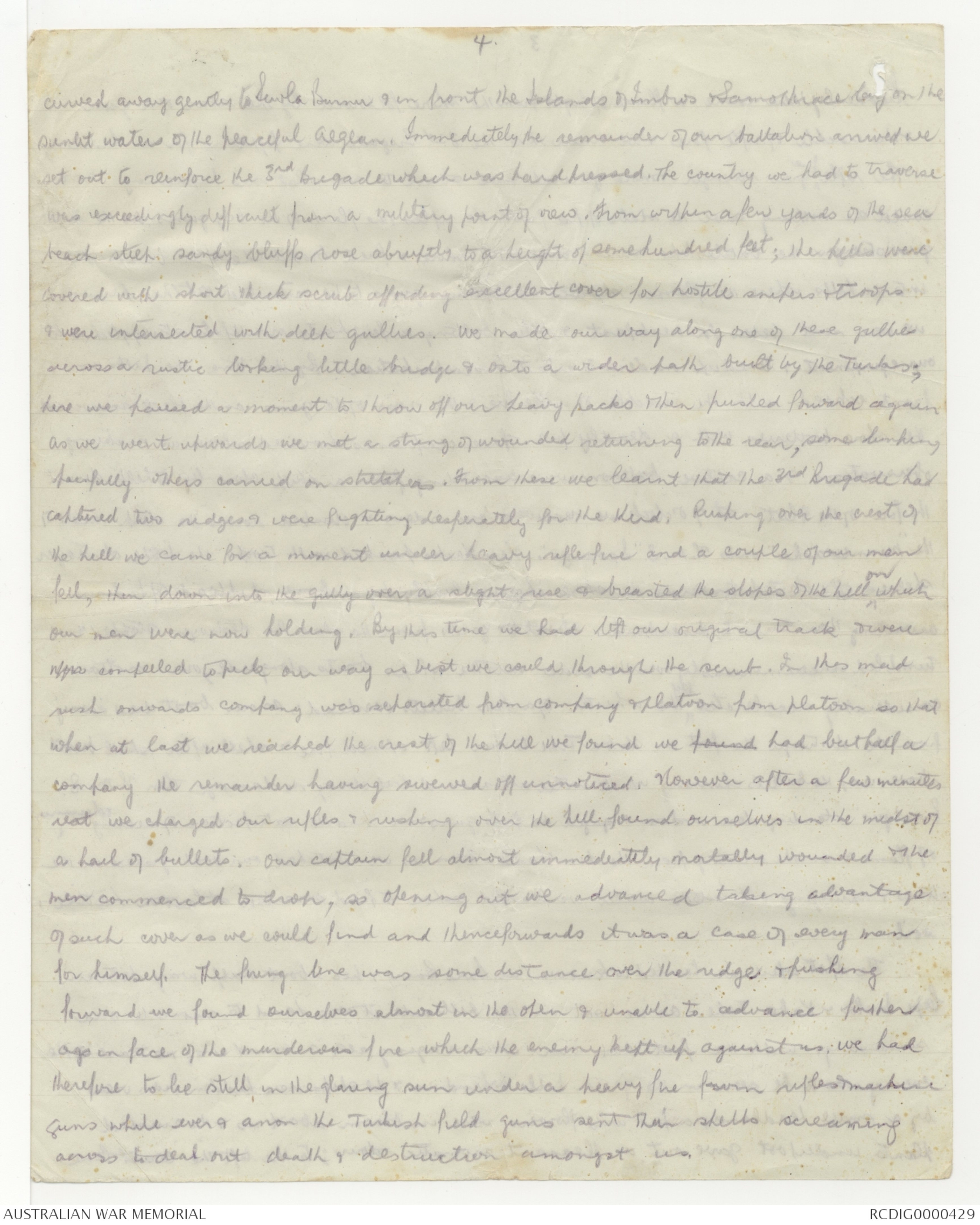
4.
curved away gently to Sewla Burner & in front, the Islands of Imbros & Samothrace long on the
sunlit waters of the peaceful Aegean. Immediately the remainder of our battalion arrived we
set out to reinforce the 3rd Brigade which was hard pressed. The country we had to traverse
was exceedingly difficult from a military point of view. Froms within a few yards of the sea
beach steep, sandy bluffs rose abruptly to a height of some hundred feet; the hills were
covered with short thick scrub affording excellent cover for hostile snipers & troops
& were intersected with deep gullies. We made our way along one of these gullies
across a rustic looking little bridge & onto a wider path built by the Turks;
here we paused a moment to throw off our heavy packs & then pushed forward again
as we went upwards we met a string of wounded returning to the rear, some limping
painfully others carried on stretchers. From these we learnt that the 3rd Brigade had
captured two ridges & were fighting desperately for the third. Rushing over the crest of
the hill we came for a moment under heavy rifle fire and a couple of our men
fell, then down into the gully over a slight rise & breasted he slopes of the hill ^on which
our men were now holding. By this time we had left our original track & werexxx compelled to pick our way as best we could through the scrub. In this mad
rush onwards company was separated from company & platoon from platoon so that
when at last we reached the crest of the hill we found we found had but half a
company the remainder having swerved off unnoticed. However after a few minutes
rest we charged our rifles & rushing over the hill found ourselves in the midst of
a hail of bullets. Our captain fell almost immediately mortally wounded & the
men commenced to drop, so opening out we advanced taking advantage
of such cover as we could find and thenceforwards it was a case of every man
for himself. The firing line was some distance over the ridge & pushing
forward we found ourselves almost in the open & unable to advance further
& go in face of the murderous fire which the enemy kept up against us; we had
therefore to be still, in the glaring sun under a heavy fire from rifles & machine
guns while ever & anon the Turkish field guns sent their shells screaming
across to deal out death & destruction amongst us.
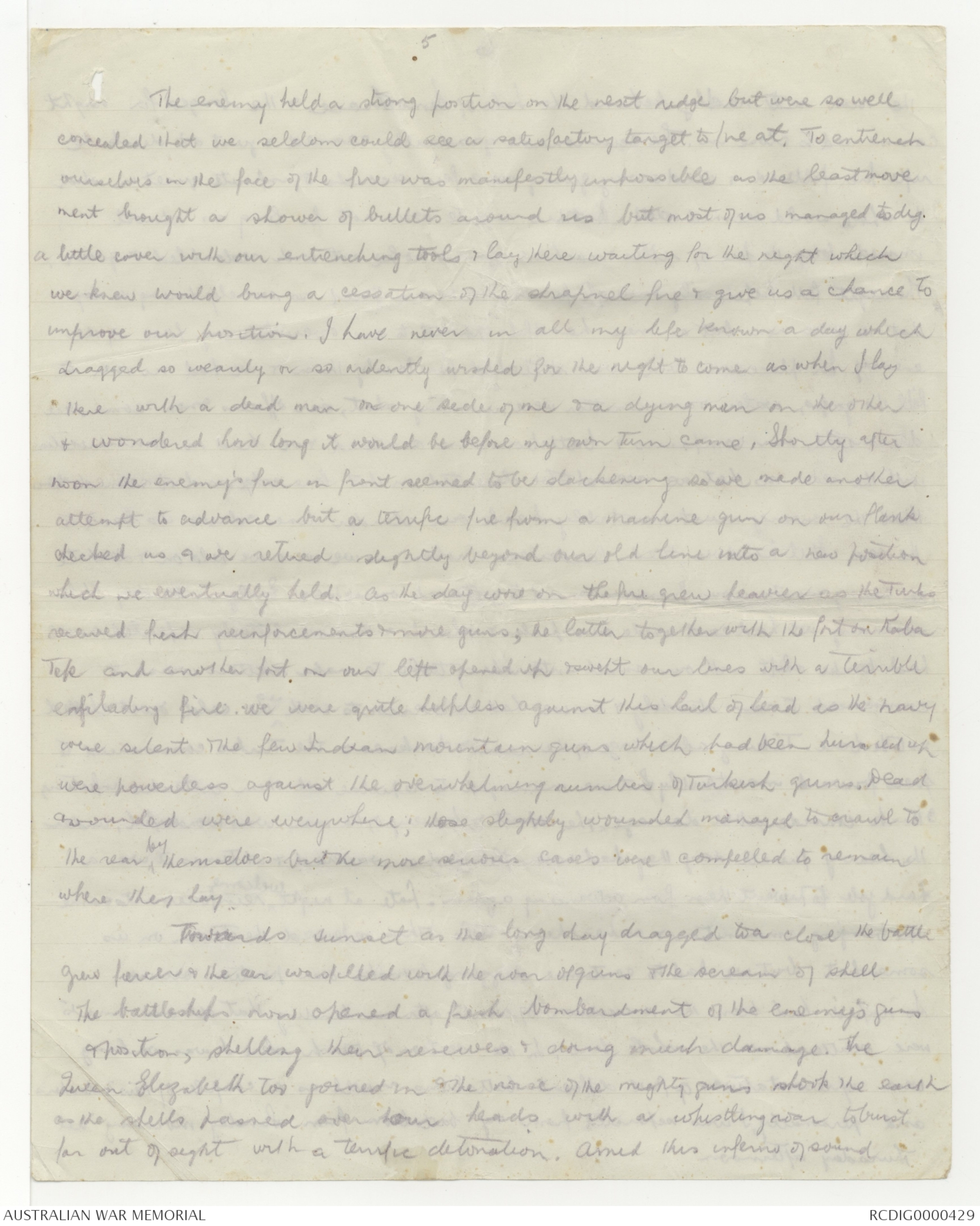
5
The enemy held a strong position on the next ridge but were so well
concealed that we seldom could see a satisfactory target to /re at. To entrench
ourselves in the face of the fire was manifestly impossible as the least movement
brought a shower of bullets around us but most of us managed to dig.
a little cover with our entrenching tools & lay there waiting for the night which
we knew would bring a cessation of the shrapnel fire & give us a chance to
improve our position. I have never in all my life known a day which
dragged so wearily & so ardently wished for the night to come as when I lay
there with a dead man on one side of me & a dying man on the other
& wondered how long it would be before my own turn came. Shortly after
noon the enemy's fire in front seemed to be slackening so we made another
attempt to advance but a terrific fire from a machine gun on our flank
checked us & we retired slightly beyond our old line into a new position
which we eventually held. As the day wore or the fire grew leavier as the Turks
received fresh reinforcements & more guns; the latter together with the fort on Kaba
Tepe and another fort on our left opened up & swept our lines with a terrible
enfilading fire. we were quite helpless against this hail of lead as the navy
were silent. The few Indian mountain guns which had been hurried up
were powerless against the overwhelming number, of Turkish guns. Dead
wounded were everywhere; those slightly wounded managed to crawl to
the rear ^ by themselves, but he more serious cases were compelled to remain
where they lay.
Towards sunset as the long day dragged to close the battle
grew fiercer & the air was filled with the roar of guns & the scream of shell
The battleships now opened a fresh bombardment of the enemy's gun
& position, shelling their reserves & doing much damage. The
Queen Elizabeth too joined in the noise of the mighty guns shook the earth
as the shells passed over our heads with a whistling roar to burst
far out of sight with a terrific detonation. Amid this inferno of sound
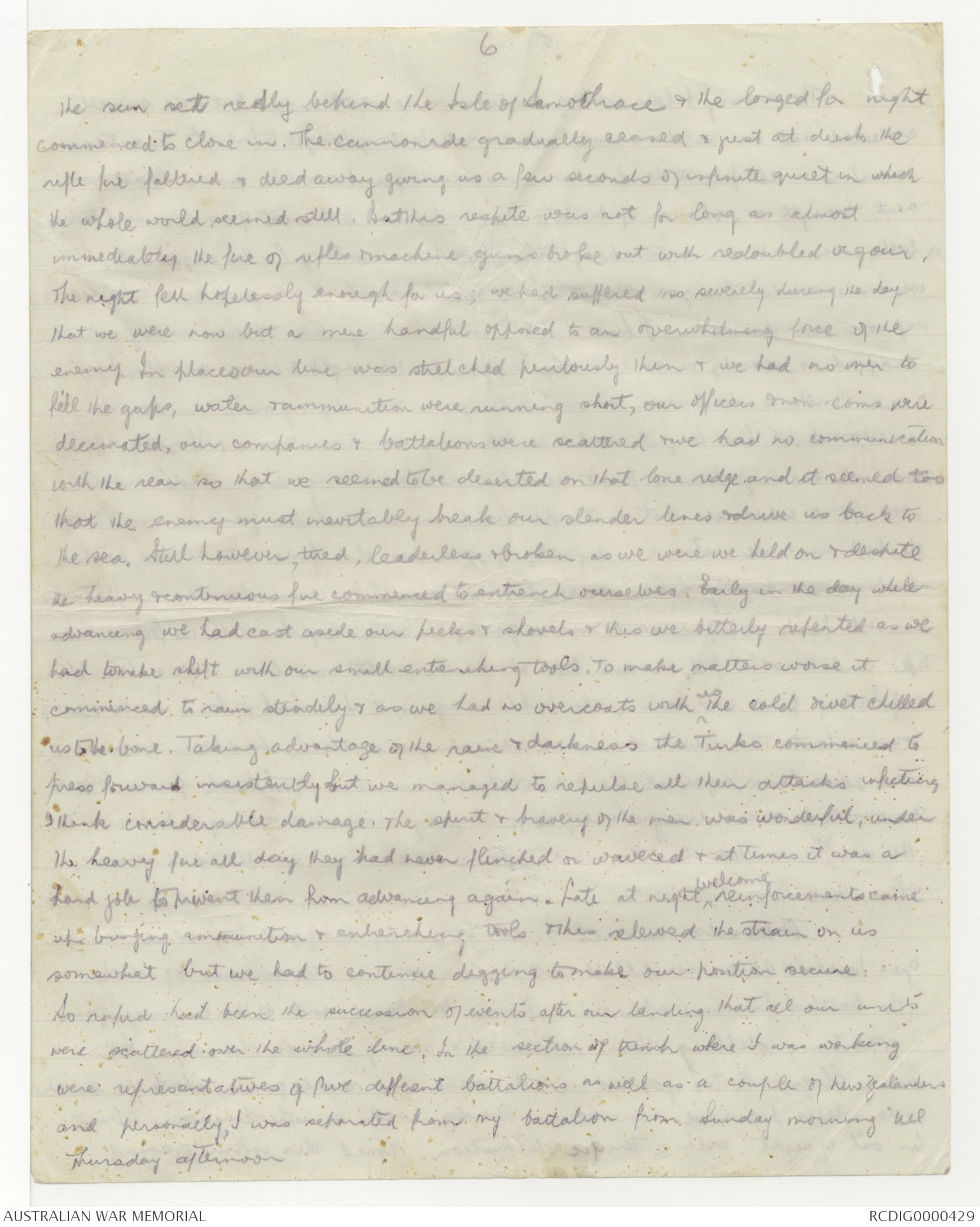
6
the sun set redly behind the Isle of Samothrace & the longed for night
commenced to close in. The cannonade gradually ceased & just at dusk the
rifle fire faltered & died away giving us a few seconds of infinite quiet in which
the whole world seemed still. But this respite was not for long as almost
immediately the fire of rifles machine guns broke out with redoubled vigour,
The night fell hopelessly enough for us, we had suffered so severely during he day
that we were now but a mere handful opposed to an overwhelming force of the
enemy. In places our line was stretched perilously then & we had no men to
fill the gaps, water & ammunition were running short, our officers & men [[coms?]] were
decimated, our companies & battalions were scattered & we had no communication
with the rear so that we seemed to be deserted on that lone ridge and it seemed too
that the enemy must inevitably break our slender lines & drive us back to
the sea. Still however tired, leaderless & broken as we were we held on & despite
the heavy & continuous fire commenced to entrench ourselves. Early in the day while
advancing we had cast aside our packs & shovels & this we bitterly repented as we
had to make shift with our small entrenching tools. To make matters worse it
commenced to rain steadily & as we had no overcoats with ^ us the cold divet chilled
us to the bone. Taking, advantage of the rain & darkness the Turks commenced to
press forward insistently but we managed to repulse all their attacks inflicting
I think considerable damage. The spirit & bravery of the men was wonderful, under
the heavy fire all day they had never flinched or wavered & at times it was a
hand job to prevent them from advancing again. Late at night ^ welcome reinforcements came
up bringing ammunition & entrenching tools. This relieved the strain on us
somewhat but we had to continue digging to make our position secure.
So rapid had been the succession of events, after our landing that all our units
were scattered over the whole line. In the section of trench where I was working
were representatives of five different battalions as well as a couple of New Zealanders
and personally, I was separated from my battalion from Sunday morning til
Thursday afternoon
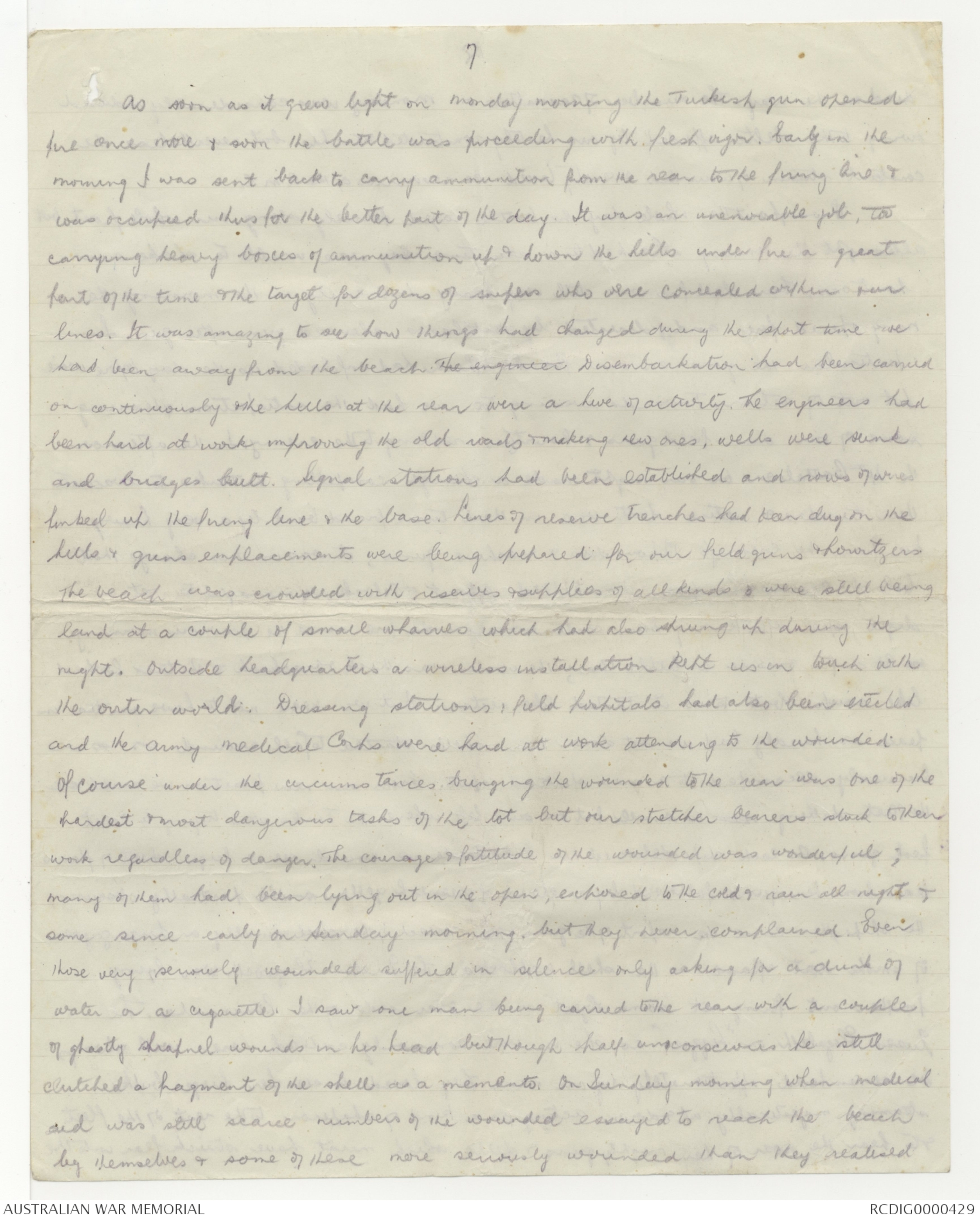
7
As soon as it grew light on Monday morning the Turkish guns opened
fire once more & soon the battle was proceeding with fresh vigor. Early in the
morning I was sent back to carry ammunition from the rear to the firing line &
was occupied thus for the better part of the day. It was an unenviable job, too
carrying heavy boxes of ammunition up & down the hills under fire a great
part of the time & the target for dozens of snipers who were concealed within our
lines. It was amazing to see how things had changed during the short time we
had been away from the beach. the engineer Disembarkation had been carried
on continuously & the hills at the rear were a hive of activity. The engineers had
been hard at work improving the old roads & making new ones, wells were sunk
and bridges built. Signal stations had been established and rows of wires
linked up the firing line & the base. Lines of reserve trenches had been dug on the
hills & guns emplacements were being prepared for our held guns & howitzers
The beach was crowded with reserves & supplies of all kinds & were still being
land at a couple of small wharves which had also sprung up during the
night. Outside headquarters a wireless installation kept us in touch with
the outer world. Dressing stations, field hospitals had also been erected
and the army medical Corps were hard at work attending to the wounded
of course under the circumstances bringing the wounded to the rear was one of the
hardest & most dangerous tasks of the lot but our stretcher bearers stuck to their
work regardless of danger. The courage & fortitude of the wounded was wonderful;
many of them had been lying out in the open, exposed to the cold & rain all night
some since early on Sunday morning, but they never complained. Even
those very seriously wounded suffered in silence only asking for a drink of
water or a cigarette. I saw one man being carried to the rear with a couple
of ghastly shrapnel wounds in his head but though half unconscious he still
clutched a fragment of the shell as a memento. On Sunday morning when medical
aid was still scarce numbers of the wounded essayed to reach the beach
by themselves & some of these were more seriously wounded than they realised
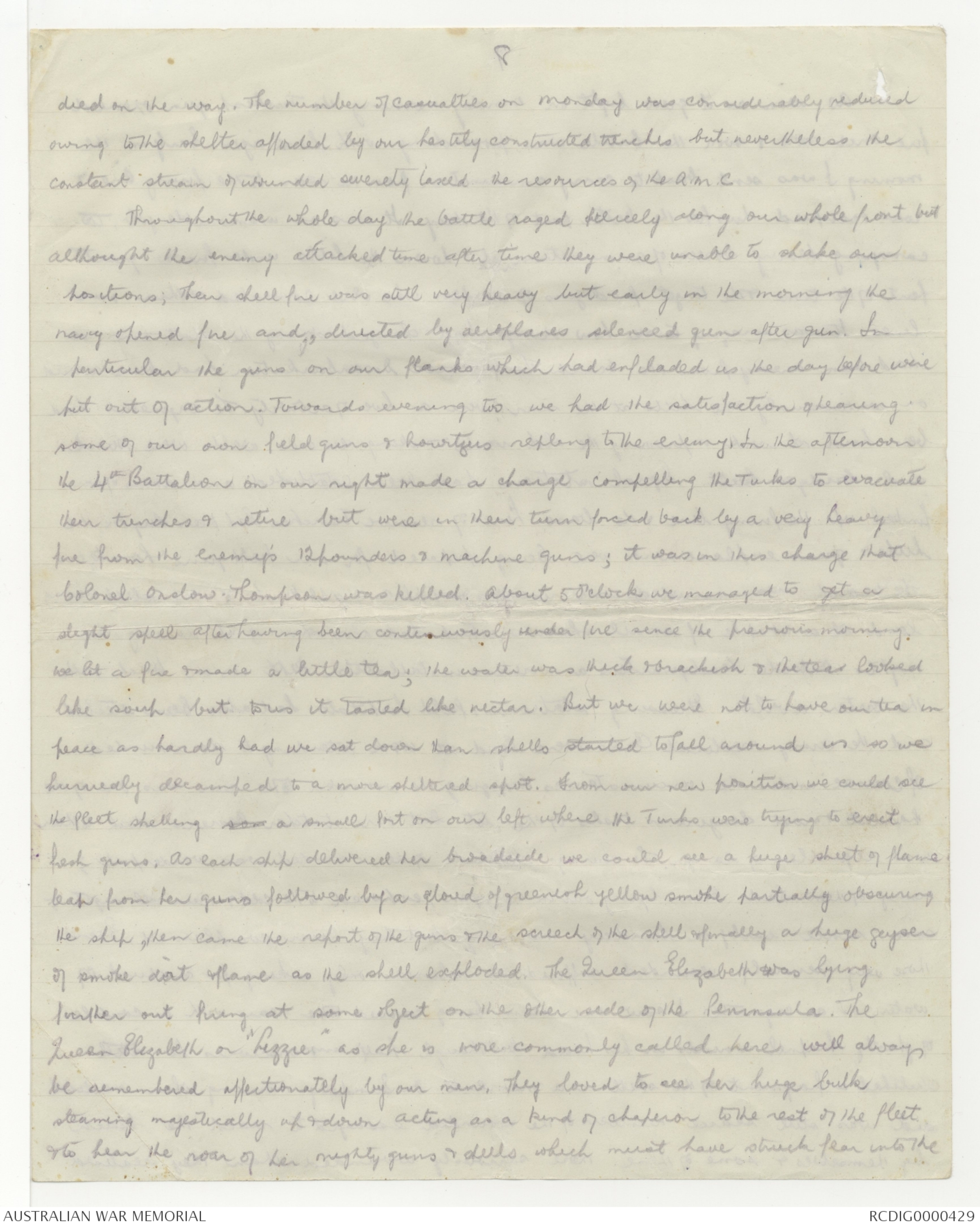
8
died on the way. The number of casualties on Monday was considerably reduced
owing to the shelter afforded by our hastily constructed trenches but nevertheless the
constant stream of wounded severely taxed the resources of the A.M.C.
Throughout the whole day the battle raged fiercely along our whole front but
althought the enemy attacked time after time they were unable to shake our
positions; their shell fire was still very heavy but early in the morning the
navy opened fire and, directed by airplanes silenced gun after gun. I n
particular the guns on our flanks which had enfiladed us. the day before were
put out of action. Towards evening too we had the satisfaction of hearing
some of our own field guns & howitzers replying to the enemy. In the afternoon
the 4th Battalion on our right made a charge compelling the Turks to evacuate
their trenches & retire but were in their turn forced back by a very heavy
fire from the enemy's 12 pounders & machine guns; it was in this charge that
Colonel Onslow Thompson was killed. about 5 o’clock we managed to get a slight spell after having been continuously under fire since the previous morning.
we lit a fire & made a little tea; the water was thick & brackish & the teas looked
like soup but to us it tasted like nectar. But we were not to have our tea in
peace as hardly had we sat down than shells started to fall us so we
hurriedly decamped to a more sheltered spot. From our new position we could see
the fleet shelling a small post on our left where the Turks were trying to erect
fresh guns. As each ship delivered her broadside we could see a huge sheet of flame
leap from her guns followed by a cloud of greenish yellow smoke partially obscuring
the ship then came the report of the guns & the screech of the shell & finally a huge geyser
of smoke & flame as the shell exploded. The Queen Elizabeth was lying
further out firing at some object on the other side of the Peninsula. The
Queen Elizabeth or “Lizzie” as she is more commonly called here will always
be remembered affectionately by our men. They loved to see her huge bulk
steaming majestically up & down acting as a kind of chaperon to the rest of the fleet
& to hear he roar of her mighty guns & shells which have struck fear into the
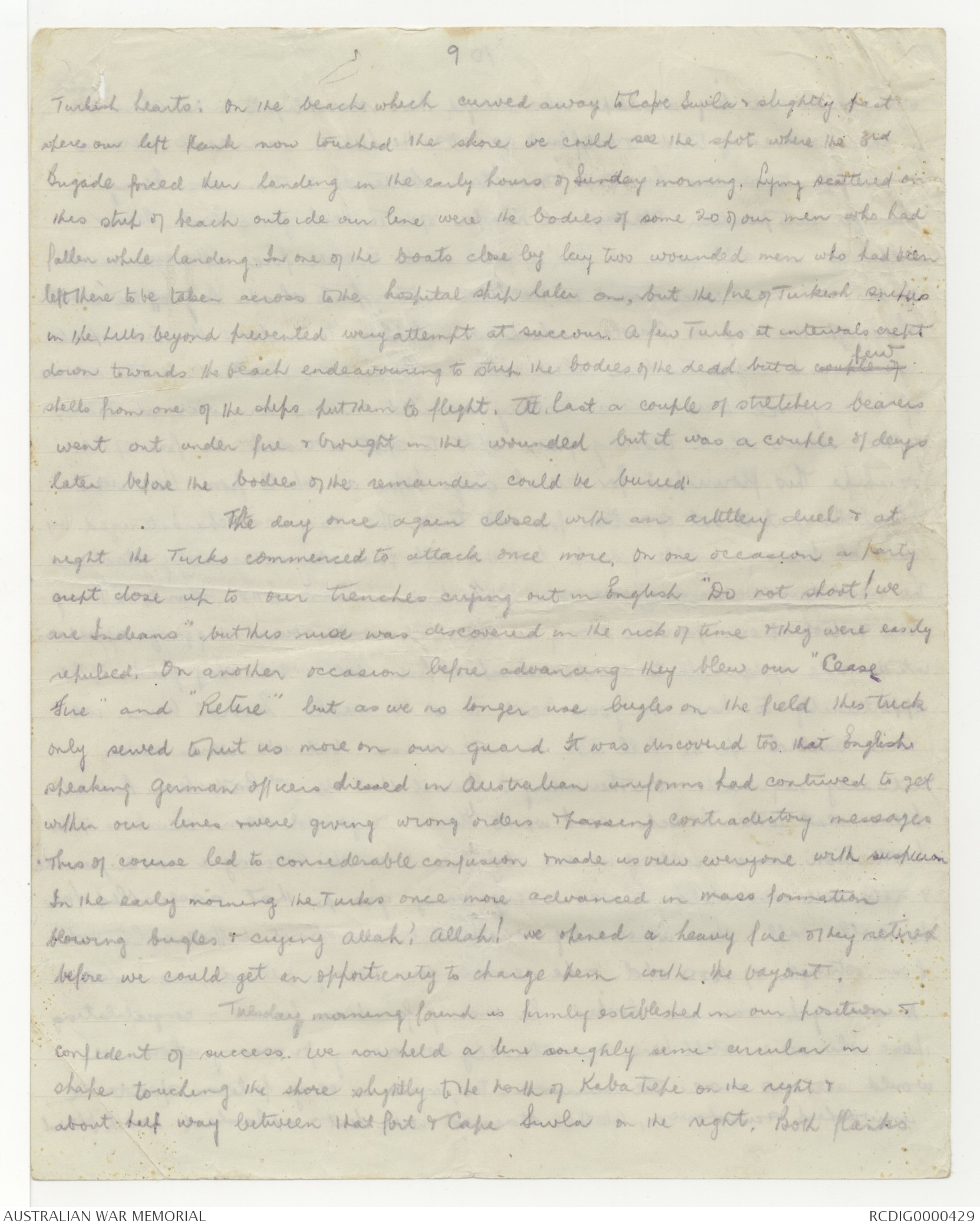
9
Turkish hearts. On the beach which curved away Cape Suvla & slightly past
where our left flank now touched the shore we could see shot where the 3rd
Brigade forced their landing in the early hours of Sunday morning. Lying scattered on
this strip of beach outside our line were the bodies of some 20 of our men who had
fallen while landing. In one of the boats close by lay two wounded men who had been
left there to be taken across to the hospital ship later on, but the fire of Turkish snipers
in the hills beyond prevented every attempt at succour. A few Turks at intervals crept
down towards the beach endeavouring to strip the bodies of the dead but a xxxxx few
shells from one of the ships put them to flight. At last a couple of stretcher bearers
went out under fire & brought in the wounded but it was a couple of days
later before the bodies of the remainder could be buried.
The day once again closed with an artillery duel & at
night the Turks commenced to attack once more. On one occasion a party
crept close up to our trenches crying out in English “Do not shoot! we
are Indians” but this ruse was discovered in the nick of time & they were easily
repulsed. On another occasion before advancing they blew our “Cease
Fire” and “Retire” but as we no longer use bugles on the field this trick
only served to put us more on our guard. It was discovered too that English
speaking German officers dressed in Australian uniforms had contrived to get
within our lines & were giving wrong orders & passing contradictory messages
this of course led to considerable confusion & made us view everyone with suspicion
In the early morning the Turks once more advanced in mass formation
blowing bugles & crying Allah! Allah! we opened a heavy fire & they retired
before we could get an opportunity to charge them with the bayonet.
Tuesday morning found us firmly established in our position &
confident of success. We how held a line roughly semi-circular in
shape touching the shore slightly to be north of Kaba Tepe on the right &
about half way between that fort & Cape Suvla on the right. Both flanks
10
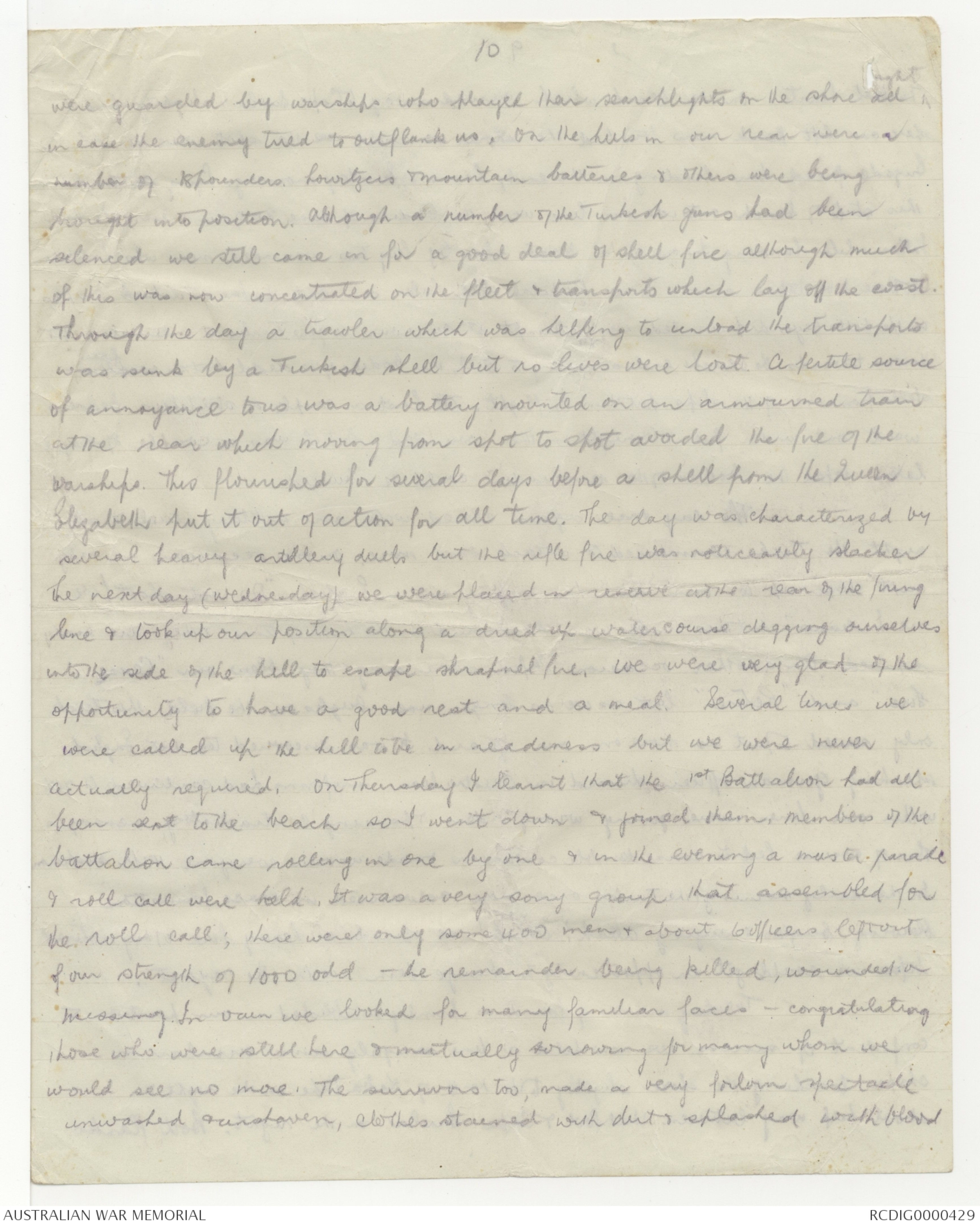
were guarded by warships who played their searchlights on the shore all night
in case the enemy tried to outflank us. On the heels in our rear were
number of 18 pounders, howitzers & mountain batteries & others were being
brought into position. Although a number of the Turkish guns had been
silenced we sill came in for a good deal of shell fire although much
of this was now concentrated on the fleet & transports which lay off the coast.
Through the day a trawler which was helping to unload the transports
was sunk by a Turkish shell but no lives were lost. A fertile source
of annoyance to us was a battery mounted on an armored train
at the rear which moving from spot to spot avoided the fire of the
warships. This flourished for several days before a shell from the Queen
Elizabeth put it out of action for all time. The day was characterized by
several heavy artillery duels but the rifle fire was noticeably slacker
The next day (Wednesday) we were placed in reserve at the rear of the firing
line & took up our position along a dried up watercourse digging ourselves
into the side of the hill to escape shrapnel fire. We were very glad of the
opportunity to have a good rest and a meal. Several times we
were called up the hill to be in readiness but we were never
actually required. On Thursday I learnt that the 1st Battalion had all
been sent to the beach so I went down & joined them. members of the
battalion came rolling in one by one & in the evening a muster- parade
& roll call were held. It was a very sorry group that assembled for
the roll call; there were only some 400 men and about 6 officers left out
of our strength of 1000 odd - the remainder being killed, wounded or
missing. In vain we looked for many familiar faces - congratulating
those who were still here & mutually sorrowing for many whom we
would see no more. The survivors too made a very forlorn spectacle
unwashed & unshaven, clothes stained with dirt & splashed with blood
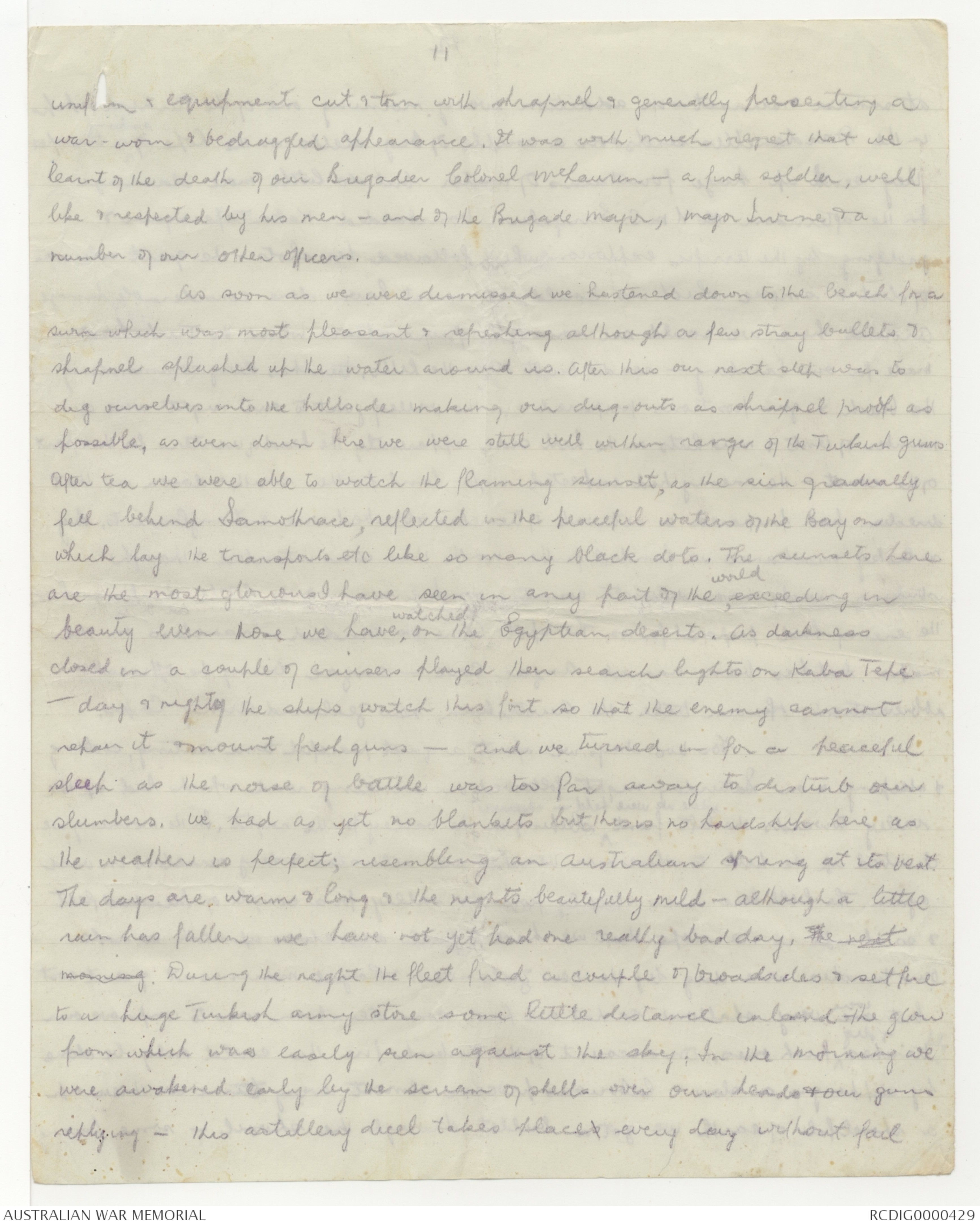
11
uniform & equipment cut & torn with shrapnel + generally presenting a
war-worn & bedraggled appearance. It was with much regret that we
learnt of the death of our Brigadier Colonel McLaurin - a fine soldier, well
like & respected by his men - and of the Brigade Major, Major Irvine & a
number of our other officers.
As soon as we were dismissed we hastened down to the beach for a
swim which was most pleasant & refreshing although a few stray bullets &
shrapnel splashed up the water around us. After this our next step was to
dig ourselves into the hillside making our dug-outs as shrapnel proof as
possible, as even down here we were still well within range of the Turkish guns
After tea we were able to watch the flaming sunset, as the sun gradually
fell behind Samothrace, reflected in the peaceful waters of the Bay on
which lay the transports etc like so many black dots. The sunsets here
are the most glorious I have seen in any part of the world exceeding in
beauty even more we have watched on the Egyptian deserts. As darkness
closed in a couple of cruisers played their search lights on Kaba Tepe
- day & nightly the ships watch this fort so that the enemy cannot
repair it & mount fresh guns - and we turned in for a peaceful
sleep as the noise of battle was too far away to disturb our
slumbers, We had as yet no blankets but this is no hardship here as
the weather is perfect; resembling an Australian spring at its best.
The days are warm & long & the nights beautifully mild - although a little
rain has fallen we have not yet had one really bad day, the nextmorning. During the night the fleet fired a couple of broadsides & set fir
to a huge Turkish army store some little distance inland the glow
from which was easily seen against the sky. In the morning we
were awakened early by the scream of shells over our heads & our guns
replying - this artillery duel takes places every day without fail
 D Coates
This transcription item is now locked to you for editing. To release the lock either Save your changes or Cancel.
This lock will be automatically released after 60 minutes of inactivity.