
Letters from Frederick Warren Muir, 1914-1915 - Part 7
4.
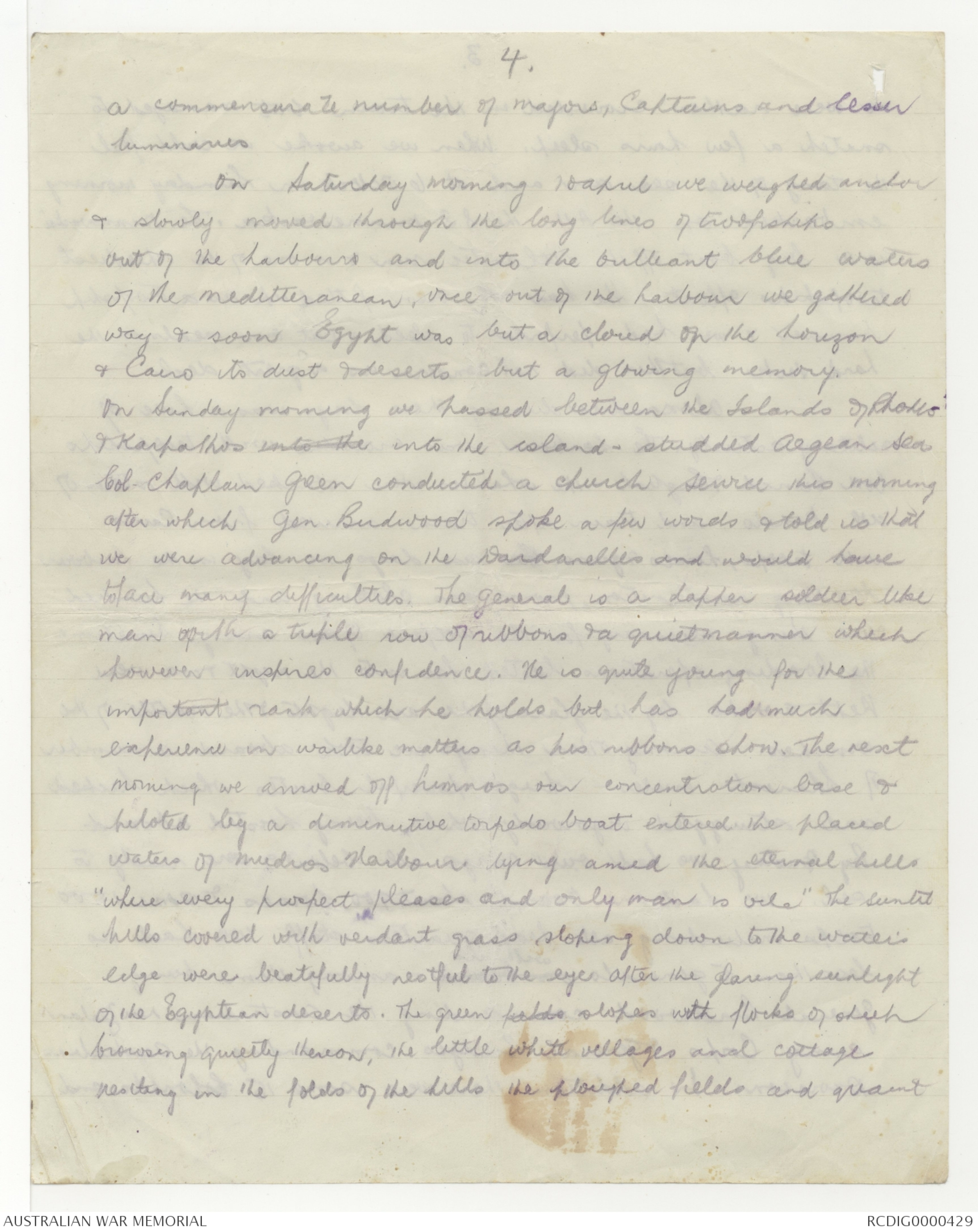
a commensurate number of Majors, Captains and lesser
luminaries.
On Saturday morning 10 April we weighed anchor
& slowly moved through the long lines of troopships
out of the harbours and into the brilliant blue waters
of the Meditteranean. Once out of the harbour we gathered
way & soon Egypt was but a cloud on the horizon
& Cairo its dust & deserts but a glowing memory.
On Sunday morning we passed between the Islands of Rhodes
& Karpathos into the into the island - studded Aegean Sea
Col Chaplain Green conducted a church service this morning
after which Gen. Birdwood spoke a few words & told us that
we were advancing on the Dardanelles and would have
to face many difficulties. The General is a dapper older like
man with a triple row of ribbons & a quiet manner which
however, inspires confidence. He is quite young for the
important rank which he holds but has had much
experience in warlike matters as his ribbons show. The next
morning we arrived off Lemnos our concentration base &
piloted by a diminutive torpedo boat entered the placid
waters of Mudros Harbour lying amid the eternal hills
"where every prospect pleases and only man is vile". The sunlit
hills covered with verdant grass sloping down to the water's
edge were beautifully restful to the eye after the glaring sunlight
of the Egyptian deserts. The green fields slopes with flocks of sheep
browsing quietly thereon, the little white villages and cottage
nestling in the folds of the hills the ploughed fields and quaint
5.
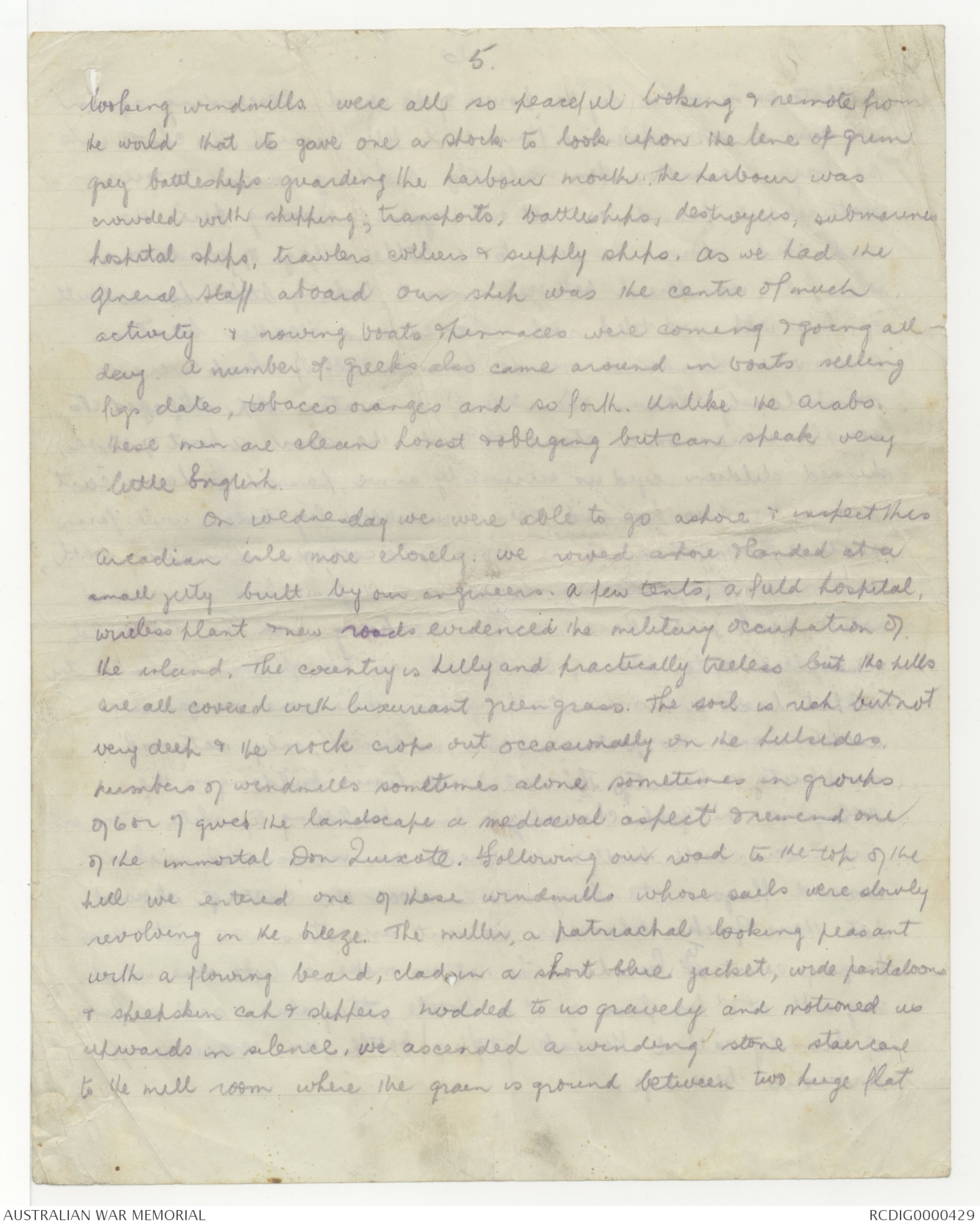
looking windmills were all so peaceful looking & remote from
the world that it gave one a shock to look upon the line of green
grey battleships guarding the harbour mouth. The harbour was
crowded with shipping, transports, battleships, destroyers, submarines
hospital ships, trawlers colliers & supply ships. As we had the
general staff aboard our ship was the centre of much
activity & rowing boats & [?] were coming & going all
day. A number of Greeks also came around in boats selling
figs, dates, tobacco, oranges and so forth. Unlike the Arabs.
These men are clean shaved & obliging but can speak very
little English.
On Wednesday we were able to go ashore & inspect this
Arcadian Isle more closely. We rowed ashore & landed at a
small jetty built by our engineers. A few tents, a field hospital,
wireless plant & new roads evidenced the military occupation of
the island. The country is hilly and practically treeless but the hills
are all covered with luxuriant green grass. The soil is rich but not
very deep & the rock crops out occasionally on the hillsides.
Numbers of windmills sometimes alone, sometimes in groups
of 6 or 7 gives the landscape a medieval aspect & revered one
of the immortal Don Quixote. Following our road to the top of the
hill we entered one of these windmills whose sails were slowly
revolving in the breeze. The miller, a patriachal looking peasant
with a flowing beard, clad in short blue jacket, wide pantaloons
& sheepskin cap & slippers nodded to us gravely and motioned us
upwards in silence, we ascended a winding stone staircase
to the mill room where the grain is ground between two huge flat
6
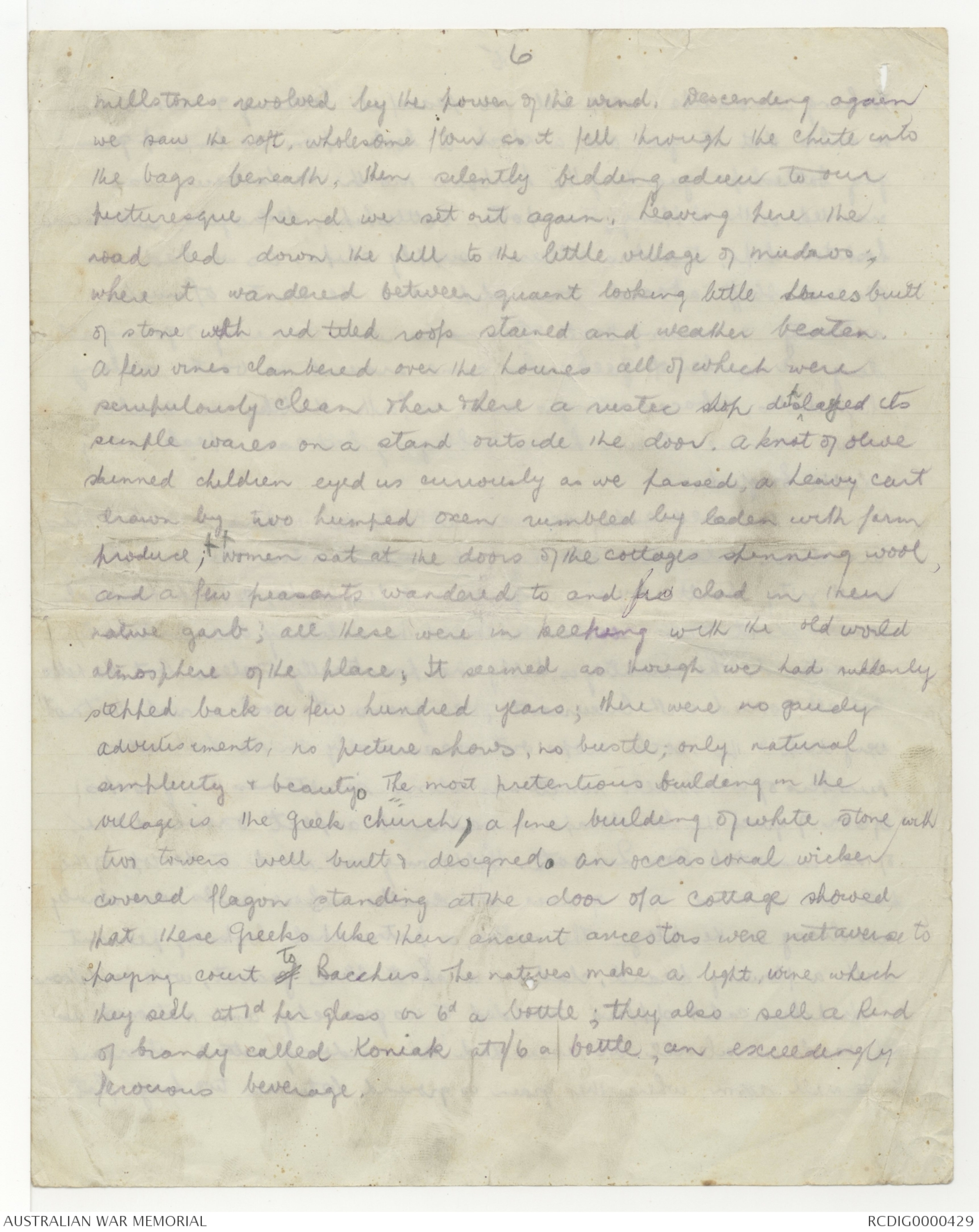
millstones revolved by the power of the wind. Descending again
we saw the soft, wholesome flour as it fell through the chute into
the bags beneath, then silently bidding adieu to our
picturesque friend we set out again. Leaving here the
road led down the hill to the little village of Mudros
where it wandered between quaint looking little houses built
of stone with red tiled roofs stained and weather beaten.
A few vines clambered over the houses all of which were
scrupulously clean then there a rustic shop dis^played its
simple wares on a stand outside the door. A knot of olive
skinned children eyed us curiously as we passed, a heavy cart
drawn by two humped oxen rumbled by laden with farm
produce; ++women sat at the doors of the cottages spinning wool,
and a few peasants wandered to and fro clad in their
native garb; all these were in keeping with the old world
atmosphere of the place; it seemed as though we had suddenly
stepped back a few hundred years; there were no gaudy
advertisements, no picture shows, no bustle; only natural
simplicity & beautys. The most pretentious building in the
village is the Greek church, a fine building of white stone with
two towers well built & designed. An occasional wicker
covered flagon standing at the door of a cottage showed
that these Greeks like their ancient ancestors were not averse to
paying court of to Bacchus. The natives make a light wine which
they sell at 1d per glass or 6d a bottle; they also sell a kind
of brandy called Koniak at 1/6 a bottle, an exceedingly
ferocious beverage.
7.
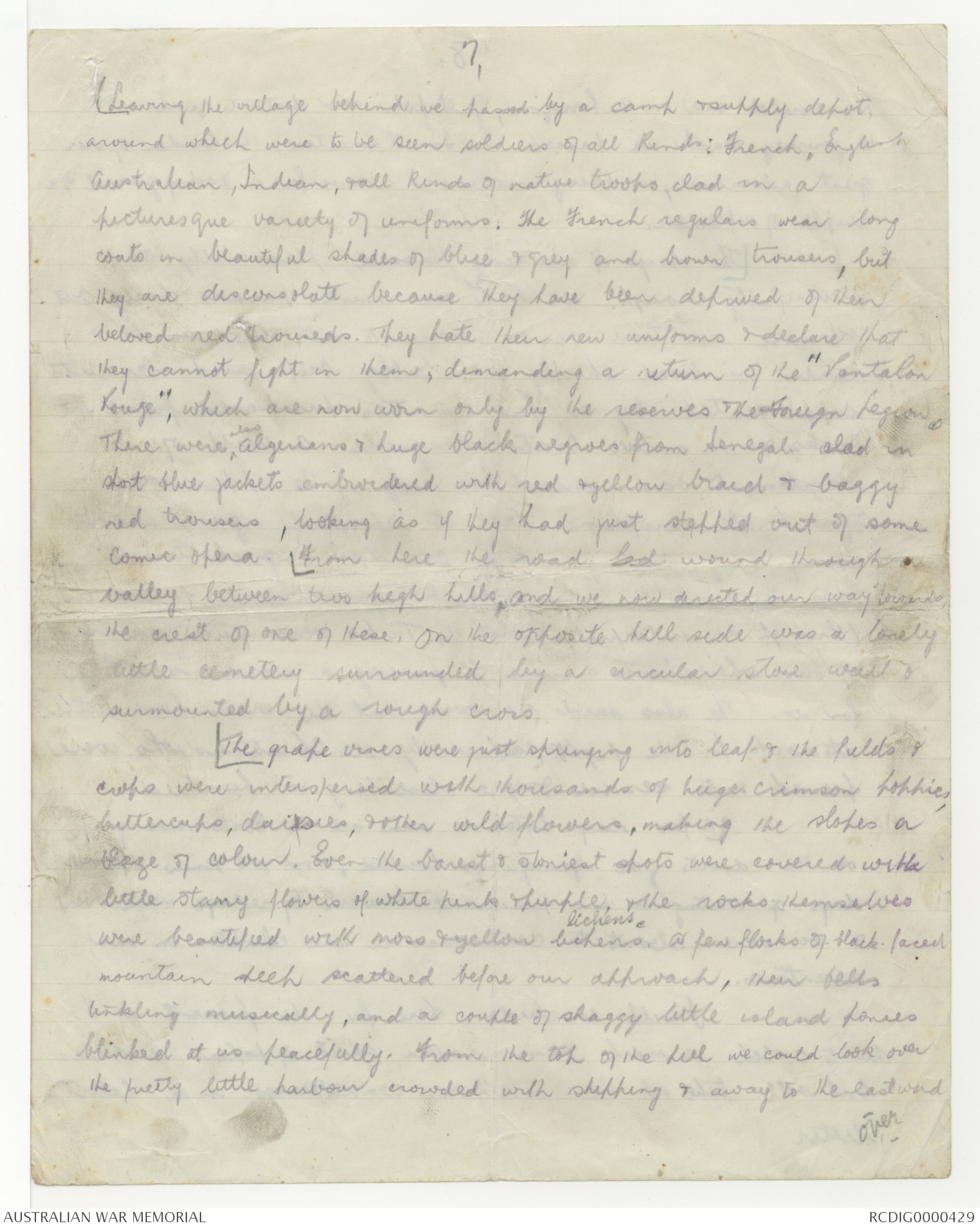
Leaving the village behind we passed by a camp & supply depot
around which were to be seen soldiers of all kinds; French, English,
Australian, Indian, & all kinds of native troops clad in a
picturesque variety of uniforms. The French regulars wear long
coats in beautiful shades of blue & grey and brown trousers, but
they are disconsolate because they have been deprived of their
beloved red trousers. They hate their new uniforms & declare that
they cannot fight in them, demanding a return of the "Pantalon
Rouge", which are now worn only by the reserves & the Foreign Legion.
There were ^also Algerians & huge black negroes from Senegal clad in
short blue jackets embroidered with red & yellow braid & baggy
red trousers, looking as if they had just stepped out of some
comic opera. From here the road bed wound through a
valley between two high hills, and we now directed our way towards
the crest of one of these. On the opposite hill side was a lonely
little cemetery surrounded by a circular stone wall &
surmounted by a rough cross.
The grape vines were just springing into leaf & the fields &
crops were interspersed with thousands of huge crimson poppies,
buttercups, daisies, & other wild flowers, making the slopes a
blaze of colour. Even the barest & stoniest spots were covered with
little starry flowers of white pink & purple, the rocks themselves
were beautiful with moss & yellow lichens. A few flocks of black faced
mountain sheep scattered before our approach, their bells
tinkling musically, and a couple of shaggy little island ponies
blinked at us peacefully. From the top of the hill we could look over
the pretty little harbour crowded with shipping & away to the eastward
over
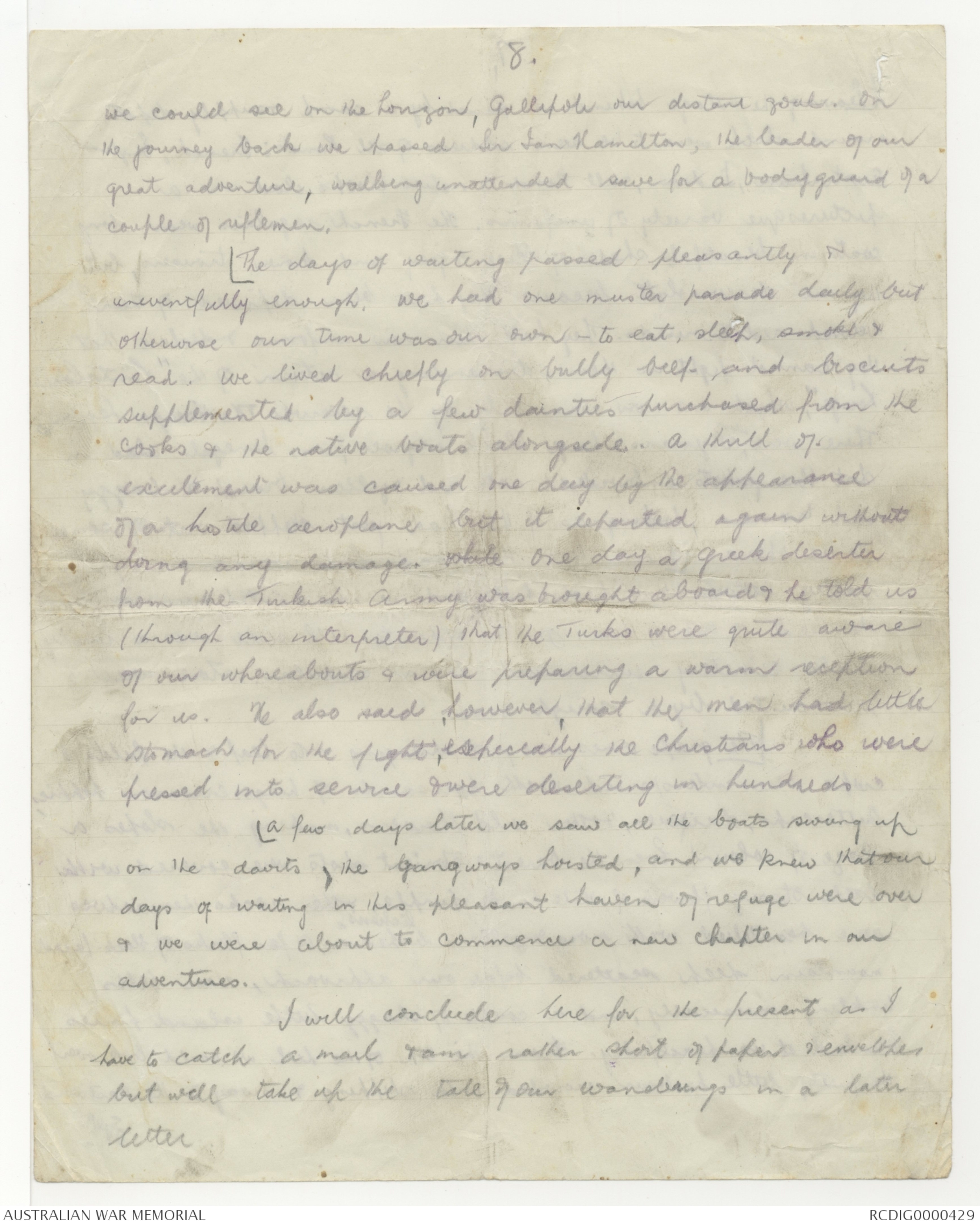
8.
we could see on the horizon, Gallipoli our distant goal. On
the journey back we passed Sir Ian Hamilton, the leader of our
great adventure, walking unattended save for a bodyguard of a
couple of riflemen.
The days of waiting passed pleasantly &
uneventfully enough. We had one muster parade daily but
otherwise our time was our own to eat, sleep, smoke &
read. We lived chiefly on bully beef and biscuits
supplemented by a few dainties purchased from the
cooks & the native boats alongside. A thrill of
excitement was caused one day by the appearance
of a hostile aeroplane but it departed again without
doing any damage. while One day a Greek deserter
from the Turkish Army was brought aboard & he told us
(through an interpreter) that the Turks were quite aware
of our whereabouts & were preparing a warm reception
for us. He also said, however, that the men had little
stomach for the fight, especially the Christians who were
pressed into service & were deserting in hundreds.
A few days later we saw all the boats swung up
on the davits, the gangways hoisted, and we knew that our
days of waiting in this pleasant haven of refuge were over
& we were about to commence a new chapter in our
adventures.
I will conclude here for the present as I
have to catch a mail & am rather short of paper & envelopes
but will take up the tale of our wanderings in a later
letter.
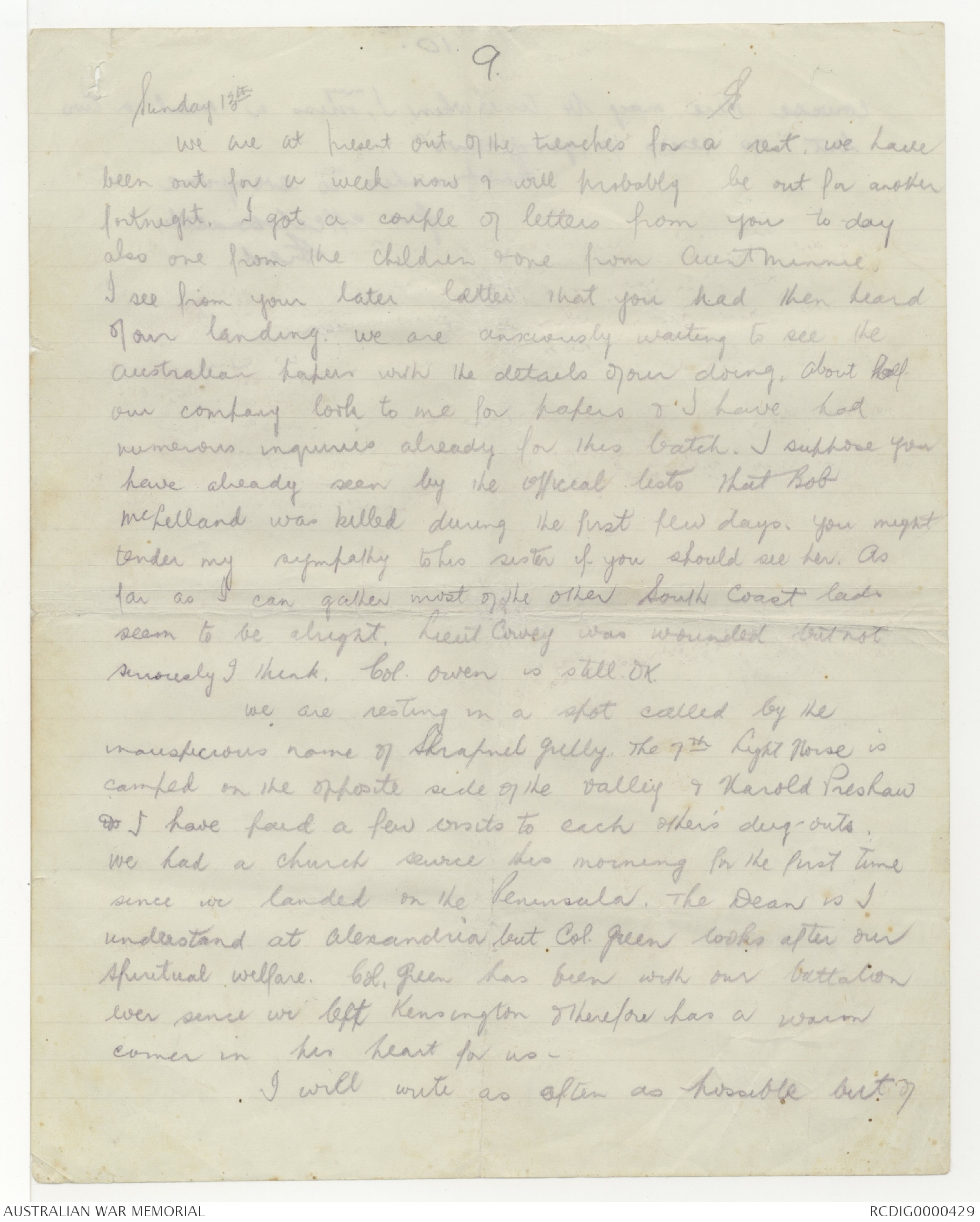
9.
Sunday 13th
We are at present out of the trenches for a rest. We have
been out for a week now & will probably be out for another
fortnight. I got a couple of letters from you to day
also one from the children & one from Aunt Minnie.
I see from your later letter that you had then heard
of our landing. We are anxiously waiting to see the
Australian papers with the details of our doing, about half
our company look to me for papers & I have had
numerous inquiries already for this batch. I suppose you
have already seen by the official lists that Bob
McLelland was killed during the first few days. You might
tender my sympathy to his sister if you should see her. As
far as I can gather most of the other South Coast lads
seem to be alright. Lieut Cowey was wounded but not
seriously I think. Col Owen is still O.K.
We are resting in a sport called by the
inauspicious name of Shrapnel Gully the 7th Light Horse is
camped on the opposite side of the valley & Harold Preshaw
& I have paid a few visits to each others dug-outs.
We had a church service this morning for the first time
since we landed on the Peninsula. The Dean is, I
understand at Alexandria but Col. Green looks after our
spiritual welfare. Col. Green has been with our battalion
ever since we left Kensington & therefore has a warm
corner in his heart for us.
I will write as often as possible but of
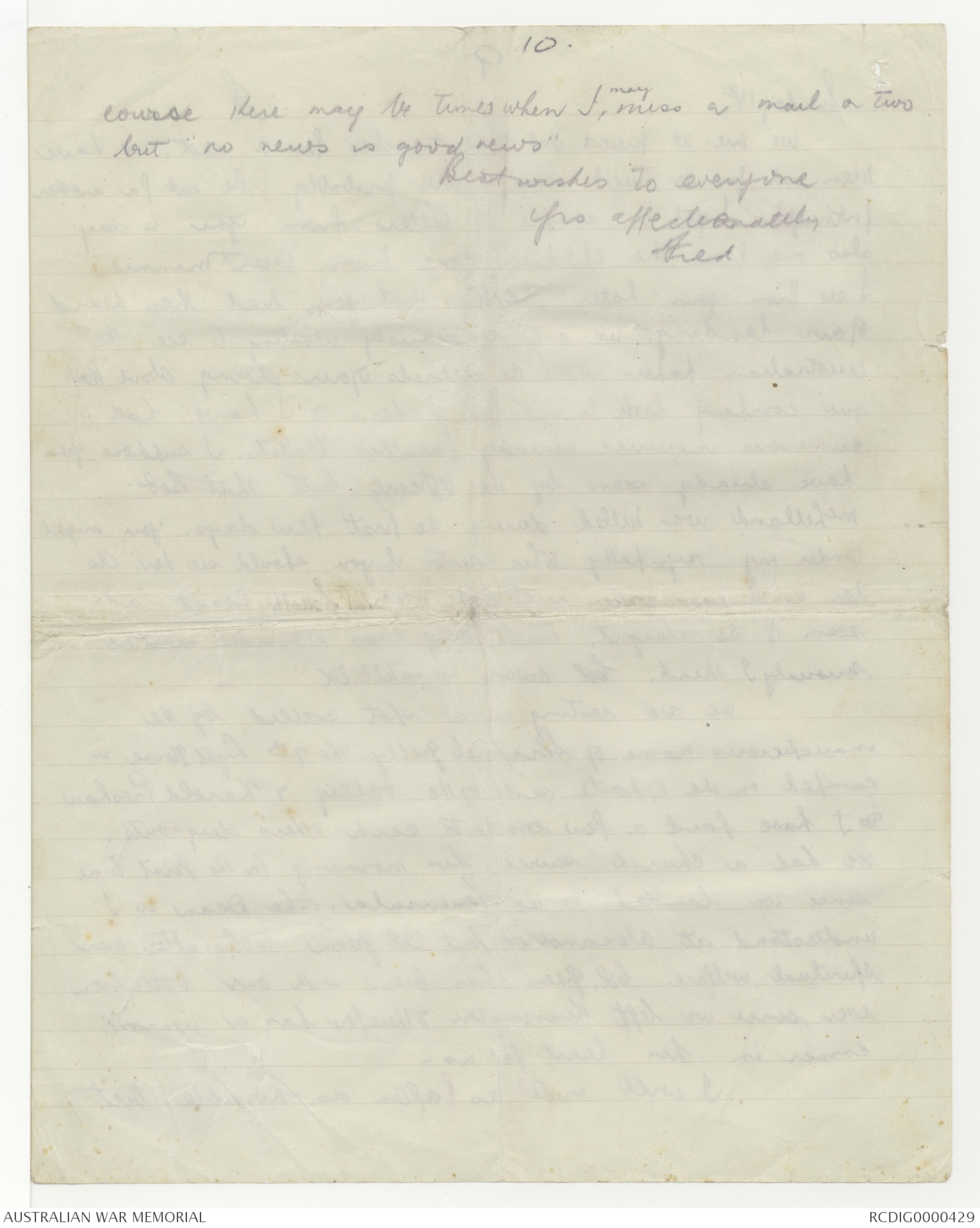
10.
course there may be times when I ^may miss a mail or two
but no news is good news.
Best wishes to everyone
Yrs affectionately
Fred
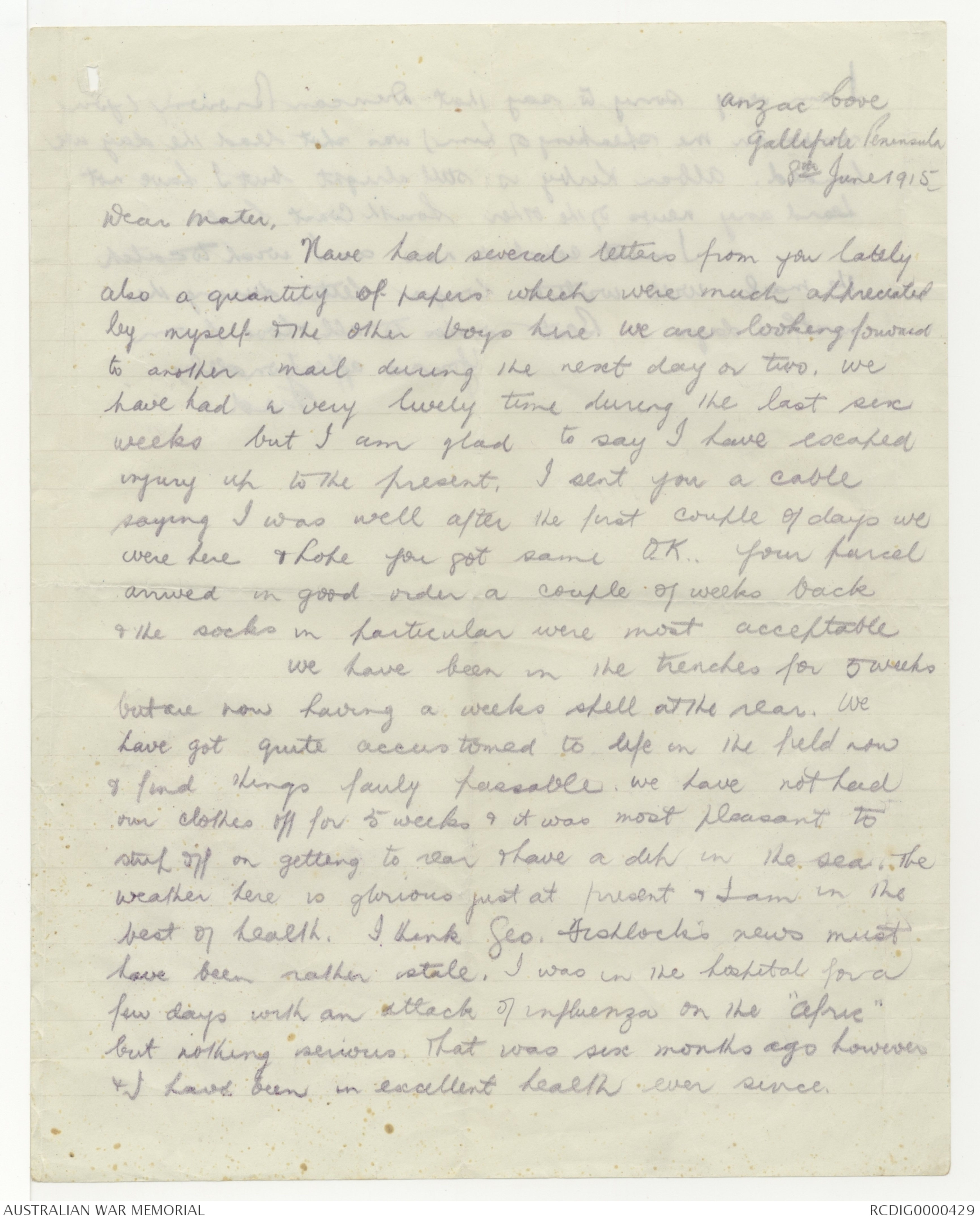
Anzac Cove
Gallipoli Peninsula
8th June 1915
Dear Mater,
Have had several letters from you lately
also a quantity of papers which were much appreciated
by myself & the other boys here. We are looking forward
to another mail during the next day or two. We
have had a very lively time during the last six
weeks but I am glad to say I have escaped
injury up to the present. I sent you a cable
saying I was well after the first couple of days we
were here & hope you got same O.K. Your parcel
arrived in good order a couple of weeks back
& the socks in particular were most acceptable.
We have been in the trenches for 5 weeks
but are now having a weeks spell at the rear. We
have got quite accustomed to life in the field now
& find things fairly passable. We have not had
our clothes off for 5 weeks & it was most pleasant to
strip off on getting to rear & have a dip in the sea. The
weather here is glorious just at present & I am in the
best of health. I think Geo. Fishlock's news must
have been rather stale. I was in the hospital for a
few days with an attack of influenza on the "[Afric?]"
but nothing serious. That was six months ago however
& I have been in excellent health ever since.
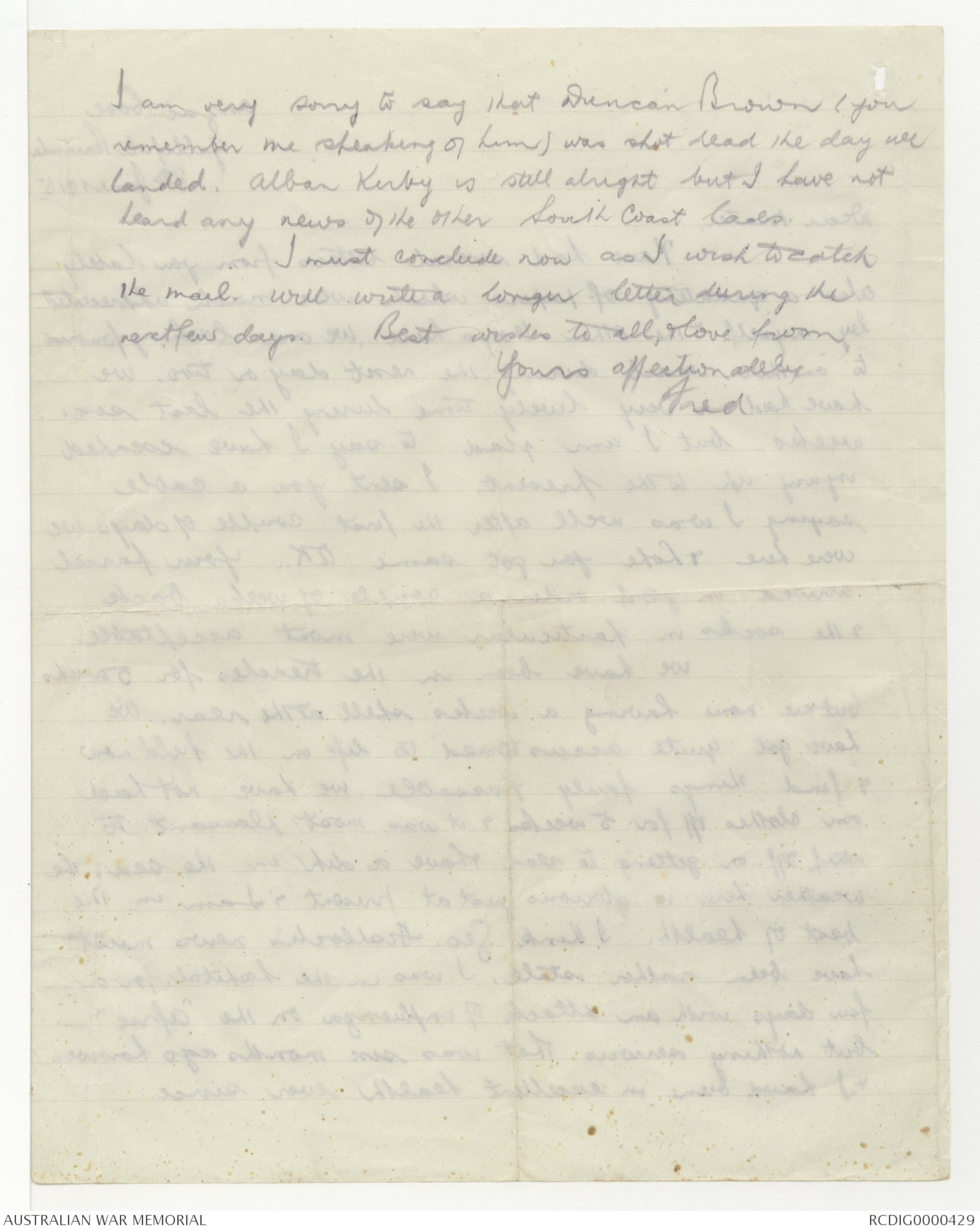
I am very sorry to say that Duncan Brown (you
remember me speaking of him) was shot dead the day we
landed. Alban Kirby is still alright, but I have not
heard any news of the other South Coast lads.
I must conclude now as I wish to catch
the mail. Will write a longer letter during the
next few days. Best wishes to all, & love from
Yours affectionately
Fred
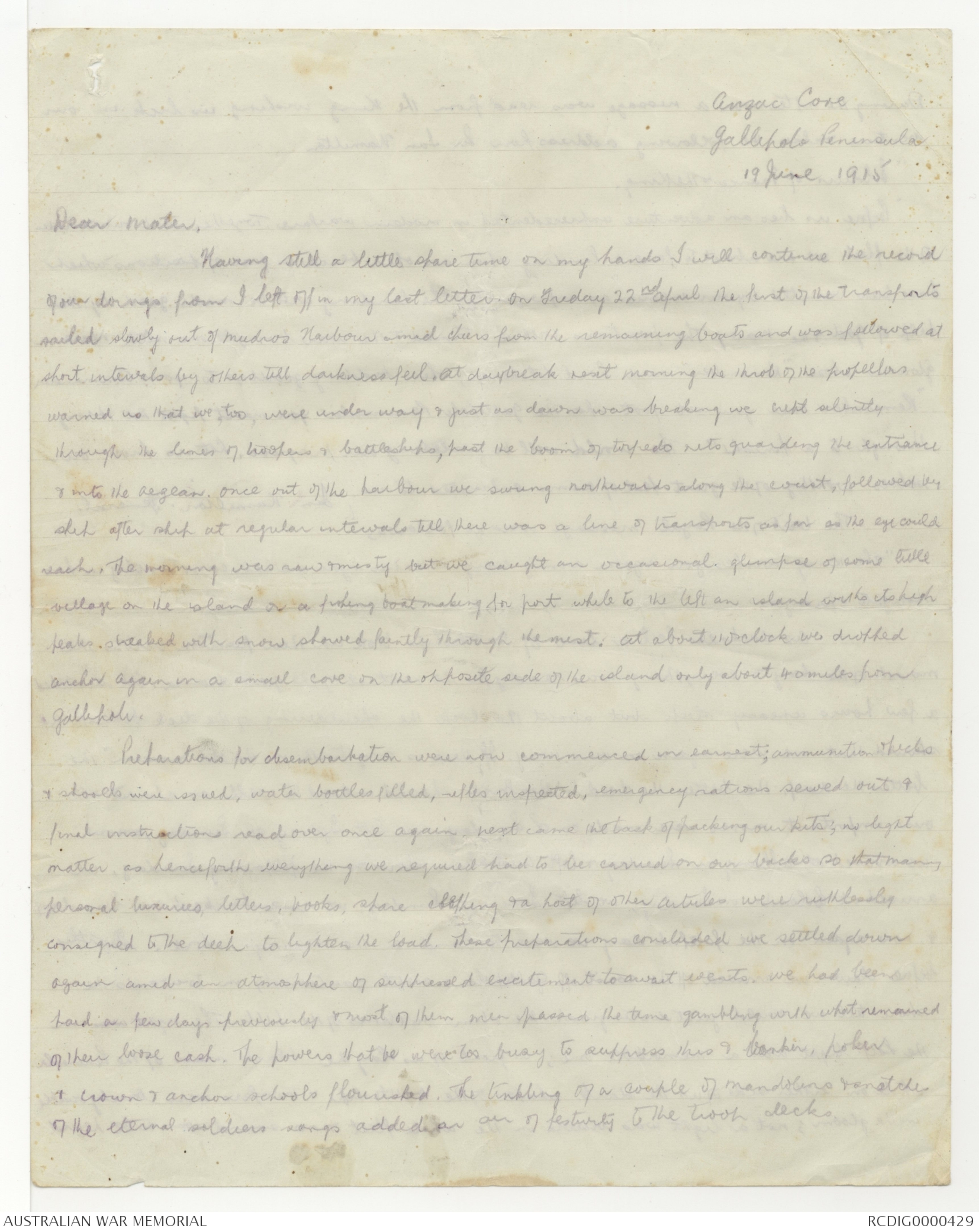
Anzac Cove
Gallipoli Peninsula
19 June 1915
Dear Mater,
Having still a little spare time on my hands I will continue the record
your doings from I left off in my last letter on Friday 22nd April. The first of the transports sailed slowly out of Mudros Harbour amid cheers from the remaining boats and was followed at short intervals by others till darkness fell. At daybreak next morning the throb of the propellars
warned us that we, too, were under way & just as dawn was breaking we went silently through the lines of troopers & battleships, past the boom of torpedo nets guarding the entrance & into the Aegean, once out of the harbour we swung northwards along the coast, followed by
ship after ship at regular intervals till there was a line of transports as far as the eye could reach. The morning was raw & misty but we caught an occasional glimpse of some little village on the island or a fishing boat making for port while to the left an island with its high peaks streaked with snow showed faintly through the mist. At about 11 o'clock we dropped anchor again in a small cove on the opposite side of the island only about 40 miles from Gallipoli.
Preparations for disembarkation were now commenced in earnest; ammunition checks & shovels were issued, water bottles filled, rifles inspected, emergency rations served out & final instructions read over once again, next came the task of packing our kits; no light matter as henceforth everything we required had to be carried on our backs so that many personal luxuries, letters, books, spare clothing & a host of other articles were ruthlessly consigned to the deck to lighten the load. These preparations concluded, we settled down again armed , an atmosphere of suppressed excitement to await events. We had been
paid a few days previously & most of these men passed the time gambling with what remained of their loose cash. The powers that be were too busy to suppress this & conker, poker & crown & anchor schools flourished. The tinkling of a couple of mandolins & snatches of the eternal soldiers songs added an air of festivity to the troop decks.
 Sam scott
This transcription item is now locked to you for editing. To release the lock either Save your changes or Cancel.
This lock will be automatically released after 60 minutes of inactivity.