
Letters from Frederick Warren Muir, 1914-1915 - Part 15
5
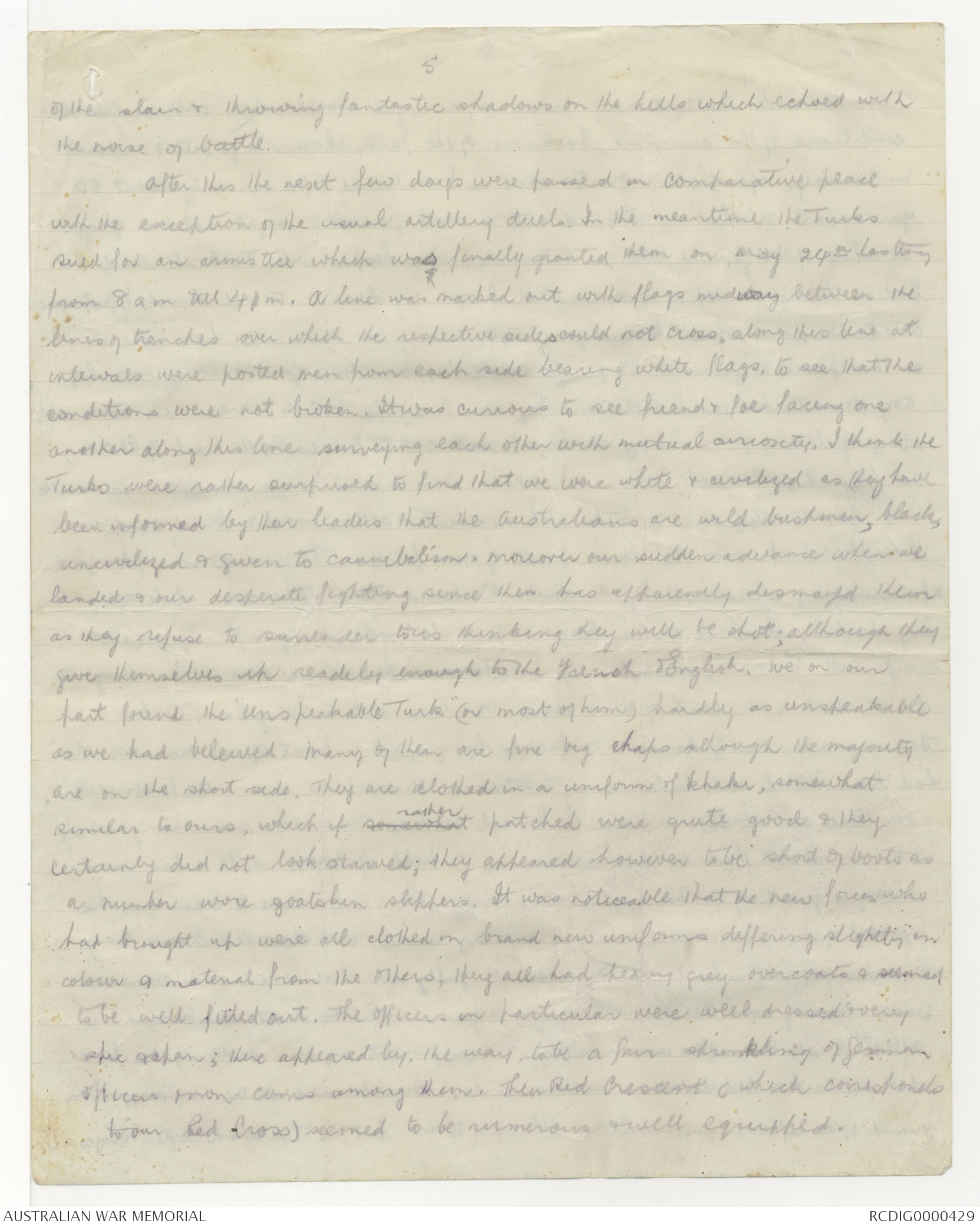
of the slain & throwing fantastic shadows on the hills which echoed with
the noise of battle.
After this the next few days were passed in comparative peace
with the exception of the usual artillery duels. In the meantime the Turks
sued for an armistice which was finally granted them on May 24th lasting
from 8 am till 4pm. A line was marked out with flags midway between the
lines of trenches over which the respective sides could not cross, along this line at
intervals were posted men from each side bearing white flags, to see that the
conditions were not broken. It was curious to see friend & foe facing one
another along this line surveying each other with mutual curiosity. I think the
Turks were rather surprised to find that we were white & civilized as they have
been informed by their leaders that the Australians are wild bushmen, black,
uncivilized & given to cannibalism. Moreover our sudden advance when we
landed & our desperate fighting since then has apparently dismayed them
as they refuse to surrender to us thinking they will be shot; although they
give themselves in readily enough to the French & English. We on our
part found the "unspeakable Turk" (or most of him) hardly as unspeakable
as we had believed many of them are fine big chaps although the majority
are on the short side. They are clothed in a uniform of Khaki, somewhat
similar to ours, which if somewhat rather patched were quite good & they
certainly did not look starved; they appeared however to be short of boots as
a number wore goatskin slippers. It was noticeable that the new forces who
had brought up were all clothed in brand new uniforms differing slightly in
colour & material from the others, they all had heavy grey overcoats & seemed
to be well fitted out. The officers in particular were well dressed & very
spic & span; there appeared by, the way, to be a fair sprinkling of German
officers & non-coms among them. Their Red Crescent (which corresponds
to our Red Cross) seemed to be numerous & well equipped.
6.
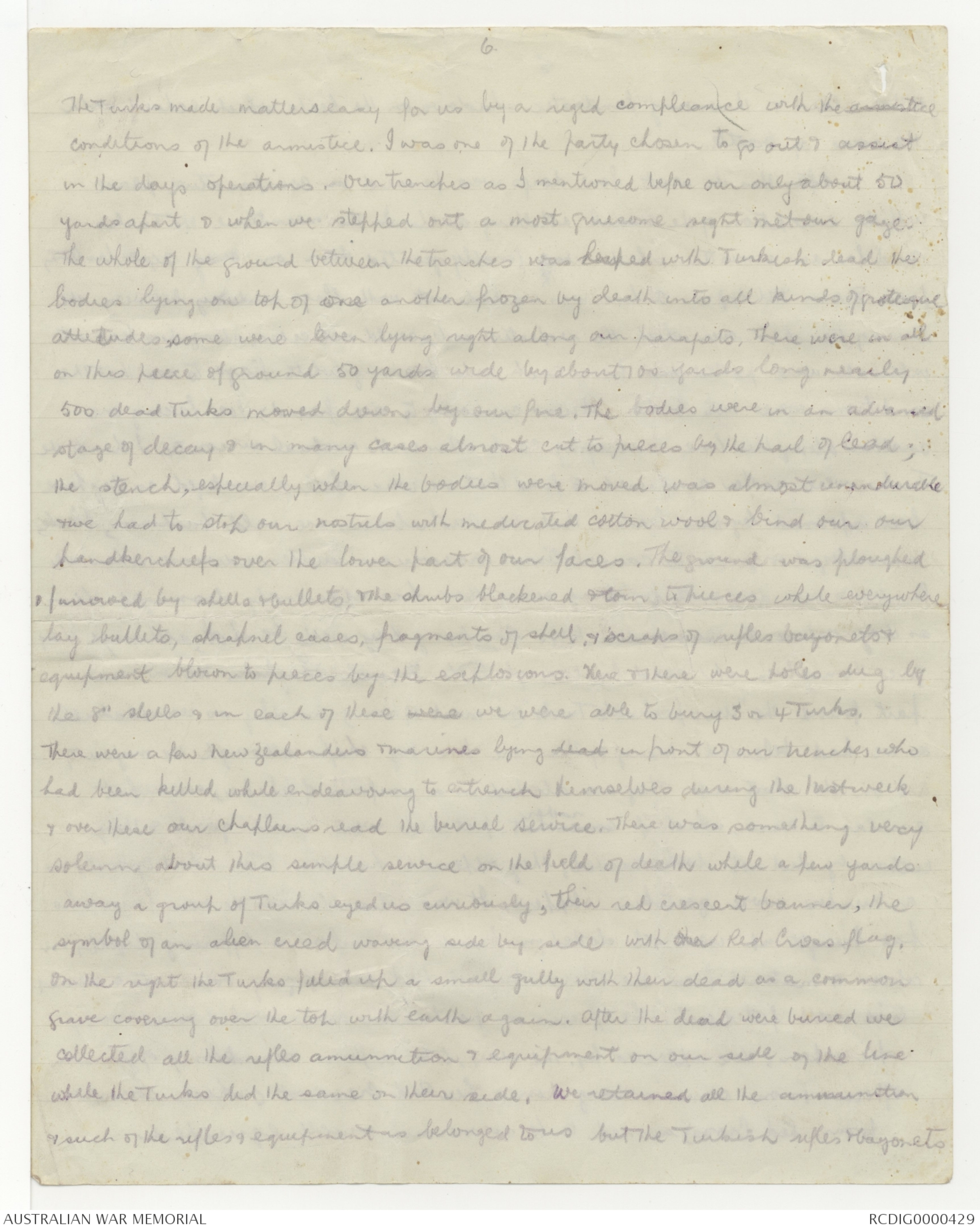
The Turks made matters easy for us by a rigid compliance with the armistice
conditions of the armistice. I was one of the party chosen to go out & assist
in the days operations. Our trenches as I mentioned before our only about 50
yards apart & when we stepped out a most gruesome sight met our gaze.
The whole of the ground between the trenches was heaped with Turkish dead the
bodies lying on top of one another frozen by death into all kinds of grotesque
attitudes, some were even lying right along our parapets. There were in all
on this piece of ground 50 yards wide by about 100 yards long nearly
500 dead Turks mowed down by our fire. The bodies were in an advanced
stage of decay & in many cases almost cut to pieces by the hail of lead;
the stench, especially when the bodies were moved was almost unendurable
& we had to stop our nostrils with medicated cotton wool & bind our our
handkerchiefs over the lower part of our faces. The ground was ploughed
& furrowed by shells & bullets, & the shrubs blackened & torn to pieces while everywhere
lay bullets, shrapnel cases, fragments of steel, & scraps of rifles bayonets &
equipment blown to pieces by the explosions. Here & there were holes dug by
the 8" shells & in each of these were we were able to bury 3 or 4 Turks.
There were a few New Zealanders & Marines lying dead in front of our trenches who
had been killed while endeavoring to entrench themselves during the last week
& over these our chaplains read the burial service. There was something very
solemn about this simple service on the field of death while a few yards
away a group of Turks eyed us curiously, their red crescent banner, the
symbol of an alien creed waving side by side with our Red Cross flag.
On the right the Turks filled up a small gully with their dead as a common
grave covering over the top with earth again. After the dead were buried we
collected all the rifles amunnition & equipment on our side of the line
while the Turks did the same on their side. We retained all the ammunition
& such of the rifles & equipment as belonged to us but the Turkish rifles & bayonets
7
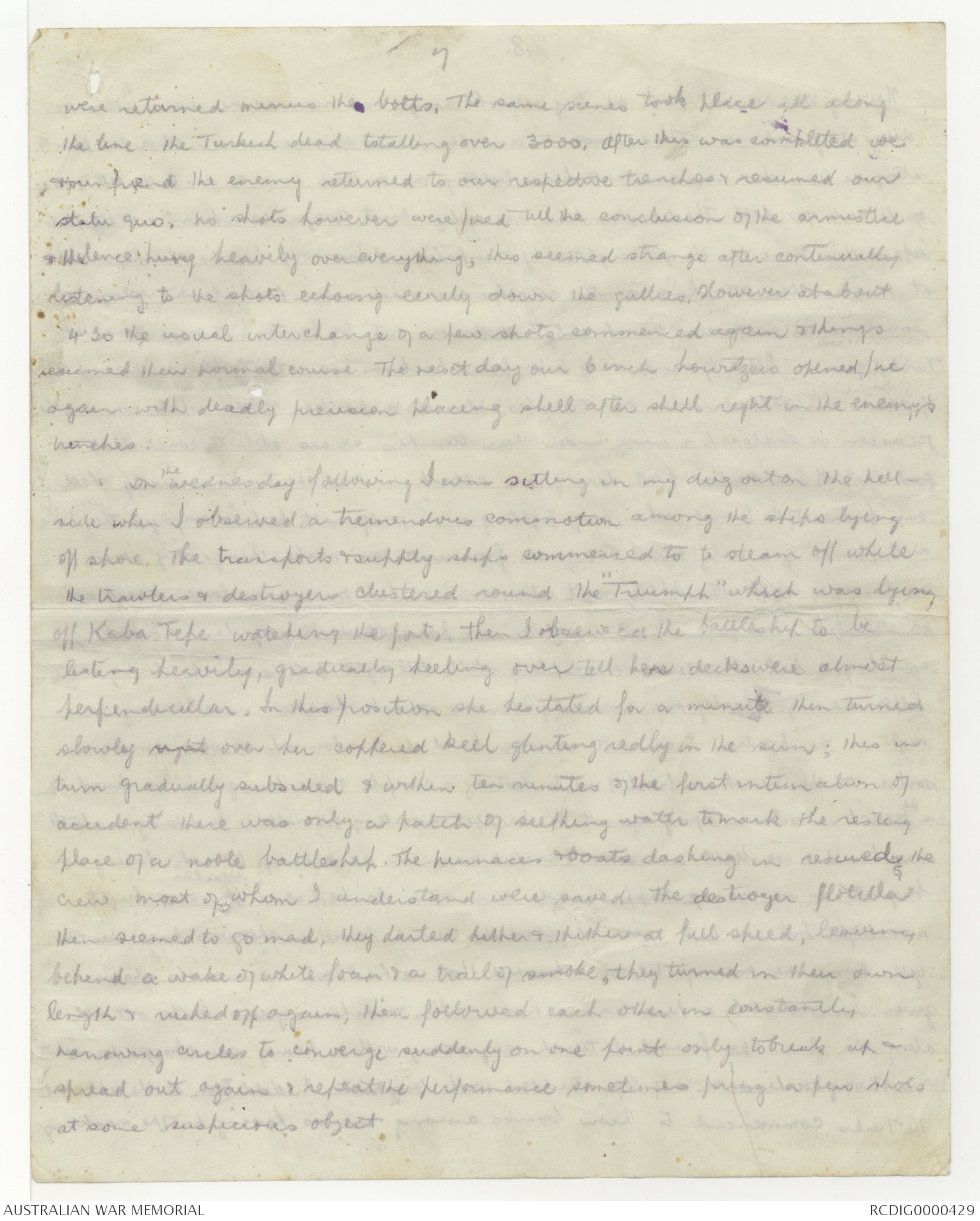
were retained minus the bolts. The same scenes took place all along
the line the Turkish dead totalling over 3000. After this was completed we
& our friend the enemy returned to our respective trenches & resumed our
statu quo; no shots however were fired till the conclusion of the armistice
& silence hung heavily over everything; this seemed strange after continually
listening to the shots echoing eerily down the gullies. However at about
4.30 the usual interchange of a few shots commenced again & things
resumed their normal course. The next day our 6 inch howitzers opened fire
again with deadly precision placing shell after shell right in the enemy's
trenches.
On the Wednesday following I was sitting in my dugout on the hillside
when I observed a tremendous commotion among the ships lying
off shore. The transports & supply ships commenced to to steam off while
the trawlers & destroyers clustered round the "Triumph" which was lying
off Kaba Tepe watching the fort. Then I observed the battleship to be
listing heavily, gradually keeling over till her decks were almost
perpendicular. In this position she hesitated for a minute then turned
slowly right over her coppered keel glinting redly in the sun; this in
turn gradually subsided & within ten minutes of the first intimation of
accident there was only a patch of seething water to mark the resting
place of a noble battleship. The pinnaces & boats dashing in rescued the
crew most of whom I understand were saved. The destroyer flotilla
then seemed to go mad, they darted hither & thither at full speed, leaving
behind a wake of white foam & a trail of smoke, they turned in their own
length & rushed off again; then followed each other in constantly
narrowing circles to converge suddenly on one point only to break up &
spread out again & repeat the performance sometimes firing a few shots
at some suspicious object.
8.
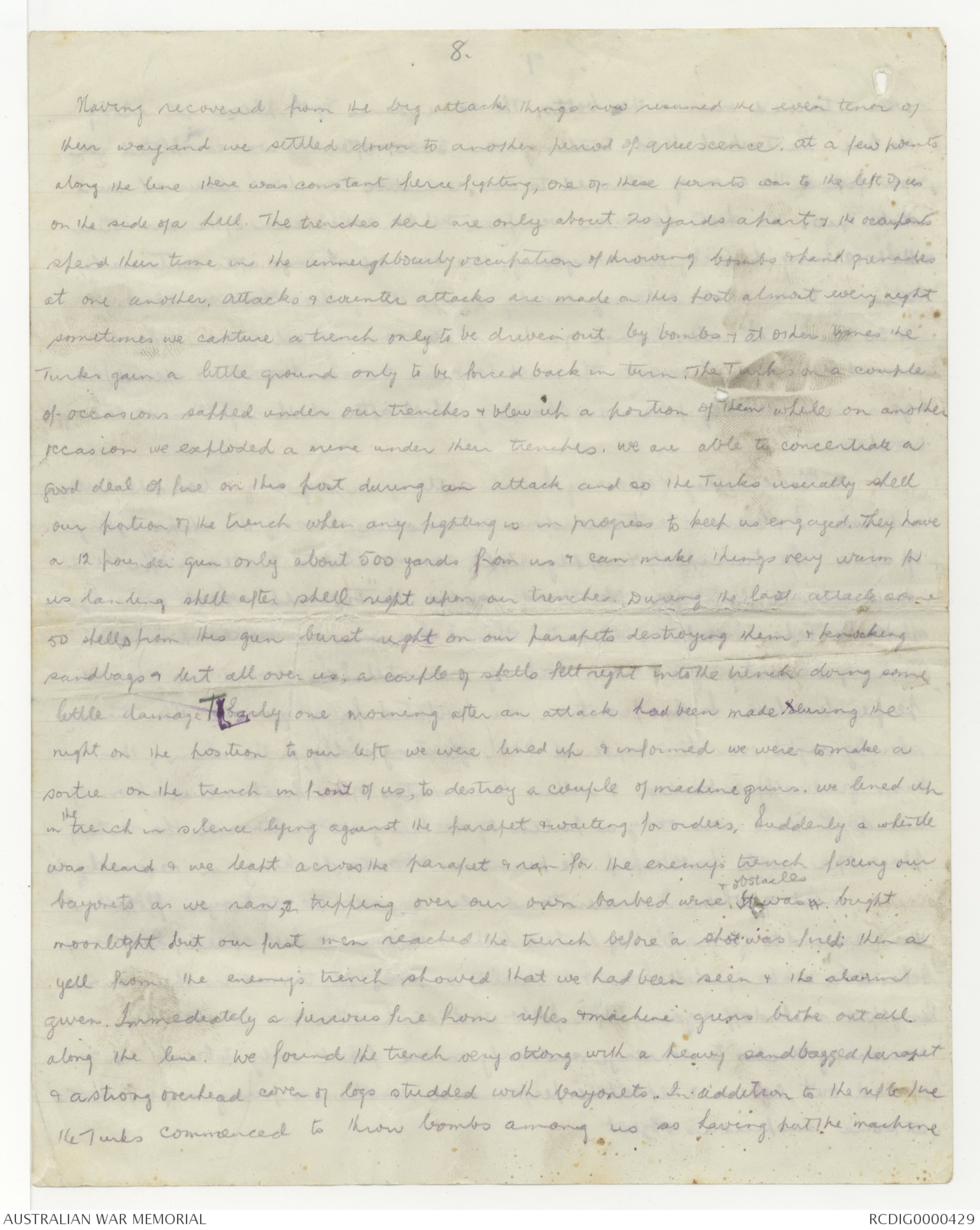
Having recovered from the big attack things now resumed the even tenor of
their way and we settled down to another period of quiescence. At a few points
along the line there was constant fierce fighting, one of these points was to the left of us
on the side of a hill. The trenches here are only about 20 yards apart & the occupants
spend their time in the unneighbourly occupation of throwing bombs & hand grenades
at one another, attacks & counter attacks are made on this post almost every night
sometimes we capture a trench only to be driven out by bombs & at other times the
Turks gain a little ground only to be forced back in turn. The Turks on a couple
of occasions sapped under our trenches & blew up a portion of them while on another
occasion we exploded a mine under their trenches. We are able to concentrate a
good deal of fire on this post during an attack and so the Turks usually shell
our portion of the trench when any fighting is in progress to keep us engaged. They have
a 12 pounder gun only about 500 yards from us & can make things very warm for
us landing shell after shell right upon our trenches. During the last attack some
50 shells from this gun burst right on our parapets destroying them & knocking
sandbags & dirt all over us, a couple of shells fell right into the trench doing some
little damage. Th Early one morning after an attack had been made f during the
night on the position to our left we were lined up & informed we were to make a
sortie on the trench in front of us, to destroy a couple of machine guns. we lined up
in the trench in silence lying against the parapet & waiting for orders. Suddenly a whistle
was heard & we leapt across the parapet & ran for the enemy's trench fixing our
bayonets as we ran, & tripping over our own barbed wire & obstacles. It was a bright
moonlight but our first men reached the trench before a shot was fired then a
yell from the enemy's trench showed that we had been seen & the alarm
given. Immediately a furious fire from rifles & machine guns broke out all
along the line. We found the trench very strong with a heavy sandbagged parapet
& a strong overhead cover of logs studded with bayonets. In addition to the rifle fire
the Turks commenced to throw bombs among us so having put the machine
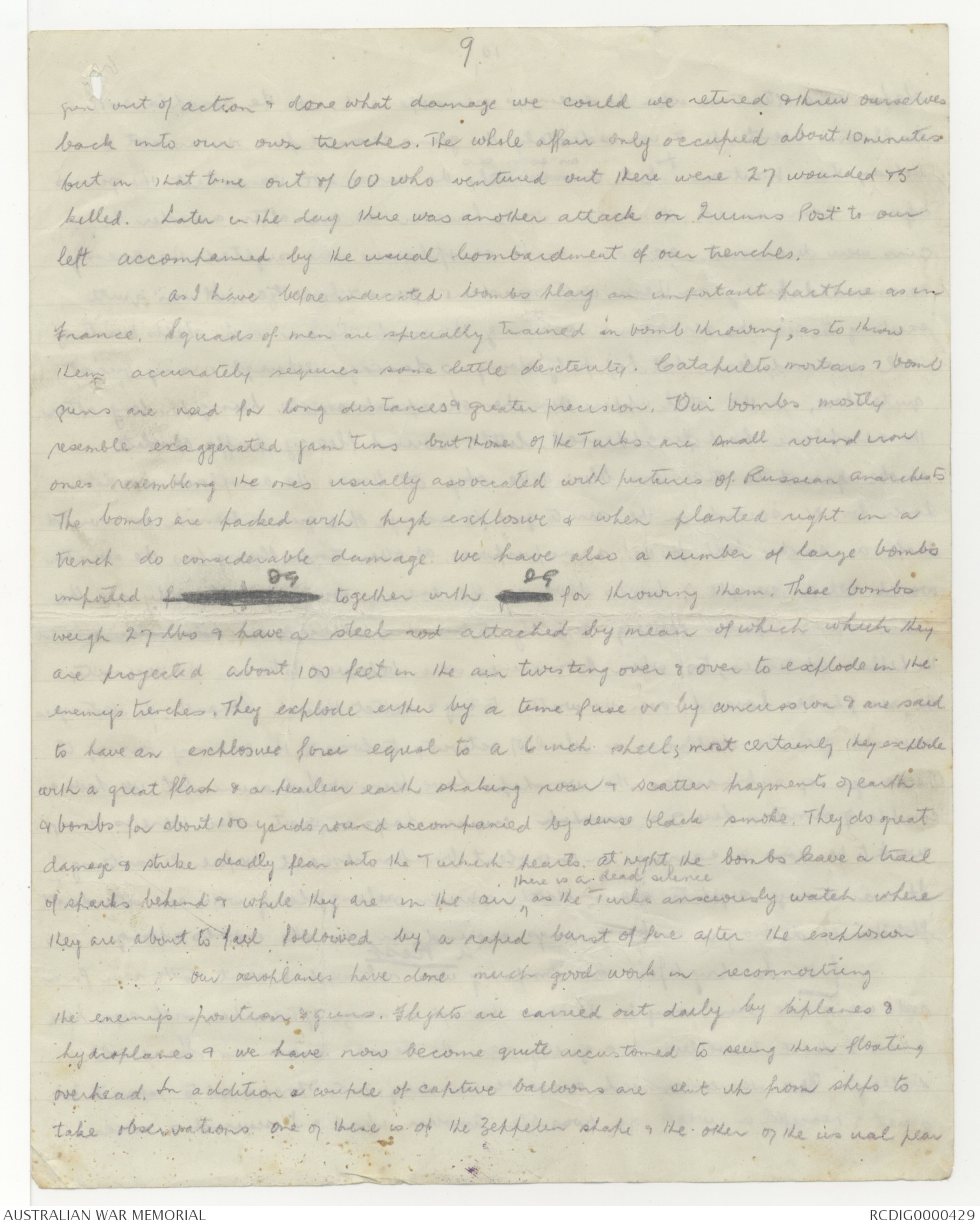
9.
gun out of action & done what damage we could we retired & threw ourselves
back into our own trenches. The whole affair only occupied about 10 minutes
but in that time out of 60 who ventured out there were 27 wounded & 5
killed. Later in the day there was another attack on Quinns Post to our
left accompanied by the usual bombardment of our trenches.
As I have before indicated bombs play an important part here as in
France. Squads of men are specially trained in bomb throwing, as to throw
them accurately requires some little dexterity. Catapults mortars & bomb
guns are used for long distances & greater precision. Our bombs mostly
resemble exaggerated jam tins but those of the Turks are small round iron
ones resembling the ones usually associated with pictures of Russian anarchists
The bombs are packed with high explosive & when planted right in a
trench do considerable damage. We have also a number of large bombs
imported fromxxxx [[OG?]] together with guns [[OG?]] for throwing them. These bombs
weigh 27 lbs & have a steel rod attached by mean of which they
are projected about 100 feet in the air twisting over & over to explode in the
enemy's trenches. They explode either by a time fuse or by concussion & are said
to have an explosive force equal to a 6 inch shell; most certainly they explode
with a great flash & a peculiar earth shaking roar & scatter fragments of earth
& bombs for about 100 yards round accompanied by dense black smoke. They do great
damage & strike deadly fear into the Turkish hearts. At night the bombs leave a trail
of sparks behind & while they are in the air ^there is a dead silence as the Turks anxiously watch where
they are about to fall followed by a rapid burst of fire after the explosion
Our aeroplanes have done much good work in reconnoitring
the enemy's position & guns. Flights are carried out daily by biplanes &
hydroplanes & we have now become quite accustomed to seeing them floating
overhead. In addition a couple of captive balloons are sent up from ships to
take observations one of these is of the Zeppelin shape & the other of the usual pear
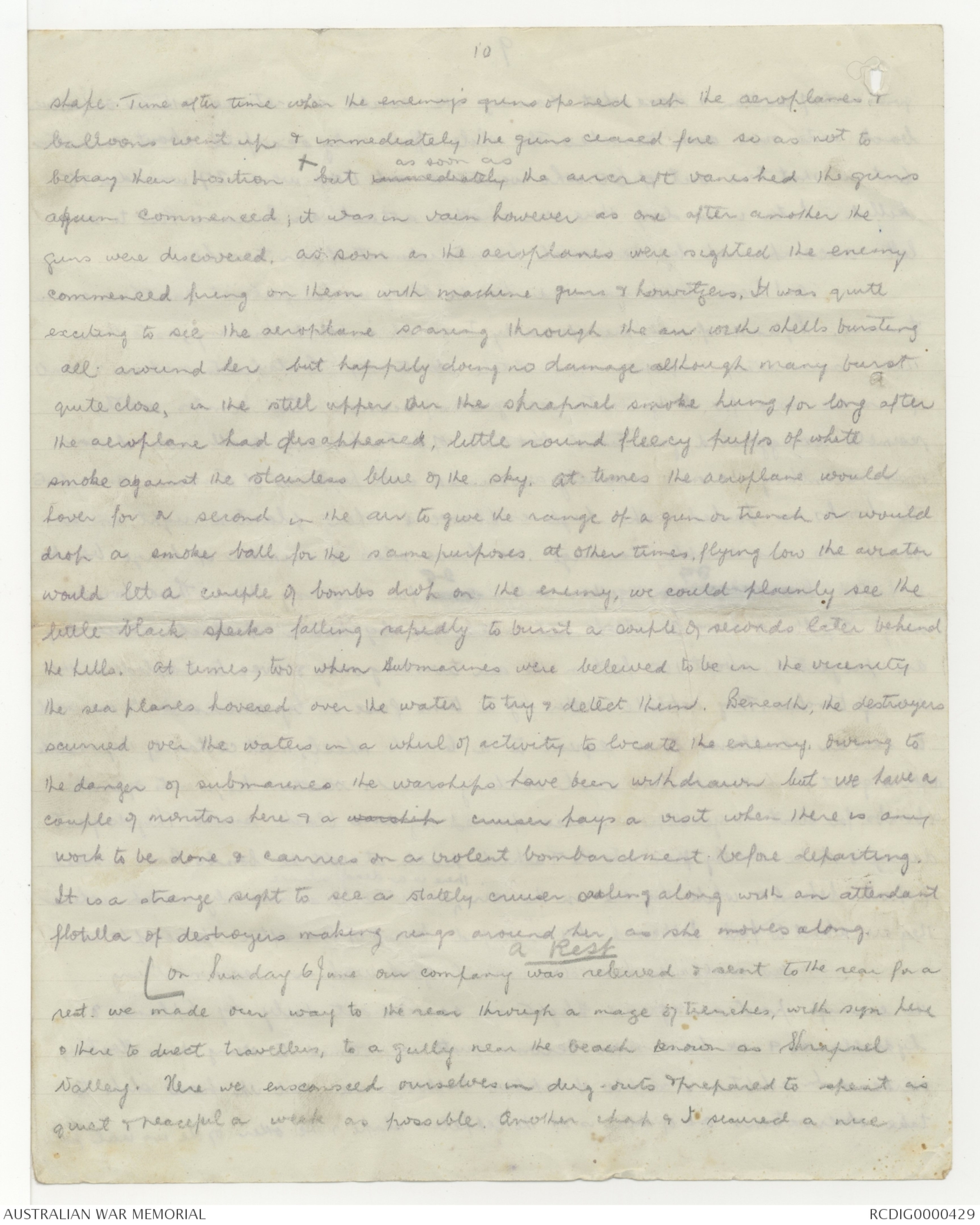
10
shape. Time after time when the enemy's guns opened up the aeroplanes &
balloons went up & immediately the guns ceased fire so as not to
betray their position X but immediately as soon as the aircraft vanished the guns
again commenced; it was in vain however as one after another the
guns were discovered. As soon as the aeroplanes were sighted the enemy
commenced firing on them with machine guns & howitzers. It was quite
exciting to see the aeroplane soaring through the air with shells bursting
all around her but happily doing no damage although many burst
quite close, in the still upper air the shrapnel smoke hung for long after
the aeroplane had disappeared, little round fleecy puffs of white
smoke against the stainless blue of the sky. At times the aeroplane would
hover for a second in the air to give the range of a gun or trench or would
drop a smoke ball for the same purposes at other times, flying low the aviator
would let a couple of bombs drop on the enemy, we could plainly see the
little black specks falling rapidly to burst a couple of seconds later behind
the hills. At times, too where Submarines were beleived to be in the vicinity
the sea places hovered over the water to try & detect them. Beneath, the destroyers
scurried over the waters, in a whirl of activity to locate the enemy, owing to
the danger of submarines the warships have been withdrawn but we have a
couple of monitors here & a warship cruiser pays a visit when there is any
work to be done & carries on a violent bombardment before departing.
It is a strange sight to see a stately cruiser sailing along with an attendant
flotilla of destroyers making rings around her, as she moves along.
A Rest
(on Sunday 6 June our company was releived & sent to the rear for a
rest. we made our way to the rear through a maze of trenches, with sign here
& there to direct travellers, to a gully near the beach known as Shrapnel
Valley. Here we ensconsed ourselves in dug-outs & prepared to spent as
quiet & peaceful a week as possible. Another chap & I secured a nice
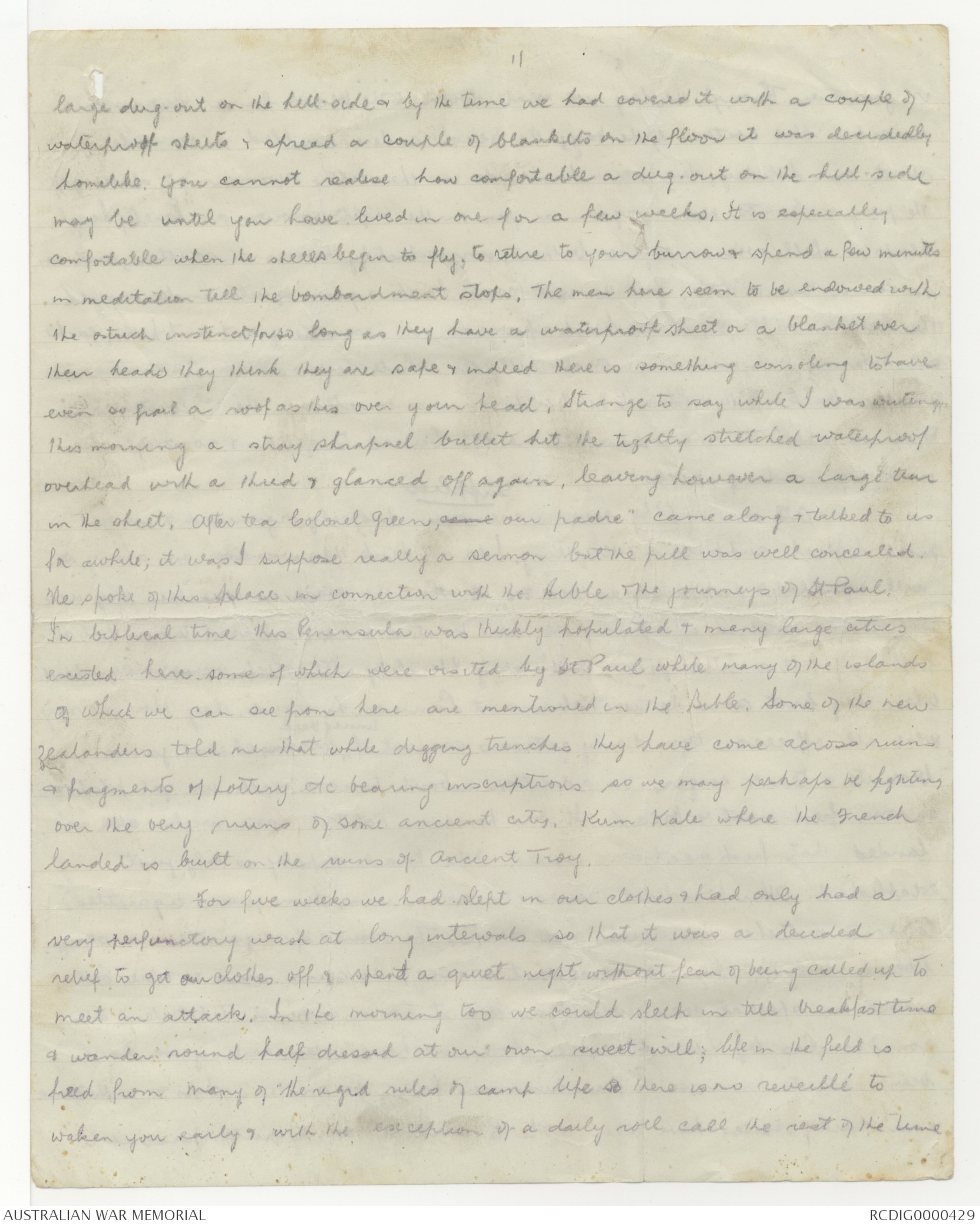
11
large dug-out on the hill-side & by the time we had covered it with a couple of
waterproof sheets & spread a couple of blankets on the floor it was decidedly
homelike. You cannot realise how comfortable a dug-out on the hill-side
may be until you have lived in one for a few weeks. It is especially
comfortable when the shells begin to fly, to retire to your burrow & spend a few minutes
in meditation till the bombardment stops. The men here seem to be endowed with
the ostrich instinct for so long as they have a waterproof sheet or a blanket over
their heads they think they are safe & indeed there is something consoling to have
even so frail a roof as this over your head. Strange to say while I was writing
this morning a stray shrapnel bullet hit the tightly stretched waterproof
overhead with a thud & glanced off again, leaving however a large tear
in the sheet. After tea Colonel Green came our "padre" came along & talked to us
for awhile; it was I suppose really a sermon but the pill was well concealed.
He spoke of this place in connection with the Bible & the journeys of St. Paul.
In biblical time this Peninsula was thickly populated & many large cities
existed here, some of which were visited by St. Paul while many of the islands
of which we can see from here are mentioned in the Bible. Some of the New
Zealanders, told me that while digging trenches, they have come across ruins
& fragments of pottery etc bearing inscriptions so we may perhaps be fighting
over the very ruins, of some ancient city. Kum Kale where the French
landed is built on the ruins of Ancient Troy.
For five weeks we had slept in our clothes & had only had a
very perfunctory wash at long intervals so that it was a decided
relief to get our clothes off & spend a quiet night without fear of being called up to
meet an attack. In the morning too we could sleep in till breakfast time
& wander round half dressed at our own sweet will; life in the field is
freed from many of the rigid rules of camp life so there is no reveillé to
waken you early & with the exception of a daily roll call the rest of the time
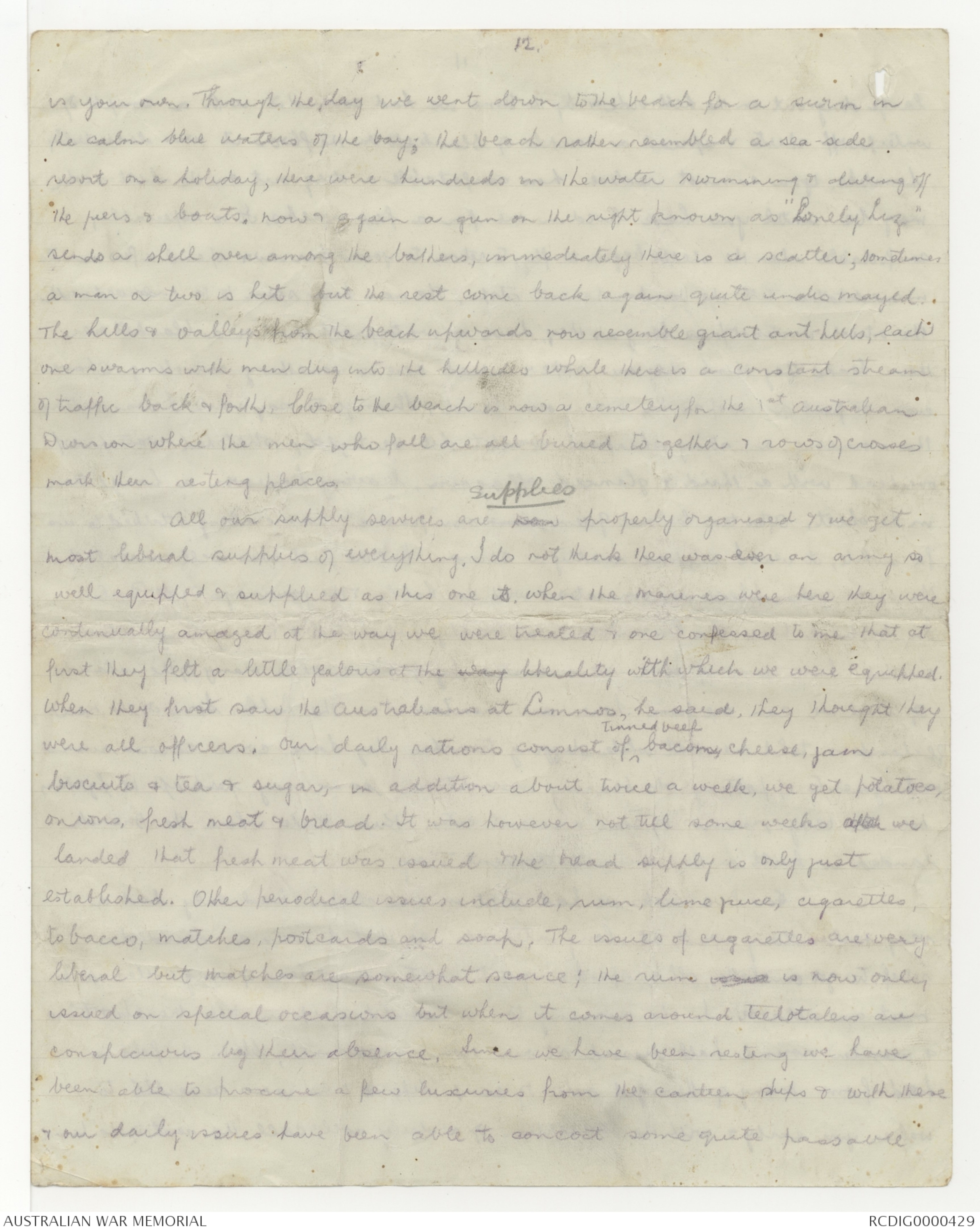
12.
is your own. Through the day we went down to the beach for a swim in
the calm blue waters of the bay; the beach rather resembled a sea-side
resort on a holiday, there were hundreds in the water swimming & diving of
the piers & boats, now & again a gun on the right known as "Lonely Liz"
sends a shell over among the bathers, immediately there is a scatter; sometimes
a man or two is hit but the rest come back again quite undismayed.
The hills & valleys from the beach upwards now resemble giant ant-hills, each
one swarms with men dig into the hillsides while there is a constant stream
of traffic back & forth. Close to be beach is now a cemetery for the 1st Australian
Division where the men who fall are all buried to-gether & rows of crosses
mark their resting places.
Supplies
All our supply services are now properly organised & we get
most liberal supplies of everything. I do not think there was ever an army so
well equipped & supplied as this one is. When the marines were here they were
continually amazed at the way we were treated & one confessed to me that at
first they felt a little jealous at the way liberality with which we were equipped.
When they first saw the Australians at Lemnos, he said, they thought they
were all officers. Our daily rations consist of ^tinned beef bacon, cheese, jam
biscuits & tea & sugar, in addition about twice a week, we get potatoes,
onions, fresh meat & bread. It was however not till some weeks after we
landed that fresh meat was issued & the bread supply is only just
established. Other periodical issues include, rum, lime juice, cigarettes,
tobacco, matches, postcards and soap. The issues of cigarettes are very
liberal but matches are somewhat scarce; the rum is one is now only
issued on special occasions but when it comes around teetotalers are
conspicuous by their absence. Since we have been resting we have
been able to procure a few luxuries from the canteen ships & with these
& our daily issues have been able to concoct some quite passable
13
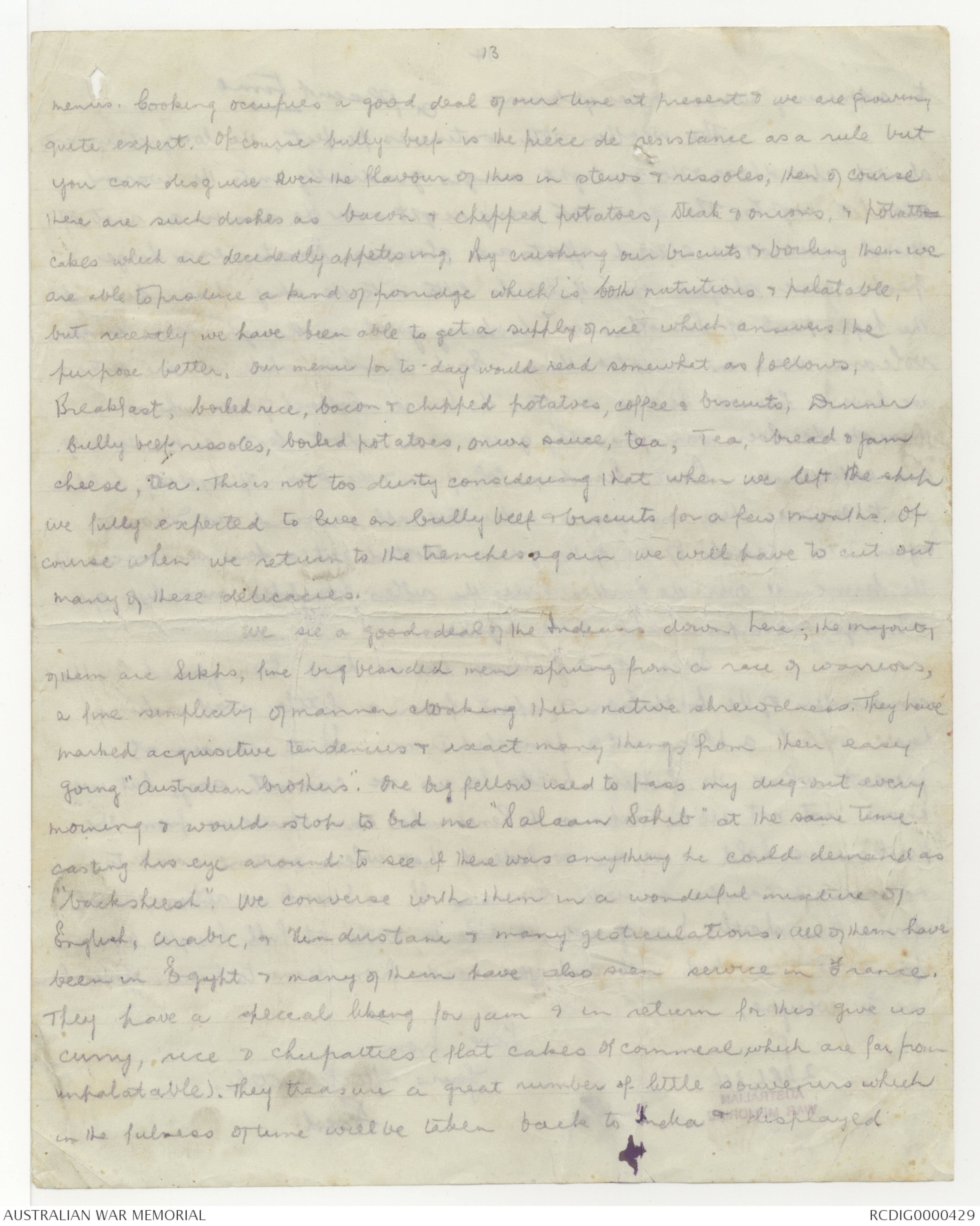
menus. Cooking occupies a good, deal of our time at present & we are growing
quite expert. Of course bully beef is the piéce de resistance as a rule but
you can disguise even the flavour of this in stews & rissoles, then of course
there are such dishes as bacon & chipped potatoes, steak & onious, & potatoes
cakes which are decidedly appetising. By crushing our biscuits & boiling them we
are able to produce a kind of porridge which is both nutritious & palatable,
but recently we have been able to get a supply of rice which answers the
purpose better. Our menu for to-day would read somewhat as follows,
Breakfast, boiled rice, bacon & chipped potatoes, coffee & biscuits. Dinner
Bully beef rissoles, boiled potatoes, onion sauce, tea, Tea, bread & jam
cheese, tea. This is not too dusty considering that when we left the ship
we fully expected to live on bully beef or biscuits for a few months. Of
course when we return to the trenches again we will have to cut out
many of these delicacies.
We see a good deal of the Indians down here; the majority
of them are Sikhs, fine big bearded men sprung from a race of warriors,
a fine simplicity of manner awaking their native shrewdness. They have
marked acquisitive tendencies & exact many things from their easy
going "Australian brothers". One big fellow used to pass my dug-out every
morning & would stop to bid me "Salaam Sahib" at the same time.
casting his eye around to see if there was anything he could demand as
"backsheesh". We converse with them in a wonderful mixture of
English, Arabic, Hindustani & many gesticulations, all of them have
been in Egypt & many of them have also seen service in France.
They have a special liking for jam & in return for this give us
curry, rice & chupatties (flat cakes of cornmeal, which are far from
unpalatable). They treasure a great number of little souvenirs which
in the fullness of time will be taken back to India & displayed
14
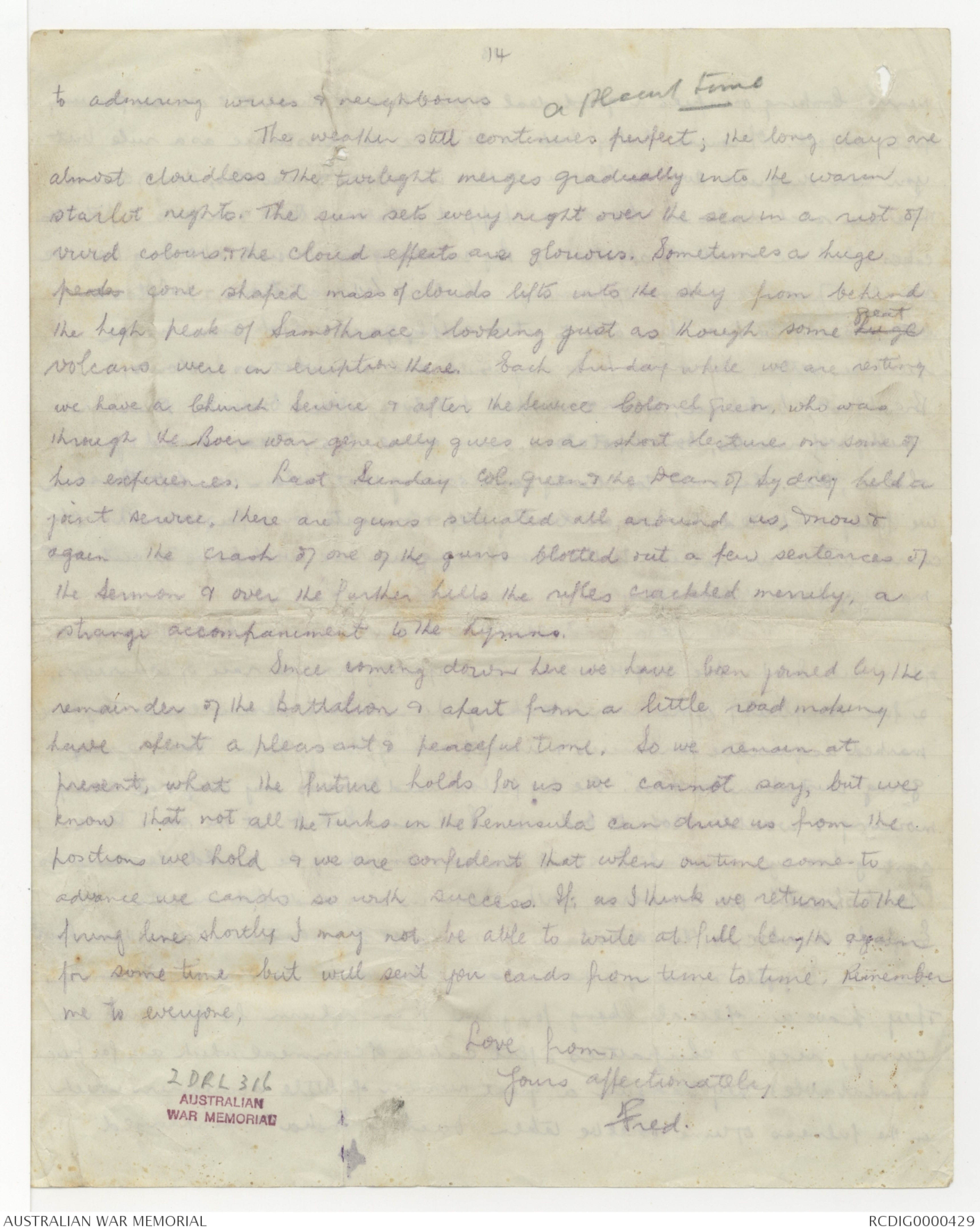
to admiring wives & neighbours a plesent time
The weather still continues perfect; the long days are
almost cloudless & the twilight merges gradually into the warm
starlit nights. The sun sets every night over the sea in a riot of
vivid colours, & the cloud effects are glorious. Sometimes a huge
peaks cone shaped mass of clouds lifts into the sky from behind
the high peak of Samothrace looking just as though some huge great
volcano were in eruption there. Each Sunday while we are resting
we have a Church Service & after the service Colonel Green, who was
through the Boer War generally gives us a short lecture on some of
his experiences. Last Sunday Col. Green & the Dean of Sydney held a
joint service, there are guns situated all around us, & now &
again the crash of one of the guns blotted out a few sentences of
the Sermon & over the farther hills the rifles crackled merrily, a
strange accompaniment to the hymns.
Since coming down here we have been joined by the
remainder of the Battalion & apart from a little road making
have spent a pleasant & peaceful time. So we remain at
present, what the future holds for us we cannot say, but we
know that not all the Turks in the Peninsula can drive us from the
positions we hold & we are confident that when our time comes to
advance we can do so with success. If, as I think we return to the
firing line shortly I may not be able to write at full length again
for some time but will sent you cards from time to time. Remember
me to everyone.
Love from
Yours affectionately
Fred.
2DRL 316
AUSTRALIAN
WAR MEMORIAL
 Deb Parkinson
This transcription item is now locked to you for editing. To release the lock either Save your changes or Cancel.
This lock will be automatically released after 60 minutes of inactivity.