Letters from Frederick Warren Muir, 1914-1915 - Part 12
Conflict:
First World War, 1914–18
Subject:
  • Documents and letters
Status:
Awaiting approval
Accession number:
RCDIG0000429
Difficulty:
3

Page 1 / 10

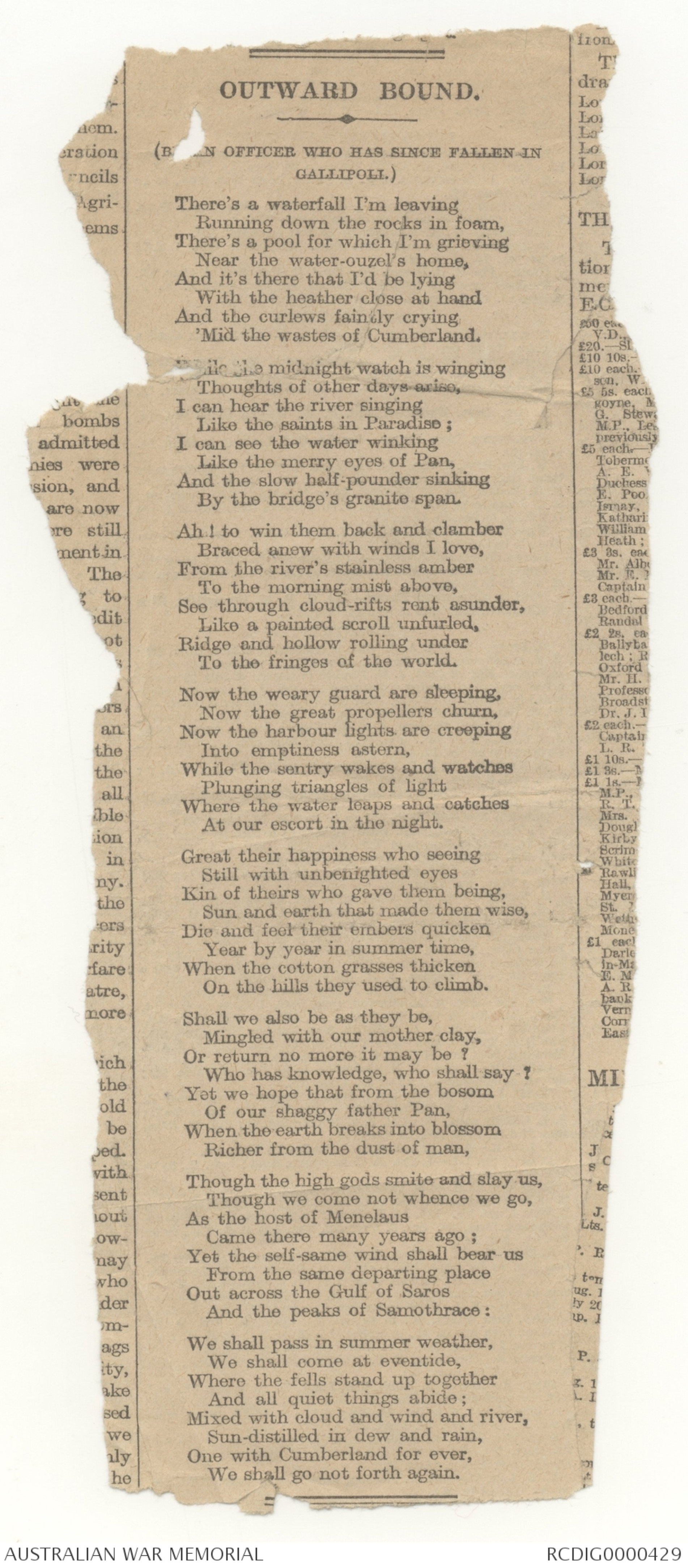
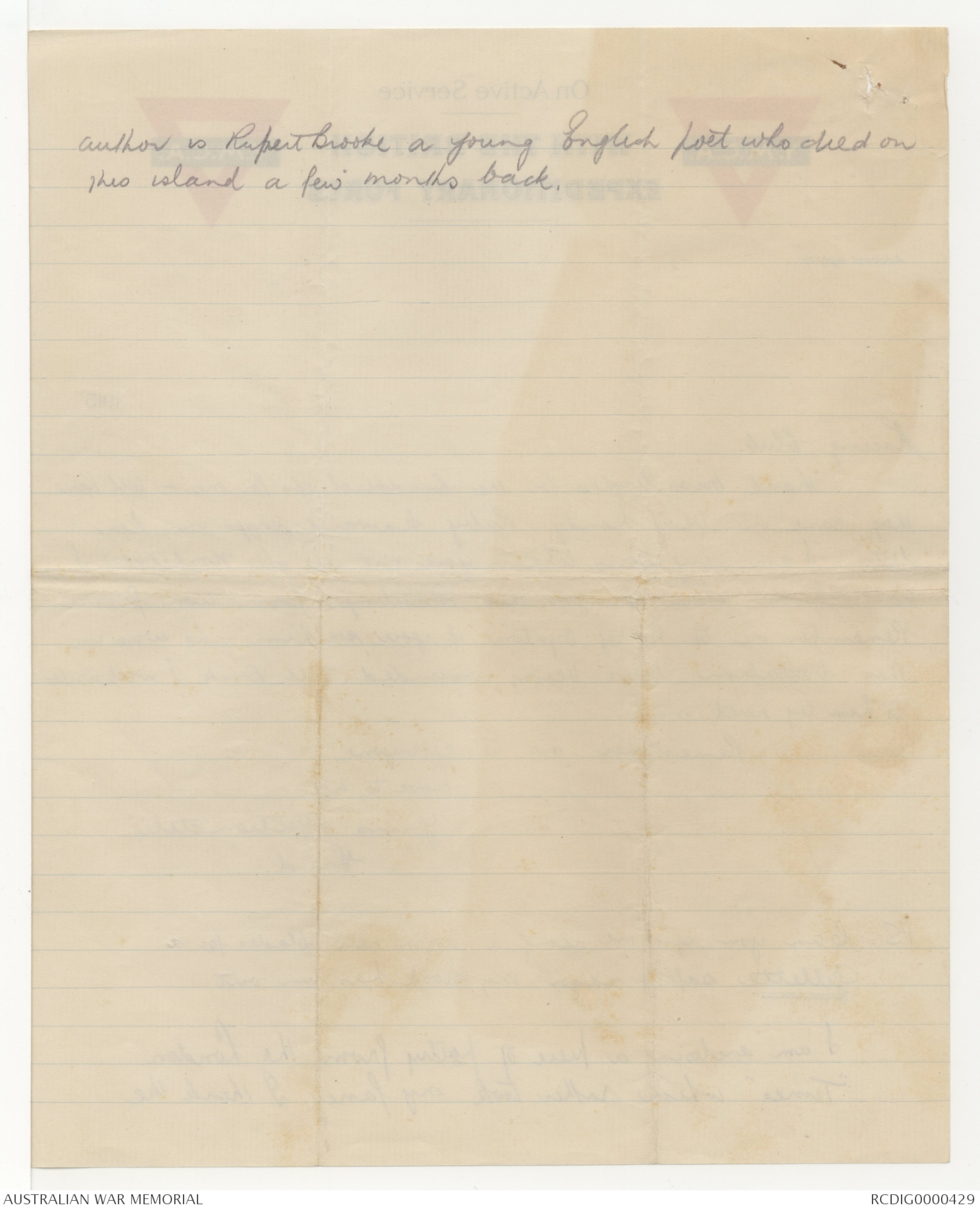
author is Rupert Brooke a young English poet who died on This island a few months back,
C sration -neils Aeri- con bombs admitted hies; were sion, and ao now no still mentin. The to dit 86 N0 an the tho all ble son in Ny. the Lers Fity fare atre, more ich the old De Sed. rith sent 10ut OW n2y who dor Mr as. 1t7 260 sed w0 11 h0 OUTWARD BOUND. AN OFFICER WHO HAS SINCE FALLENIN (a GALLIPOEL.) There's a waterfall Pm leaving Running down the rocks in foam, There's a pool for which I'm grieving Near the water-ouzels home, And it's there that Id be lying With the heather close at hand And the curlows faintly crying Mid the wastes of Cumberland. MlcLemidnight watch is winging Thoughts of other daysarise. I can hear the river singing Like the saints in Paradise; I can soe the water winking Like the merry eyes of Pan, And the slow half-pounder sinking By the bridge’s granite span. Ah1 to win them back and clamber Braced anew with winds I love, From the river’s stainless amber To the morning mist above, See through cloud-rifts rent asunder, Like a painted scroll unfurled, Ridge and hollow rolling under To the fringes of the world. Now the weary guard are sleeping, Now the great propollers churn, Now the harbour lights are creeping Into emptiness astorn, While the sentry wakes and watches Phunging triangles of light Where the water leaps and catches At our escort in the night. Great their happiness who seeing Still with unbenighted eves Kin of theirs who gave them boing, Sun and earth that made them wise, Die and foot their embers quickon Year by year in summer time, When the cotton grasses thicken On the hills they used to climb. Shall we also be as they be, Mingled with our mother clay, Or return no more it may be 7 Who has knowledge, who shall say.1 Yet we hope that from the bosom Of our shaggy father Pan, When the earth breaks into blossom Richer from the dust of man, Though the high gods smite and stay us, Though we come not whence we go, As the host of Menelaus Came there many years ago; Vet the self-same wind shall bear us From the same departing place Out across the Gulf of Saros And the peaks of Samothrace: We shall pass in summer weather, We shall come at eventide, Where the fells stand up together And all quiet things abide; Mixed with cloud and wind and river, Sun-distilled in dew and rain, One with Cumberland for ever, We shall go not forth again. Mon dra Lo Lo. 19 10 Lor Lor TH tor mc EC 0e F.D. 220. ₤10 108. 210 each sin. 5 5s. eaci korne O. M.P.I previous 25 each. Toberm Duchest E. Poo. Ismay Kathar Wiliam Meath. 8s. eas Mr. Alb Mr. Captain cact Bedfort Rar Sect OrtC Mr. H. Pro Broads Dr.J. 22 each Capt. L. R. 21 10s. 138. Ar Don KirL Sori Raw. Hall Mye Mont 3 20 MI lte 2 ton us. 52 10.1
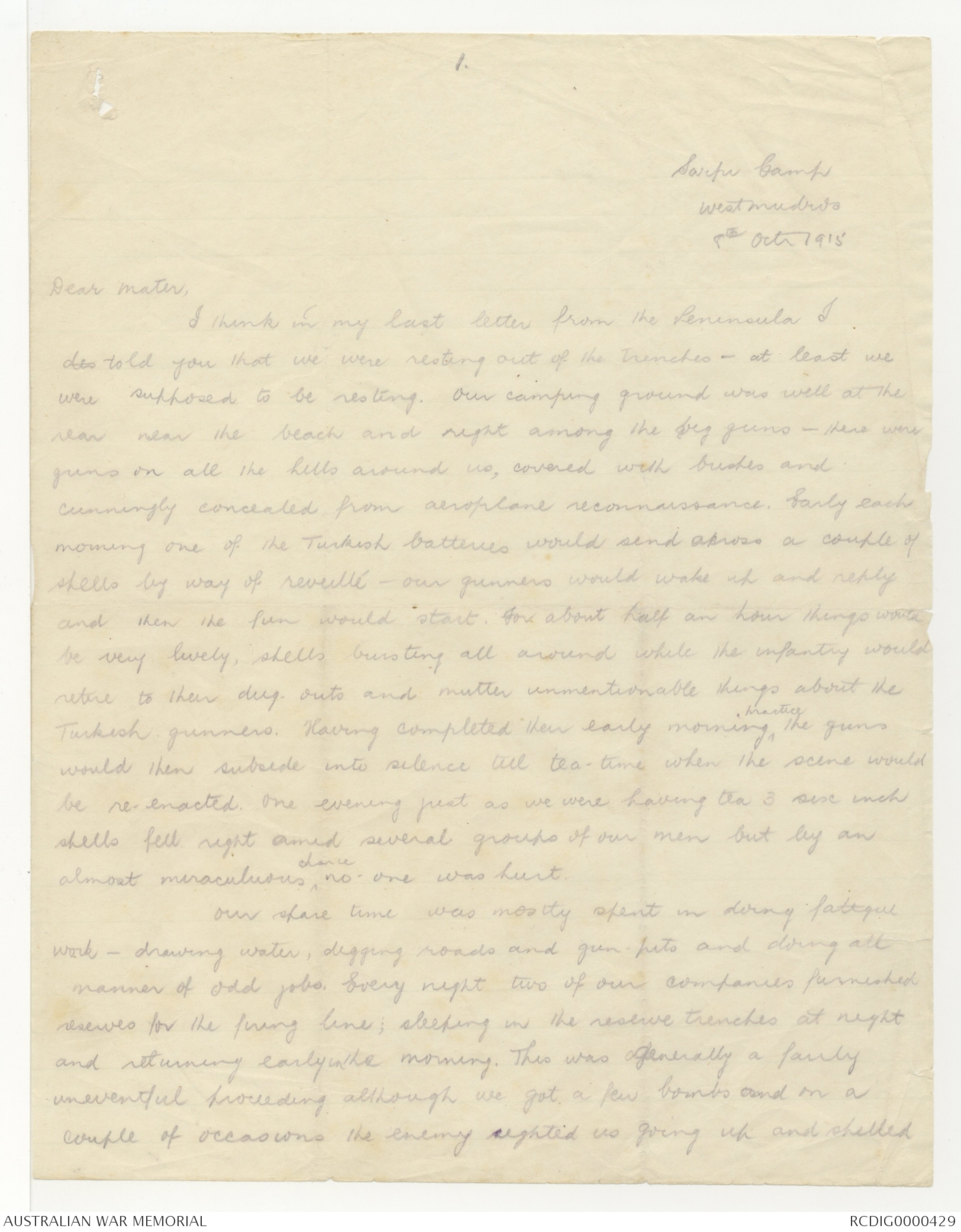
1. Sarp Camp westmudrds 8t Octr 1915 Dear mater, I think in my last letter from the Peninsula I dis told you that we were resting out of the trenches - at least we were supposed to be resting. Our camping ground was well at the rear near the beach and right among the begguns - hhere were grens on all the hells around us, covered with bushes and cunningly conceated from acroplane reconnussance. Faily each morning one of the Turkish batteries would send apross a couple of shells by way of reveille - our gunners would wake up and reply and then the fun would start. Hor about half an hour things wort be very lively, shells buisting all around while the infantry would reture to their duy outs and mutter unmentionable things about the Mastice Turkesh gunners. Having completed their early morning, the guns would then subsede into silence till tea-time when the scene would be re-enacted. One evening just as we were having tea 3 six inch shells fell right amed several groups of our men but by an darce almost miraculuous no-one was hust. our stare time was mostly spent in doing fattgul work - drawing water, digging roads and gun-pits and doing att manner of odd jobo. Every night two of our companies furnished reserves for the firing line; sleeping in the reseive trenches at night and returning early enhe morning. This was agenerally a fairly uneventful proceeding although we got a few bombs and on a couple of occasions the enemy sighted us going up and shelled
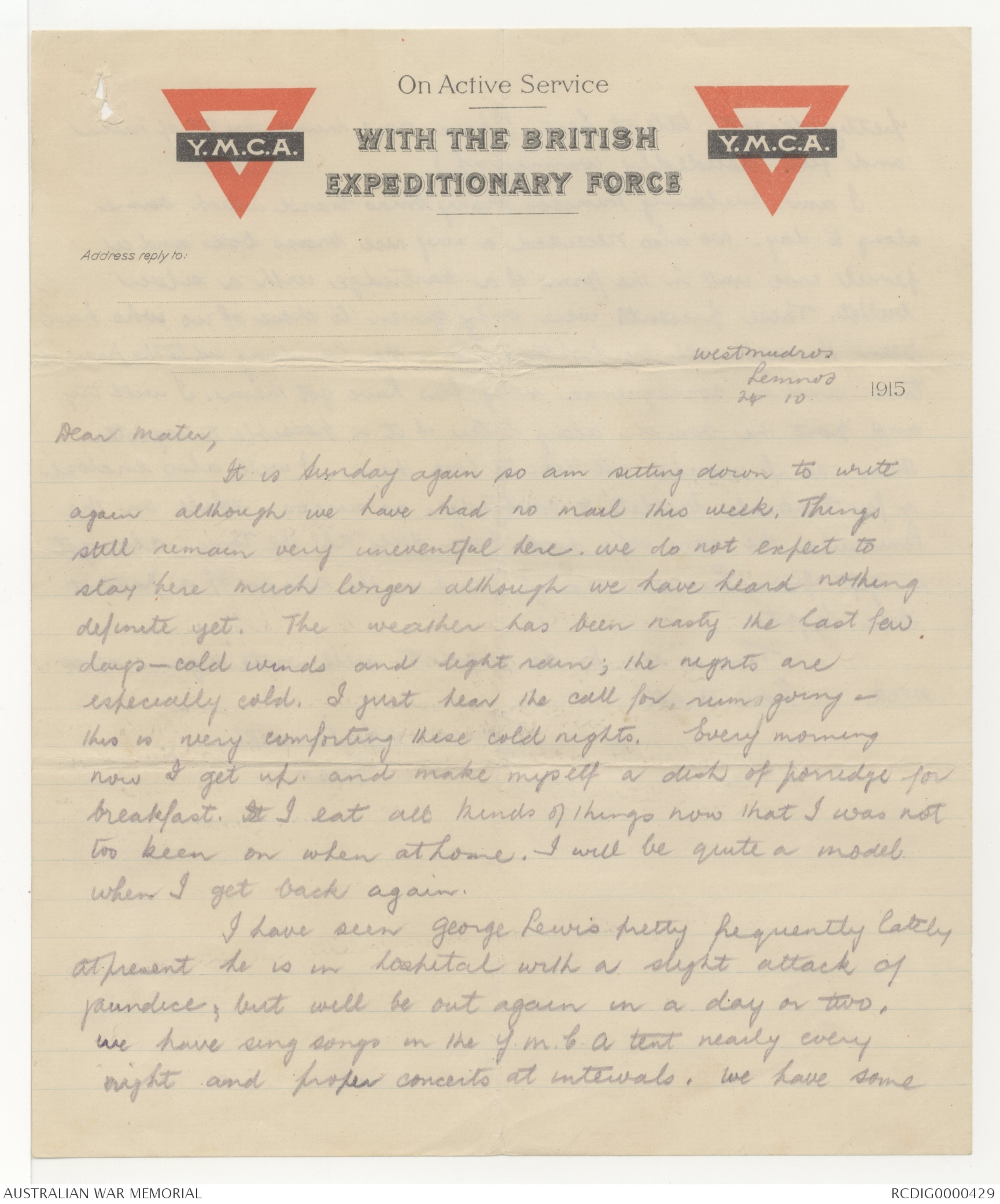
On Active Service WHTHTHEBS S EHPBDITIONARY FORES AOIReSSTepY P. westmudros Lemnos 1915 2o 10 Dear Mater It is Sunday again so am sitting down to write again although we have had no nail this week, things still remain very uneventful here. we do not expect to stay here much longer although we have heard nothing definite yet. The weather has been rasty the last few days - cold winds and light rain; the nights are especially cold. I just hear the call for runs going thes is vvery comforting these cold nights. Every morning now I get up and make myself a dick of porredge for breakfast. It I eat all kinds of things now that I was not too keen on when athome. I will be quite a model when I get back again. I have seen george Lewis pretty pequently lately at present he is in lospital with a slight attack of faundice, but will be out again in a day or two. we have sing songs in the G.M.C. A tent nearly every night and proper concerts at intervals. We have some
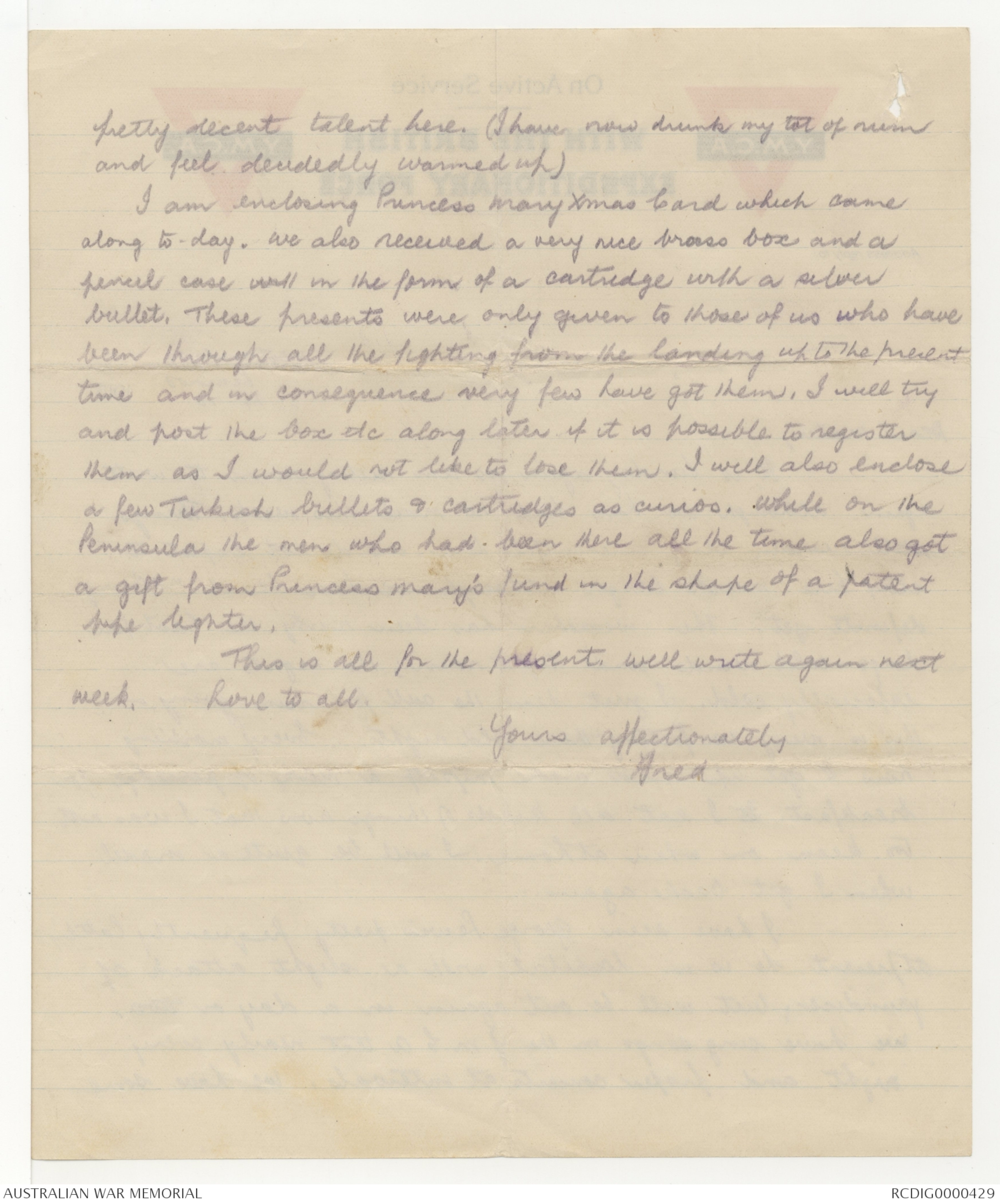
sfretty dlecent talent here. I have now dunk my tor of rum and feel decidedly warmed up I am enclosing Puncess mary Imas bard which came along to-day. We also received a very nice broeso box and a peneel case wtl in the form of a cartridge with a silver bullet. These presents were only given to those of us who have been through all the fighting from the landing up to the present time and in consequence very few have got them, I will try and post the box etc along later if it is possible to register them as I would not like to lose them. I will also enclose a few Turkish bullets & castridges as curiso. while on the Penensula the men who had been here all the time also got a gift from hincess may's fand in the shape of a parent hpe lighter. present well write again next This is all for the week. have to all Yours affectionately fored
40 Sarpe Camp West mudes 26:29124 Dear mater; onrreturning from Imbros as I mentioned in my last letter we lost no time in returning to the trenches for a few hours after disembarking we found ourselves once more in the firing line. The position we now took over was some distance to the right of the trenches previoust occupied by us. The trenches had been much improved since we were lasts an them; they were now wides and deeper wish istrong parapets and good look holls presentiong an almoste compttle immeenity from wifle and shrapneb fires, Dehind the firing line was a network of support, reatrse and communication tenches reaching right down to the beach, undeed position until we got useds to the new it was not unusual for us to get buishedin this mage of trenches and sapo under the new conditionsot was necessary for us to live in the trenches all the time, when we cane out of the pring line wer went into the reserve trenches so that many days night hass without us getting out of the trenches at all Under these circumstances of course we could not do any cooking for ourselves, and had to fall back again on a mence chiefly composed of busly beef and biscuts. Water was one of our chief troubles, as we had to cany all our supply from the valley which necessitated climbing a couple of steep hells so that we did not use any more than necessary. On our sector of the front the enemy's trenches were about 200 yards from us occupying a very strong position knowne to us as Lonesome t
Ridge; to the left was another tremendously strong position known as Johnstons jolly and in between lay Owen's gully (so- called after Col. Owen). The Turks were well dug in having several parallel rows of trenches with strong earth works and bailed were entanglements, while communication trenches could be seen 3tg zagging over all the hells at the rear. In places, between ou trenches and the Turks could be seen confused masses of earth marking the shots where mines. had been exploded by one side or the other at this time things all along ver front were very quiet once more, there was little rifle fire during she day and only a decultory exchange of shots at night; in the afternoons as as rule there were artillery duels in which our 8 and 6 howitzer generally gave a good account of temselves. The Turks in reply sent over, a number of 6 shells which did little harm to us and on more than one recasion fell reght in ten own tunches a more unweliome visitor was. whistling Kufers! a honderous non bomb about 15 in diameter, which was fired from a trench mortan and flew through the air wish a strange whestling sound to burit amed a cloisel of black smote and a horrible smell of the Turks themselves, but little was to be seen, an occasional shovelful of earth showed that they were still busy elegging but they very seldom, exposed themselves even for an second. our periscopes rifles gave us a great ascendancy over their snifees as we were thus enabled to the wtout expising Coursels at all and on this account that the enemy were o dilegent in keeping out of sight. Often on still nights we could hear the dogs backing in the farm Chouses and villages at the rear and sometimes could hear the tucks talling ar even senging Under these circumstances you will perhaps be able to understand how monotonous it is possible for trench warfare to become back day in the trenches exactly recembled the laste differing only perhaps in the intensity of the eveni
bombardment which probably depended on the temper of the Turkesh gunners, Day and night a ceaseless watch was kept by our observers on the ground and trenches in front abut there was seldom anyshing to report. The line if trnchessan before us seceneddifeless and deeted save now agains when a stray showelful of othe thrown over the parapet ishowed that he enemy were still there owere wtill bunowing in decpn. A few weeks of this constants evigilance with sleepless nights and broten rest is enough to strain anyones mewer taperially in the long night watches, when the moonlight cas to grotes gue shadows on, the ground in front is one oleable to contract her discase known, as turks before the eyes and regard every dark obust on adow with suspicion tll daylight or the fast of as star shell reats ito innecence many i shot too, has been wasted on there and other tharmless objectslest tey should be turkish scouts or mnepers crawting up But the hours spent in the trerches formed only a very small part of our work in being releived; after abrief rest we had to n to again and labuie by the sweat of our brows hew gun were continually being landed and noads and gun ipts had to be constructed for shese and then the guin themselves hailed into position, I new terches were duy and shell proof shelters built, and our old trenches had all to be widened and deepened. As any sign of digging orM unusual activily would inevitably draw the fire of the Turkish, atillery on us mt of this work had to be carried on steering the night time; so that manysdays would pass at a time without ist gesting a decent recent rest, In addition all the usual joba performed sirch as carrying water and supplies had to be can ut inour shere te It was a period of great strain for everyone but later on we were thankful for all these preparations saned wonth Monday 11th July marked the beginning of the Turkish of Ramadan the nosty important sacred festival in the Turkead year. The Koran enjoins very street fast
A0 during this period but by a decree of the Sultan soldiers on active sewice are exempted from these. Fearing lest the Turhish + german officers might take advantage of this opportunity to work up the religious fanatacism of the men we took special precaution (against attack and arranged an artillery demonstration for the first night of the Month, The articlery fried istar shells and flare lights all neght and at intervals bombarded the enemy's trencheswith exploswe shell and shrapnel, while the Turks. being becomen alarmed fired volley after volley haimlessly over our heads. The skene was very pictures gue and resembled a freworks display on a huge scale. The star shells are particularly beautiful; they are firedaou 200 feet into the air at which height they buist into about a dozen separate balls of fame which separate and slowly senk to the earth leghting up the landsape for hundreds of yards around, others. again, have a parcchute attached and descend very slowly in a series of sprrals keeping. alight for an extra long time. In addition red and green flare lights thrown out between the trenches khiew a ghasily and Tuneal radiance over the scene while the flash of rifles and buisting shells, the palled beams of the searchlights sweeking the shy and an occasional bomb leaving a wrilliant trail of sparks like as comets all added to the spectacular effect. Behind all the crescent moon sinking into the water and the red and green & lights of the hospital ships, completed the picture B) Duriry the next few days, although the expected attack did not eventuate, the artillery in bothsides were very active. The Tinks bombarded as freely with by shells including a number of 112 inch from one of the waiskeps, they also kept thirgs lively. on the beach with a gun situated in the blive groves to the South of Rabas Tepe and familearly kown to everyone as Beachy Bill. This gun was very well hidden and deped all the efforts of our artillery to silence it. our ownattitlery, more especially the heavy howitzers put in some very fine work, dropping shell after
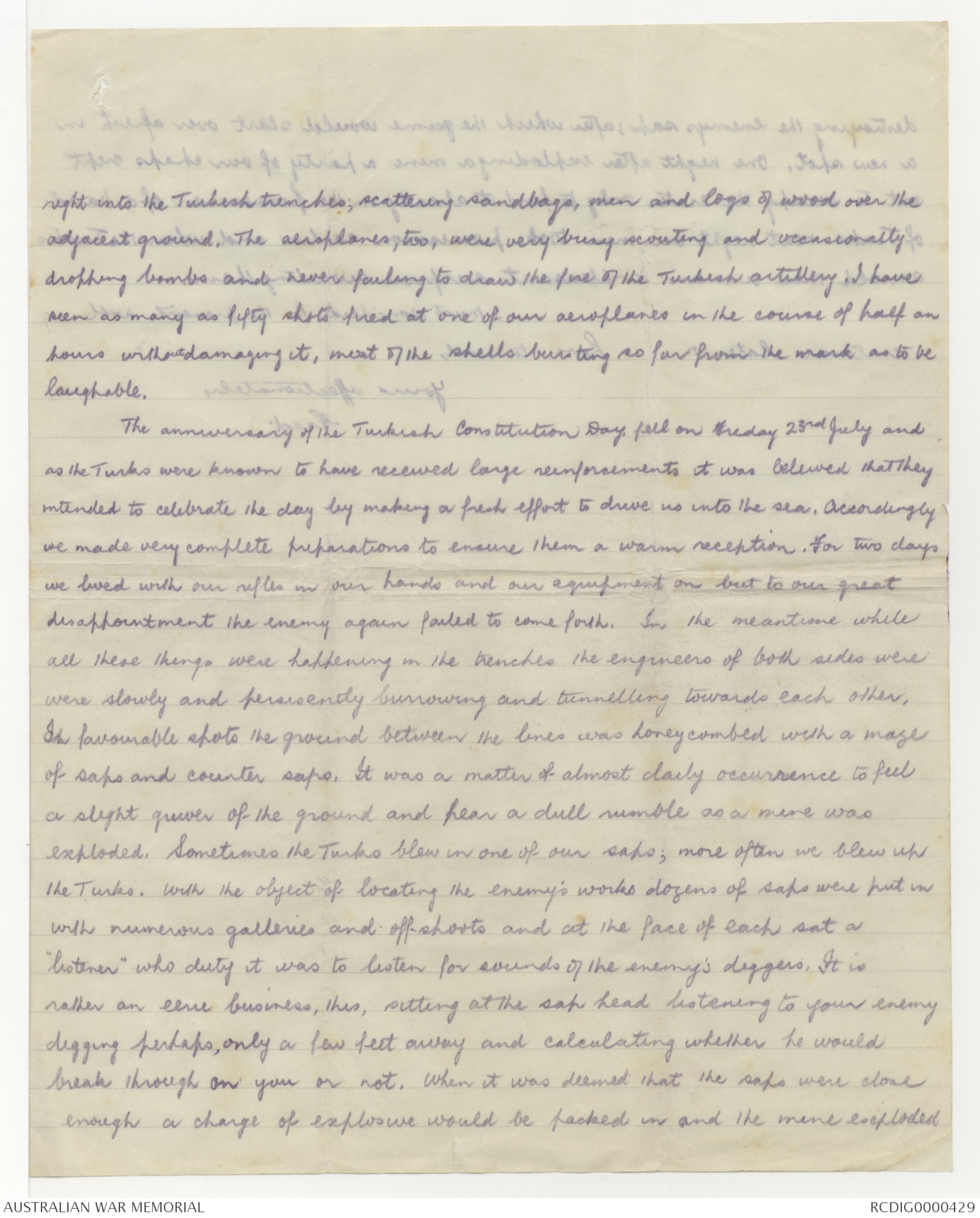
542 right into the Turkish trenches; scattering sandbags, men and logs of wood over the adjacent ground The aeisplanes, too, swere very bury sevrting and occasionalty drophing bombs and never failing to draw the fire of the Turkesh artillery. I have seen as many as fifty shots fired at one of our acroplanes in the course of half an hours withoutdamaging it, meat of the shells bursting so far from the mark as to be laughable. The anniversary of the Turkish Constitution day fell on Freday 23rd July and as the Turks were known to have received large reinforsements it was beleived that they intended to celebrate the day by making a fresh effort to drive us into the sea, Accordingly we made very complete preparations to ensure them a warm reception. For two day we lived with our refles in our hands and our equipment on but to onr great disappointment the enemy again failed to come forth. In the meantisne while all these things were happening in the trenches the engineers of both sides were were slowly and persesently burrowing and tunnelling towards each other, Th favourable shots the ground between the lines was honeycombed with a mage of saps and counter saps. It was a matter of almost caily occurrence to feel a slight guiver of the ground and pear a dull numble as a mire was exploded. Sometimes the tarks blew in one of our saks; more often we blew up The Turks. with the object of locating the enemy's works dozens of saps were put in with numerous galleries and off shorts and at the face of each sat a listener who dity it was to listen for socends of the enemy's deggers. It is rather an eeve business, this, sitting at the sap head listening to your enemy degging perhaps, only a few feet away and calculating whether he would break through on you or not. When it was deemed that the saps were close enough a charge of explosive would be packed in and the mene exploded

author is Rupert Brooke a young English poet who died on
this island a few months back.


Paper cutting - see originial document

OUTWARD BOUND.
([[?]] OFFICER WHO HAS SINCE FALLEN IN
GALLIPOLI.)
There's a waterfall I'm leaving
Running down the rocks in foam,
There's a pool for which I'm grieving
Near the water-ouzels home,
And it's there that I'd be lying
With the heather close at hand
And the curlews faintly crying
'Mid the wastes of Cumberland.


While the midnight watch is winging
Thoughts of other days arise,
I can hear the river singing
Like the saints in Paradise;
I can see the water winking
Like the merry eyes of Pan,
And the slow half-pounder sinking
By the bridge’s granite span.

Ah! to win them back and clamber
Braced anew with winds I love,
From the river’s stainless amber
To the morning mist above,
See through cloud-rifts rent asunder,
Like a painted scroll unfurled,
Ridge and hollow rolling under
To the fringes of the world.

Now the weary guard are sleeping,
Now the great propellers churn,
Now the harbour lights are creeping
Into emptiness astern,
While the sentry wakes and watches
Plunging triangles of light
Where the water leaps and catches
At our escort in the night.

Great their happiness who seeing
Still with unbenighted eyes
Kin of theirs who gave them being,
Sun and earth that made them wise,
Die and feel their embers quicken
Year by year in summer time,
When the cotton grasses thicken
On the hills they used to climb.

Shall we also be as they be,
Mingled with our mother clay,
Or return no more it may be?
Who has knowledge, who shall say?
Yet we hope that from the bosom
Of our shaggy father Pan,
When the earth breaks into blossom
Richer from the dust of man,

Though the high gods smite and stay us,
Though we come not whence we go,
As the host of Menelaus
Came there many years ago;
Yet the self-same wind shall bear us
From the same departing place
Out across the Gulf of Saros
And the peaks of Samothrace:

We shall pass in summer weather,
We shall come at eventide,
Where the fells stand up together
And all quiet things abide;
Mixed with cloud and wind and river,
Sun-distilled in dew and rain,
One with Cumberland for ever,
We shall go not forth again.


1.
Sarpi Camp
West Mudros
8th Octr 1915
Dear mater,
I think in my last letter from the Peninsula I
des told you that we were resting out of the trenches — at least we
were supposed to be resting. Our camping ground was well at the
rear near the beach and right among the big guns - here were
guns on all the hills around us, covered with bushes and
cunningly concealed from aeroplane reconnaissance. Early each
morning one of the Turkish batteries would send across a couple of
shells by way of reveillé - our gunners would wake up and reply
and then the fun would start. For about half an hour things would
be very lively, shells bursting all around while the infantry would
retire to their dug outs and mutter unmentionable things about the
Turkish gunners. Having completed their early morning ^practice the guns
would then subside into silence till tea-time when the scene would
be re-enacted. One evening just as we were having tea 3 six inch
shells fell right amid several groups of our men but by an
almost miraculous ^chance no-one was hurt.
Our spare time was mostly spent in doing fatigue
work - drawing water, digging roads and gun-pits and doing all
manner of odd jobs. Every night two of our companies furnished
reserves for the firing line; sleeping in the reserve trenches at night
and returning early in the morning. This was generally a fairly
uneventful proceeding although we got a few bombs and on a
couple of occasions the enemy sighted us going up and shelled 


West Mudros
Lemnos
24. 20. 1915
Dear Mater,
It is Sunday again so am sitting down to write
again although we have had no mail this week. Things
still remain very uneventful here. we do not expect to
stay here much longer although we have heard nothing
definite yet. The weather has been nasty the last few
days — cold winds and light rain; the nights are
especially cold. I just hear the call for rums going —
this is very comforting these cold nights. Every morning
now I get up and make myself a dish of porridge for
breakfast. It I eat all kinds of things now that I was not
too keen on when at home. I will be quite a model
when I get back again.
I have seen George Lewis pretty frequently lately
At present he is in hospital with a slight attack of
jaundice, but will be out again in a day or two.
we have sing songs in the Y.M.C. A tent nearly every
night and proper concerts at intervals. We have some 


pretty decent talent here. (I have now drunk my tot of rum
and feel decidedly warmed up)
I am enclosing Princess Mary Xmas Card which came
along to-day. We also received a very nice brass box and a
pencil case wil in the form of a cartridge with a silver
bullet. These presents were only given to those of us who have
been through all the fighting from the landing up to the present
time and in consequence very few have got them, I will try
and post the box etc along later if it is possible to register
them as I would not like to lose them. I will also enclose
a few Turkish bullets & cartridges as curios. While on the
Peninsula the men who had been here all the time also got
a gift from Princess Mary's fund in the shape of a patent
pipe lighter.
This is all for the present will write again next
week. Love to all
Yours affectionately
Fred 


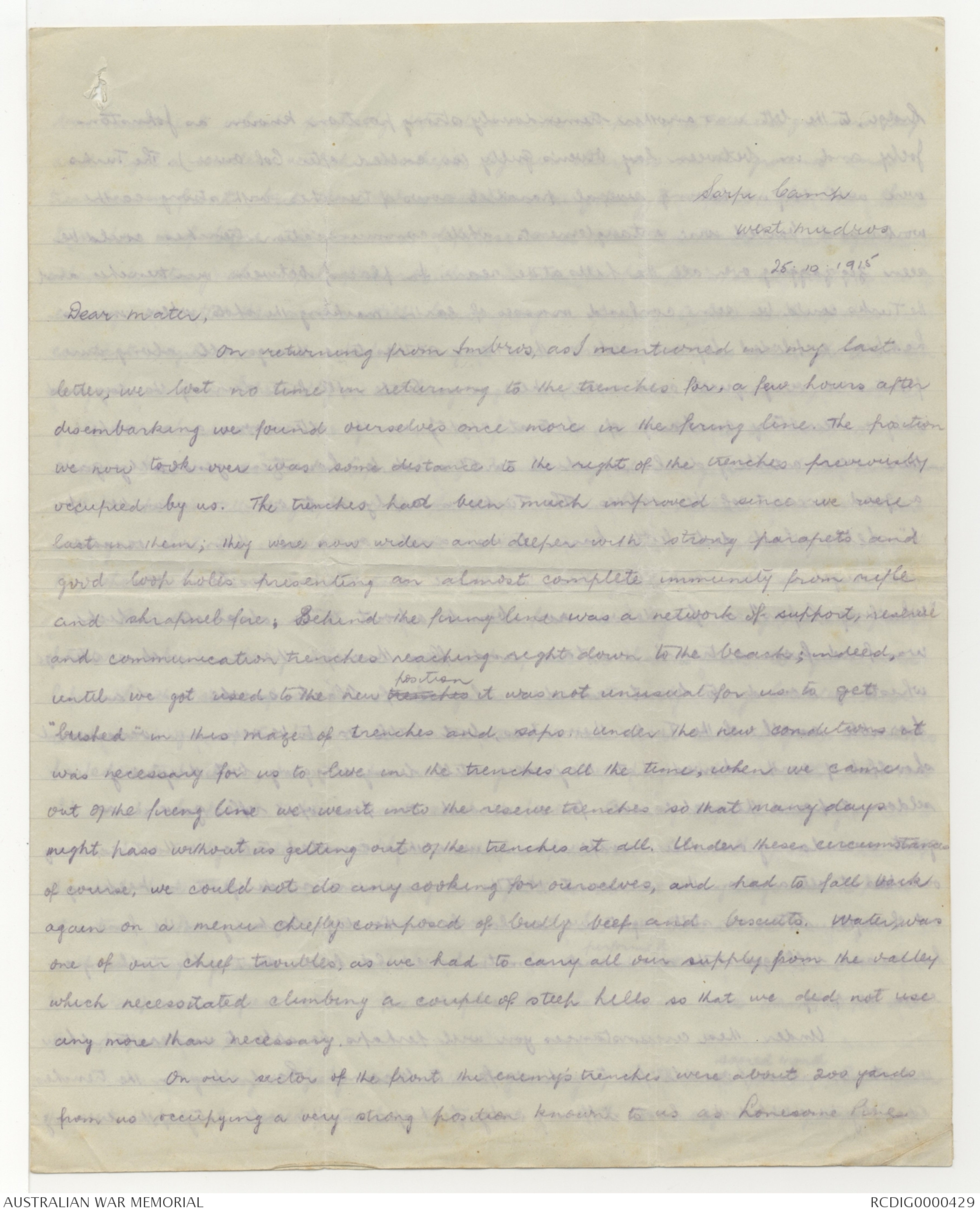
Sarpi Camp
West Mudros
25.10.1915
Dear Mater,
On returning from Imbros as I mentioned in my last
letter, we lost no time in returning to the trenches for, a few hours after
disembarking we found ourselves once more in the firing line. The position
we now took over was some distance to the right of the trenches previously
occupied by us. The trenches had been much improved since we were
last in them; they were now wider and deeper with strong parapets and
good loop holes presenting an almost complete immunity from rifle
and shrapnel fire. Behind the firing line was a network of support, structure
and communication trenches reaching right down to the beach; indeed,
until we got used to the trenches position it was not unusual for us to get
"bushed" in this maze of trenches and saps. Under these new conditions it
was necessary for us to live in the trenches all the time, when we came
out of the firing line we went into the reserve trenches so that many days
might pass without us getting out of the trenches at all. Under these circumstances
of course, we could not do any cooking for ourselves, and had to fall back
again on a menu chiefly composed of bully beef and biscuits. Water was
one of our chief troubles, as we had to carry all our supply from the valley
which necessitated climbing a couple of steep hills so that we did not use
any more than necessary.
On our sector of the front the enemy's trenches were about 200 yards
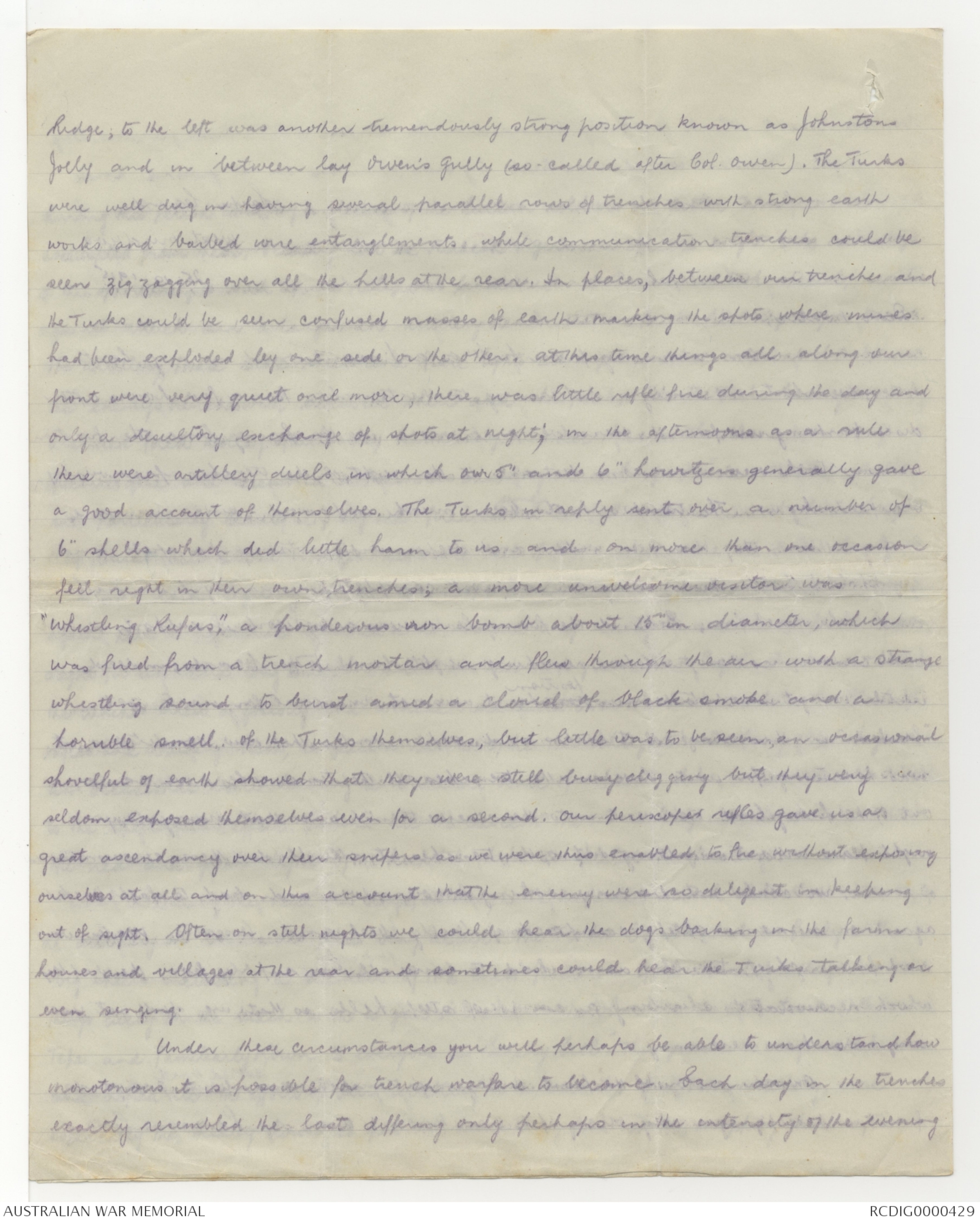
from us occupying a very strong position known to us as Lonesome Pine 


Ridge; to the left was another tremendously strong position known as Johnstons
Jolly and in between lay Owen's gully (so-called after Col. Owen). The Turks
were well dug in having several parallel rows of trenches with strong earth
works and barbed wire entanglements while communication trenches could be
seen zig zagging over all the hills at the rear. In places, between our trenches and
the Turks could be seen confused masses of earth marking the spots where mines.
had been exploded by one side or the other. At this time things all along our
front were very quiet once more, there was little rifle fire during the day and
only a desultory exchange of shots at night; in the afternoons as a rule
there were artillery duels in which our 5" and 6" howitzer generally gave
a good account of themselves. The Turks in reply sent over a number of
6" shells which did little harm to us and on more than one occasion
fell right in their own trenches, a more unwelcome visitor was.
"Whistling Rufus", a ponderous iron bomb about 15" in diameter, which
was fired from a trench mortar and flew through the air with a strange
whistling sound to burst amid a cloud of black smoke and a
horrible smell of the Turks themselves, but little was to be seen, an occasional
shovelful of earth showed that they were still busy digging but they very
seldom, exposed themselves even for a second. Our periscoped rifles gave us a
great ascendancy over their snipers as we were thus enabled to fire without exposing
ourselves at all and on this account that the enemy were so diligent in keeping
out of sight. Often on still nights we could hear the dogs barking in the farm
houses and villages at the rear and sometimes could hear the Turks talking or
even singing.
Under these circumstances you will perhaps be able to understand how
monotonous it is possible for trench warfare to become. Each day in the trenches
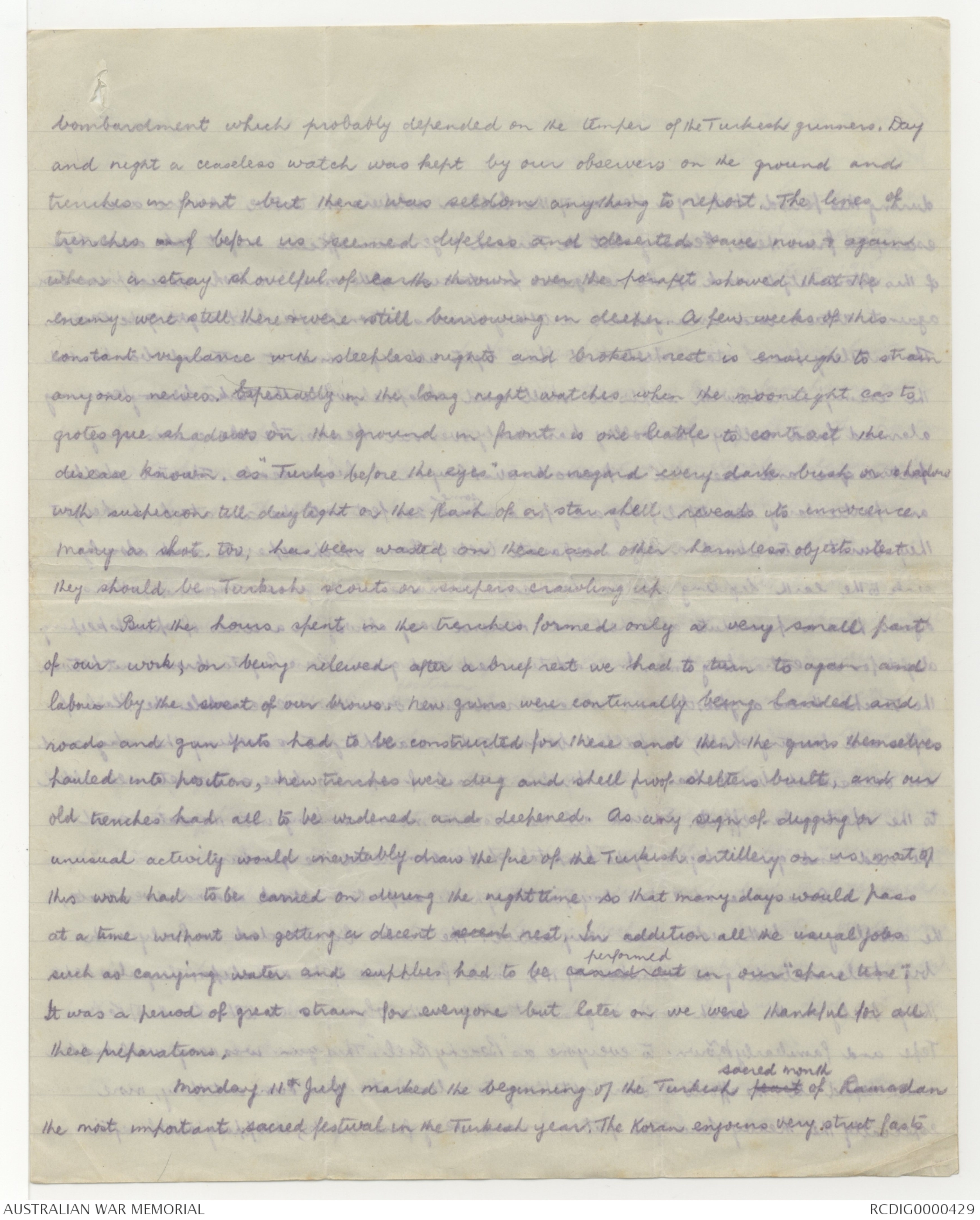
exactly resembled the last differing only perhaps in the intensity of the evening 


bombardment which probably depended on the temper of the Turkish gunners, Day
and night a ceaseless watch was kept by our observers on the ground and
trenches in front but there was seldom anything to report. The line of
trenches [[an?]] of before us seemed lifeless and deserted save now & again
when a stray shovelful of earth thrown over the parapet showed that the
enemy were still there & were still burrowing in deeper. A few weeks of this
constants vigilance with sleepless nights and broken rest is enough to strain
anyones nerves. Especially in the long night watches when the moonlight casts
grotesque shadows on the ground in front is one liable to contract the
disease known, as "Turks before the eyes" and regard every dark bush or shadow
with suspicion till daylight or the flash of a star shell revealss its innocence
many a shot too, has been wasted on these and other harmless objects lest
they should be Turkish scouts or snipers crawling up.
But the hours spent in the trenches formed only a very small part
of our work, on being relieved after a brief rest we had to turn to again and
labour by the sweat of our brows. New guns were continually being landed and
roads and gun pits had to be constructed for these and then the guns themselves
hauled into position, new trenches were dug and shell proof shelters built, and our
old trenches had all to be widened and deepened. As any sign of digging or
unusual activity would inevitably draw the fire of the Turkish, artillery on us most of
this work had to be carried on during the night time so that many days would pass
at a time without us getting a decent recent rest. In addition all the usual jobs
such as carrying water and supplies had to be carried out performed in our "spare time".
It was a period of great strain for everyone but later on we were thankful for all
these preparations.
Monday 11th July marked the beginning of the Turkish feast sacred month of Ramadan
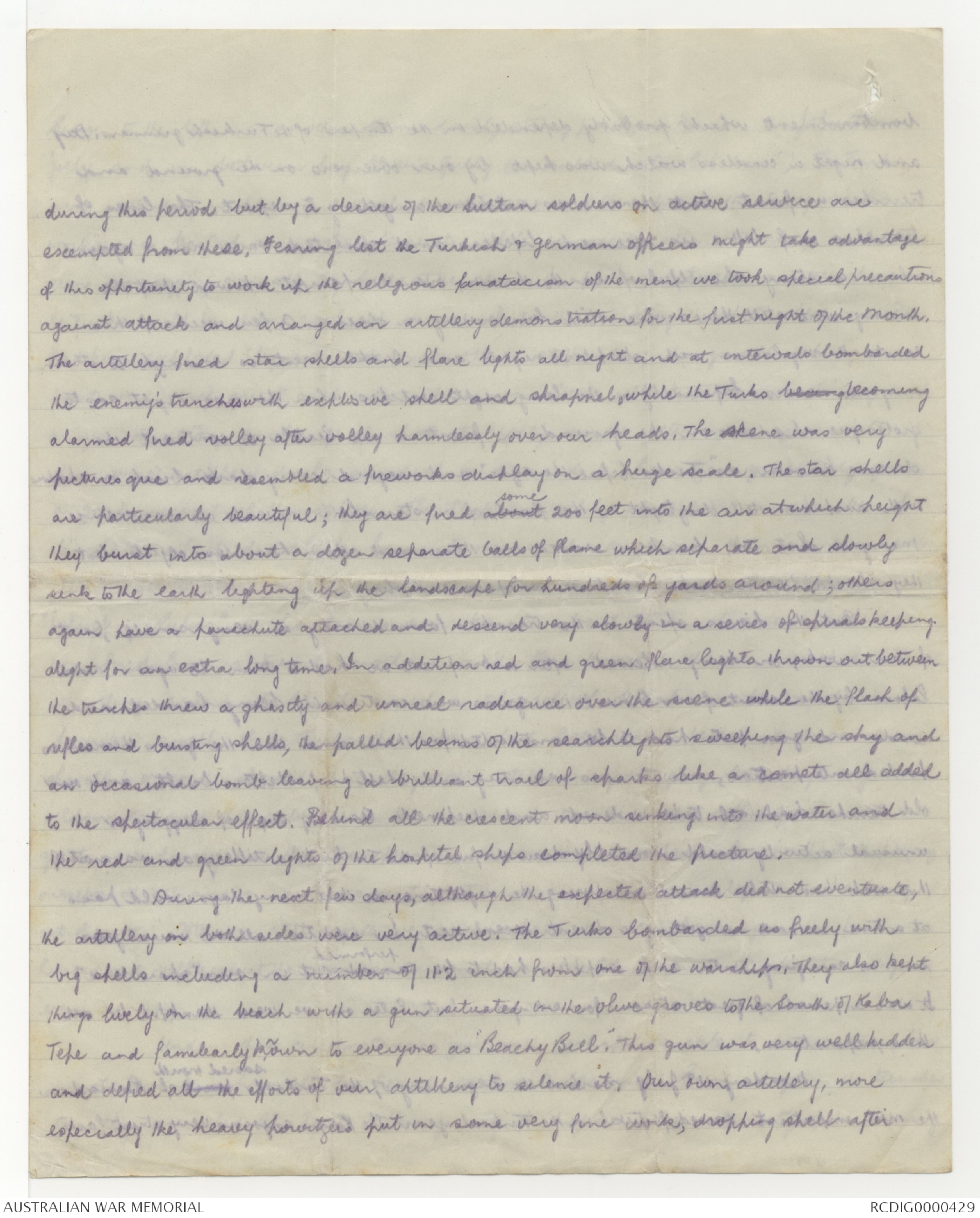
the most important sacred festival in the Turkish year. The Koran enjoins very strict fasts 


during this period but by a decree of the Sultan soldiers on active service are
exempted from these. Fearing lest the Turkish & german officers might take advantage
of this opportunity to work up the religious fanaticism of the men we took special precautions 
against attack and arranged an artillery demonstration for the first night of the month.
The artillery fired star shells and flare lights all night and at intervals bombarded
the enemy's trenches with explosive shell and shrapnel, while the Turks being becoming
alarmed fired volley after volley harmlessly over our heads. The scene was very
picturesque and resembled a fireworks display on a huge scale. The star shells
are particularly beautiful; they are fired about some 200 feet into the air at which height 
they burst into about a dozen separate balls of flame which separate and slowly
sink to the earth lighting up the landscape for hundreds of yards around; others.
again, have a parachute attached and descend very slowly in a series of spirals keeping.
alight for an extra long time. In addition red and green flare lights thrown out between
the trenches threw a ghastly and unreal radiance over the scene while the flash of
rifles and bursting shells, the palled beams of the searchlights sweeping the sky and
an occasional bomb leaving a brilliant trail of sparks like as comets all added
to the spectacular effect. Behind all the crescent moon sinking into the water and
the red and green & lights of the hospital ships, completed the picture.
During the next few days, although the expected attack did not eventuate,
the artillery on both sides were very active. The Turks bombarded us freely with
big shells including a number of 11.2 inch from one of the warships, they also kept
things lively on the beach with a gun situated in the olive groves to the South of Kaba
Tepe and Pamibarly known to everyone as "Beachy Bill". This gun was very well hidden
and defied all the efforts of our artillery to silence it. Our own artillery, more
especially the heavy howitzers put in some very fine work, dropping shell after 


right into the Turkish trenches; scattering sandbags, men and logs of wood over the
adjacent ground. The aeroplanes, too, were very busy scouting and occasionally
dropping bombs and never failing to draw the fire of the Turkish artillery. I have
seen as many as fifty shots fired at one of our aeroplanes in the course of half an
hours without damaging it, most of the shells bursting so far from the mark as to be
laughable.
The anniversary of the Turkish Constitution Day fell on Friday 23rd July and
as the Turks were known to have received large reinforcements it was beleived that they
intended to celebrate the day by making a fresh effort to drive us into the sea. Accordingly
we made very complete preparations to ensure them a warm reception. For two days
we lived with our rifles in our hands and our equipment on but to our great
disappointment the enemy again failed to come forth. In the meantime while
all these things were happening in the trenches the engineers of both sides were
were slowly and persisently burrowing and tunnelling towards each other.
In favourable spots the ground between the lines was honeycombed with a maze
of saps and counter saps. It was a matter of almost daily occurrence to feel
a slight quiver of the ground and hear a dull rumble as a mine was
exploded. Sometimes the Turks blew in one of our saps; more often we blew up
the Turks. With the object of locating the enemy's works dozens of saps were put in
with numerous galleries and off shoots and at the pace of each sat a
"listener" who duty it was to listen for sounds of the enemy's diggers. It is
rather an eerie business, this, sitting at the sap head listening to your enemy
digging perhaps, only a few feet away and calculating whether he would
break through on you or not. When it was deemed that the saps were close
enough a charge of explosive would be packed in and the mine exploded 

 
Last edited by:
D CoatesD Coates
Last edited on:

Last updated: