
Letters from Frederick Warren Muir, 1914-1915 - Part 2
Eden Palace Hotel
CAIRO 'EGYPT'
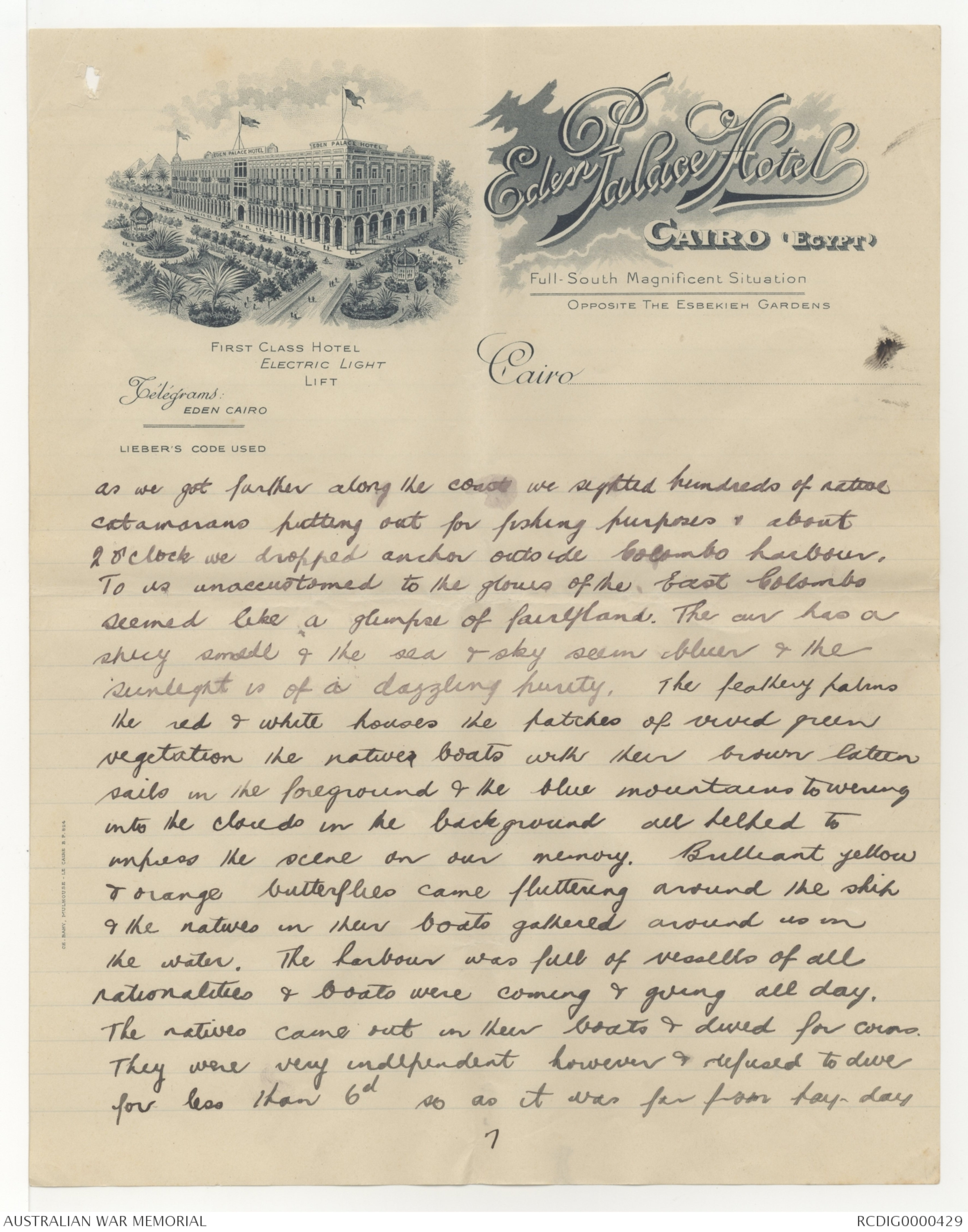
as we got further along the coast we sighted hundreds of native
catamarans putting out for fishing purposes & about
2 o'clock we dropped anchor outside Colombo harbour.
To us unaccustomed to the glories of the East Colombo
seemed like a glimpse of fairyland. The air has a
spicy smell & the sea & sky seem bluer & the
sunlight is of a dazzling purity. The feathery palms
the red & white houses the patches of vivid green
vegetation the native boats with their brown lateen
sails in the foreground & the blue mountains towering
into the clouds in the background all helped to
impress the scene on our memory. Brilliant yellow
& orange butterflies came fluttering around the ship
& the natives in their boats gathered around us in
the water. The harbour was full of vessels of all
nationalities & boats were coming & going all day.
The natives came out in their boats & dived for coins.
They were very independent however & refused to dive
for less than 6d so as it was far from pay-day
7
Eden Palace Hotel
CAIRO 'EGYPT'
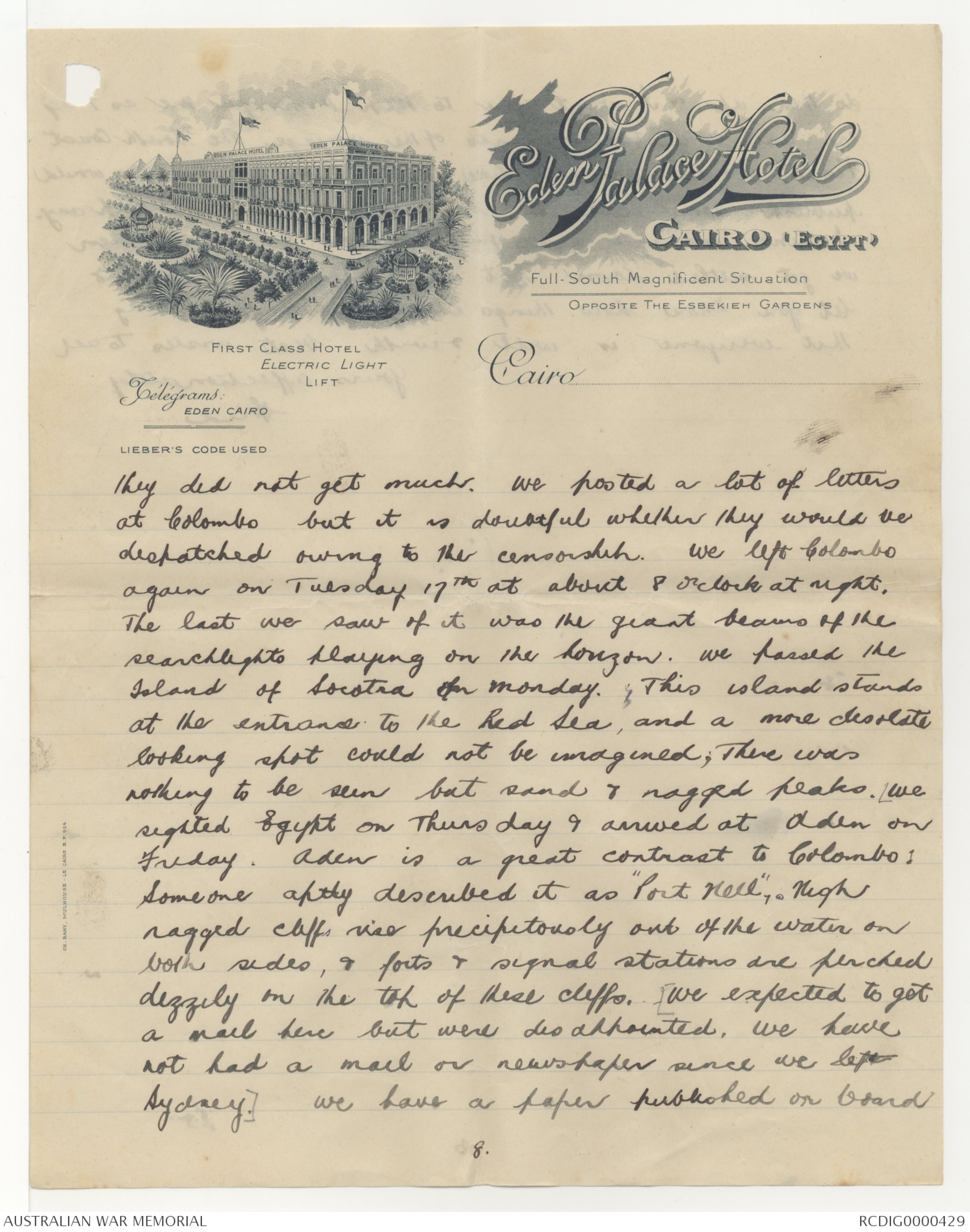
they did not get much. we posted a lot of letters
at Colombo but it is doubtful whether they would be
dispatched owing to the censorship. We left Colombo
again on Tuesday 17th at about 8 o'clock at night.
The last we saw of it was the giant beams of the
searchlights playing on the horizon. We passed the
Island of Socotra on Monday. This island stands
at the entrance to the Red Sea, and a more desolate
looking spot could not be imagined. There was
nothing to be seen but sand & ragged peaks. [We
sighted Egypt on Thursday & arrived at Aden on
Friday. Aden is a great contrast to Colombo.
Someone aptly described it as "Port Hell". High
ragged cliff rise precipitously out of the water on
both sides, & forts & signal stations are perched
dizzily on the top of these cliffs. [We expected to get
a mail here but were disappointed. We have
not had a mail or newspaper since we left
Sydney.] we have a paper published on board
8.
Eden Palace Hotel
CAIRO 'EGYPT'
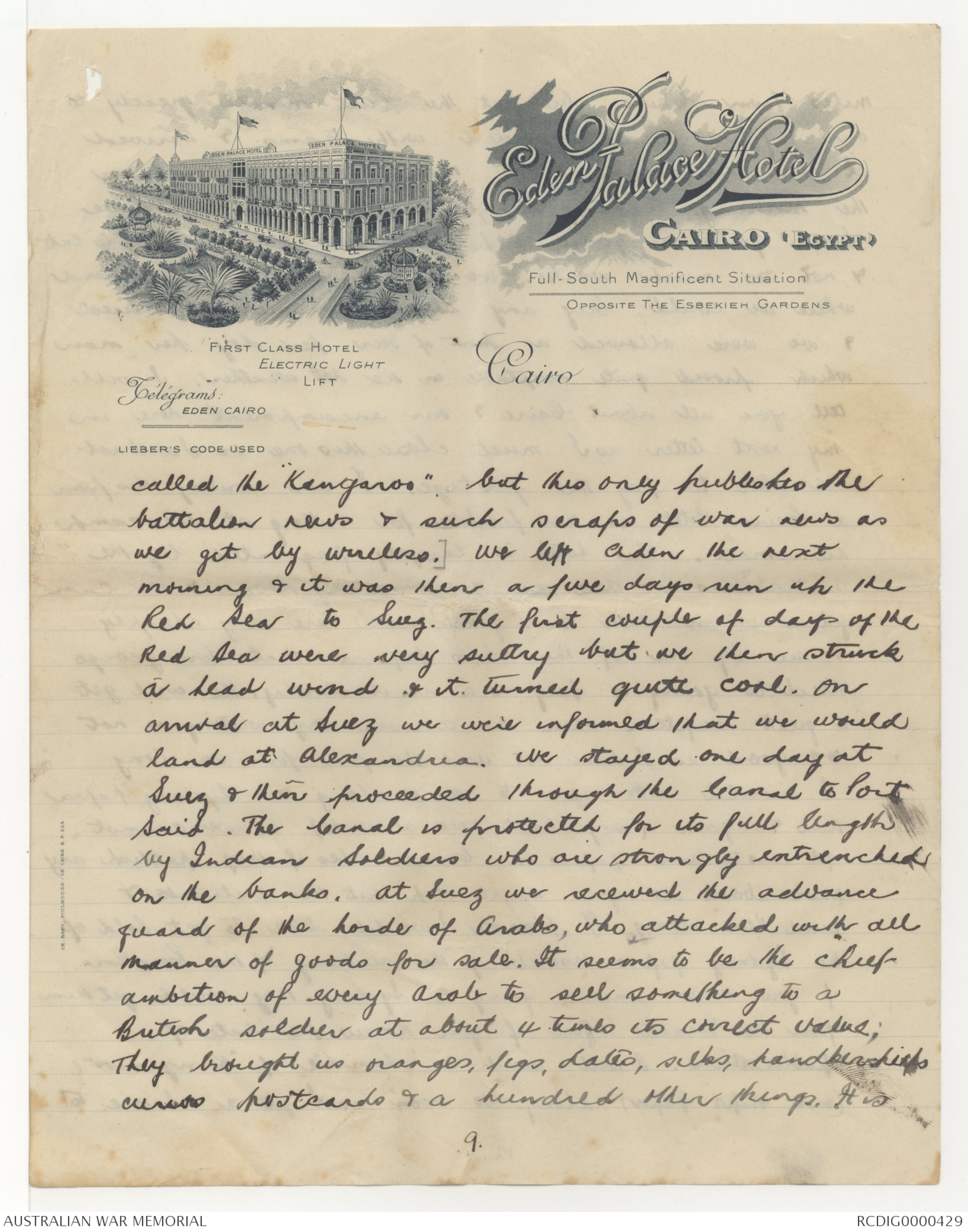
called the "Kangaroo". but this only publishes the
battalion news & such scraps of war news as
we get by wireless.] We left Aden the next
morning & it was then a five days run up the
Red Sea to Suez. The first couple of days of the
Red Sea were very sultry but we then struck
a head wind & it turned quite cool. On
arrival at Suez we were informed that we would
land at Alexandria. We stayed one day at
Suez & then proceeded through the Canal to Port
Said. The Canal is protected for its full length
by Indian Soldiers who are strongly entrenched
on the banks. At Suez we received the advance
guard of the horde of Arabs, who attacked with all
manner of goods for sale. It seems to be the chief
ambition of every Arab to sell something to a
British soldier at about 4 times its correct value.
They brought us oranges, figs, dates, silks, handkerchiefs
curios postcards & a hundred other things. It is
9.
Eden Palace Hotel
CAIRO 'EGYPT'
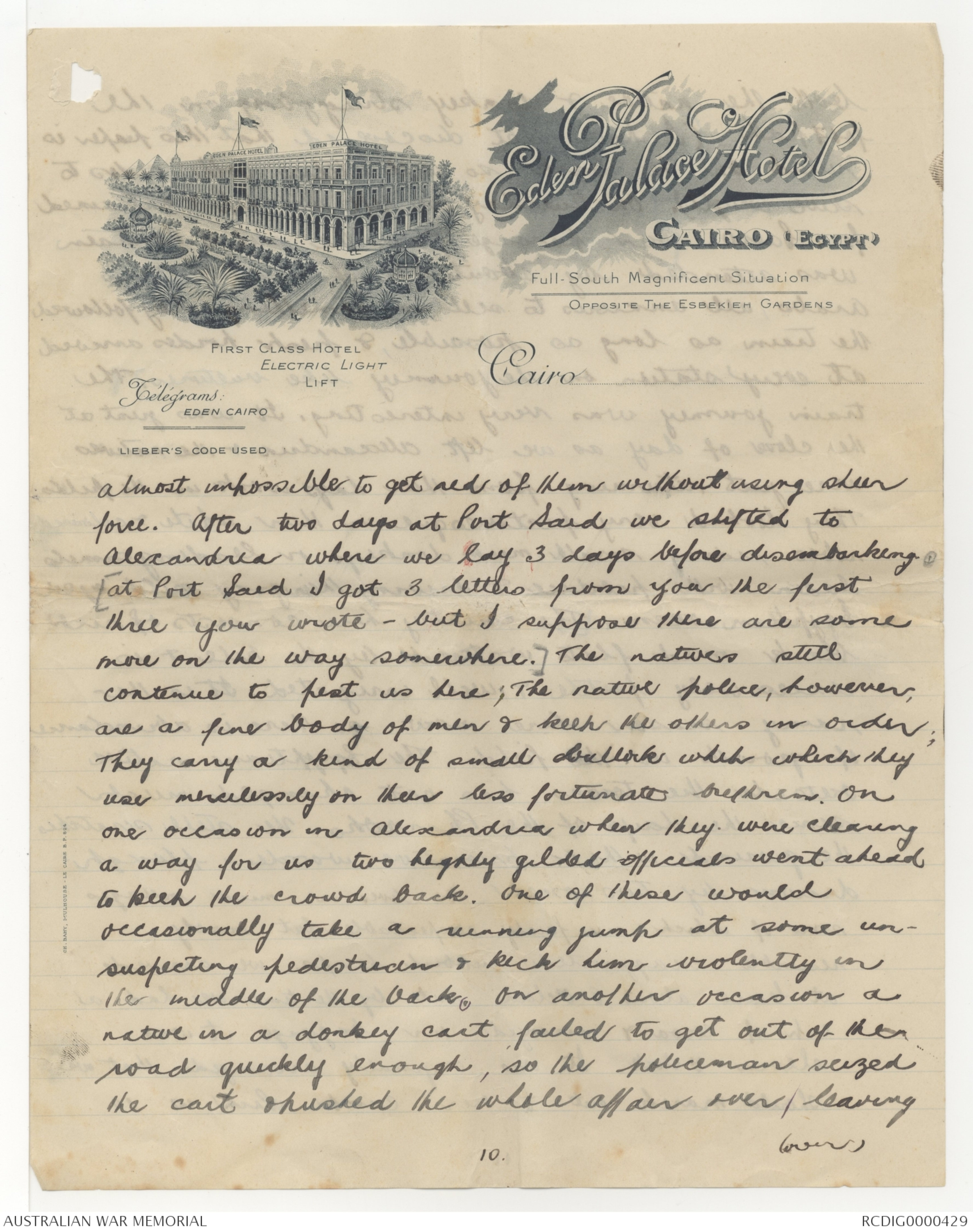
almost impossible to get rid of them without using sheer
force. After two days at Port Said we shifted to
Alexandria where we lay 3 days before disembarking.
[at Port Said I got 3 letters from you the first
three you wrote - but I suppose there are some
more on the way somewhere.] The natives still
continue to pest us here. The native police, however,
are a fine body of men & keep the others in order.
They carry a kind of small bullock with which they
use mercilessly on their less fortunate brethren. On
one occasion in Alexandria when they were clearing
a way for us two highly gilded officers went ahead
to keep the crowd back. One of these would
occasionally take a running jump at some unsuspecting
pedestrian & kick him violently in
the middle of the back. On Another occasion a
native in a donkey cart failed to get out of the
road quickly enough, so the policeman seized
the cart & pushed the whole thing over, leaving
(over)
10.
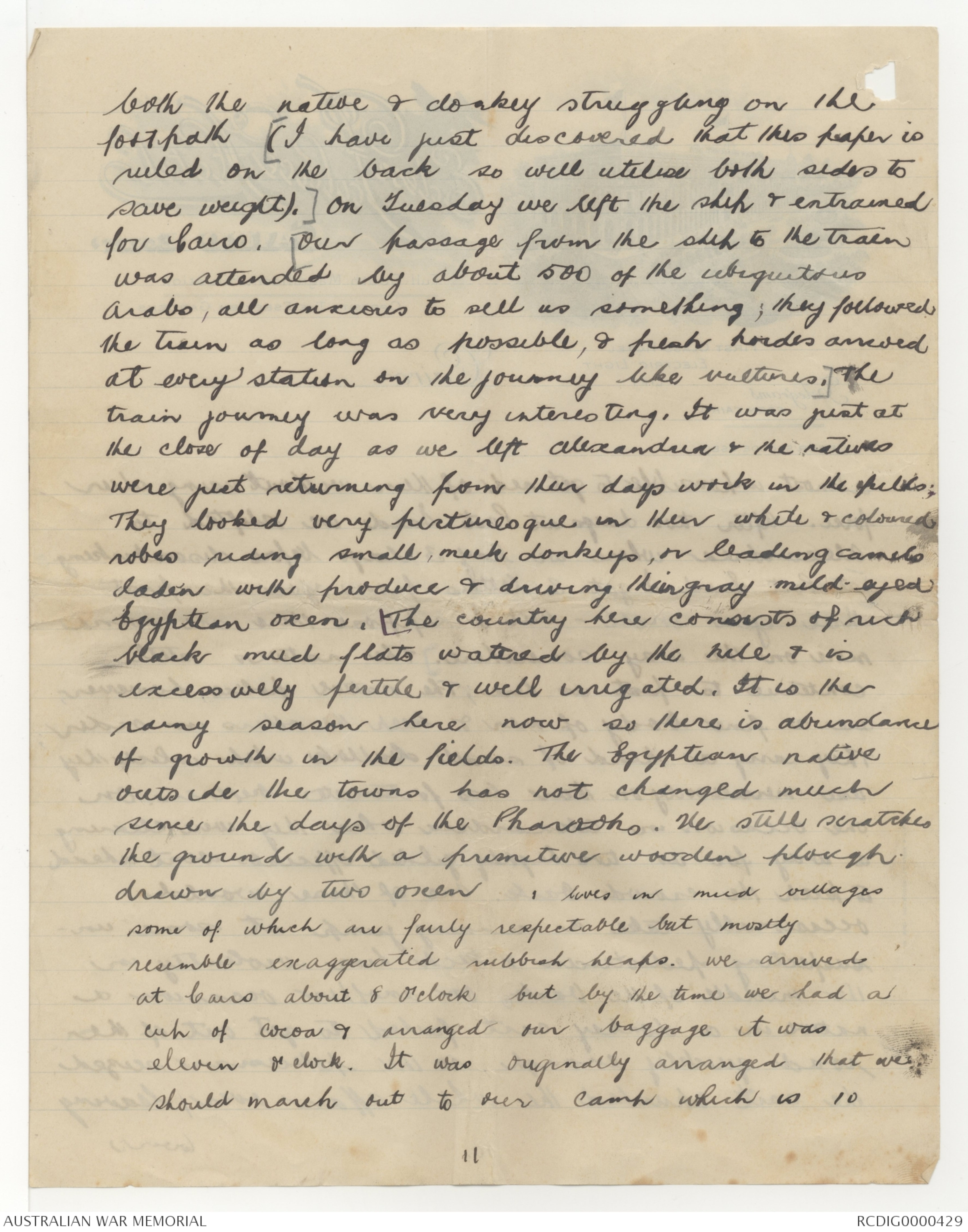
both the native & donkey struggling on the
footpath [(I have just discovered that this paper is
ruled on the back so will utilise both sides to
save weight).] On Tuesday we left the ship & entrained
for Cairo. [Our passage from the ship to the train
was attended by about 500 of the ubiquitous
Arabs, all anxious to sell us something, they followed
the train as long as possible, & fresh hordes arrived
at every station on the journey like vultures.] The
train journey was very interesting. It was just at
the close of day as we left Alexandria & the natives
were just returning from their days work in the fields.
They looked very picturesque in their white & coloured
robes riding small, meek donkeys, or leading camels
laden with produce & driving their gray mild-eyed
Egyptian oxen. [The country here consists of rich
black mud flats watered by the Nile & is
excessively fertile & well irrigated. It is the
rainy season here now so there is abundance
of growth in the fields. The Egyptian native
outside the towns has not changed much
since the days of the Pharaohs. He still scratches
the ground with a primitive wooden plough
drawn by two oxen, lives in mud villages
some of which are fairly respectable but mostly
resemble exaggerated rubbish heaps. we arrived
at Cairo about 8 o'clock but by the time we had a
cup of cocoa & arranged our baggage it was
eleven o'clock. It was originally arranged that we
should march out to our camp which is 10
11
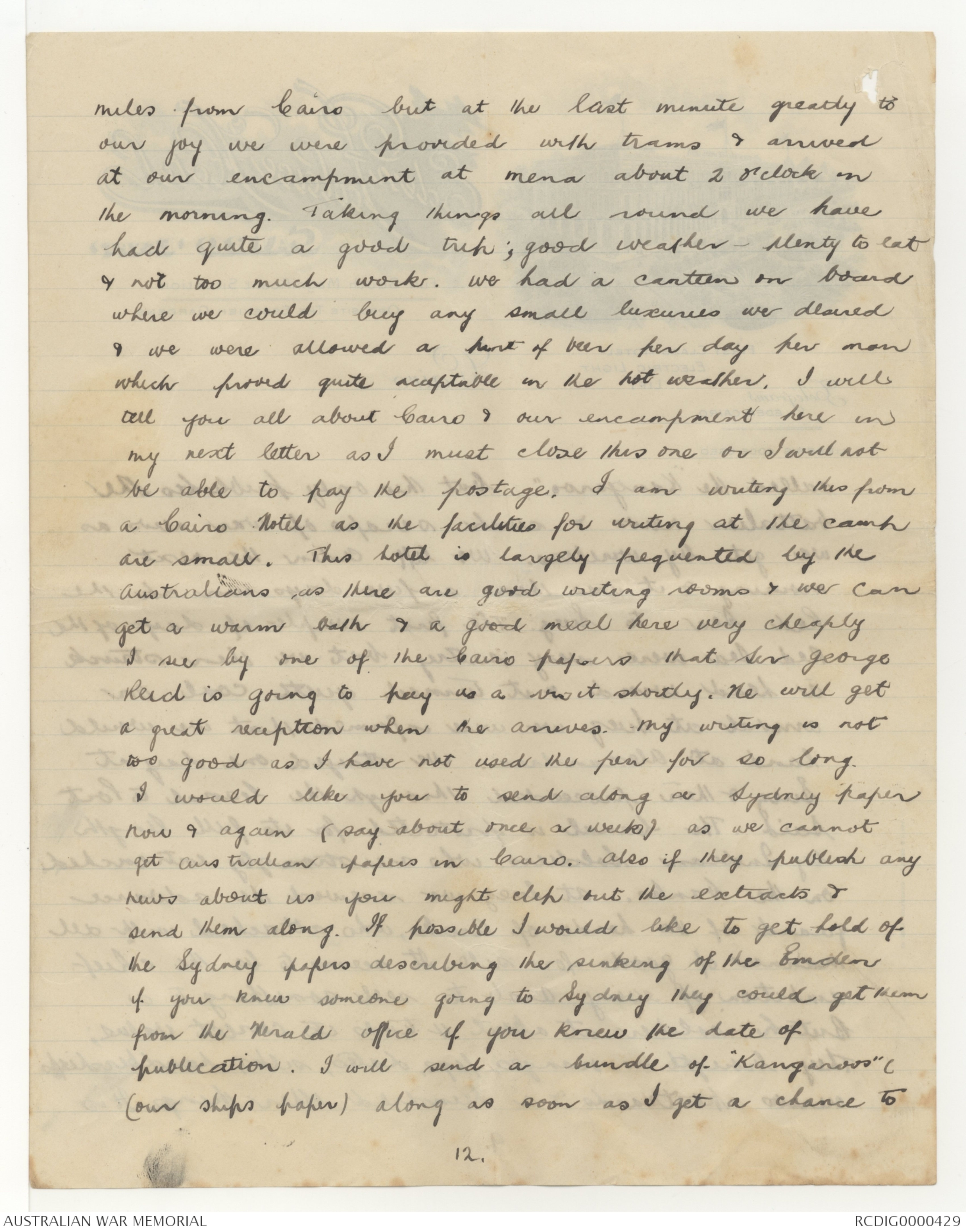
miles from Cairo but at the last minute greatly to
our joy we were provided with trams & arrived
at our encampment at Mena about 2 o'clock in
the morning. Taking things all round we have
had quite a good trip; good weather - plenty to eat
& not too much work. We had a canteen on board
where we could buy any small luxuries we desired
& we were allowed a pint of beer per day per man
which proved quite acceptable in the hot weather. I will
tell you all about Cairo & our encampment here in
my next letter as I must close this one or I will not
be able to pay the postage. I am writing this from
a Cairo Hotel as the facilities for writing at the camp
are small. This hotel is largely frequented by the
Australians as there are good writing rooms & we can
get a warm bath & a good meal here very cheaply
I see by one of the Cairo papers that Sir George
Reid is going to pay us a visit shortly. He will get
a great reception when he arrives. My writing is not
too good as I have not used the pen for so long.
I would like you to send along a Sydney paper
now & again (say about once a week) as we cannot
get Australian papers in Cairo. Also if they publish any
news about us you might clip out the extracts &
send them along. If possible I would like to get hold of
the Sydney papers describing the sinking of the Emden
if you knew someone going to Sydney they could get them
from the Herald office if you knew the date of
publication. I will send a bundle of "Kangaroos"
(our ships paper) along as soon as I get a chance to
12.
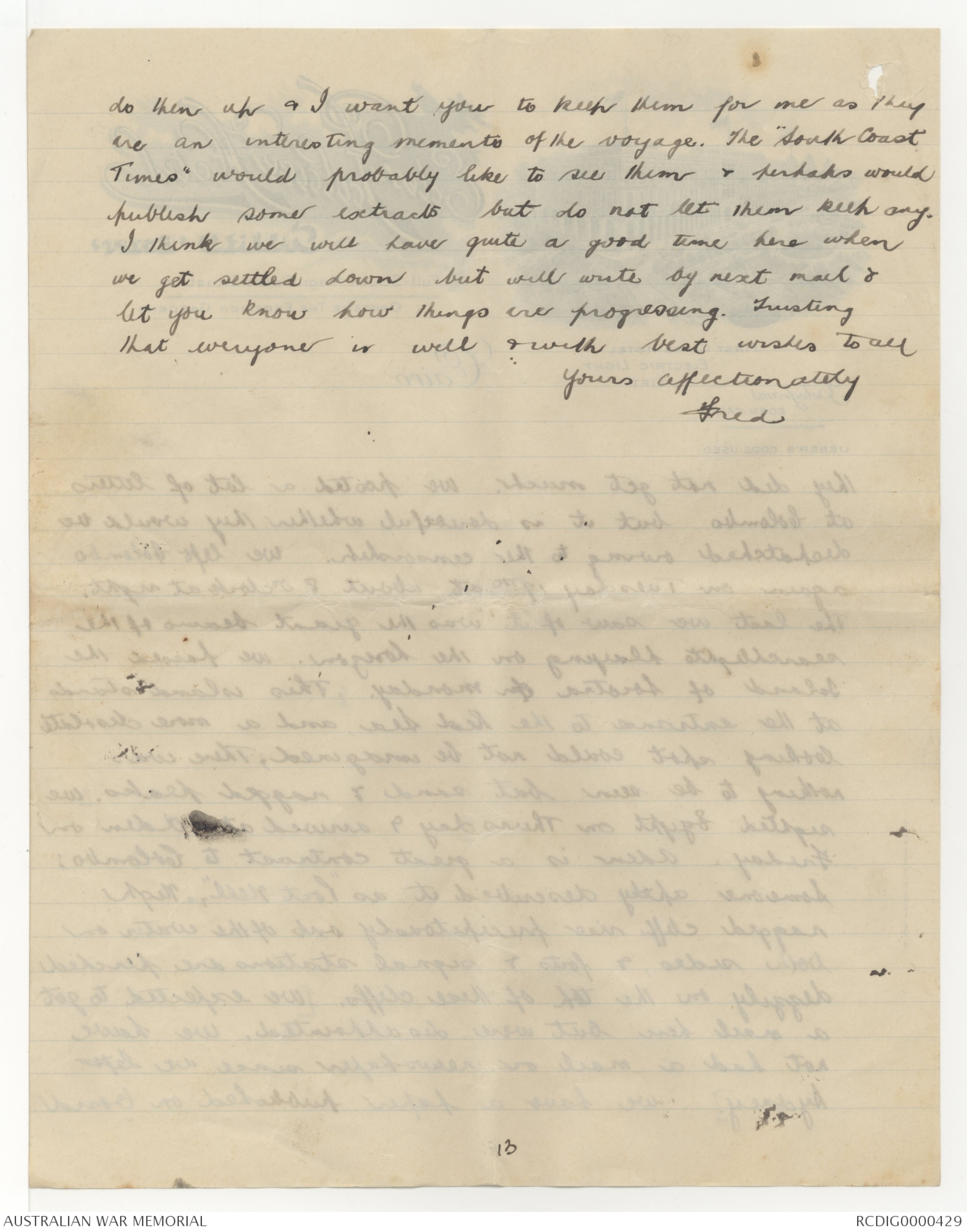
do them up & I want you to keep them for me as they
are an interesting memento of the voyage. The "South Coast
Times" would probably like to see them & perhaps would
publish some extracts but do not let them keep any.
I think we will have quite a good time here when
we get settled down but will write by next mail &
let you know how things are progressing. Trusting
that everyone is well & with best wishes to all
Yours affectionately
Fred
13
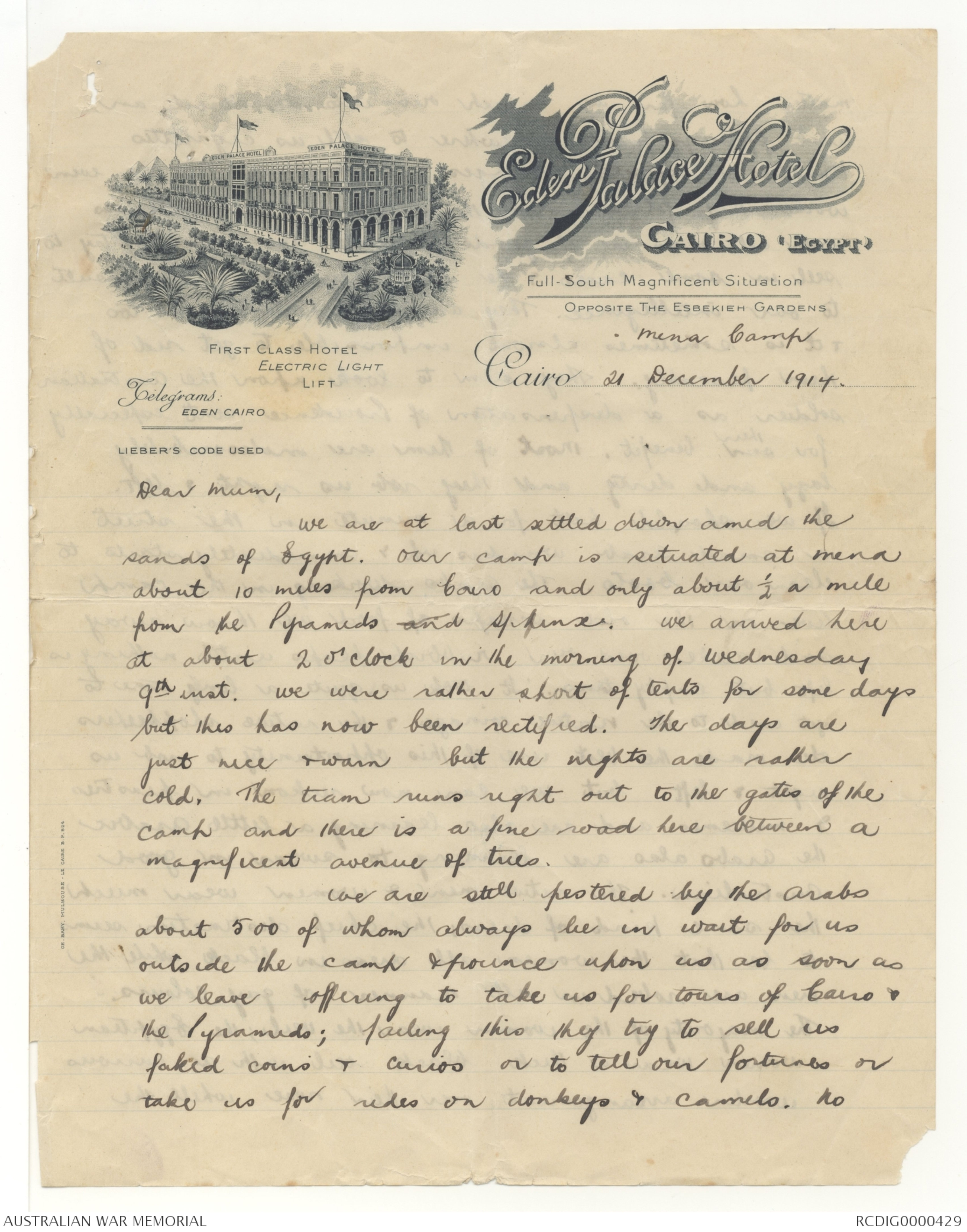
Eden Palace Hotel
CAIRO 'EGYPT'
Mena Camp
Cairo 21 December 1914.
Dear Mum,
we are at last settled down amid the
sands of Egypt. Our camp is situated at Mena
about 10 miles from Cairo and only about ½ a mile
from the Pyramids and Sphinx. we arrived here
at about 2 o'clock in the morning of Wednesday
9th inst. we were rather short of tents for some days
but this has been rectified. The days are
just nice & warm but the nights are rather
cold. The tram was right out to the gates of the
camp and there is a fine road here between a
magnificent avenue of trees.
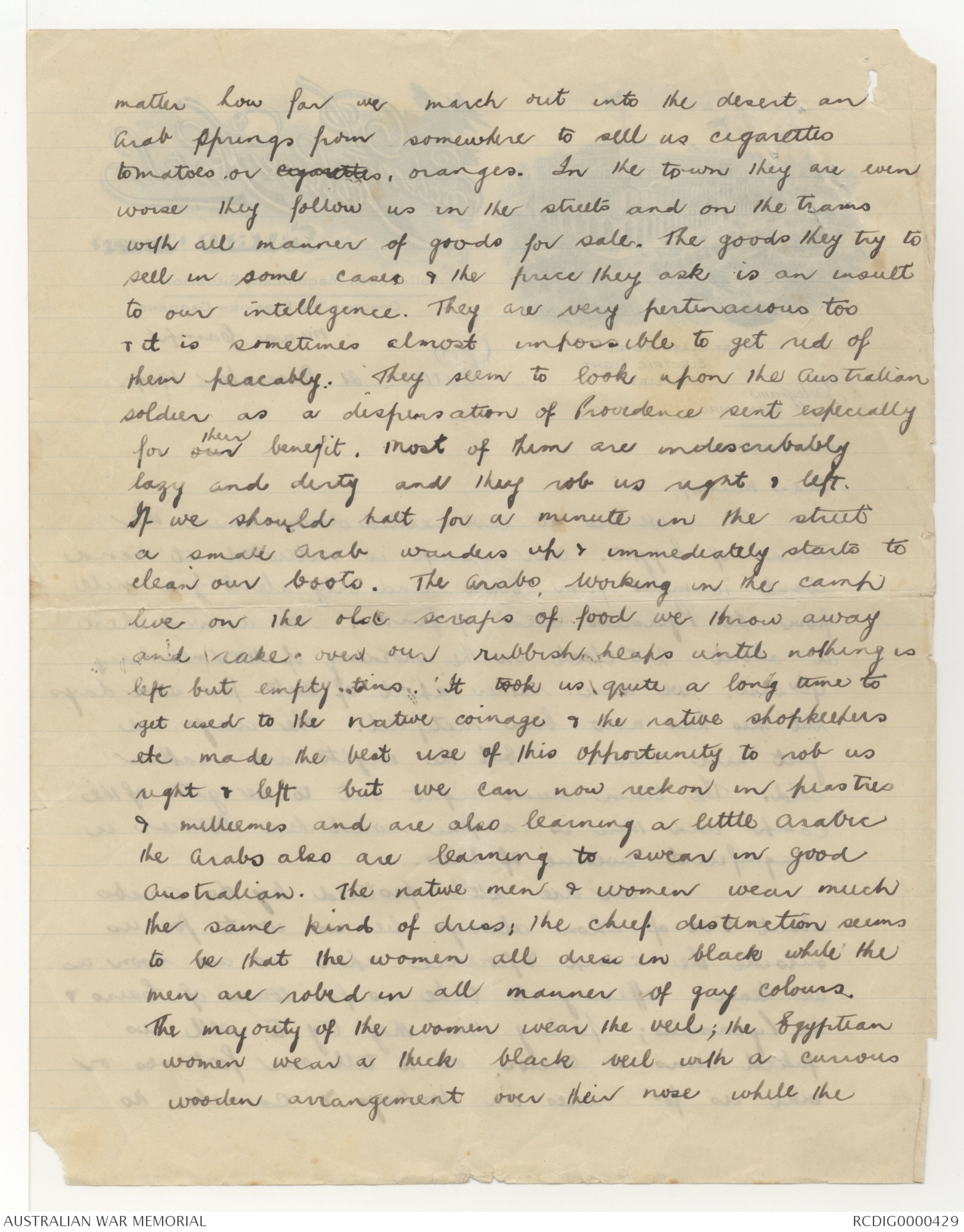
We are still pestered by the Arabs
about 500 of whom always lie in wait for us
outside the camp & pounce upon us as soon as
we leave offering to take us for tours of Cairo &
the Pyramids; failing this they try to sell us
faked coins & curios or to tell our fortunes or
take us for rides on donkeys & camels. no
matter how far we march out into the desert an
Arab springs from somewhere to sell us cigarettes
tomatoes or cigarettes, oranges. In the town they are even
worse they follow us in the streets and on the trams
with all manner of goods for sale. The goods they try to
sell in some cases & the price they ask is an insult
to our intelligence. They are very pertinacious too
& it is sometimes almost impossible to get rid of
them peacably. They seem to look upon the Australian
soldier as a dispensation of Providence sent especially
for our their benefit. Most of them are indescribably
lazy and dirty and they rob us right & left.
If we should halt for a minute in the street
a small Arab wanders up & immediately starts to
clean our boots. The Arabs working in the camp
live on the old scraps of food we throw away
and rake over our rubbish heaps until nothing is
left but empty tins. It took us quite a long time to
get used to the native coinage & the native shopkeepers
etc made the best use of this opportunity to rob us
right & left but we can now reckon in piastres
& milliemes and we are also learning a little Arabic
The Arabs also are learning to swear in good
Australian. The native men & women wear much
the same kind of dress; the chief distinction seems
to be that the women all dress in black while the
men are robed in all manner of gay colours.
The majority of the women wear the veil; the Egyptian
women wear a thick black veil with a curious
wooden arrangement over their nose while the
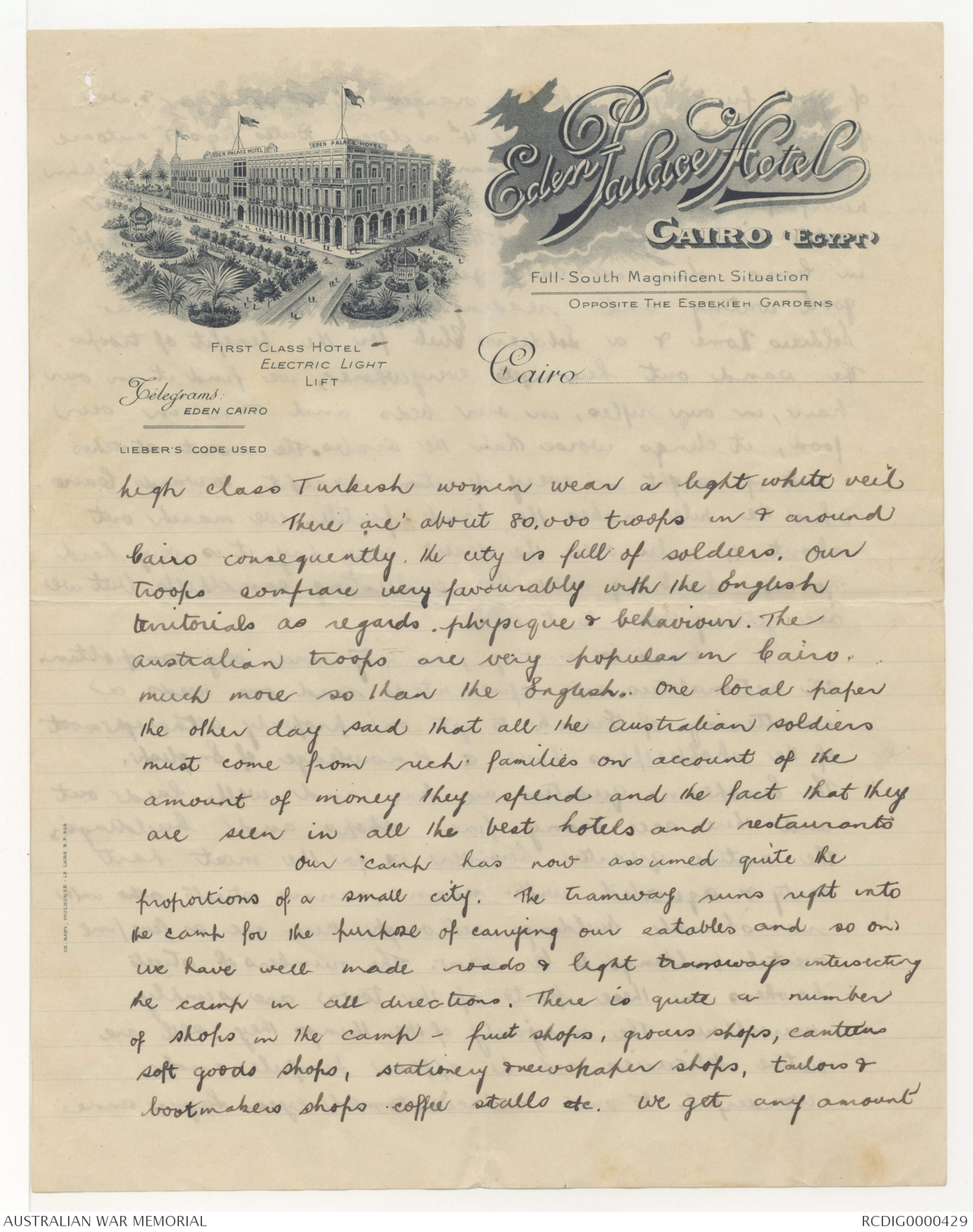
Eden Palace Hotel
CAIRO 'EGYPT'
high class Turkish women wear a light white veil
There are about 80,000 troops in & around
Cairo consequently the city is full of soldiers. Our
troops compare very favourably with the English
territorials as regards physique & behaviour. The
Australian troops are very popular in Cairo
much more so than the English. One local paper
the other day said that all the Australian soldiers
must come from rich families on account of the
amount of money they spend and the fact that they
are seen in all the best hotels and restaurants
Our camp has now assumed quite the
proportions of a small city. The tramway runs right into
the camp for the purpose of carrying our eatables and so on.
we have well made roads & light tramways intersecting
the camp in all directions. There is quite a number
of shops in the camp - fruit shops, grocers shops, canteens
soft goods shops, stationery & newspaper shops, tailors &
bootmakers shops coffee stalls etc. we get any amount
 D Coates
This transcription item is now locked to you for editing. To release the lock either Save your changes or Cancel.
This lock will be automatically released after 60 minutes of inactivity.