
Diary of Frederick Warren Muir, 1915 - Part 2
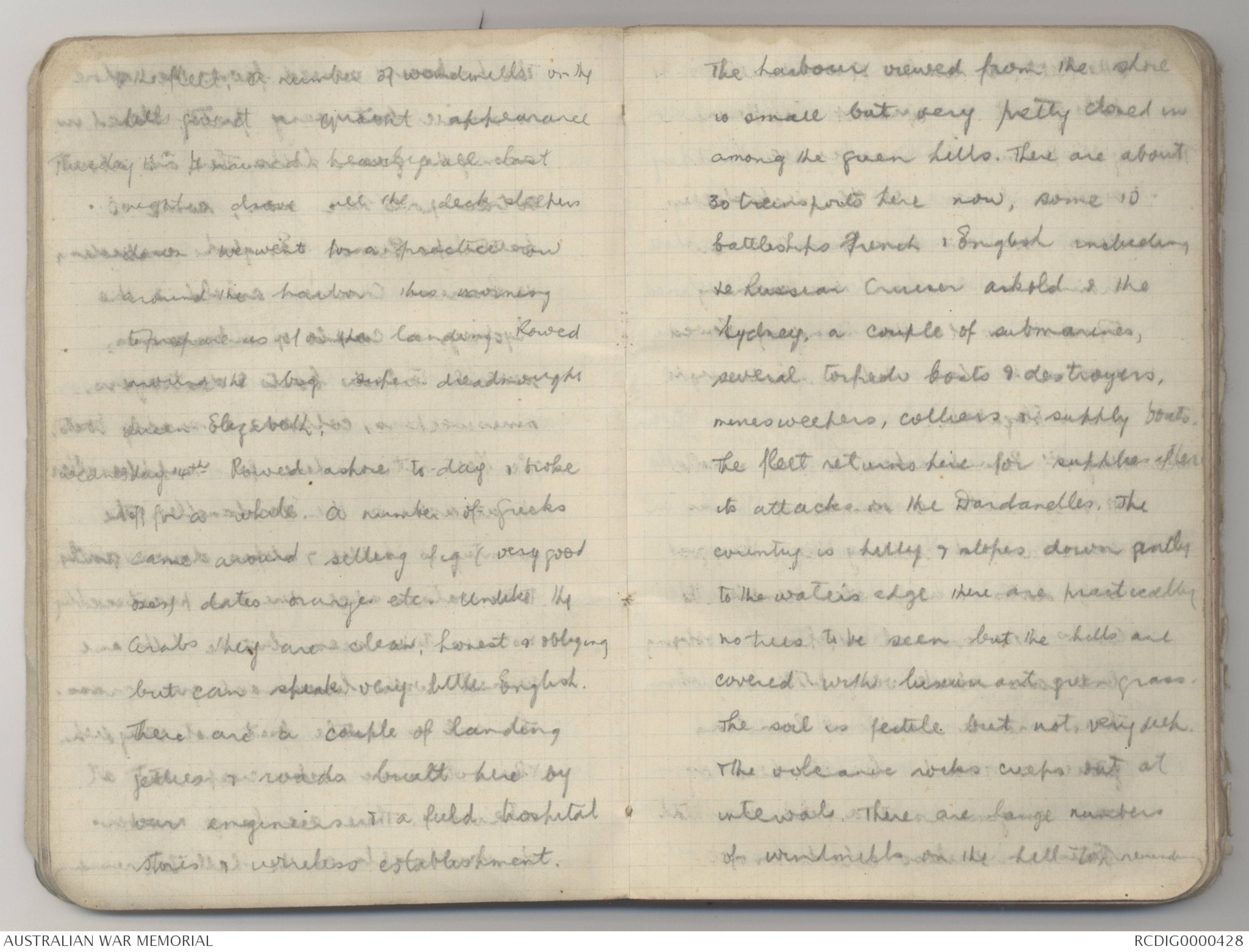
the Kell, a number of windmills on the
hills gave it a quaint appearance
Tuesday 13th It rained heavily all last
night & drove all the deck sleepers
down we went for a practice row
around the harbor this morning
to prepare us for the landings. Rowed
round the big super dreadnought
Queen Elizabeth.
Wednesday 14th Rowed ashore to day & broke
off for a while. A number of Greeks
came around selling fig (very good
ones) dates oranges etc. Unlike the
Arabs they are clean, honest & obliging
but can speak very little English.
There are a couple of landing
jetties & roads built here by
our engineers & a field hospital
stores & wireless establishment.
The harbour viewed from the shore
is small but very pretty closed in
among the green hills. There are about
30 transports here now, some 10
battleships French & English including
the Russian Cruiser arkold & the
Sydney, a couple of submarines,
several torpedo boats & destroyers,
minesweepers, colliers & supply boats.
The fleet returns here for supplies after
its attacks on the Dardanelles. The
country is hilly & slopes down gently
to the water's edge there are practically
no trees to be seen but the hills are
covered with luxuriant green grass.
The soil is fertile but not very deep.
The volcanic rocks creeps out at
intervals. There are large numbers
of windmills on the hill top reminding
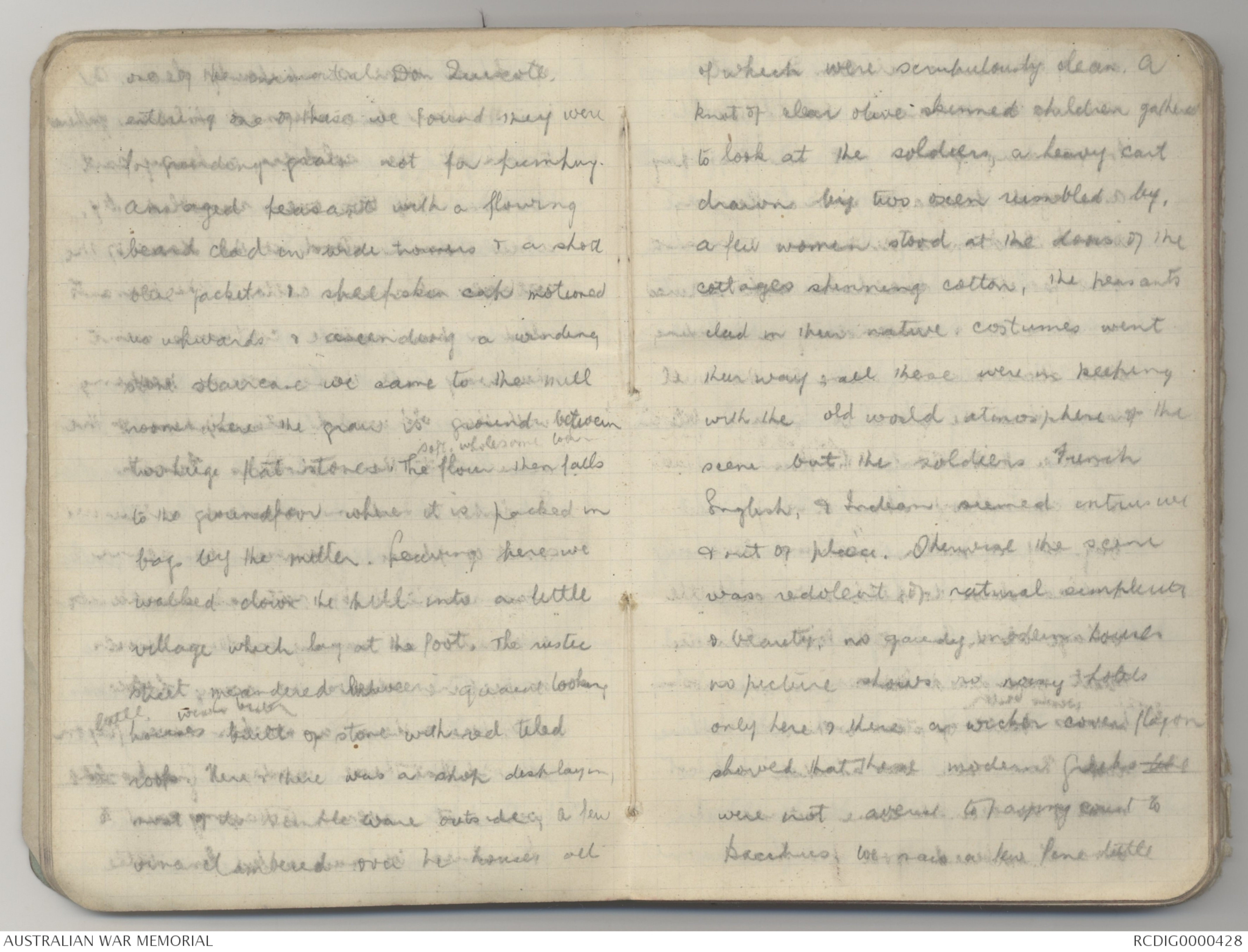
one of the immortal Don Quixote,
entering one of these we found they were
for garden purposes not for pumping.
An aged peasant with a flowing
beard clad in wide trousers & a short
black jacket & sheepskin cap motioned
us upwards & ascending a winding
stone staircase we came to the mill
room where the grain is ground between
two huge flat stones. The soft wholesome corn flour then falls
to the ground floor where it is packed in
bags by the miller. Leaving here we
walked down the hill into a little
village which lay at the foot. The rustic
street meandered between quaint looking
little houses weather beaten built of stone with red tiled
roofs. Here & there was a shop displaying
most of the humble ware outside. A few
vines clambered over the houses all
of which were scrupulously clean. A
knot of clean olive skinned children gathered
to look at the soldiers, a heavy cart
drawn by two oxen rumbled by.
A few women stood at the doors of the
cottages spinning cotton, the peasants
clad in their native costumes went
their way & all these were in keeping
with the old world atmosphere of the
scene but the soldiers French
English, & Indian seemed intrusive
& out of place. Otherwise the scene
was redolent of natural simplicity
& beauty, no gaudy, modern houses
no picture shows no noisy hotels
only here & there a wicker covered flagon
showed that these modern Greeks like
were not averse to paying court to
Bachus. We saw a few fine little
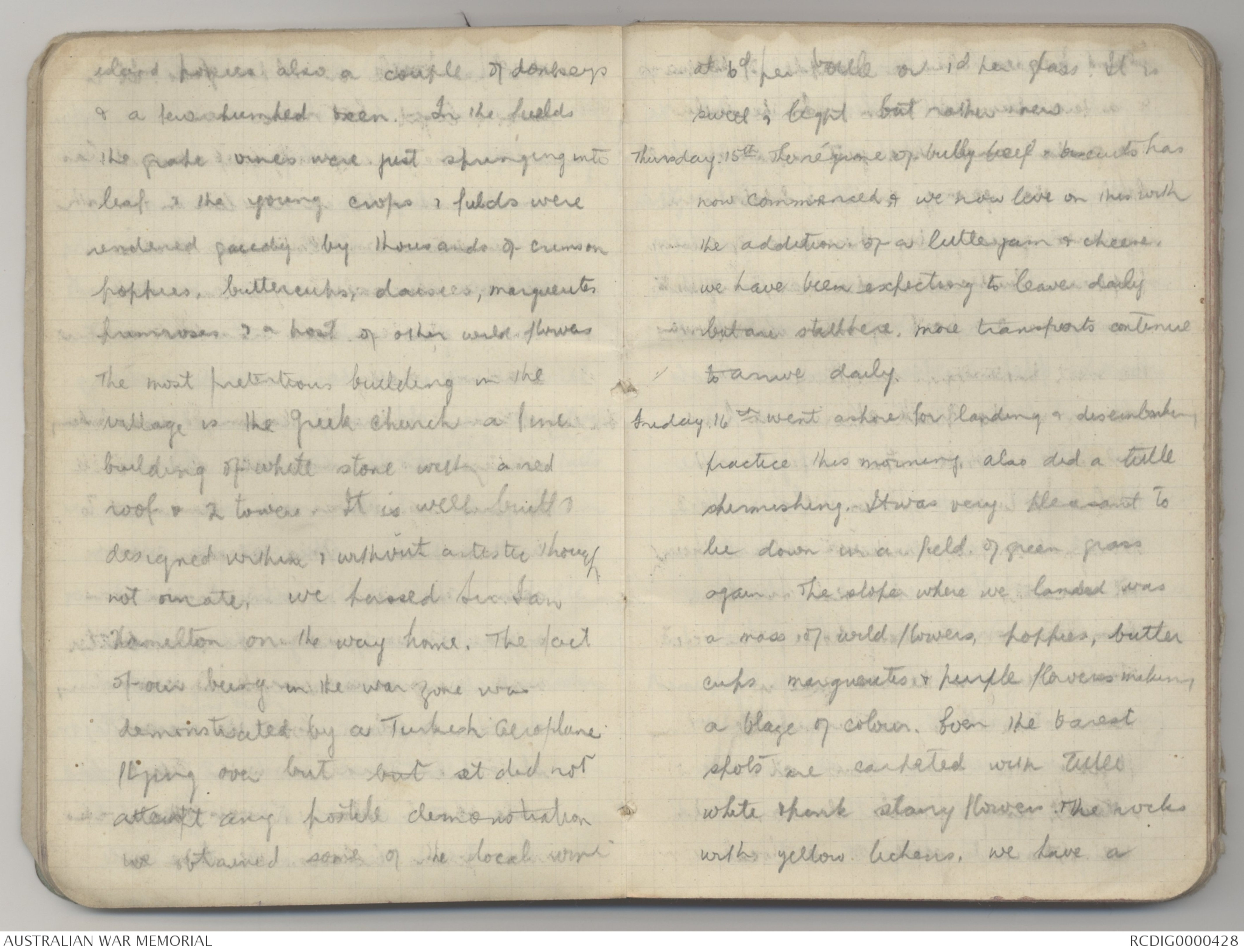
island ponies also a couple of donkeys
& a few humped oxen. In the fields
the grape vines were just springing into
leaf & the young crops & fields were
rendered gaudy by thousands of crimson
poppies, buttercups, daisies, marguerites
primroses & a host of other wild-flowers.
The most pretentious building in the
village is the Greek church a fine
building of white stone with a red
roof & 2 towers. It is well built &
designed within & without artistic though
not ornate. We passed Sir Ian
Hamilton on the way home. The fact
of our being in a war zone was
demonstrated by a Turkish Aeroplane
flying over but but it did not
attempt any hostile demonstration
we obtained some of the local wine
at 6d. per bottle or 1d. per glass. It is
sweet & light but rather new.
Thursday 15th The régime of bully beef & biscuits has
now commenced & we now live on this with
the addition of a little jam & cheese.
We have been expecting to leave daily
but are still here, more transports continue
to arrive daily.
Friday 16th Went ashore for landing & disembarking
practice this morning, also did a little
skirmishing. It was very pleasant to
lie down in a field of green grass
again. The slope where we landed was
a mass of wild flowers, poppies, buttercups,
marguerites & purple flowers making
a blaze of colour. Even the barest
spots are carpeted with little
white & pink starry flowers. The rocks
with yellow lichens. We have a
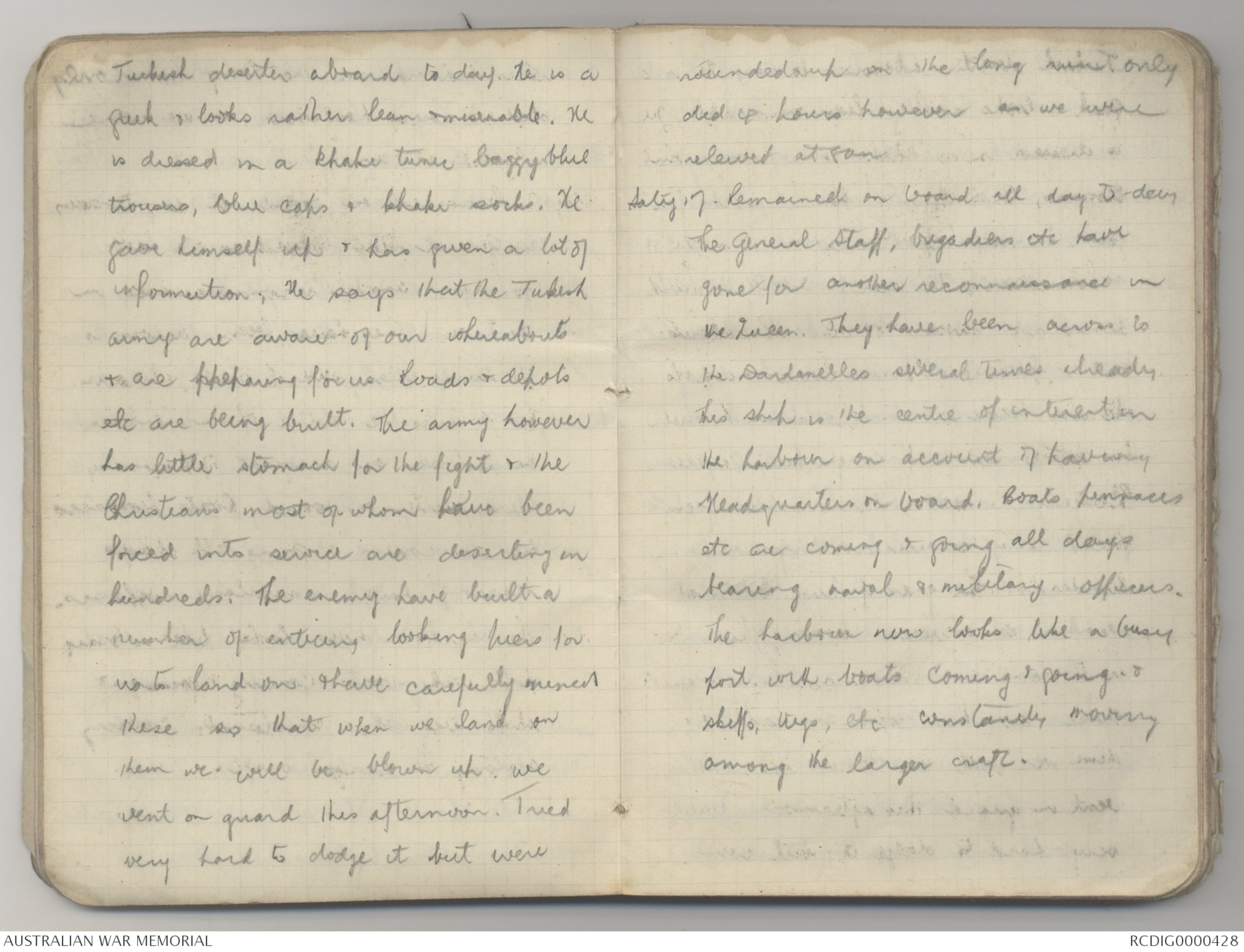
Turkish deserter aboard to day. He is a
Greek & looks rather lean & miserable. He
is dressed in a khaki tunic baggy blue
trousers, blue caps & khaki socks. He
gave himself up & has given a lot of
information. He says that the Turkish
army are aware of our whereabouts
& are preparing for us. Roads & depots
etc are being built. The army however
has little stomach for the fight & the
Christians most of whom have been
forced into service are deserting in
hundreds. The enemy have built a
number of enticing looking piers for
us to land on & have carefully mined
these so that when we land on
them we will be blown up. We
went on guard this afternoon. Tried
very hard to dodge it but were
rounded up on the long run. Only
did 4 hours however as we were
releived at 8am.
Saty 17. Remained on board all day to-day
The General Staff, Brigadier etc have
gone for another reconnaissance in
the Queen. They have been across to
the Dardanelles several times already.
This ship is the centre of interest in
the harbour on account of having
Headquarters on board. Boats pinnaces
etc are coming & going all days
leaving naval & military officers.
The harbour now looks like a busy
port with boats coming & going &
skiffs, tugs, etc constantly moving
among larger craft.
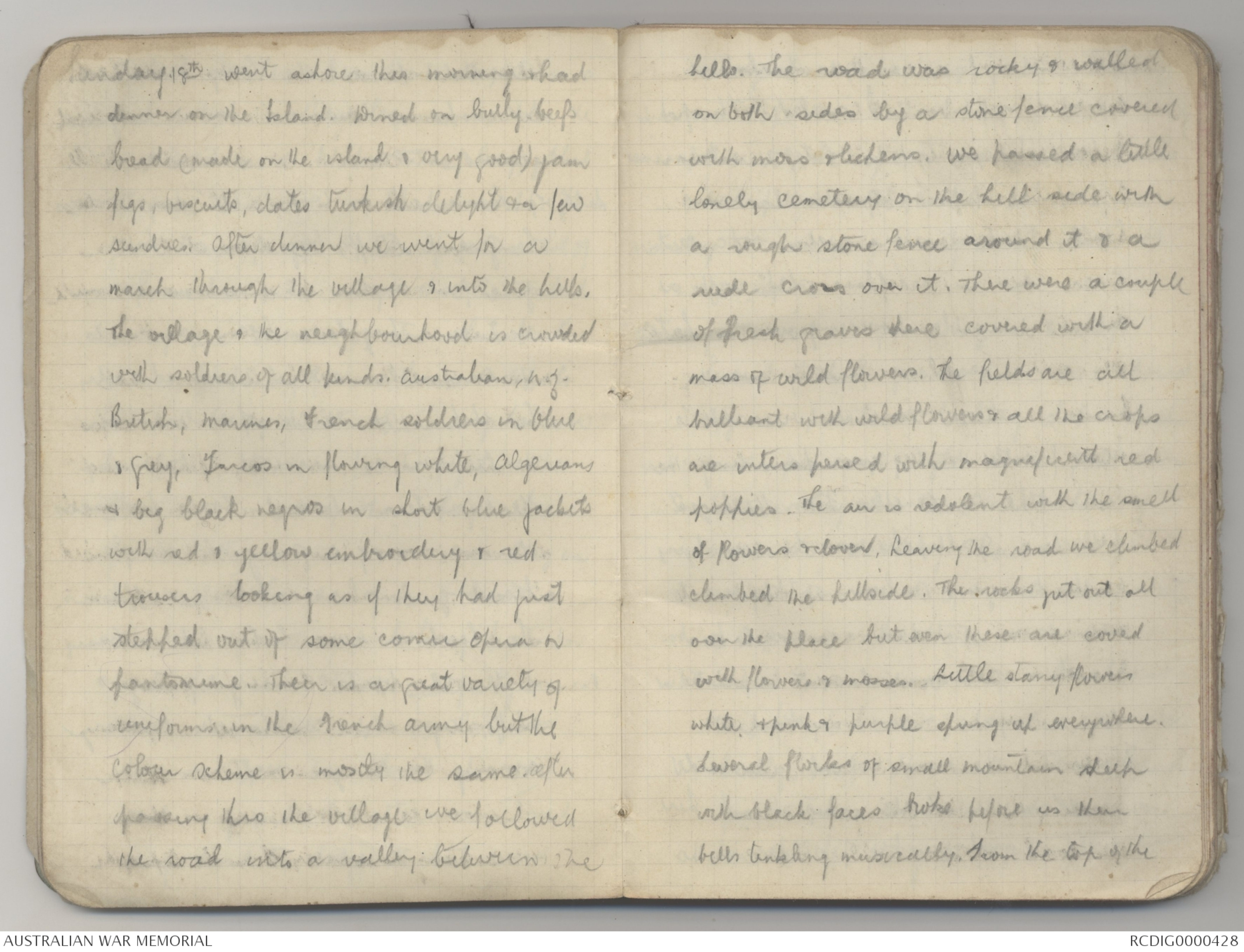
Sunday 18th went ashore this morning & had
dinner on the Island. Dined on bully beef
bread (made on the island & very good) jam
figs, biscuits, dates turkish delight & a few
sundaes. After dinner we went for a
march through the village & into the hills.
The village & the neighbourhood is crowded
with soldiers of all kinds. Australians, N.Z.
British, Marines, French soldiers in blue
& grey, Tarcos in flowing white, Algerians
& big black negros in short blue jackets
with red & yellow embroidery & red
trousers looking as if they had just
stepped out of some comic opera or
pantomime. Their is a great variety
uniforms in the French army but the
colour scheme is mostly the same. After
passing thro the village we followed
the road into a valley between the
hills. The road was rocky & walled
on both sides by a stone fence covered
with moss & lichens. We passed a little
lonely cemetery on the hill side with
a rough stone fence around it & a
rude cross over it. There were a couple
of fresh graves there covered with a
mass of wild flowers. The fields are all
brilliant with wild flowers & all the crops
are inters persed with magnificent red
poppies. The air is redolent with the smell
of flowers & clover. Leaving the road we climbed
climbed the hillside. The rocks jut out all
over the place but even these are coved
with flowers and mosses. Little starry flowers
white & pink & purple sprung up everywhere.
Several flocks of small mountain sheep
with black faces broke before us their
bells tinkling musically. From the top of the
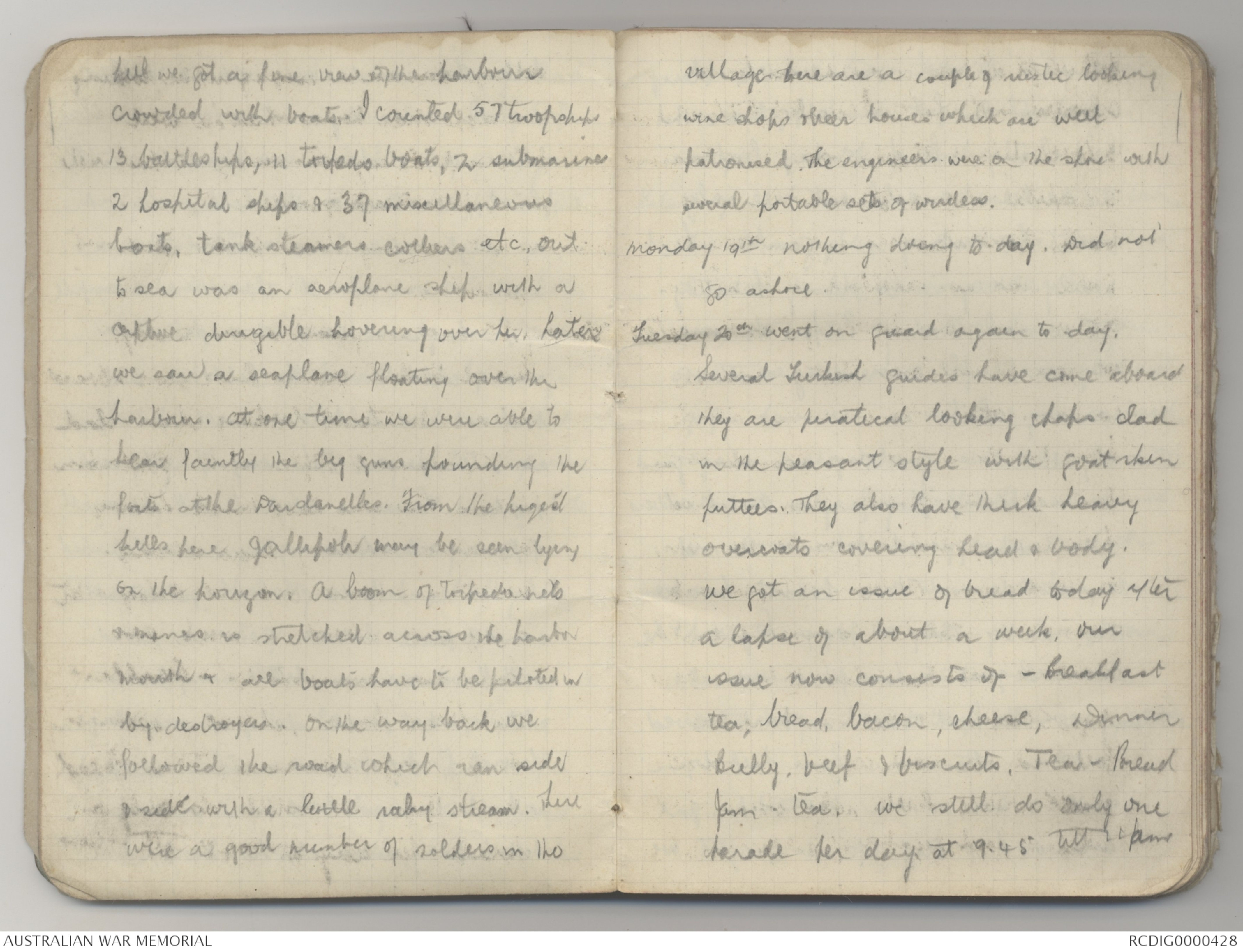
hill we got a fine view of the harbour
crowded with boats. I counted 57 troopships
13 battleships, 11 torpedo boats, 2 submarines
2 hospital ships & 37 miscellaneous
boats, tank steamers & others etc., out
to sea was an aeroplane ship with a
captive dirigible hovering over her. Later
we saw a seaplane floating over the
harbour. At one time we were able to
hear faintly the big guns pounding the
forts at the Dardanelles. From the highest
hills here Gallipoli may be seen lying
on the horizon. A boom of torpedo nets
& mines is stretched across the harbour
mouth & all boats have to be piloted in
by destroyers. On the way back we
followed the road which ran side
by side with the little raby stream. There
were a good number of soldiers in the
village. There are a couple of rustic looking
wine shops & beer houses which are well
patronised. The engineers were on the shore with
several portable sets of wireless.
Monday 19th Nothing doing to-day. Did not
go ashore.
Tuesday 20th Went on guard again to-day.
Several Turkish guides have come aboard
they are practical looking chaps clad
in the peasant style with goat skin
puttees. They also have thick heavy
overcoats covering head and body.
We got an issue of bread today after
a lapse of about a week, our
issue now consists of - breakfast
tea, bread, bacon, cheese, Dinner
Bully, beef & biscuits. Tea - Bread
Jam - tea. We still do only one
parade per day at 9.45 till 11 am
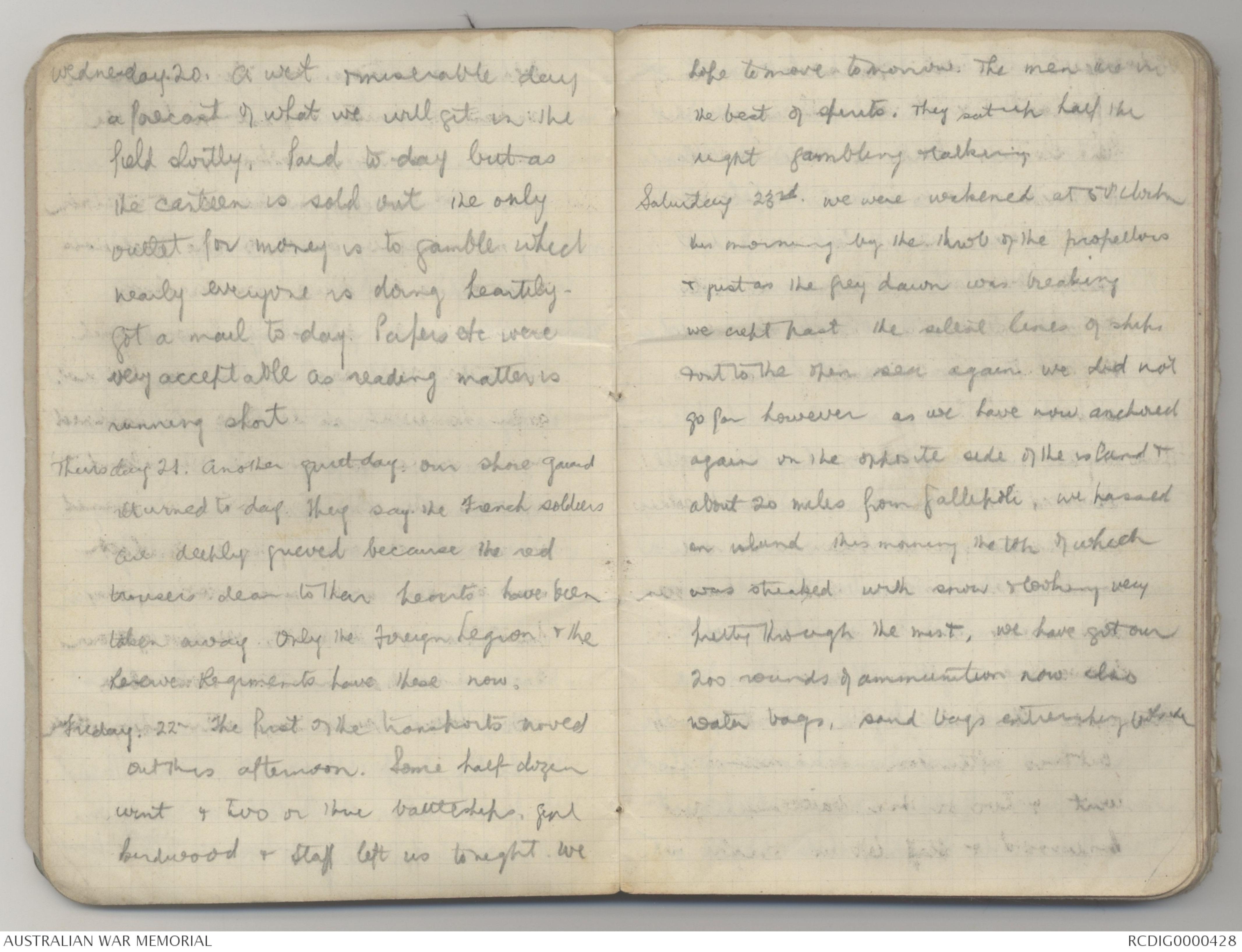
Wednesday.20. A wet miserable day
a forecast of what we will get in the
field shortly. Paid today but as
the canteen is sold out the only
outlet for money is to gamble which
nearly everyone is doing heartily.
Got a mail to-day. Papers etc were
very acceptable as reading matter is
running short.
Thursday 21. Another great day. Our shore guard
returned to-day. They say the French soldiers
are deeply grieved because the red
trousers dear to their hearts have been
taken away. Only the Foreign Legion & the
Reserve Regiments have these now.
Friday. 22nd The first of the transports moved
out this afternoon. Some half dozen
went & two or three battleships. Genl
Birdwood & Staff left us tonight we
hope to move tomorrow. The men are in
the best of spirits. They sat up half the
night gambling & talking.
Saturday 23rd We were wakened at 5o'clock
this morning by the throb of the propellors
& just as the grey dawn was breaking
we crept past the silent lines of ships
& out to the open sea again. We did not
go far however as we have now anchored
again on the opposite side of the island &
about 20 miles from Gallipoli, we passed
an island this morning the top of which
was streaked with snow & looking very
pretty through the mist. We have got our
200 rounds of ammunition now also
water bags, sand bags entrenching shovels
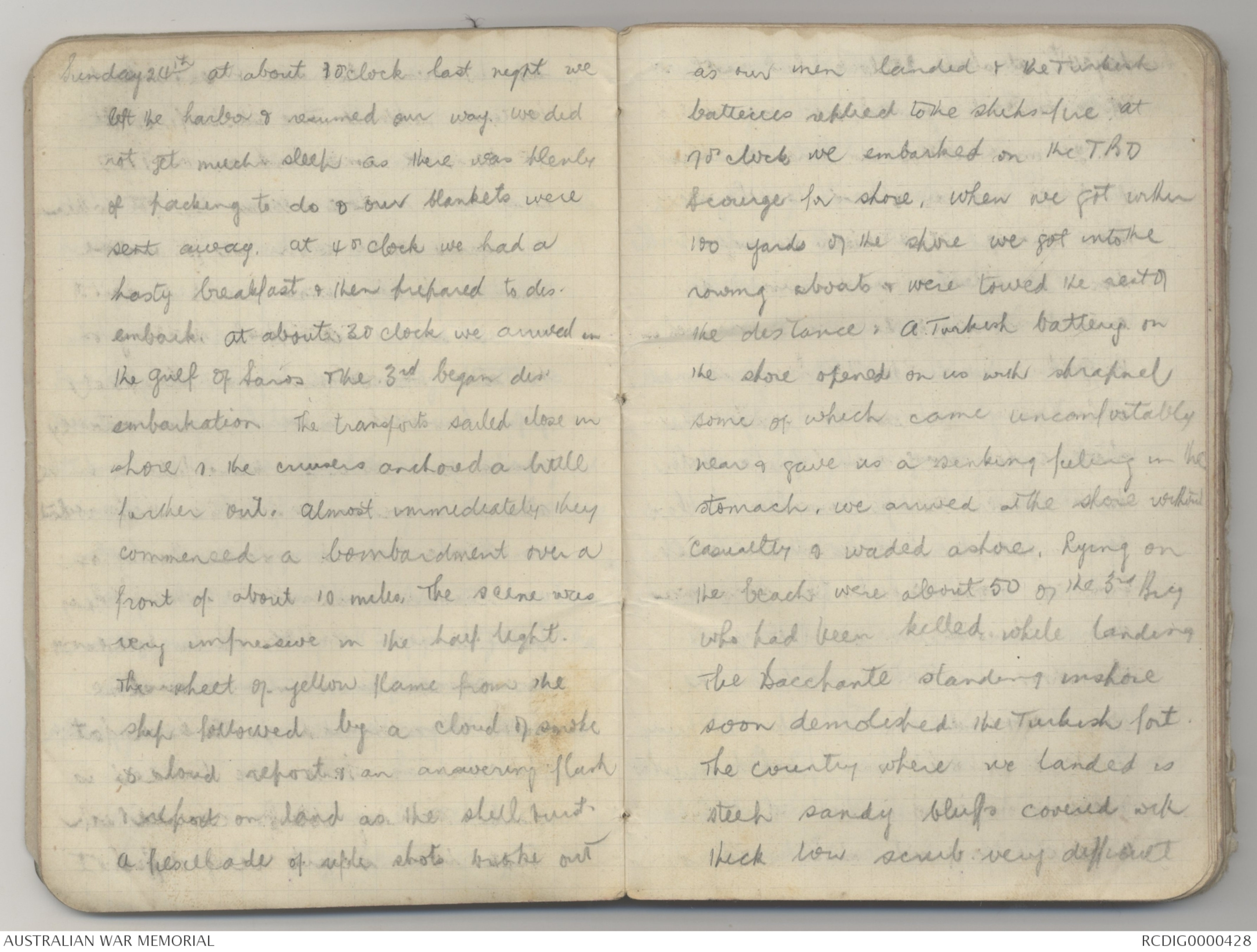
Sunday 24th At about 7 o'clock last night we
left the harbor & resumed our way. We did
not get much sleep as there was plenty
of packing to do & our blankets were
sent away. At 4 o'clock we had a
hasty breakfast & then prepared to disembark.
At about 3 o clock we arrived in
the Gulf of Saros. The 3rd began disembarkation.
The transports sailed close in
shore & the cruisers anchored a little
further out. Almost immediately they
commenced a bombardment over a
front of about 10 miles. The scene was
very impressive in the half light.
The sheet of yellow flame from the
ship followed by a cloud of smoke
its loud report & an answering flash
repost on land as the shell burst.
A fusillade of rifle shots broke out
as our men landed and the Turkish
batteries replied to the ships fire. At
7 o'clock we embarked on the TBD
Scourge for shore. When we got within
100 yards of the shore we got into the
rowing boats & were towed the rest of
the distance. A Turkish battery on
the shore opened on us with shrapnel
some of which came uncomfortably
near & gave us a sinking feeling in the
stomach. we arrived at the shore without
casualty & waded ashore. Lying on
the beach were about 50 of the 3rd Brg
who had been killed while landing.
The Bacchante standing inshore
soon demolished the Turkish fort.
The country where we landed is
steep sandy bluffs covered with
thick low scrub: very difficult
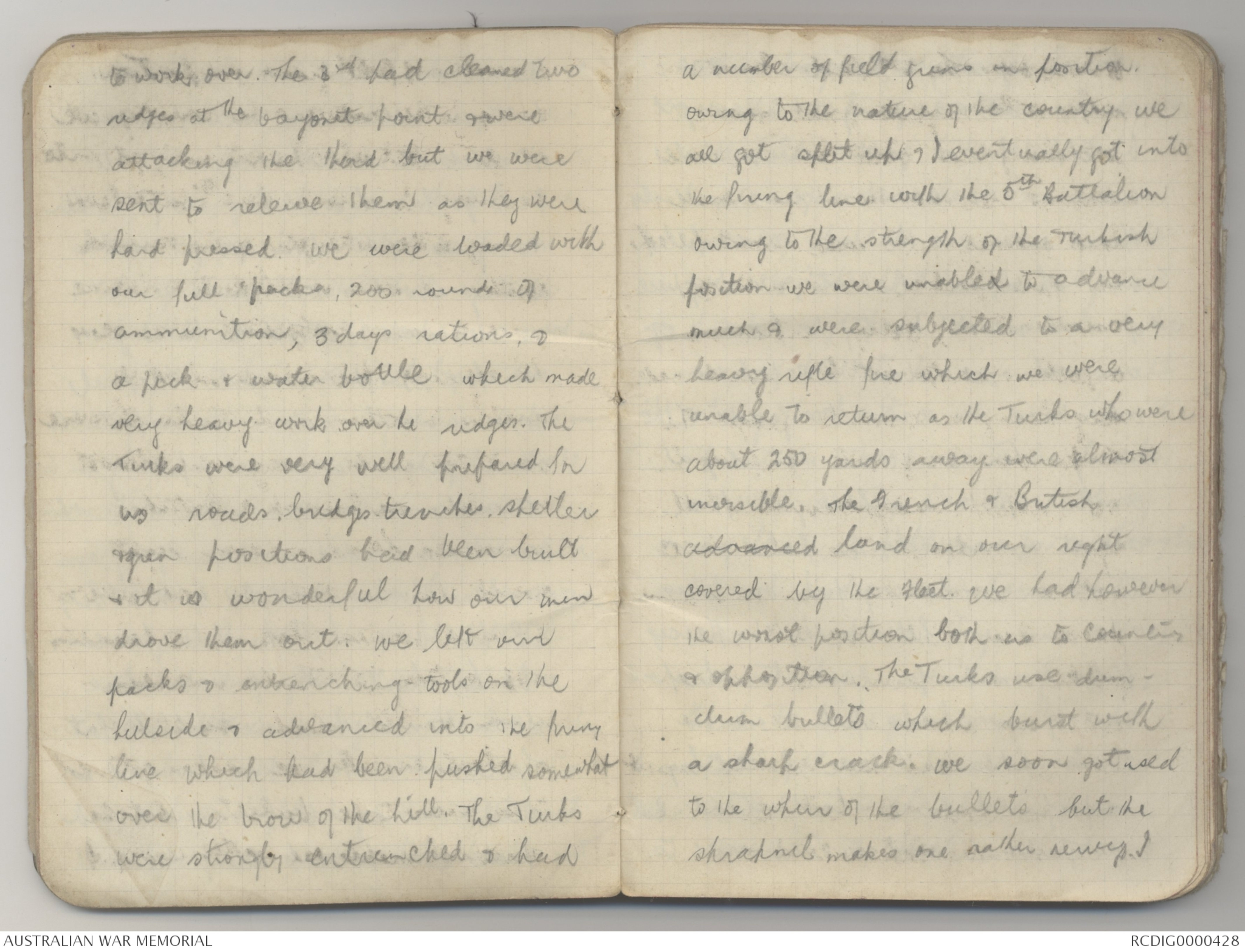
to work over. The 3rd had cleared two
ridges at the bayonet point & were
attacking the third but we were
sent to releive them as they were
hard pressed. We were loaded with
our full packs, 200 rounds of
ammunition, 3 days rations &
a pick & water bottle which made
very heavy work over the ridges. The
Turks were very well prepared for
us roads, bridges, trenches, shelter
& gun positions had been built
& it is wonderful how our men
drove them out. We left our
packs & entrenching tools on the
hillside & advanced into the firing
line which had been pushed somewhat
over the brow of the hill. The Turks
were strongly entrenched & had
a number of field guns in position.
Owing to the nature of the country we
all got split up & I eventually got into
the firing line with the 5th Battalion.
Owing to the strength of the Turkish
position we were unabled to advance
much & were subjected to a very
heavy rifle fire which we were
unable to return as the Turks who were
about 250 yards away were almost
invisible. The French & British
advanced land on our right
covered by the Fleet. We had however
the worst position both us to country
& opposition. The Turks use dum-dum
bullets which burst with
a sharp crack. We soon got used
to the whine of the bullets but the
shrapnel makes one rather nervous. I
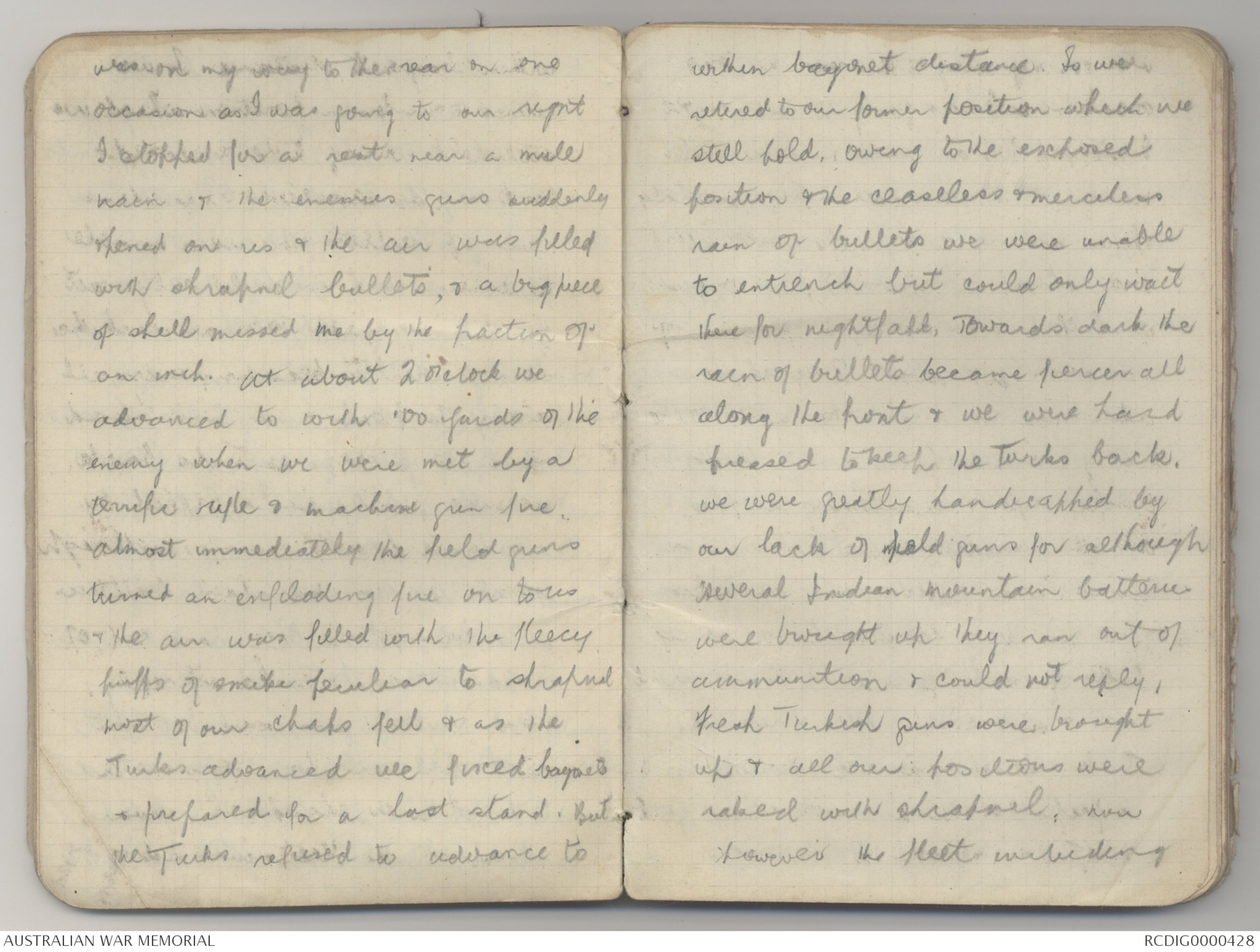
was on my way to the rear on one
occasion as I was going to our regnt
I stopped for a rest near a mule
train & the enemies guns suddenly
opened on us & the air was filled
with shrapnel bullets, & a big piece
of shell missed me by the fraction of
an inch. At about 2 o'clock we
advanced to with 100 yards of the
enemy when we were met by a
terrific rifle & machine gun fire.
Almost immediately the field guns
turned an enfilading fire on to us
& the air was filled with the fleecy
puffs of smoke peculiar to shrapnel
most of our chaps fell & as the
Turks advanced we fixed bayonets
& prepared for a last stand. But
the Turks refused to advance to
within bayonet distance. So we
retired to our former position which we
still hold, owing to the exposed
position & the ceaseless & merciless
rain of bullets we were unable
to entrench but could only wait
there for nightfall. Towards dark the
rain of bullets became fiercer all
along the front & we were hard
pressed to keep the Turks back,
we were greatly handicapped by
our lack of field guns for although
several Indian mountain batteries
were brought up they ran out of
ammunition & could not reply,
Fresh Turkish guns were brought
up & all our positions were
raked with shrapnel, now
however the fleet including
 Loretta Corbett
This transcription item is now locked to you for editing. To release the lock either Save your changes or Cancel.
This lock will be automatically released after 60 minutes of inactivity.