
Diary of Frederick Trouton Small, 1915 - Part 8
106
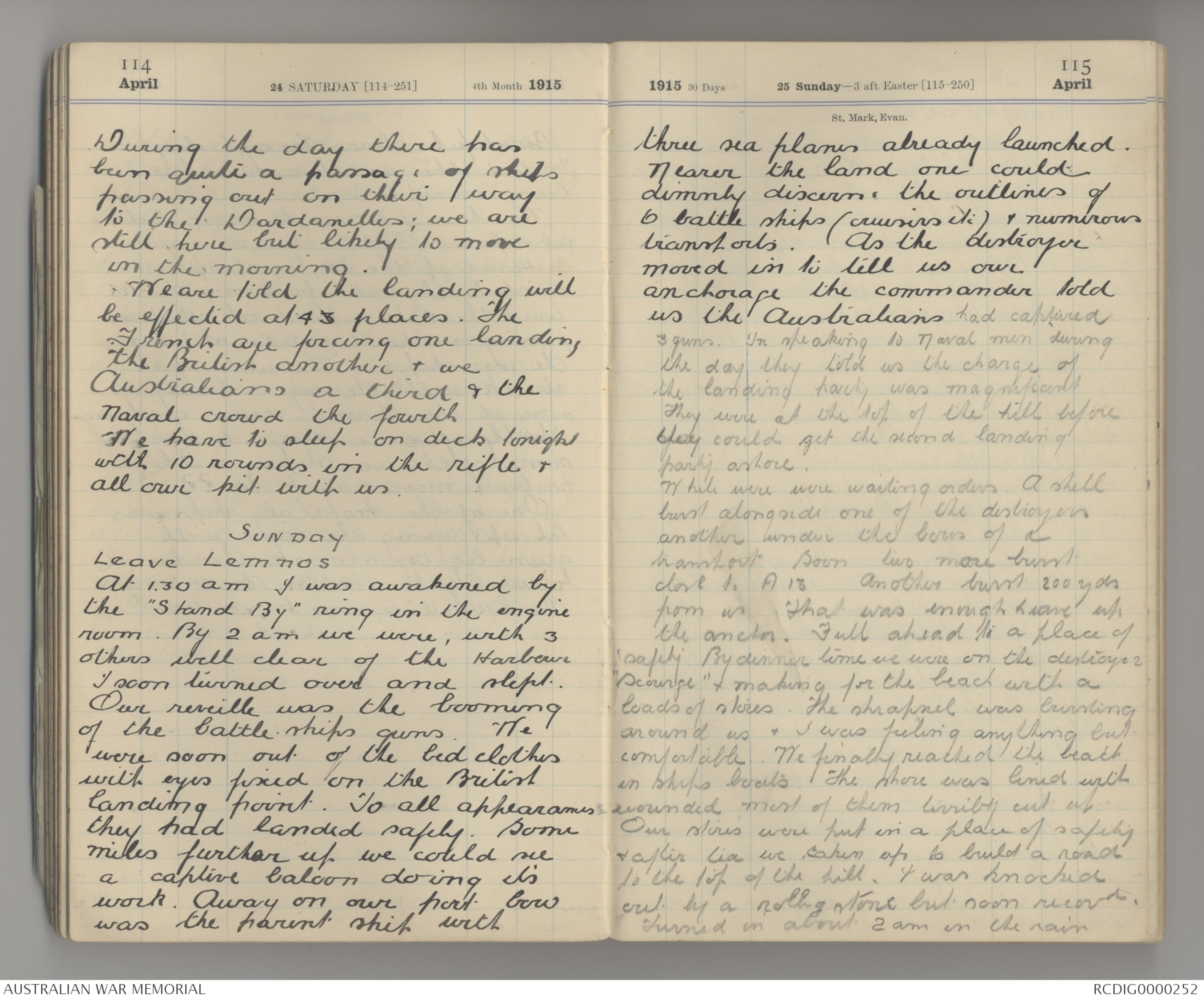
April 16 FRIDAY 1915
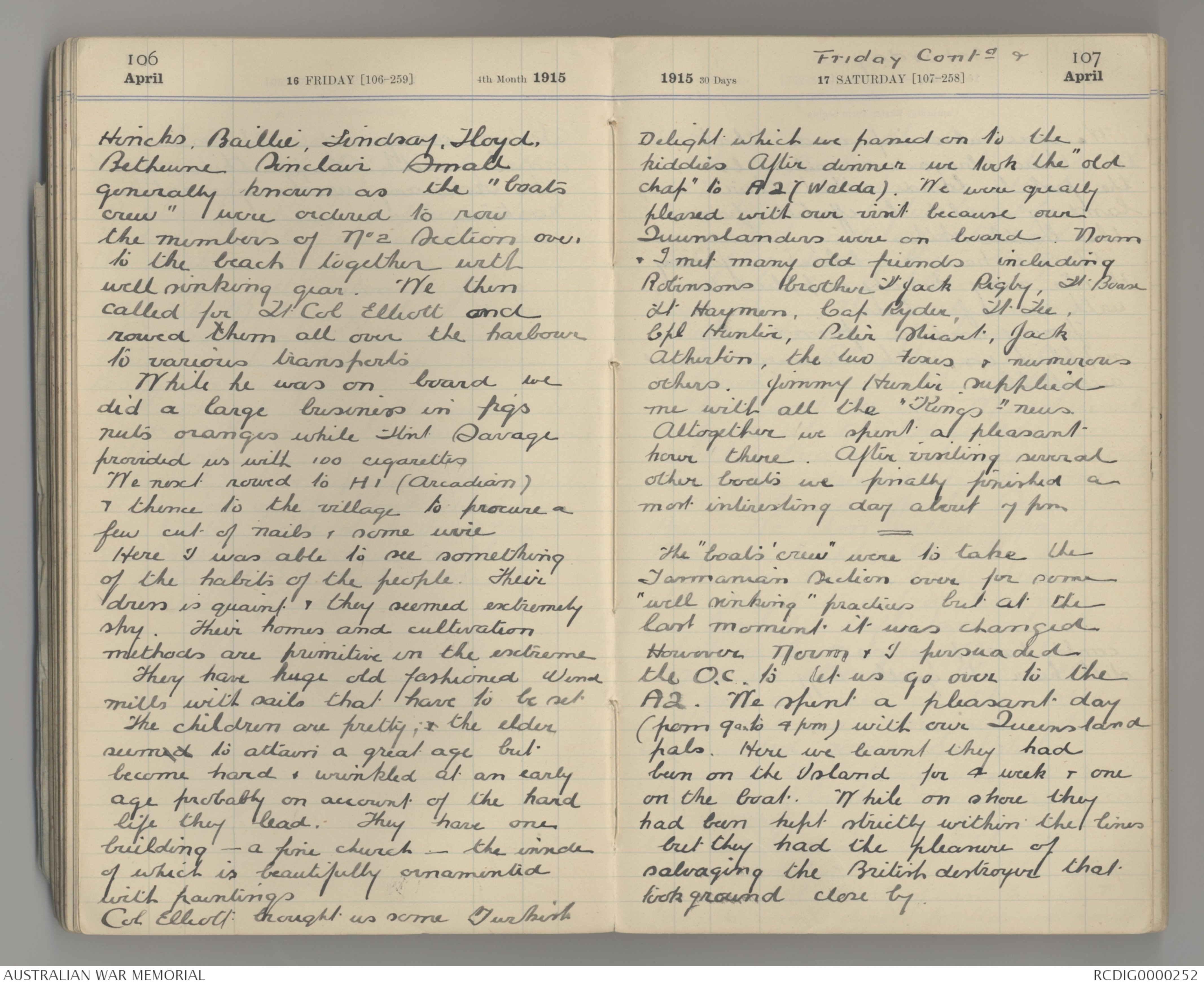
Hincks, Baillie, Lindsay, Lloyd,
Betheune Sinclair Small
generally known as the "boats
crew" were ordered to row
the members of No 2 Section over
to the beach together with
well sinking gear. We then
called for Lt Col Elliott and
rowed them all over the harbour
to various transports
While he was on board we
did a large business in figs
nuts oranges while Ltnt Savage
provided us with 100 cigarettes
We next rowed to H I (Arcadian)
& thence to the village to procure a
few cut of nails & some wire
Here I was able to see something
of the habits of the people. Their
dress is quaint & they seemed extremely
shy. Their homes and cultivation
methods are primitive in the extreme
They have huge old fashioned Wind
mills with sails that have to be set
The children are pretty; & the elder
seemed to attain a great age but
become hard & wrinkled at an early
age probably on account of the hard
life they lead. They have one
building - a fine church - the inner
of which is beautifully ornamented
with paintings
Col Eliott brought us some Turkish
107
Friday Contd &
1915 17 SATURDAY April
Delight which we passed on to the
kiddies After dinner we took the "old
chap" to A29 (Walda). We were greatly
pleased with our visit because our
Queenslanders were on board. Norm
& I met many old friends including
Robinsons brother Lt Jack Rigby, Lt Boase
Lt Haymen, Cap Ryder, Lt Lee,
Cpl Hunter, Peter Stuart, Jack
Atherton, the two Foxes & numerous
others. Jimmy Hunter supplied
me with all the "Kings" news.
Altogether we spent a pleasant
hour there. After visiting several
other boats we finally finished a
most interesting day about 7 pm
The "boat's crew" were to take the
Tasmanian Section over for some
"well sinking" practices but at the
last moment it was changed
However Norm & I persuaded
the O.C. to let us go over to the
A2. We spent a pleasant day
(from 9 am to 4 pm) with our Queensland
pals. Here we learnt they had
been on the Island for a week & one
on the boat. While on shore they
had been kept strictly within the lines
but they had the pleasure of
salvaging the British destroyer that
took ground close by.
108 Saturday
April 18 Sunday 1915
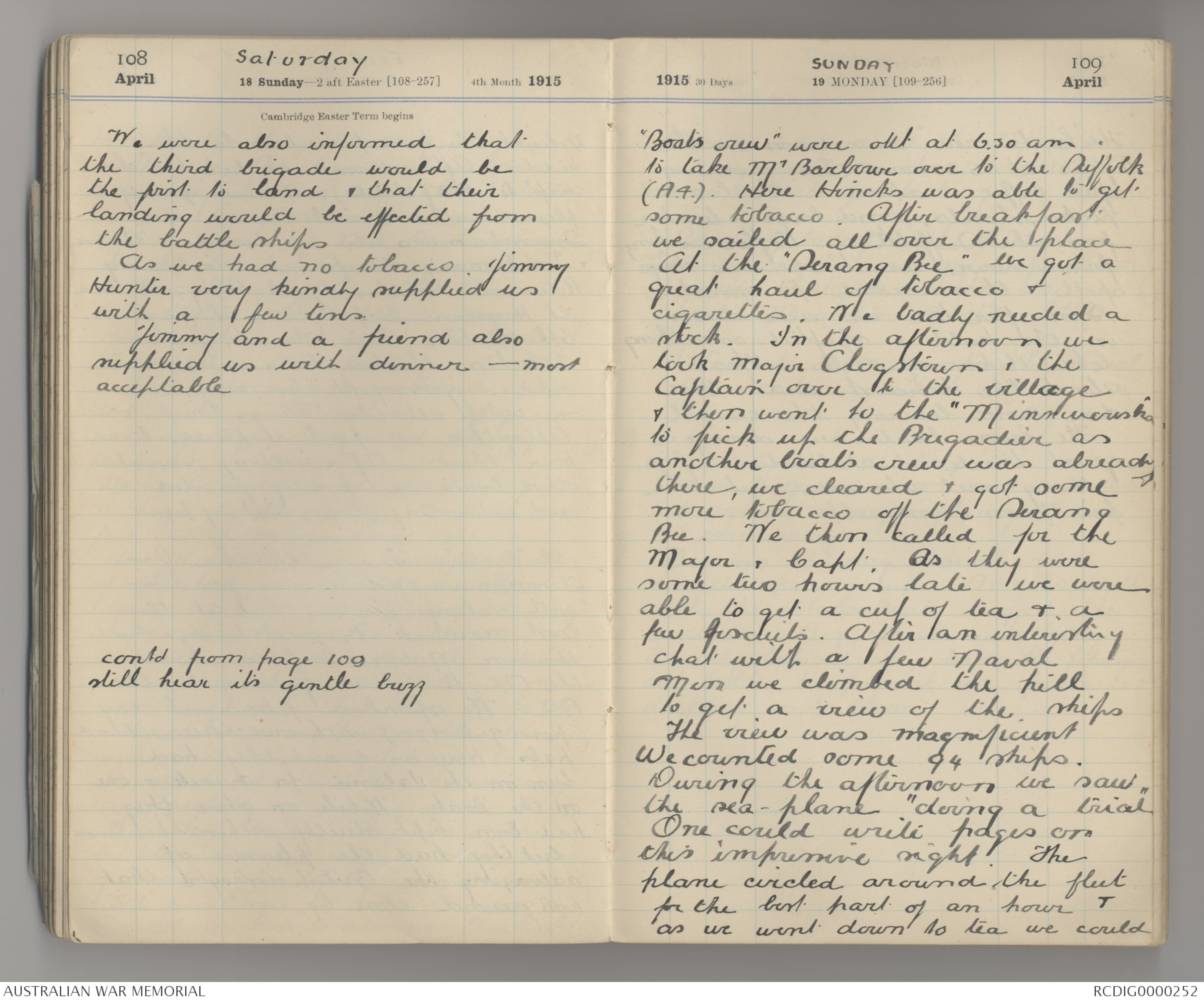
We were also informed that
the third brigade would be
the first to land & that their
landing would be effected from
the battle ships
As we had no tobacco Jimmy
Hunter very kindly supplied us
with a few tins.
Jimmy and a friend also
supplied us with dinner - most
acceptable
contd from page 109
still hear its gentle buzz
SUNDAY 109
1915 19 MONDAY April
"Boats crew" were out at 6.30 am
to take Mr Barlowe over to the Suffolk
(A.4.). Here Hincks was able to get
some tobacco. After breakfast
we sailed all over the place
At the "Serang Bee" we got a
great haul of tobacco &
cigarettes. We badly needed a
stock. In the afternoon we
took Major Clogstoun & the
Captain over to the village
& then went to the "Minnewaska
to pick up the Brigadier as
another boats crew was already
there, we cleared & got some
more tobacco off the Serang
Bee. We then called for the
Major & Capt. As they were
some two hours late we were
able to get a cup of tea & a
few biscuits. After an interesting
chat with a few Naval
Men we climbed the hill
to get a view of the ships
The view was magnificent
We counted some 94 ships.
During the afternoon we saw
the sea-plane "doing a trial"
One could write pages on
this impressive sight. The
plane circled around the fleet
for the best part of an hour &
as we went down to tea we could
110 Monday April 20 TUESDAY 1915
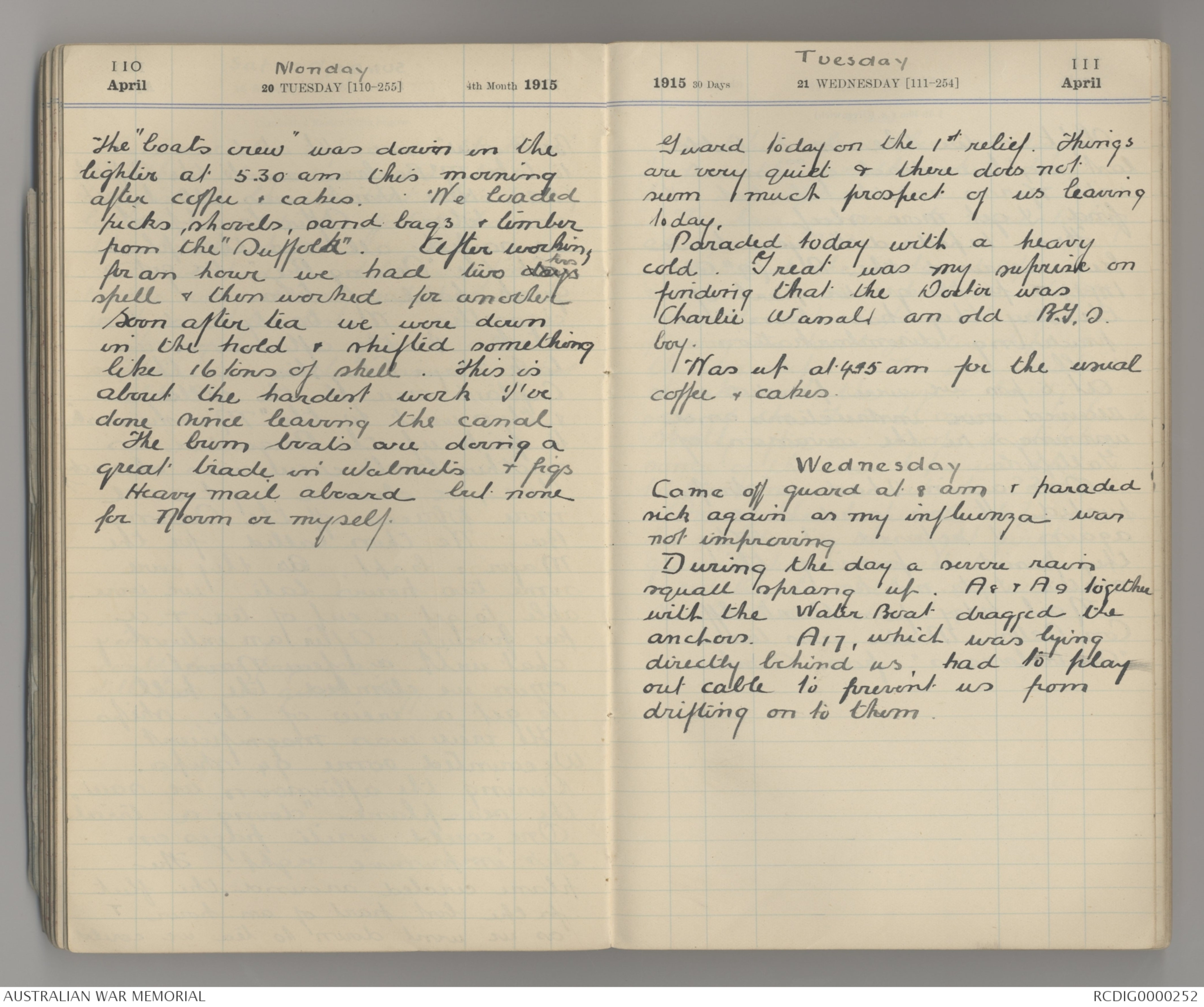
The "boats crew" was down in the
lighter at 5.30 am this morning
after coffee & cakes. We loaded
picks, shovels, sand bags & timber
from the "Suffolk". After working
for an hour we had two days hrs
spell & then worked for another
Soon after tea we were down
in the hold & shifted something
like 16 tons of shell. This is
about the hardest work I've
done since leaving the canal
The bum boats are doing a
great trade in walnuts & figs
Heavy mail aboard but none
for Norm or myself.
Tuesday 111
1915 21 WEDNESDAY April
Guard today on the 1st relief. Things
are very quiet & there does not
seem much prospect of us leaving
today.
Paraded today with a heavy
cold. Great was my surprise on
finding that the Doctor was
Charlie Wassal an old B.F.S. boy.
Was up at 4.35 am for the usual
coffee & cakes.
Wednesday
Came of guard at 8 am & paraded
sick again as my influenza was
not improving
During the day a severe rain
squall sprang up. A8 & A9 together
with the Water Boat dragged the
anchors. A17, which was lying
directly behind us, had to play
out cable to prevent us from
drifting on to them.
112
April 22 THURSDAY 1915
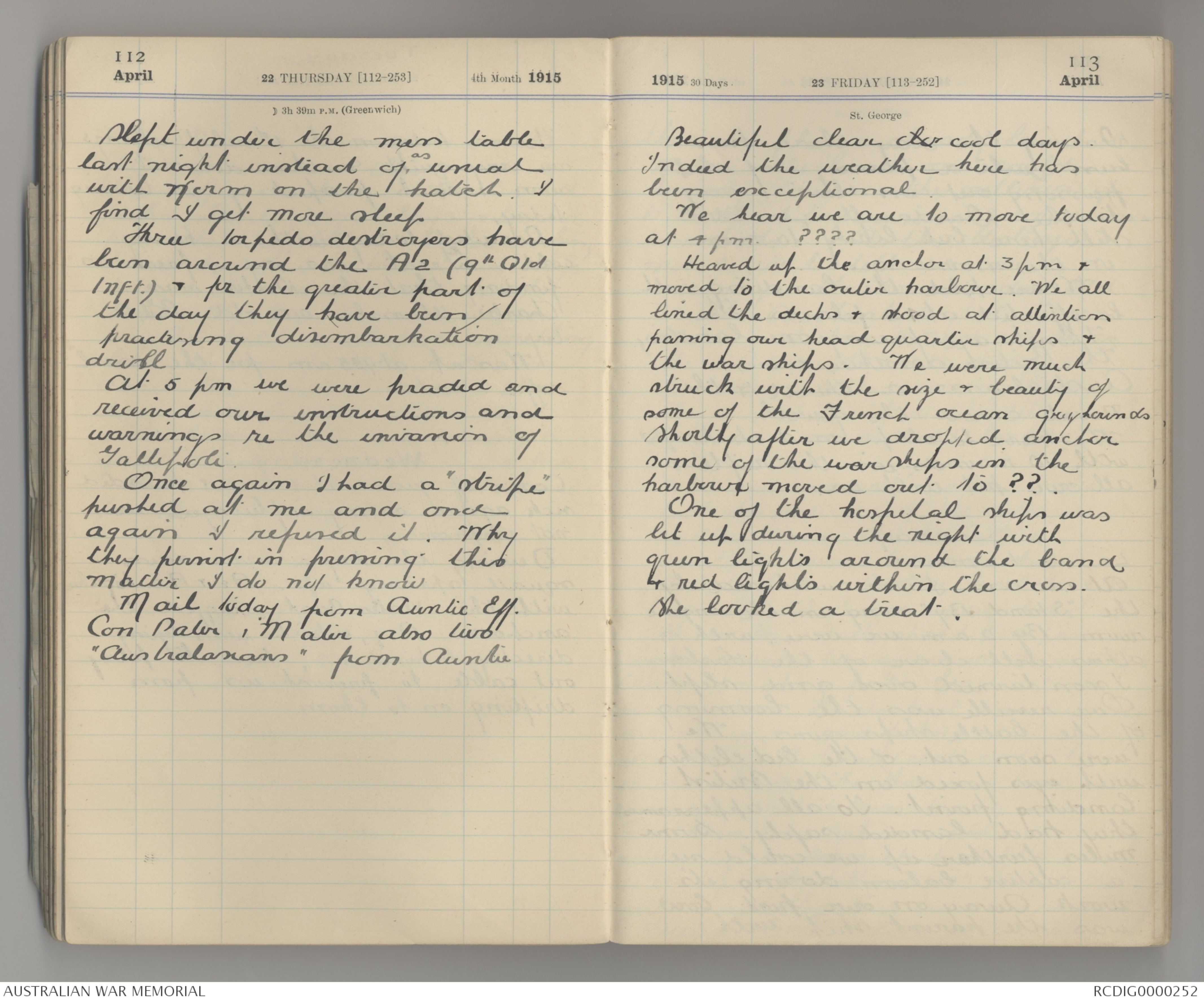
Slept under the mess table
last night instead of, as usual
with Norm on the hatch. I
find I get more sleep
Three torpedo destroyers have
been around the A2 (9th Qld
Inft.) & for the greater part of
the day they have been
practising disembarkation
drill
At 5 pm we were paraded and
received our instructions and
warnings re the invasion of
Gallipoli.
Once again I had a "stripe"
pushed at me and once
again I refused it. Why
they persist in pressing this
matter I do not know
Mail today from Auntie Eff.
Con Pater, Mater also two
"Australasians" from Auntie
1915 23 FRIDAY April 113
Beautiful clear clo cool days.
Indeed the weather here has
been exceptional.
We hear we are to move today
at 4 pm. ????
Heaved up the anchor at 3 pm &
moved to the outer harbour. We all
lined the decks & stood at attention
passing our head quarter ships &
the war ships. We were much
struck with the size & beauty of
some of the French ocean greyhounds
Shortly after we dropped anchor
some of the warships in the
harbour moved out to ?? .
One of the hospital ships was
lit up during the night with
green lights around the band
& red lights within the cross.
She looked a treat.
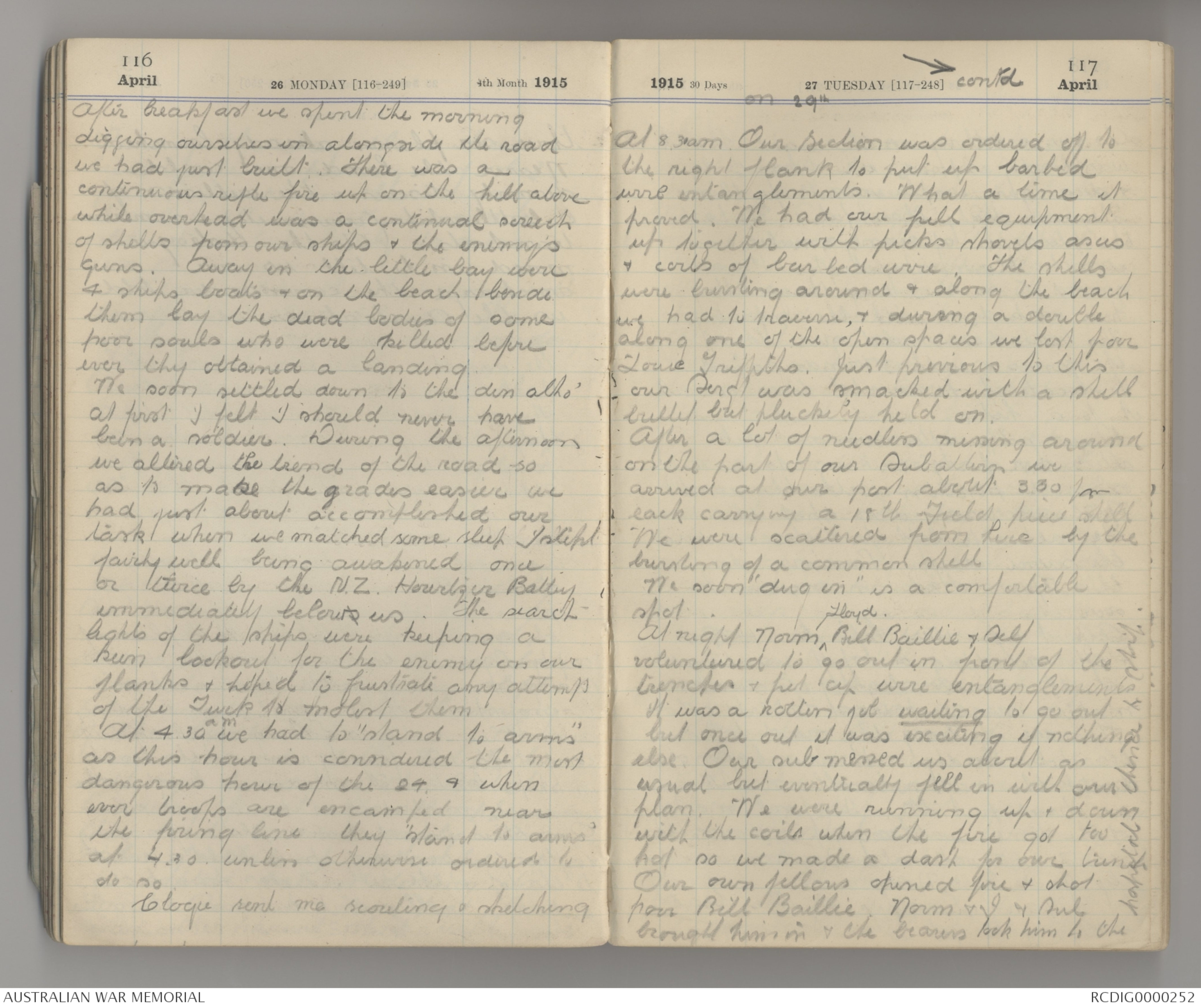
114
April 24 SATURDAY 1915
During the day there has
been quite a passage of ships
passing out on their way
to the Dardanelles; we are
still here but likely to move
in the morning.
We are told the landing will
be effected at 4 3 places. The
French are forcing one landing
the British another & we
Australians a third & the
Naval crowd the fourth
We have to sleep on deck tonight
with 10 rounds in the rifle &
all our kit with us.
SUNDAY
Leave Lemnos
At 1.30 am I was awakened by
the "Stand By" ring in the engine
room. By 2 am we were, with 3
others well clear of the Harbour
I soon turned over and slept.
Our reveille was the booming
of the battle ships guns. We
were soon out of the bed clothes
with eyes fixed on the British
landing point. To all appearances
they had landed safely. Some
miles further up we could see
a captive baloon doing its
work. Away on our port bow
was the parent ship with
1915 25 Sunday April 115
three sea planes already launched.
Nearer the land one could
dimnly discern the outlines of
6 battle ships (cruisers etc) & numerous
transports. As the destroyer
moved in to tell us our
anchorage the commander told
us the Australians had captured
3 guns. In speaking to Naval men during
the day they told us the charge of
the landing party was magnificent
They were at the top of the hill before
they could get the second landing
party ashore.
While were were waiting orders. A shell
burst alongside one of the destroyers
another under the bows of a
transport Soon two more burst
close to A 13 Another burst 200 yds
from us That was enough heave up
the anchor. Full ahead to a place of
'safety'. By dinner time we were on the destroyer
"Scourge" & making for the beach with a
loads of stores. The shrapnel was bursting
around us & I was feeling anything but
comfortable. We finally reached the beach
in ships boats. The shore was lined with
wounded most of them terribly cut up
Our stores were put in a place of safety
& after tea we taken up to build a road
to the top of the hill. I was knocked
out by a rolling stone but soon recovd.
Turned in about 2 am in the rain
116
April 26 MONDAY 1915
After breakfast we spent the morning
digging ourselves in alongside the road
we had just built. There was a
continuous rifle fire up on the hill above
while overhead was a continual screech
of shells from our ships & the enemy's
guns. Away in the little bay were
4 ships boats & on the beach beside
them lay the dead bodies of some
poor souls who were killed before
ever they obtained a landing.
We soon settled down to the din alho'
at first I felt I should never have
been a soldier. During the afternoon
we altered the bend of the road so
as to make the grades easier we
had just about accomplished our
task when we snatched some sleep I slept
fairly well being awakened once
or twice by the N.Z. Howitzer Battry
immediately belows us. The search
lights of the ships were keeping a
keen lookout for the enemy on our
flanks & helped to frustrate any attempt
of the Turk to molest them
At 4.30 am we had to "stand to arms"
as this hour is considered the most
dangerous hour of the 24, & when
ever troops are encamped near
the firing line the "stand to arms"
at 4.30 unless otherwise ordered to do so.
Clogie sent me scouting & sketching
1915 on 29th 27 TUESDAY April → contd 117
At 8.30am. Our Section was ordered off to
the right flank to put up barbed
wire entanglements. What a time it
proved. We had our full equipment
up together with picks shovels as us
& coils of barbed wire. The shells
were bursting around & along the beach
we had to traverse, & during a double
along one of the open spaces we lost poor
Louie Griffiths. Just previous to this
our Serg was smacked with a shell
bullet but pluckily held on.
After a lot of needless messing around
on the part of our Subaltern we
arrived at our post about 3.30 pm
each carrying a 18 lb Field piece shell
We were scattered from here by the
bursting of a common shell
We soon "dug in" in a comfortable
spot.
At night Norm ^Lloyd. Bill Baillie & Self
volunteered to go out in front of the
trenches & put up wire entanglements
It was a rotten job waiting to go out
but once out it was exciting if nothing
else. Our sub messed us about as
usual but eventually fell in with our
plan. We were running up & down
with the coils when the fire got too
hot so we made a dash for our trench
Our own fellows opened fire & shot
poor Bill Baillie. Norm & I & Sub
brought him in & the bearers took him to the
*hospital thence to ship.*
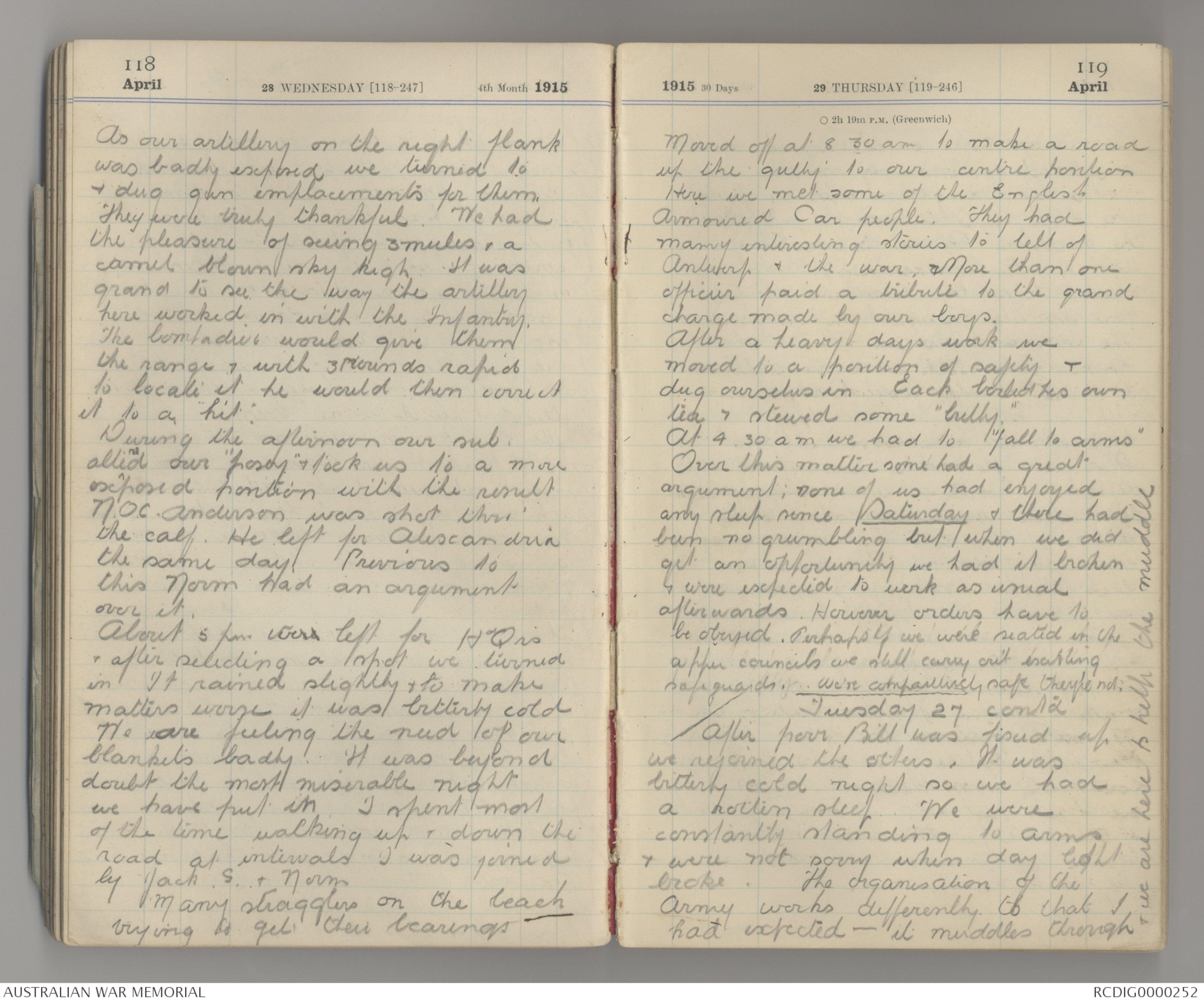
118
April 28 WEDNESDAY 1915
As our artillery on the right flank
was badly exposed we turned to
& dug gun emplacements for them.
They were truly thankful. We had
the pleasure of seeing 3 mules, & a
camel blown sky high. It was
grand to see the way the artillery
here worked in with the Infantry,
The bombadier would give them
the range & with 3 rounds rapid
to locate it he would then correct
it to a "hit".
During the afternoon our sub.
alli^ned our "posey" & took us to a more
exposed position with the result
N.O.C. Anderson was shot thro'
the calf. He left for Alexandria
the same day. Previous to
this Norm Had an argument
over it.
About 5 pm wers left for HdQrs
& after selecting a spot we turned
in It rained slightly & to make
matters worse it was bitterly cold
We are feeling the need of our
blankets badly. It was beyond
doubt the most miserable night
we have put in. I spent most
of the time walking up & down the
road at intervals I was joined
by Jack. S. . & Norm
Many stragglers on the beach
trying to get their bearings
1915 28 THURSDAY April 119
Moved off at 8 30 am to make a road
up the gully to our centre position
Here we met some of the English
Armoured Car people. They had
many interesting stories to tell of
Antwerp & the war, & More than one
officier paid a tribute to the grand
charge made by our boys.
After a heavy days work we
moved to a position of safety &
dug ourselves in Each boiled his own
tea & stewed some "bully".
At 4.30 am we had to "fall to arms"
Over this matter some had a great
argument; none of us had enjoyed
any sleep since Saturday & there had
been no grumbling but when we did
get an opportunity we had it broken
& were expected to work as usual
afterwards. However orders have to
be obeyed. Perhaps if we were seated in the
upper councils we still carry out existing
safeguards. We're comparetively safe they're not:
Tuesday 27 cont'd
After poor Bill was fixed up
we rejoined the others. It was
bitterly cold night so we had
a rotten sleep. We were
constantly standing to arms
& were not sorry when day light
broke. The organisation of the
Army works differently to that I
had expected - it muddles through
& we are here to help the muddle
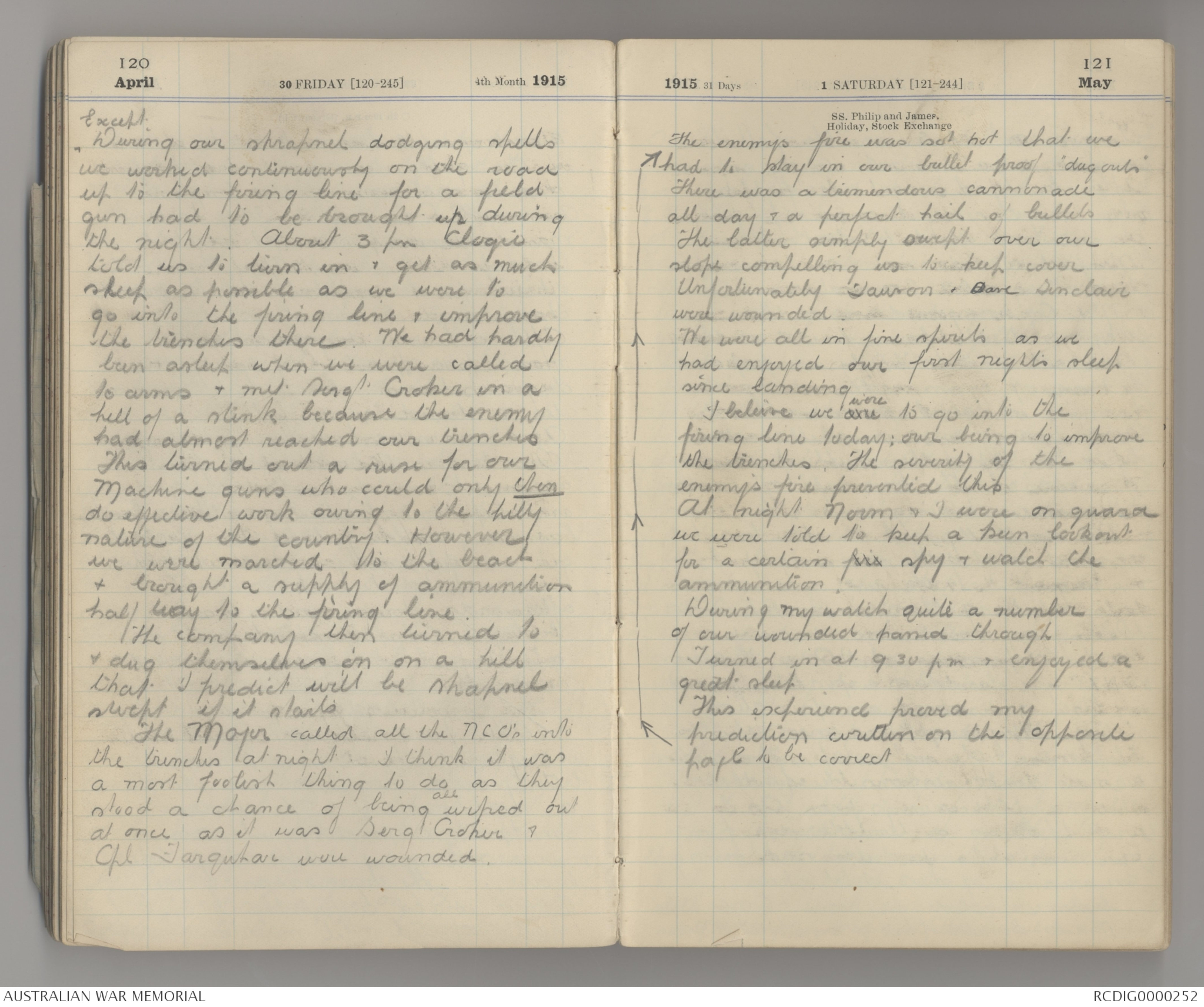
120
April 30 FRIDAY 1915
Except During our shrapnel dodging spells
we worked continuously on the road
up to the firing line for a field
gun had to be brought up during
the night. About 3 pm Clogie
told us to turn in & get as much
sleep as possible as we were to
go into the firing line & improve
the trenches there. We had hardly
been asleep when we were called
to arms & met Sergt Croker in a
hell of a stink because the enemy
had almost reached our trenches
This turned out a ruse for our
Machine guns who could only then
do effective work owing to the hilly
nature of the country. However
we were marched to the beach
& brought a supply of ammunition
half way to the firing line.
The company then turned to
& dug themselves in on a hill
that I predict will be shrapnel
swept if it starts
The Major called all the NCO's into
the trenches at night. I think it was
a most foolish thing to do as they
stood a chance of being all wiped out
at once as it was Serg Croker &
Cpl Farquhar were wounded.
1915 1 SATURDAY May 121
↗The enemys fire was sot hot that we
had to stay in our bullet proof "dug outs"
There was a tremendous cannonade
all day & a perfect hail of bullets
The latter simply swept over our
slope compelling us to keep cover
Unfortunately Tauron & Dave Sinclair
were wounded.
We were all in fine spirits as we
had enjoyed our first nights sleep
since landing.
I believe we are were to go into the
firing line today; our being to improve
the trenches. The severity of the
enemy's fire prevented this
At night Norm & I were on guard
we were told to keep a keen lookout
for a certain fire spy & watch the
ammunition.
During my watch quite a number
of our wounded passed through
Turned in at 9 30 pm & enjoyed a
great sleep
This experience proved my
prediction written on the opposite
↖page to be correct
122
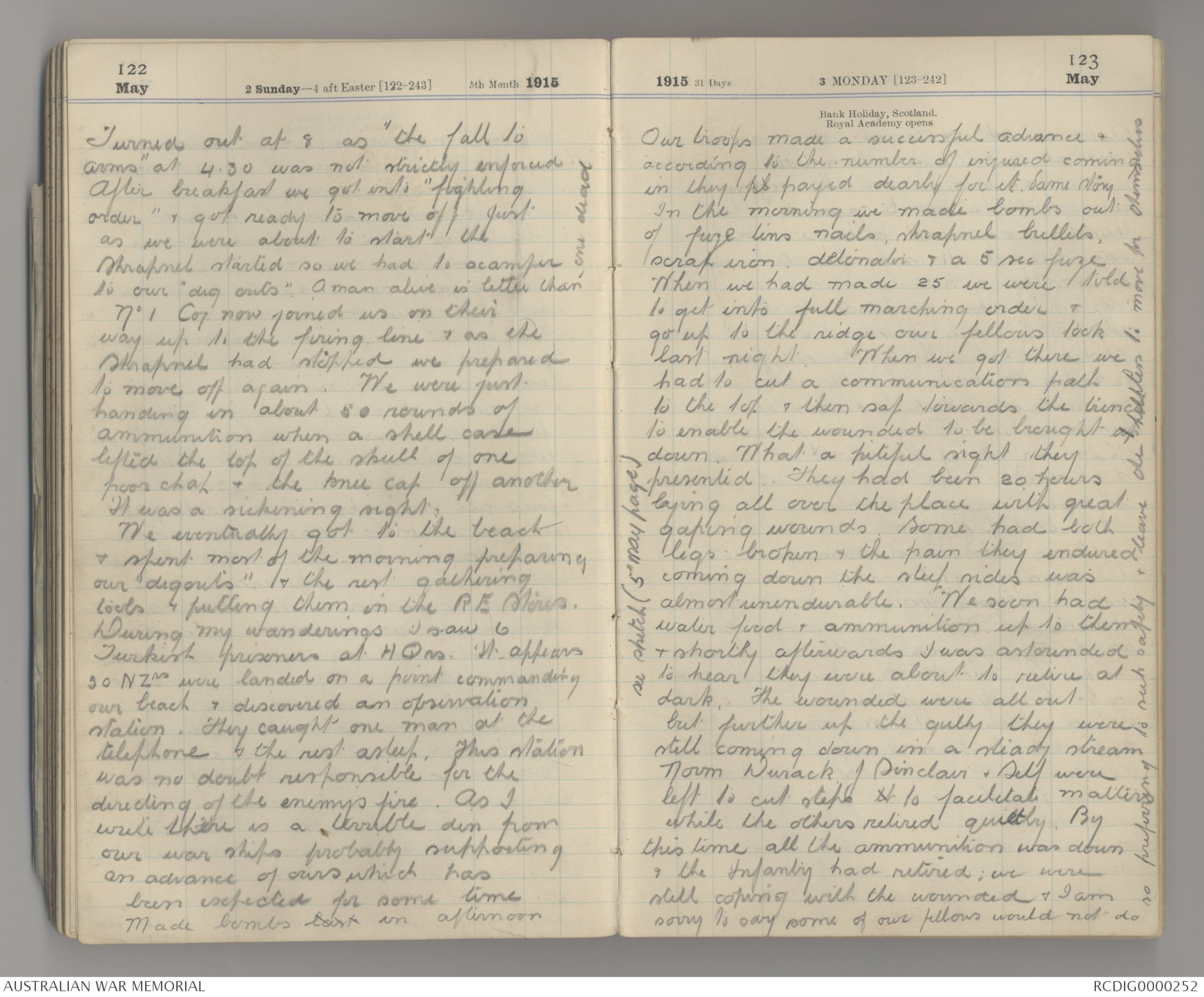
May 2 Sunday 1915
Turned out at 8 as "the fall to
arms" at 4.30 was not strictly enforced
After breakfast we got into "fighting
order" & got ready to move off Just
as we were about to start the
Shrapnel started so we had to scamper
to our "dug outs". A man alive is better than one dead
No 1 Coy now joined us on their
way up to the firing line & as the
Shrapnel had stopped we prepared
to move off again. We were just
handing in about 50 rounds of
ammunition when a shell case
lifted the top of the skull of one
poor chap & the knee cap off another
It was a sickening sight.
We eventually got to the beach
& spent most of the morning preparing
our "dugouts" & the rest gathering
tools & putting them in the RE Stores.
During my wanderings I saw 6
Turkish prisoners at HQrs. It appears
30 NZrs were landed on a point commanding
our beach & discovered an observation
station. They caught one man at the
telephone & the rest asleep. This station
was no doubt responsible for the
directing of the enemys fire. As I
write there is a terrible din from
our war ships probably supporting
an advance of ours which has
been expected for some time
Made bombs last in afternoon
1915 3 MONDAY May 123
Our troops made a successful advance &
according to the number of injured coming
in they pl payed dearly for it. Same story
In the morning we made bombs out
of fuze tins nails, shrapnel bullets,
scrap iron. detonator & a 5 sec fuse
When we had made 25 we were told
to get into full marching order &
go up to the ridge our fellows took
last night. When we got there we
had to cut a communication path
to the top & then sap towards the trench
to enable the wounded to be brought
down. What a pitiful sight they
presented. They had been 20 hours
laying all over the place with great
gaping wounds. Some had both
legs broken & the pain they endured
coming down the steep sides was
almost unendurable. We soon had
water food & ammunition up to them
& shortly afterwards I was astounded
to hear they were about to retire at
dark. The wounded were all out
but further up the gully they were
still coming down in a steady stream
Norm Durack, J Sinclair & Self were
left to cut steps it to facilitate matters
while the others retired quietly. By
this time all the ammunition was down
& the Infantry had retired; we were
still coping with the wounded & I am
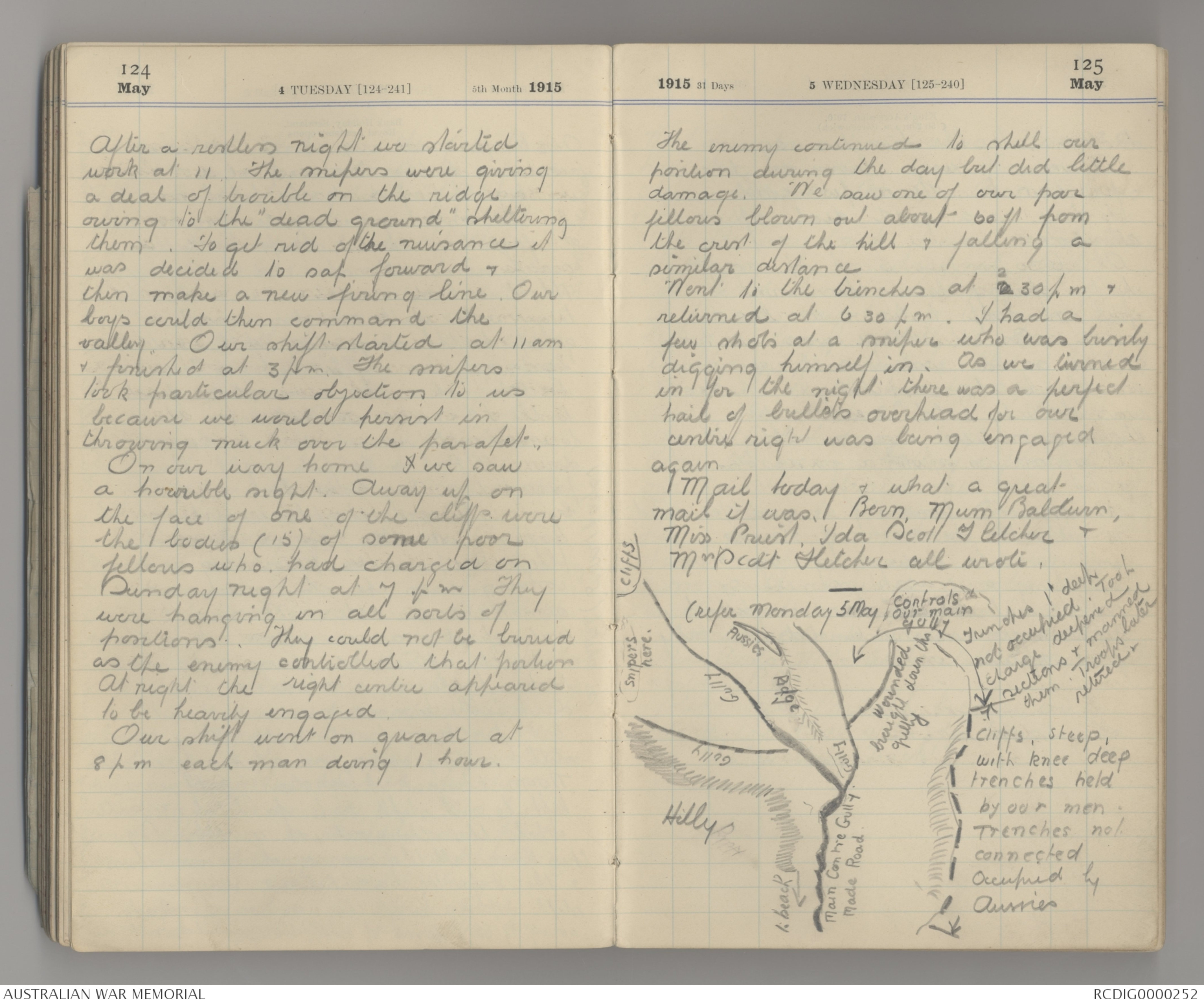
sorry to say some of our fellows would not do so preferring to seek safety & leave the helpless to move for themselves [*see sketch (5th May page)*]
124 May 4 TUESDAY 1915
After a restless night we started
work at 11. The snipers were giving
a deal of trouble on the ridge
owing to the "dead ground" sheltering
them. To get rid of the nuisance it
was decided to sap forward &
then make a new firing line. Our
boys could then command the
valley. Our shift started at 11 am
& finished at 3 pm. The snipers
took particular objection to us
because we would persist in
throwing muck over the parapet.
On our way home I we saw
a horrible sight. Away up on
the face of one of the cliffs were
the bodies (15) of some poor
fellows who had charged on
Sunday night at 7 pm They
were hanging in all sorts of
positions. They could not be buried
as the enemy controlled that portion
At night the right centre appeared
to be heavily engaged.
Our shift went on guard at
8 pm each man doing 1 hour.
1915 5 WEDNESDAY May 125
The enemy continued to shell our
position during the day but did little
damage. We saw one of our poor
fellows blown out about 60 ft from
the crest of the hill & falling a
similar distance
Went to the trenches at x2 30 pm &
returned at 6 30 pm. I had a
few shots at a sniper who was busily
digging himself in. As we turned
in for the night there was a perfect
hail of bullets overhead for our
centre right was being engaged
again
Mail today & what a great
mail it was. Bern, Mum Baldwin,
Miss Priest, Ida Scott Fletcher &
Mrs Scott Fletcher all wrote. Diagram - see original document
 D Coates
This transcription item is now locked to you for editing. To release the lock either Save your changes or Cancel.
This lock will be automatically released after 60 minutes of inactivity.