
Extracts of letters from Reginald Scott Gardiner to his Mother, 1914-1915
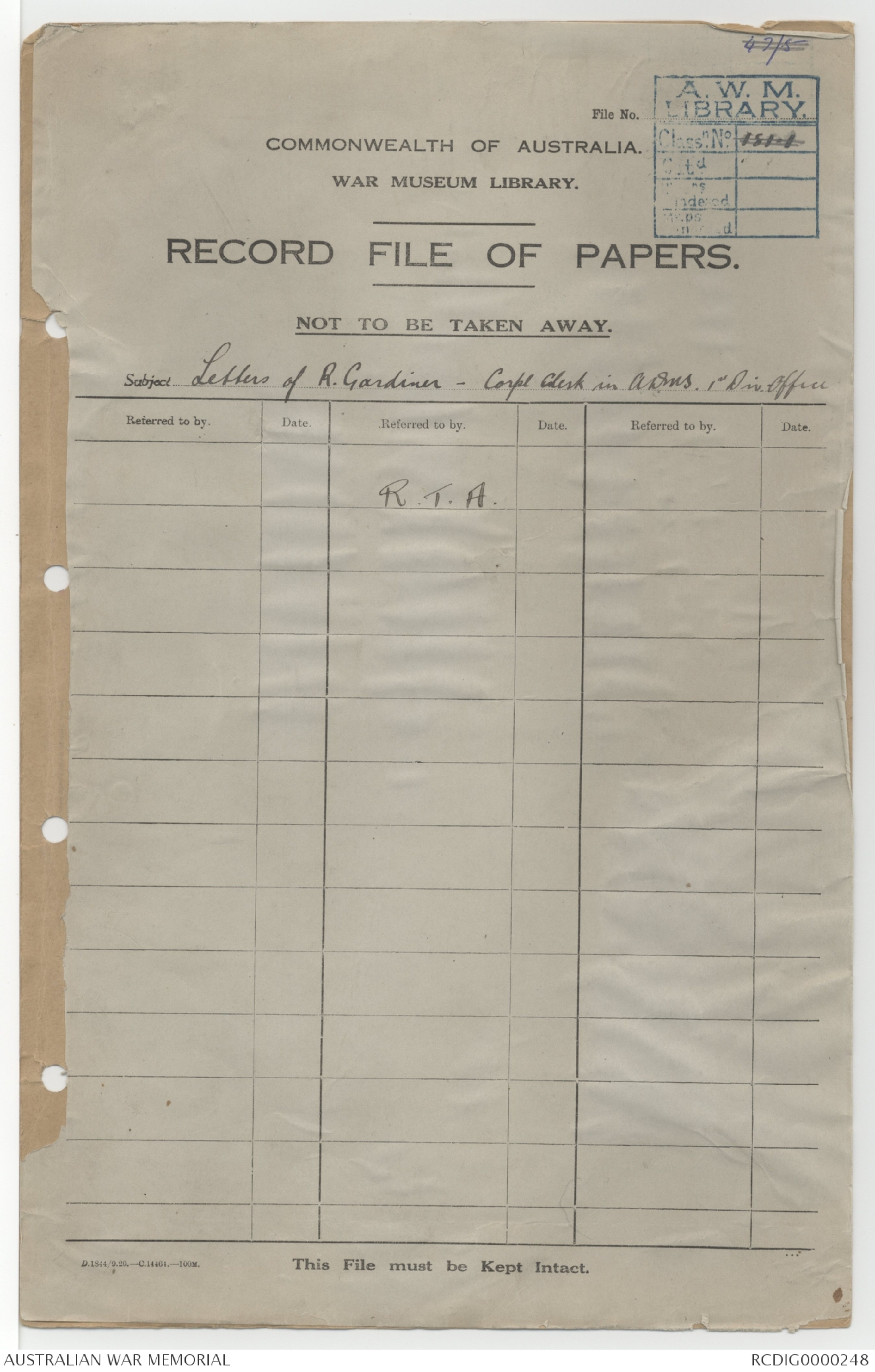
COMMONWEALTH OF AUSTRALIA.
WAR MUSEUM LIBRARY.
RECORD FILE OF PAPERS.
NOT TO BE TAKEN AWAY.
Subject Letters of R. Gardiner - Corpl Clerk in ADMS. 1st Div. Office.
| Referred to by. | Date. | Referred to by. | Date. | Referred to by. | Date. |
| R.T.A |
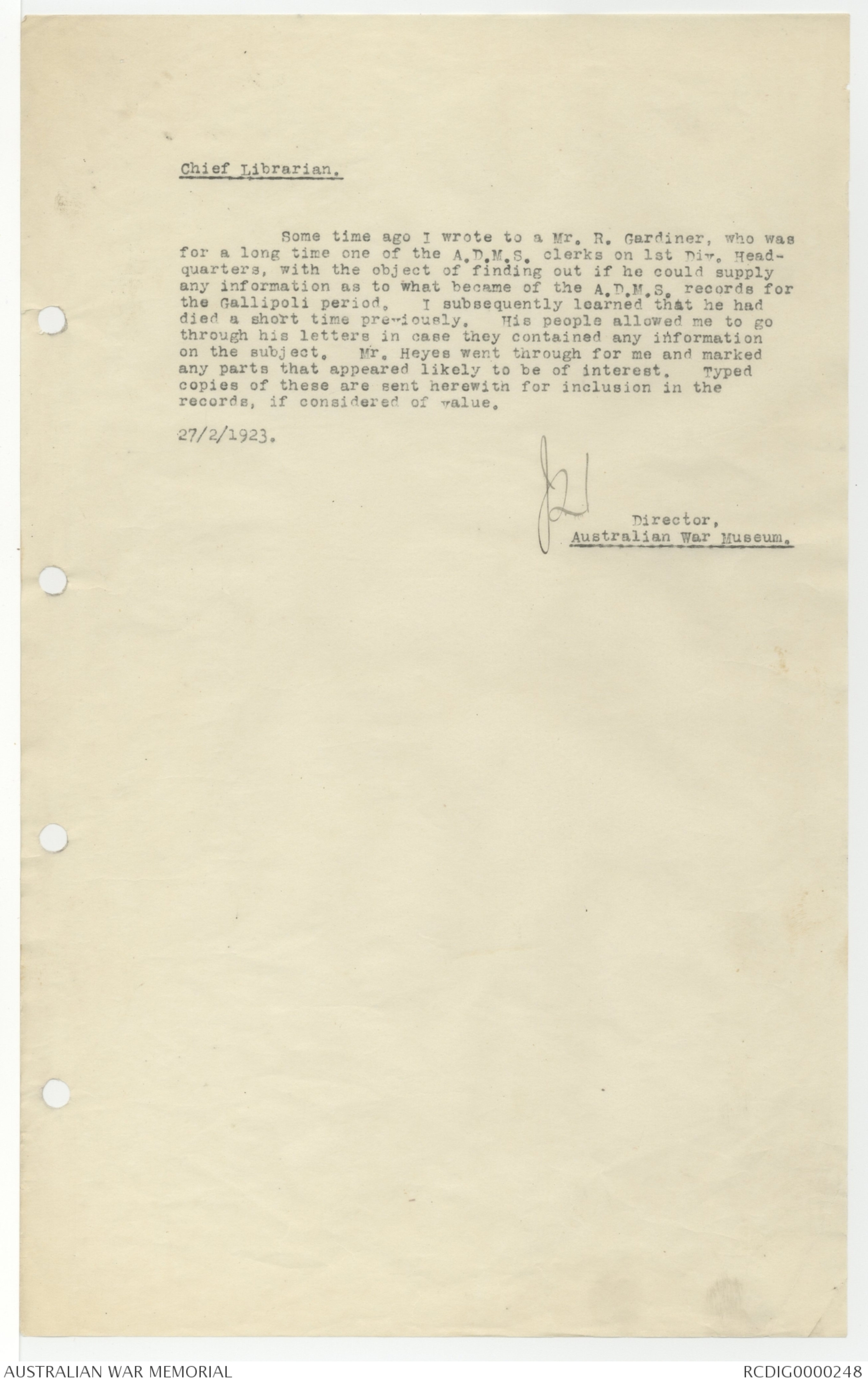
Chief Librarian.
Some time ago I wrote to a Mr. R. Gardiner, who was
for a long time one of the A.D.M.S. clerks on 1st Div. Headquarters,
with the object of finding out if he could supply
any information as to what became of the A.D.M.S. records for
the Gallipoli period. I subsequently learned that he had
died a short time previously. His people allowed me to go
through his letters in case they contained any information
on the subject. Mr. Heyes went through for me and marked
any parts that appeared likely to be of interest. Typed
copies of these are sent herewith for inclusion in the
records, if considered of value.
27/2/1923.
JLT
Director,
Australian War Museum.
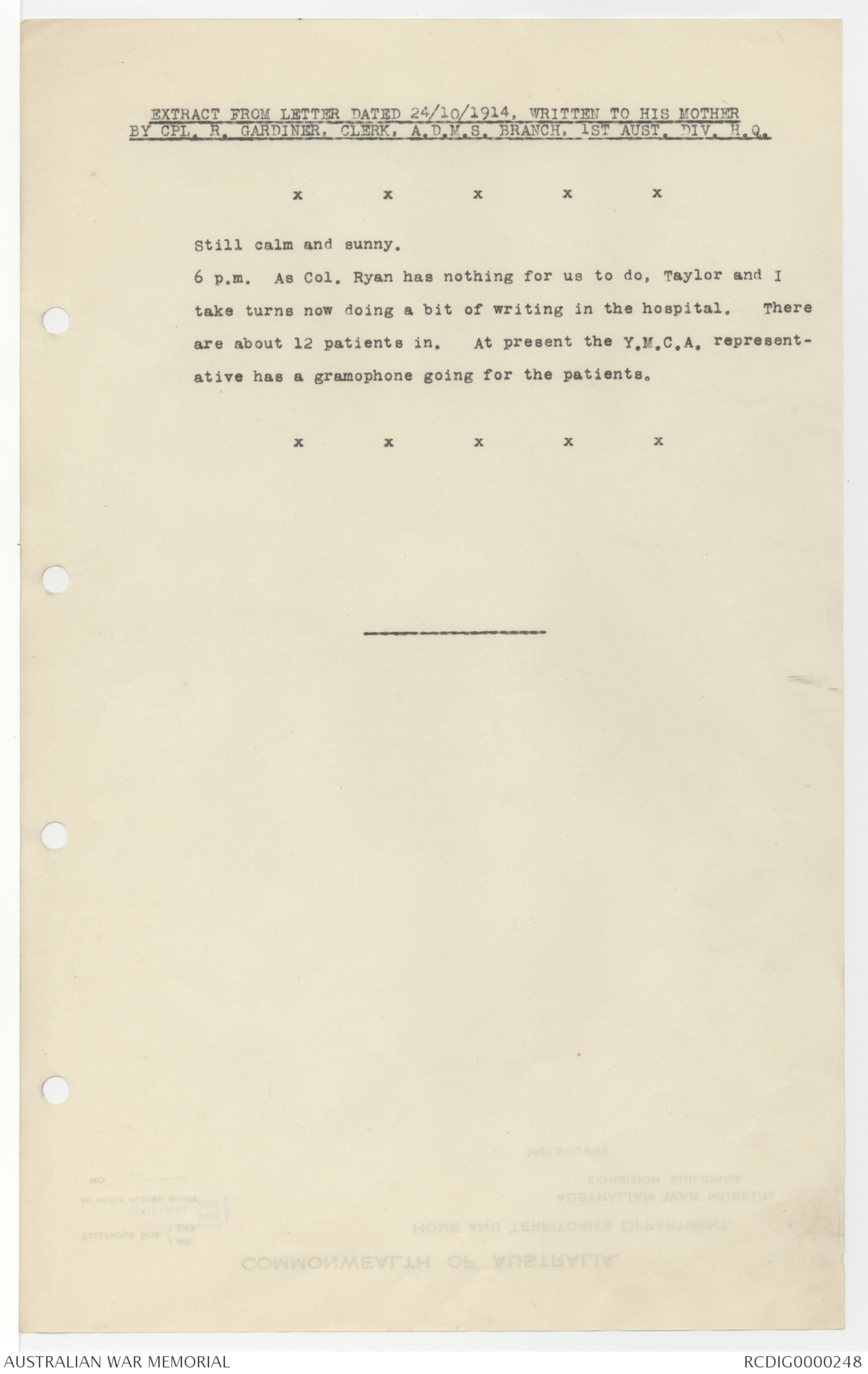
EXTRACT FROM LETTER DATED 24/10/1914, WRITTEN TO HIS MOTHER
BY CPL. R. GARDINER, CLERK, A.D.M.S. BRANCH, 1ST AUST. DIV. H.Q.
Still calm and sunny.
6 p.m. As Col. Ryan has nothing for us to do, Taylor and I
take turns now doing a bit of writing in the hospital. There
are about 12 patients in. At present the Y.M.C.A. representative
has a gramophone going for the patients.
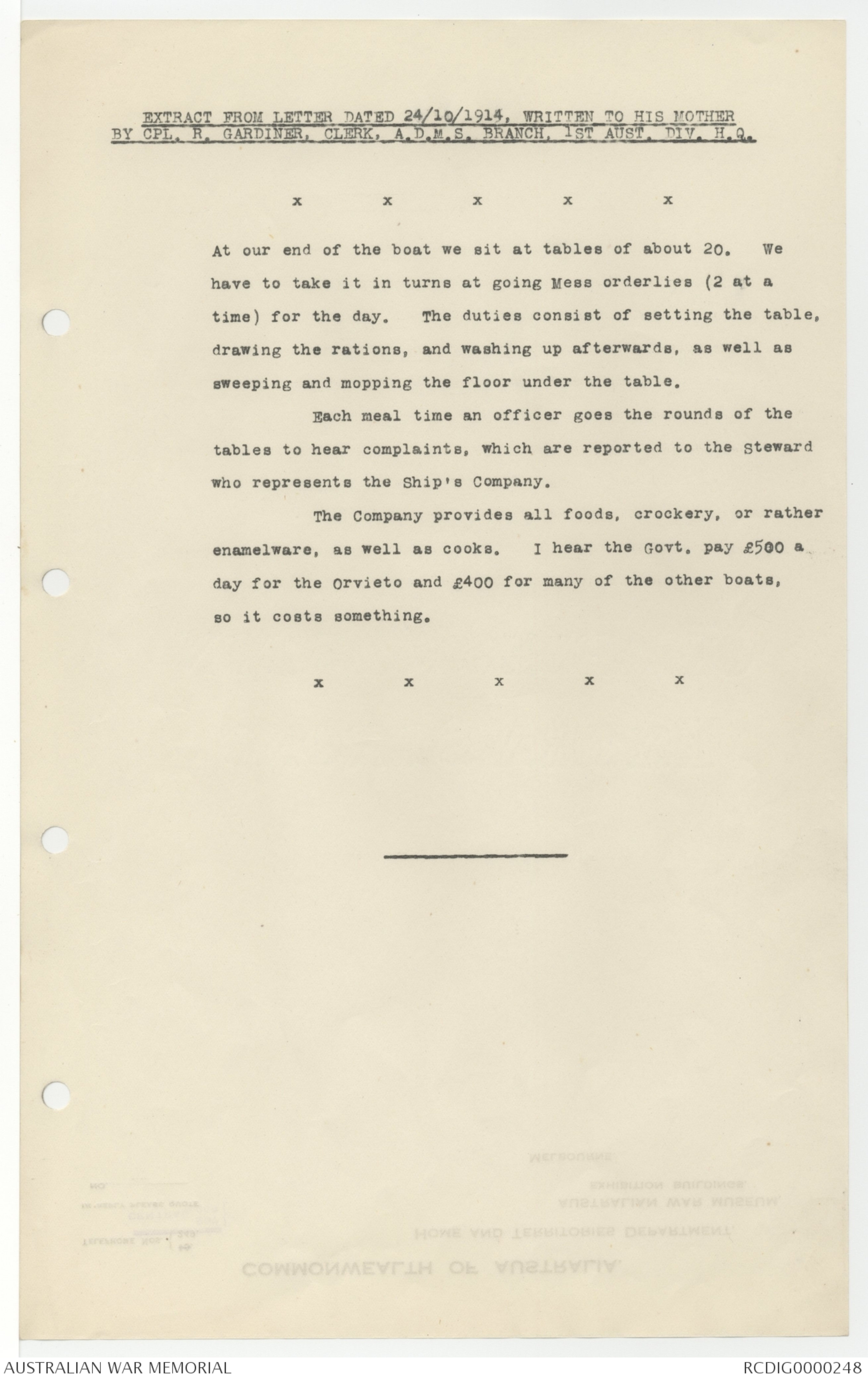
EXTRACT FROM LETTER DATED 24/10/1914, WRITTEN TO HIS MOTHER
BY CPL. R. GARDINER, CLERK, A.D.M.S. BRANCH, 1ST AUST. DIV. H.Q.
At our end of the boat we sit at tables of about 20. We
have to take it in turns at going Mess orderlies (2 at a
time) for the day. The duties consist of setting the table,
drawing the rations, and washing up afterwards, as well as
sweeping and mopping the floor under the table.
Each meal time an officer goes the rounds of the
tables to hear complaints, which are reported to the steward
who represents the Ship's Company.
The Company provides all foods, crockery, or rather
enamelware, as well as cooks. I hear the Govt. pay £500 a
day for the Orvieto and £400 for many of the other boats,
so it costs something.
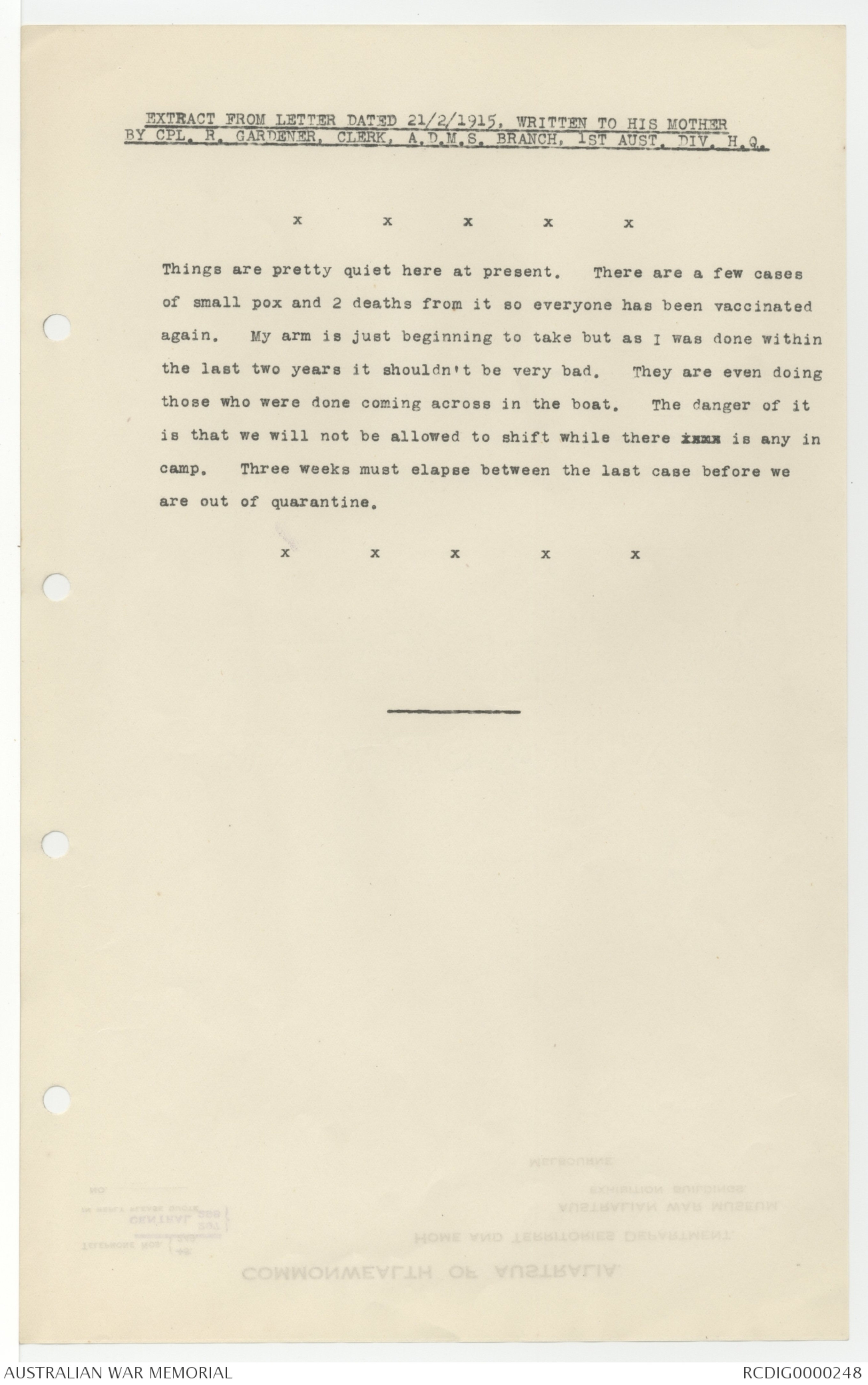
EXTRACT FROM LETTER DATED 21/2/1915, WRITTEN TO HIS MOTHER
BY CPL. R. GARDENER, CLERK, A.D.M.S. BRANCH, 1ST AUST. DIV. H.Q.
Things are pretty quiet here at present. There are a few cases
of small pox and 2 deaths from it so everyone has been vaccinated
again. My arm is just beginning to take but as I was done within
the last two years it shouldn't be very bad. They are even doing
those who were done coming across in the boat. The danger of it
is that we will not be allowed to shift while there xxxx is any in
camp. Three weeks must elapse between the last case before we
are out of quarantine.
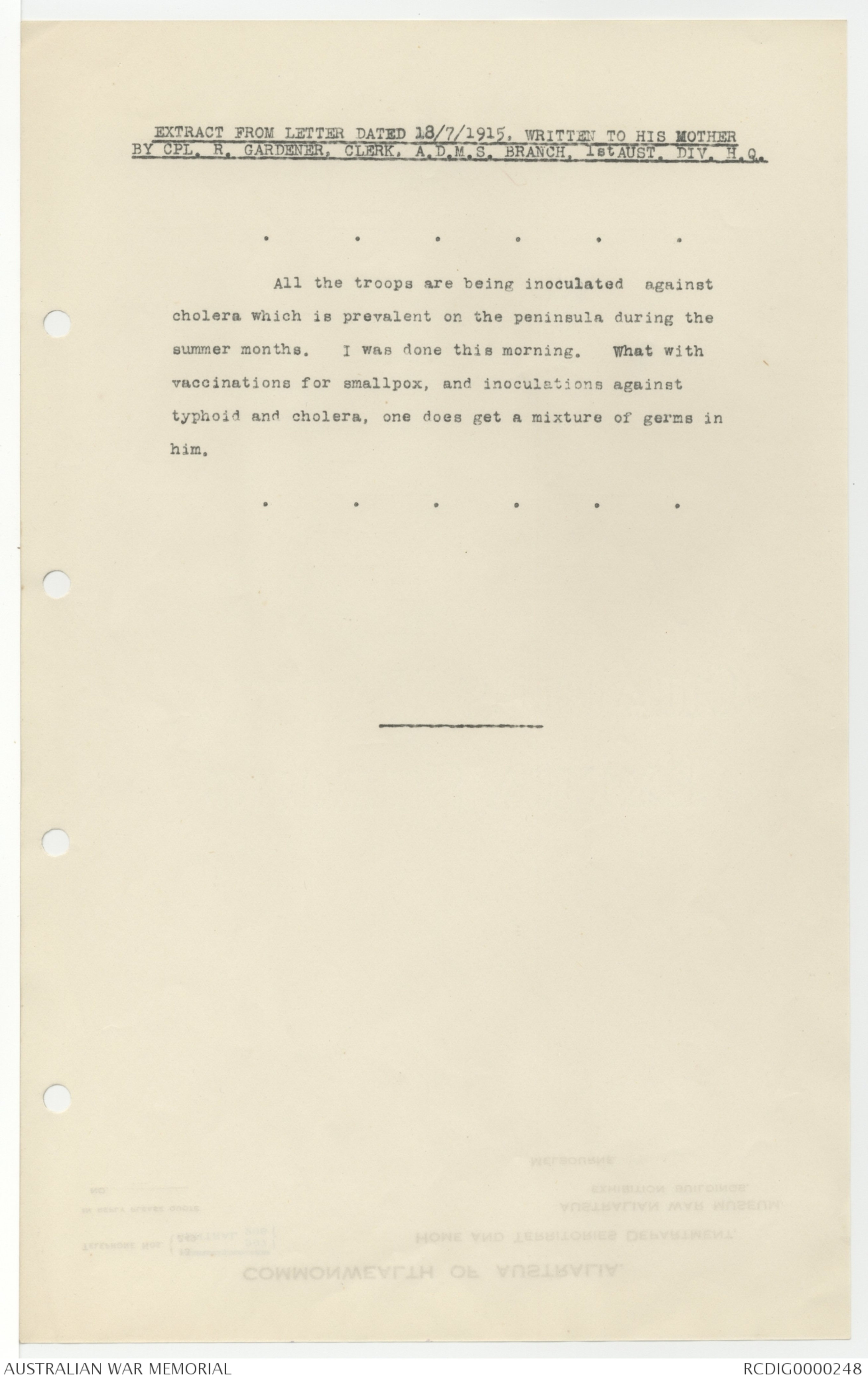
EXTRACT FROM LETTER DATED 18/7/1915, WRITTEN TO HIS MOTHER
BY CPL. R. GARDENER, CLERK, A.D.M.S. BRANCH, 1st AUST. DIV. H.Q.
All the troops are being inoculated against
cholera which is prevalent on the peninsula during the
summer months. I was done this morning. What with
vaccinations for smallpox, and inoculations against
typhoid and cholera, one does get a mixture of germs in
him.
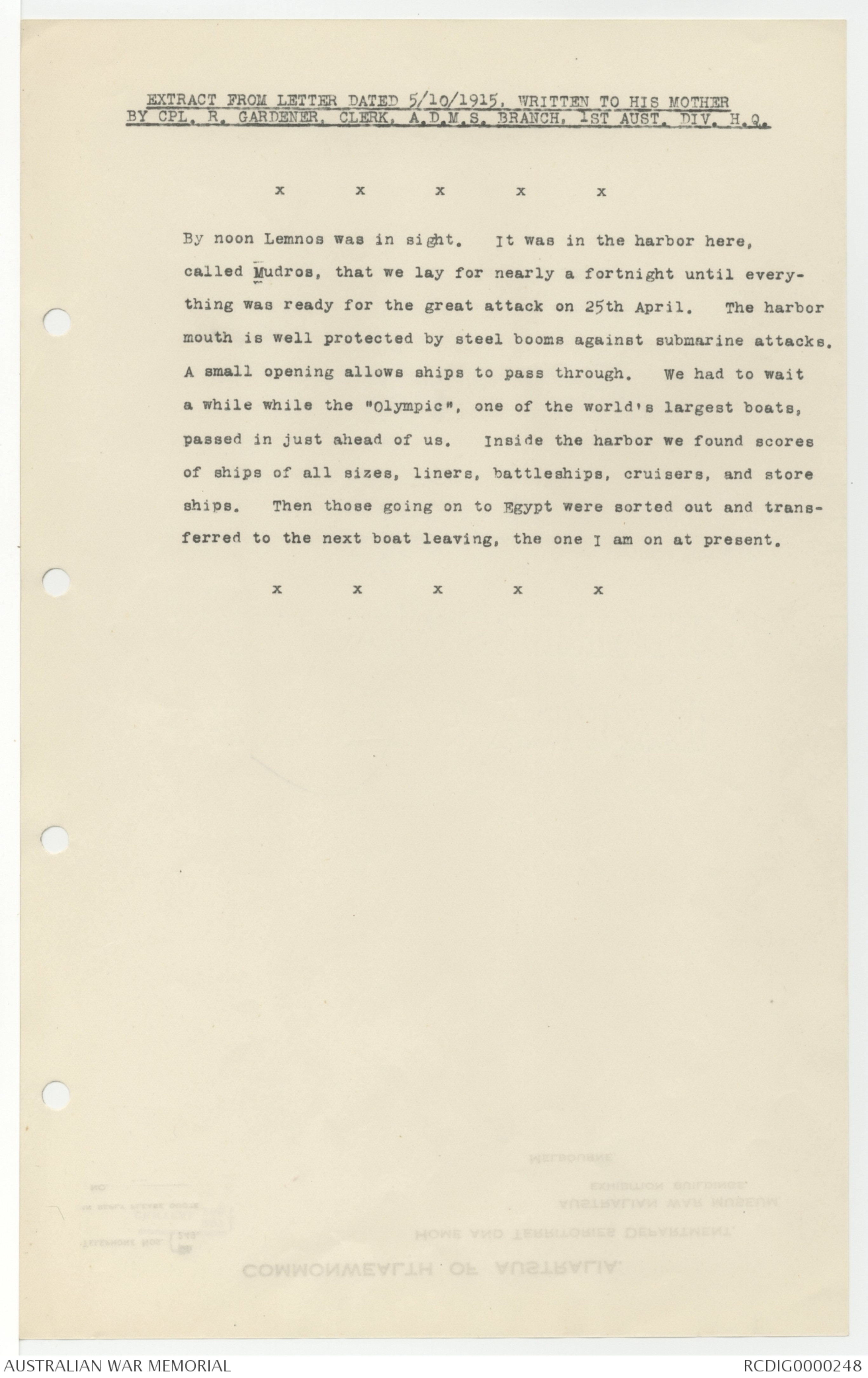
EXTRACT FROM LETTER DATED 5/10/1915, WRITTEN TO HIS MOTHER
BY CPL. R. GARDENER, CLERK, A.D.M.S. BRANCH, 1ST AUST. DIV. H.Q.
By noon Lemnos was in sight. It was in the harbor here,
called Mudros, that we lay for nearly a fortnight until everything
was ready for the great attack on 25th April. The harbor
mouth is well protected by steel booms against submarine attacks.
A small opening allows ships to pass through. We had to wait
a while while the "Olympic", one of the world's largest boats,
passed in just ahead of us. Inside the harbor we found scores
of ships of all sizes, liners, battleships, cruisers, and store
ships. Then those going on to Egypt were sorted out and transferred
to the next boat leaving, the one I am on at present.
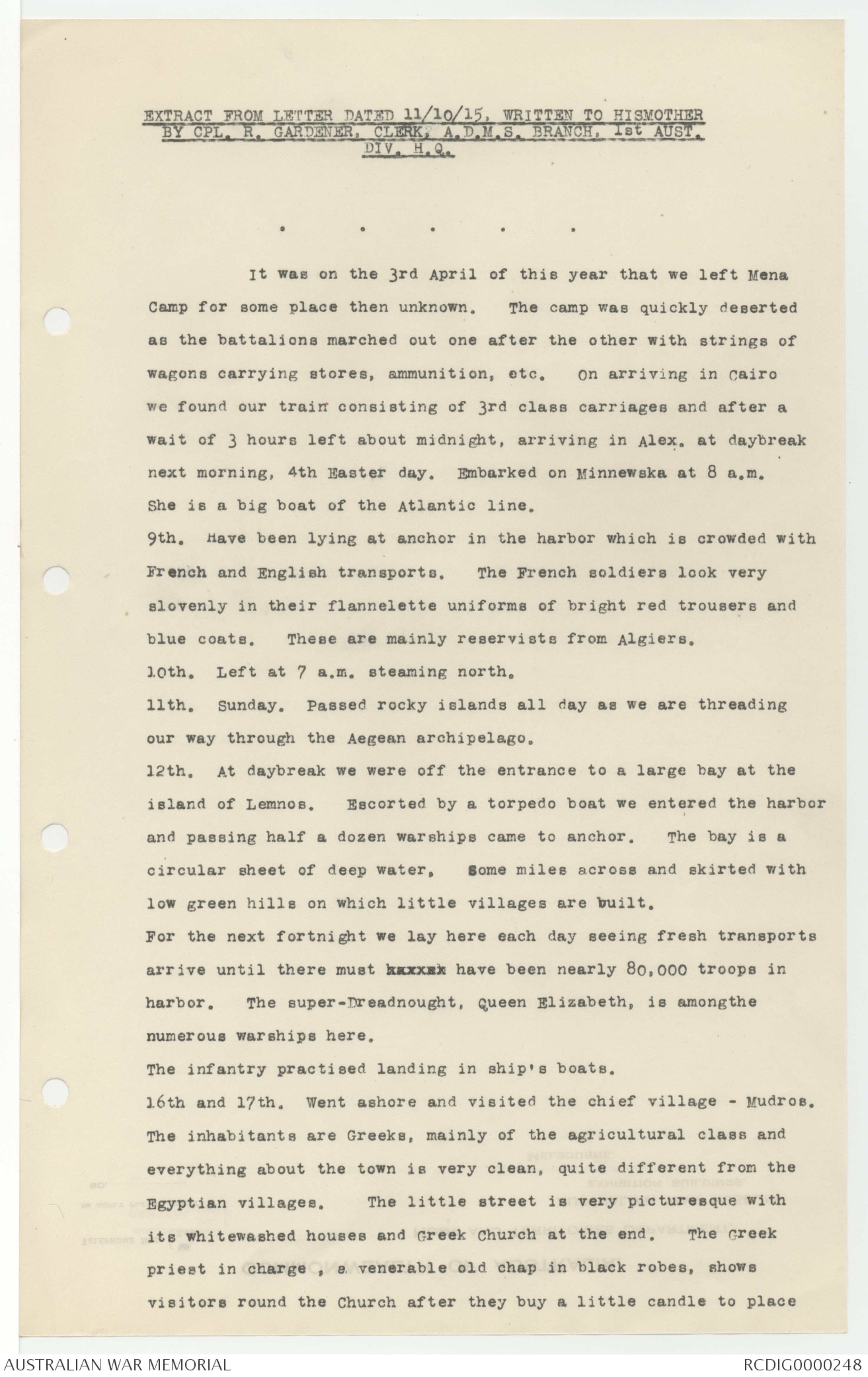
EXTRACT FROM LETTER DATED 11/10/15, WRITTEN TO HISMOTHER
BY CPL. R. GARDENER, CLERK, A.D.M.S. BRANCH, 1st AUST.
DIV. H.Q.
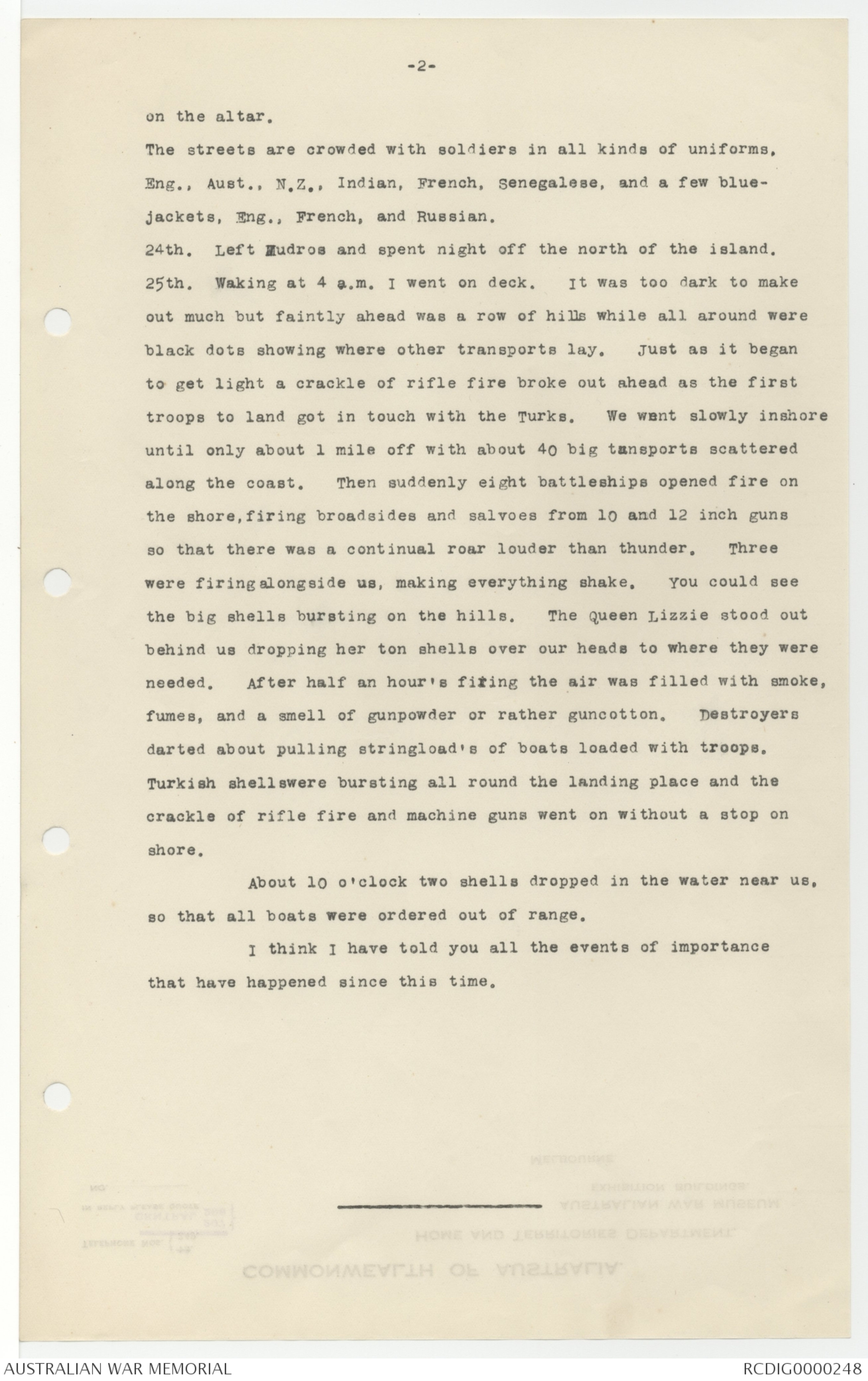
It was on the 3rd April of this year that we left Mena
Camp for some place then unknown. The camp was quickly deserted
as the battalions marched out one after the other with strings of
wagons carrying stores, ammunition, etc. On arriving in Cairo
we found our train consisting of 3rd class carriages and after a
wait of 3 hours left about midnight, arriving in Alex. at daybreak
next morning, 4th Easter day. Embarked on Minnewska at 8 a.m.
She is a big boat of the Atlantic line.
9th. Have been lying at anchor in the harbor which is crowded with
French and English transports. The French soldiers look very
slovenly in their flannelette uniforms of bright red trousers and
blue coats. These are mainly reservists from Algiers.
10th. Left at 7 a.m. steaming north.
11th. Sunday. Passed rocky islands all day as we are threading
our way through the Aegean archipelago.
12th. At daybreak we were off the entrance to a large bay at the
island of Lemnos. Escorted by a torpedo boat we entered the harbor
and passing half a dozen warships came to anchor. The bay is a
circular sheet of deep water, some miles across and skirted with
low green hills on which little villages are built.
For the next fortnight we lay here each day seeing fresh transports
arrive until there must xxxxxx have been nearly 80,000 troops in
harbor. The super-Dreadnought, Queen Elizabeth, is amongthe
numerous warships here.
The infantry practised landing in ship's boats.
16th and 17th. Went ashore and visited the chief village - Mudros.
The inhabitants are Greeks, mainly of the agricultural class and
everything about the town is very clean, quite different from the
Egyptian villages. The little street is very picturesque with
its whitewashed houses and Greek Church at the end. The Greek
priest in charge , a venerable old chap in black robes, shows
visitors round the Church after they buy a little candle to place
-2-
on the altar.
The streets are crowded with soldiers in all kinds of uniforms,
Eng., Aust., N.Z., Indian, French, Senegalese, and a few blue-jackets,
Eng., French, and Russian.
24th. Left Mudros and spent night off the north of the island.
25th. Waking at 4 a.m. I went on deck. It was too dark to make
out much but faintly ahead was a row of hills while all around were
black dots showing where other transports lay. Just as it began
to get light a crackle of rifle fire broke out ahead as the first
troops to land got in touch with the Turks. We went slowly inshore
until only about 1 mile off with about 40 big tansports scattered
along the coast. Then suddenly eight battleships opened fire on
the shore, firing broadsides and salvoes from 10 and 12 inch guns
so that there was a continual roar louder than thunder. Three
were firing alongside us, making everything shake. You could see
the big shells bursting on the hills. The Queen Lizzie stood out
behind us dropping her ton shells over our heads to where they were
needed. After half an hour's firing the air was filled with smoke,
fumes, and a smell of gunpowder or rather guncotton. Destroyers
darted about pulling stringload's of boats loaded with troops.
Turkish shellswere bursting all round the landing place and the
crackle of rifle fire and machine guns went on without a stop on
shore.
About 10 o'clock two shells dropped in the water near us,
so that all boats were ordered out of range.
I think I have told you all the events of importance
that have happened since this time.
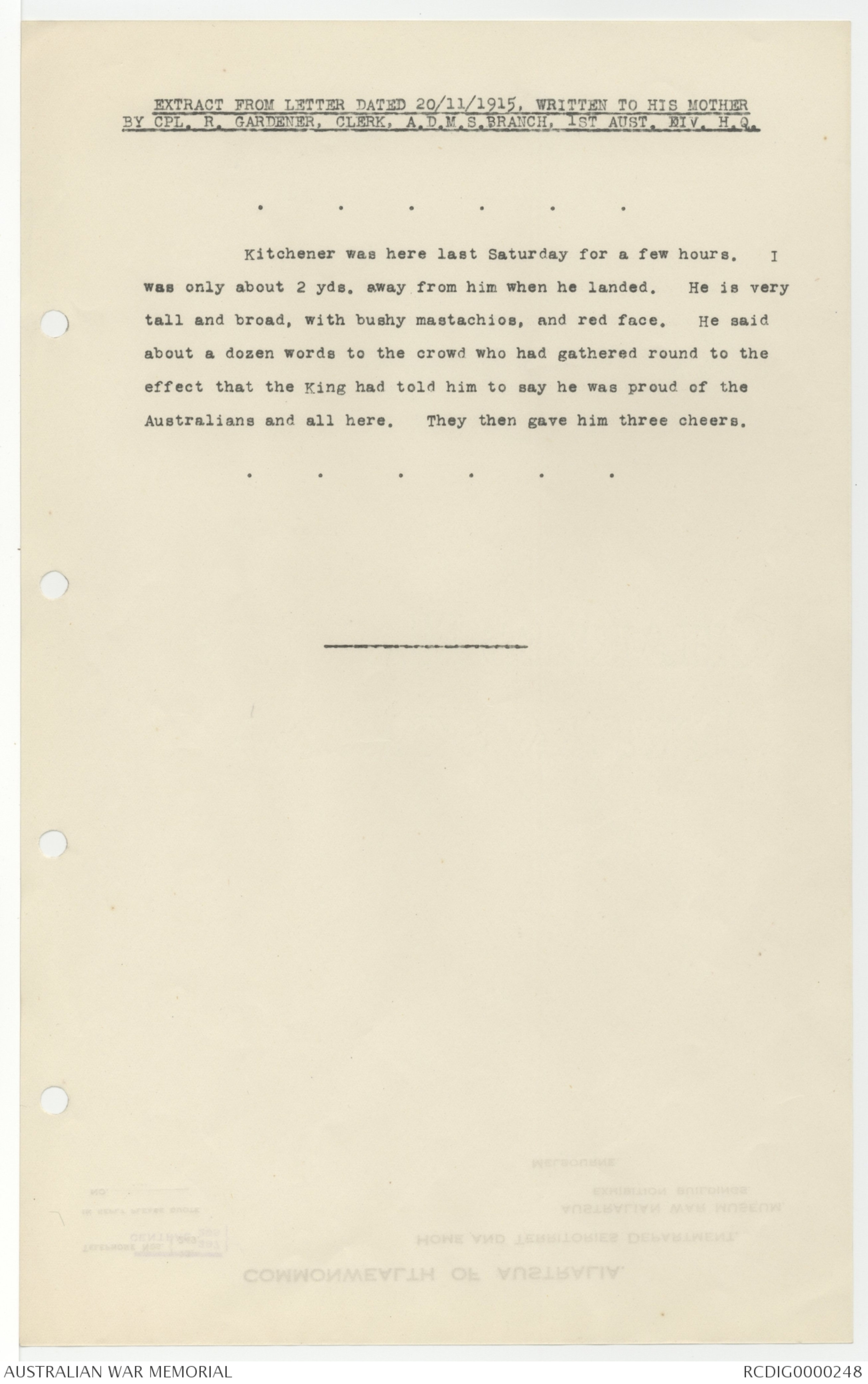
EXTRACT FROM LETTER DATED 20/11/1915, WRITTEN TO HIS MOTHER
BY CPL. R. GARDENER, CLERK, A.D.M.S.BRANCH, 1ST AUST. DIV. H.Q.
Kitchener was here last Saturday for a few hours. I
was only about 2 yds. away from him when he landed. He is very
tall and broad, with bushy mastachios, and red face. He said
about a dozen words to the crowd who had gathered round to the
effect that the King had told him to say he was proud of the
Australians and all here. They then gave him three cheers.
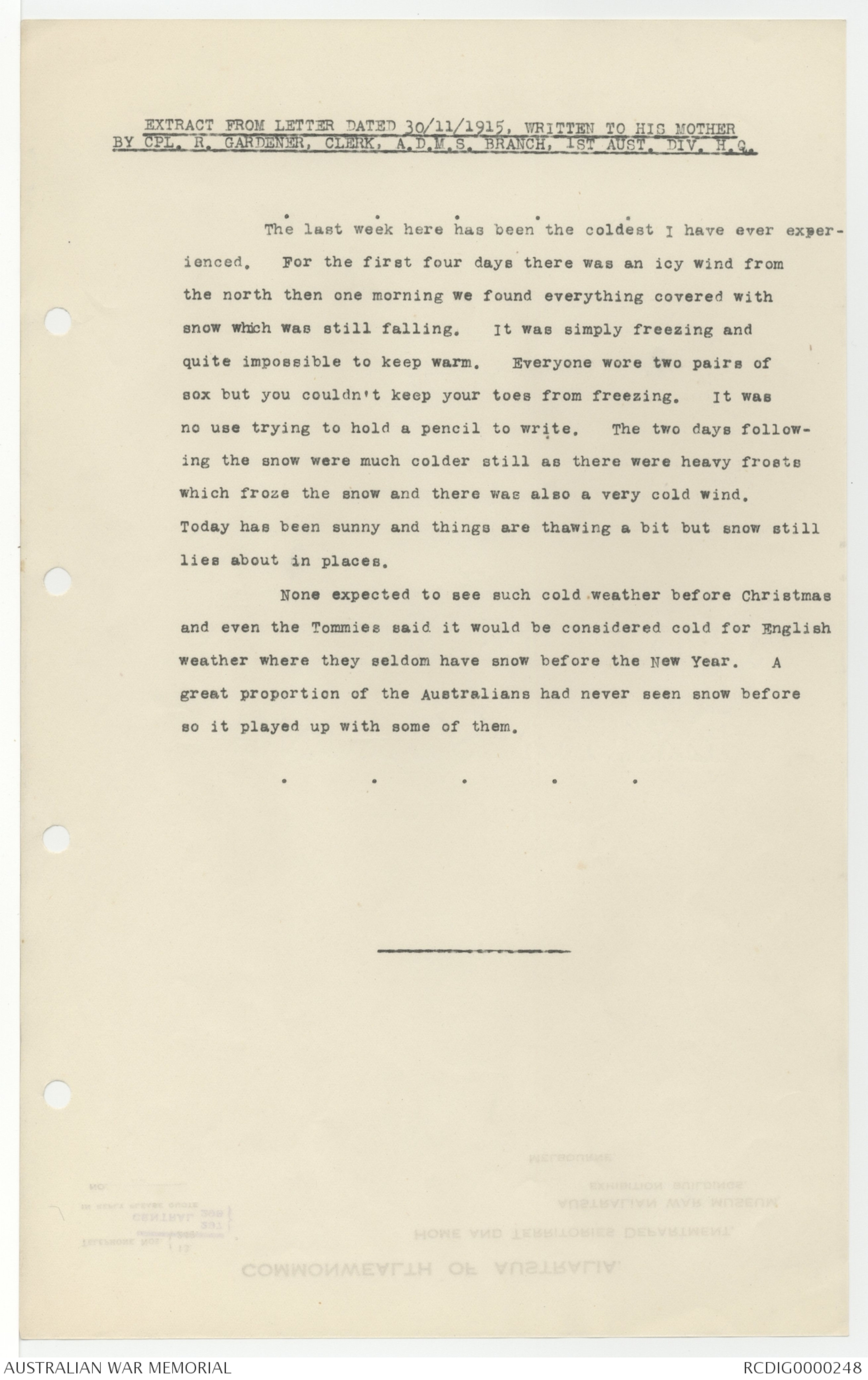
EXTRACT FROM LETTER DATED 30/11/1915, WRITTEN TO HIS MOTHER
BY CPL. R. GARDENER, CLERK, A.D.M.S. BRANCH, 1ST AUST. DIV. H.Q.
The last week here has been the coldest I have ever experienced.
For the first four days there was an icy wind from
the north then one morning we found everything covered with
snow which was still falling. It was simply freezing and
quite impossible to keep warm. Everyone wore two pairs of
sox but you couldn't keep your toes from freezing. It was
no use trying to hold a pencil to write. The two days following
the snow were much colder still as there were heavy frosts
which froze the snow and there was also a very cold wind.
Today has been sunny and things are thawing a bit but snow still
lies about in places.
None expected to see such cold weather before Christmas
and even the Tommies said it would be considered cold for English
weather where they seldom have snow before the New Year. A
great proportion of the Australians had never seen snow before
so it played up with some of them.
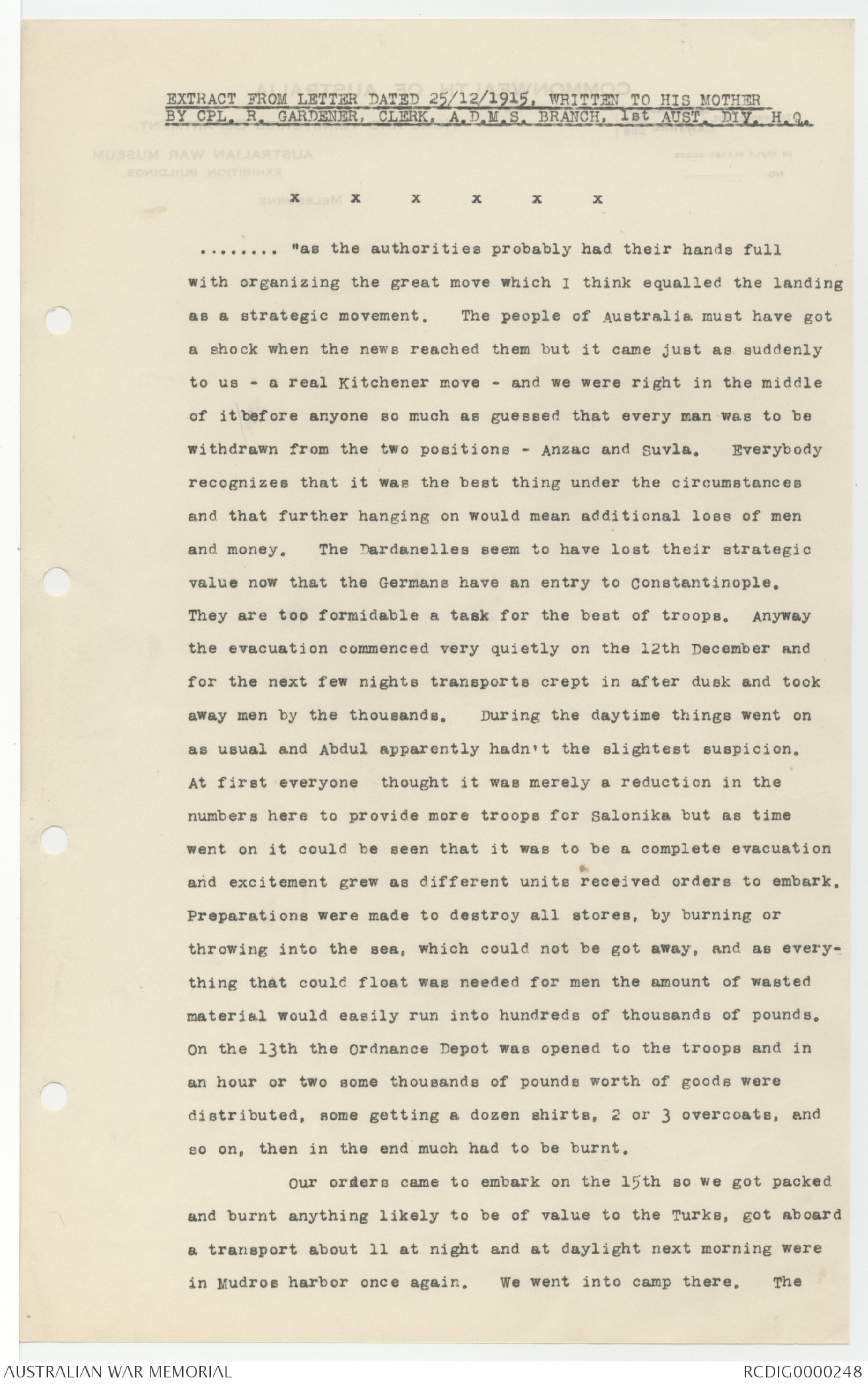
EXTRACT FROM LETTER DATED 25/12/1915, WRITTEN TO HIS MOTHER
BY CPL. R. GARDENER, CLERK, A.D.M.S. BRANCH, 1ST AUST. DIV. H.Q.
"as the authorities probably had their hands full
with organizing the great move which I think equalled the landing
as a strategic movement. The people of Australia must have got
a shock when the news reached them but it came just as suddenly
to us - a real Kitchener move - and we were right in the middle
of it before anyone so much as guessed that every man was to be
withdrawn from the two positions - Anzac and Suvla. Everybody
recognizes that it was the best thing under the circumstances
and that further hanging on would mean additional loss of men
and money. The Dardanelles seem to have lost their strategic
value now that the Germans have an entry to Constantinople.
They are too formidable a task for the best of troops. Anyway
the evacuation commenced very quietly on the 12th December and
for the next few nights transports crept in after dusk and took
away men by the thousands. During the daytime things went on
as usual and Abdul apparently hadn't the slightest suspicion.
At first everyone thought it was merely a reduction in the
numbers here to provide more troops for Salonika but as time
went on it could be seen that it was to be a complete evacuation
and excitement grew as different units received orders to embark.
Preparations were made to destroy all stores, by burning or
throwing into the sea, which could not be got away, and as everything
that could float was needed for men the amount of wasted
material would easily run into hundreds of thousands of pounds.
On the 13th the Ordnance Depot was opened to the troops and in
an hour or two some thousands of pounds worth of goods were
distributed, some getting a dozen shirts, 2 or 3 overcoats, and
so on, then in the end much had to be burnt.
Our orders came to embark on the 15th so we got packed
and burnt anything likely to be of value to the Turks, got aboard
a transport about 11 at night and at daylight next morning were
in Mudros harbor once again. We went into camp there. The
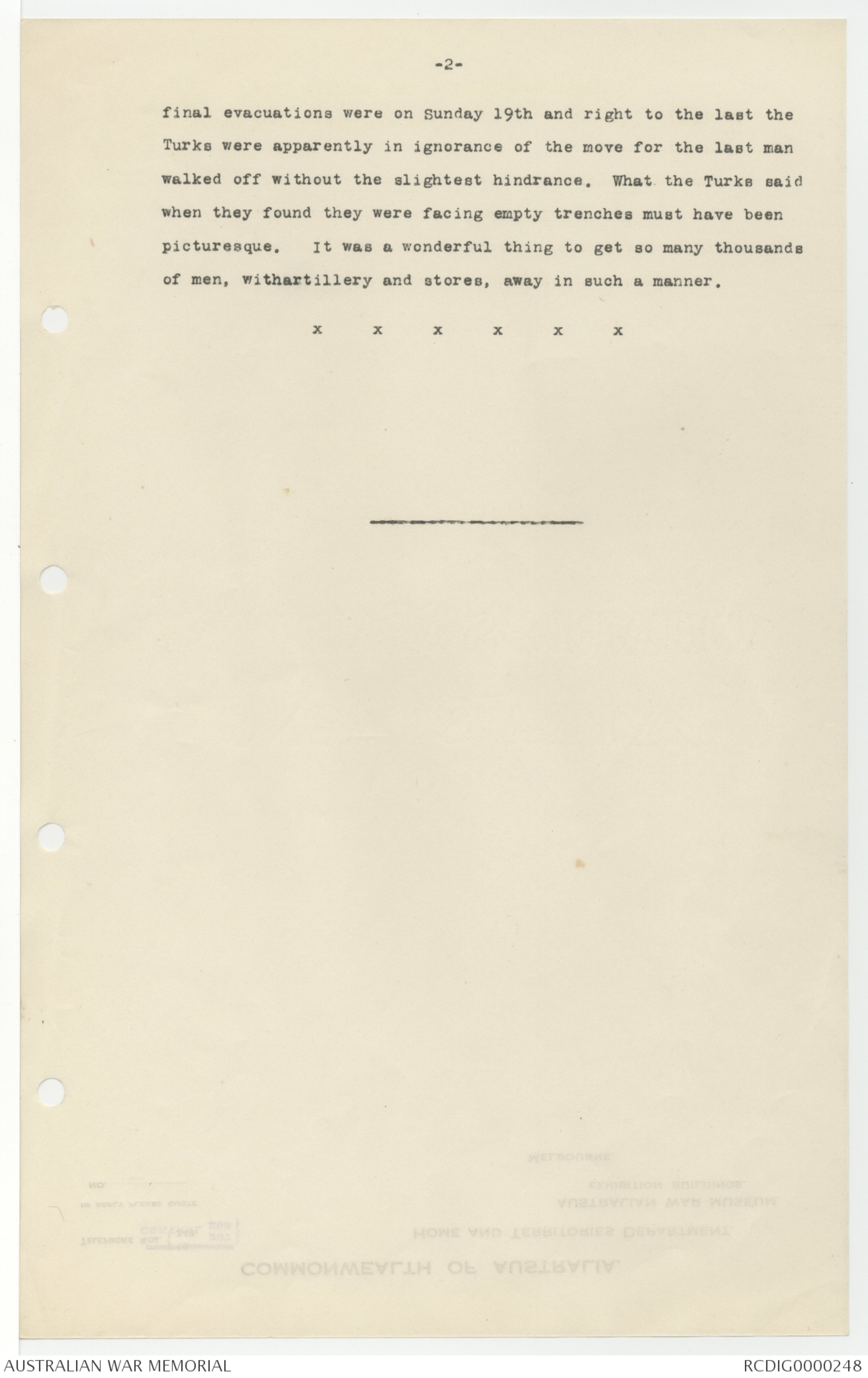
-2-
final evacuations were on Sunday 19th and right to the last the
Turks were apparently in ignorance of the move for the last man
walked off without the slightest hindrance. What the Turks said
when they found they were facing empty trenches must have been
picturesque. It was a wonderful thing to get so many thousands
of men, withartillery and stores, away in such a manner.
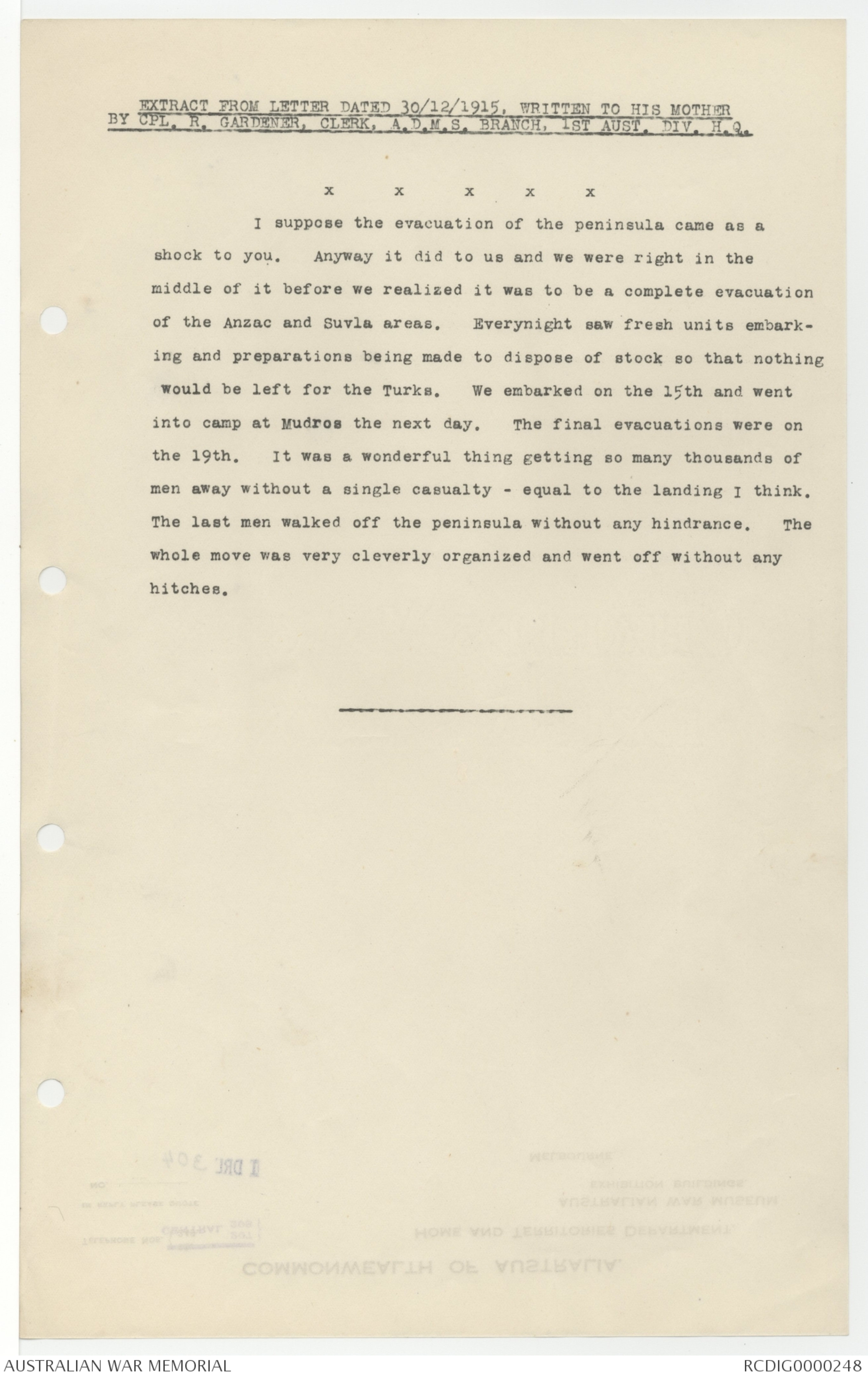
EXTRACT FROM LETTER DATED 30/12/1915, WRITTEN TO HIS MOTHER
BY CPL. R. GARDENER, CLERK, A.D.M.S. BRANCH, 1ST AUST. DIV. H.Q.
I suppose the evacuation of the peninsula came as a
shock to you. Anyway it did to us and we were right in the
middle of it before we realized it was to be a complete evacuation
of the Anzac and Suvla areas. Everynight saw fresh units embarking
and preparations being made to dispose of stock so that nothing
would be left for the Turks. We embarked on the 15th and went
into camp at Mudros the next day. The final evacuations were on
the 19th. It was a wonderful thing getting so many thousands of
men away without a single casualty - equal to the landing I think.
The last men walked off the peninsula without any hindrance. The
whole move was very cleverly organized and went off without any
hitches.
 Deb Parkinson
This transcription item is now locked to you for editing. To release the lock either Save your changes or Cancel.
This lock will be automatically released after 60 minutes of inactivity.