
Letters from David Gibson Alexander to his Mother, 1915
[*8.4.15-14.7.15*]
EXTRACTS FROM LETTERS WRITTEN BY DAVID G. ALEXANDER
(PRIVATE)
1509A
TO HIS MOTHER.
Aerodrome Camp.
Heliopolis.
April 8th, 1915.
My dear Mother,
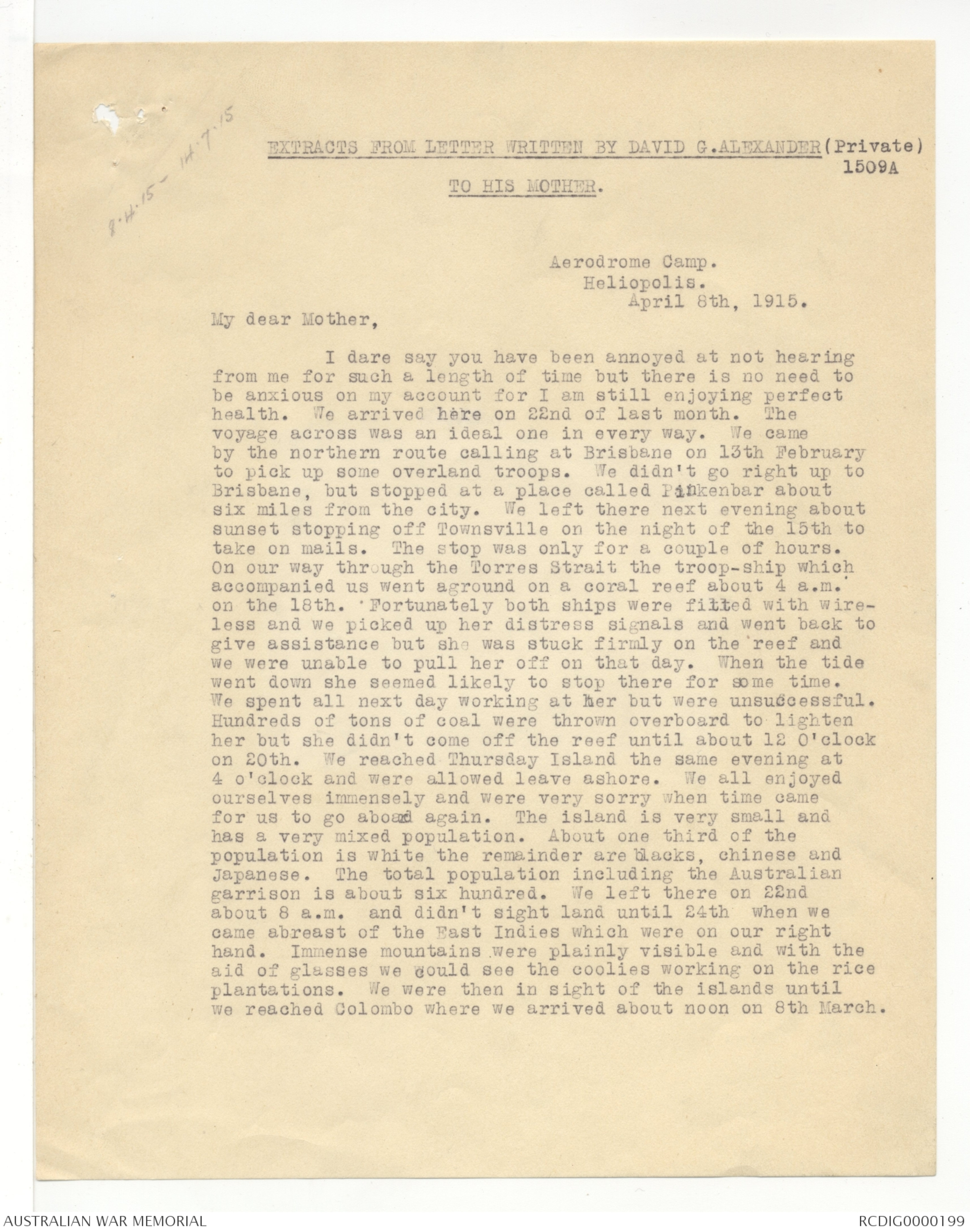
I dare say you have been annoyed at not hearing
from me for such a length of time but there is no need to
be anxious on my account for I am still enjoying perfect
health. We arrived hère on 22nd of last month. The
voyage across was an ideal one in every way. We came
by the northern route calling at Brisbane on 13th February
to pick up some overland troops. We didn't go right up to
Brisbane, but stopped at a place called Pinkenbar about
six miles from the city. We left there next evening about
sunset stopping off Townsville on the night of the 15th to
take on mails. The stop was only for a couple of hours.
On our way through the Torres Strait the troop-ship which
accompanied us went aground on a coral reef about 4 a.m.
on the 18th. Fortunately both ships were filted with wireless
and we picked up her distress signals and went back to
give assistance but she was stuck firmly on the reef and
we were unable to pull her off on that day. When the tide
went down she seemed likely to stop there for some time.
We spent all next day working at her but were unsuccessful.
Hundreds of tons of coal were thrown overboard to lighten
her but she didn't come off the reef until about 12 O'clock
on 20th. We reached Thursday Island the same evening at
4 o'clock and were allowed leave ashore. We all enjoyed
ourselves immensely and were very sorry when time came
for us to go aboard again. The island is very small and
has a very mixed population. About one third of the
population is white the remainder are blacks, chinese and
Japanese. The total population including the Australian
garrison is about six hundred. We left there on 22nd
about 8 a.m. and didn't sight land until 24th when we
came abreast of the East Indies which were on our right
hand. Immense mountains were plainly visible and with the
aid of glasses we dould see the coolies working on the rice
plantations. We were then in sight of the islands until
we reached Colombo where we arrived about noon on 8th March.
-2-
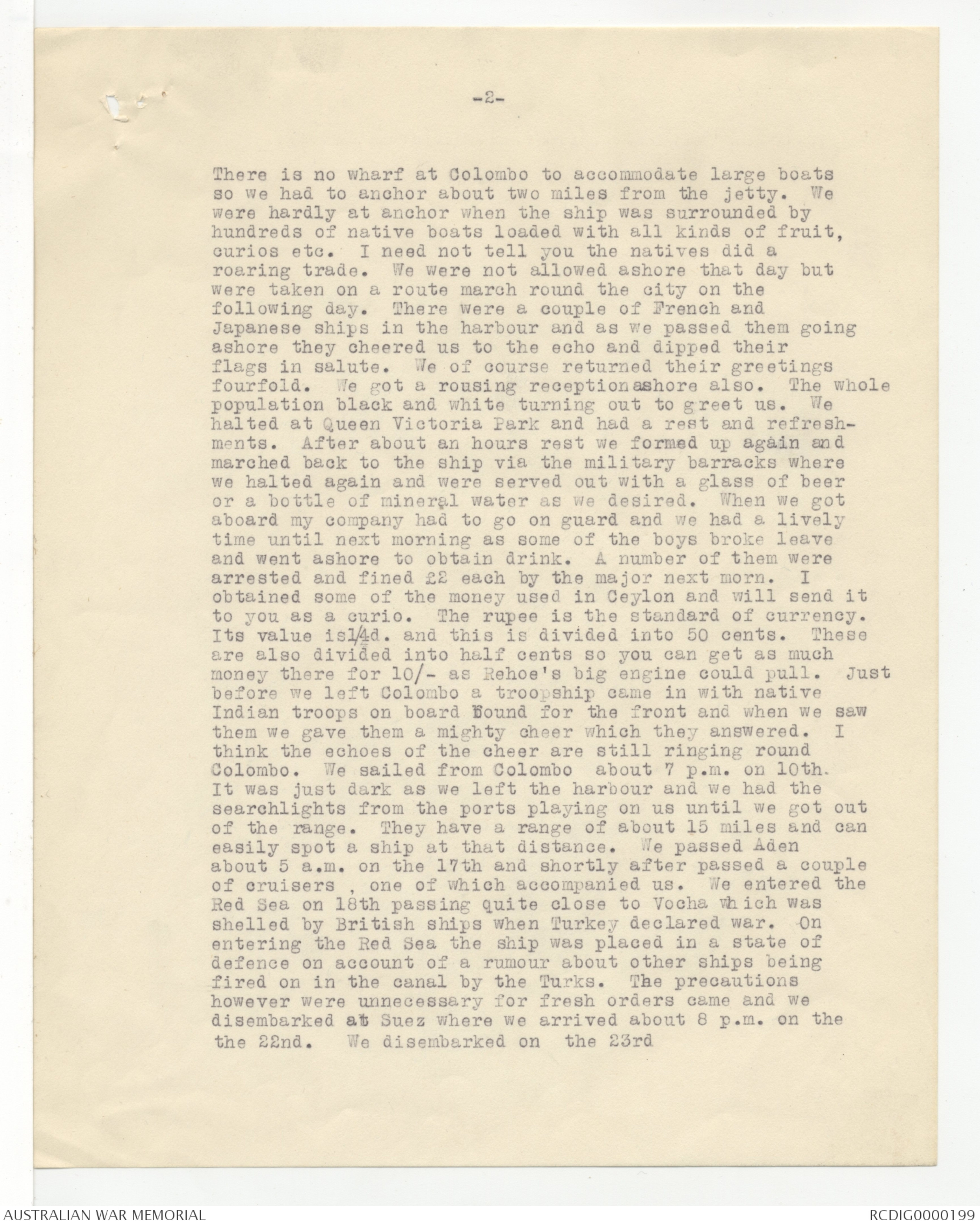
There is no wharf at Colombo to accommodate large boats
so we had to anchor about two miles from the jetty. We
were hardly at anchor when the ship was surrounded by
hundreds of native boats loaded with all kinds of fruit,
curios etc. I need not tell you the natives did a
roaring trade. We were not allowed ashore that day but
were taken on a route march round the city on the
following day. There were a couple of French and
Japanese ships in the harbour and as we passed them going
ashore they cheered us to the echo and dipped their
flags in salute. We of course returned their greetings
fourfold. We got a rousing reception ashore also. The whole
population black and white turning out to greet us. We
halted at Queen Victoria Park and had a rest and refreshments.
After about an hours rest we formed up again and
marched back to the ship via the military barracks where
we halted again and were served out with a glass of beer
or a bottle of mineral water as we desired. When we got
aboard my company had to go on guard and we had a lively
time until next morning as some of the boys broke leave
and went ashore to obtain drink. A number of them were
arrested and fined £2 each by the major next morn. I
obtained some of the money used in Ceylon and will send it
to you as a curio. The rupee is the standard of currency.
Its value is 1/4d. and this is divided into 50 cents. These
are also divided into half cents so you can get as much
money there for 10/- as Rehoe's big engine could pull. Just
before we left Colombo a troopship came in with native
Indian troops on board bound for the front and when we saw
them we gave them a mighty cheer which they answered. I
think the echoes of the cheer are still ringing round
Colombo. We sailed from Colombo about 7 p.m. on 10th.
It was just dark as we left the harbour and we had the
searchlights from the ports playing on us until we got out
of the range. They have a range of about 15 miles and can
easily spot a ship at that distance. We passed Aden
about 5 a.m. on the 17th and shortly after passed a couple
of cruisers, one of which accompanied us. We entered the
Red Sea on 18th passing quite close to Vocha which was
shelled by British ships when Turkey declared war. On
entering the Red Sea the ship was placed in a state of
defence on account of a rumour about other ships being
fired on in the canal by the Turks. The precautions
however were unnecessary for fresh orders came and we
disembarked at Suez where we arrived about 8 p.m. on the
the 22nd. We disembarked on the 23rd
-3-
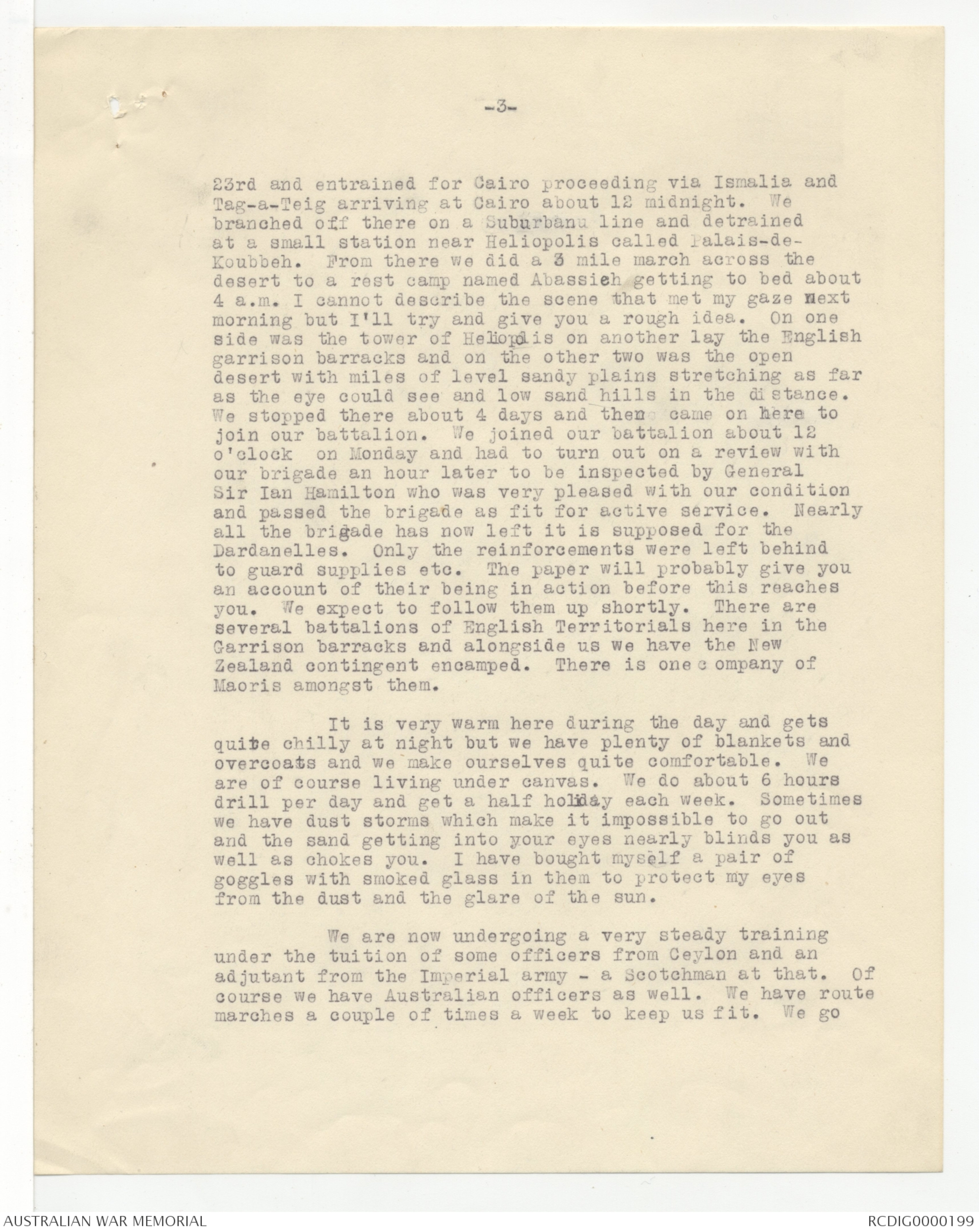
23rd and entrained for Cairo proceeding via Ismalia and
Tag-a-Teig arriving at Cairo about 12 midnight. We
branched off there on a Suburban line and detrained
at a small station near Heliopolis called Palais-de-Koubbeh.
From there we did a 3 mile march across the
desert to a rest camp named Abassieh getting to bed about
4 a.m. I cannot describe the scene that met my gaze next
morning but I'll try and give you a rough idea. On one
side was the tower of Heloplis on another lay the English
garrison barracks and on the other two was the open
desert with miles of level sandy plains stretching as far
as the eye could see and low sand hills in the distance.
We stopped there about 4 days and then came on here to
join our battalion. We joined our battalion about 12
o'clock on Monday and had to turn out on a review with
our brigade an hour later to be inspected by General
Sir Ian Hamilton who was very pleased with our condition
and passed the brigade as fit for active service. Nearly
all the brigade has now left it is supposed for the
Dardanelles. Only the reinforcements were left behind
to guard supplies etc. The paper will probably give you
an account of their being in action before this reaches
you. We expect to follow them up shortly. There are
several battalions of English Territorials here in the
Garrison barracks and alongside us we have the New
Zealand contingent encamped. There is one company of
Maoris amongst them.
It is very warm here during the day and gets
quite chilly at night but we have plenty of blankets and
overcoats and we make ourselves quite comfortable. We
are of course living under canvas. We do about 6 hours
drill per day and get a half holiday each week. Sometimes
we have dust storms which make it impossible to go out
and the sand getting into your eyes nearly blinds you as
well as chokes you. I have bought myself a pair of
goggles with smoked glass in them to protect my eyes
from the dust and the glare of the sun.
We are now undergoing a very steady training
under the tuition of some officers from Ceylon and an
adjutant from the Imperial army - a Scotchman at that. Of
course we have Australian officers as well. We have route
marches a couple of times a week to keep us fit. We go
-4-
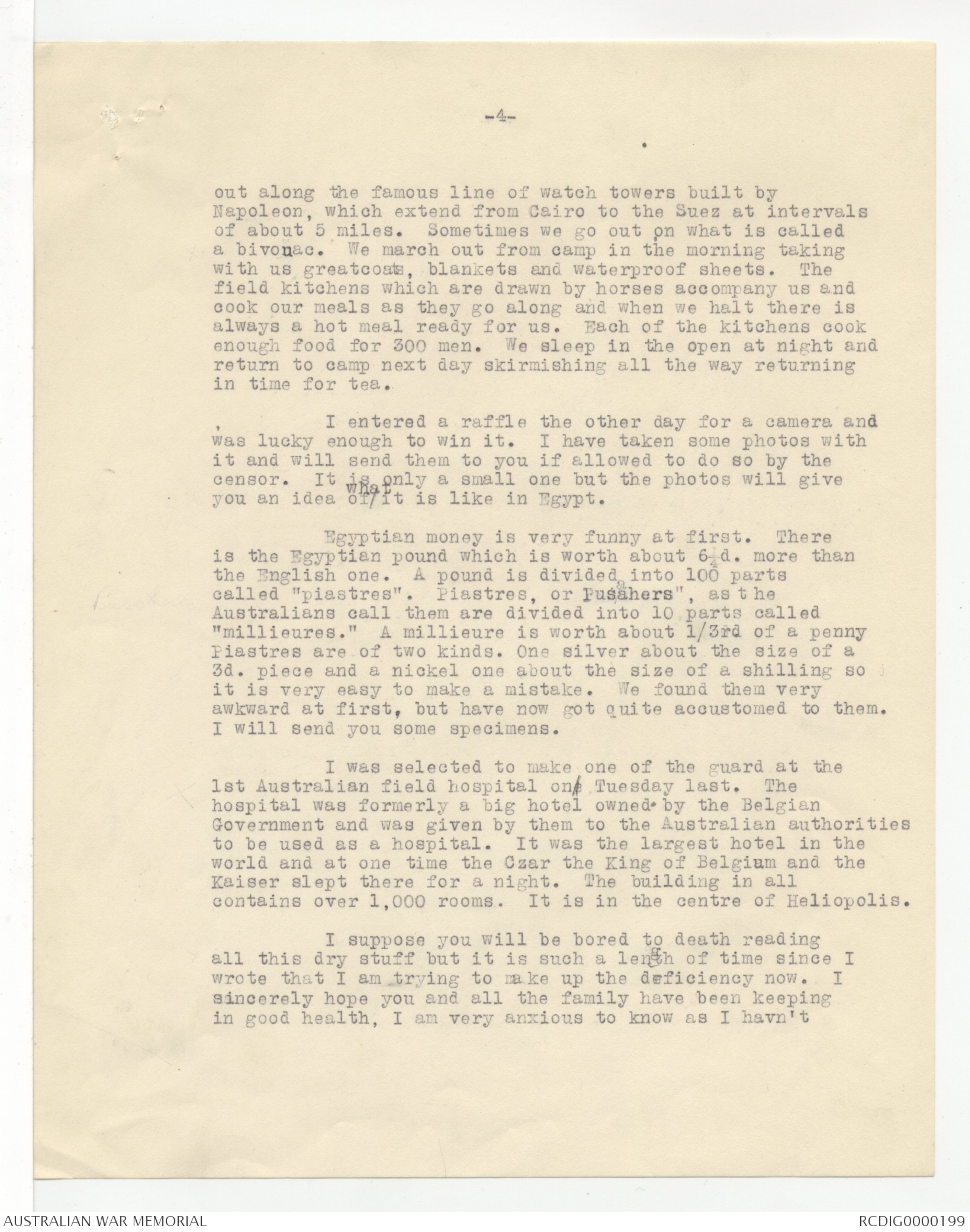
out along the famous line of watch towers built by
Napoleon, which extend from Cairo to the Suez at intervals
of about 5 miles. Sometimes we go out on what is called
a bivouac. We march out from camp in the morning taking
with us greatcoats, blankets and waterproof sheets. The
field kitchens which are drawn by horses accompany us and
cook our meals as they go along and when we halt there is
always a hot meal ready for us. Each of the kitchens cook
enough food for 300 men. We sleep in the open at night and
return to camp next day skirmishing all the way returning
in time for tea.
I entered a raffle the other day for a camera and
was lucky enough to win it. I have taken some photos with
it and will send them to you if allowed to do so by the
censor. It is only a small one but the photos will give
you an idea of what it is like in Egypt.
Egyptian money is very funny at first. There
is the Egyptian pound which is worth about 6¼-d. more than
the English one. A pound is divided into 100 parts
called "piastres". Piastres, or Pusaahers", as the
Australians call them are divided into 10 parts called
"millieures." A millieure is worth about 1/3rd of a penny
Piastres are of two kinds. One silver about the size of a
3d. piece and a nickel one about the size of a shilling so
it is very easy to make a mistake. We found them very
awkward at first, but have now got quite accustomed to them.
I will send you some specimens.
I was selected to make one of the guard at the
1st Australian field hospital one Tuesday last. The
hospital was formerly a big hotel owned by the Belgian
Government and was given by them to the Australian authorities
to be used as a hospital. It was the largest hotel in the
world and at one time the Czar the King of Belgium and the
Kaiser slept there for a night. The building in all
contains over 1,000 rooms. It is in the centre of Heliopolis.
I suppose you will be bored to death reading
all this dry stuff but it is such a length of time since I
wrote that I am trying to make up the deficiency now. I
sincerely hope you and all the family have been keeping
in good health, I am very anxious to know as I havn't
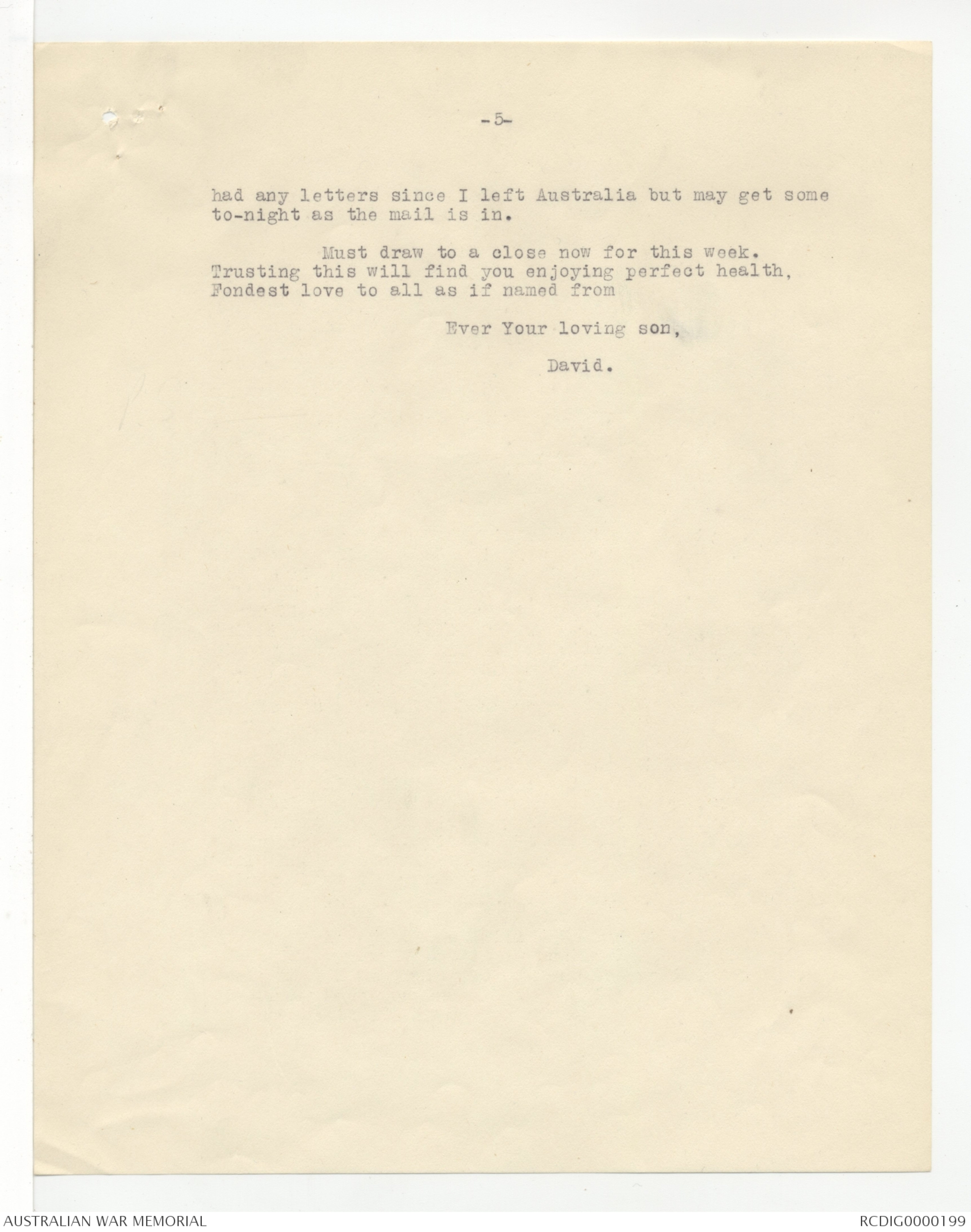
-5-
had any letters since I left Australia but may get some
to-night as the mail is in.
Must draw to a close now for this week.
Trusting this will find you enjoying perfect health,
Fondest love to all as if named from
Ever Your loving son,
David.
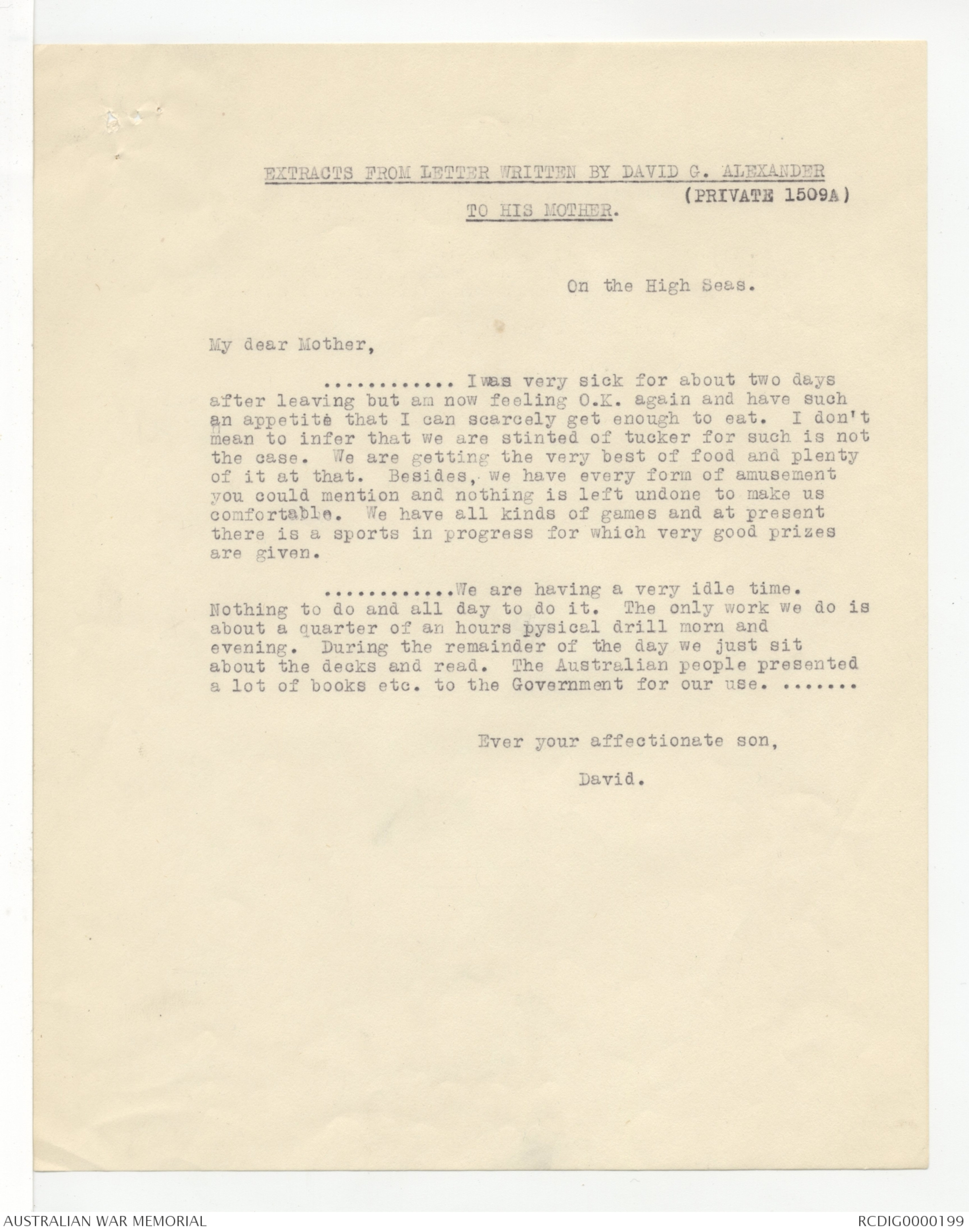
EXTRACTS FROM LETTERS WRITTEN BY DAVID G. ALEXANDER
(PRIVATE 1509A)
TO HIS MOTHER.
On the High Seas.
My dear Mother,
. . . . . . . . . . .. l was very sick for about two days
after leaving but am now feeling O.K. again and have such
an appetite that I can scarcely get enough to eat. I don't
mean to infer that we are stinted of tucker for such is not
the case. We are getting the very best of food and plenty
of it at that. Besides, we have every form of amusement
you could mention and nothing is left undone to make us
comfortable. We have all kinds of games and at present
there is a sports in progress for which very good prizes
are given.
. . . . . . . . . . . . We are having a very idle time.
Nothing to do and all day to do it. The only work we do is
about a quarter of an hours pysical drill morn and
evening. During the remainder of the day we just sit
about the decks and read. The Australian people presented
a lot of books etc. to the Government for our use. . . . . . .
Ever your affectionate son,
David.
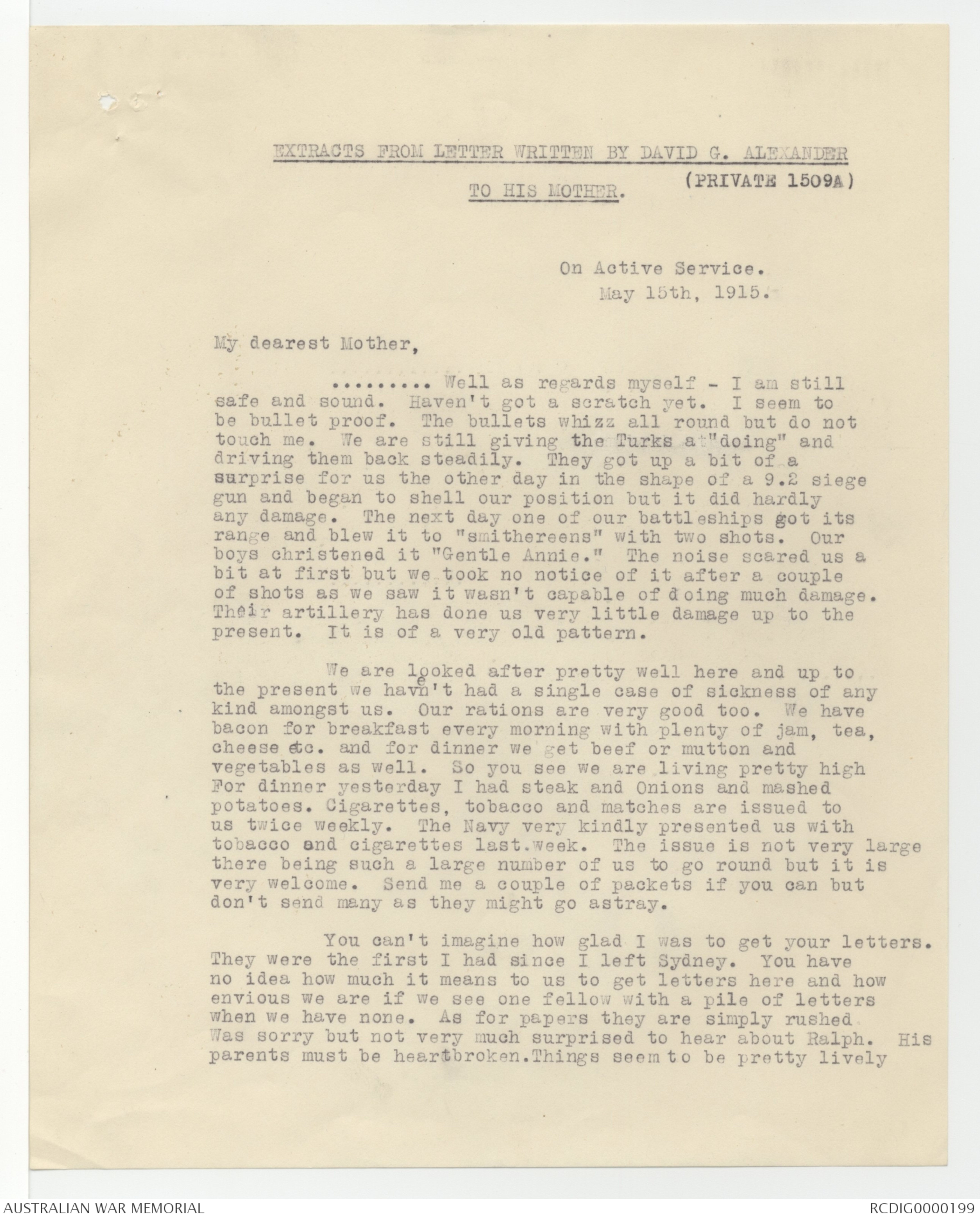
EXTRACTS FROM LETTERS WRITTEN BY DAVID G. ALEXANDER
(PRIVATE 1509A)
TO HIS MOTHER.
On Active Service.
May 15th, 1915.
My dearest Mother,
. . . . . . . . . Well as regards myself - I am still
safe and sound. Haven't got a scratch yet. I seem to
be bullet proof. The bullets whizz all round but do not
touch me. We are still giving the Turks at "doing" and
driving them back steadily. They got up a bit of a
surprise for us the other day in the shape of a 9.2 siege
gun and began to shell our position but it did hardly
any damage. The next day one of our battleships got its
range and blew it to "smithereens" with two shots. Our
boys christened it "Gentle Annie." The noise scared us a
bit at first but we took no notice of it after a couple
of shots as we saw it wasn't capable of doing much damage.
Their artillery has done us very little damage up to the
present. It is of a very old pattern.
We are looked after pretty well here and up to
the present we haven't had a single case of sickness of any
kind amongst us. Our rations are very good too. We have
bacon for breakfast every morning with plenty of jam, tea,
cheese etc. and for dinner we get beef or mutton and
vegetables as well. So you see we are living pretty high
For dinner yesterday I had steak and Onions and mashed
potatoes. Cigarettes, tobacco and matches are issued to
us twice weekly. The Navy very kindly presented us with
tobacco and cigarettes last. week. The issue is not very large
there being such a large number of us to go round but it is
very welcome. Send me a couple of packets if you can but
don't send many as they might go astray.
You can't imagine how glad I was to get your letters.
They were the first I had since I left Sydney. You have
no idea how much it means to us to get letters here and how
envious we are if we see one fellow with a pile of letters
when we have none. As for papers they are simply rushed.
Was sorry but not very much surprised to hear about Ralph. His
parents must be heartbroken. Things seem to be pretty lively
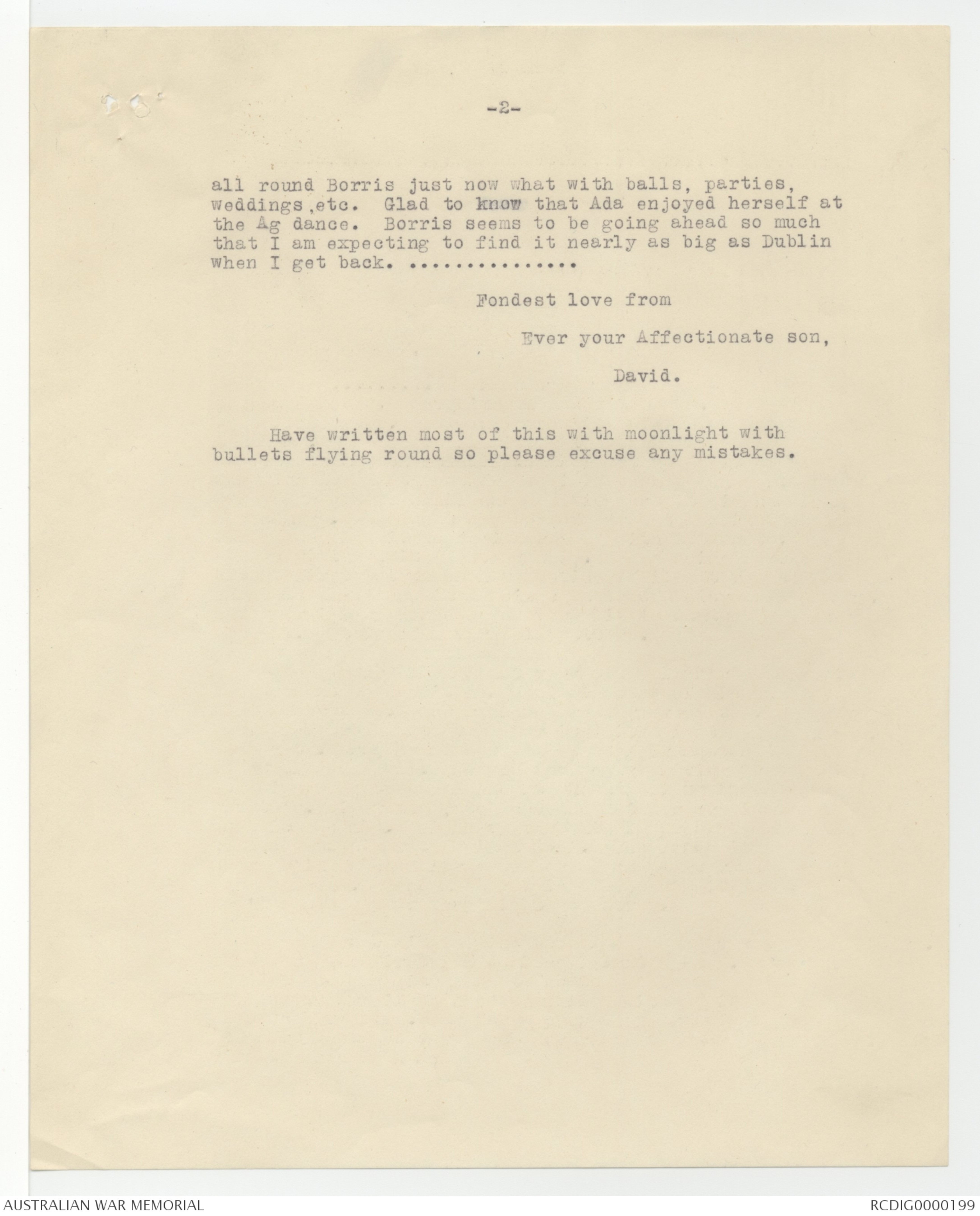
-2-
all round Borris just now what with balls, parties
weddings, etc. Glad to know that Ada enjoyed herself at
the Ag dance. Borris seems to be going ahead so much
that I am expecting to find it nearly as big as Dublin
when I get back. . . . . . . . . . . . . . . .
Fondest love from
Ever your Affectionate son,
David.
Have written most of this with moonlight with
bullets flying round so please excuse any mistakes.
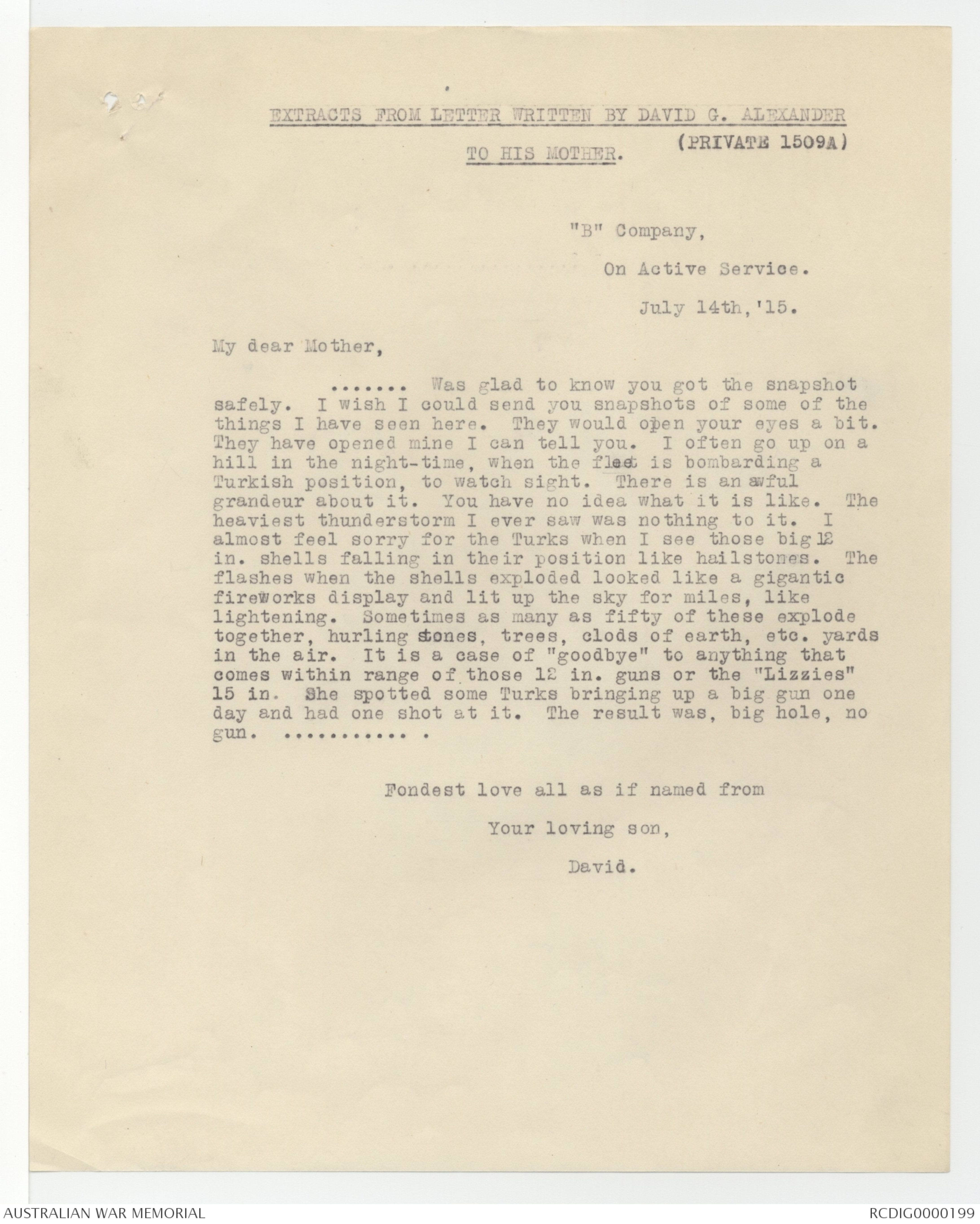
EXTRACTS FROM LETTERS WRITTEN BY DAVID G. ALEXANDER
(PRIVATE 1509A)
TO HIS MOTHER.
"B" Company,
On Active Service.
July 14th, '15.
My dear Mother,
. . . . . . . Was glad to know you got the snapshot
safely. I wish I could send you snapshots of some of the
things I have seen here. They would open your eyes a bit.
They have opened mine I can tell you. I often go up on a
hill in the night-time, when the fleet is bombarding a
Turkish position, to watch sight. There is an awful
grandeur about it. You have no idea what it is like. The
heaviest thunderstorm I ever saw was nothing to it. I
almost feel sorry for the Turks when I see those big 12
in. shells falling in their position like hailstones.The
flashes when the shells exploded looked like a gigantic
fireworks display and lit up the sky for miles, like
lightening. Sometimes as many as fifty of these explode
together, hurling stones, trees, clods of earth, etc. yards
in the air. It is a case of "goodbye" to anything that
comes within range of those 12 in. guns or the "Lizzies'
15 in. She spotted some Turks bringing up a big gun one
day and had one shot at it. The result was, big hole, no
gun. . . . . . . . . . . . . .
Fondest love all as if named from
Your loving son,
David.
 Deb Parkinson
This transcription item is now locked to you for editing. To release the lock either Save your changes or Cancel.
This lock will be automatically released after 60 minutes of inactivity.