
Letters from Irving Russell Flett to his Family, 1915-1916 - Part 9
(3)
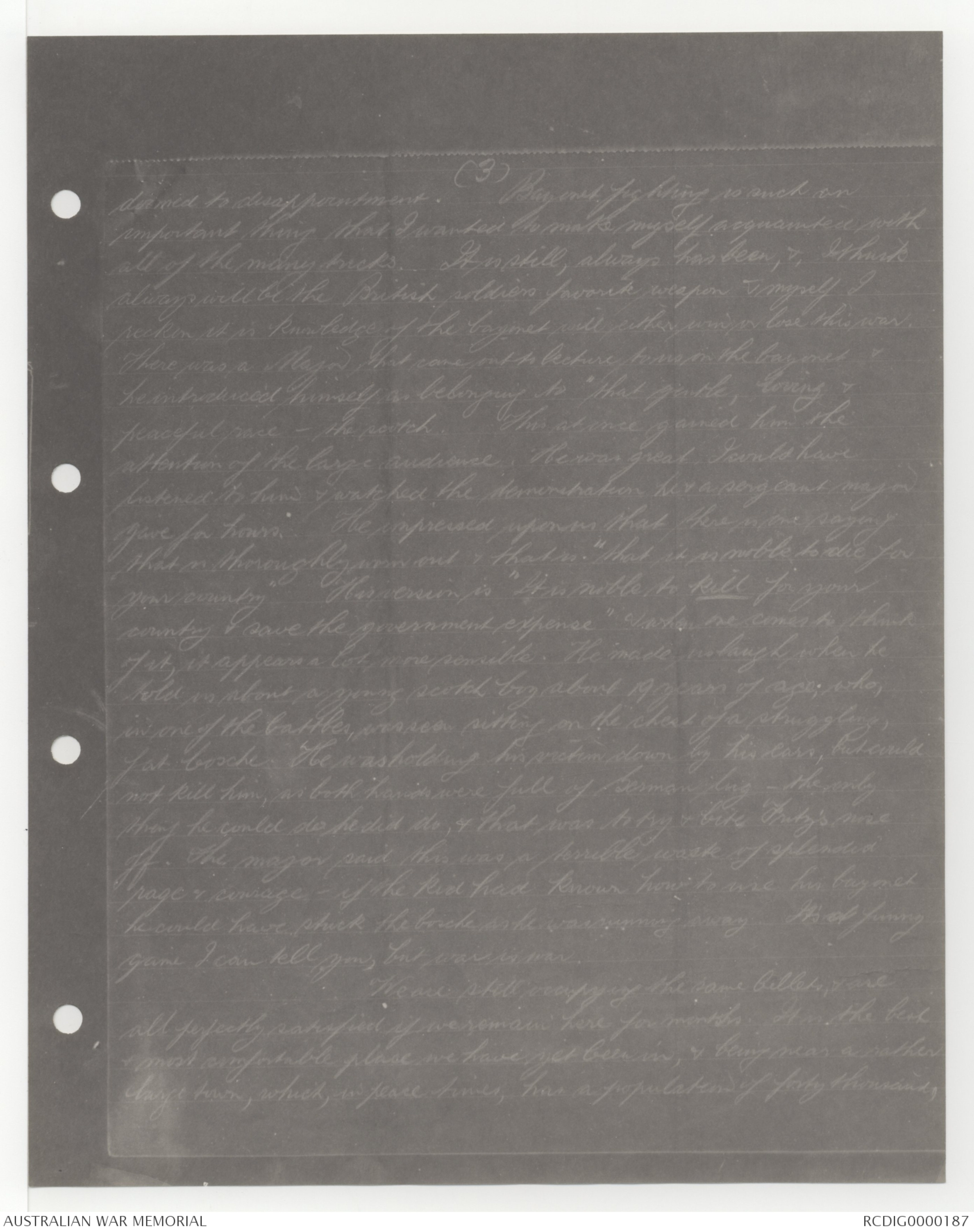
doomed to disappointment. Bayonet fighting is such an
important thing that I wanted to make myself acquainted with
all of the many tricks. It is still, always has been, &, I think
always will be the British soldiers favorite weapon & myself I
reckon it is knowledge of the bayonet will either win or lose the war.
There was a Major that came out to lecture to us on the bayonet &
he introduced himself as belonging to "that gentle, loving &
peaceful race - the scotch. This at once gained him the
attention of the large audience. He was great. I could have
listened to him & watched the demonstration he & a sergeant major
gave for hours. He impressed upon us that there is one saying
that is thoroughly worn out & that is - "that it is noble to die for
your country" His version is "It is noble to kill for your
country & save the government expense" & when one comes to think
of it, it appears a lot more sensible. He made us laugh when he
told us about a young scotch boy about 19 years of age; who,
in one of the battles, was seen sitting on the chest of a struggling,
fat bosche. He was holding his victim down by his ears, but could
not kill him, as both hands were full of German lug - the only
thing he could do he did do, & that was to try & bite Fritz's nose
off. The major said this was a terrible waste of splendid
rage & courage - if the kid had known how to use his bayonet
he could have struck the bosche as he was running away. It's a funny
game I can tell you, but war is war.
We are atill occupying the same billets, & are
all perfectly satisfied if we remain here for months. It is the best
& most comfortable place we have yet been in, & being near a rather
large town, which, in peace times, has a population of forty thousand,
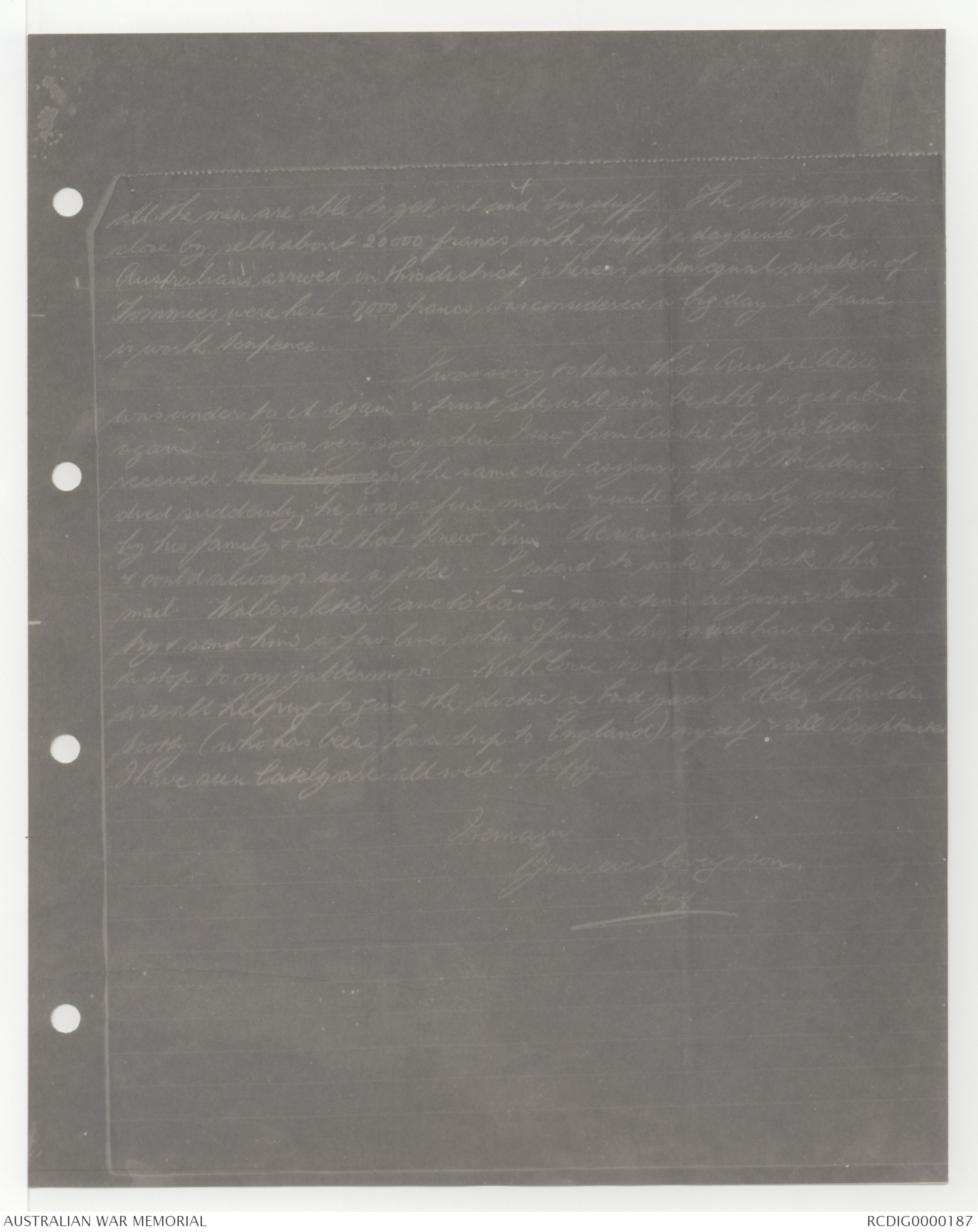
4
all the men are able to get out and bug stuff. The army canteen
close by sells about 20000 francs worth of stuff a day since the
Australians arrived in this district, whereas when equal numbers of
Tommies were here 7,000 francs was considered a big day. A franc
is worth tenpence.
I was sorry to hear that Auntie Alice
was under to it again & trust she will soon be able to get about
again. I was very sorry when I saw from Auntie Lizzie's letter
received three days ago the same day as yours, that Mr Adam
died suddenly; he was a fine man & will be greatly missed
by his family & all that knew him. He was such a jovial sort
& could always see a joke. I intend to write to Jack this
mail. Walters letter came to hand same time as yours & will
try & send him a few lines when I finish this as will have to find
a stop to my jabbernut. With love to all & hoping you
all are helping to give the doctor a bad year. Hec, Harold,
Scotty (who has been for a trip to England) myself & all Brightonites
I have seen lately are all well & happy.
I remain
Your ever loving son,
Irvy.
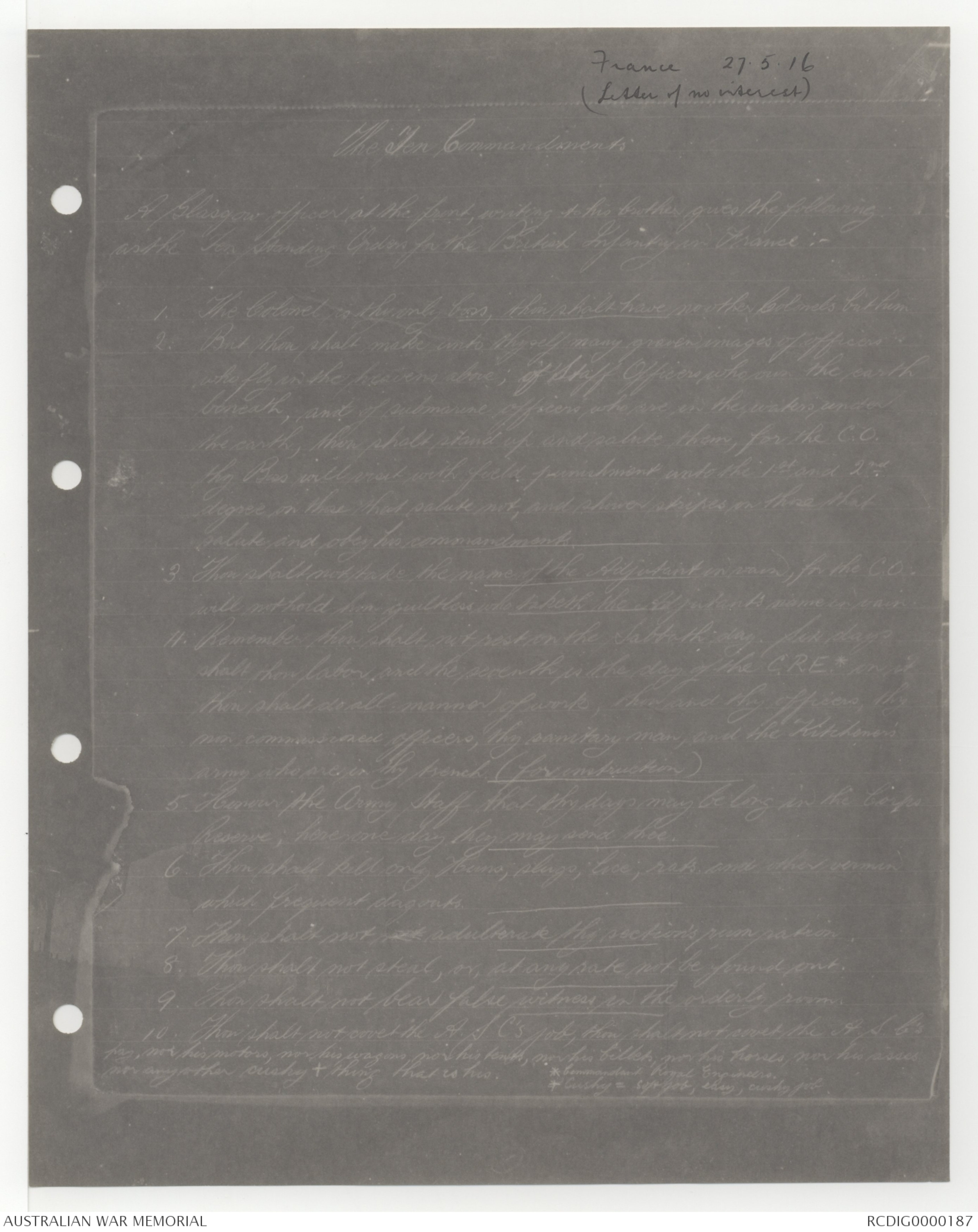
France 27.5.16
(Letter of no interest)
The Ten Commandments
A Glasgow officer at the front, writing to his brother, gives the following
as the Ten Standing Orders for the British Infantry France:-
1.The Colonel is thy only boss, thou shall have no other Colonels but him
2. But thou shalt make into thyself many graven images of officers
who fly in the heavens above; of Staff Officers who own the earth
beneath, and of submarine officers who are in the waters under
the earth, then thou shalt stand up and salute them, for the C.O.
thy Boss will visit with field punishment unto the 1st and 2nd
degree on those that salute not, and shower stripes on those that
salute and obey his commandments.
3. Thou shalt not take the name of the Adjutant in vain, for the C.O.
will not hold him guiltless who taketh the Adjutant's name in vain.
4. Remember thou shalt not rest on the Sabbath day. Six days
shalt thou labor, and the seventh is the day of the C.R.E.* on it
thou shalt do all manner of work, thou and thy officers, thy
non commissioned officers, thy sanitary man and the Kitchener's
army who are in thy trench (for instruction)
5. Honour the Army Staff that thy days may be long in the Corps
Reserve; here one day they may send thee.
6. Thou shalt kill only Huns; slugs; lice; rats and other vermin
which frequent dugouts
7. Thou shalt not not adulterate thy section's rum ration.
8. Thou shalt not steal, or, at any rate not be found out.
9. Thou shalt not bear false witness in the orderly room.
10. Thou shalt not covet the A.S.C's job, thou shalt not covet the A.S.C's
job, nor his motors, nor his wagons, nor his tents, nor his billets, nor his horses, nor his asses
nor any other cushy + thing that is his.
*Commanadament Royal Engineers.
*Cushy = soft job, easy, cushy job.
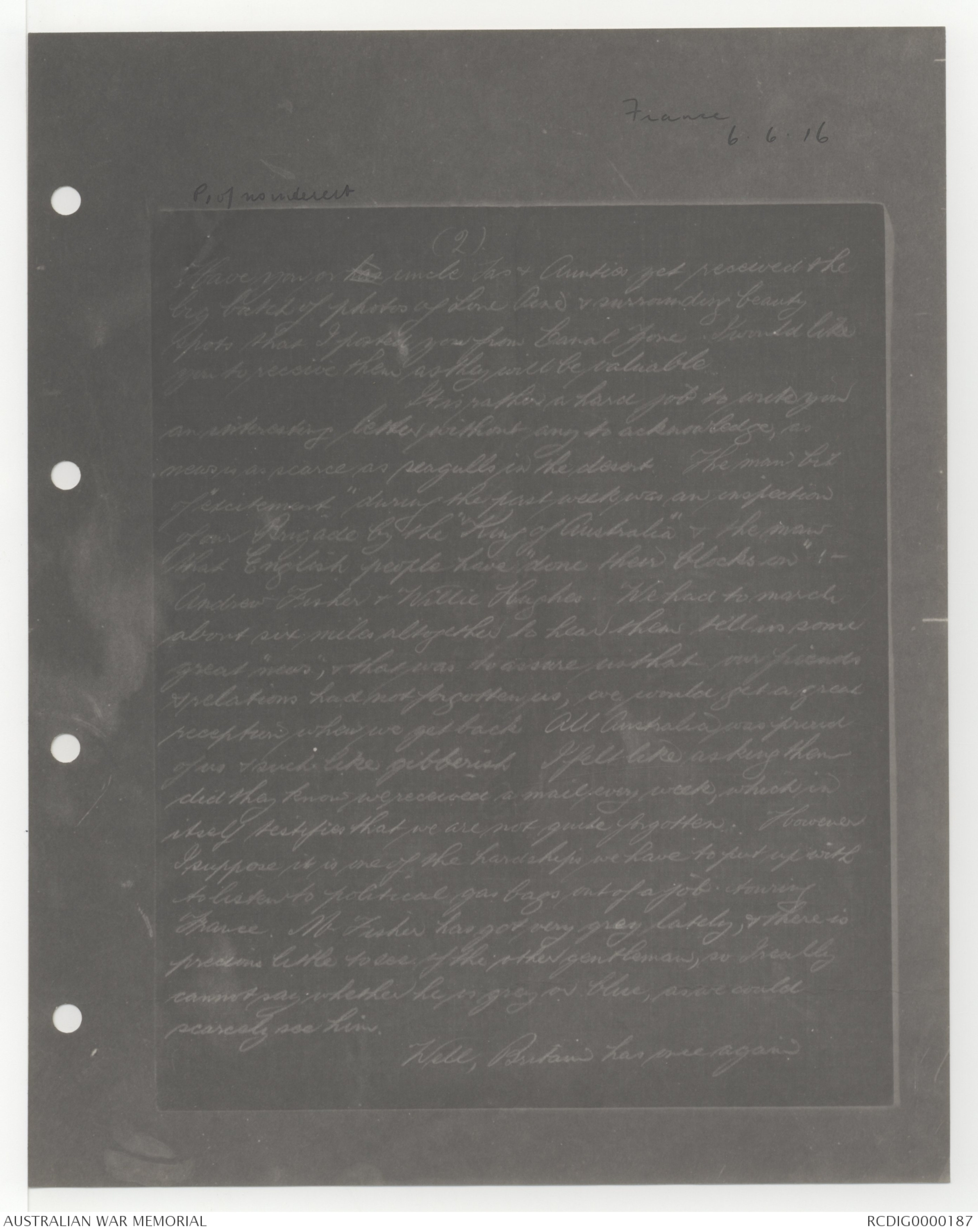
France
6.6.16
P. of no interest
(2)
Have you or has uncle Tas & Aunties yet received the
big batch of photos of Lone Pine & surrounding beauty
spots that I posted you from Canal Zone. I would like
you to receive them as they will be valuable.
It is rather a hard job to write you
an interesting letter without any to acknowledge, as
news is as scarce as seagulls in the desert. The man bit
of "excitement" during the past week was an inspection
of our Brigade by the "King of Australia" & the man
that English people have "done their blocks on":-
Andrew Fisher & Willie Hughes. We had to march
about six miles altogether to hear them tell us some
great "news", that was to assure us that our friends
& relations had not forgotten us, we would get a great
reception when we get back All Australia was proud
of us & such like gibberish I felt like asking them
did they know we received a mail every week, which in
itself testifies that we are not quite forgotten. However
I suppose it is one of the hardships we have to put up with
to listen to political gas bags out of a job touring
France. Mr Fisher has got very grey lately, & there is
precious little to see of the other gentleman, so really
cannot say whether he is grey or blue, as we would
scarcely see him.
Well, Britain has once again
(3)
shown the world that she has a little bit to say with
regards to ongoings at sea. The North Sea fight must
have been a tremendous battle - the results we have to date
are British losses 14 ships & Germany 22, which speaks
for itself, & although both sides have lost heavily, it has
proved a great victory for us. The only thing we are all
waiting for is for the two full navies to meet in a
ding dong go, after which I guarantee the war will not
last a great deal longer, as we all think that a great
sea victory for us will have an undoubted influence on
land doings. Today altogether has been a day of
great news, & we are just waiting to see the English
papers tomorrow morning to have everything we have heard
confirmed as "furfies" are still very plentiful, & just
about keep us alive, the same as they did on the Peninsula.
Yesterday afternoon Bob Raws &
myself went in to a neighbouring town to do a bit of shopping
& ran across a major who is a doctor in the 1st Aust Clearings
Hospital in that town whom he used to go to school with.
He promptly invited us to stay to dinner, which of course
we did, as we have religious scruples against refusing
any good stunts, in the shape of dinners etc. Well
this was a special occasion as they were celebrating
with the Military Cross. This is the first time I have
been out of bounds after hours but got a lift home in a
motor ambulance car which was much better than pushing
(4)
along the road at night more especially as we are not
permitted to show any lights.
Our chief work at present is the
same as when I last wrote, & that is a 12 miles march
every night, & when we get there we have to set to
work on digging & Cable laying. The march along the
cobble stones is the worst part of the business as they
are pretty rough & play up with the feet a little. All
the roads in the French towns are paved the same way
& must be pretty severe on vehicles, motor tyres etc..
The weather is still fine but keeps pretty cool for
summer. I suppose you into be getting pretty cool
stretches now & plenty of rain. No doubt the Larcrosse &
different other Clubs have started work for the season.
I had a letter from I.J. last week, & he states he has
taken on the Boys Club again. I am disappointed at the
way they have treated Will Ellis last season, & I wonder
that some of the Church gentlemen who take an interest in
the club did not step in & see he got a fair deal.
Hope Auntie Alice is now better,
& will not get frozen this winter, as I have an idea she is
not fond of the cold. I will be writing to Wally when I
get his letter - the mail should be delivered to us any
day now. Give my love to Aunties at Lupra, Uncle Tas
Rest of no interest
France
14.6.16
P. of no interest
(2)
the weather at Easter, as if usually turn out wet, but
even a wet Easter at home would do me after the slime
mud & slush of this place. It has been raining for
about four days now, & they call their summer I don't
know what winter is like. So Bob has at last been on
final leave, but very likely he will have a few
more final leaves before he really gets away, as
Charlie McLean & Will D'Alton were treated. It
seems pretty hard to get away now, attached definitely
to any battalion. - It is best to come as we did
work a definite battalion, a chap always has a
much better time & gets to know all the men
properly, not only by name.
So Bert Corr has at last been
snared - I thought he was past catching - I knew the
Stewarts of Black Street pretty well & have an idea
that he was "tracking square" before I left.
We are again in the firing line but
are in a rather quiet spot, but the weather we have
been having of late has been simply rotten, rain, rain
slime, slush & muck all round. It is a terribly hard
job to keep clean. There are multitudes of rats
about. I have never seen such specimens before. We
amuse ourselves in the evening by having revolver shots
(3)
at them, but it is terribly annoying when you have a
shot at one & he only stands & looks at you. I was
walking along the other night & heard a crunch under
my feet, & when I looked down saw a big rat about the
size of a rabbit that I had trodden on - this is a fact
& just shows how thick they are. We had rather a
lively night last night - dozen of our big guns opened
fire about 11 oclock & the din was terrific - you have
no idea what an artillery duel sounds like - It was very
one sided, as the Germans scarcely replied; but later
on in the night they launched a gas attack about
3 miles on our left. However we scorn gas now, as we
have ample protection against it, as the helmets we
are issued with are absolutely proof against it. About
a week ago we went through a trench with gas in it,
over one hundred percent stronger than the Germans use,
& all it did was to rust the buckle on our tunics, &
discolored the decorations on our shoulders. Even the
women & children in the towns & villages near the front have
always to carry gas helmets with them, & if they are
caught by any of the authorities without them are
liable to a heavy penalty. Whenever there is gas about
bells & gas horns for miles round are heard & they scream
a warning to prepare, & once we get the helmets on
well we can defy the gas.
(4)
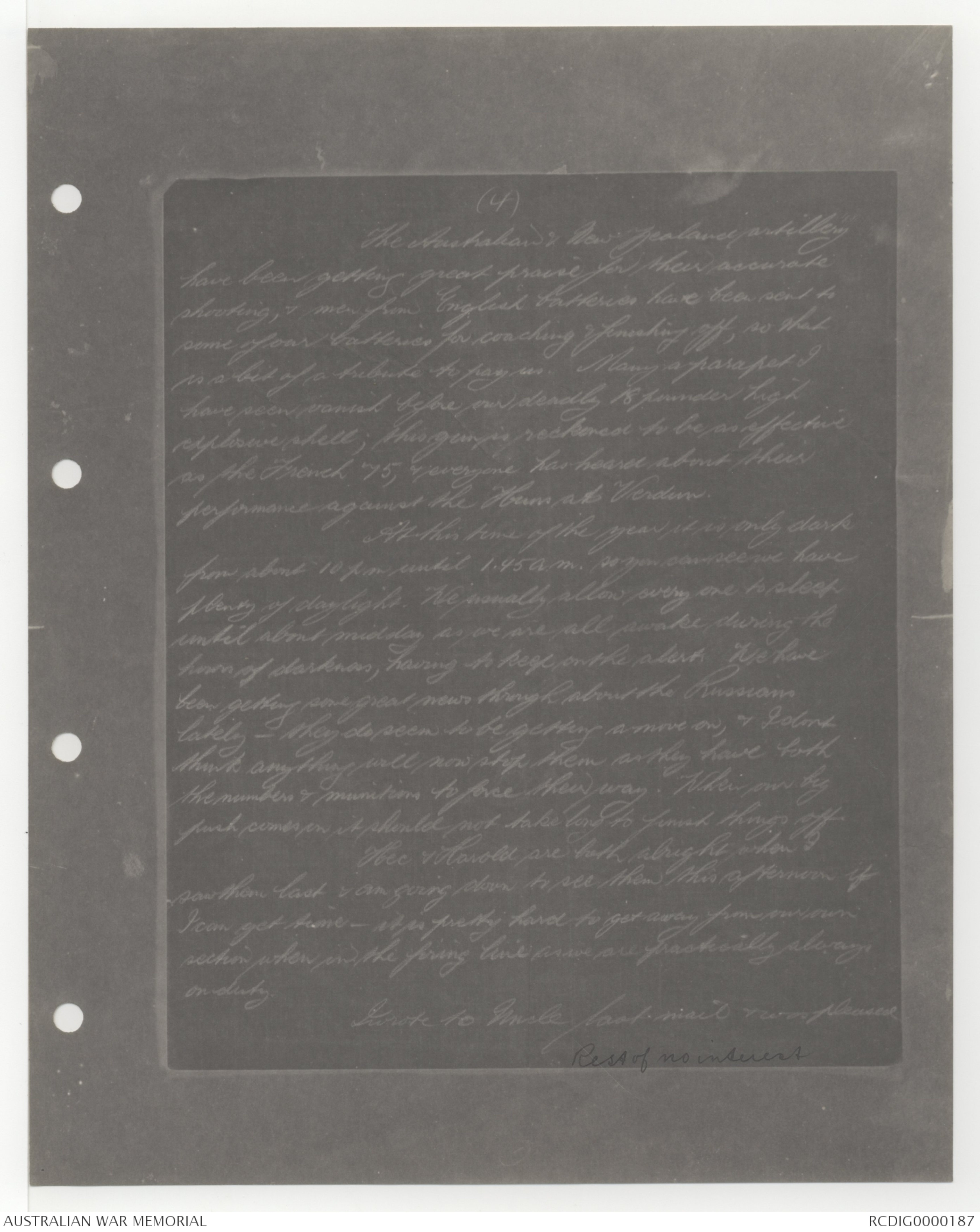
The Australian & New Zealand artillery
has been getting great praise for their accurate
shooting, & men from English batteries have been sent to
some of our batteries for coaching & finishing off, so that
is a bit of a tribute to pay us. Many a parapet I
have seen vanish before our deadly 18 pounder high
explosive shell; this gun is rekoned to be as effective
as the French 75, & everyone has heard about their
performance against the Huns at Verdun.
At this time of the year it is only dark
from about 10pm until 1.45am. As you can see we have
plenty of daylight. We usually allow every one to sleep
until about midday as we are all awake during the
hours of darkness, having to keep on the alert. We have
been getting some great news through about the Russians
lately - they do seem to be getting a move on, & I dont
think anything will now stop them as they have both
the numbers & munitions to force their way. When our big
push comes on it should not take long to finish things off.
Hec & Harold are both alright when I
saw them last & am going down to see them this afternoon if
I can get time - it is pretty hard to get away from our own
section when in the firing line as we are practically always
on duty.
I wrote toUncle last mail & was pleased
Rest of no interest
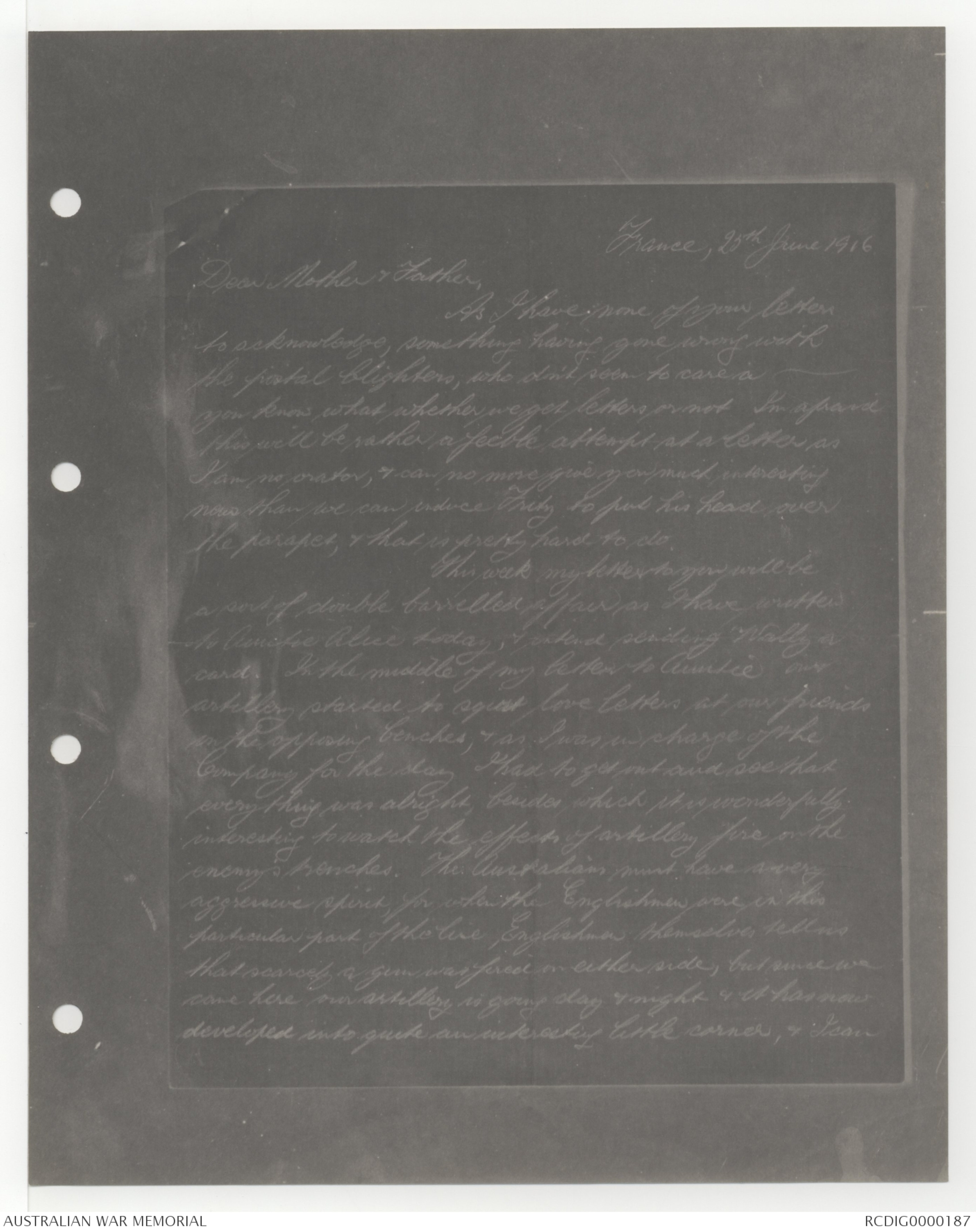
France, 25th June 1916.
Dear Mother & Father,
As I have some of your letters
to acknowledge, somethings having gone wrong with
the postal blighters, who don't seem to care a ∼
you know what whether we get letters or not. Im afraid
this will be rather a feeble attempt at a letter as
I am no orator, & can no more give you much interesting
news than we can induce Fritz to put his head over
the parapet, & that is pretty hard to do.
This week my letter to you will be
a sort of double barrelled affair as I have written
to Auntie Alice today, & intend sending Wally a
card. In the middle of my letter to Auntie our
artillery started to squirt love letters at our friends
in the opposing trenches, & as I was in charge of the
Company for the day I had to get out and see that
everything was alright, besides which it is wonderfully
interesting to watch the effects of artillery fire on the
enemy trenches. The Australians must have a very
aggressive spirit for when the Englishmen were in this
particular part of the line, Englishmen themselves tell is
that scarcely a gun was fired on either side, but since we
came here our artillery is going day & night & it has now
developed into quite an interesting little corner, & I can
 Loretta Corbett
This transcription item is now locked to you for editing. To release the lock either Save your changes or Cancel.
This lock will be automatically released after 60 minutes of inactivity.