
Papers of Cyril John Percy Hill - Part 5
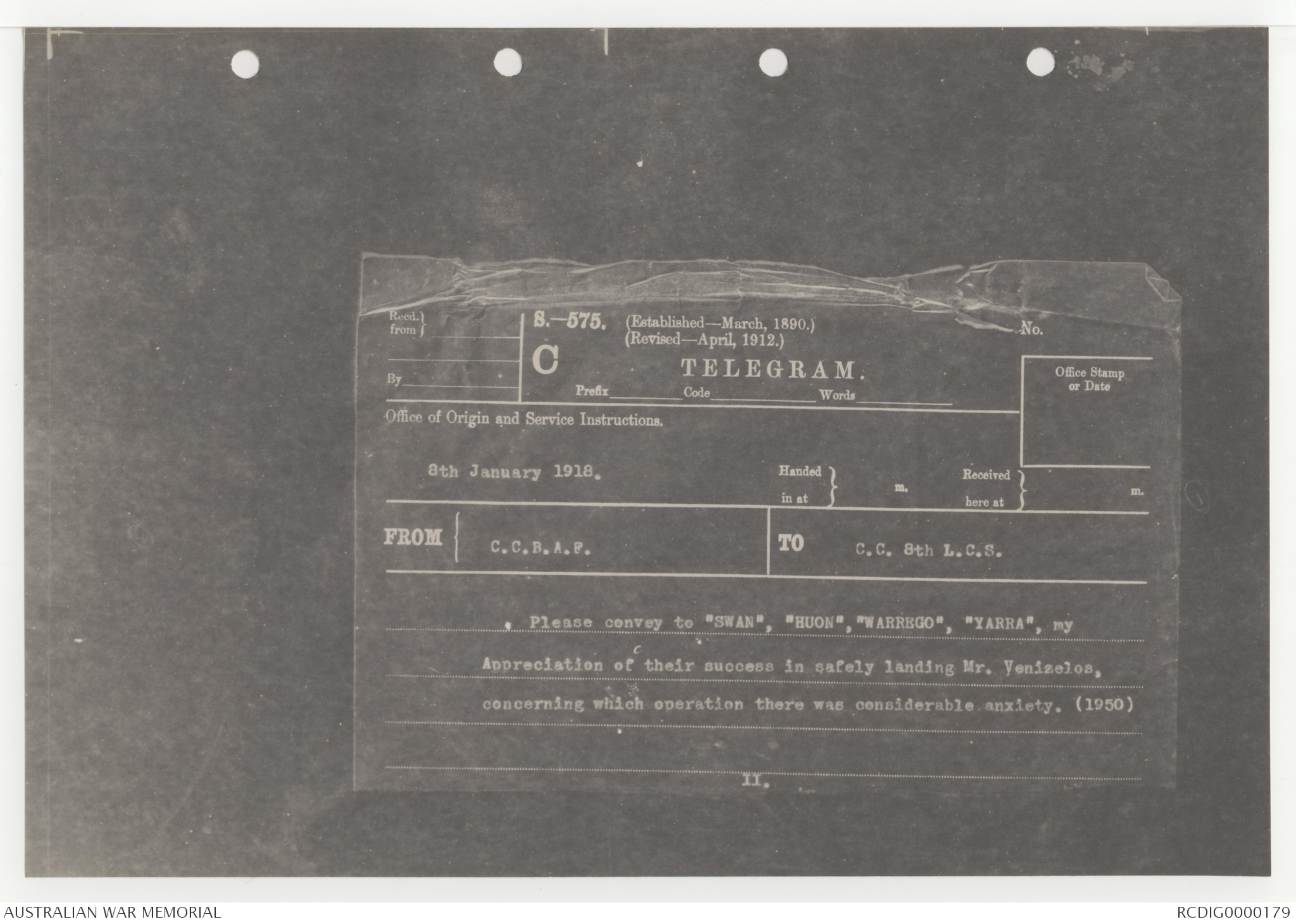
TELEGRAM
8th January 1918.
FROM C.C.B.A.F. TO C.C. 8th L.C.S.
Please convey to "SWAN, "HUON," WARRGO", YARRA", my
Appreciation of their success in safely landing Mr. Yenizeloa,
concerning which operation there was considerable anxiety. (1950)
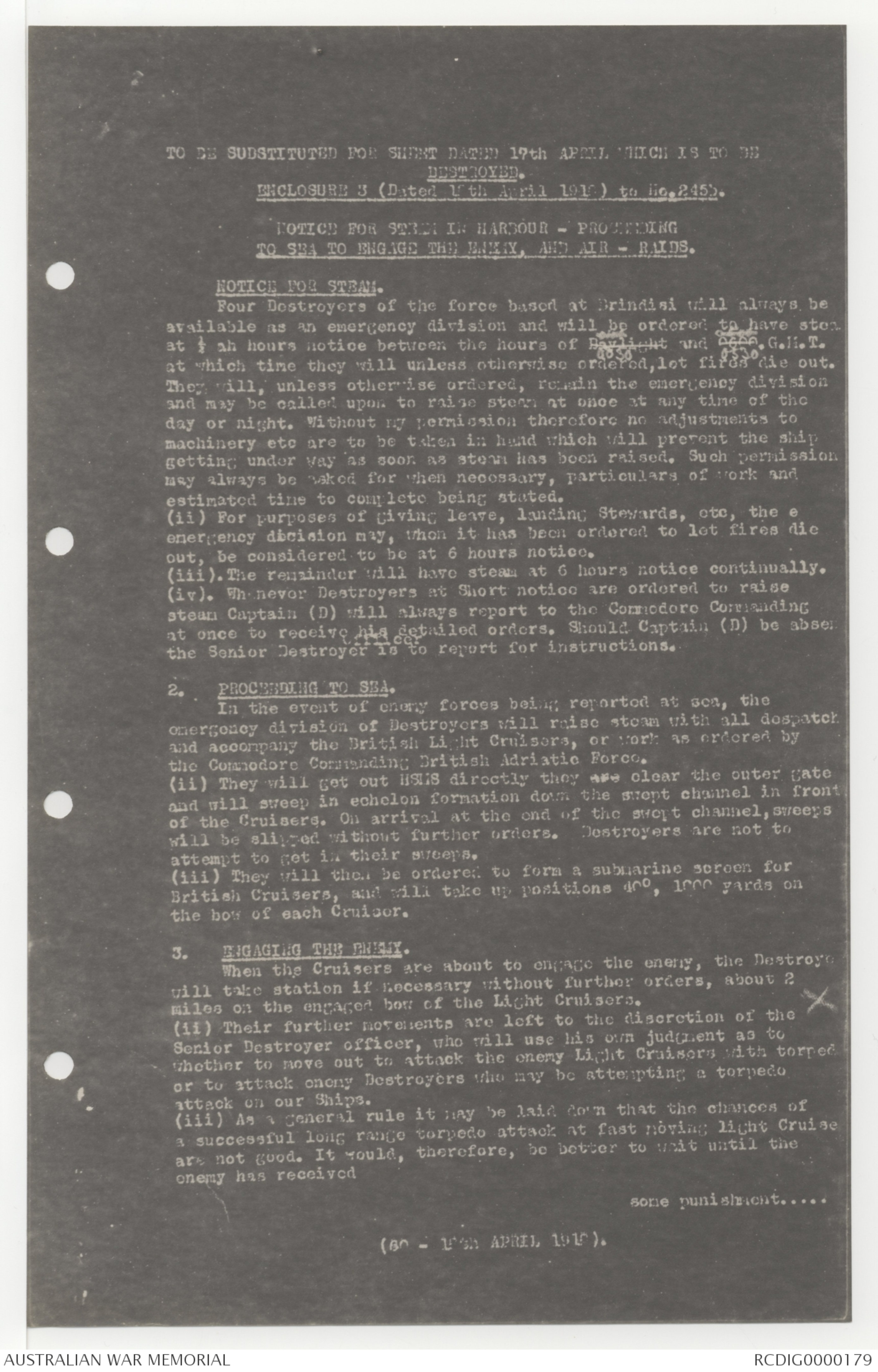
TO BE SUBSTITUTED FOR SHEET DATED 17th APRIL WHICH IS TO BE
DESTROYED.
ENCLOSURE 3 (Dated 18th April to No.245).
NOTICE FOR STEAM IN HARBOUR - PROCEEDING
TO SEA TO ENGAGE THE ENEMY, AND AIR - RAIDS.
NOTICE FOR STEAM.
Four Destroyers of the force based at Brindisi will always be
available as an emergency division and will be ordered to have steam
at ¼ an hours notice between the hours of Daylight 0030 and 0600. 0530 G.M.T.
at which time they will unless otherwise ordered, let fires die out.
They will, unless otherwise ordered, remain the emergency division
and may be called upon to raise steam at once at any time of the
day or night. Without my permission therefore no adjustments to
machinery etc are to be taken in hand which will present the ship
getting under way as soon as steam has been raised. Such permission
may always be asked for when necessary, particulars of work and
estimated time to complete being stated.
(ii) For purposes of giving leave, landing Stewards, etc, the e
emergency decision may, when it has been ordered to let fires die
out, be considered to be at 6 hours notice.
(iii). The remainder will have steam at 6 hours notice continually.
(iv). Whenever Destroyers at Short notice are ordered to raise
steam Captain (D) will always report to the Commodore Commanding
at once to receive his detailed orders. Should Captain (D) be absent
the Senior Destroyer Officer is to report for instructions.
2. PROCEEDING TO SEA.
In the event of enemy forces being reported at sea, the
emergency division of Destroyers will raise steam with all despatch
and accompany the British Light Cruisers, or work as ordered by
the Commodore Commanding British Adriatic Force.
(ii) They will get out HSMS directly they xxx clear the outer gate
and will sweep in echelon formation down the swept channel, sweeps
will be slipped without further orders. Destroyers are not to
attempt to get in their sweeps.
(iii) They will then be ordered to form a submarine screen for
British Cruisers, and will take up positions 40°, 1000 yards on
the bow of each Cruiser.
3. ENGAGING THE ENEMY.
When the Cruisers are about to engage the enemy, the Destroyor
will take station if necessary without further orders, about 2
miles on the engaged bow of the Light Cruisers. [*X*]
(ii) Their further movements are left to the discretion of the
Senior Destroyer officer, who will use his own judgment as to
whether to move out to attack the enemy Light Cruisers with torped
or to attack enemy Destroyers who may be attempting a torpedo
attack on our Ships.
(iii) As a general rule it may be laid down that the chances of
a successful long range torpedo attack at fast moving light Cruise
are not good. It would, therefore, be better to wait until the
enemy has received
some punishment.....
([[60?]] - 19th APRIL, 1918).
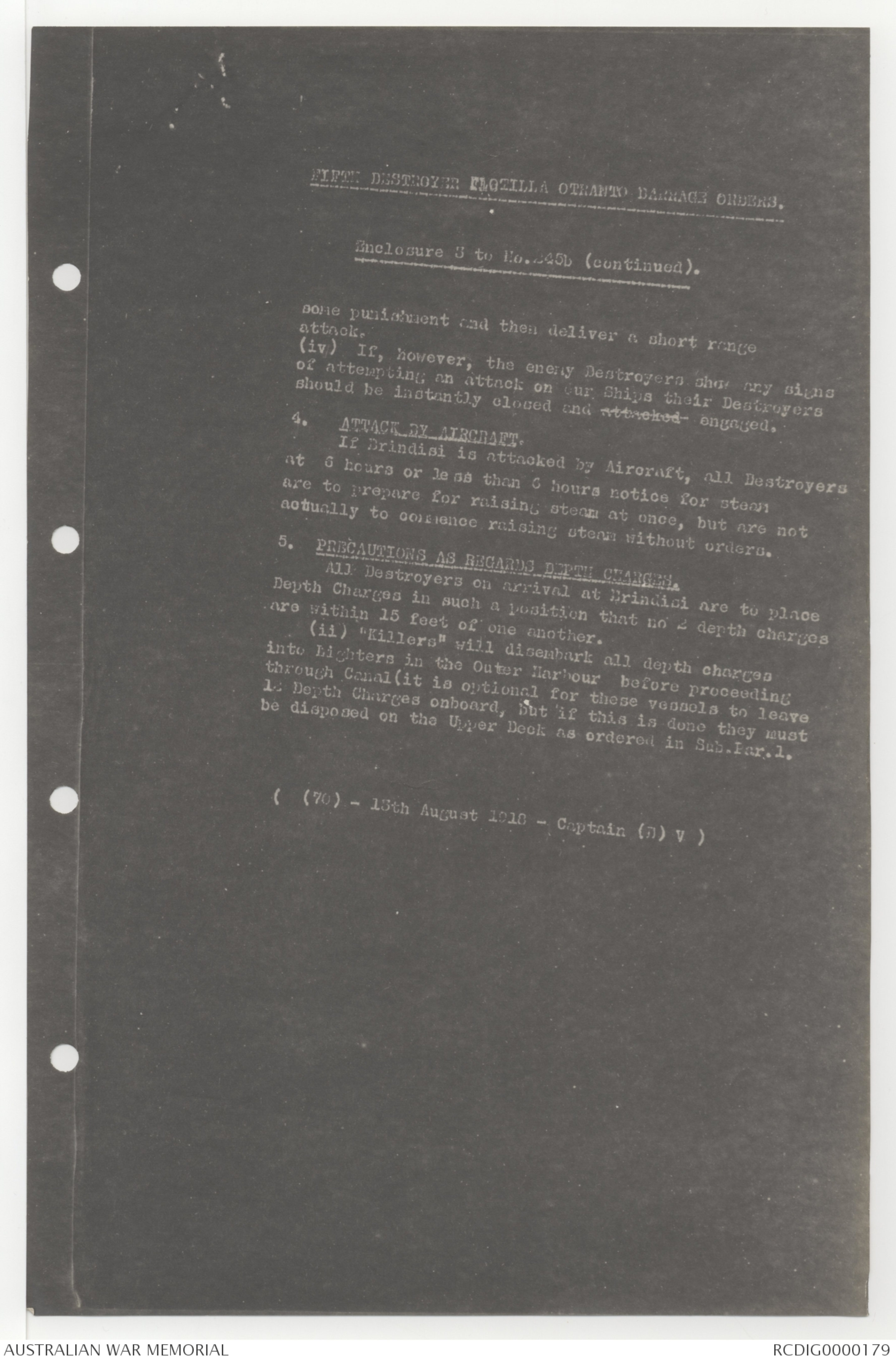
FIFTH DESTROYER FLOTILLA OTRANTO BARRAGE ORDERS.
Enclosure 3 to No.245b (continued).
Some punishment and then deliver a short range
attack.
(iv) If, however, the enemy Destroyers show any signs
of attempting an attack on our Ships their Destroyers
should be instantly closed and attacked engaged.
4. ATTACK BY AIRCRAFT.
If Brindisi is attacked by Aircraft, all Destroyers
at 6 hours or less than 6 hours notice for steam
are to prepare for raising steam at once, but are not
actually to commence raising steam without orders.
5. PRECAUTIONS AS REGARDS DEPTH CHARGES.
All Destroyers on arrival at Brindisi are to place
Depth Charges in such a position that no 2 depth charges
are within 15 feet of one another.
(ii) “Killers” will disembark all depth charges
into Lighters in the Outer Harbour before proceeding
through Canal(it is optional for these vessels to leave
12 Depth Charges onboard, but if this is done they must
be disposed on the Upper Deck as ordered in Sub.Par.1.
( (70) – 13th August 1918 – Captain (D) V )
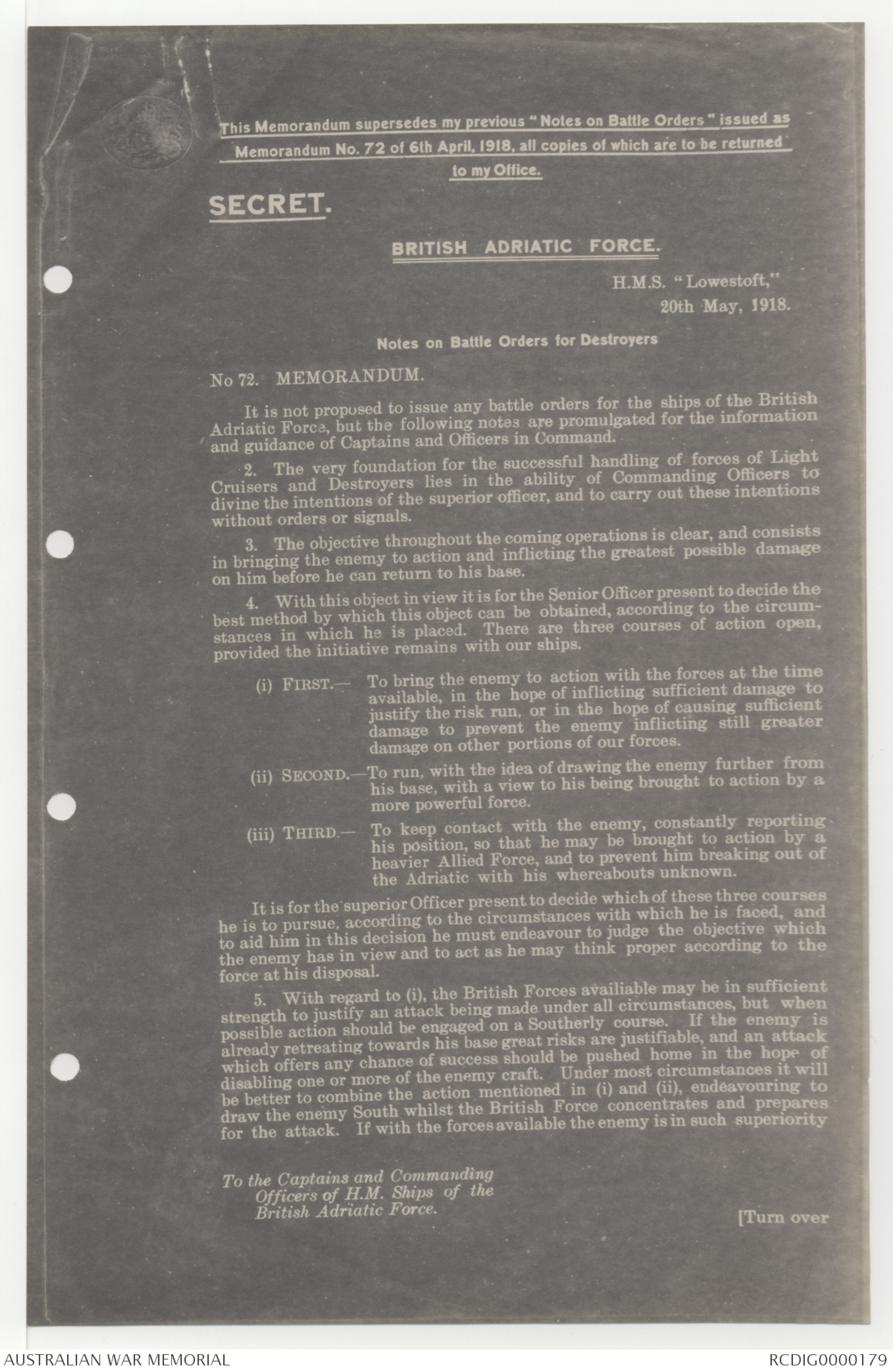
This Memorandum supersedes my previous “Note on Battle Orders” issued as
Memorandum No. 72 of 6th April, 1918, all copies of which are to be returned
to my Office.
SECRET.
BRITISH ADRIATIC FORCE.
H.M.S “Lowestoft,”
20th May, 1918.
Notes on Battle Orders for Destroyers
No. 72. MEMORANDUM.
It is not proposed to issue any battle orders for the ships of the British
Adriatic Forces, but the following notes are promulgated for the information
and guidance of Captains and Officers in Command.
2. The very foundation for the successful handling of forces of Light
Cruisers and Destroyers lies in the ability of Commanding Officers to
divine the intentions of the superior officer, and to carry out these intentions
without orders or signals.
3. The objective throughout the coming operations is clear, and consists
in bringing the enemy to action and inflicting the greatest possible damage
on him before he can return to his base.
4. With this object in view it is for the Senior Officers present to decide the
best method of which this object can be obtained, according to the circumstances
in which he is placed. There are three courses of action open,
provided the initiative remains with our ships.
(i) FIRST.— To bring the enemy to action with the forces at the time
available, in the hope of inflicting sufficient damage to
justify the risk run, or in the hope of causing sufficient
damage to prevent the enemy inflicting still greater
damages on other portions of our forces.
(ii) SECOND.— To run, with the idea of drawing the enemy further from
his base, with a view to his being brought to action by a
more powerful force.
(iii) THIRD.— To keep contact with the enemy, constantly reporting
his position, so that he may be brought to action by a
heavier Allied Force, and to prevent him breaking out of
the Adriatic with his whereabouts unknown.
It is for the superior Officer present to decide which of these three coursed
he is to pursue, according to the circumstances with which he is faced, and
to aid him in this decision he must endeavour to judge the objective which
the enemy has in view and to act as he may think proper according to the
force at his disposal.
5. With regard to (i), the British Forces available may be in sufficient
strength to justify an attack being made under all circumstances, but when
possible action should be engaged on a Southerly course. If the enemy is
already retreating towards his base great risks are justifiable, and an attack
which offers any chance of success should be pushed home in the hope of
disabling one or more of the enemy craft. Under most circumstance it will
be better to combine the action mentioned in (i) and (ii), endeavouring to
draw the enemy South whilst the British Force concentrates and prepares
for the attack. If with the forces available the enemy is in such superiority
To the Captains and Commanding
Officers of H.M. Ships of the
British Adriatic Force.
[Turn over
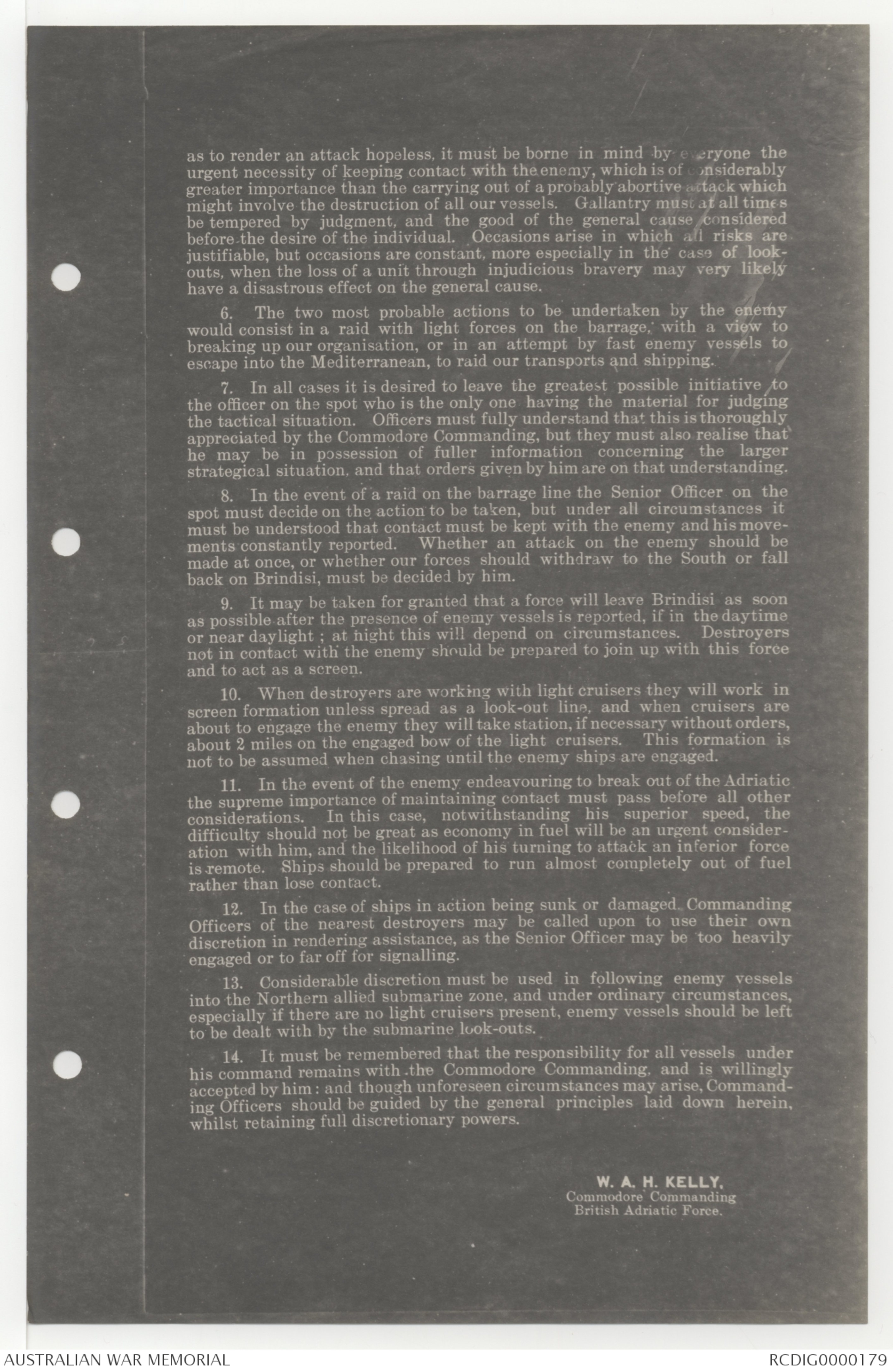
as to render an attack hopeless, it must be borne in mind by everyone the
urgent necessity of keeping contact with the enemy, which is of considerably
greater importance than the carrying out of a probably abortive attack which
might involve the destruction of all our vessels. Gallantry must at all times
be tempered by judgment, and the good of the general cause considered
before the desire of the individual. Occasions arise in which all risks are
justifiable, but occasions are constant, more especially in the case of look-outs,
when the loss of a unit through injudicious bravery may very likely
have a disastrous effect on the general cause.
6. The two most probable actions to be undertaken by the enemy
would consist in a raid with light forces on the barrage, with a view to
breaking up our organisation, or in an attempt by fast enemy vessels to
escape into the Mediterranean, to raid our transports and shipping.
7. In all cases it is desired to leave the greatest possible initiative to
the officer on the spot who is the only one having the material for judging
the tactical situation. Officers must fully understand that this is thoroughly
appreciated by the Commodore Commanding, but they must also realise that
he may be in possession of fuller information concerning the larger
strategical situation, and that orders given by him are on that understanding.
8. In the event of a raid on the barrage line the Senior Officer on the spot
must decide on the action to be taken, but under all circumstances it
must be understood that contact must be kept with the enemy and his movements
constantly reported. Whether an attack on the enemy should be
made at once, or whether our forces should withdraw to the South or fall
back on Brindisi, must be decided by him.
9. It may be taken for granted that a force will leave Brindisi as soon
as possible after the presence of enemy vessels is reported, if in the daytime
or near daylight ; at night this will depend on circumstances. Destroyers
not in contact with the enemy should be prepared to join up with this force
and to act as a screen.
10. When destroyers are working with light cruisers they will work in
screen formation unless spread as a look-out line, and when cruisers are
about to engage the enemy they will take station, if necessary without orders,
about 2 miles on the engaged bow of the light cruisers. This formation is
not to be assumed when chasing until the enemy ships are engaged.
11. In the event of the enemy endeavouring to break out of the Adriatic
the supreme importance of maintaining contact must pass before all other
considerations. In this case, notwithstanding his superior speed, the
difficulty should not be great as economy in fuel will be an urgent consideration
with him, and the likelihood of his turning to attack an inferior force
is remote. Ships should be prepared to run almost completely out of fuel
rather than lose contact.
12. In the case of ships in action being sunk or damaged. Commanding
Officers of the nearest destroyers may be called upon to use their own
discretion in rendering assistance, as the Senior Officer may be too heavily
engaged or to far off for signalling.
13. Considerable discretion must be used in following enemy vessels
into the Northern allied submarine zone, and under ordinary circumstances,
especially if there are no light cruisers present, enemy vessels should be left
to be dealt with by the submarine look-outs.
14. It must be remembered that the responsibility for all vessels under
his command remains with the Commodore Commanding, and is willingly
accepted by him : and though unforeseen circumstances may arise, Commanding
Officers should be guided by the general principles laid down herein,
whilst retaining full discretionary powers.
W. A. H. KELLY,
Commodore Commanding
British Adriatic Force.
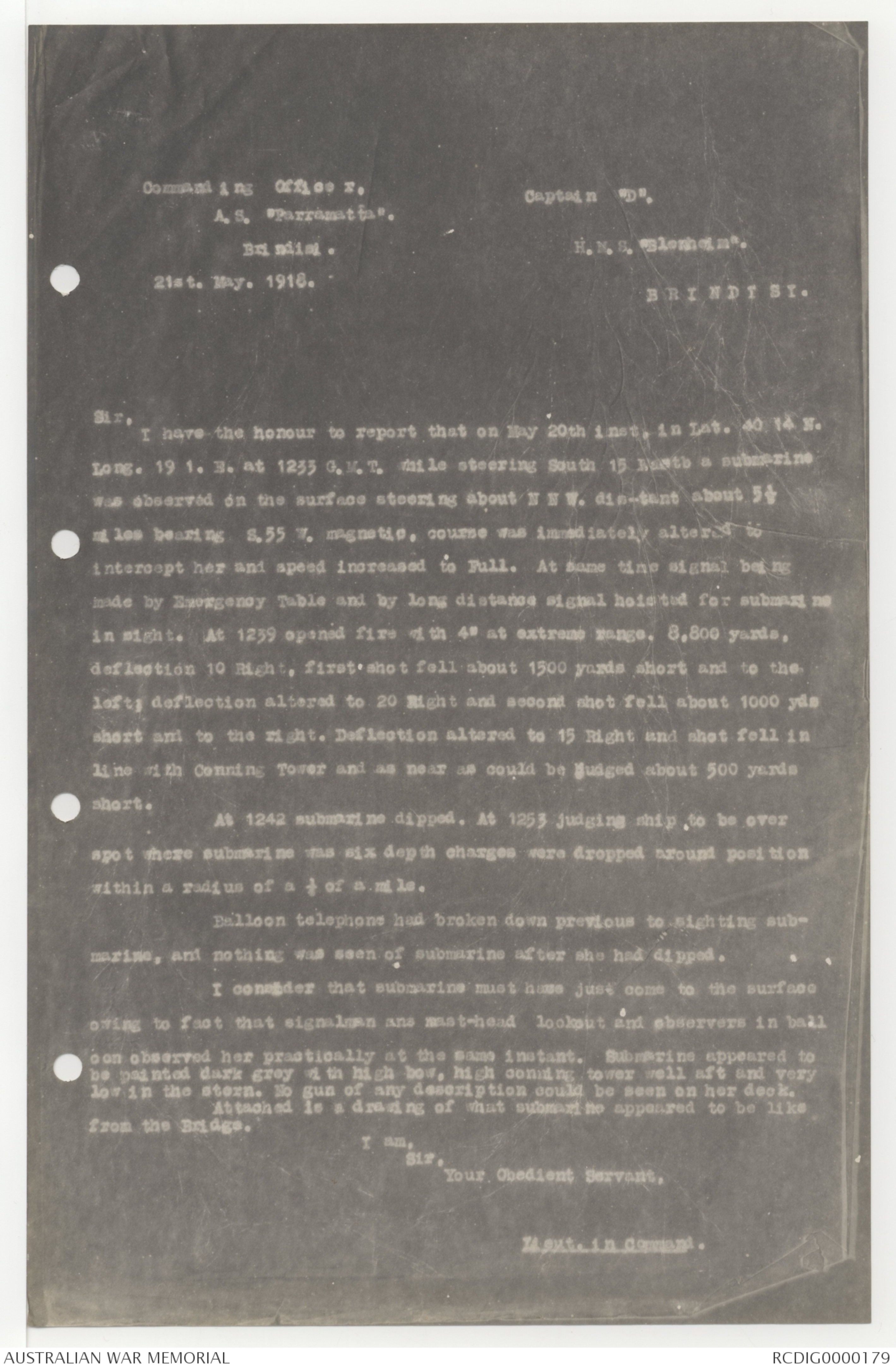
| Commanding Officer, A.S. "Parramatta", Brindisi. 21st. May, 1918. |
Captain "D" H.M.S. "Blenheim", BRINDISI |
Sir,
I have the honour to report that on May 20th inst. in Lat. 40 14 N.
Long. 19 1. E. at 1235 G.M.T. while steering South 15 [[?]] a submarine
was observed on the surface steering about N N W. distant about 5 half
miles bearing S.55 W. magnetic, course was immediately altered to
intercept her and speed increased to Full. At same tine signal being
made by Emergency Table and by long distance signal hoisted for submarine
in sight. At 1239 opened fire with 4” at extreme range, 8,800 yards,
deflection 10 Right, first shot fell about 1500 yards short and to the
left; deflection altered to 20 Right and a second shot fell about 1000 yds
short and to the right. Deflection altered to 15 Right and shot fell in
line with Conning Tower and as near as could be judged about 500 yards
short.
At 1242 submarine dipped. At 1253 judging ship to be over
spot where submarine was six depth charges were dropped around position
within a radius of a ¼ of a mile.
Balloon telephone had broken down previous to sighting submarine,
and nothing was seen of submarine after she had dipped.
I consider that submarine must have just come to the surface
owing to fact that signalman and mast-head lookout and observers in balloon
observed her practically at the same instant. Submarine appeared to
be painted dark grey with high bow, high conning tower well aft and very
low in the stern. No gun of any description could be seen on her deck.
Attached is a drawing of what submarine appeared to be like
from the Bridge.
I am,
Sir,
Your obedient Servant,
Lieut. in command.
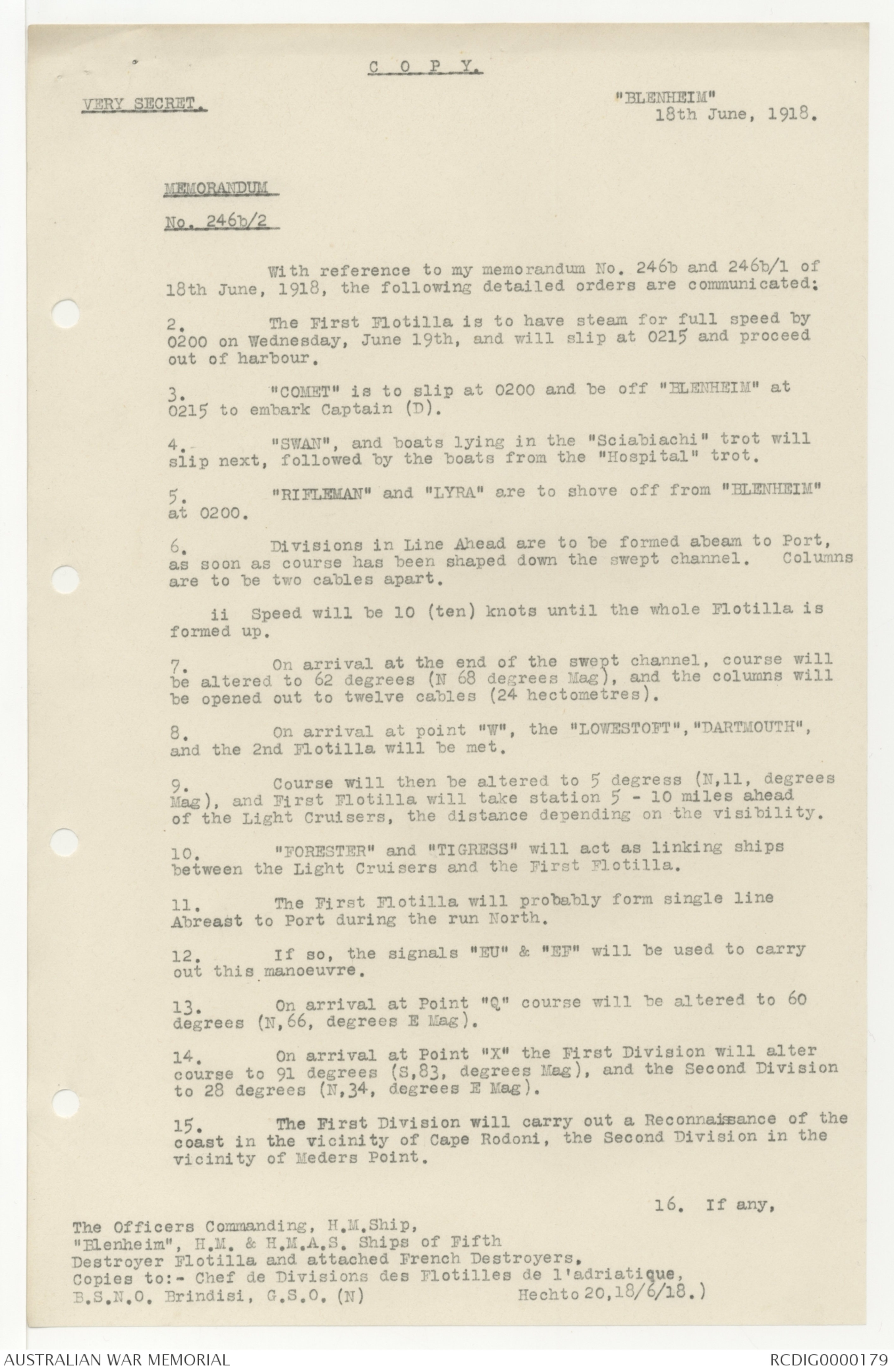
COPY
VERY SECRET.
"BLENHEIM"
18th June, 1918.
MEMORANDUM
No. 246b/2
With reference to my memorandum No. 246b and 246b/1 of
18th June, 1918, the following detailed orders are communicated:
The First Flotilla is to have steam for full speed by
0200 on Wednesday, June 19th, and will slip at 0215 and proceed
out of harbour.
3. "COMET" is to slip at 0200 and be off "BLENHEIM" at
0215 to embark Captain (D).
4. "SWAN", and boats lying in the "Sciabiachi" trot will
slip next, followed by the boats from the "Hospital" trot.
5. "RIFLEMAN" and "LYRA" are to shove off from "BLENHEIM"
at 0200.
6. Divisions in Line Ahead are to be formed abeam to Port,
as soon as course has been shaped down the swept channel. Columns
are to be two cables apart.
ii Speed will be 10 (ten) knots until the whole Flotilla is
formed up.
7. On arrival at the end of the swept channel, course will
be altered to 62 degrees (N 68 degrees Mag), and the columns will
be opened out to twelve cables (24 hectometres).
8. On arrival at point "W", the "LOWESTOFT", "DARTMOUTH",
and the 2nd Flotilla will be met.
9. Course will then be altered to 5 degress (N,11, degrees
Mag), and First Flotilla will take station 5 - 10 miles ahead
of the Light Cruisers, the distance depending on the visibility.
10. "FORESTER" and "TIGRESS" will act as linking ships
between the Light Cruisers and the First Flotilla.
11. The First Flotilla will probably form single line
Abreast to Port during the run North.
12. If so, the signals "EU" & "EF" will be used to carry
out this manoeuvre.
13. On arrival at Point "Q" course will be altered to 60
degrees (N, 66, degrees E Mag).
14. On arrival at Point "X" the First Division will alter
course to 91 degrees (S,83, degrees Meg), and the Second Division
to 28 degrees (N,34, degrees E Mag).
15. The First Division will carry out a Reconnaissance of the
coast in the vicinity of Cape Rodoni, the Second Division in the
vicinity of Meders Point.
16. If any,
The Officers Commanding, H.M.Ship,
"Blenheim", H.M. & H.M.A.S. Ships of Fifth
Destroyer Flotilla and attached French Destroyers,
Copies to: - Chef de Divisions des Flotilles de l'adriatique
B.S.N,O. Brindisi, G.S.O. (N) Hechto 20, 18/6/18.)
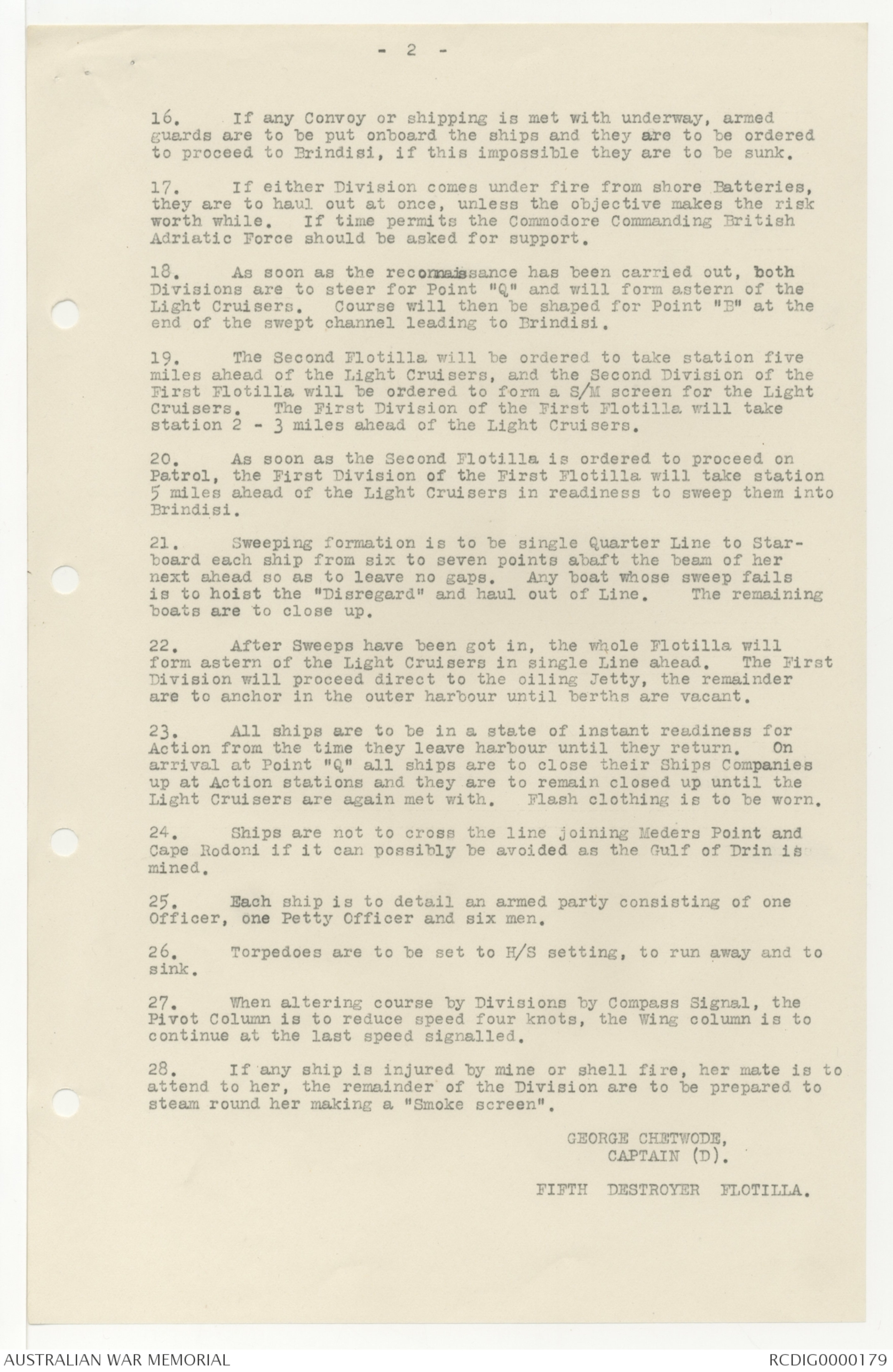
- 2 -
16. If any Convoy or shipping is met with underway, armed
guards are to be put onboard the ships and they are to be ordered
to proceed to Brindisi, if this impossible they are to be sunk.
17. If either Division comes under fire from shore Batteries,
they are to haul out at once, unless the objective makes the risk
worth while. If time permits the Commodore Commanding British
Adriatic Force should be asked for support.
18. As soon as the reconnaissance has been carried out, both
divisions are to steer for Point "Q" and will form astern of the
Light Cruisers. Course will then be shaped for Point "B" at the
end of the swept channel leading to Brindisi.
19. The Second Flotilla will be ordered to take station five
miles ahead of the Light Cruisers, and the Second Division of the
First Flotilla will be ordered to form a S/M screen for the Light
Cruisers. The First Division of the First Flotilla will take
station 2 - 3 miles ahead of the Light Cruisers.
20. As soon as the Second Flotilla is ordered to proceed on
Patro1, the First Division of the First Flotilla will take station
5 miles ahead of the Light Cruisers in readiness to sweep them into
Brindisi.
21. Sweeping
formation is to be single Quarter Line to Starboard
each ship from six to seven points abaft the beam of her
next ahead so as to leave no gaps. Any boat whose sweep fails
is to hoist the "Disregard" and haul out of Line. The remaining
boats are to close up.
22. After Sweeps have been got in, the whole Flotilla will
form astern of the Light Cruisers in single Line ahead. The First
Division will proceed direct to the oiling Jetty, the remainder
are to anchor in the outer harbour until berths are vacant.
23. All ships are to be in a state of instant readiness for
Action from the time they leave harbour until they return. On
arrival at Point "Q" all ships are to close their Ships Companies
up at Action stations and they are to remain closed up until the
Light Cruisers are again met with. Flash clothing is to be worn.
24. Ships are not to cross the line joining Meders Point and
Cape Rodoni if it can possibly be avoided as the Gulf of Drin is
mined.
25. Each ship is to detail an armed party consisting of one
Officer, one Petty Officer and six men.
26. Torpedoes are to be set to H/S setting, to run away and to
sink.
27. When altering course by Divisions by Compass Signal, the
Pivot Column is to reduce speed four knots, the Wing column is to
continue at the last speed signalled.
28. If any ship is injured by mine or shell fire, her mate is to
attend to her, the remainder of the Division are to be prepared to
steam round her making a "Smoke screen".
GEORGE CHETWODE,
CAPTAIN (D).
FIFTH DESTROYER FLOTILLA.
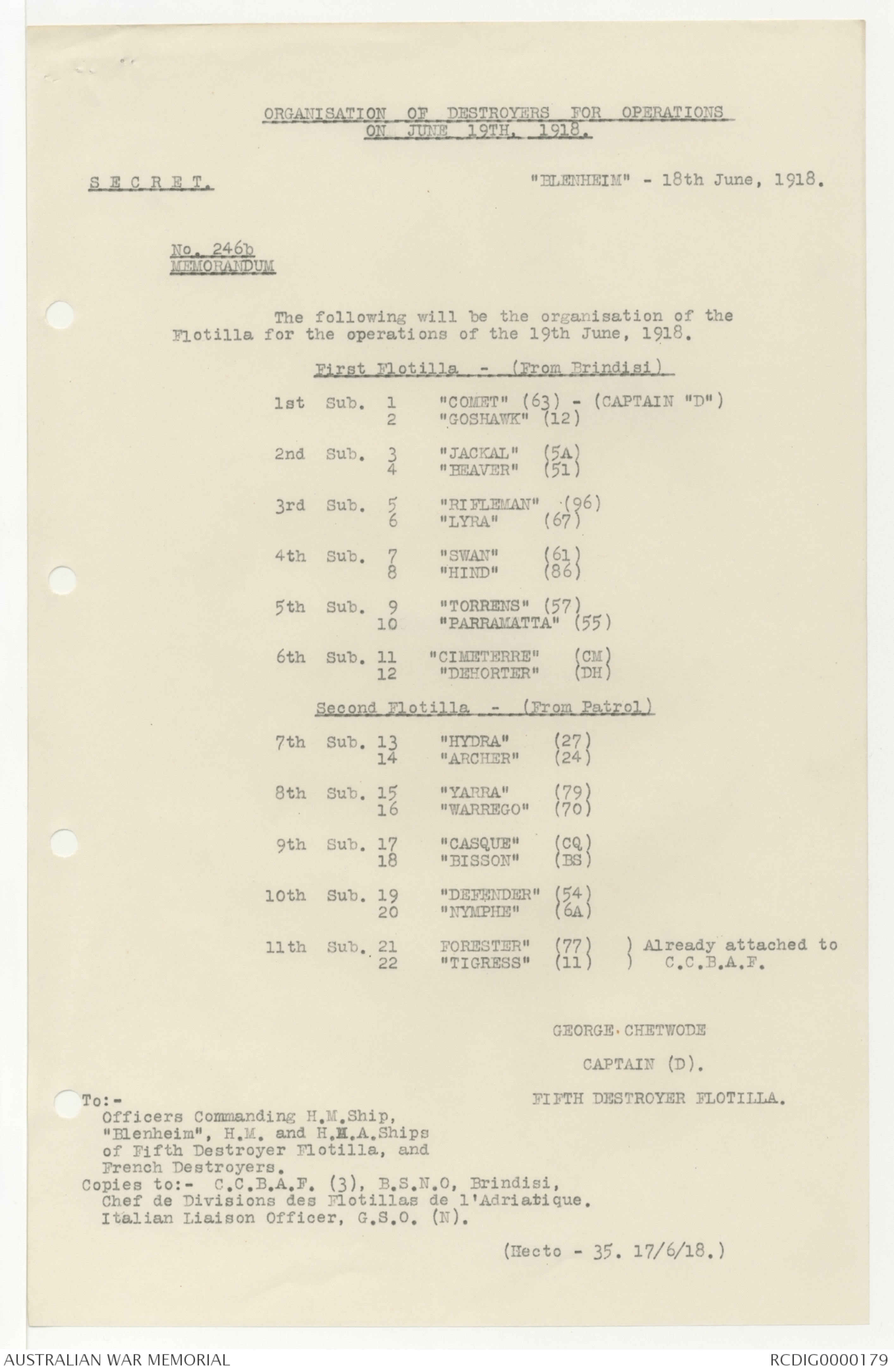
ORGANISATION OF DESTROYERS FOR OPERATIONS
ON JUNE 19TH, 1918.
SECRET. "BLENHEIM" - 18th June, 1918.
No. 246b
MEMORANDUM
The following will be the organisation of the
Flotilla for the operations of the 19th June, 1918.
| First Flotilla - (From Brindisi) | ||
| 1st Sub. | 1 2 |
"COMET" (63) - (CAPTAIN "D") "GOSHAWK" (12) |
| 2nd Sub. | 3 4 |
"JACKAL" (5A) "BEAVER" (51) |
| 3rd Sub. | 5 6 |
"RIFLEMAN" (96) "LYRA" (67) |
| 4th Sub. | 7 8 |
"SWAN" (61) "HIND" (86) |
| 5th Sub. | 9 10 |
"TORRENS" (57) "PARRAMATTA" (55) |
| 6th Sub. | 11 12 |
"CIMETERRE" (CM) "DEHORTER" (DH) |
| Second flotilla - (From Patrol) | ||
| 7th Sub | 13 14 |
"HYDRA" (27) "ARCHER" (24) |
| 8th Sub | 15 16 |
“YARRA" (79) "WARREGO" (70) |
| 9th Sub | 17 18 |
"CASQUE" (CQ) "BISSON" (BS) |
| 10th Sub | 19 20 |
"DEFENDER" (54) "NYMPHE" (6A) |
| 11th Sub | 21 22 |
FORESTER" (77) ) Already attached to "TIGRESS" (11) ) C.C.B.A.F. |
GEORGE CHETWODE
CAPTAIN (D).
FIFTH DESTROYER FLOTILLA.
To:-
Officers Commanding H.M.Ship,
"Blenheim", H.M. and H.M.A.Ships
of Fifth Destroyer Flotilla, and
French Destroyers.
Copies to:- C.C.B.A.F. (3), B.S.N.O, Brindisi,
Chef de Divisions des Flotillas de Adriatique.
Italian Liaison Officer, G.S.O. (N).
(Hecto - 35. 17/6/18. )
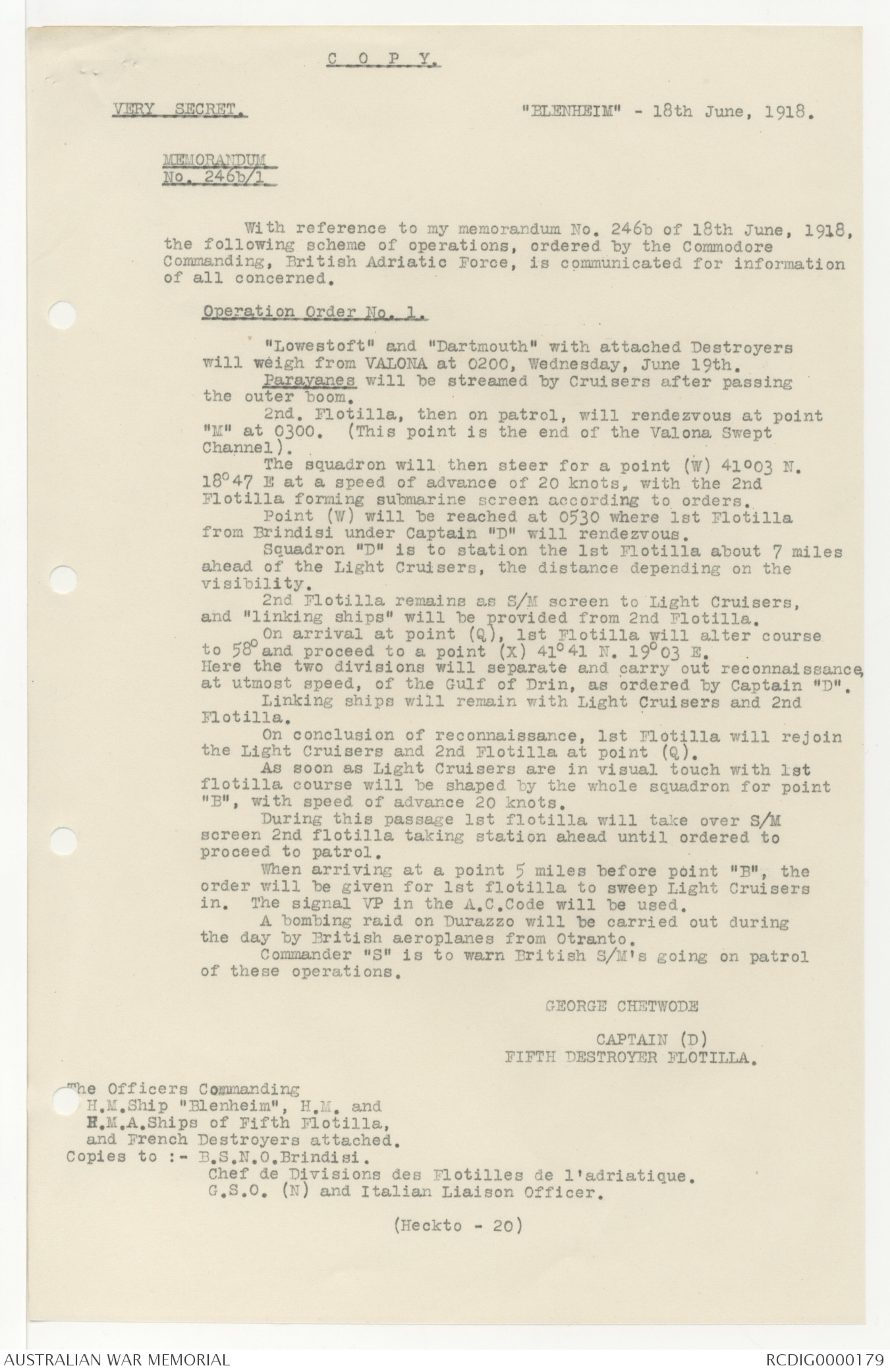
COPY.
VERY SECRET. "BLENHEIM" - 18th June, 1918.
MEMORANDUM
No. 246b/1
With reference to my memorandum No. 246b of 18th June, 1918,
the following scheme of operations, ordered by the Commodore
Commanding, British Adriatic Force, is communicated for information
of all concerned.
Operation Order No. 1.
"Lowestoft" and "Dartmouth" with attached Destroyers
will weigh from VALONA at 0200, Wednesday, June 19th.
Parayanes will be streamed by Cruisers after passing
the outer boom.
2nd. Flotilla, then on patrol, will rendezvous at point
“M" at 0300. (This point is the end of the Valona Swept
Channel).
The squadron will then steer for a point (W) 41°03 N.
18°47 E at a speed of advance of 20 knots, with the 2nd
Flotilla forming submarine screen according to orders.
Point (W) will be reached at 0530 where 1st Flotilla
from Brindisi under Captain "D" will rendezvous.
Squadron "D" is to station the 1st Flotilla about 7 miles
ahead of the Light Cruisers, the distance depending on the
visibility.
2nd Flotilla remains as S/M screen to Light Cruisers,
and "linking ships" will be provided from 2nd Flotilla
On arrival at point (Q), 1st Flotilla will alter course
to 58° and proceed to a point (X) 41°41 N. 19°03 E.
Here the two divisions will separate and carry out reconnaissance,
at utmost speed, of the Gulf of Drin, as ordered by Captain "D".
Linking ships will remain with Light Cruisers and 2nd
Flotilla.
On conclusion of reconnaissance, 1st Flotilla will rejoin
the Light Cruisers and 2nd Flotilla at point (Q).
As soon as Light Cruisers are in visual touch with 1st
flotilla course will be shaped by the whole squadron for point
"B", with speed of advance 20 knots.
During this passage 1st flotilla will take over S/M
screen 2nd flotilla taking station ahead until ordered to
proceed to patrol.
When arriving at a point 5 miles before point "B", the
order will be given for 1st flotilla to sweep Light Cruisers
in. The signal VP in the A.C.Code will be used.
A bombing raid on Durazzo will be carried out during
the day by British aeroplanes from Otranto.
Commander "S" is to warn British S/M's going on patrol
of these operations.
GEORGE CHETWODE
CAPTAIN (D)
FIFTH DESTROYER FLOTILLA.
The Officers Commanding
H.M.Ship "Blenheim", H.M. and
H.M.A.Ships of Fifth Flotilla,
and French Destroyers attached.
Copies to : - B.S.N.O.Brindisi.
Chef de Divisions des Flotilles de l'adriatique.
G.S.O. (N) and Italian Liaison Officer.
(Heckto - 20)
 Sam scott
This transcription item is now locked to you for editing. To release the lock either Save your changes or Cancel.
This lock will be automatically released after 60 minutes of inactivity.