
Papers of Edgar Sydney Worrall - Wallet 2 - Part 15
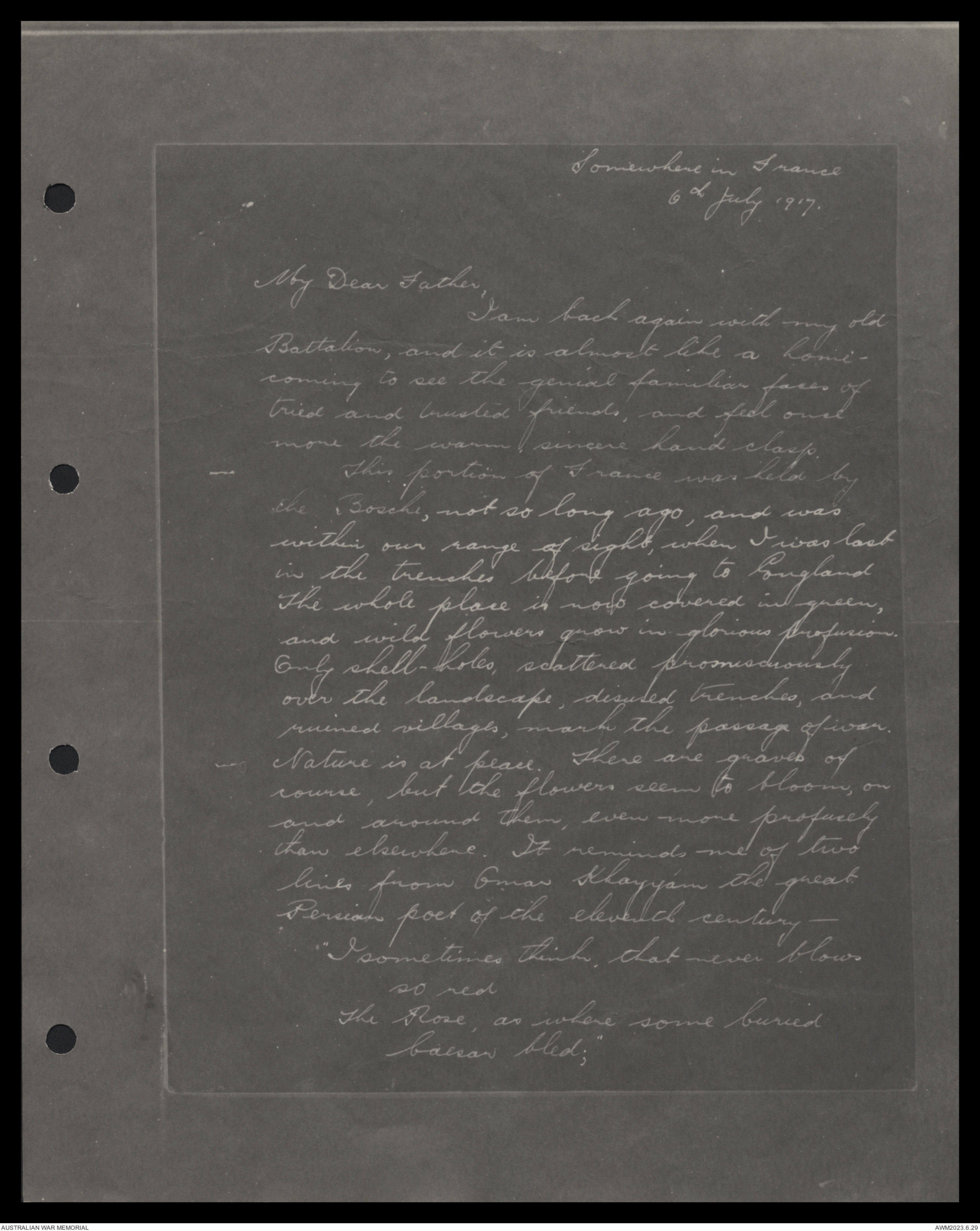
Somewhere in France
6th July 1917.
My Dear Father,
I am back again with my old
Battalion, and it is almost like a home-coming
to see the genial familiar faces of
tried and trusted friends, and feel once
more the warm sincere hand clasp.
This portion of France was held by
the Bosche, not so long ago, and was
within our range of sight, when I was last
in the trenches before going to England
The whole place is now covered in green,
and wild flowers grow in glorious profusion.
Only shell-holes, scattered promiscuously
over the landscape, disused trenches, and
ruined villages, mark the passage of war.
Nature is at peace. There are graves of
course, but the flowers seem to bloom, on
and around them, even more profusely
than elsewhere. It reminds me of two
lines from Omar Khayyam the great
Persian poet of the eleventh century -
"I sometimes think, that never blows
so red
The Rose, as where some buried
Caesar bled;"
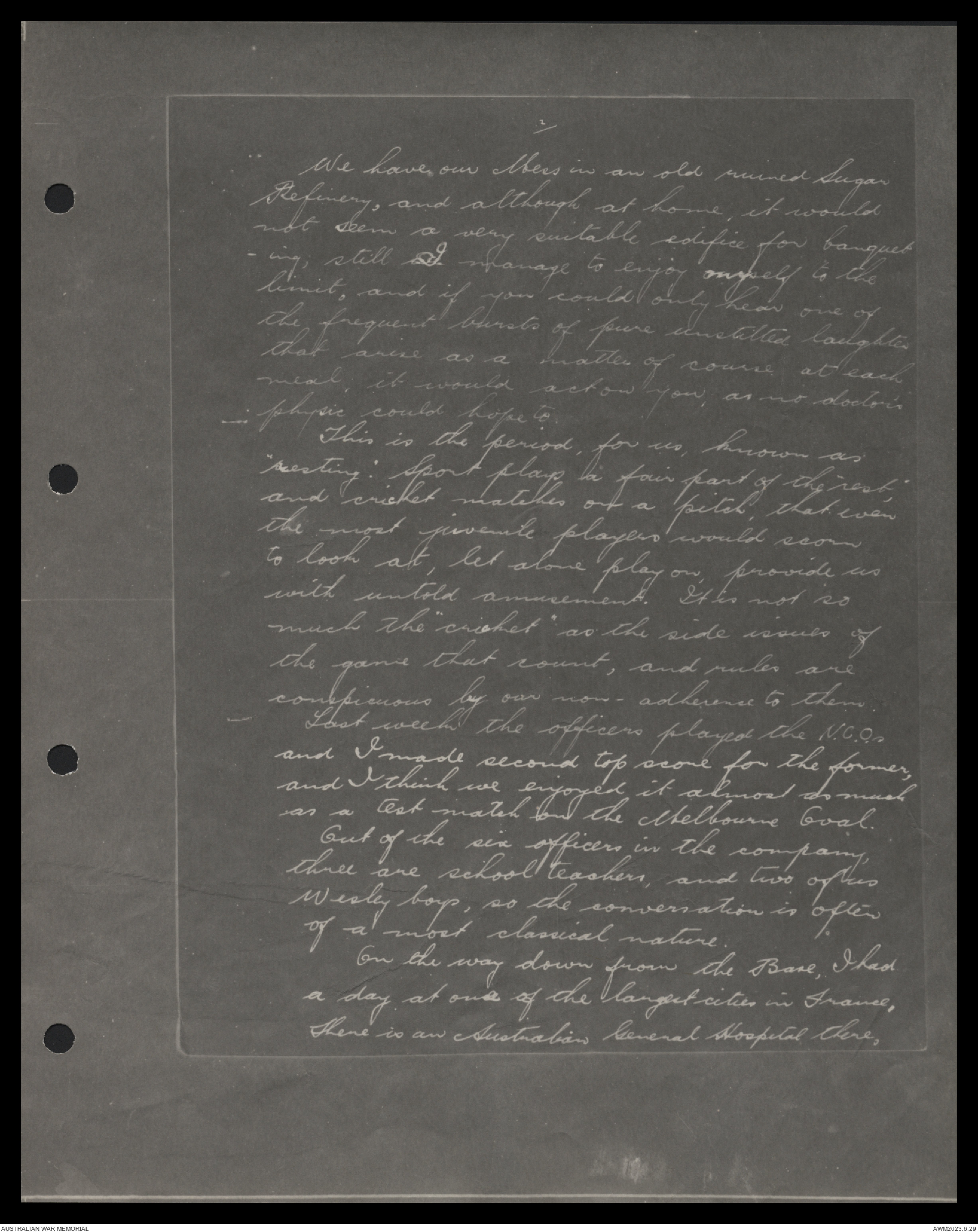
2
We have our Mess in an old ruined Sugar
Refinery, and although at home, it would
not seem a very suitable edifice for banqueting,
still I manage to enjoy myself to the
limit, and if you could only hear one of
the frequent bursts of pure unstilted laughter
that arise as a matter of course at each
meal, it would act on you, as no doctor's
physic could hope to.
This is the period, for us, known as
"resting". Sport plays a fair part of the "rest,"
and cricket matches on a pitch, that even
the most juvenile players would scorn
to look at, let alone play on, provide us
with untold amusement. It is not so
much the "cricket" as the side issues of
the game that count, and rules are
conspicuous by our non-adherence to them.
Last week the officers played the N.C.O.s
and I made second top score for the former,
and I think we enjoyed it almost as much
as a test match on the Melbourne Oval.
Out of the six officers in the company,
three are school teachers, and two of us
Wesley boys, so the conversation is often
of a most classical nature.
On the way down from the Base, I had
a day at one of the largest cities in France,
There is an Australian General Hospital there,
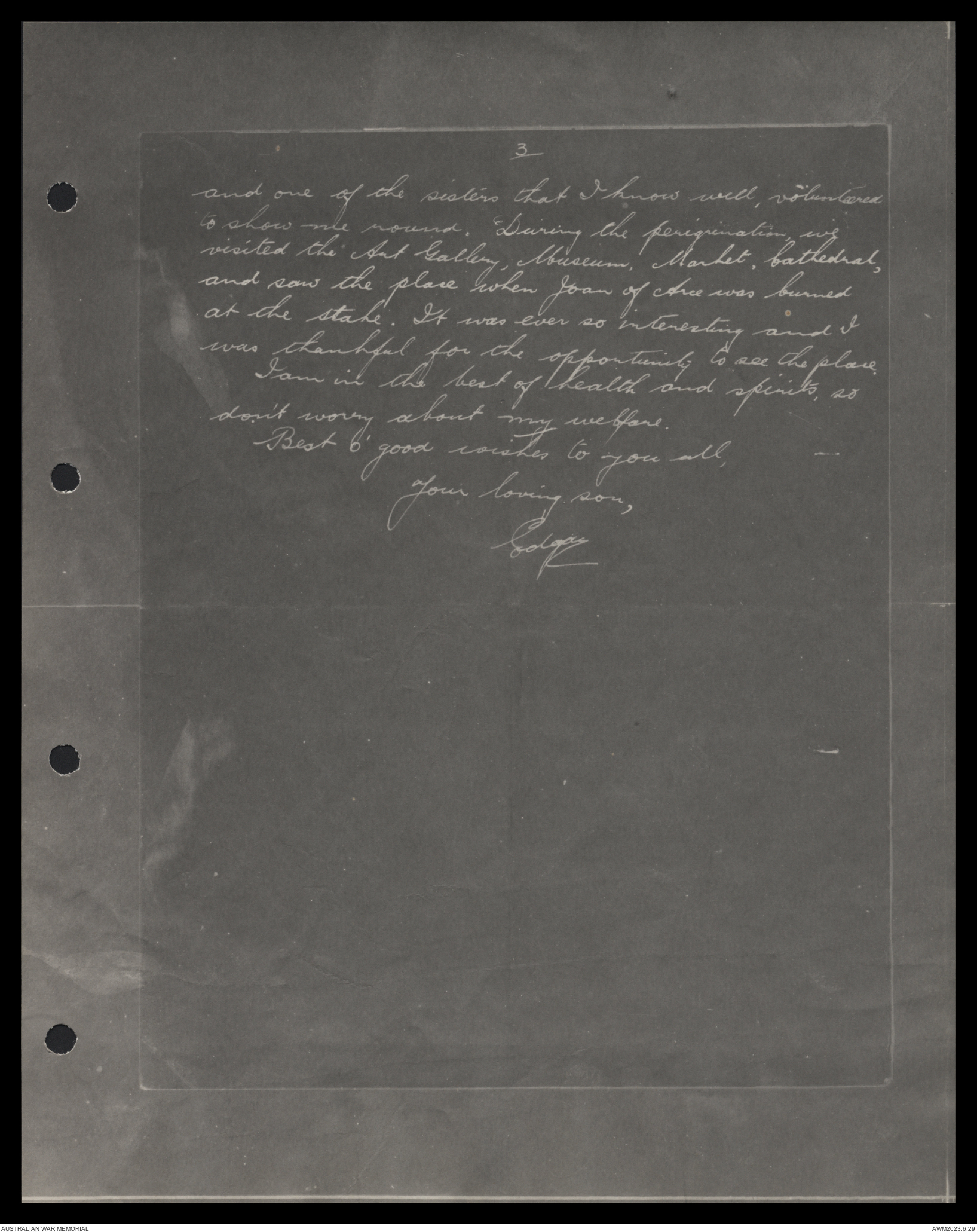
3
and one of the sisters that I know well, volunteered
to show me round. During the perigrination, we
visited the Art Gallery, Museum, Market, Cathedral,
and saw the place when Joan of Arc was burned
at the stake. It was ever so interesting and I
was thankful for the opportunity to see the place.
I am in the best of health and spirits, so
don't worry about my welfare.
Best o' good wishes to you all,
Your loving son,
Edgar
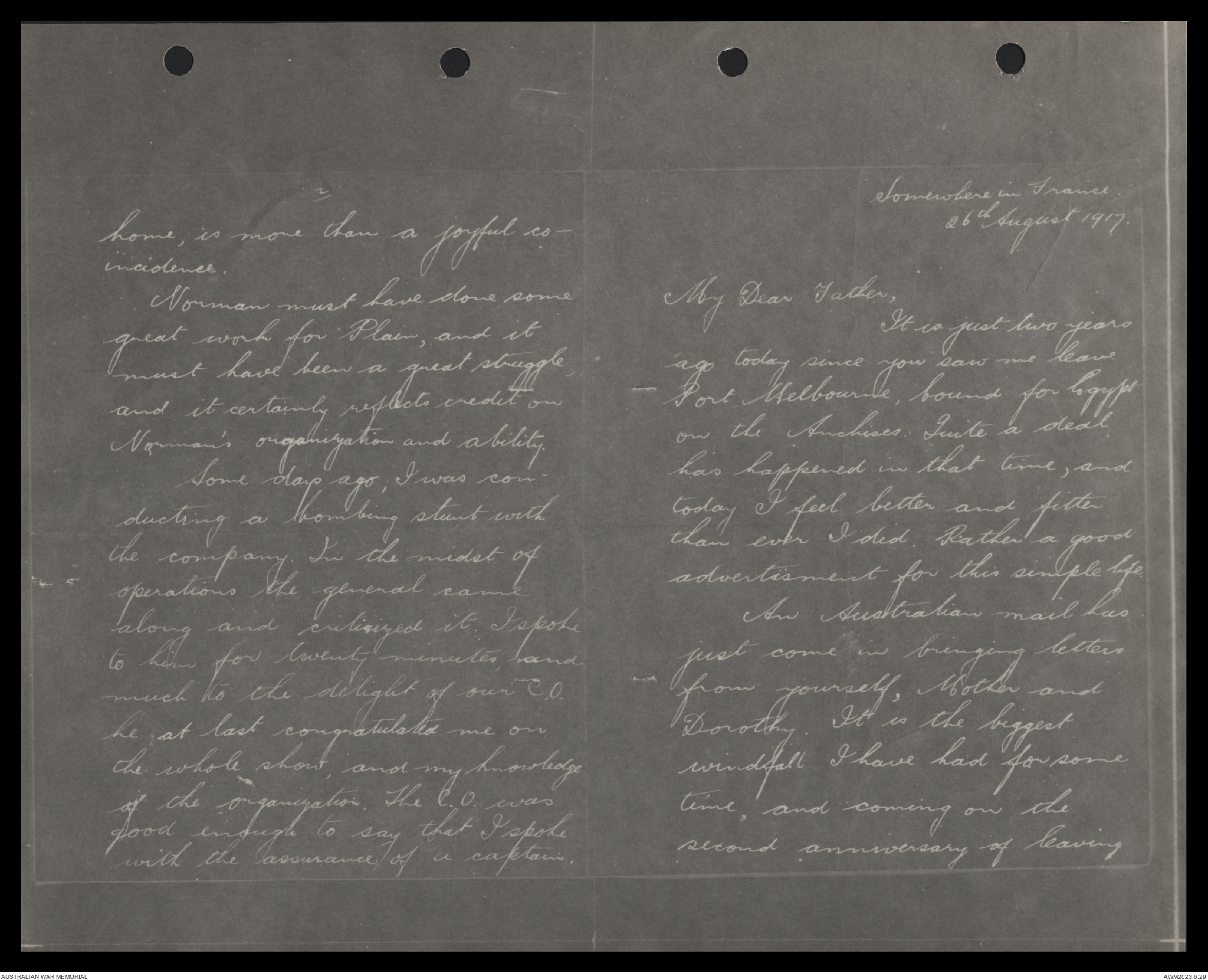
2
home, is more than a joyful coincidence.
Norman must have done some
great work for Plain, and it
must have been a great struggle
and it certainly reflects credit on
Norman's organization and ability.
Some days ago, I was conducting
a bombing stunt with
the company. In the midst of
operations the general came
along and criticized it. I spoke
to him for twenty minutes and
much to the delight of our C.O.
he at last congratulated me on
the whole show, and my knowledge
of the organization. The C.O. was
good enough to say that I spoke
with the assurance of a captain.
Somewhere in France
26th August 1917.
My Dear Father,
It is just two years
ago today since you saw me leave
Port Melbourne, bound for Egypt
on the Anchises. Quite a deal
has happened in that time, and
today I feel better and fitter
than ever I did. Rather a good
advertisement for this simple life.
An Australian mail has
just come in bringing letters
from yourself, Mother and
Dorothy. It is the biggest
windfall I have had for some
time, and coming on the
second anniversary of leaving
3
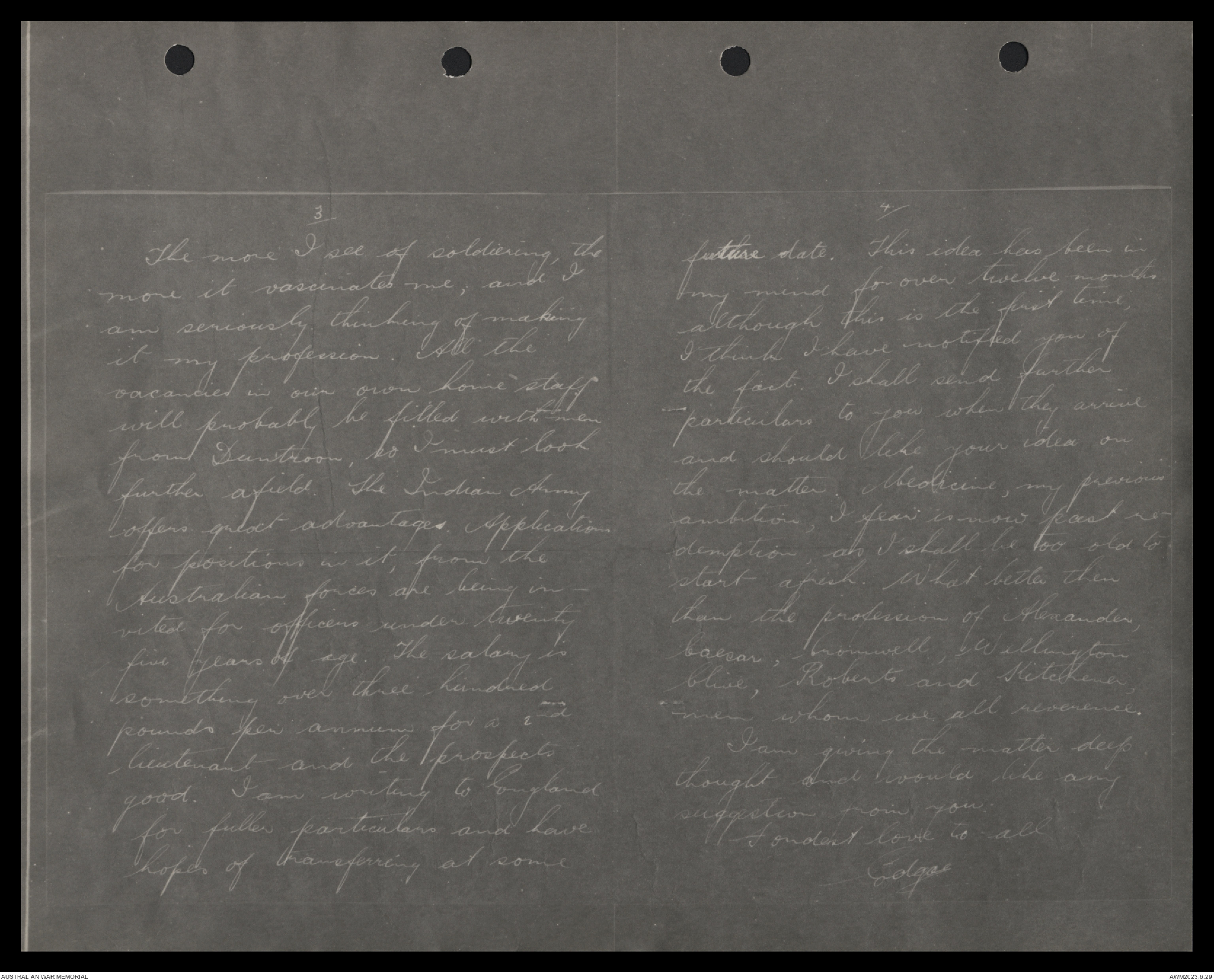
The more I see of soldiering, the
more it vascinates me, and I
am seriously thinking of making
it my profession. All the
vacancies in our own home staff
will probably be filled with men
from Duntroon, so I must look
further afield. The Indian Army
offers great advantages. Applications
for positions in it, from the
Australian forces are being invited
for officers under twenty
five years of age. The salary is
something over three hundred
pounds per annum for a 2nd
lieutenant and the prospects
good. I am writing to England
for fuller particulars and have
hopes of transferring at some
4
future date. This idea has been in
my mind for over twelve months
although this is the first time,
I think I have notified you of
the fact. I shall send further
particulars to you when they arrive
and should like your idea on
the matter. Medicine, my previous
ambition, I fear is now past redemption,
as I shall be too old to
start afresh. What better then
than the profession of Alexander,
Caesar, Cromwell, Wellington
Clive, Roberts and Kitchener,
men whom we all reverence.
I am giving the matter deep
thought and would like any
suggestion from you.
Fondest love to all
Edgar
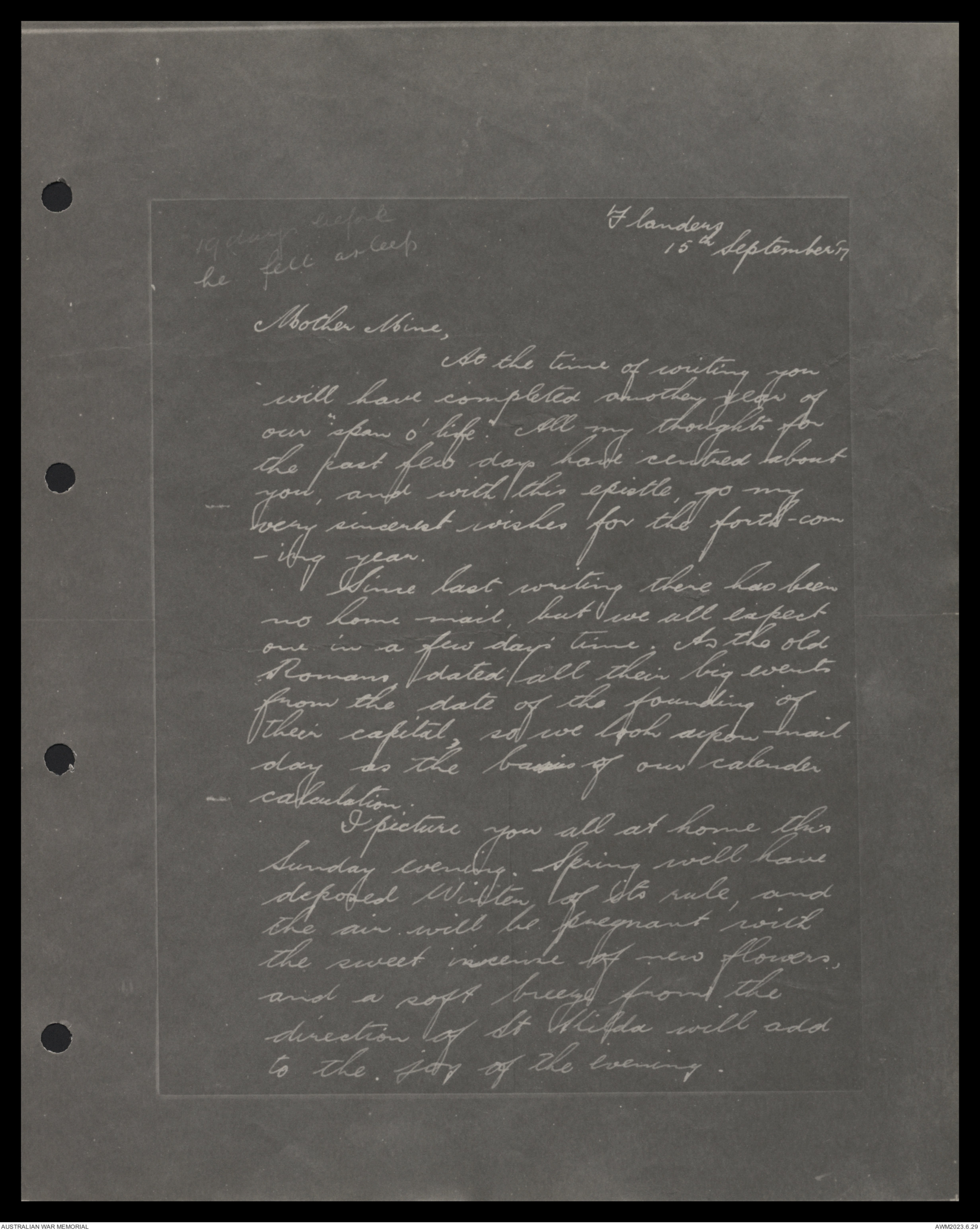
Flanders
15th September '17
[*19 days before
he fell asleep*]
Mother Mine,
At the time of writing you
will have completed another year of
our "span o' life". All my thoughts for
the past few days have centred about
you, and with this epistle, go my
very sincerest wishes for the forth-coming
year.
Since last writing there has been
no home mail, but we all expect
one in a few days time. As the old
Romans dated all their big events
from the date of the founding of
their capital, so we look upon mail
day as the basis of our calender
calculation.
I picture you all at home this
Sunday evening. Spring will have
deposed Winter of its rule, and
the air will be pregnant with
the sweet incense of new flowers,
and a soft breeze from the
direction of St Kilda will add
to the joy of the evening.
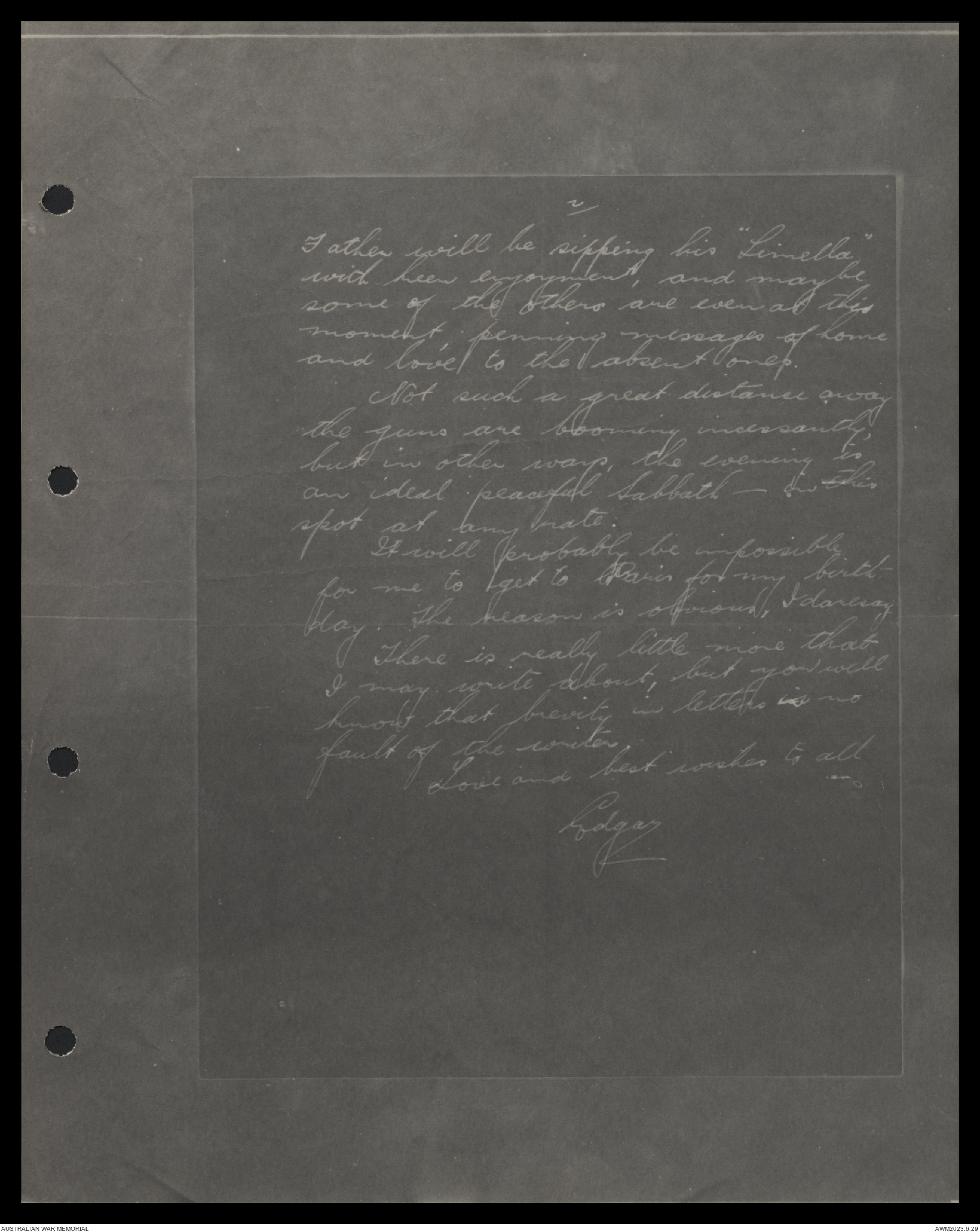
2
Father will be sipping his "Limella"
with keen enjoyment, and maybe
some of the others are even at this
moment, penning messages of home
and love to the absent ones.
Not such a great distance away
the guns are booming incessantly,
but in other ways, the evening is
an ideal peaceful Sabbath - in this
spot at any rate.
It will probably be impossible
for me to get to Paris for my birthday.
The reason is obvious, I daresay.
There is really little more that
I may write about, but you will
know that brevity in letters is no
fault of the writer.
Love and best wishes to all
Edgar
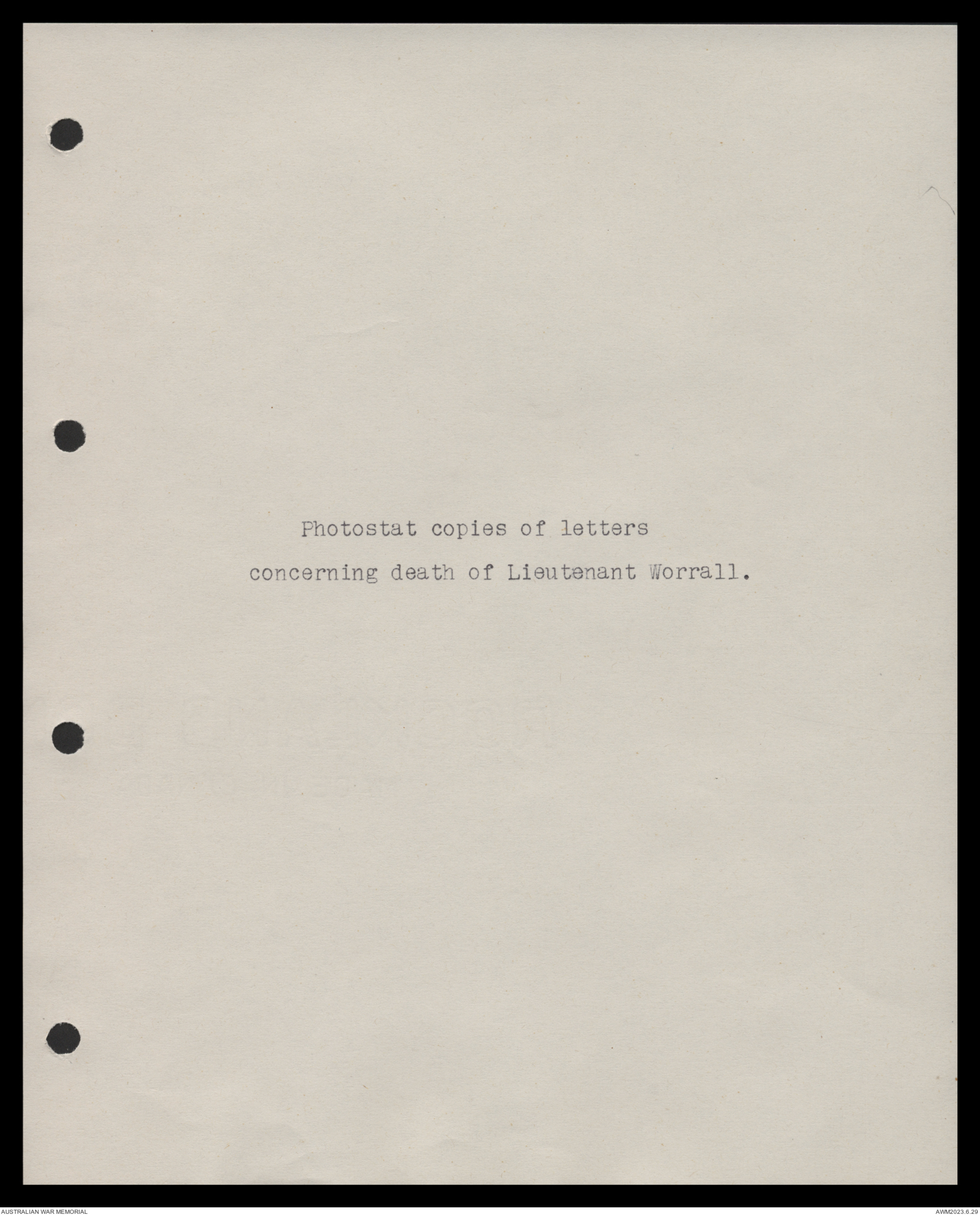
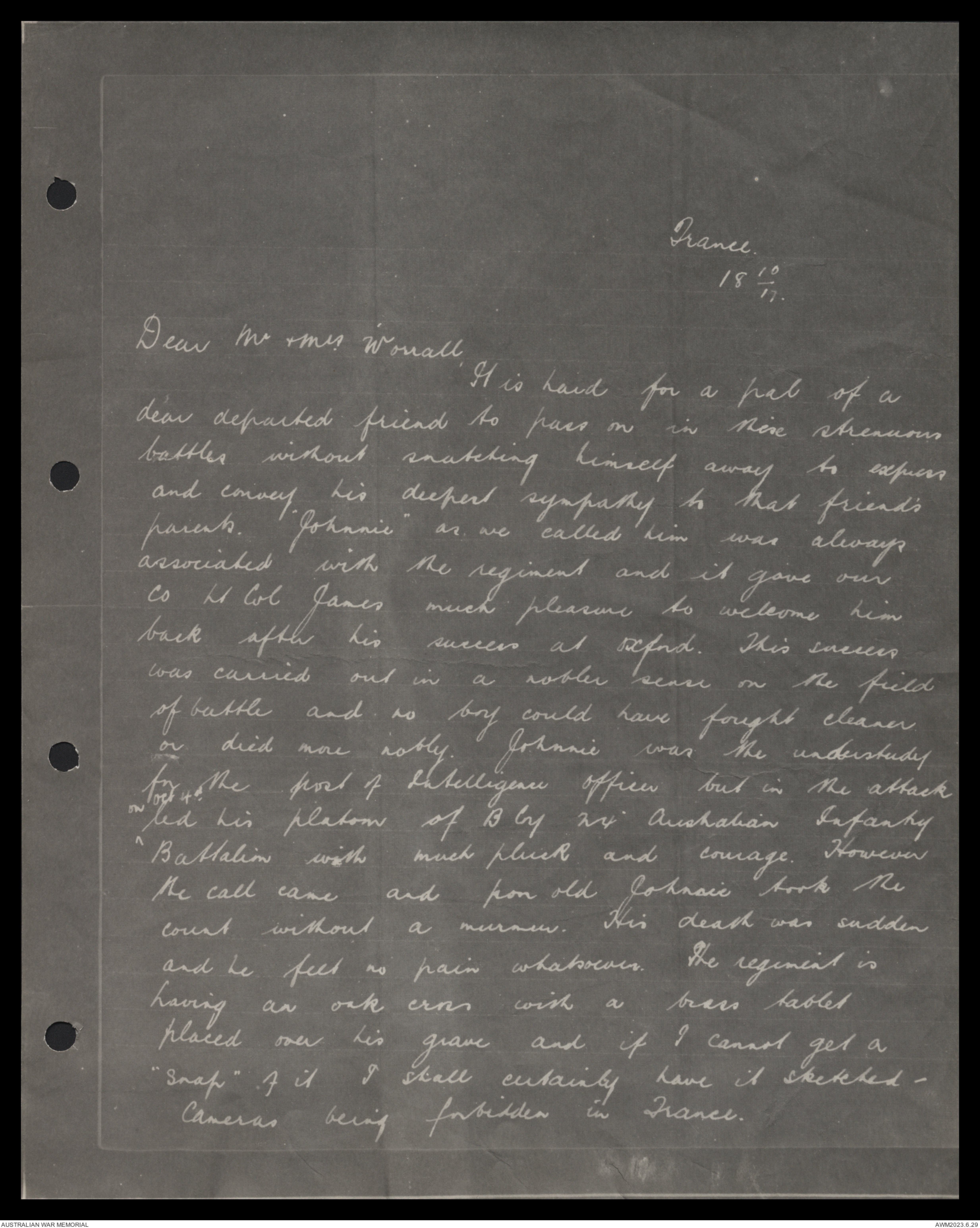
Photostat copies of letters
concerning death of Lieutenant Worrell.
France.
18 10/17
Dear Mr & Mrs Worrall
It is hard for a pal of a
dear departed friend to pass on in these strenuous
battles without snatching himself away to express
and convey his deepest sympathy to that friend's
parents. "Johnnie" as we called him was always
associated with the regiment and it gave our
Co Lt Col James much pleasure to welcome him
back after his success at Oxford. His success
was carried out in a nobler sense on the field
of battle and no boy could have fought cleaner
or died more nobly. Johnnie was the understudy
for the post of Intelligence officer but in the attack
∧ on Oct 4th led his platoon of B Cy 24 Australian Infantry
Battalion with much pluck and courage. However
the call came and poor old Johnnie took the
count without a murmur. His death was sudden
and he felt no pain whatsoever. The regiment is
having an oak cross with a brass tablet
placed over his grave and if I cannot get a
"snap"of it I shall certainly have it sketched-
cameras being forbidden in France.
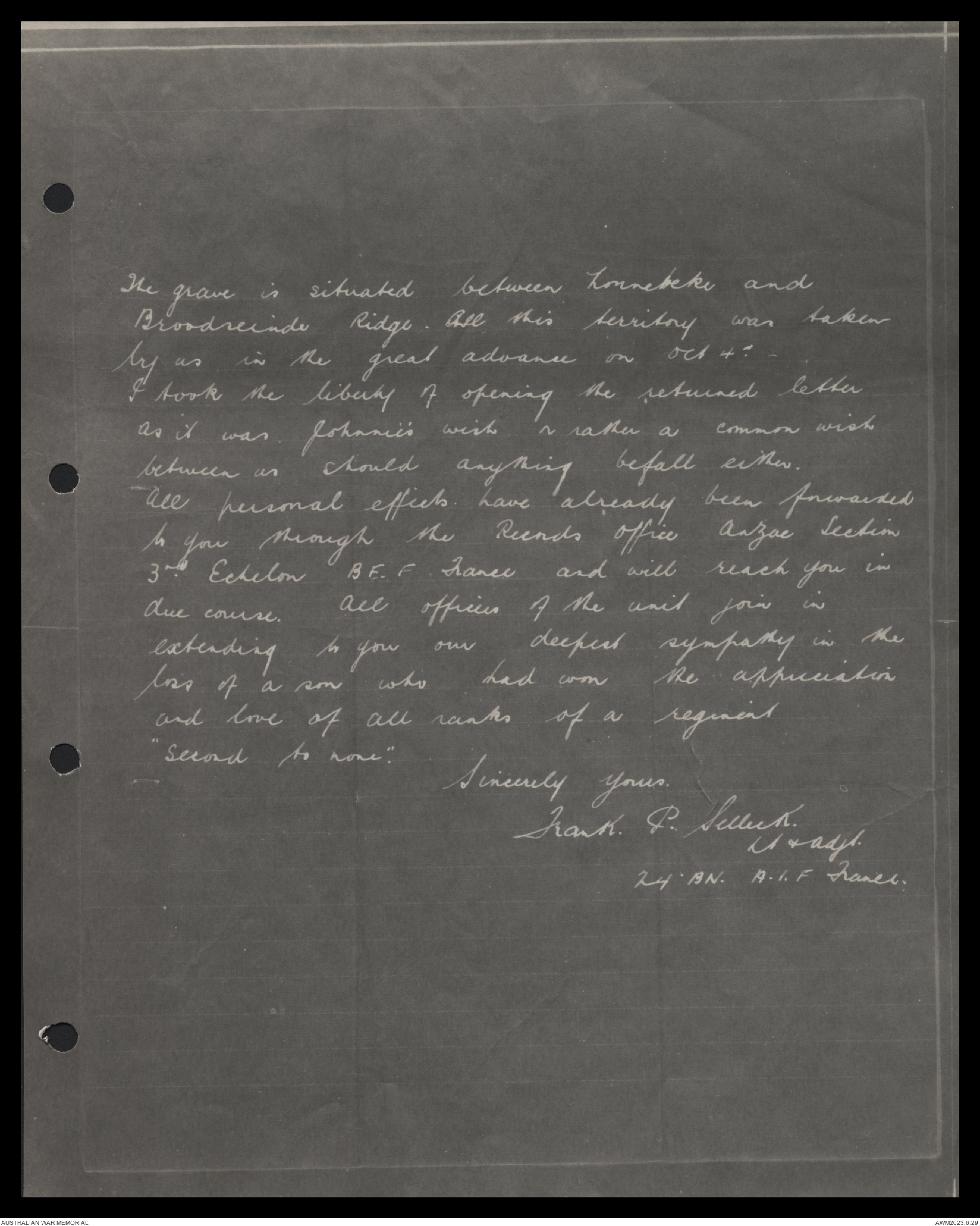
The grave is situated between Zonnebeke and
Broodseinde Ridge. All this territory was taken
by us in the great advance on Oct 4th.
I took the liberty of opening the returned letter
as it was Johnnies wish or rather a common wish
between us should anything befall either.
All personal effects have already been forwarded
to you through the Records Office Anzac Section
3rd Echelon B.E.F France and will reach you in
due course. All officers of the unit join in
extending to you our deepest sympathy in the
loss of a son who had won the appreciation
and love of all ranks of a regiment
"second to none".
Sincerely yours.
Frank. P. Selleck.
Lt & adjt.
24 Bn. A.I.F France.
 Deb Parkinson
This transcription item is now locked to you for editing. To release the lock either Save your changes or Cancel.
This lock will be automatically released after 60 minutes of inactivity.