
Diary of service - Donald Morrison, 1940 - 1945 - Part 7
AIF History
Captain N Morrison
lines and after a day in which the party marched for eighteen hours they arrived at
Benut and the safety of the British lines. From Benut they were taken to Johore Bahru
and across to the island of Singapore where they rejoined the Battalion. They crossed
the causeway, which links the mainland of Malaya to the island, only a few hours
before it was blown up.
Sergeant Atkinson could not speak too highly of the endurance of the men under his
care; with little to eat they existed mainly on pineapples, rice and water. The men
reached safety in an exhausted condition, bearded and in rags. Blistered and tinea
infected feet had caused them to discard their boots. The majority of the party were
evacuated to hospital.
On arrival at the base, five miles west of Johore Bahru, the main body of "B"
Company were temporarily quartered for the night in attap huts where they were able
to get a good rest.
The Battalion commenced to reform with many changes in personnel, Lieutenant
Colonel SAF Pond, OBE, formerly Brigade Major of 27 Infantry Brigade, was
appointed Commanding Officer with Major F Hore as second in command. Captain
DS West from "C" Company was made OC of "B" Company.
The first task for the Company administration was the unpleasant one of preparing the
casualty list of the main land. This proved to be 9 killed, 12 wounded, 9 missing
believed wounded and 30 missing.
All welcomed the return of Lieutenant Jock Richards, who had been in hospital with
Malaria during the Muar Battle.
The following morning, on 25 January 1942, the air raid alarm sounded and a flight of
twenty seven enemy bombers passed overhead. This was a daily occurrence at the
base, but the destination of the planes was Singapore so no bombs were dropped. That
afternoon, the Battalion was moved by motor transport to a new location in a rubber
planation approximately one mile further south. Another good nights rest was
Beer Company
Page 48
AIF History
Captain N Morrison
possible and the next morning the companies were sorted out and dispersed to platoon
areas.
A large number of reinforcements had arrived from Australia, on 24 January and these
men wee allotted to the various units. The Company received 83 reinforcements.
This heavy replacement of men was necessary, as quite apart from the casualties
sustained, partied of the original company were still coming back through the jungle.
Many others had been evacuated to hospital suffering from fever and exhaustion.
No. 11 Platoon received a new Commander, Lieutenant Trantor, Sergeant Freeland,
from reinforcements was appointed Company Sergeant Major.
The CO had been given the difficult task of reforming the unit and preparing it ready
for action in four days. So equipment was issued rapidly and replaced where
necessary from the store which was still in the capable hands of Senior Sergeant J
Arthur.
The Company immediately began battle training adapted to its new surroundings. The
original members of the company were meanwhile given the opportunity to obtain a
well earned rest.
Lieutenant Colonel Pond paid the company his first visit in the capacity of CO, and
told the men of his pride in being appointed Commanding Officer of a Battalion that
already had a fine battle record. He mentioned his long association with the unit and
paid a tribute to its late commander.
Owing to the necessity of rapid reorganisation of the unit and to the possibility of
having to be in action again shortly, no leave could be granted. Many of the Muar
Veterans availed themselves of the rest period in making unofficial excursions to
Johore Bahru. On finding most of the town already evacuated they hitch hiked onto
Singapore for a brief frolic.
Beer Company
Page 49
AIF History
Captain N Morrison
Sergeant Knott assumed temporary command of "12" Platoon as lieutenant, Bonney
was evacuated to hospital.
The strenuous training programme for the reinforcements proceeded under the
guidance of their own NCO's and the new arrivals soon adapted themselves to the
enervating conditions. Padre Mac Neil visited the company and conducted a brief mid
week service to each of the platoons.
Shortly before noon on 29 January the Company received a warning of half an hour
that the Battalion would be moving back to the island of Singapore. After a hasty
meal, the Company embussed and recrossed the causeway for the last time as it had
been prepared for demolition.
On reaching the island, the Battalion moved to its dispersal area at Kranji, about five
miles from the causeway to the south west near the estuary of the Kranji River. The
Company took up a defensive position about half a mile from an important
ammunition dump of twenty eight concrete structures.
The digging of slit trenches was completed rapidly and the company settled down to
recapitulation training in platoon areas. This consisted mainly of bayonet and Lewis
gun work.
Constant patrols were maintained in the area of the Kranji Estuary to counter possible
enemy infiltration as well as hourly patrols of the ammunition dump.
Lieutenant Harry Archdall of the recently arrived reinforcements was appointed
Commander "12" Platoon, Corporal Larry Richards acting Platoon Sergeant "11"
Platoon and Corporal Norm Stephens acting for "10" Platoon. Later, Lieutenant A
Ellerman of "A" Company assumed the post of 2IC of the Company.
Early one morning, a single enemy plane approached and, after dropping a flare to
illuminate the area, bombed a group of huge naval oil storage tanks which were
situated close to the railway line and over a mile from the Company area. One bomb
Beer Company
Page 50
AIF History
Captain N Morrison
scored a direct hit on a tank causing a blaze which lasted several days. While another
bomb completely demolished a small Chinese store on the main road killing the
occupants.
Intermittent shelling had commenced, but no shells landed close enough to cause any
casualties among the Battalion. Although one burst three hundred yards in the rear of
the Company and did some damage to an Aussie battery.
"A" Company however was close to the shelling and it was decided to putt "A" and
"B" Companies back a short distance to be out of danger.
The new position was closer to the oil storage tanks although the Platoons still
maintained patrols on the estuary, ammunition dump and throughout their allotted
area.
On Sunday 8 February, a heavy shelling of the Australian positions along the west
coast commenced. This are was defended by the "22" Australian Infantry Brigade
supported by "2/15" Field regiment and "A" Company of "2/4" machine gunners.
The Battalion's role was that of Brigade and Divisional Reserves. "2/26" Battalion
were also in the Kranji area, forward of the main road and between the eastern shores
of the estuary and the causeway. "2/30" Battalion faced Johore Bahru around the
southern end of the causeway.
In its roll as divisional reserve, the Battalion received orders shortly after midnight, 9
February, to move to the west coast. The idea was to counter enemy infiltration from
the coast where they had landed. The enemy had broken through the defences of "22"
Brigade who had been pounded by heavy artillery fire from early that morning.
Company Commanders had received orders independently and the companies had
moved off in a like manner.
Beer Company
Page 51
AIF History
Captain N Morrison
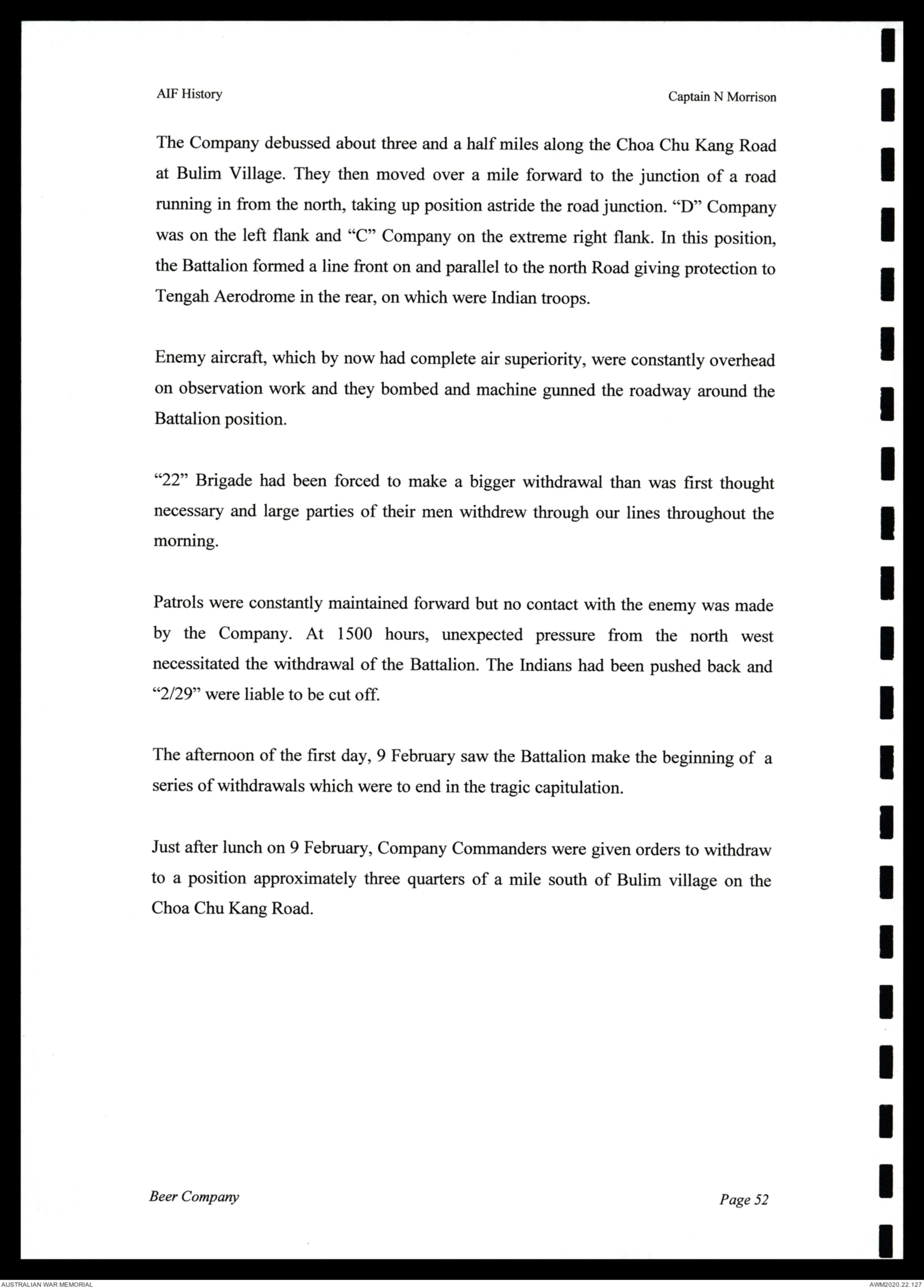
The Company debussed about three and a half miles along the Choa Chu Kang Road
at Bulim Village. They then moved over a mile forward to the junction of a road
running in from the north, taking up position astride the road junction. "D" Company
was on the left flank and "C" Company on the extreme right flank. In this position,
the Battalion formed a line front on and parallel to the north Road giving protection to
Tengah Aerodrome in the rear, on which were Indian troops.
Enemy aircraft, which by now had complete air superiority, were constantly overhead
on observation work and they bombed and machine gunned the roadway around the
Battalion position.
"22" Brigade had been forced to make a bigger withdrawal that was first thought
necessary and large parties of their men withdrew through our lines throughout the
morning.
Patrols were constantly maintained forward but no contact with the enemy was made
by the Company. At 1500 hours, unexpected pressure from the north west
necessitated the withdrawal of the Battalion. The Indians had been pushed back and
"2/29" were liable to be cut off.
The afternoon of the first day, 9 February saw the Battalion make the beginning of a
series of withdrawal which were to end on the tragic capitulation.
Just after lunch on 9 February, Company Commanders were given orders to withdraw
to a position approximately three quartes of a mile south of Bulim village on the
Choa Chu Kang Road.
Beer Company
Page 52
AIF History
Captain N Morrison
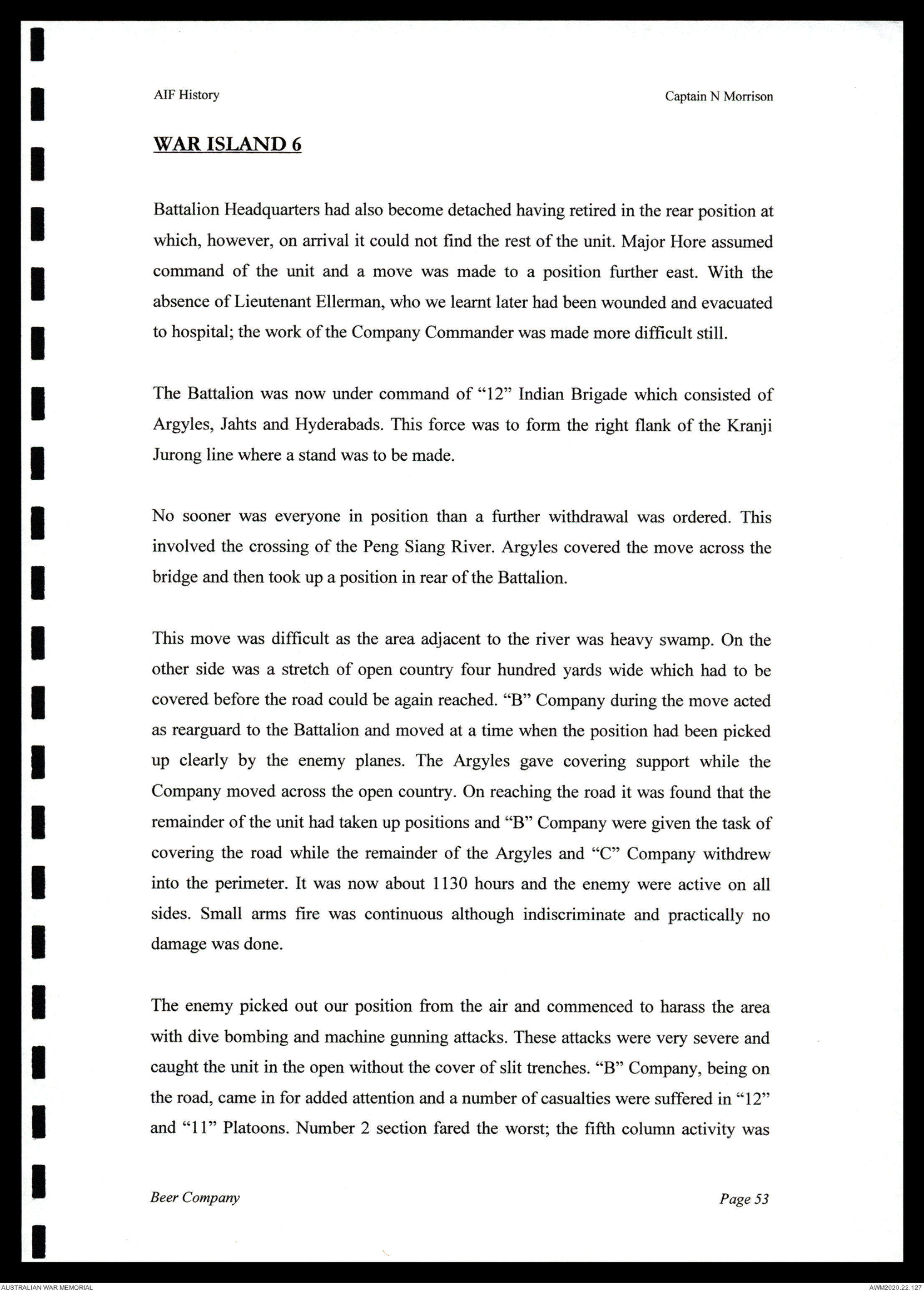
WAR ISLAND 6
Battalion Headquarters has also become detached having retired in the rear position at
which, however, on arrival it could not find the rest of the unit. Major Hore assumed
command of the unit and a move was made to a position further east. With the
absence of Lieutenant Ellerman, who we learnt later had been wounded and evacuated
to hospital; the work of the Company Commander was made more difficult still.
The Battalion was now under command of "12" Indian Brigade which consisted of
Argyles, Jahts and Hyderabads. This force was to form the right flank of the Kranji
Jurong line where a stand was to be made.
No sooner was everyone in position than a further withdrawal was ordered. This
involved the crossing of the Peng Siang River. Argyles covered the move across the
bridge and then took up a position in rear of the Battalion.
This move was difficult as the area adjacent to the river was heavy swamp. On the
other side was a stretch of open country four hundred yards wide which had to be
covered before the road could be again reached. "B" Company during the move acted
as rearguard to the Battalion and moved at a time when the position had been picked
up clearly by the enemy planes. The Argyles gave covering support while the
Company moved across the open country. On reaching the road it was found that the
remainder of the unit had taken up positions and "B" Company were given the task of
covering the road while the remainder of the Argyles and "C" Company withdrew
into the perimeter. It was now about 1130 hours and the enemy were active on all
sides. Small arms fire was continuous although indiscriminate and practically no
damage was done.
The enemy picked out our position from the air and commenced to harass the area
with dive bombing and machine gunning attacks. These attacks were very severe and
caught the unit in the open without the cover of slit trenches. "B" Company, being on
the road, came in for added attention and a number of casualties were suffered in "12"
and "11" Platoons. Number 2 section fared the worst; the fifth column activity was
Beer Company P
age 53
AIF History
Captain N Morrison
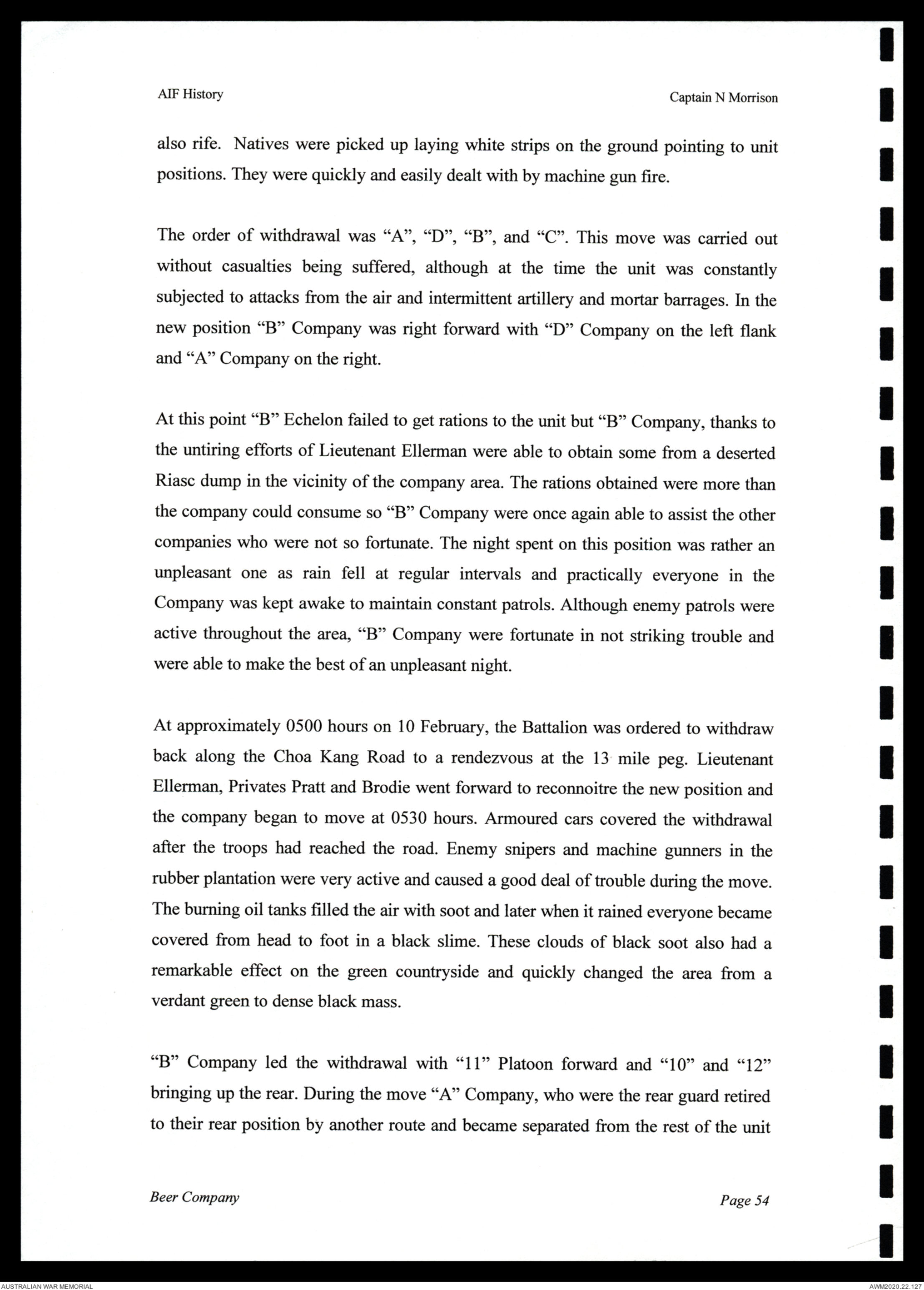
also rife. Natives were picked up laying white strips on the ground pointing to unit
positions. They were quickly and easily dealt with by machine gun fire.
The order of withdrawal was "A", "D", "B", and "C". This move was carried out
without casualties being suffered, although at the time the unit was constantly
subjected to attacks from the air and intermittent artillery and mortar barrages. In the
new position "B" Company was right forward with "D" Company on the left flank
and "A" Company on the right.
At this point “B” Echelon failed to get rations to the unit but “B” Company, thanks to
the untiring efforts of Lieutenant Ellerman were able to obtain some from a deserted
Riasc dump in the vicinity of the company area. The rations obtained were more than
the company could consume so “B” Company were once again able to assist the other
companies who were not so fortunate. The night spent on this position was rather an
unpleasant one as rain fell at regular intervals and practically everyone in the
Company was kept awake to maintain constant patrols. Although enemy patrols were
active throughout the area, “B” Company were fortunate in not striking trouble and
were able to make the best of an unpleasant night.
At approximately 0500 hours on 10 February, the Battalion was ordered to withdraw
back along the Choa Kang Road to a rendezvous at the 13 mile peg. Lieutenant
Ellerman, Privates Pratt and Brodie went forward to reconnoitre the new position and
the company began to move at 0530 hours. Armoured cars covered the withdrawal
after the troops had reached the road. Enemy snipers and machine gunners in the
rubber plantation were very active and caused a good deal of trouble during the move.
The burning oil tanks filled the air with soot and later when it rained everyone became
covered from head to foot in a black slime. These clouds of black soot also had a
remarkable effect on the green countryside and quickly changed the area from a
verdant green to dense black mass.
“B” Company led the withdrawal with “11” Platoon forward and “10” and “12”
bringing up the rear. During the move “A” Company, who were the rear guard retired
to their rear position by another route and became separated from the rest of the unit
Beer Company
Page 54
AIF History
Captain N Morrison
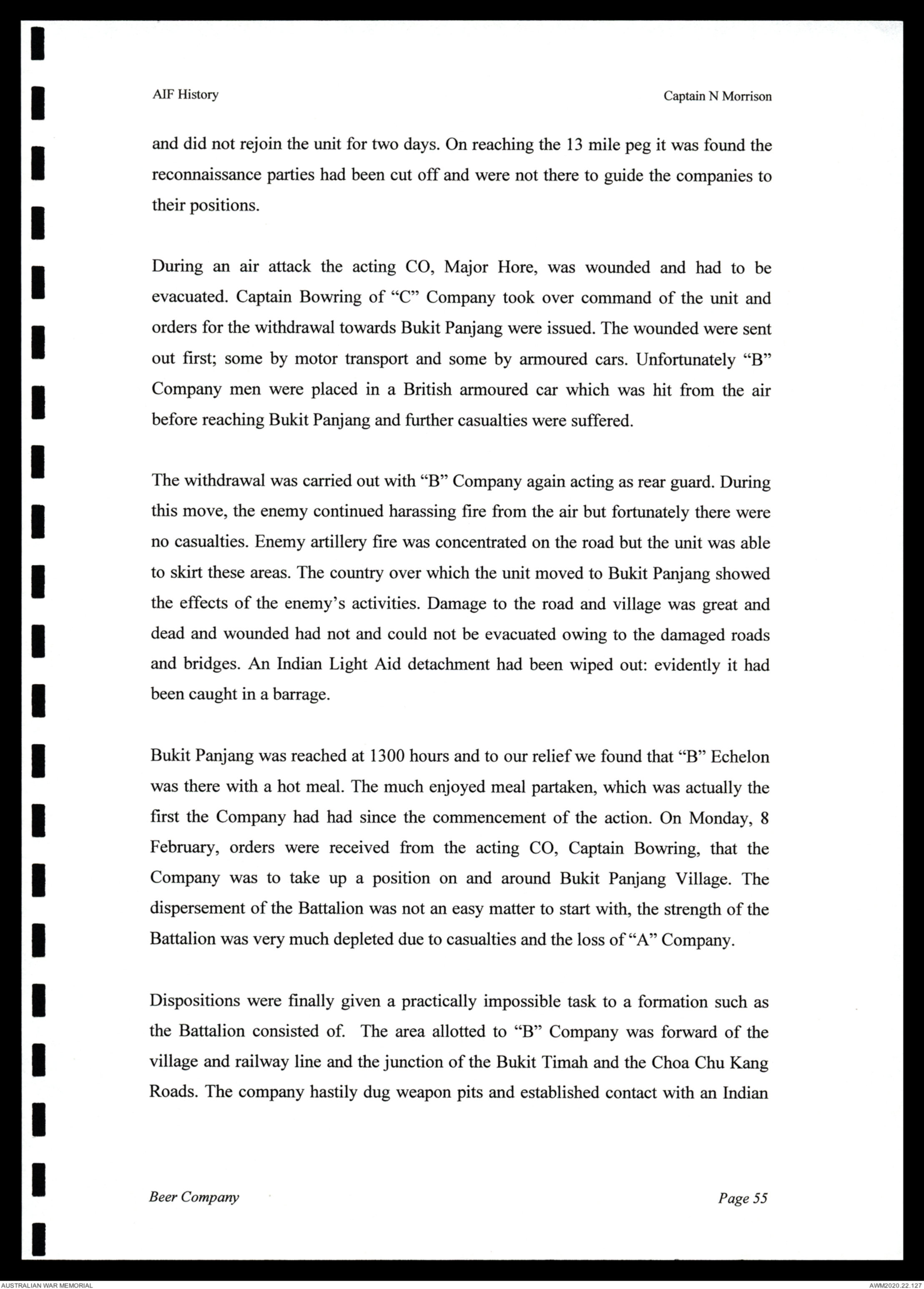
and did not rejoin the unit for two days. On reaching the 13 mile peg it was found the
reconnaissance parties had been cut off and were not there to guide the companies to
their positions.
During an air attack the acting CO, Major Hore, was wounded and had to be
evacuated. Captain Bowring of “C” Company took over command of the unit and
orders for the withdrawal towards Bukit Panjang were issued. The wounded were sent
out first; some by motor transport and some by armoured cars. Unfortunately “B”
Company men were placed in a British armoured car which was hit from the air
before reaching Bukit Panjang and further casualties were suffered.
The withdrawal was carried out with “B” Company again acting as rear guard. During
this move, the enemy continued harassing fire from the air but fortunately there were
no casualties. Enemy artillery fire was concentrated on the road but the unit was able
to skirt these areas. The country over which the unit moved to Bukit Panjang showed
the effects of the enemy’s activities. Damage to the road and village was great and
dead and wounded had not and could not be evacuated owing to the damaged roads
and bridges. An Indian Light Aid detachment had been wiped out: evidently it had
been caught in a barrage.
Bukit Panjang was reached at 1300 hours and to our relief we found that “B” Echelon
was there with a hot meal. The much enjoyed meal partaken, which was actually the
first the Company had had since the commencement of the action. On Monday, 8
February, orders were received from the acting CO, Captain Bowring, that the
Company was to take up a position on and around Bukit Panjang Village. The
dispersement of the Battalion was not an easy matter to start with, the strength of the
Battalion was very much depleted due to casualties and the loss of “A” Company.
Dispositions were finally given a practically impossible task to a formation such as
the Battalion consisted of. The area allotted to “B” Company was forward of the
village and railway line and the junction of the Bukit Timah and the Choa Chu Kang
Roads. The company hastily dug weapon pits and established contact with an Indian
Beer Company
Page 55
AIF History
Captain N Morrison
Brigade Headquarters forward of the position. During the afternoon enemy Recce
planes remained constantly in the area.
At approximately 1800 hours, a heavy enemy artillery barrage fell on the area. “B”
Company, being nearest to the cross roads derived full benefit of the attack which
lasted for three quarters of an hour. Shortly after the barrage ceased, Indian Troops
began to filter back through the Company’s area. At 1945 hours enemy verey lights in
signal form were seen some distance away on the Company’s front and some minutes
later the noise of advancing tanks could be heard on the road.
At this stage, Lieutenant Arthur Tranter and a patrol set out to endeavour to contact
the Headquarters of forward Indian Troops. This patrol proved to be a fateful one,
(from later information), and it was not until liberation in 1945 that Lieutenant Tranter
and many of his men were seen again. With the approach of the tanks, heavy enemy
fire was concentrated on the area, built up with a very effective mortar barrage.
Enemy infiltration followed the tanks and a general fanning out plan was adopted by
them as they approached the railway crossing.
Again at this stage, the effect of our inadequate arms was most pronounced, the old
question of “how can infantry combat tanks with only a small number of automatic
weapons and rifles at their disposal and with a complete absence of grenades,
mortars and anti tank support” was asked.
As the enemy tanks advanced and started the encircling movement it left “B”
Company in a position which was far from comfortable. The company could not
communicate with Battalion Headquarters owing to the burning village and to a gap
of about three hundred yards which was alive with our own and enemy fire. As every
minute went by the enemy pressed deeper into the position and began to consolidate
on the flanks.
At about 2045 hours, Captain West issued orders that a withdrawal would have to be
made. Each platoon was to move independently and rendezvous behind Bukit Panjang
Village and then to the units position on the east side of the village. This meant a
Beer Company
Page 56
AIF History
Captain N Morrison
difficult move, the Company area was large, the night was pitch black and some delay
was caused bringing in the outlying sections. Lieutenant Trantor was out on patrol
with a section and could not be located. Corporal McGrath was left with the job of
withdrawing the platoon. The only course open for the withdrawal appeared to be on a
bearing of south west and then east; this being necessary in order to skirt the blazing
village and burning fuel dumps. Many of these dumps had been fired on by our own
forces during the day. This area was also subjected to heavy small arms fire from our
own force behind the village.
“12” Platoon withdrew from the position in a south west direction for about three
quarters of a mile. The area was very difficult to cover because of the natural and
other obstacles met. Firstly an eight foot fence with close strands of wire on top; this
took sometime to overcome as there were no wire cutters. A quarry was then
encountered and great difficulty experienced in crossing it.
The noise of falling rubble as the troops crossed the quarry attracted not only the
attention of the enemy but also of our own troops and a hell of small arms fire broke
loose. The enemy seized the opportunity to drive a tank up the narrow road leading
into the quarry and began to open up at point blank range with machine guns and
canon fire. The platoon, after much difficulty, succeeded in crossing the open road
and scaled the other side. Only one fatal casualty was suffered. Private Pike did
excellent work in crossing these obstacles as he was carrying a Lewis gun and all the
spare parts. The platoon then passed through a desert camp area comprised mainly
of Attap huts. At this point, the platoon came under fire from snipers and what was
evidently enemy patrols. The platoon became split when passing through the camp,
mainly because the fatigued men could not keep up with those who were more robust.
Captain Gilmartin, at this point, missed the forward section and went too far west and
ran into the enemy in large numbers. He carried on with a wounded man in his section
and later reached the west coast. He had a number of encounters with the enemy; one
of which cost a life.
The remainder of the platoon, less Private Pursell and eight men, succeeded in
reaching Bukit Timah Road about one mile south of Bukit Panjang Village.
Beer Company
Page 57
 Sam scott
This transcription item is now locked to you for editing. To release the lock either Save your changes or Cancel.
This lock will be automatically released after 60 minutes of inactivity.