
Diary of service - Donald Morrison, 1940 - 1945 - Part 5
AIF History
Captain N Morrison
Maps of this area did not show these tracks with any accuracy, if at all, so Platoons
carried out reconnaissances to correct these errors. Privates Garvin and Ensby of the
Intelligence section, who were attached to the Company, mapped the area and
gathered much useful information on the tidal variation of the local rivers.
carried out reconnaissances to correct these errors. Privates Garvin and Ensby of the
Intelligence section, who were attached to the Company, mapped the area and
gathered much useful information on the tidal variation of the local rivers.
With these tasks completed, a recapitulation of the Platoon and Company in attack
took place which was carried on until the first warning of impending hostilities was
received.
took place which was carried on until the first warning of impending hostilities was
received.
During the seven weeks of tent life at Kluang, things ran smoothly. On week nights
leave was granted until 2200 hours and this was extended to midnight over the
weekend. The town was typical of most in Johore with its innumerable Chinese stores
and eating houses. Two theatres showing Chinese and English films were the chief
attractions, while two restaurants served European food. In the “cold storage” bar
members of the Company fraternised with the RAF and were invited to visit the
station during the weekends. A canteen run by CSM Burton, ably assisted by Private
Roy Webb, was opened and this enabled the men to obtain goods at NAAF rates.
leave was granted until 2200 hours and this was extended to midnight over the
weekend. The town was typical of most in Johore with its innumerable Chinese stores
and eating houses. Two theatres showing Chinese and English films were the chief
attractions, while two restaurants served European food. In the “cold storage” bar
members of the Company fraternised with the RAF and were invited to visit the
station during the weekends. A canteen run by CSM Burton, ably assisted by Private
Roy Webb, was opened and this enabled the men to obtain goods at NAAF rates.
In early November Lieutenant Corporal Arnold was attached for five weeks training
to the Argyle and Sutherland Highlanders at Seremban. This was part of a plan to
promote better understanding between British and Australian Units. This exchange of
men was carried out by all arms. Corporals Roy Barker and Percy Haworth of the
Carrier Platoon were attached as MMG Instructors. This was a far sighted project as it
later enabled the Carrier Platoon to obtain trained gunners from the Company.
to the Argyle and Sutherland Highlanders at Seremban. This was part of a plan to
promote better understanding between British and Australian Units. This exchange of
men was carried out by all arms. Corporals Roy Barker and Percy Haworth of the
Carrier Platoon were attached as MMG Instructors. This was a far sighted project as it
later enabled the Carrier Platoon to obtain trained gunners from the Company.
One of the busiest men in the camp was Private Jim Lark, attached to the Company as
postal orderly for the area. On airmail days, he rose before reveille to enable the
distribution of letters by breakfast. With the approach of Christmas he had also to
cope with a big rush of parcels.
postal orderly for the area. On airmail days, he rose before reveille to enable the
distribution of letters by breakfast. With the approach of Christmas he had also to
cope with a big rush of parcels.
Officers in succession began a period of seven days leave. Lieutenant Clark went first,
followed by Lieutenants Bonney and Cootes and then, the OC. Lieutenant Lovett had
his leave cancelled, owing to the outbreak of hostilities.
followed by Lieutenants Bonney and Cootes and then, the OC. Lieutenant Lovett had
his leave cancelled, owing to the outbreak of hostilities.
Beer Company
Page 28
AIF History
Captain N Morrison
Camp life had become monotonous. Most of October, November and December
period was experienced in torrential down pours, twice or thrice daily. To keep spirits
up under these conditions sing songs were conducted frequently in the canteen. A
section of an English signal unit was attached to the camp and these men became very
friendly with the lads. This section was moved to another location and prior to their
departure a farewell was given in the form of a concert.
period was experienced in torrential down pours, twice or thrice daily. To keep spirits
up under these conditions sing songs were conducted frequently in the canteen. A
section of an English signal unit was attached to the camp and these men became very
friendly with the lads. This section was moved to another location and prior to their
departure a farewell was given in the form of a concert.
Private Les Bennett had been transferred to the newly formed divisional concert party
prior to leaving Segamat and this Unit made two visits to Kluang where excellent
shows were given at the Government English School. Guests of the AIF Units in the
district were the RAF boys and prominent members of the English, Malayan and
Chinese civil communities.
prior to leaving Segamat and this Unit made two visits to Kluang where excellent
shows were given at the Government English School. Guests of the AIF Units in the
district were the RAF boys and prominent members of the English, Malayan and
Chinese civil communities.
Sporting activities at Kluang were confined mainly to cricket and football. A football
match against 2/2 Reserves MT, provided a very thrilling game, although a defeat for
the Company. In cricket a victory was scored over the English Signal Unit on the
School Padang. About this time the Company received eight reinforcements from
base.
match against 2/2 Reserves MT, provided a very thrilling game, although a defeat for
the Company. In cricket a victory was scored over the English Signal Unit on the
School Padang. About this time the Company received eight reinforcements from
base.
A good example of the generosity of the men was when they contributed $40 towards
the Poppy Day Appeal. The collectors, who were entertained to afternoon tea, were
very pleased with this contribution.
the Poppy Day Appeal. The collectors, who were entertained to afternoon tea, were
very pleased with this contribution.
The hospitality of the Company was extended to many parties of AIF Officers and
men who were quartered at the camp on their way to other localities.
An attractive greetings card was made available to the Company in time to be
despatched for Christmas delivery in Australia, which was designed by a member of
the Unit and printed in colour. It was retailed at a reasonable price and sold in large
numbers.
men who were quartered at the camp on their way to other localities.
An attractive greetings card was made available to the Company in time to be
despatched for Christmas delivery in Australia, which was designed by a member of
the Unit and printed in colour. It was retailed at a reasonable price and sold in large
numbers.
The serenity of camp life at Kluang was broken on 30 November by the Company
assuming the second degree of readiness.
assuming the second degree of readiness.
Beer Company
Page 29
AIF History
Captain N Morrison
This meant the strengthening of guards and preparations for the Company’s quick
move to battle stations. This lasted for seven days and on the 6 December, the
Company was prepared for a state of war. In the evening a further warning was
received: The Company “Stood To” ready to move and the camp was demolished.
move to battle stations. This lasted for seven days and on the 6 December, the
Company was prepared for a state of war. In the evening a further warning was
received: The Company “Stood To” ready to move and the camp was demolished.
Before daylight on 7 December the remainder of the Battalion, less “D” Company,
arrived at Kluang and took up a position in the drome area. “C” Company remained at
the Kahang Drome some miles to the east.
arrived at Kluang and took up a position in the drome area. “C” Company remained at
the Kahang Drome some miles to the east.
“Beer Company” occupied a prominent feature overlooking the town in the vicinity of
the Government offices. On the morning of 8 December, the fateful news was
received. Singapore had been bombed and the Japanese had landed on the North
Coast of Malaya at Kota Bahru.
the Government offices. On the morning of 8 December, the fateful news was
received. Singapore had been bombed and the Japanese had landed on the North
Coast of Malaya at Kota Bahru.
Beer Company
Page 30
AIF History
Captain N Morrison
WAR MAINLAND
The Battalion was immediately relieved from the Kluang area; 2/30 Battalion took
over, and in the early afternoon moved by transport to Kahang Drome, about 26 miles
to the east. The two weeks in this area were spent in the occupation of innumerable
defensive positions.
over, and in the early afternoon moved by transport to Kahang Drome, about 26 miles
to the east. The two weeks in this area were spent in the occupation of innumerable
defensive positions.
“10” and “11” Platoons occupied positions in deep jungle on the banks of the Lenggor
River. The remainder guarded a strategic bridge on some jungle tracks. Company
Headquarters was near the Drome for communications, the delivery of supplies and
for keeping contact with the far flung platoons. Stores were brought by river in
commandeered native canoes and Company Headquarters including the OC, acted as
the crews.
River. The remainder guarded a strategic bridge on some jungle tracks. Company
Headquarters was near the Drome for communications, the delivery of supplies and
for keeping contact with the far flung platoons. Stores were brought by river in
commandeered native canoes and Company Headquarters including the OC, acted as
the crews.
Just prior to Christmas, the Company moved back to Kluang, while 2/30 went to
Jemaluang, where temporary positions on the Drome were taken up for the day. It was
here that Privates Bredin and Pullen volunteered for a special job and were attached to
a Guerilla force known as “Rose Force”. This force made three daring raids into and
behind the Japanese lines in the north. The Company then moved to a hill overlooking
the Drome where a perimeter was formed around the evacuated hospital buildings.
Corporal Howard with Privates Devery, Michell, Ross and Browning were attached to
Company Headquarters as stretcher bearers and RAP Personnel. They had all been
trained in first aid work by the RMO Captain Brand.
Jemaluang, where temporary positions on the Drome were taken up for the day. It was
here that Privates Bredin and Pullen volunteered for a special job and were attached to
a Guerilla force known as “Rose Force”. This force made three daring raids into and
behind the Japanese lines in the north. The Company then moved to a hill overlooking
the Drome where a perimeter was formed around the evacuated hospital buildings.
Corporal Howard with Privates Devery, Michell, Ross and Browning were attached to
Company Headquarters as stretcher bearers and RAP Personnel. They had all been
trained in first aid work by the RMO Captain Brand.
Christmas Eve found the Company very much on the alert. As no leave was possible
to celebrate a bottle of beer was issued to each man. There were many parcels from
the comforts fund and from home to be opened. Christmas Day was quiet and food
parcels were opened to supplement the army rations which, however, were extremely
good considering the difficulties under which the meals were prepared. WO Bill
Burtons contribution to the Christmas dinner was a delicious sauce for the plum
pudding.
to celebrate a bottle of beer was issued to each man. There were many parcels from
the comforts fund and from home to be opened. Christmas Day was quiet and food
parcels were opened to supplement the army rations which, however, were extremely
good considering the difficulties under which the meals were prepared. WO Bill
Burtons contribution to the Christmas dinner was a delicious sauce for the plum
pudding.
Beer Company
Page 31
AIF History
Captain N Morrison
At 1100 hours, ironically enough it was 29 December, the town AI siren blew its
warning and the men moved unhurriedly towards the slit trenches. An orderly room,
being conducted by the CO, against some members of “11” Platoon, rapidly dispersed
when one of the “prisoners” sighted eighteen Japanese bombers in two formations
bearing straight for Hospital Hill.
warning and the men moved unhurriedly towards the slit trenches. An orderly room,
being conducted by the CO, against some members of “11” Platoon, rapidly dispersed
when one of the “prisoners” sighted eighteen Japanese bombers in two formations
bearing straight for Hospital Hill.
Lieutenant Lovett sounded the Company alarm and this had scarcely finished before
the bombs were blasting the position. Bofors on the outskirts of the Drome sent a hail
of shrapnel into the air as the first wave of planes which had unloaded their bombs
attempted to swing in for another attack. The second formation diverted from their
target by “AA” fire, turned away in a north westerly direction with bofors shells
bursting close behind them.
the bombs were blasting the position. Bofors on the outskirts of the Drome sent a hail
of shrapnel into the air as the first wave of planes which had unloaded their bombs
attempted to swing in for another attack. The second formation diverted from their
target by “AA” fire, turned away in a north westerly direction with bofors shells
bursting close behind them.
Through a haze of dust and smoke came the cry “stretcher bearers”. Unfortunately
Private Olsen, attached to Company Headquarters from Battalion signals, was killed
while running for shelter. Privates Riley, Kilpatrick and McGrath were buried by
debris from a bomb bursting on the parapet of their slit trench and were slightly
shaken by their ordeal. When dug out, Captain Knott suffered abrasions and shock
and was evacuated to 2/4 clearing station.
Private Olsen, attached to Company Headquarters from Battalion signals, was killed
while running for shelter. Privates Riley, Kilpatrick and McGrath were buried by
debris from a bomb bursting on the parapet of their slit trench and were slightly
shaken by their ordeal. When dug out, Captain Knott suffered abrasions and shock
and was evacuated to 2/4 clearing station.
The casualties were remarkably light considering that many of the Company had been
unable to reach shelter due to the brief warning, coupled with the fact that about fifty
bombs were dropped on the Company position. The men were badly shaken, but little
else, from their baptism of fire. A few days later Company Headquarters 10 and 12
Platoons shifted into new positions on the Drome while 11 Platoon went to fresh
ground on Hospital Hill.
unable to reach shelter due to the brief warning, coupled with the fact that about fifty
bombs were dropped on the Company position. The men were badly shaken, but little
else, from their baptism of fire. A few days later Company Headquarters 10 and 12
Platoons shifted into new positions on the Drome while 11 Platoon went to fresh
ground on Hospital Hill.
It was just seven days since the bombing ordeal when the aircraft alarm was sounded
by the control tower of the Drome. It was immediately suspect and was fired on by the
AA Gunners. A stick of bombs were dropped on the station Headquarters as the
Company crouched in their slit trenches, well schooled from the experience of the
first raid.
by the control tower of the Drome. It was immediately suspect and was fired on by the
AA Gunners. A stick of bombs were dropped on the station Headquarters as the
Company crouched in their slit trenches, well schooled from the experience of the
first raid.
Beer Company
Page 32
AIF History
Captain N Morrison
The ALL CLEAR was sounded shortly afterwards.
Breakfast was being eaten at 0730 hours when the AA Guns again went into action.
Bombs followed in quick succession, dropped by small formations of low flying
aircraft, which attacked the Drome from all angles. Flying in threes, they repeatedly
dived to tree top level. A Blenheim Bomber, with a one thousand pound load of
bombs, suffered a direct hit in a bomb bay close to 9 section. Two Wirraway
Reconnaissance planes were completely destroyed while seven others were damaged
by bomb splinters.
Bombs followed in quick succession, dropped by small formations of low flying
aircraft, which attacked the Drome from all angles. Flying in threes, they repeatedly
dived to tree top level. A Blenheim Bomber, with a one thousand pound load of
bombs, suffered a direct hit in a bomb bay close to 9 section. Two Wirraway
Reconnaissance planes were completely destroyed while seven others were damaged
by bomb splinters.
All this was close to 12 Platoon’s position. Low flying fighters machine gunned close
to Company Headquarters and then finished the attack on the AA Gunners and
Kluang Township. Fortunately, there were no casualties in the raid, but it proved
extremely unnerving to the ground troops helplessly pinned down by the attack and
unable to offer any effective resistance.
to Company Headquarters and then finished the attack on the AA Gunners and
Kluang Township. Fortunately, there were no casualties in the raid, but it proved
extremely unnerving to the ground troops helplessly pinned down by the attack and
unable to offer any effective resistance.
While in battle stations in areas where malaria was uncontrolled, several members
were evacuated to hospital suffering from fever.
were evacuated to hospital suffering from fever.
Lieutenant Lovell, who had been acting as 2IC of the Company received promotion to
the rank of Captain about 10 January, and was heartily congratulated by all ranks,
especially 12 Platoon who welcomed the promotion of their former commander.
the rank of Captain about 10 January, and was heartily congratulated by all ranks,
especially 12 Platoon who welcomed the promotion of their former commander.
On 9 January, the entire Company moved back to the position they had occupied prior
to the outbreak of war. This was the hill overlooking the town, and the Company took
over the defence of the Drome.
to the outbreak of war. This was the hill overlooking the town, and the Company took
over the defence of the Drome.
The following day, the Battalion received a warning order, preparatory to a move. The
Company stores and baggage were loaded into the trucks while troop carrying
transport stood by to move the men.
Company stores and baggage were loaded into the trucks while troop carrying
transport stood by to move the men.
Beer Company
Page 33
AIF History
Captain N Morrison
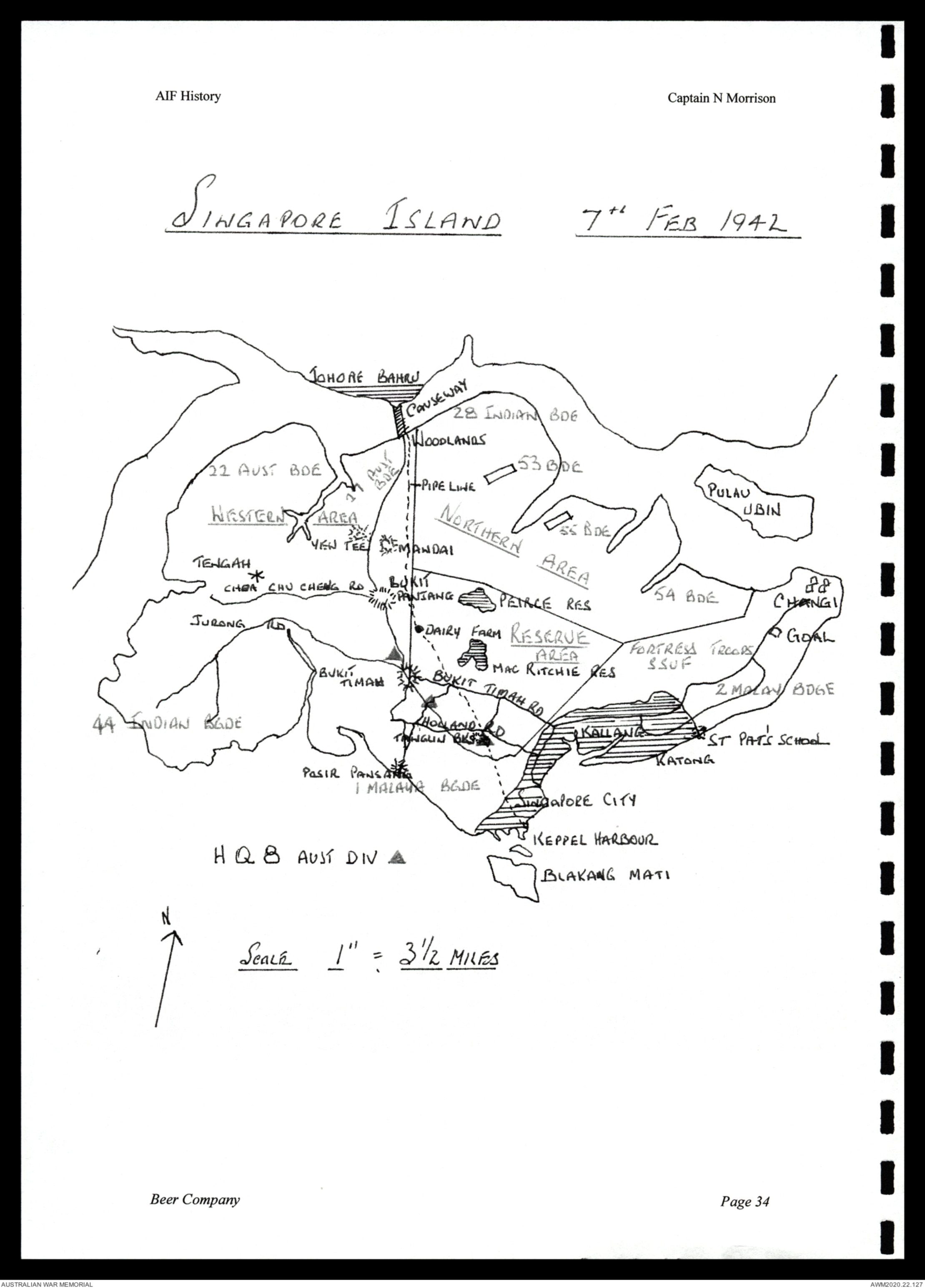
SINGAPORE ISLAND 7th FEB 1942
Hand drawn image of map - see original document
Beer Company
Page 34
AIF History
Captain N Morrison
It was just after dawn on 11 January, that the Company left Kluang for the last time.
They headed west to Ayer Hitam and then turned north up the main road through
Labis and Segamat to Buloh Kasap, a small village near the border of Johore and
Negri Sembilan.
They headed west to Ayer Hitam and then turned north up the main road through
Labis and Segamat to Buloh Kasap, a small village near the border of Johore and
Negri Sembilan.
The Battalion was held as a reserve to 2/26 and 2/30 which were in position a few
miles further north near Gemas. “Beer Company” took up position with 12 Platoon
guarding the main road and the bridge across the Muar River. 11 Platoon commanded
a bend of the river about half a mile to the right of the main road and 10 Platoon was
in reserve at the rear of Company Headquarters.
miles further north near Gemas. “Beer Company” took up position with 12 Platoon
guarding the main road and the bridge across the Muar River. 11 Platoon commanded
a bend of the river about half a mile to the right of the main road and 10 Platoon was
in reserve at the rear of Company Headquarters.
On Wednesday, 14 January, 2/30 fought its first engagement with the enemy. The AIF
were in action and the Company was keyed up to the realisation that they may soon be
in action.
were in action and the Company was keyed up to the realisation that they may soon be
in action.
On several occasions during the next few days the officers visited the forward areas
with the view to relieving them on 17 January. During this period the Unit was
subjected to bombing and machine gunning attacks by enemy aircraft but, no
casualties were sustained.
with the view to relieving them on 17 January. During this period the Unit was
subjected to bombing and machine gunning attacks by enemy aircraft but, no
casualties were sustained.
On 15 January, 12 Platoon was relieved by a company of Indian troops and withdrew
to a new position in preparation for the move. The following day 11 Platoon was
relieved by a company of Malay volunteers. A delivery of mail and parcels was made
that day. This showed the efficiency of the Postal Unit which maintained regular
delivery and despatch of mail.
to a new position in preparation for the move. The following day 11 Platoon was
relieved by a company of Malay volunteers. A delivery of mail and parcels was made
that day. This showed the efficiency of the Postal Unit which maintained regular
delivery and despatch of mail.
At 0500 hours on 17 January, Company Commanders were called to a conference at
Battalion Headquarters. The previous plan was cancelled and the Battalion was to
proceed to Muar on the west coast of Johore to counter an enemy infiltration. At 0715
Company Commanders were to proceed to a conference with GOC, AIF, Major
General H Gordon Bennett, Privates Bredin and Pullen, with many thrilling tales of
their escapades for eager ears, returned to the Company from “Rose Force”.
Battalion Headquarters. The previous plan was cancelled and the Battalion was to
proceed to Muar on the west coast of Johore to counter an enemy infiltration. At 0715
Company Commanders were to proceed to a conference with GOC, AIF, Major
General H Gordon Bennett, Privates Bredin and Pullen, with many thrilling tales of
their escapades for eager ears, returned to the Company from “Rose Force”.
Beer Company
Page 35
AIF History
Captain N Morrison
Lieutenant Hosford reported to the Company with several of the boys who had been
temporarily absent with various sicknesses; he was posted as Commander 10 Platoon.
temporarily absent with various sicknesses; he was posted as Commander 10 Platoon.
The Company was to embus at 0745 hours, but, the movement was delayed for more
than two hours as Segamat was bombed. The convoy was under way by 1030 hours
and on arrival at Labis was rejoined by the OC. Everyone had a hasty lunch before
moving off again.
than two hours as Segamat was bombed. The convoy was under way by 1030 hours
and on arrival at Labis was rejoined by the OC. Everyone had a hasty lunch before
moving off again.
At Yong Peng, the convoy turned off the main road towards Muar. One minor mishap
occurred when Corporal Aldridge and Private Condon fell from their vehicle which
struck a very large rut and caused the tailboard to collapse. Both were tossed into the
road but suffered only mild abrasions.
occurred when Corporal Aldridge and Private Condon fell from their vehicle which
struck a very large rut and caused the tailboard to collapse. Both were tossed into the
road but suffered only mild abrasions.
In the late afternoon the convoy had reached a position two miles east of Bakri and
approximately twelve from Muar. The CO with his Company Commanders then went
forward to reconnoitre positions for the night. The transport moved up and the
companies were immediately placed in position forming a Battalion perimeter. “Beer
Company” was forward on the right of the road, C forward on the left, A right behind
B with Headquarters Company left rear behind C and D Company had remained in
the Segamat area attached to Headquarters 8th division on patrol duties. Battalion
Headquarters was within the perimeter. This formation resulted in a rough square
bisected by the road.
approximately twelve from Muar. The CO with his Company Commanders then went
forward to reconnoitre positions for the night. The transport moved up and the
companies were immediately placed in position forming a Battalion perimeter. “Beer
Company” was forward on the right of the road, C forward on the left, A right behind
B with Headquarters Company left rear behind C and D Company had remained in
the Segamat area attached to Headquarters 8th division on patrol duties. Battalion
Headquarters was within the perimeter. This formation resulted in a rough square
bisected by the road.
Near midnight “A” Company were withdrawn to the Bakri Cross Road to cover 69
Battery of 2/15 field regiment. The artillery had moved into this position from Muar
where they had given valiant support to the Indian troops defending the areas. They
returned to their former position the following afternoon.
Battery of 2/15 field regiment. The artillery had moved into this position from Muar
where they had given valiant support to the Indian troops defending the areas. They
returned to their former position the following afternoon.
Anti tank protection was provided by two guns, one on the left of the road between
“B” and “C” forward troops and the other on the right between “A” and “HQ”
Companies, covering the rear. A small detachment of madras sappers and miners had
been occupying a defensive position in the “B” Company area and these were
withdrawn across the road to the “C” Company perimeter.
“B” and “C” forward troops and the other on the right between “A” and “HQ”
Companies, covering the rear. A small detachment of madras sappers and miners had
been occupying a defensive position in the “B” Company area and these were
withdrawn across the road to the “C” Company perimeter.
Beer Company
Page 36
AIF History
Captain N Morrison
“B” Company were deployed with 11 Platoon forward on the right, 12 forward to the
road on the left, 10 Platoon right with company headquarters within the perimeter.
This situation was in a rubber estate with the heavy foliage of the trees giving ample
protection from aerial observation.
road on the left, 10 Platoon right with company headquarters within the perimeter.
This situation was in a rubber estate with the heavy foliage of the trees giving ample
protection from aerial observation.
It was almost dark and the Company was just in position when a Japanese mortar
barrage accompanied by small arms fire landed on 12 Platoon. The tree trunks offered
little protection but, the only casualties suffered were three wounded. It was midnight
before the next action when CQMS Arthur, with the ration truck, was fired on by a
Nippon patrol while being directed into position by the second in command.
However, the remainder of the cold night passed quietly.
barrage accompanied by small arms fire landed on 12 Platoon. The tree trunks offered
little protection but, the only casualties suffered were three wounded. It was midnight
before the next action when CQMS Arthur, with the ration truck, was fired on by a
Nippon patrol while being directed into position by the second in command.
However, the remainder of the cold night passed quietly.
It was just after dawn on 18 January, that a heavy rattle was heard coming from the
enemy’s lines and the first of five camouflaged tanks with guns ablaze came into
view. The forward anti tank gun, near “B” Company’s position, opened fire with
armour piercing shells. Although all tanks were hit they continued on their way.
enemy’s lines and the first of five camouflaged tanks with guns ablaze came into
view. The forward anti tank gun, near “B” Company’s position, opened fire with
armour piercing shells. Although all tanks were hit they continued on their way.
By this time, the No “1” of the rear gun had sighted the first tank. He opened up with
high explosive shells which put the first three tanks out of action.
high explosive shells which put the first three tanks out of action.
The forward gunner then swung his gun and destroyed the two remaining tanks which
were blocked by the crippled ones and trying to turn back. The high explosive shells
aided by Molotov cocktails fired the tanks; which blazed and crackled with exploding
ammunition. The gallant forward gunner was mortally wounded by small arms fire
from a tank while swinging his gun around to engage the two vehicles attempting to
escape. He continued at his post until the action was over. An hour later three more
tanks appeared but met with a similar fate to the others; being destroyed by the
forward gun. The credit for this excellent shooting goes to “13” Battery “4” anti tank
regiment who had done a glorious mornings work with a bag of eight tanks.
were blocked by the crippled ones and trying to turn back. The high explosive shells
aided by Molotov cocktails fired the tanks; which blazed and crackled with exploding
ammunition. The gallant forward gunner was mortally wounded by small arms fire
from a tank while swinging his gun around to engage the two vehicles attempting to
escape. He continued at his post until the action was over. An hour later three more
tanks appeared but met with a similar fate to the others; being destroyed by the
forward gun. The credit for this excellent shooting goes to “13” Battery “4” anti tank
regiment who had done a glorious mornings work with a bag of eight tanks.
Beer Company
Page 37
Last edited by:
 Sam scott
Last edited on:
This transcription item is now locked to you for editing. To release the lock either Save your changes or Cancel.
This lock will be automatically released after 60 minutes of inactivity.