
Diary of service - Donald Morrison, 1940 - 1945 - Part 4
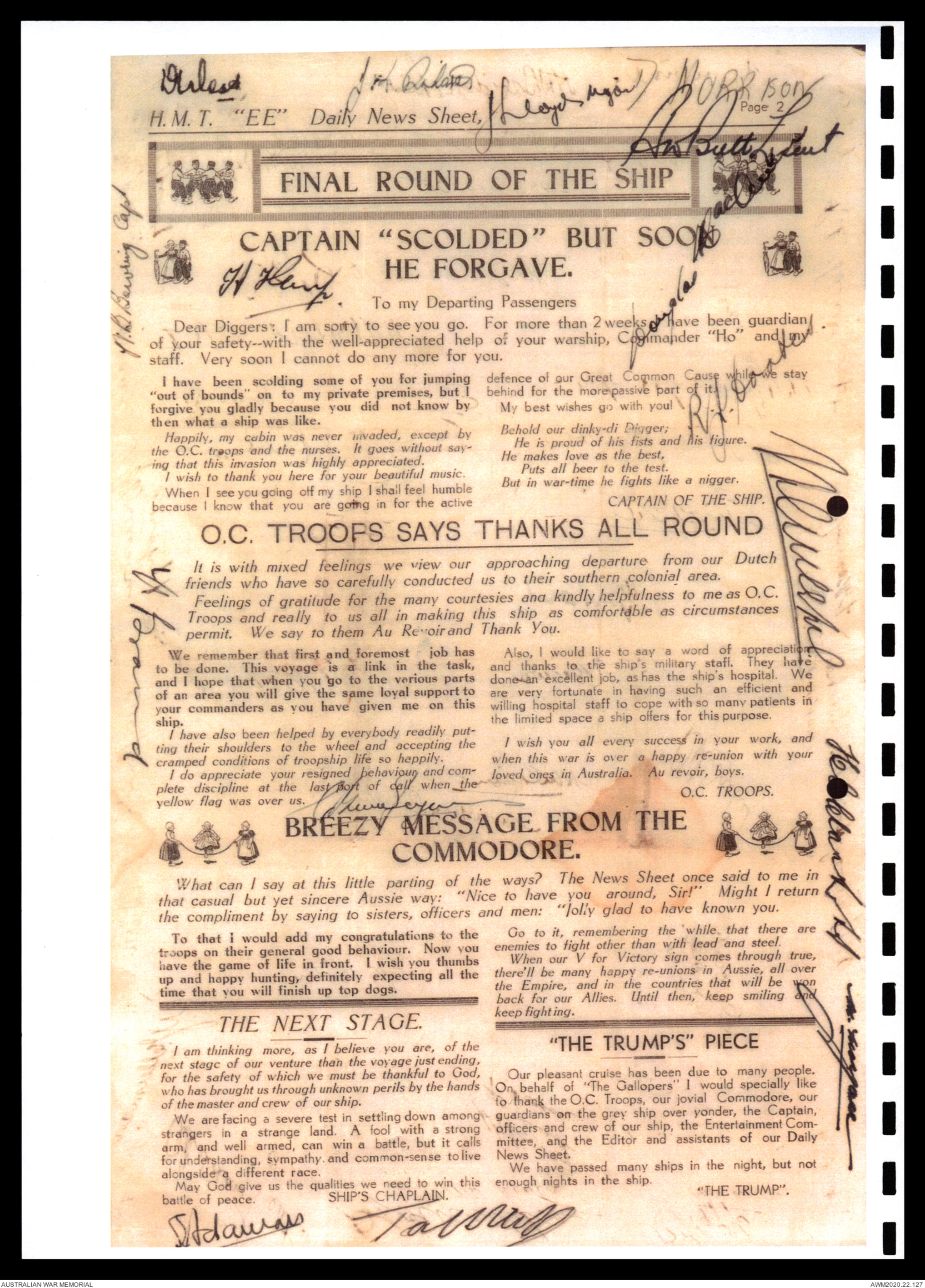
FINAL ROUND OR THE SHIP
News letter - see original document
AIF History
Captain N Morrison
who fell for the job at least got off the ship. The remainder were fortunate in having
the full benefit of the leave period.
Security regulations are a funny thing; 2/20 Battalion were in Perth enjoying their
leave, sending telegrams to relations in the eastern states and even ringing them up.
We were anchored in “The Roads”. Some of the lads wrote letters home and dropped
them into a lighter alongside, instead of having them censored in the official manner.
The culprits on the ship were heavily fined for breaches of the Security Regulations
but, no one was able to point out the difference between sending an uncensored letter
from the ship and an uncensored telegram from the shore. One letter dropped over the
side was obviously a bait, as it contained nothing but very caustic comments for
whoever should open it.
Early the next morning the “Mad Ship Marnix” left her berth in the Swan River and
proceeded with the rest of the convoy, to head into a choppy sea. Everybody lined the
rails to watch the Australian coastline fade into the distance; the last glimpse of home
for a long time to come.
After a couple of days of choppy sea the sun became much warmer and the sea more
placid; summer clothes were issued.
Only a few lucky ones managed to get a decent fit as the smaller sizes were in the
hold of the ship. At night, there was a wild scramble to secure a cool sleeping place on
the deck. A long queue frequented the canteen and a giant rush was made on
cigarettes and tobacco, which were duty free and very cheap.
Soon the islands of the East Indies appeared and we altered course to get as close
as possible to the famous island volcano of Krakatoa. Through the Sunda Straits the
coasts of Java and Sumatra were seen and on 15 August, the convoy steamed into
Keppel Harbour, Singapore, amidst what was soon no novelty, “A Downpour”.
Beer Company
Page 19
AIF History
Captain N Morrison
SINGAPORE
Transport conveyed the Company through the City to our billet. This was the
beautiful St Patrick’s School on the East Coast Road at Katong about six miles out of
the City. Here we were quartered on the third floor of the spacious building. Captain
Betteridge, 2/20 Battalion with the aid of men from two Loyals, had made the place
habitable for us and had prepared a good hot meal for the hungry men. Captain
Maher, who was suffering a mild blood disorder, was unable to leave the ship for a
few days. We also left on board an unloading party under Sergeant Irvine, these
rejoined in a couple of days. Captain Morrison, Acting CC, lectured the men on food
problems and the precautions that had to be observed in the tropics. There was
fortunately little sickness of a serious nature as Anti Malarial measures were enforced
from the start with mosquito nets tucked in around the beds before sundown and long
sleeves and long trousers worn after 1730 hours. Food problems presented a difficulty
at first owing to the lack of fresh meat and green vegetables to which the men had
been accustomed. This shortage was augmented by the ever unpopular tinned fish.
Later tinned vegetables and frozen meat largely replaced the monotonous fish diet. It
is said that in Malaya there are eight kinds of vegetables; four that you cannot buy and
four that you cannot eat.
Some of the dos and don'ts that were drilled into all ranks make funny reading in the
light of our later experiences and are worth recording:
DON'Ts
- Don't drink unchlorinated or unboiled water
- Don't bathe in the open sea without first making sure that the sea bed is free from man-of-war fish and such like
- Don't walk round in bare feet for fear of hookworm
- Don't consume food purchased from itinerant vendors
- Don't eat raw fruit without washing it thoroughly
- Don't drink native spirits or wine as they are sudden death
- Don't go out in the sun without a hat
- Don't dally with the fairer sex
Beer Company
Page 20
AIF History
Captain N Morrison
Dos
- Do sleep under a mosquito net
- Do inspect your net and underneath the bed for scorpions etc, before turning in
- Do wear long trousers and roll down your sleeves by 1730 hours
- Do scald all mess gear and serving utensils before using
- Do treat everything that is unfamiliar as something to keep away from including the fair sex.
Acclimatisation – that word made famous by white cargo – was the first necessity in
training. This consisted of short route marches through rubber plantations, market
gardens and patches of jungle in the district. After a few days of these company
exercises which took the full day in the field with lunch brought out in the utility.
After seven days quarantine, local leave was granted from 1800 to 2200 hours with
afternoon leave extra on Sunday. Our boundary was Katong Village which was a
popular rendezvous with the boys with the native children who cry “hello Joe” and
give the characteristic thumbs up. Many local people opened their homes to the
troops. On two occasions, a half days leave was granted into Singapore where the
famous and infamous sights of the City were visited.
Two places in Singapore that deserve special mention are the Anzac Club and the
Union Jack Club. The former, as its name implies, was reserved for the AIF, while the
latter was open to all. Each had the same facilities; reading and writing rooms,
refreshment bars, restaurant and showers. Both were manned by volunteers who did
an excellent job.
The cabarets, theatres and bazaars of the Chinese quarter were often visited, mainly in
rickshaws which were a great novelty. Unfortunately, an order was promulgated
forbidding the troops from pulling the rickshaw boys through the streets in their own
vehicles. This stopped a lot of fun. Transport was provided by the Battalion but the
period of leave was, unfortunately all too short to see the City properly. Numerous
Beer Company
Page 21
AIF History
Captain N Morrison
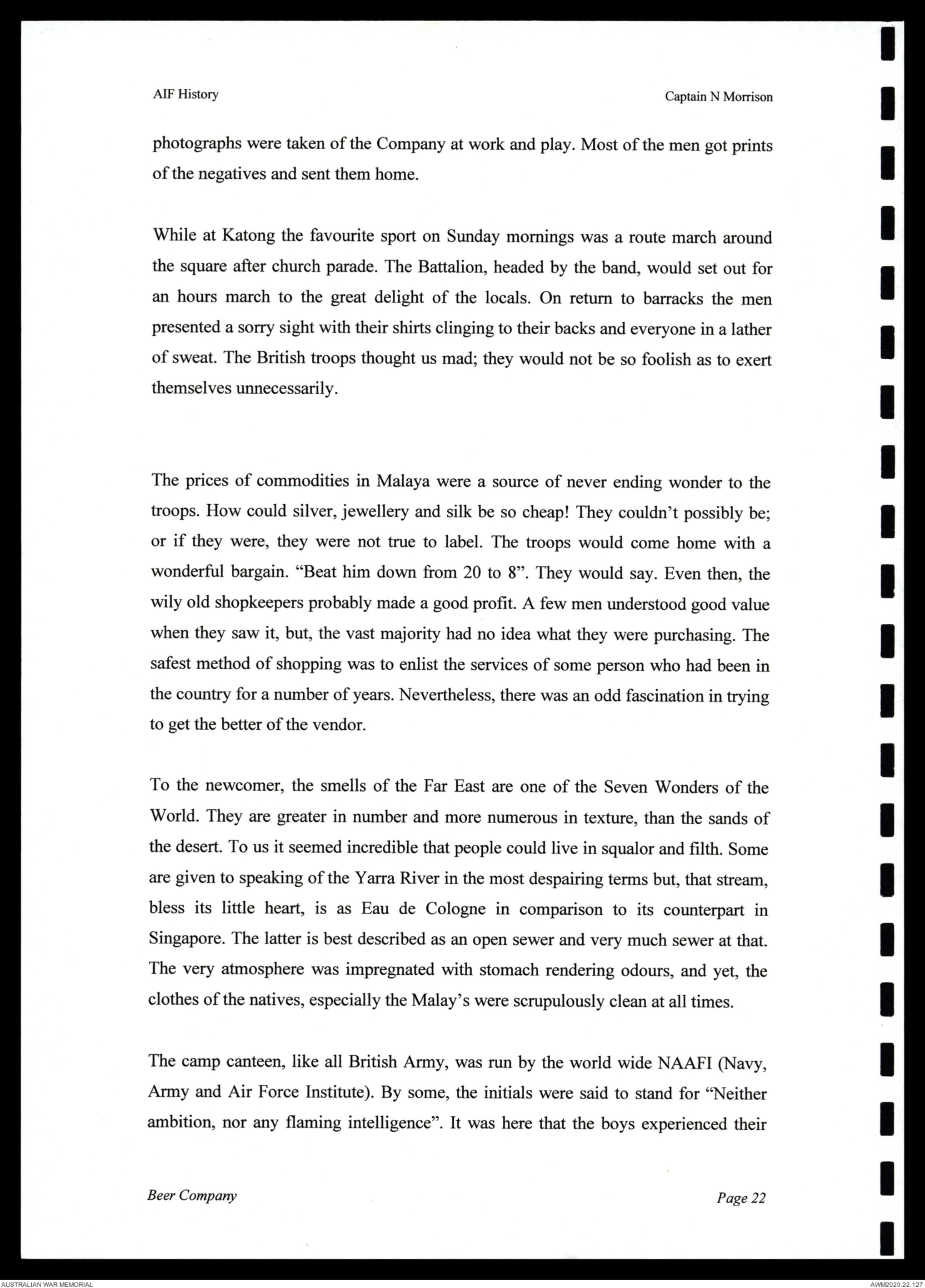
photographs were taken of the Company at work and play. Most of the men got prints
of the negatives and sent them home.
While at Katong the favourite sport on Sunday mornings was a route march around
the square after church parade. The Battalion, headed by the band, would set out for
an hours march to the great delight of the locals. On return to barracks the men
presented a sorry sight with their shirts clinging to their backs and everyone in a lather
of sweat. The British troops thought us mad; they would not be so foolish as to exert
themselves unnecessarily.
The prices of commodities in Malaya were a source of never ending wonder to the
troops. How could silver, jewellery and silk be so cheap! They couldn’t possibly be;
or if they were, they were not true to label. The troops would come home with a
wonderful bargain. “Beat him down from 20 to 8”. They would say. Even then, the
wily old shopkeepers probably made a good profit. A few men understood good value
when they saw it, but, the vast majority had no idea what they were purchasing. The
safest method of shopping was to enlist the services of some person who had been in
the country for a number of years. Nevertheless, there was an odd fascination in trying
to get the better of the vendor.
To the newcomer, the smells of the Far East are one of the Seven Wonders of the
World. They are greater in number and more numerous in texture, than the sands of
the desert. To us it seemed incredible that people could live in squalor and filth. Some
are given to speaking of the Yarra River in the most despairing terms but, that stream,
bless its little heart, is as Eau de Cologne in comparison to its counterpart in
Singapore. The latter is best described as an open sewer and very much sewer at that.
The very atmosphere was impregnated with stomach rendering odours, and yet, the
clothes of the natives, especially the Malay’s were scrupulously clean at all times.
The camp canteen, like all British Army, was run by the world wide NAAFI (Navy,
Army and Air Force Institute). By some, the initials were said to stand for “Neither
ambition, nor any flaming intelligence”. It was here that the boys experienced their
Beer Company
Page 22
AIF History
Captain N Morrison
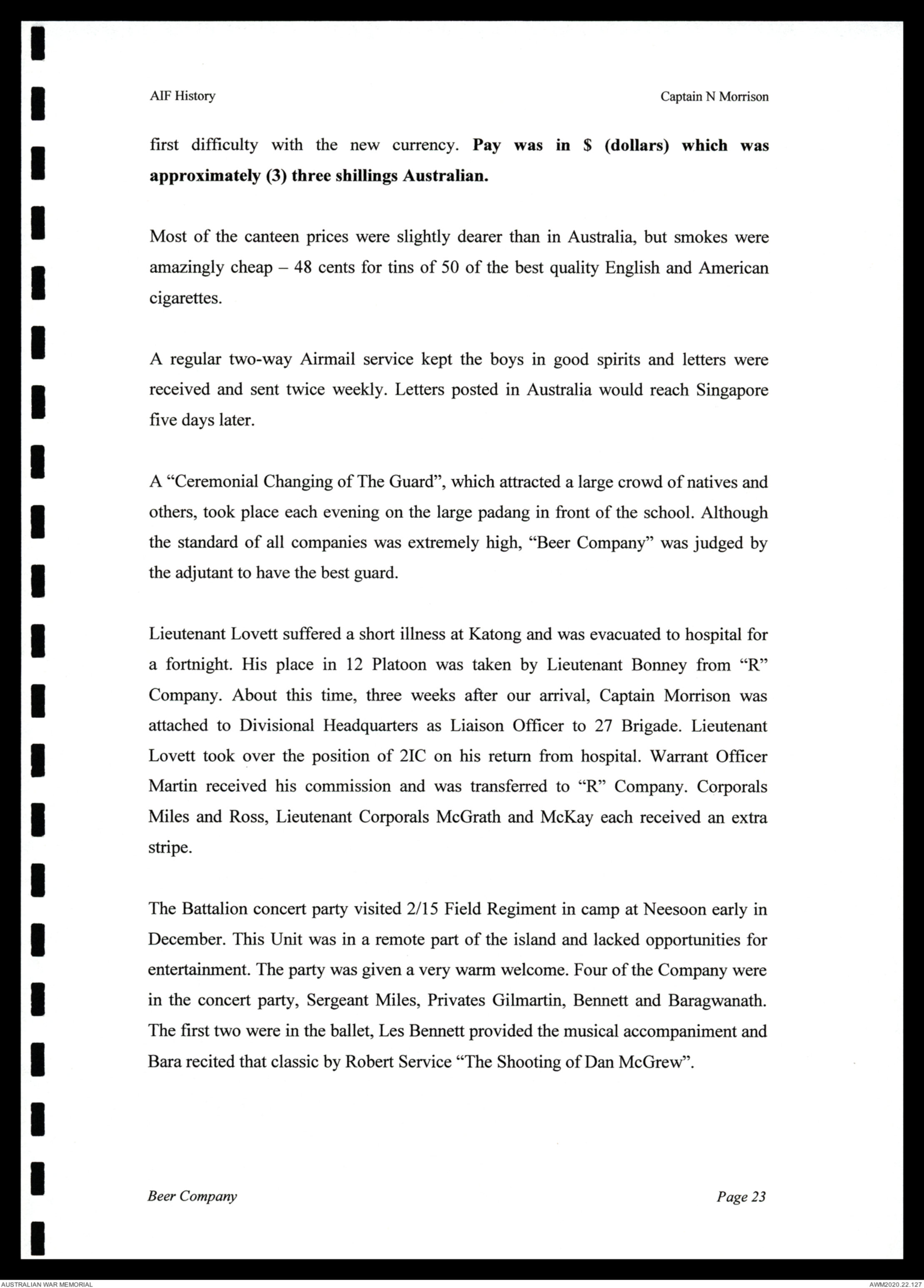
first difficulty with the new currency. Pay was in $ (dollars) which was
approximately (3) three shillings Australian.
approximately (3) three shillings Australian.
Most of the canteen prices were slightly dearer than in Australia, but smokes were
amazingly cheap – 48 cents for tins of 50 of the best quality English and American
cigarettes.
amazingly cheap – 48 cents for tins of 50 of the best quality English and American
cigarettes.
A regular two-way Airmail service kept the boys in good spirits and letters were
received and sent twice weekly. Letters posted in Australia would reach Singapore
five days later.
received and sent twice weekly. Letters posted in Australia would reach Singapore
five days later.
A “Ceremonial Changing of The Guard”, which attracted a large crowd of natives and
others, took place each evening on the large padang in front of the school. Although
the standard of all companies was extremely high, “Beer Company” was judged by
the adjutant to have the best guard.
others, took place each evening on the large padang in front of the school. Although
the standard of all companies was extremely high, “Beer Company” was judged by
the adjutant to have the best guard.
Lieutenant Lovett suffered a short illness at Katong and was evacuated to hospital for
a fortnight. His place in 12 Platoon was taken by Lieutenant Bonney from “R”
Company. About this time, three weeks after our arrival, Captain Morrison was
attached to Divisional Headquarters as Liaison Officer to 27 Brigade. Lieutenant
Lovett took over the position of 2IC on his return from hospital. Warrant Officer
Martin received his commission and was transferred to “R” Company. Corporals
Miles and Ross, Lieutenant Corporals McGrath and McKay each received an extra
stripe.
a fortnight. His place in 12 Platoon was taken by Lieutenant Bonney from “R”
Company. About this time, three weeks after our arrival, Captain Morrison was
attached to Divisional Headquarters as Liaison Officer to 27 Brigade. Lieutenant
Lovett took over the position of 2IC on his return from hospital. Warrant Officer
Martin received his commission and was transferred to “R” Company. Corporals
Miles and Ross, Lieutenant Corporals McGrath and McKay each received an extra
stripe.
The Battalion concert party visited 2/15 Field Regiment in camp at Neesoon early in
December. This Unit was in a remote part of the island and lacked opportunities for
entertainment. The party was given a very warm welcome. Four of the Company were
in the concert party, Sergeant Miles, Privates Gilmartin, Bennett and Baragwanath.
The first two were in the ballet, Les Bennett provided the musical accompaniment and
Bara recited that classic by Robert Service “The Shooting of Dan McGrew”.
December. This Unit was in a remote part of the island and lacked opportunities for
entertainment. The party was given a very warm welcome. Four of the Company were
in the concert party, Sergeant Miles, Privates Gilmartin, Bennett and Baragwanath.
The first two were in the ballet, Les Bennett provided the musical accompaniment and
Bara recited that classic by Robert Service “The Shooting of Dan McGrew”.
Beer Company
Page 23
AIF History
Captain N Morrison
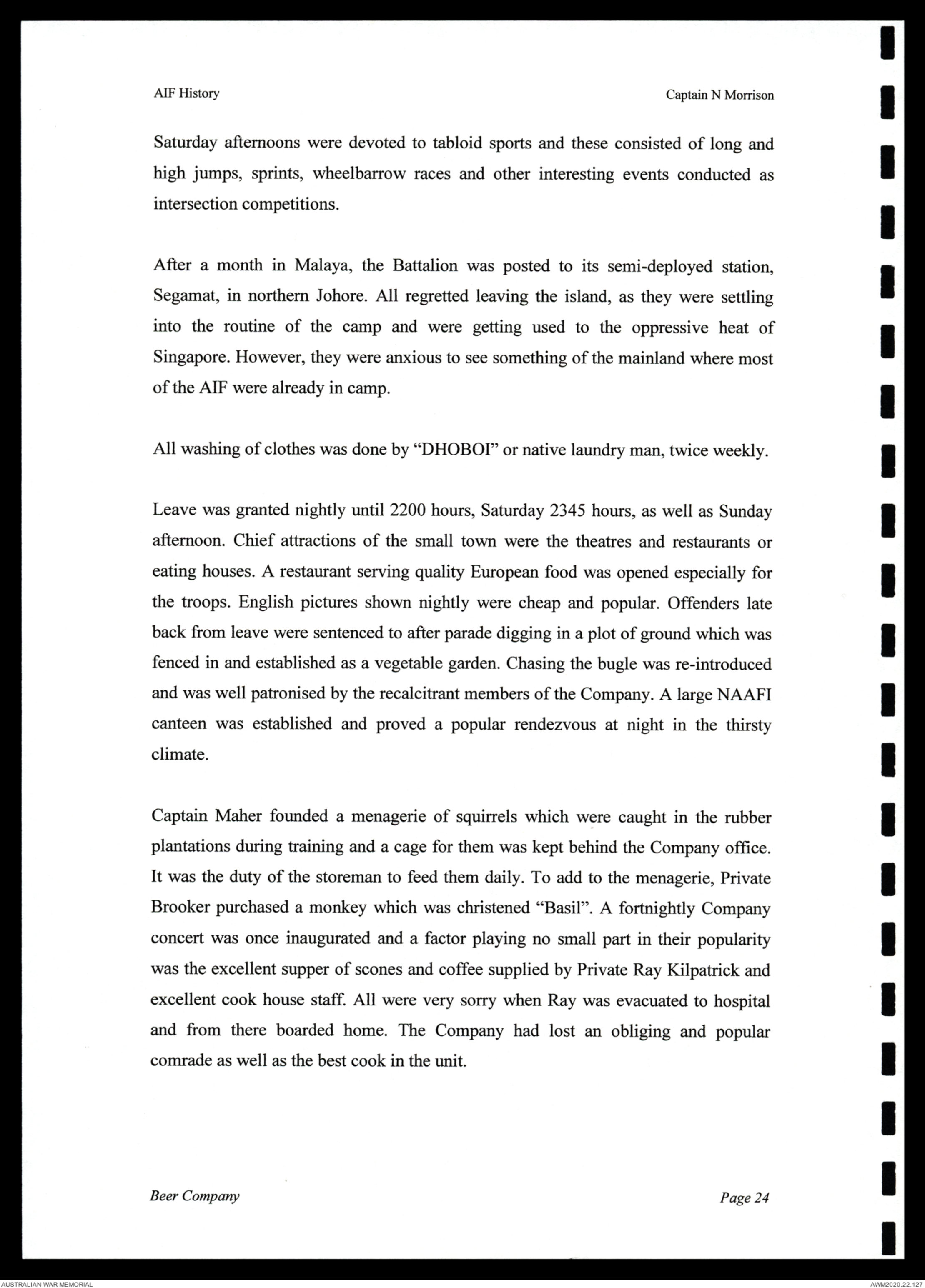
Saturday afternoons were devoted to tabloid sports and these consisted of long and
high jumps, sprints, wheelbarrow races and other interesting events conducted as
intersection competitions.
high jumps, sprints, wheelbarrow races and other interesting events conducted as
intersection competitions.
After a month in Malaya, the Battalion was posted to its semi-deployed station,
Segamat, in northern Johore. All regretted leaving the island, as they were settling
into the routine of the camp and were getting used to the oppressive heat of
Singapore. However, they were anxious to see something of the mainland where most
of the AIF were already in camp.
Segamat, in northern Johore. All regretted leaving the island, as they were settling
into the routine of the camp and were getting used to the oppressive heat of
Singapore. However, they were anxious to see something of the mainland where most
of the AIF were already in camp.
All washing of clothes was done by “DHOBOI” or native laundry man, twice weekly.
Leave was granted nightly until 2200 hours, Saturday 2345 hours, as well as Sunday
afternoon. Chief attractions of the small town were the theatres and restaurants or
eating houses. A restaurant serving quality European food was opened especially for
the troops. English pictures shown nightly were cheap and popular. Offenders late
back from leave were sentenced to after parade digging in a plot of ground which was
fenced in and established as a vegetable garden. Chasing the bugle was re-introduced
and was well patronised by the recalcitrant members of the Company. A large NAAFI
canteen was established and proved a popular rendezvous at night in the thirsty
climate.
afternoon. Chief attractions of the small town were the theatres and restaurants or
eating houses. A restaurant serving quality European food was opened especially for
the troops. English pictures shown nightly were cheap and popular. Offenders late
back from leave were sentenced to after parade digging in a plot of ground which was
fenced in and established as a vegetable garden. Chasing the bugle was re-introduced
and was well patronised by the recalcitrant members of the Company. A large NAAFI
canteen was established and proved a popular rendezvous at night in the thirsty
climate.
Captain Maher founded a menagerie of squirrels which were caught in the rubber
plantations during training and a cage for them was kept behind the Company office.
It was the duty of the storeman to feed them daily. To add to the menagerie, Private
Brooker purchased a monkey which was christened “Basil”. A fortnightly Company
concert was once inaugurated and a factor playing no small part in their popularity
was the excellent supper of scones and coffee supplied by Private Ray Kilpatrick and
excellent cook house staff. All were very sorry when Ray was evacuated to hospital
and from there boarded home. The Company had lost an obliging and popular
comrade as well as the best cook in the unit.
plantations during training and a cage for them was kept behind the Company office.
It was the duty of the storeman to feed them daily. To add to the menagerie, Private
Brooker purchased a monkey which was christened “Basil”. A fortnightly Company
concert was once inaugurated and a factor playing no small part in their popularity
was the excellent supper of scones and coffee supplied by Private Ray Kilpatrick and
excellent cook house staff. All were very sorry when Ray was evacuated to hospital
and from there boarded home. The Company had lost an obliging and popular
comrade as well as the best cook in the unit.
Beer Company
Page 24
AIF History
Captain N Morrison
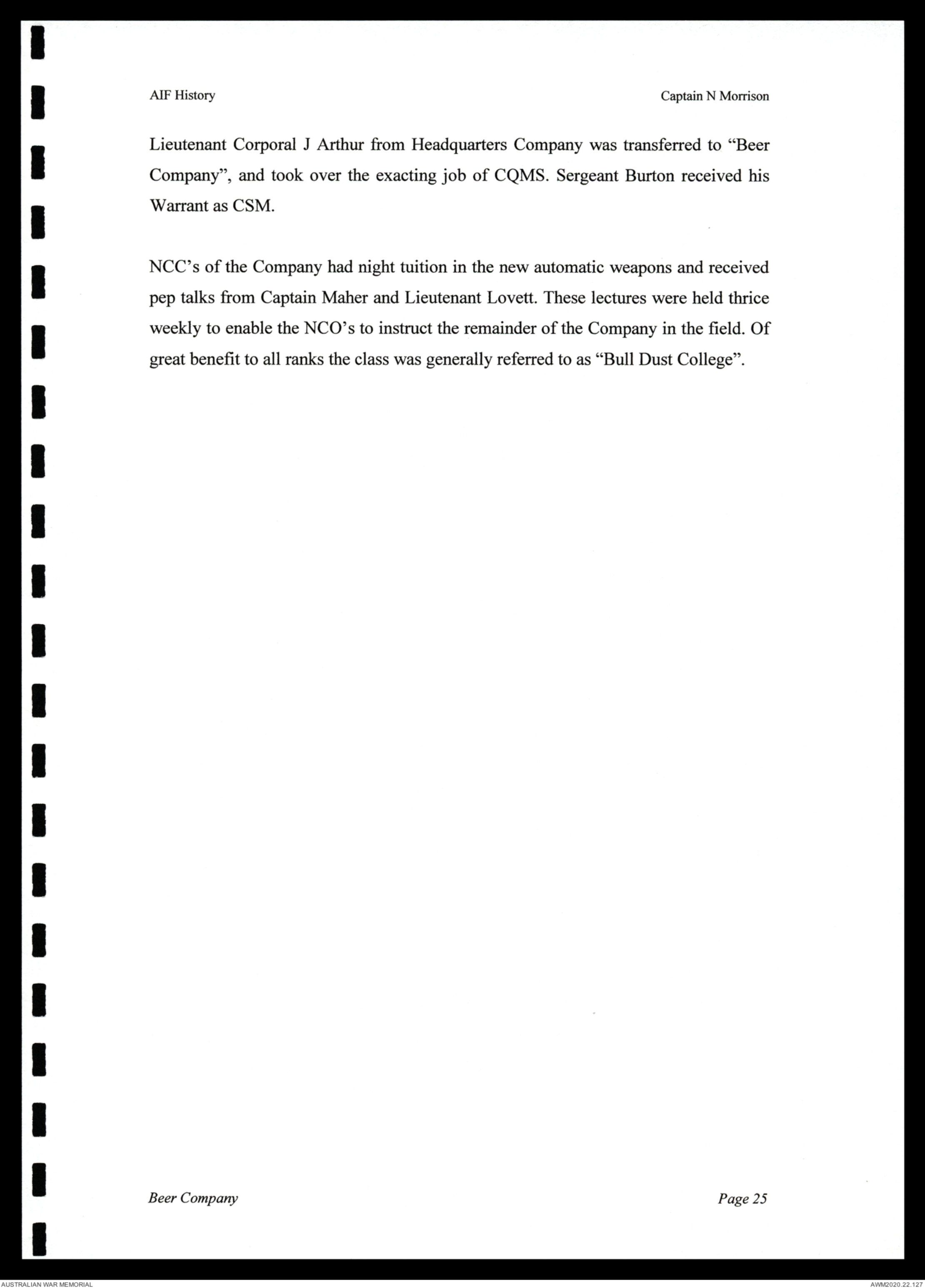
Lieutenant Corporal J Arthur from Headquarters Company was transferred to “Beer
Company”, and took over the exacting job of CQMS. Sergeant Burton received his
Warrant as CSM.
Company”, and took over the exacting job of CQMS. Sergeant Burton received his
Warrant as CSM.
NCC’s of the Company had night tuition in the new automatic weapons and received
pep talks from Captain Maher and Lieutenant Lovett. These lectures were held thrice
weekly to enable the NCO’s to instruct the remainder of the Company in the field. Of
great benefit to all ranks the class was generally referred to as “Bull Dust College”.
pep talks from Captain Maher and Lieutenant Lovett. These lectures were held thrice
weekly to enable the NCO’s to instruct the remainder of the Company in the field. Of
great benefit to all ranks the class was generally referred to as “Bull Dust College”.
Beer Company
Page 25
AIF History
Captain N Morrison
SEGAMAT AND KLUANG
The movement of the Battalion on 15 September was by train but, the stores were
taken by road. After being used to the comfortable trains in Australia, the second and
third class carriages of the FMS Railways were a great contrast. Seats were unpadded
and soot covered the interior of the compartments, which made travelling in the heat
and in such crowded conditions extremely irksome.
taken by road. After being used to the comfortable trains in Australia, the second and
third class carriages of the FMS Railways were a great contrast. Seats were unpadded
and soot covered the interior of the compartments, which made travelling in the heat
and in such crowded conditions extremely irksome.
After about four hours travelling the Company detrained at Segamat and marched
through the streets to the camp at the outskirts of town. The appearance of the town
was neat and clean with well cared for lawns, shrubs and padangs.
through the streets to the camp at the outskirts of town. The appearance of the town
was neat and clean with well cared for lawns, shrubs and padangs.
The camp was of thatched huts built on the slopes of the hill. The area had recently
been cleared from the jungle and strewn with brush, boulders and timber. This meant
that more clearing and cleaning would be necessary to make the camp clean and tidy.
Nights were much cooler than on the island but, mosquitoes were more prevalent
owing to the proximity of the paddy fields, so the anti-malarial precautions were again
rigidly enforced. Charpoys and mosquito nets were soon rigged in the new quarters,
sheets and pillows provided and the Company quickly settled down in the new
surroundings. For the first few days, the Company were engaged in clearing the area,
constructing paths and building a parade ground. Scorpions, centipedes and snakes of
various kinds were unearthed, and, after being suitably dealt with, were handed over
to the RAP and preserved in spirits. The Company then began training, leaving behind
each day a strong work party to continue the levelling and drainage.
been cleared from the jungle and strewn with brush, boulders and timber. This meant
that more clearing and cleaning would be necessary to make the camp clean and tidy.
Nights were much cooler than on the island but, mosquitoes were more prevalent
owing to the proximity of the paddy fields, so the anti-malarial precautions were again
rigidly enforced. Charpoys and mosquito nets were soon rigged in the new quarters,
sheets and pillows provided and the Company quickly settled down in the new
surroundings. For the first few days, the Company were engaged in clearing the area,
constructing paths and building a parade ground. Scorpions, centipedes and snakes of
various kinds were unearthed, and, after being suitably dealt with, were handed over
to the RAP and preserved in spirits. The Company then began training, leaving behind
each day a strong work party to continue the levelling and drainage.
Most training was carried out on one or other of the large rubber estates in the district.
The areas were reached either by march route or transport. In the latter case,
embussing and debussing by platoons was practiced. Lunch was brought to the area
by truck. Exercises were confined to the platoon in attack and defence and compass
marches through the swamps and jungle. Physical exertion in this climate soon
drenched the clothes with perspiration and they needed constant changing.
The areas were reached either by march route or transport. In the latter case,
embussing and debussing by platoons was practiced. Lunch was brought to the area
by truck. Exercises were confined to the platoon in attack and defence and compass
marches through the swamps and jungle. Physical exertion in this climate soon
drenched the clothes with perspiration and they needed constant changing.
Beer Company
Page 26
AIF History
Captain N Morrison
Sporting activities at Segamat received great impetus by reason of the number of
playing fields at the disposal of the unit. Whilst playing soccer (his national game),
Lieutenant Jock Richards broke his wrist and was evacuated to 10 AGH Malacca. His
place was taken by Lieutenant Ron Cootes of “R” Company. One half day during the
week was devoted to cricket, badminton, tennis or soccer.
playing fields at the disposal of the unit. Whilst playing soccer (his national game),
Lieutenant Jock Richards broke his wrist and was evacuated to 10 AGH Malacca. His
place was taken by Lieutenant Ron Cootes of “R” Company. One half day during the
week was devoted to cricket, badminton, tennis or soccer.
Several members of the Company were very fortunate to receive invitations to play
tennis at the home of the European population. This hospitality was very much
appreciated by all those who took part. Battalion teams were selected in the various
sports to compete against units in other parts of Johore.
tennis at the home of the European population. This hospitality was very much
appreciated by all those who took part. Battalion teams were selected in the various
sports to compete against units in other parts of Johore.
The first extensive exercise, in which the Company took part, was the defence of
Kluang Drome against paratroops. With only a couple of hours sleep after arrival at
Kluang, the Company moved during darkness, to the area from which they were to
attack the Drome. At a given time the Company moved across country to their
objective and were heavily engaged by machine gun fire but succeeded in gaining
their objective. The Umpires, however, ruled that as a unit the Battalion had been
defeated.
Kluang Drome against paratroops. With only a couple of hours sleep after arrival at
Kluang, the Company moved during darkness, to the area from which they were to
attack the Drome. At a given time the Company moved across country to their
objective and were heavily engaged by machine gun fire but succeeded in gaining
their objective. The Umpires, however, ruled that as a unit the Battalion had been
defeated.
On return to Segamat the Company began immediate preparation for their transfer to
Kluang as an independent Company. It was only five weeks since the arrival at
Segamat, but everyone was keen to explore some new ground. Motor transport took
the kits and equipment while the men moved by train. A tented camp was ready sited
at Kluang while permanent buildings were available for kitchens and stores. As the
Company was a small and compact body, it soon settled down in the new buildings.
The primary task was the defence of the Drome. In the event of attack it was the duty
of the Company to hold the enemy until such time as the remainder of the Battalion
could reinforce the defenders. The first job of everyone was to make themselves
familiar with the area and the first step in this direction was a tour of the drome
defences, which were manned by the Johore Military Forces. The second phase
consisted of detailed surveys of the district, noting tracks and bridle paths that could
be used by enemy forces approaching the Drome.
Kluang as an independent Company. It was only five weeks since the arrival at
Segamat, but everyone was keen to explore some new ground. Motor transport took
the kits and equipment while the men moved by train. A tented camp was ready sited
at Kluang while permanent buildings were available for kitchens and stores. As the
Company was a small and compact body, it soon settled down in the new buildings.
The primary task was the defence of the Drome. In the event of attack it was the duty
of the Company to hold the enemy until such time as the remainder of the Battalion
could reinforce the defenders. The first job of everyone was to make themselves
familiar with the area and the first step in this direction was a tour of the drome
defences, which were manned by the Johore Military Forces. The second phase
consisted of detailed surveys of the district, noting tracks and bridle paths that could
be used by enemy forces approaching the Drome.
Beer Company
Page 27
Last edited by:
 Beverley Pagano
Last edited on:
This transcription item is now locked to you for editing. To release the lock either Save your changes or Cancel.
This lock will be automatically released after 60 minutes of inactivity.