
Diary of service - Donald Morrison, 1940 - 1945 - Part 20
POW Life: 1942-1945
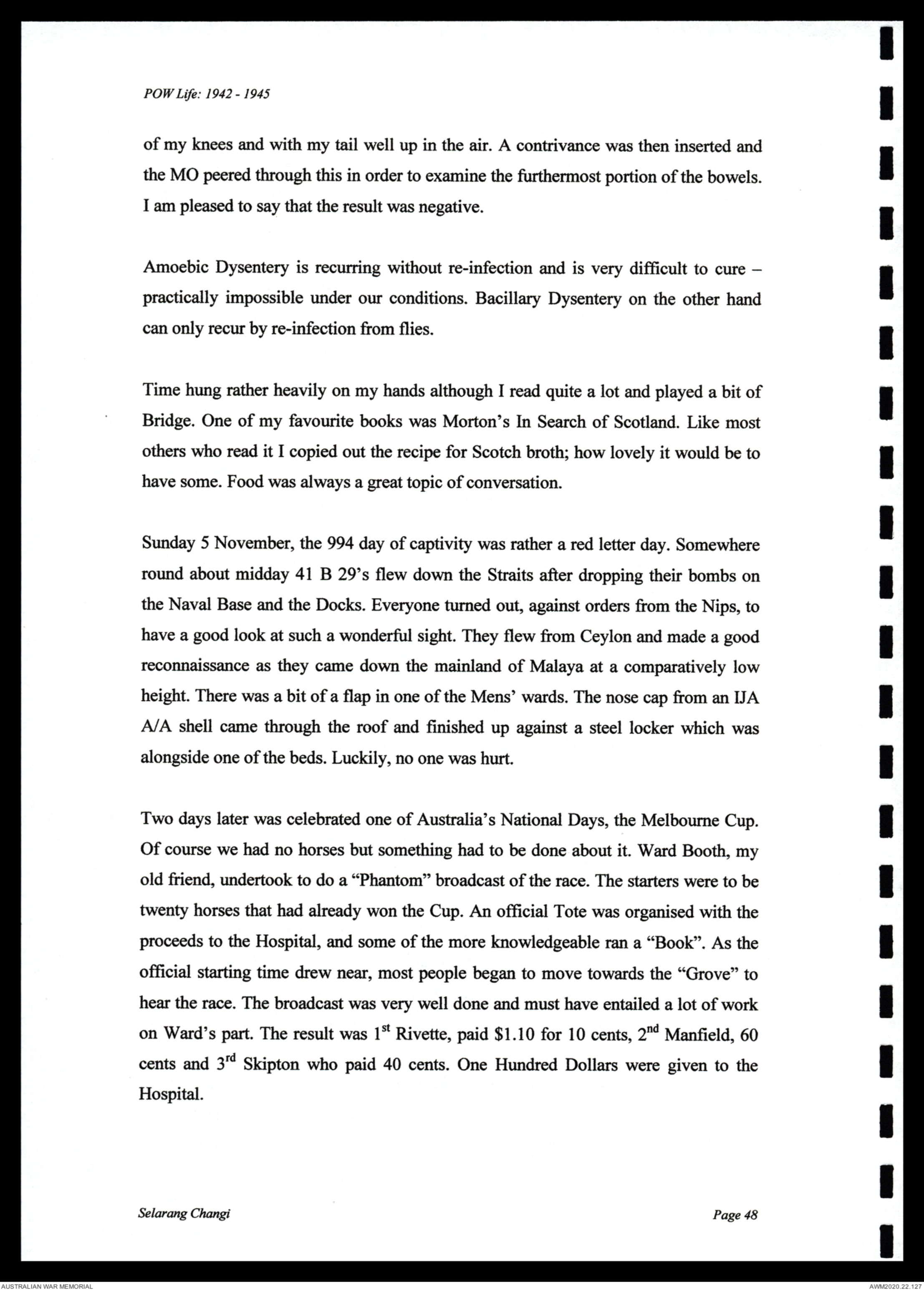
of my knees and with my tail up in the air. A contrivance was then inserted and
the MO peered through this in order to examine the furthermost portion of the bowels.
I am pleased to say that the result was negative.
Amoebic Dysentry is recurring without re-infection and is very difficult to cure –
practically impossible under our conditions. Bacillary Dysentry on the other hand
can only recur by re-infection from flies.
Time hung rather heavily on my hands although I read quite a lot and played a bit of
Bridge. One of my favourite books was Morton's In Search of Scotland. Like most
others who read it I copied out the recipe for Scotch broth; how lovely it would be to
have some. Food was always a great topic of conversation.
Sunday 5 November, the 994 day of captivity was rather a red letter day. Somewhere
round about midday 41 B 29's flew down the Straits after dropping their bombs on
the Naval Base and the Docks. Everyone turned out, against orders from the Nips, to
have a good look at such a wonderful sight. They flew from Ceylon and made a good
reconnaissance as they came down the mainland of Malaya at a comparatively low
height. There was a bit of a flap in one of the Mens' wards. The nose cap from an IJA
A/A shell came through the roof and finished up against a steel locker which was
alongside one of the beds. Luckily, no one was hurt.
Two days later was celebrated one of Australia's National Days, the Melbourne Cup.
Of course we had no horses but something had to be done about it. Ward Booth, my
old friend, undertook to do a "Phantom" broadcast of the race. The starters were to be
twenty horses that had already won the Cup. An official Tote was organised with the
proceeds to the Hospital, and some of the more knowledgeable ran a "Book". As the
official starting time drew near, most people began to move towards the "Grove" to
hear the race. The broadcast was very well done and must have entailed a lot of work
on Ward's part. The result was 1st Rivette, paid $1.10 for 10 cents, 2nd Manfield, 60
cents and 3rd Skipton who paid 40 cents. One Hundred Dollars were given to the
Hospital.
Selarang Changi
Page 48
POW Life: 1942-1945
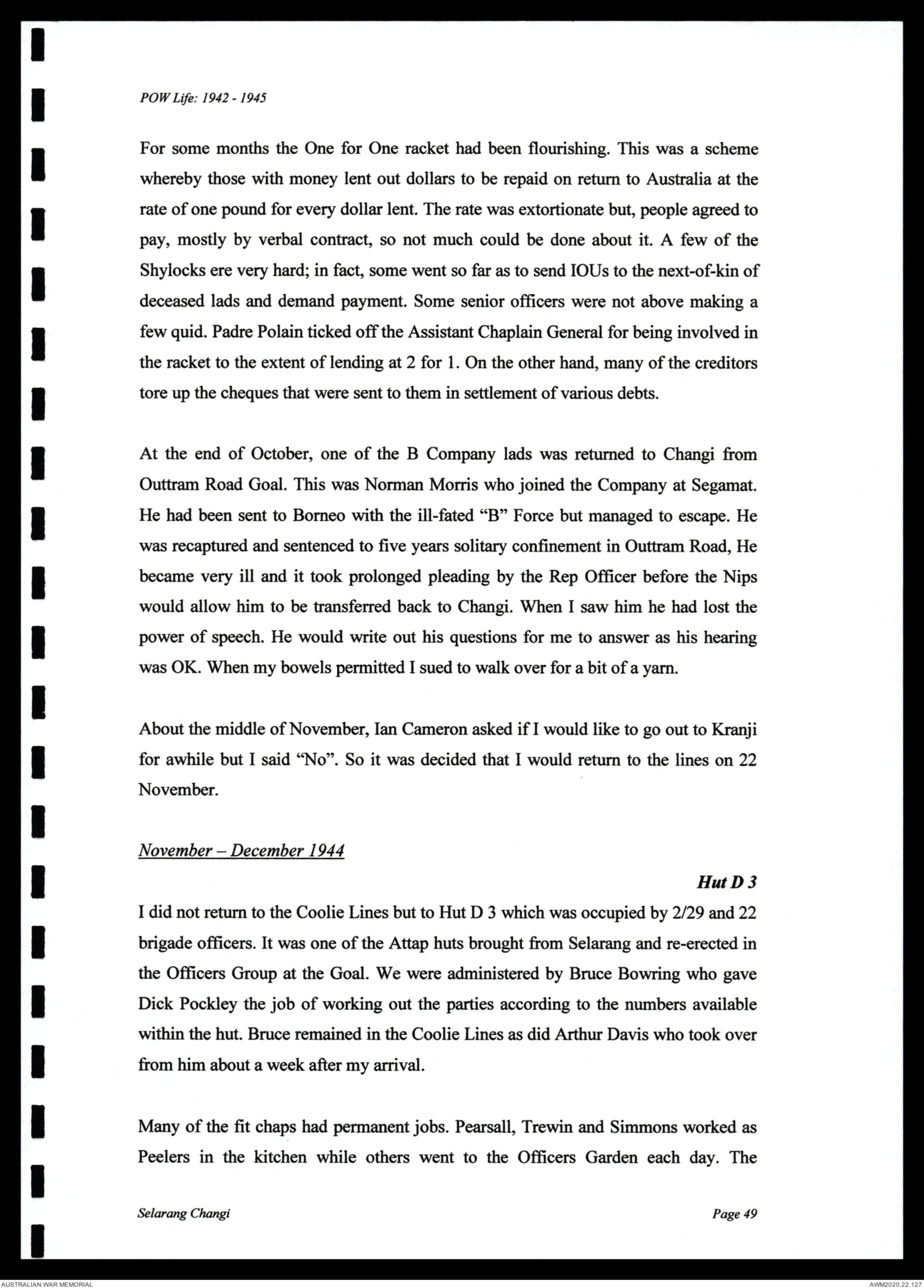
For some months the One for One racket had been flourishing. This was a scheme
whereby those with money lent out dollars to be repaid on return to Australia at the
rate of one pound for every dollar lent. The rate was extortionate but, people agreed to
pay, mostly by verbal contract, so not much could be done about it. A few of the
Shylocks ere very hard; in fact, some went so far as to send IOUs to the next-of-kin of
deceased lads and demand payment. Some senior officers were not above making a
few quid. Padre Polain ticked off the Assistant Chaplain General for being involved in
the racket to the extent of lending at 2 for 1. On the other hand, many of the creditors
tore up the cheques that were sent to them in settlement of various debts.
At the end of October, one of the B Company lads was returned to Changi from
Outtram Road Gaol. This was Norman Morris who joined the Company at Segamat.
He had been sent to Borneo with the ill-fated "B" Force but managed to escape. He
was recaptured and sentenced to five years solitary confinement in Outtram Road, He
became very ill and it took prolonged pleading by the Rep Officer before the Nips
would allow him to be transferred back to Changi. When I saw him he had lost the
power of speech. He would write out his questions for me to answer as his hearing
was OK. When my bowels permitted I sued to walk over for a bit of a yarn.
About the middle of November, Ian Cameron asked if I would like to go out to Kranji
for awhile but I said "No". So it was decided that I would return to the lines on 22
November.
November - December 1944
Hut D 3
I did not return to the Coolie Lines but to Hut D 3 which was occupied by 2/29 and 22
brigade officers. It was one of the Attap huts brought from Selarang and re-erected in
the Officers Group at the Goal. We were administered by Bruce Bowring who gave
Dick Pockley the job of working out the parties according to the numbers available
within the hut. Bruce remained in the Coolie Lines as did Arthur Davis who took over
from him about a week after my arrival.
Many of the fit chaps had permanent jobs. Pearsall, Trewin and Simmons worked as
Peelers in the kitchen while others went to the Officers Garden each day. The
Selarang Changi
Page 49
POW Life: 1942-1945
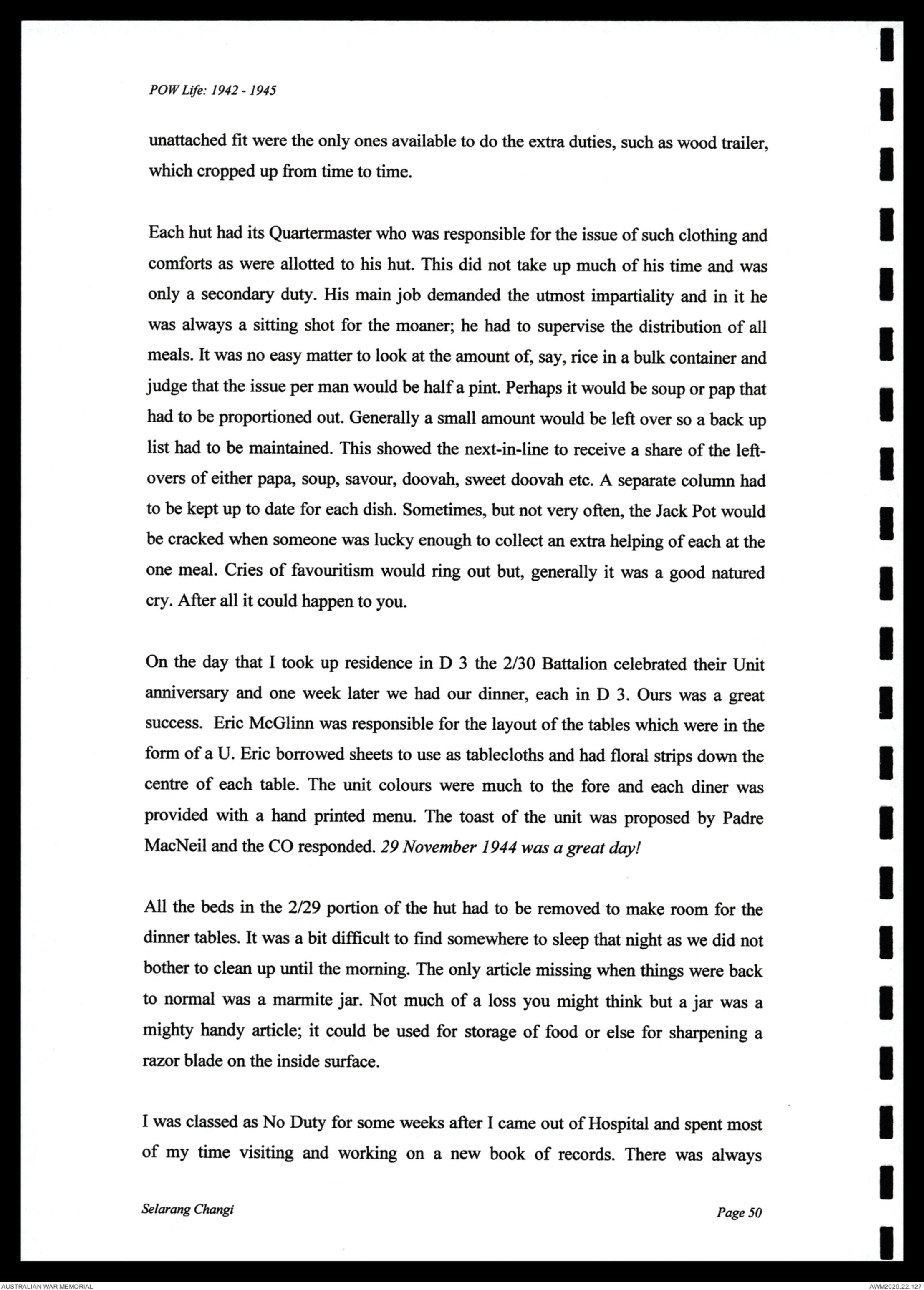
unattached fit were the only ones available to do the extra duties, such as wood trailer,
which cropped from time to time.
Each hut had its Quartermaster who was responsible for the issue of such clothing and
comforts as were allotted to his hut. This did not take up much of his time and was only a secondary duty. His main job demanded the utmost impartiality and in it he
was always a sitting shot for the moaner; he had to supervise the distribution of all
meals. It was no easy matter to look at the amount of, say, rice in a bulk container and
judge that the issue per man would be half a pint. Perhaps it would be soup or pap that
had to be proportioned out. Generally a small amount would be left over so a back up
list had to be maintained. This showed the next-in-line to receive a share of the left-
overs of either papa, soup, savour, doovah, sweet doovah etc. A separate column had
to be kept up to date for each dish. Sometimes, but not very often, the Jack Pot would
be cracked when someone was lucky enough to collect an extra helping of each at the
one meal. Cries of favouritism would ring out but, generally it was a good natured
cry. After all, it could happen to you.
On the day that I took up residence in D 3 the 2/30 Battalion celebrated their Unit
anniversary and one week later we had our dinner, each in D 3. Ours was a great
success. Eric McGlinn was responsible for the layout of the tables which were in the
form of a U. Eric borrowed sheets to use as tablecloths and had floral strips down the
centre of each table. The unit colours were much to the fore and each diner was
provided with a hand printed menu. The toast of the unit was proposed by Padre
MacNeil and the CO responded. 29 November 1944 was a great day!
All the beds in the 2/29 portion of the hut had to be removed to make room for the
dinner tables. It was a bit difficult to find somewhere to sleep that night as we dd not
bother to clean up until the morning. The only article missing when things were back
to normal was a marmite jar. Not much of a loss you might think but a jar was a
mighty handy article; it could be used for storage of food or else for sharpening a
razor blade on the inside surface.
I was classed as No Duty for some weeks after I came out of Hospital and spent most
of my time visiting and working on a new book of records. There was always
Selarang Changi
Page 50
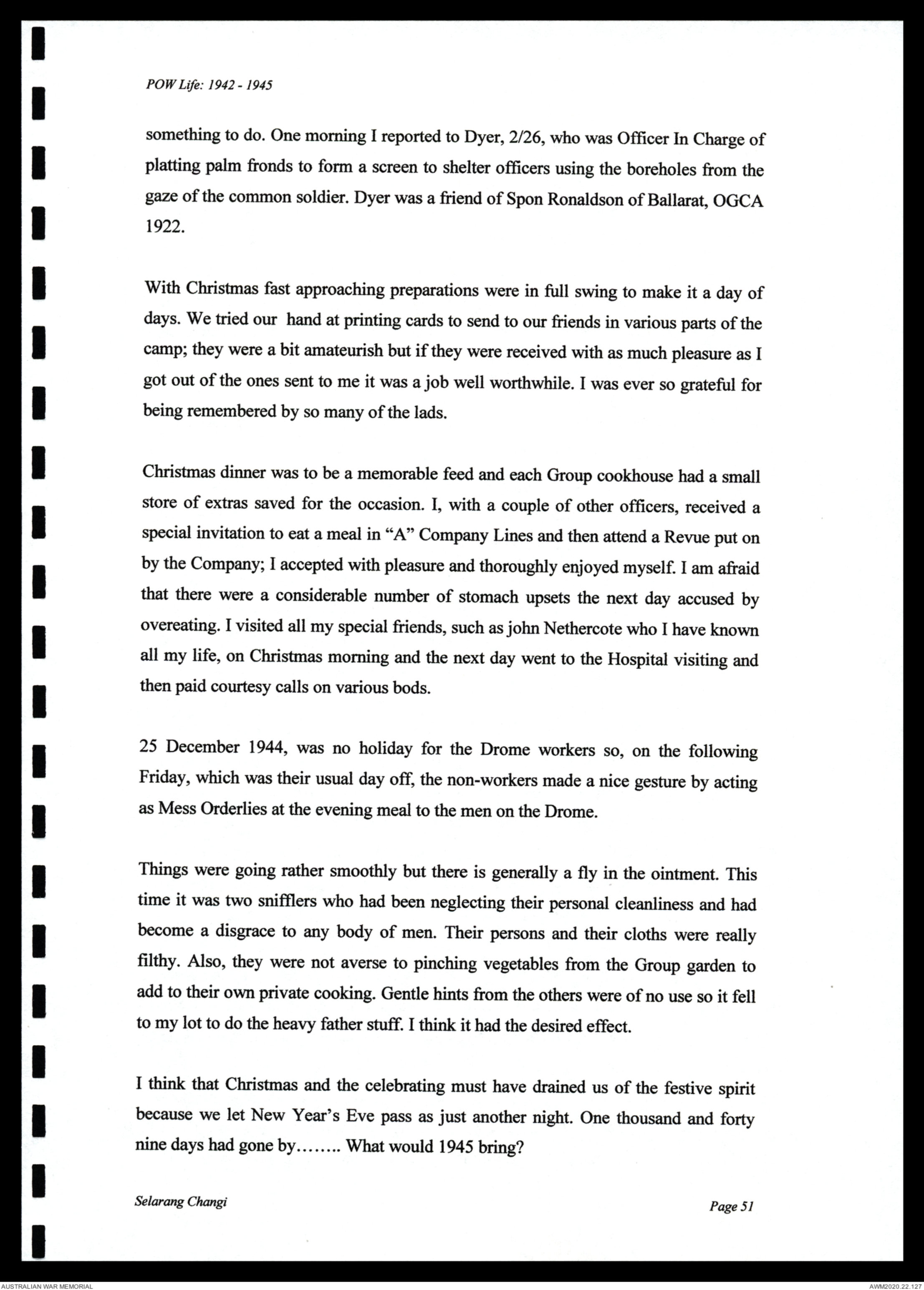
platting palm fronds to form a screen to shelter officers using the boreholes from the
gaze of the common soldier. Dyer was a friend of Spon Ronaldson of Ballarat, OGCA
1922.
days. We tried our hand at printing cards to send to our friends in various parts of the
camp; they were a bit amateurish but if they were received with as much pleasure as I
got out of the ones sent to me it was a job well worthwhile. I was ever so grateful for
being remembered by so many of the lads.
store of extras saved for the occasion. I, with a couple of other officers, received a
special invitation to eat a meal in “A” Company Lines and then attend a Revue put on
by the Company; I accepted with pleasure and thoroughly enjoyed myself. I am afraid
that there were a considerable number of stomach upsets the next day accused by
overeating. I visited all my special friends, such as john Nethercote who I have known
all my life, on Christmas morning and the next day went to the Hospital visiting and
then paid courtesy calls on various bods.
Friday, which was their usual day off, the non-workers made a nice gesture by acting
as Mess Orderlies at the evening meal to the men on the Drome.
time it was two snifflers who had been neglecting their personal cleanliness and had
become a disgrace to any body of men. Their persons and their cloths were really
filthy. Also, they were not averse to pinching vegetables from the Group garden to
add to their own private cooking. Gentle hints from the others were of no use so it fell
to my lot to do the heavy father stuff. I think it had the desired effect.
because we let New Year’s Eve pass as just another night. One thousand and forty
nine days had gone by…….. What would 1945 bring?
Page 51
Hut D 3
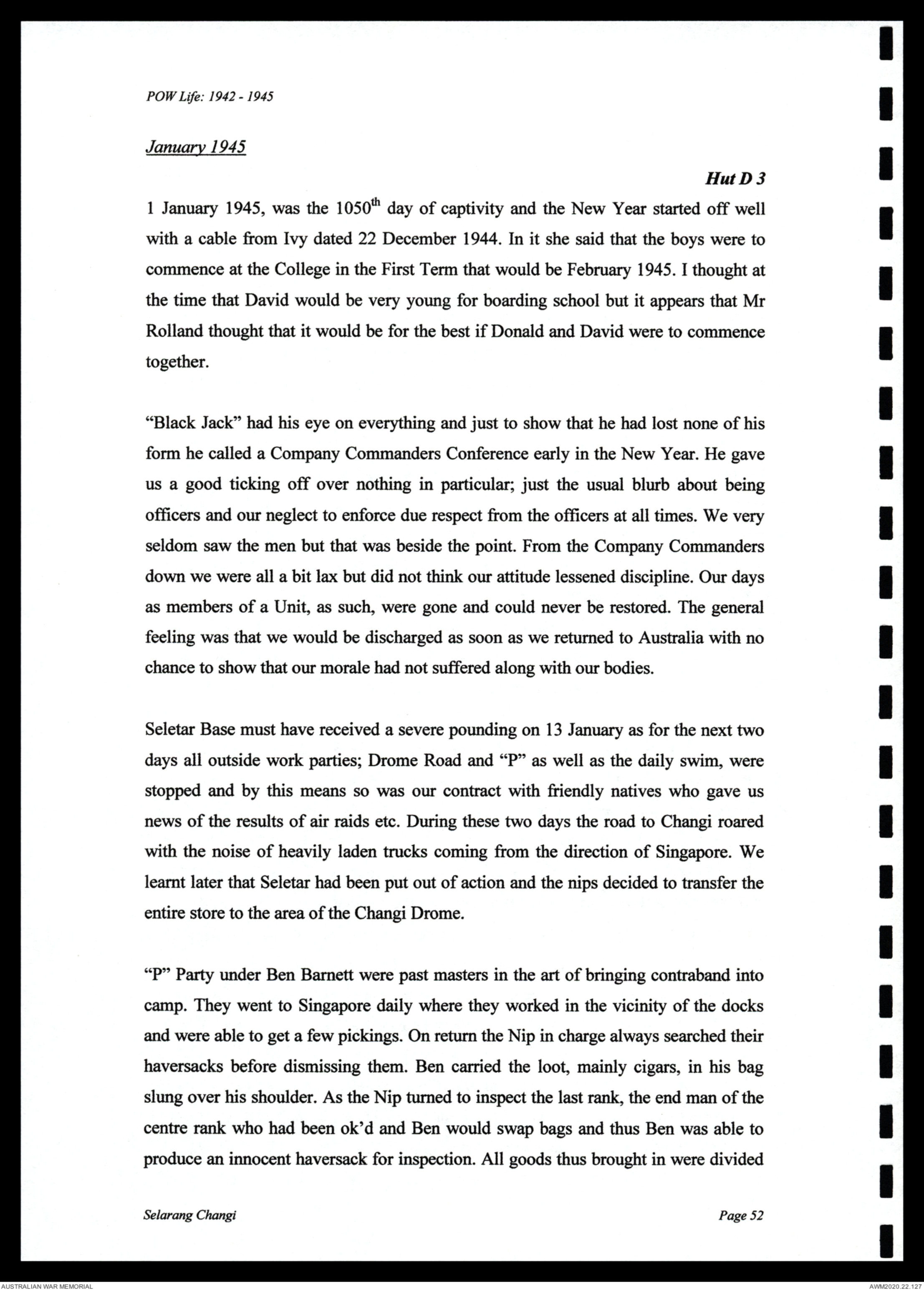
with a cable from Ivy dated 22 December 1944. In it she said that the boys were to
commence at the College in the First Term that would be February 1945. I thought at
the time that David would be very young for boarding school but it appears that Mr
Rolland thought that it would be for the best if Donald and David were to commence
together.
“Black Jack” had his eye on everything and just to show that he had lost none of his
form he called a Company Commanders Conference early in the New Year. He gave
us a good ticking off over nothing in particular; just the usual blurb about being
officers and our neglect to enforce due respect from the officers at all times. We very
seldom saw the men but that was beside the point. From the Company Commanders
down we were all a bit lax but did not think our attitude lessened discipline. Our days
as members of a Unit, as such, were gone and could never be restored. The general
feeling was that we would be discharged as soon as we returned to Australia with no
chance to show that our morale had not suffered along with our bodies.
days all outside work parties; Drome Road and “P” as well as the daily swim, were
stopped and by this means so was our contract with friendly natives who gave us
news of the results of air raids etc. During these two days the road to Changi roared
with the noise of heavily laden trucks coming from the direction of Singapore. We
learnt later that Seletar had been put out of action and the nips decided to transfer the
entire store to the area of the Changi Drome.
camp. They went to Singapore daily where they worked in the vicinity of the docks
and were able to get a few pickings. On return the Nip in charge always searched their
haversacks before dismissing them. Ben carried the loot, mainly cigars, in his bag
slung over his shoulder. As the Nip turned to inspect the last rank, the end man of the
centre rank who had been ok’d and Ben would swap bags and thus Ben was able to
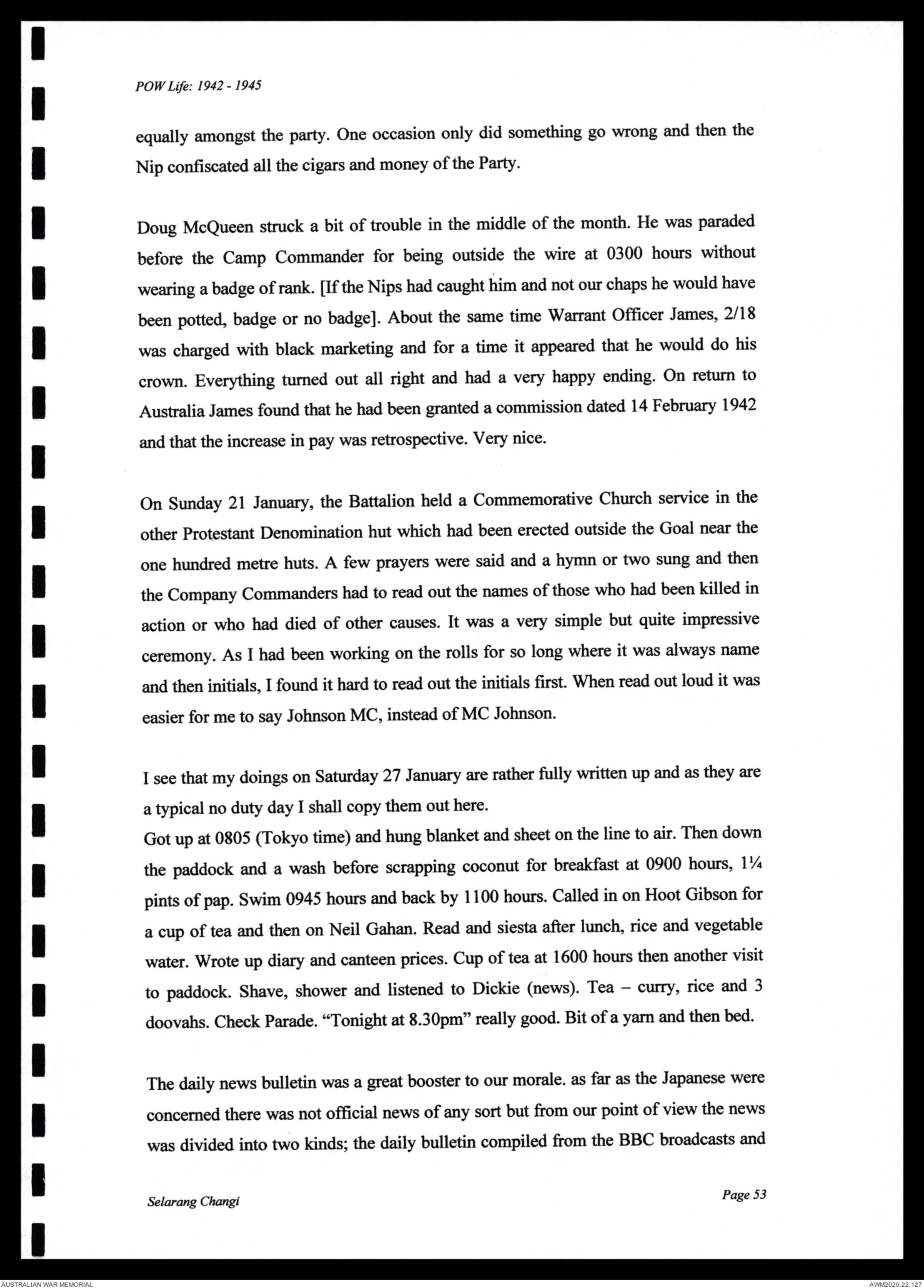
produce an innocent haversack for inspection. All goods thus brought in were divided
Page 52
Nip confiscated all the cigars and money of the Party.
before the Camp Commander for being outside the wire at 0300 hours without
wearing a badge of rank. [If the Nips had caught him and not our chaps he would have
been potted, badge or no badge]. About the same time Warrant Officer James, 2/18
was charged with black marketing and for a time it appeared that he would do his
crown. Everything turned out all right and had a very happy ending. On return to
Australia James found that he had been granted a commission dated 14 February 1942
and that the increase in pay was retrospective. Very nice.
other Protestant Denomination hut which had been erected outside the Goal near the
one hundred metre huts. A few prayers were said and a hymn or two sung and then
the Company Commanders had to read out the names of those who had been killed in
action or who had died of other causes. It was a very simple but quite impressive
ceremony. As I had been working on the rolls for so long where it was always name
and then initials, I found it hard to read out the initials first. When read out loud it was
easier for me to say Johnson MC, instead of MC Johnson.
a typical no duty day I shall copy them out here.
the paddock and a wash before scrapping coconut for breakfast at 0900 hours, 1¼
pints of pap. Swim 0945 hours and back by 1100 hours. Called in on Hoot Gibson for
a cup of tea and then on Neil Gahan. Read and siesta after lunch, rice and vegetable
water. Wrote up diary and canteen prices. Cup of tea at 1600 hours then another visit
to paddock. Shave, shower and listened to Dickie (news). Tea – curry, rice and 3
doovahs. Check Parade. “Tonight at 8.30pm” really good. Bit of a yarn and then bed.
concerned there was not official news of any sort but from our point of view the news
was divided into two kinds; the daily bulletin compiled from the BBC broadcasts and
Page 53
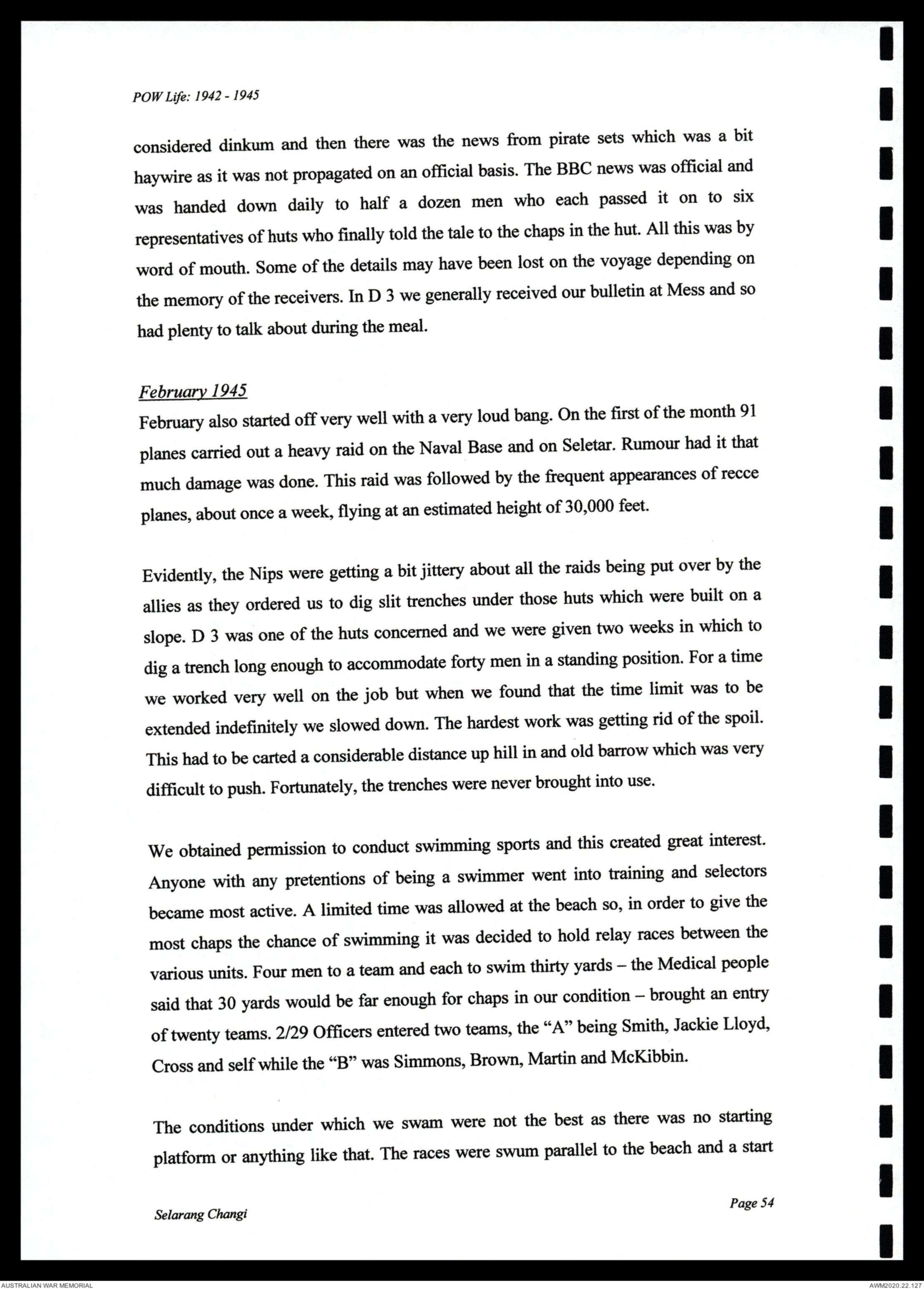
haywire as it was not propagated on an official basis. The BBC news was official and
was handed down daily to half a dozen men who each passed it on to six
representatives of huts who finally told the tale to the chaps in the hut. All this was by
word of mouth. Some of the details may have been lost on the voyage depending on
the memory of the receivers. In D 3 we generally received our bulletin at Mess and so
had plenty to talk about during the meal.
planes carried out a heavy raid on the Naval Base and on Seletar. Rumour had it that
much damage was done. This raid was followed by the frequent appearances of recce
planes, about once a week, flying at an estimated height of 30,000 feet.
allies as they ordered us to dig slit trenches under those huts which were built on a
slope. D 3 was one of the huts concerned and we were given two weeks in which to
dig a trench long enough to accommodate forty men in a standing position. For a time
we worked very well on the job but when we found that the time limit was to be
extended indefinitely we slowed down. The hardest work was getting rid of the spoil.
This had to be carted a considerable distance up hill in and old barrow which was very
difficult to push. Fortunately, the trenches were never brought into use.
Anyone with any pretentions of being a swimmer went into training and selectors
became most active. A limited time was allowed at the beach so, in order to give the
most chaps the chance of swimming it was decided to hold relay races between the
various units. Four men to a team and each to swim thirty yards – the Medical people
said that 30 yards would be far enough for chaps in our condition – brought an entry
of twenty teams. 2/29 Officers entered two teams, the “A” being Smith, Jackie Lloyd,
Cross and self while the “B” was Simmons, Brown, Martin and McKibbin.
platform or anything like that. The races were swum parallel to the beach and a start
Page 54
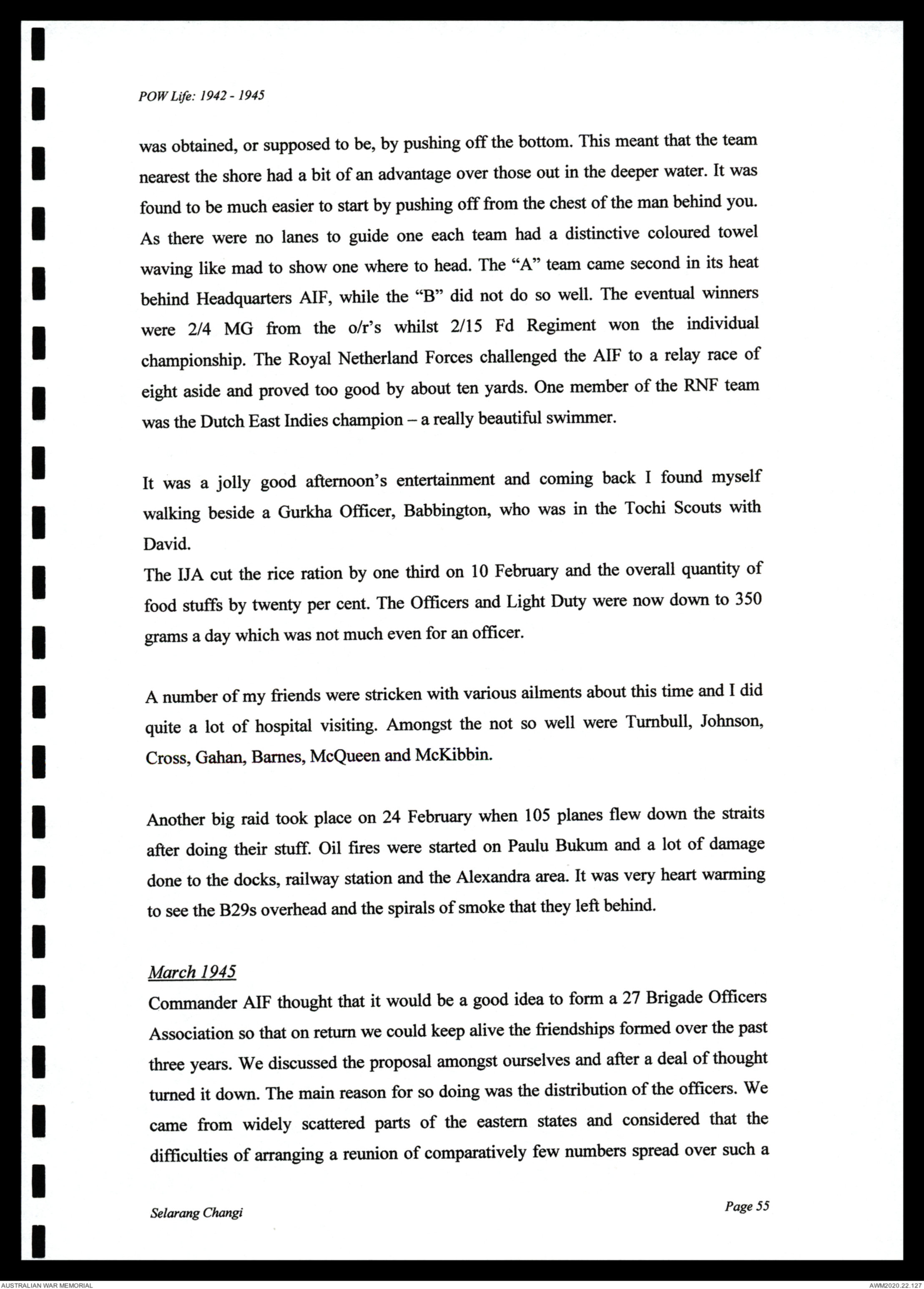
nearest the shore had a bit of an advantage over those out in the deeper water. It was
found to be much easier to start by pushing off from the chest of the man behind you.
As there were no lanes to guide one each team had a distinctive coloured towel
waving like mad to show one where to head. The “A” team came second in its heat
behind Headquarters AIF, while the “B” did not do so well. The eventual winners
were 2/4 MG from the o/r’s whilst 2/15 Fd Regiment won the individual
championship. The Royal Netherland Forces challenged the AIF to a relay race of
eight aside and proved too good by about ten yards. One member of the RNF team
was the Dutch East Indies champion – a really beautiful swimmer.
walking beside a Gurkha Officer, Babbington, who was in the Tochi Scouts with
David.
The IJA cut the rice ration by one third on 10 February and the overall quantity of
food stuffs by twenty per cent. The Officers and Light Duty were now down to 350
grams a day which was not much even for an officer.
quite a lot of hospital visiting. Amongst the not so well were Turnbull, Johnson,
Cross, Gahan, Barnes, McQueen and McKibbin.
after doing their stuff. Oil fires were started on Paulu Bukum and a lot of damage
done to the docks, railway station and the Alexandra area. It was very heart warming
to see the B29s overhead and the spirals of smoke that they left behind.
Association so that on return we could keep alive the friendships formed over the past
three years. We discussed the proposal amongst ourselves and after a deal of thought
turned it down. The main reason for so doing was the distribution of the officers. We
came from widely scattered parts of the eastern states and considered that the
difficulties of arranging a reunion of comparatively few numbers spread over such a
Page 55
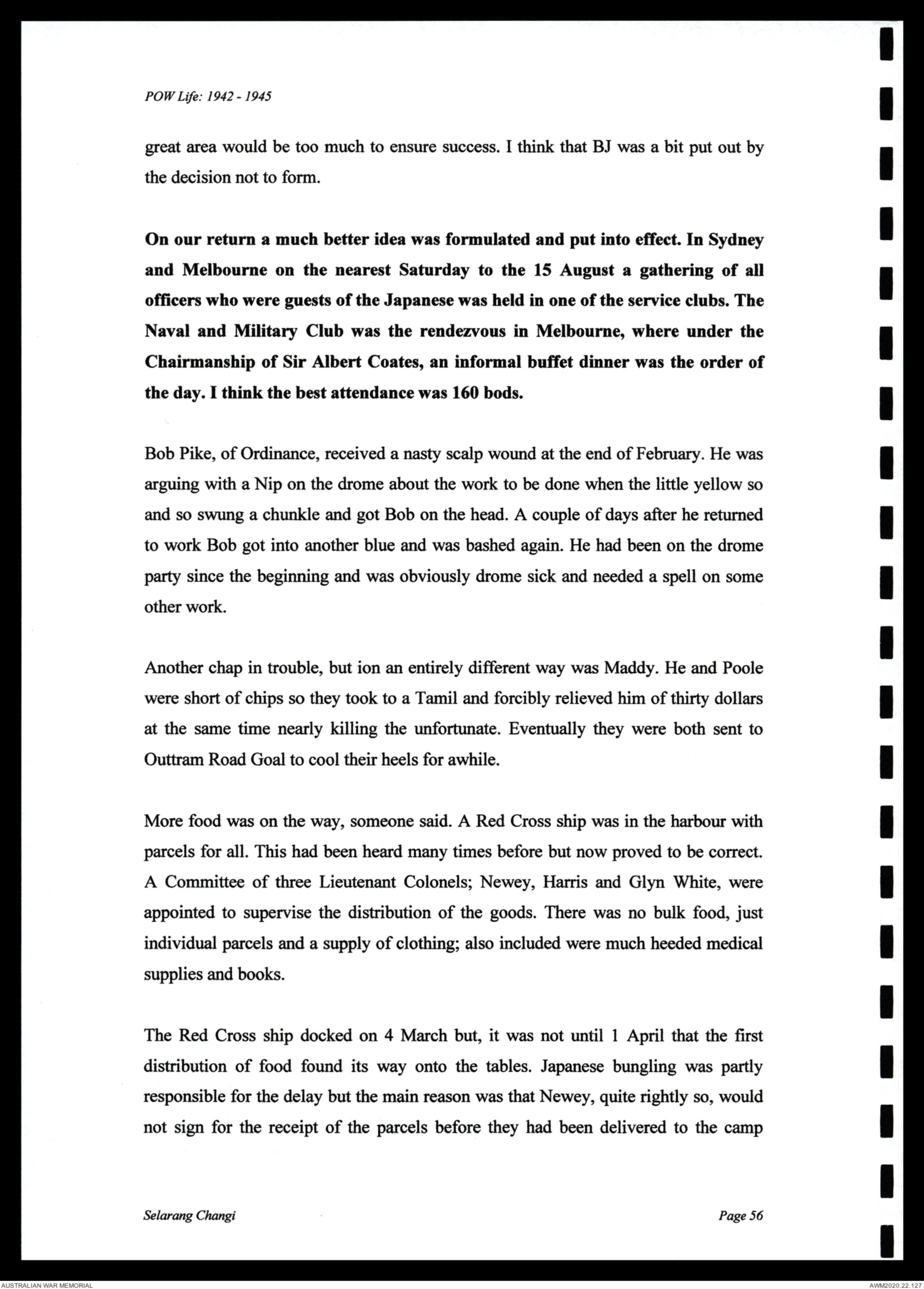
the decision not to form.
and Melbourne on the nearest Saturday to the 15 August a gathering of all
officers who were guests of the Japanese was held in one of the service clubs. The
Naval and Military Club was the rendezvous in Melbourne, where under the
Chairmanship of Sir Albert Coates, an informal buffet dinner was the order of
the day. I think the best attendance was 160 bods.
arguing with a Nip on the drome about the work to be done when the little yellow so
and so swung a chunkle and got Bob on the head. A couple of days after he returned
to work Bob got into another blue and was bashed again. He had been on the drome
party since the beginning and was obviously drome sick and needed a spell on some
other work.
were short of chips so they took to a Tamil and forcibly relieved him of thirty dollars
at the same time nearly killing the unfortunate. Eventually they were both sent to
Outtram Road Goal to cool their heels for awhile.
parcels for all. This had been heard many times before but now proved to be correct.
A Committee of three Lieutenant Colonels; Newey, Harris and Glyn White, were
appointed to supervise the distribution of the goods. There was no bulk food, just
individual parcels and a supply of clothing; also included were much heeded medical
supplies and books.
distribution of food found its way onto the tables. Japanese bungling was partly
responsible for the delay but the main reason was that Newey, quite rightly so, would
not sign for the receipt of the parcels before they had been delivered to the camp
Page 56
POW Life: 1942 - 1945
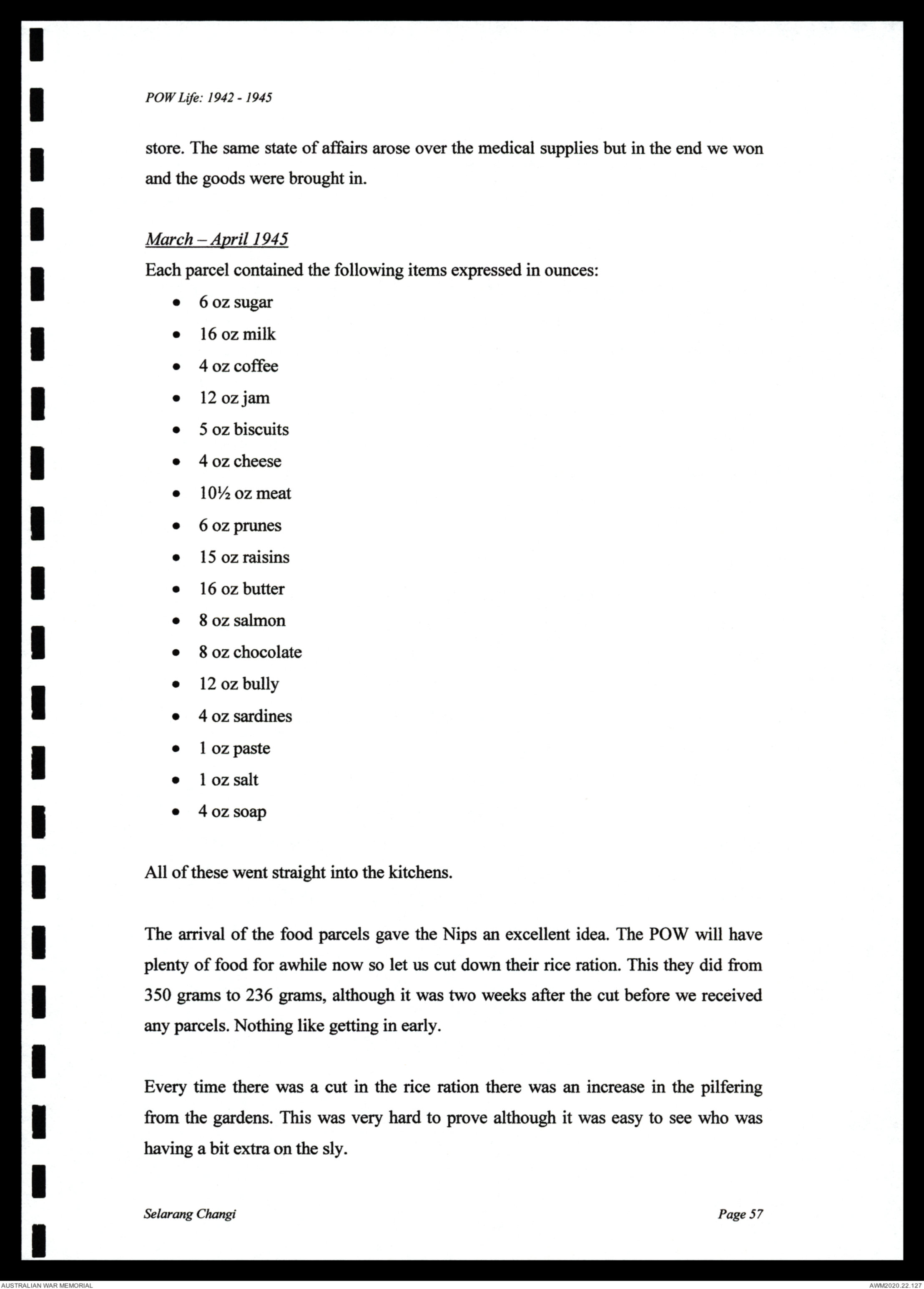
store. The same state of affairs arose over the medical supplies but in the end we won
and the goods were brought in.
March – April 1945
Each parcel contained the following items expressed in ounces:
• 6 oz sugar
• 16 oz milk
• 4 oz coffee
• 12 oz jam
• 5 oz biscuits
• 4 oz cheese
• 10½ oz meat
• 6 oz prunes
• 15 oz raisins
• 16 oz butter
• 8 oz salmon
• 8 oz chocolate
• 12 oz bully
• 4 oz sardines
• 1 oz paste
• 1 oz salt
• 4 oz soap
All of these went straight into the kitchens.
The arrival of the food parcels gave the Nips an excellent idea. The POW will have
plenty of food for awhile now so let us cut down their rice ration. This they did from
350 grams to 236 grams, although it was two weeks after the cut before we received
any parcels. Nothing like getting in early.
Every time there was a cut in the rice ration there was an increase in the pilfering
from the gardens. This was very hard to prove although it was easy to see who was
having a bit extra on the sly.
Selarang Changi
Page 57
 Transcriber 28489
This transcription item is now locked to you for editing. To release the lock either Save your changes or Cancel.
This lock will be automatically released after 60 minutes of inactivity.