
Diary of service - Donald Morrison, 1940 - 1945 - Part 17
POW Life: 1942 - 1945
I did my chores in the morning and then had a yarn with those left in the lines as I
went round with George Murphy my CSM. After lunch, a sleep, or a read; and then a
cup of tea before having a game of circloss on the lawn. To vary the monotony Bruce
and I would occasionally go visiting. Before the evening meal I generally had a cup of
yeast which did me a lot of good. I was fortunate to have efficient cooks who were
interested in their job and who were always trying to improve their technique. Silver
"Trevithick" was in charge of the kitchen and it was his brains that thought out ways
to make the most of and to vary the rations and the chaps appreciated his efforts. My
aim was to feed them as well as possible and not buggar them about.
We had several commanders while we were at Happy Valley – Bruce Bowring who
was very much the Bull; Ron Campbell of 2/40 Battalion who came to be known as
Belly Up and Anderson and the Mongolian Monster Johnston both of 2/30 battalion
who made doubly sure that their own unit got everything its own way.
On 1 November, I had my first meeting with members of the Royal Netherland Forces
when a large party came in from Java. As time went on I got to like them less and
less. I could never get used to the idea of coloured people being classed as Europeans.
The main entertainment was provided by the AIF concert party. After the Square they
were allotted an old garage which was converted into a theatre to seat six hundred.
The stage effects and lighting eventually became first class and production, under
John Wood excellent. Most of the shows were of the Vaudeville type with tickets
rationed to Groups on a population basis.
18 December was one of our black days for it marked the end of the weekly issue of
meat and it hit our tummies very hard as well as taking a great deal of variety away
from the menu.
This change in diet marked the end of our peaceful existence in Happy Valley. The
work parties were returning from Singapore so the two Brigades would be reformed
and the Battalions would occupy the buildings surrounding the Square. The Group
would break up and act as advance party to the main body marching in, in four days
time, each to its own unit.
Selarang Changi Page 18
POW Life: 1942 -1945
December 1942
On Sunday 20 December, we moved back to the Square to make things ready for the
Unit which would march in, in a couple of days time. The move was very hard to
organise as 2/20 would not cooperate in any way and later in the afternoon it began to
rain, just to try our patience a bit more. However, we completed the job before dark
and I then handed over to Bruce. It had been a hard day and I was very tired. The next
couple of days were spent in cleaning up the building which had been occupied by the
Dutch niggers. They were a filthy crowd and left their mess everywhere; the whole
building had to be thoroughly washed. 2/20 had a building of their own to do but they
were no great loss.
Just after lunch on Thursday the Unit marched in under Freddie Hore as Saf Pond had
to stay in Singapore until the move back to Changi was complete as he was
commander of the work parties. I had not seen the men for several months and the
improvement in their morale was good to see; they marched with a swing and looked
more like the troops they once were.
I was OC "B" Company with Rutherford 2IC, Archdall No 12, McGlin 11 and
Pearsall 10. As usual we got the rotten end of the stick and had some troops on the top
floor and some on the centre. Everyone was very busy for the next two weeks getting
the kitchens going and starting another lot of vegetable gardens. The overcrowding
was very bad with eight hundred and five sleeping in a building which was made to
house about ninety.
Christmas Day came and with it our thoughts turned to those at home. The IJA gave
all the camp a holiday and all work parties were cancelled for the day. After dinner
that night Fred Hore produced a small bottle of Liqueur Brandy and we each had a
small tot. Very nice it was too!
After Christmas "B" Company gradually got more room as the Machine Gunners
moved to another building and then "C" Company went over to the Kit store. The
health of the men was pretty good and the Unit sent six officers and two hundred and
Selarang Changi Page 19
POW Life: 1942 - 1945
fifty men daily to work in the garden. These men were paid a bonus of five cents and
received an additional seven ounces of rice daily.
New Year's Day was a semi-holiday and the garden party worked only half a day.
Tojo gave all the men an issue of toddy on New Year's night and pretty fiery stuff it
was. There was only one incident, when some "A" Company lads began to sling off at
the officers. Doug went to shut them up and so did Hore. Fred fell over in the dark
and some low hounds wanted to throw him over the balcony. Harry Rowbotton was
the instigator of it.
During the day the IJA made a raid and took away Wyett, McAlister and Roberts. The
reason was not fully understood at the time but we learnt later that the charges were
attempting to escape for the first two and trading with the natives for the latter who
was a Red Cross representative.
January 1943
We soon became very regimental once more and even our makeshift beds had to
conform to a certain pattern. There was a daily inspection of the quarters and points
were allotted for tidiness; the idea was to create a competitive spirit amongst the men
but it only tended to make them fed up. They were quite capable of keeping their gear
tidy and their surrounds clean without the 2IC, Fred Hore, crawling around on his
hands and knees poking under the beds with his stick. "Auntie" as he was called
by the troops was making a bit of a fool of himself.
The old Brigades were officially reorganised on 4 January. Headquarters staff for 27
Brigade was Commander Kappe, BM Morgan, SCA Madden, SCQ Hardacre, LO's
Curlewis, Jessup and Stephens of the Gurkhas.
Just about a fortnight later, 17 January, was the anniversary of the 8 Division going
into action and also of the 2/29 Battalion at Muar. We held a simple service in the
concert hall - hymn, two prayers, reading of the names of the fallen, Pericles Oration
and the laying of the wreath. I had to kick Ben Martin's backside for not attending.
2/26 and 2/30 went to the AIF Cemetery.
Selarang Changi Page 20
POW Life: 1942 - 1945
"Black Jack" decided to stage a review of 27 Brigade on Australia Day with a march
past and we had ten days to get into shape. The men kicked at first, mainly because it
was a 2/30 idea. After a couple of practices they got back into their old friendly
interbattalion rivalry and were determined to make ours the best show of the three
units. I must have had all the dills as "B" Company got roasted after every rehearsal
and the CO even want so far as to take McGlinn and Hackney away from me and give
them special jobs as they were not considered very good marchers - Eric was a little
portly and poor Ben had a gammy leg. Eric was stationed on top of the building
during each parade to take notes of any mistakes made and by whom.
The great day, 26 January, dawned, and each battalion came onto parade with five
officers and one hundred and fifty other ranks in each company. The whole show
went very well indeed especially the advance in review order. It was a unique
ceremony with the Commander AIF taking the salute while he stood under a Union
Jack which fluttered in the breeze. The music was supplied by three pipers; we
marched to "The Cock O' the North". To round off the day "A" Company put on a
floor show with musical items, taxi dancers and such like after mess.
Three days later we were told that we could send home a twenty work excluding the
address wireless message and that one man in each company could send one of thirty
words. There was much scratching of pens and sucking of pencils especially on the
part of those who had never written letters before and their number was remarkably
high, higher than should be.
February 1943
Our evenings were spent at the Concerts, listening to lectures, reading or playing
cards. I took up contract bridge and with the help of Hoot and later Fred Cross
became quite good. Doug, Mel, Neil, Freddie and I formed the "Do you remember
Club", which used to meet after lights out generally on the roof above the officers
quarters. Scenes and events of happier days were talked about, our memories
stretching back to Trawool in June 1940. Sometimes we would get a little hilarious
and Freddie Hore would send up a message per one of the subalterns for us to get to
bed.
Selarang Changi Page 21
POW Life: 1942 - 1945
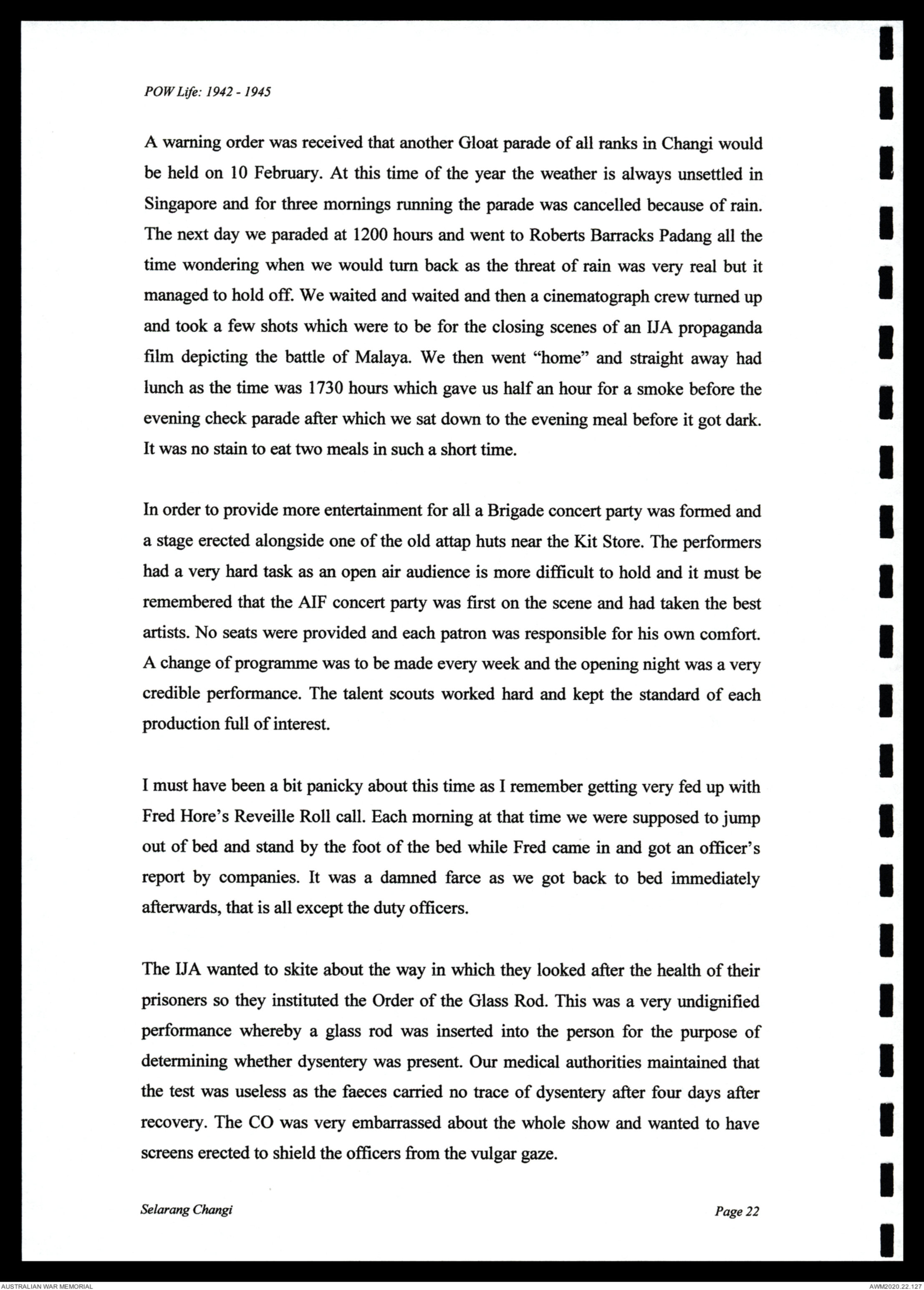
A warning order was received that another Gloat parade of all ranks in Changi would
be held on 10 February. At this time of the year the weather is always unsettled in
Singapore and for three mornings running the parade was cancelled because of rain.
The next day we paraded at 1200 hours and went to Roberts Barracks Padang all the
time wondering when we would turn back as the threat of rain was very real but it
managed to hold off. We waited and waited and then a cinematograph crew turned up
and took a few shots which were to be for the closing scenes of an IJA propaganda
film depicting the battle of Malaya. We then went "home" and straight away had
lunch as the time was 1730 hours which gave us half an hour for a smoke before the
evening check parade after which we sat down to the evening meal before it got dark.
It was no stain to eat two meals in such a short time.
In order to provide more entertainment for all a Brigade concert party was formed and
a stage erected alongside one of the old attap huts near the Kit Store. The performers
had a very hard task as an open air audience is more difficult to hold and it must be
remembered that the AIF concert party was first on the scene and had taken the best
artists. No seats were provided and each patron was responsible for his own comfort.
A change of programme was to be made every week and the opening night was a very
credible performance. The talent scouts worked hard and kept the standard of each
production full of interest.
I must have been a bit panicky about this time as I remember getting very fed up with
Fred Hore's Reveille Roll call. Each morning at that time we were supposed to jump
out of bed and stand by the foot of the bed while Fred came in and got an officer's
report by companies. It was a damned farce as we got back to bed immediately
afterwards, that is all except the duty officers.
The IJA wanted to skite about the way in which they looked after the health of their
prisoners so the instituted the Order of the Glass Rod. This was a very undignified
performance whereby a glass rod was inserted into the person for the purpose of
determining whether dysentery was present. Our medical authorities maintained that
the test was useless as the faeces carried no trace of dysentery after four days after
recovery. The CO was very embarrassed about the whole show and wanted to have
screens erected to shield the officers from the vulgar gaze.
Selarang Changi Page 22
POW Life: 1942 - 1945
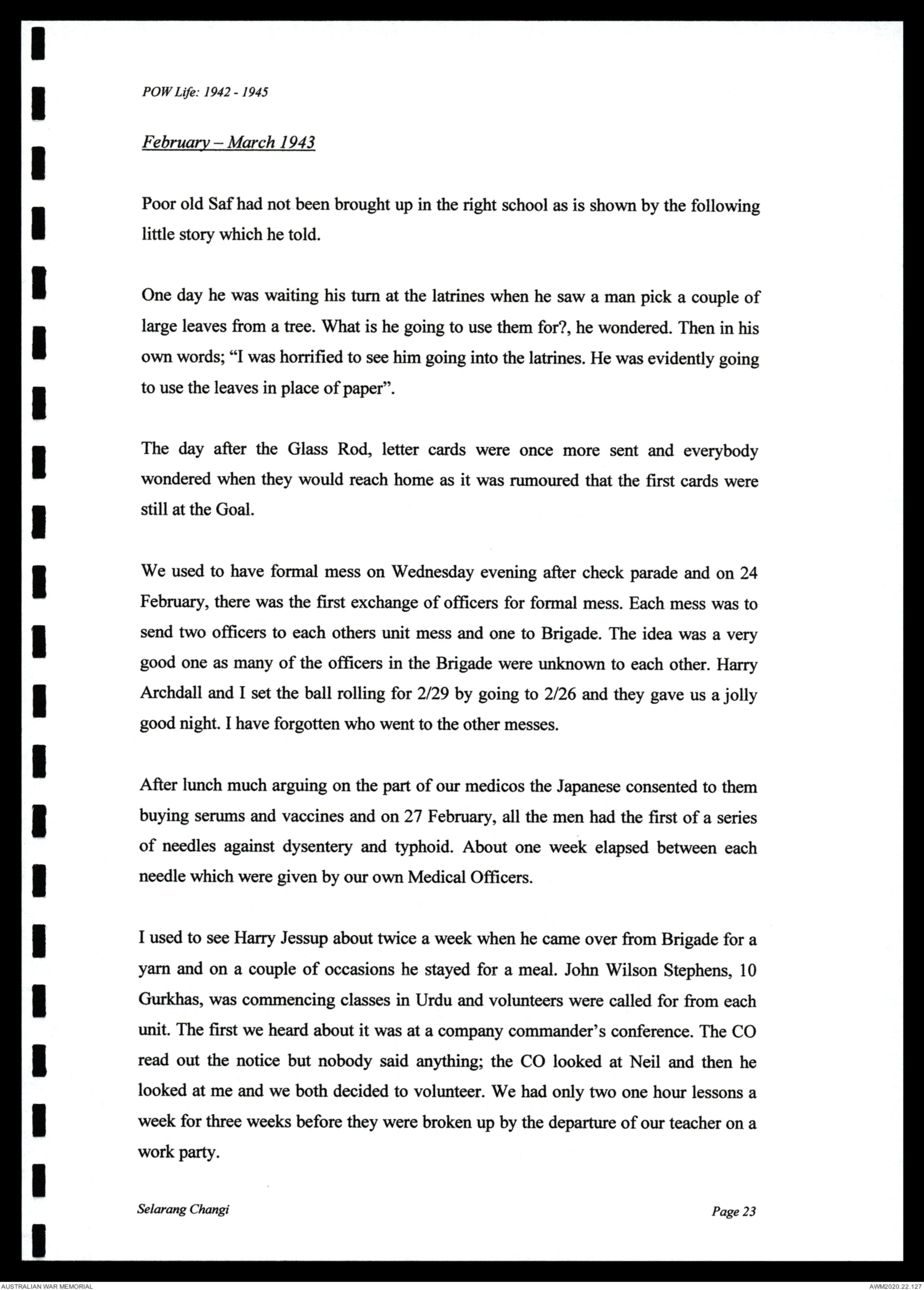
February - March 1943
Poor old Saf had not been brought up in the right school as is shown by the following
little story which he told.
One day he was waiting his turn at the latrines when he saw a man pick a couple of
large leaves from a tree. What is he going to use them for?, he wondered. Then in his
own words; "I was horrified to see him going into the latrines. He was evidently going
to use the leaves in place of paper".
The day after the Glass Rod, letter cards were once more sent and everybody
wondered when they would reach home as it was rumored that the first cards were
still at the Goal.
We used to have formal mess on Wednesday evening after check parade and on 24
February, there was the first exchange of officers for formal mess. Each mess was to
send two officers to each others unit mess and one to Brigade. The idea was a very
good one as many of the officers in the Brigade were unknown to each other. Harry
Archdall and I set the ball rolling for 2/29 by going to 2/26 and they gave us a jolly
good night. I have forgotten who went to the other messes.
After lunch much arguing on the part of our medicos the Japanese consented to them
buying serums and vaccines and on 27 February, all the men had the first of a series
of needles against dysentery and typhoid. About one week elapsed between each
needle which were given by our own Medical Officers.
I used to see Harry Jessup about twice a week when he came over from Brigade for a
yarn and on a couple of occasions he stayed for a meal. John Wilson Stephens, 10
Gurkhas, was commencing classes in Urdu and volunteers were called for from each
unit. The first we heard about it was at a company commander's conference. The CO
read out the notice but nobody said anything; the CO looked at Neil and then he
looked at me and we both decided to volunteer. We had only two one hour lessons a
week for three weeks before they were broken up by the departure of our teacher on a
work party.
Selarang Changi Page 23
POW Life: 1942 - 1945
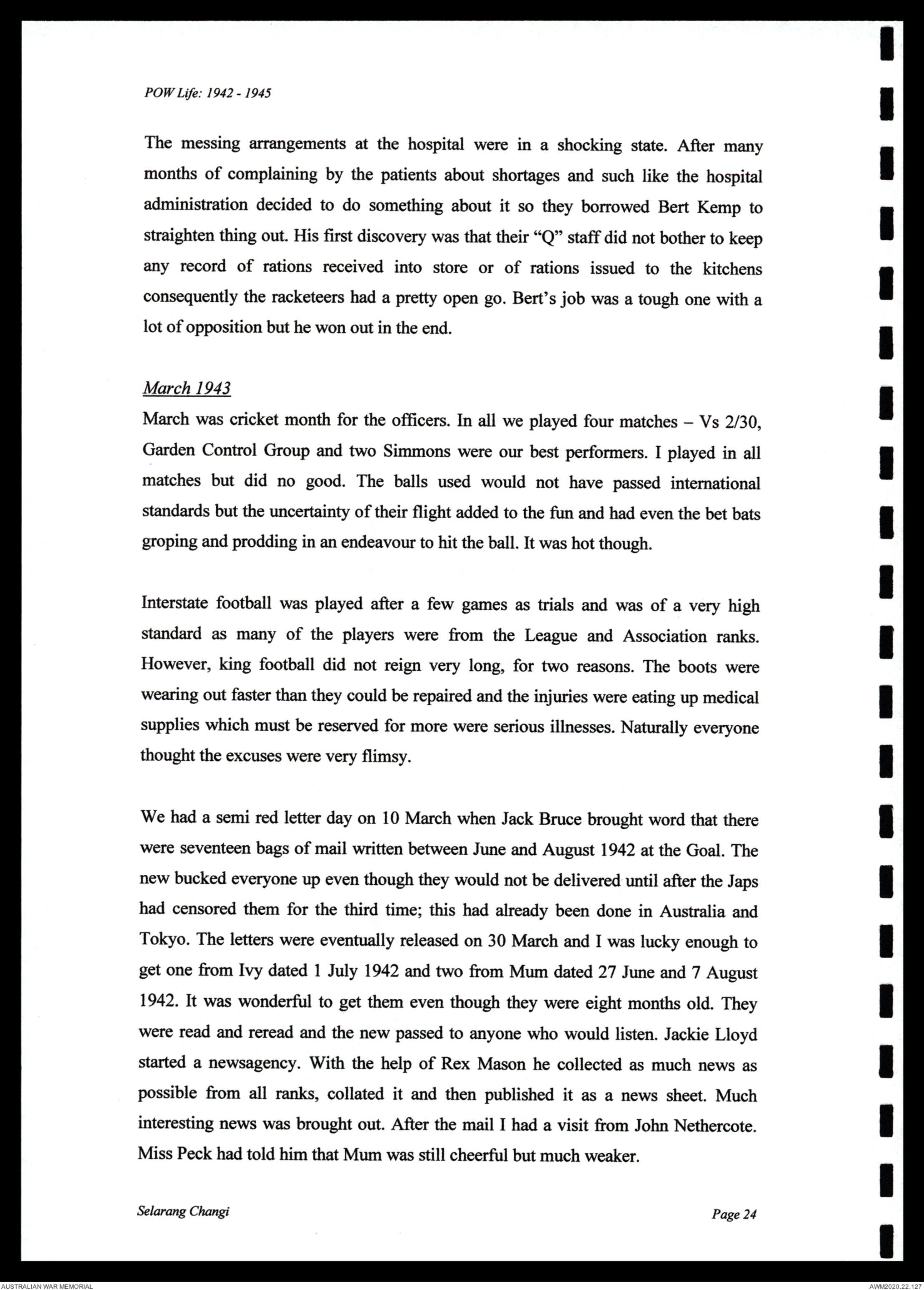
The messing arrangements at the hospital were in a shocking state. After many
months of complaining by the patients about shortages and such like the hospital
administration decided to do something about it so they borrowed Bert Kemp to
straighten thing out. His first discovery was that their "Q" staff did not bother to keep
any record of rations received into store or of rations issued to the kitchens
consequently the racketeers had a pretty open go. Bert's job was a tough one with a
lot of opposition but he won out in the end.
March 1943
March was cricket month for the officers. In all we played four matches - Vs 2/30,
Garden Control Group and two Simmons were our best performers. I played in all
matches but did no good. The balls used would not have passed international
standards but the uncertainty of their flight added to the fun and had even the bet bats
groping and prodding in an endeavour to hit the ball. It was hot though.
Interstate football was played after a few games as trials and was of a very high
standard as many of the players were from the League and Association ranks.
However, king football did not reign very long, for two reasons. The boots were
wearing out faster than they could be repaired and the injuries were eating up medical
supplies which must be reserved for more were serious illnesses. Naturally everyone
thought the excuses were very flimsy.
We had a semi red letter day on 10 March when Jack Bruce brought word that there
were seventeen bags of mail written between June and August 1942 at the Goal. The
new bucked everyone up even though they would not be delivered until after the Japs
had censored them for the third time; this had already been done in Australia and
Tokyo. The letters were eventually released on 30 March and I was lucky enough to
get one from Ivy dated 1 July 1942 and two from Mum dated 27 June and 7 August
1942. It was wonderful to get them even though they were eight months old. They
were read and reread and the new passed to anyone who would listen. Jackie Lloyd
started a newsagency. With the help of Rex Mason he collected as much news as
possible from all ranks, collated it and then published it as a news sheet. Much
interesting news was brought out. After the mail I had a visit from John Nethercote.
Miss Peck had told him that Mum was still cheerful but much weaker.
Selarang Changi Page 24
POW Life: 1942 - 1945
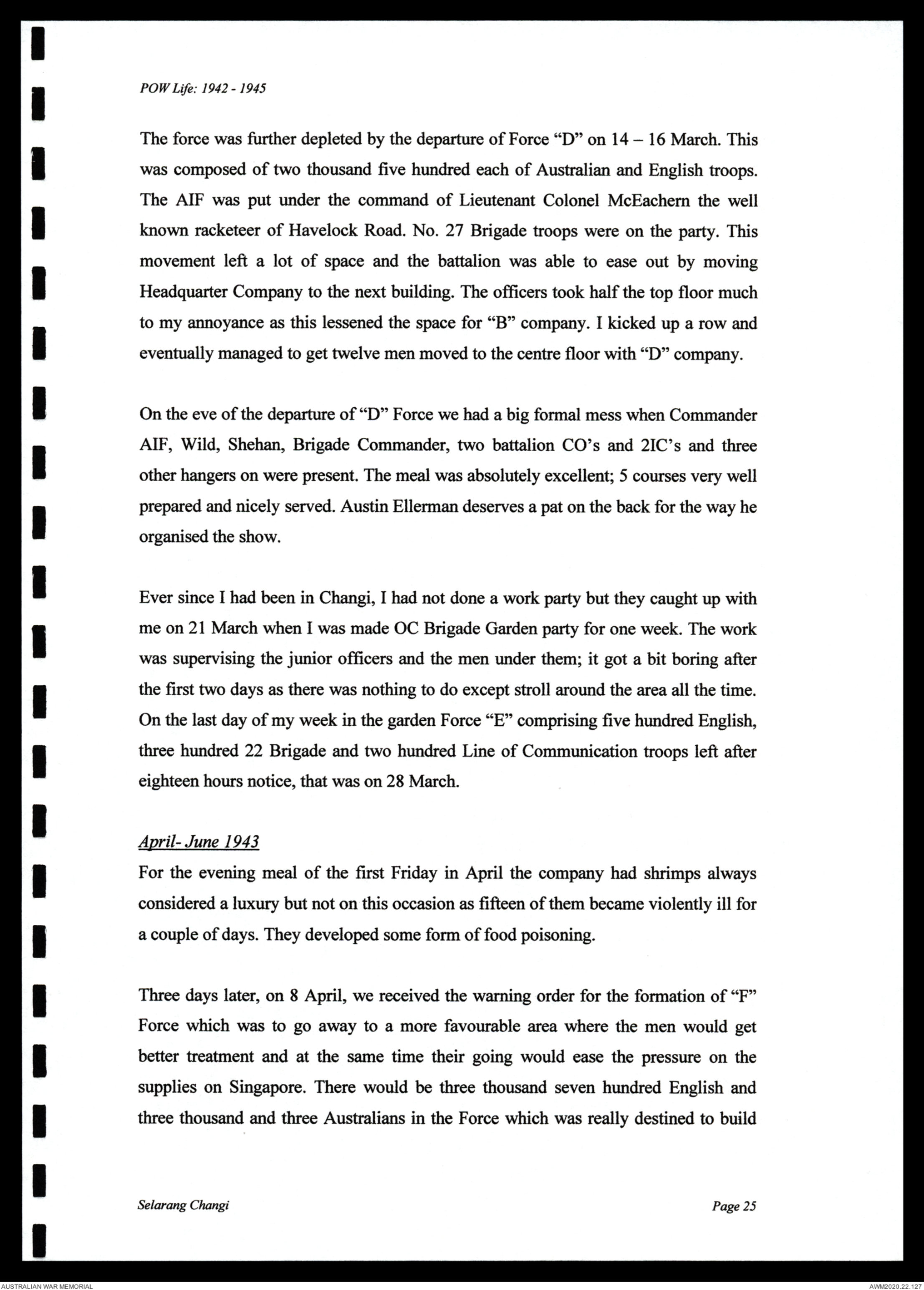
The force was further depleted by the departure of Force "D" on 14 - 16 March. This
was composed of two thousand five hundred each of Australian and English troops.
The AIF was put under the command of Lieutenant Colonel McEachern the well
known racketeer of Havelock Road. No. 27 Brigade troops were on the party. This
movement left a lot of space and the battalion was able to ease out by moving
Headquarter Company to the next building. The officers took half the top floor much
to my annoyance as this lessened the space for "B" company. I kicked up a row and
eventually managed to get twelve men moved to the centre floor with "D" company.
On the eve of the departure of "D" Force we had a big formal mess when Commander
AIF, Wild, Shehan, Brigade Commander, two battalion CO's and 2IC's and three
other hangers on were present. The meal was absolutely excellent; 5 courses very well
prepared and nicely served. Austin Ellerman deserves a pat on the back for the way he
organised the show.
Ever since I had been in Changi, I had not done a work party but they caught up with
me on 21 March when I was made OC Brigade Garden party for one week. The work
was supervising the junior officers and the men under them; it got a bit boring after
the first two days as there was nothing to do except stroll around the area all the time.
On the last day of my week in the garden Force "E" comprising five hundred English,
three hundred 22 Brigade and two hundred Line of Communication troops left after
eighteen hours notice, that was on 28 March.
April-June 1943
For the evening meal of the first Friday in April the company had shrimps always
considered a luxury but not on this occasion as fifteen of them became violently ill for
a couple of days. They developed some form of food poisoning.
Three days later, on 8 April, we received the warning order for the formation of "F"
Force which was to go away to a more favourable area where the men would get
better treatment and at the same time their going would ease the pressure on the
supplies on Singapore. There would be three thousand seven hundred English and
three thousand and three Australians in the Force which was really destined to build
Selarang Changi Page 25
POW Life: 1942 - 1945
the Burma railway and to leave nearly half their number in Thailand. I was to remain
behind as OC 2/29 crocks with Cross, Paul, Martin and Davidson.
The day before the force moved out or rather the first batch went I was made a staff
Captain "Q" in place of Jim Hardacre. My job was to see that all stores were loaded
onto the baggage trucks which were supplied by the Japanese and that the units did
not exceed their allotment. Some of the Nip drivers would cooperate and let me load
the vehicles in the order I thought best but others were snags and had me put stores
aboard their way which was not the most economical for space saving. The job meant
getting up at 0130 every morning for a week and I got very tired. The unit moved out
on the early morning of 20 April and returned sadly depleted seven months later.
The remnants of the six battalions and the machine gunners were to be concentrated
as "C" Group on the other side of the Square under Lieutenant Colonel Byrne of the
Army Service Corps and I was to be his 2IC. Byrne got off to a bad start on the first
parade by saying that the infantry should take a lesson from the AASC in saluting;
there was nearly a riot on the spot but all was forgotten by the next night. Freddie
Cross was Adjutant for 27 Brigade and he worked under a terrific handicap. I chose a
sergeant to act as RSM for him but did not find out for two days that the sergeant was
a terrific liar and that if anything went wrong through his fault he would never admit
to it but would deny all knowledge of the event. A nice fellow to work with!
We soon adapted to the new organisation but once again we were not left in peace for
very long. Another Force, "H" of twelve hundred English, the same number of Dutch
and six hundred Australian including twenty eight of the battalion moved out on 8
May. Many of these men were unfit for work and when the Commander AIF
protested he was told to mark the physical fitness of all the men up one grade and then
there would be enough fit men to do the work required. One week later Force "J" was
formed with six hundred English and three Australians under the command of
Lieutenant Colonel Byrne and was destined for Japan. With the departure of Les
Byrne "C" Group came under command of AIf Lamacraft of 2/30 battalion with Jock
Dole of the Traffic Control as Quartermaster while I was in charge of the 26/29
Platoon. Once more we settled in and stayed as "C" Group until the return of "F"
Force. We actually rejoined the main body of the unit on 1 April 1944.
Selarang Changi Page 26
POW Life: 1942 - 1945
The polished rice lacked a lot of vitamins and my legs were beginning to swell so I
began a course of rice polishings. There were not very pleasant tasting but they did a
great deal of good which after all was the main thing.
An AIF offices club was opened on 30 May in a building near Headquarters AIF. A
big room was equipped with electric light and tables and chairs. Super of coffee and a
doovah cost 2½ cents each and the entertainment was provided by 18 Division
orchestra and artists on alternate Sundays and by the AIF every other Saturday. It was
a very good place to play bridge and to have a smoke and a yarn. The next day
"Smokey Joes" was opened. This was a club run on similar lines for the men and had
its supper, floor show and band.
June brought an increase in wages to all ranks but like all such increases it brought
with it a rise in the cost of living as the canteen prices went up in sympathy the same
day. The new rates were 33 – 20 – 14 cents per day for Warrant Officers, Non-Coms
and Privates respectively with $17 for Captains and below and $20 for field rank.
Macauley came over on 3 June to tell me that Arthur Ross, who was undergoing Jap
detention for being AWL form a work party, had died in Outtram Road Goal from
Beri-Beri a month previously. Black Jack had hit the roof properly; we had a hospital
which could cure Beri-Beri and any other disease.
Another force was to be formed. This time a medical one of two hundred medical
personnel of which the AIF was to supply six officers and fifty other ranks. One who
went on this force was Lyle Andrews who had the first shot at patching me up after
my accident at Moorilim.
June – August 1943
A word of praise must be given to the cooks who worked under very trying
conditions. The cookhouse was a makeshift affair with an earthen floor and situated
about two hundred yards from the mess huts. Facilities were practically non-existent
and experience was at a premium as "F" Force had taken all the regular kitchen staff.
Most of the offsiders were laymen, but prepared to give it a go. With encouragement
from Jock Dole, Pro, "Q", and tuition from "Silver" Trevithick, 2/29, they worked
Selarang Changi Page 27
 Loretta Corbett
This transcription item is now locked to you for editing. To release the lock either Save your changes or Cancel.
This lock will be automatically released after 60 minutes of inactivity.