
Diary of service - Donald Morrison, 1940 - 1945 - Part 15
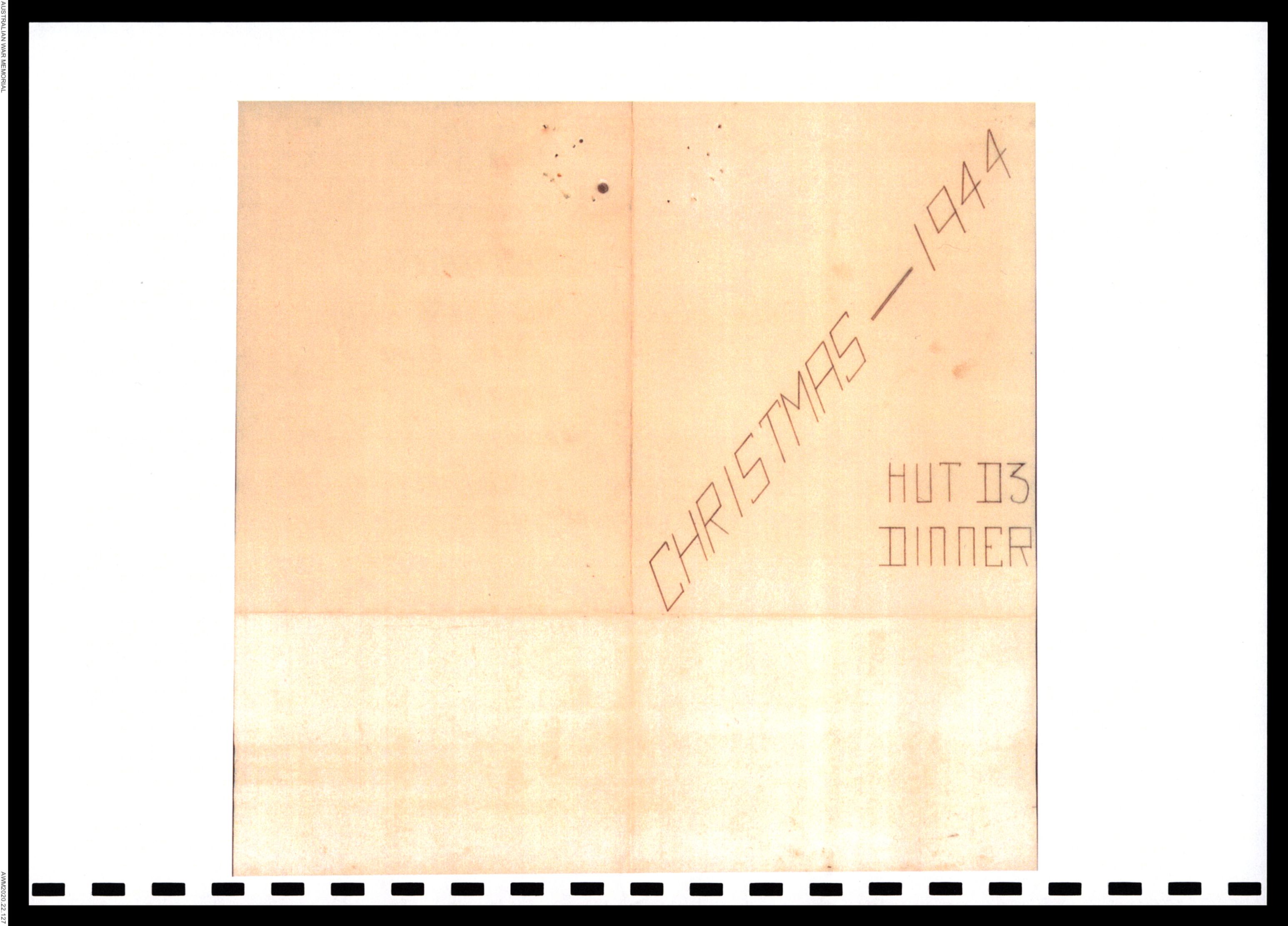
CHRISTMAS – 1944
HUT D3
DINNER
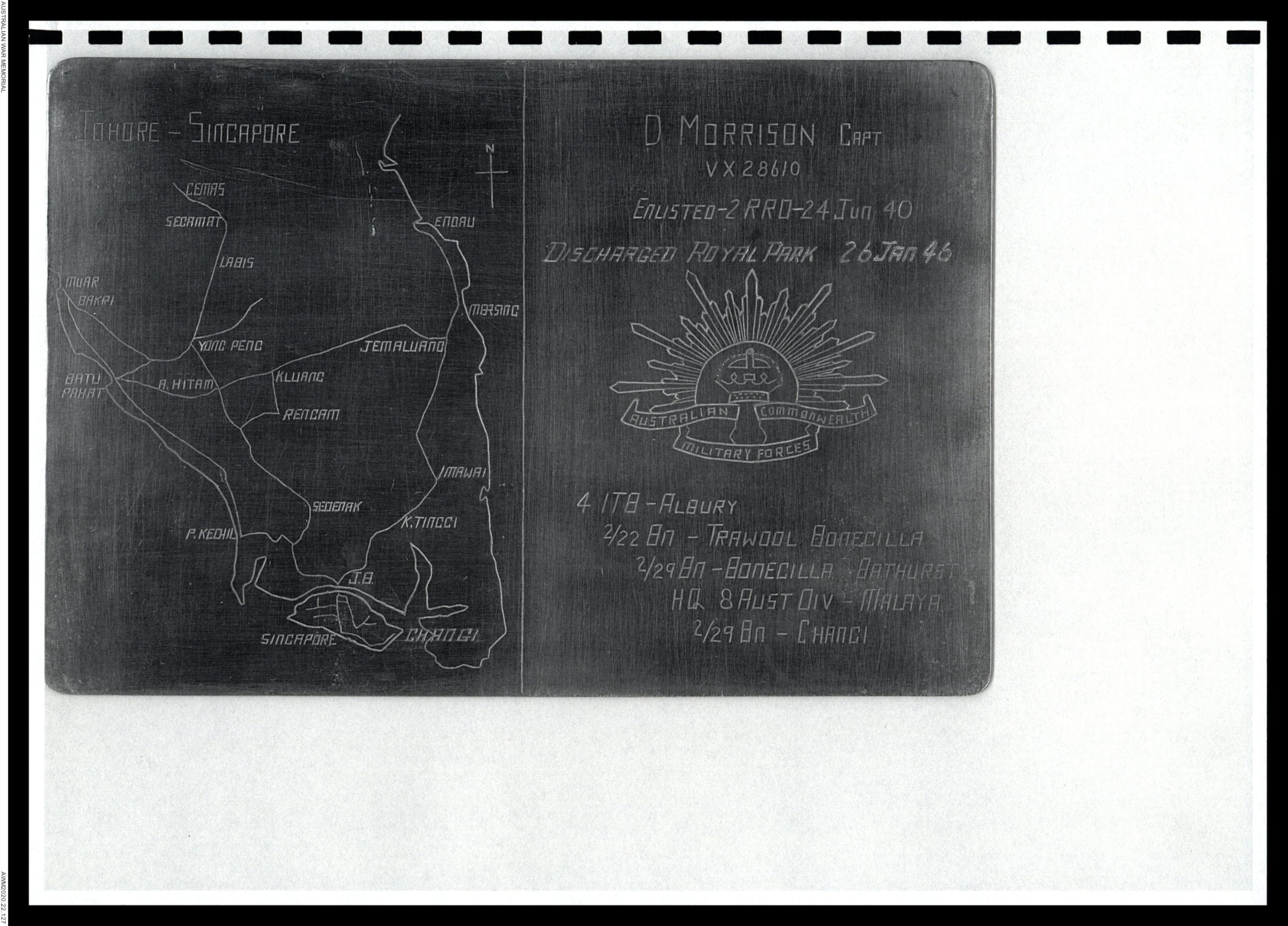
Map - see original document
JOHORE - SINGAPORE
D MORRISON CAPT
VX28610
ENLISTED - 2RRD - 24 JUN 40
DISCHARGED ROYAL PARK 26 JAN 46
Diagram insignia - see original document
AUSTRALIAN COMMONWEALTH
MILITARY FORCES
4 ITB - ALBURY
2/22 BN - TRAWOOL BONEGILLA
2/29 BN - BONEGILLA BATHURST
HQ 8 AUST DIV - MALAYA
2/29 BN - CHANGI
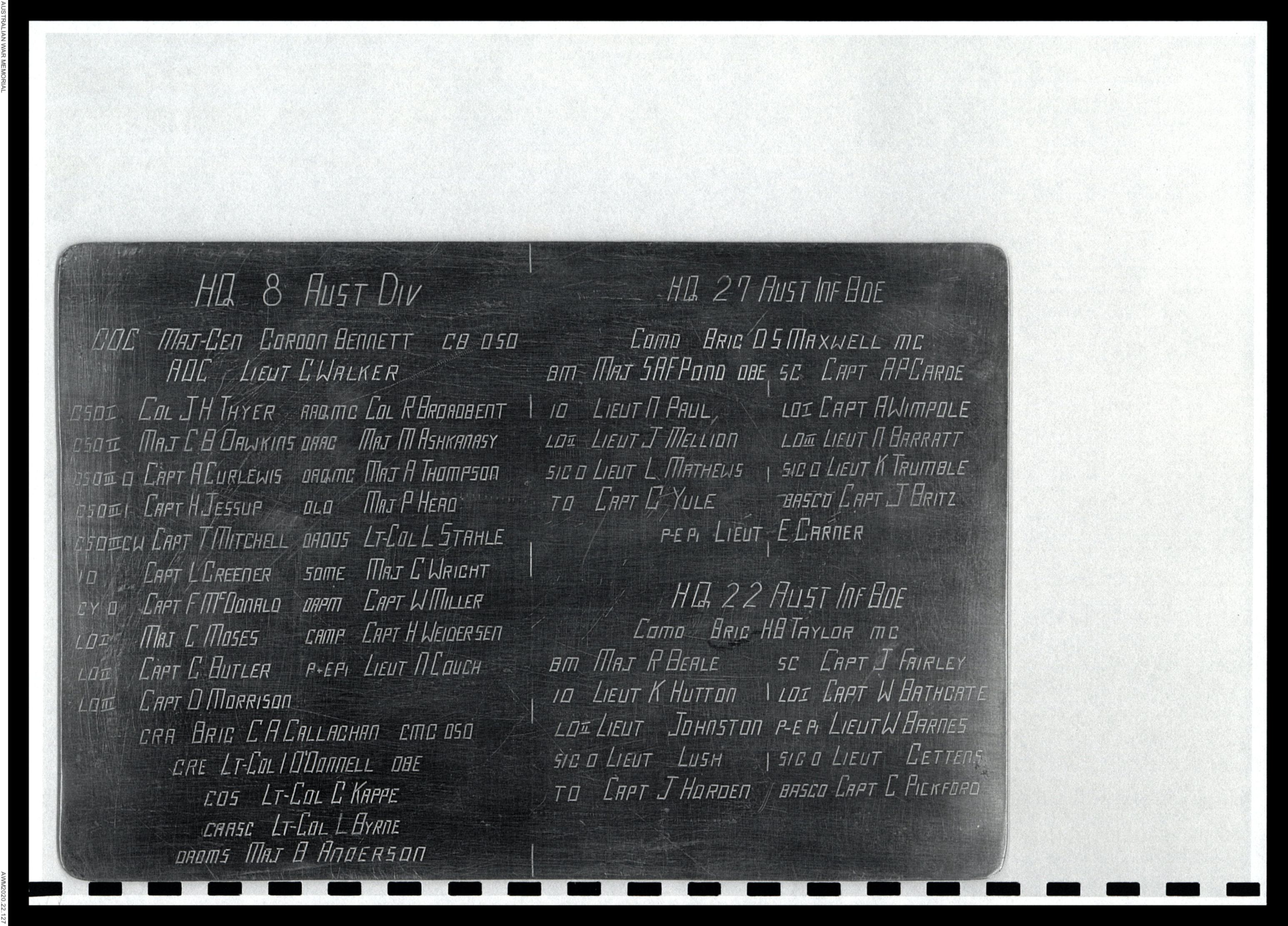
HQ 8 AUST DIV
COC MAJ-GEN GORDON BENNETT CB DSO
ADC LIEUT C WALKER
| CSO I | COL JH THYER | AAQMC | COL R BROADBENT |
| CSO II | MAJ CB DAWKINS | DAAC | MAJ M ASHKANASY |
| CSO III 0 | CAPT A CURLEWIS | DRQMC | MAJ A THOMPSON |
| CSO III 1 | CAPT H JESSUP | DLD | MAJ P HERD |
| CSO III CW | CAPT T MITCHELL | DADDS | LT-COL L STAHLE |
| ID | CAPT L GREENER | SOME | MAJ C WRIGHT |
| CY 0 | CAPT F McDONALD | DAPM | CAPT W MILLER |
| LO I | MAJ C MOSES | CAMP | CAPT H WEIDERSEN |
| LO II | CAPT C BUTLER | P+EP1 | LIEUT N COUCH |
| LO III | CAPT D MORRISON |
CRA BRIG CA CALLAGHAN CMC DSO
CRE LT-COL I O'DONNEL OBE
COS LT-COL C KAPPE
CAASC LT-COL L BYRNE
DAOMS MAJ B ANDERSON
HQ 27 AUST INF BDE
COMD BRIG D S MAXWELL MC
| BM | MAJ SAF POND OBE | SC | CAPT AP CARDE |
| ID | LIEUT N PAUL | LO I | CAPT A WIMPOLE |
| LO II | LIEUT J MELLION | LO III | LIEUT N BARRATT |
| SIC O | LIEUT L MATHEWS | SIC O | LIEUT K TRUMBLE |
| TO | CAPT C YULE | BASCO | CAPT J BRITZ |
| P-E P1 | LIEUT E CARNER |
HQ 22 AUST INF BDE
COMD BRIG HB TAYLOR MC
| BM | MAJ R BEALE | SC | CAPT J FAIRLEY |
| ID | LIEUT K HUTTON | LO I | CAPT W BATHGATE |
| LO II | LIEUT JOHNSTON | P-E P1 | LIEUT W BARNES |
| SIC O | LIEUT LUSH | SIG O | LIEUT GETTERS |
| TO | CAPT J HORDEN | BASCO | CAPT C PICKFORD |
POW Life: 1942 - 1945
February 1942
Reveille woke me on Wednesday morning 18, February 1942. I had a look around and
for a minute did not realise where I was. Suddenly it all came back - I was a prisoner
of war, but, there was no need to dwell on the past the future was more important. I
was aching all over from sleeping on a concrete floor and my feet hurt like the devil.
Neither foot had much skin left on it.
Selarang had only been slightly bombed but, the sewerage, light and water were out of
action. I thought that there must be somewhere to wash so I took my towel and soap
downstairs and went outside to have a look around. I saw a line of men disappearing
over a hill and as they were obviously on the same errand as myself. I followed. In
the valley was an anti-malarial drain in which had been built a tong or native washing
place. Many hundreds were gathered there, but, eventually I got my wash and in
doing so lost my soap, thus I was taught lesson number 1 of the POW - If you wish to
retain anything never leave it lying about. The most unlikely people had the habit of
souveniring when there was little chance of being found out.
After a very light breakfast, I could think of nothing more beneficial to my health than
some medical attention to my feet, so, at a very slow hobble, I made my way to the
MIR which was approximately 250 yards distant. A couple of hundred others had the
same idea and a queue many yards long was already waiting. The Medical Officers
worked flat out to cope with the rush of blistered feet but, even then I was late for
lunch.
For the first two days the lunch for twenty eight officers, incuding two Brigadiers,
consisted of one tin Bully Beef, one tin of Cheese, fifty six Savoury Biscuits
between the lot. Thank goodness I had plenty of cigarettes to fill in the gaps. After
lunch; a siesta. I spent every spare minute for three or four days in a horizontal
position sometimes on the floor but more often on one of the lawns with which the
building was surrounded. I was mentally and physically worn out.
That afternoon I managed to get hold of an iron bed which I was able to hang onto
during my stay in change. When I moved quarters it came with me and it was always
referred to as "Morrison's" bed. It was some months before I could scrounge a
mattress but even then it was preferable to a concrete floor.
Selarang Changi
Page 1
POW Life: 1942 - 1945
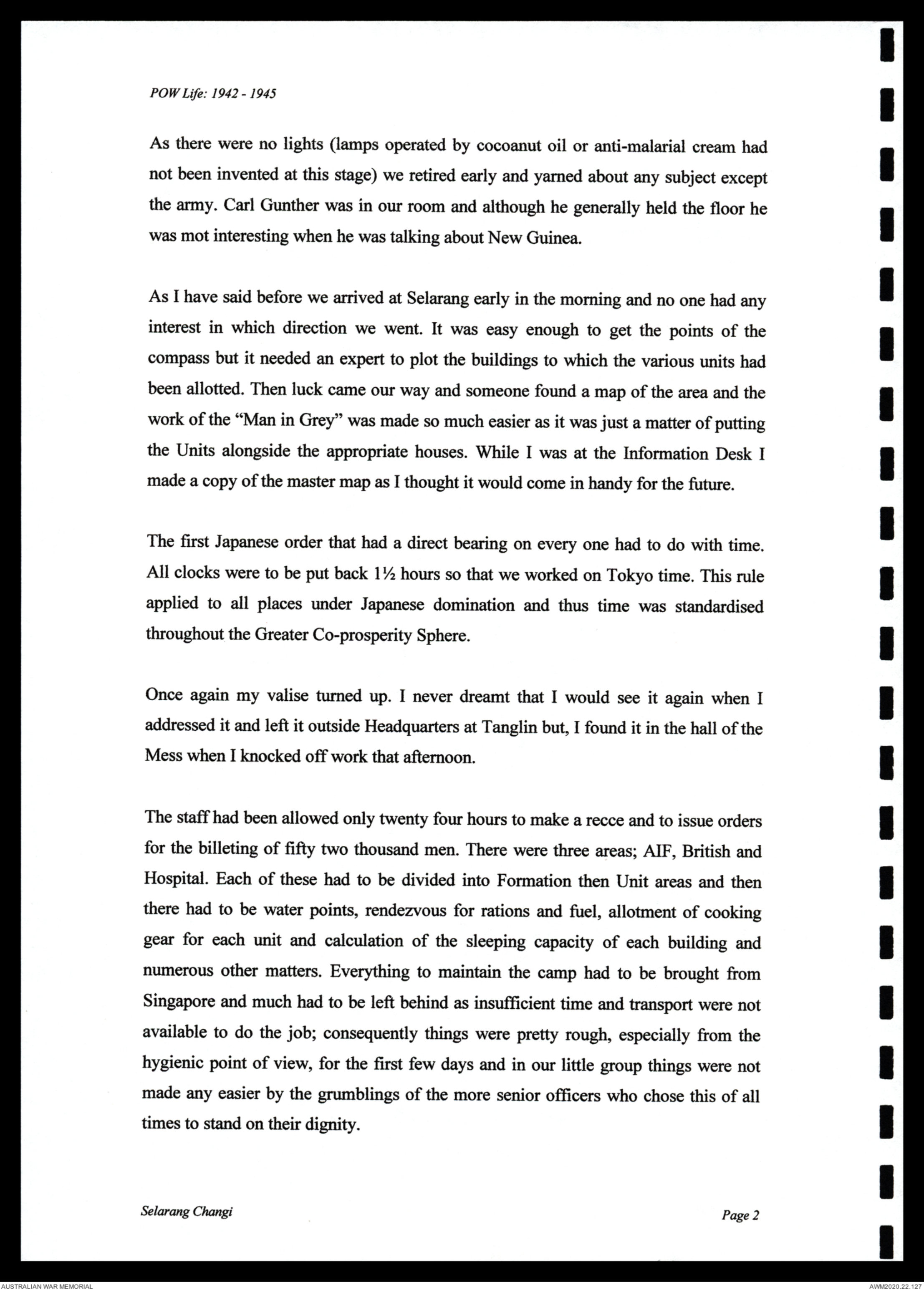
As there were no lights (lamps operated by cocoanut oil or anti-malarial cream had
not been invented at this stage) we retired early and yarned about any subject except
the army. Carl Gunther was in our room and although he generally held the floor he
was mot interesting when he was talking about New Guinea.
As I have said before we arrived at Selarang early in the morning and no one had any
interest in which direction we went. It was easy enough to get the points of the
compass but it needed an expert to plot the buildings to which the various units had
been allotted. Then luck came our way and someone found a map of the area and the
work of the "Man in Grey" was made so much easier as it was just a matter of putting
the Units alongside the appropriate houses. While I was at the Information Desk I
made a copy of the master map as I thought it would come in handy for the future.
The first Japanese order that had a direct bearing on every one had to do with time.
All clocks were to be put back 1½ hours so that we worked on Tokyo time. This rule
applied to all places under Japanese domination and thus time was standardised
throughout the Greater Co-prosperity Sphere.
Once again my valise turned up. I never dreamt that I would see it again when I
addressed it and left it outside Headquarters at Tanglin but, I found it in the hall of the
Mess when I knocked off work that afternoon.
The staff had been allowed only twenty four hours to make a recce and to issue orders
for the billeting of fifty two thousand men. There were three areas; AIF, British and
Hospital. Each of these had to be divided into Formation then Unit areas and then
there had to be water points, rendezvous for rations and fuel, allotment of cooking
gear for each unit and calculation of the sleeping capacity of each building and
numerous other matters. Everything to maintain the camp had to be brought from
Singapore and much had to be left behind as insufficient time and transport were not
available to do the job; consequently things were pretty rough, especially from the
hygienic point of view, for the first few days and in our little group things were not
made any easier by the grumblings of the more senior officers who chose this of all
times to stand on their dignity.
Selarang Changi
Page 2
POW Life: 1942 - 1945
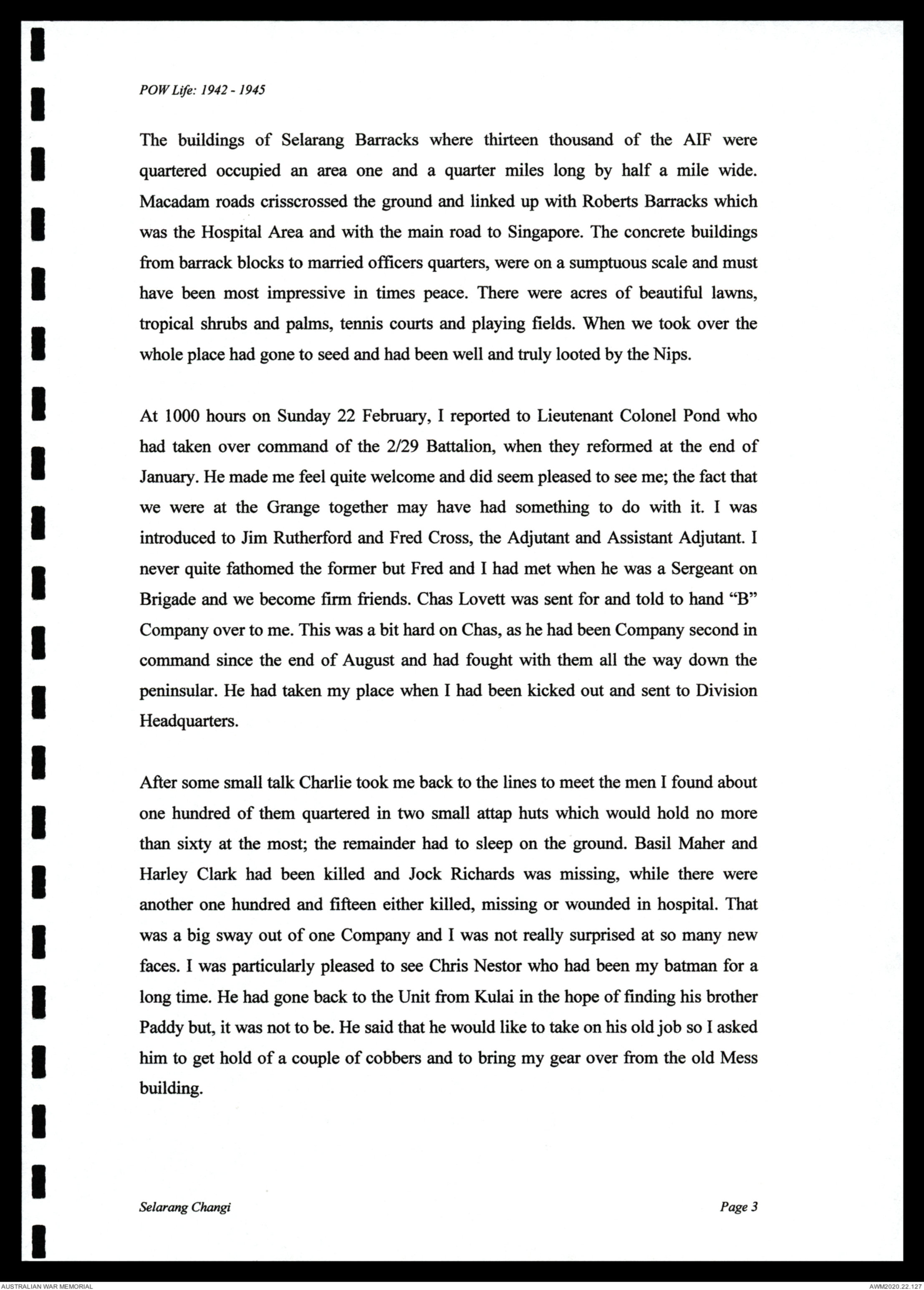
The buildings of Selarang Barracks where thirteen thousand of the AIF were
quartered occupied an area one and a quarter miles long by half a mile wide.
Macadam roads crisscrossed the ground and linked up with Roberts Barracks which
was the Hospital Area and with the main road to Singapore. The concrete buildings
from barrack blocks to married officers quarters, were on a sumptuous scale and must
have been most impressive in times peace. There were acres of beautiful lawns,
tropical shrubs and palms, tennis courts and playing fields. When we took over the
whole place had gone to seed and had been well and truly looted by the Nips.
At 1000 hours on Sunday 22 February, I reported to Lieutenant Colonel Pond who
had taken over command of the 2/29 Battalion, when they reformed at the end of
January. He made me feel quite welcome and did seem pleased to see me; the fact that
we were at the Grange together may have had something to do with it. I was
introduced to Jim Rutherford and Fred Cross, the Adjutant and Assistant Adjutant. I
never quite fathomed the former but Fred and I had met when he was a Sergeant on
Brigade and we became firm friends. Chas Lovett was sent for and told to hand "B"
Company over to me. This was a bit hard on Chas, as he had been Company second in
command since the end of August and had fought with them all the way down the
peninsular. He had taken my place when I had been kicked out and sent to Division
Headquarters.
After some small talk Charlie took me back to the lines to meet the men I found about
one hundred of them quartered in two small attap huts which would hold no more
than sixty at the most; the remainder had to sleep on the ground. Basil Maher and
Harley Clark had been killed and Jock Richards was missing, while there were
another one hundred and fifteen either killed, missing or wounded in hospital. That
was a big sway out of one Company and I was not really surprised at so many new
faces. I was particularly pleased to see Chris Nestor who had been my batman for a
long time. He had gone back to the Unit from Kulai in the hope of finding his brother
Paddy but, it was not to be. He said that he would like to take on his old job so I asked
him to get hold of a couple of cobbers and to bring my gear over from the old Mess
building.
Selarang Changi
Page 3
POW Life: 1942 - 1945
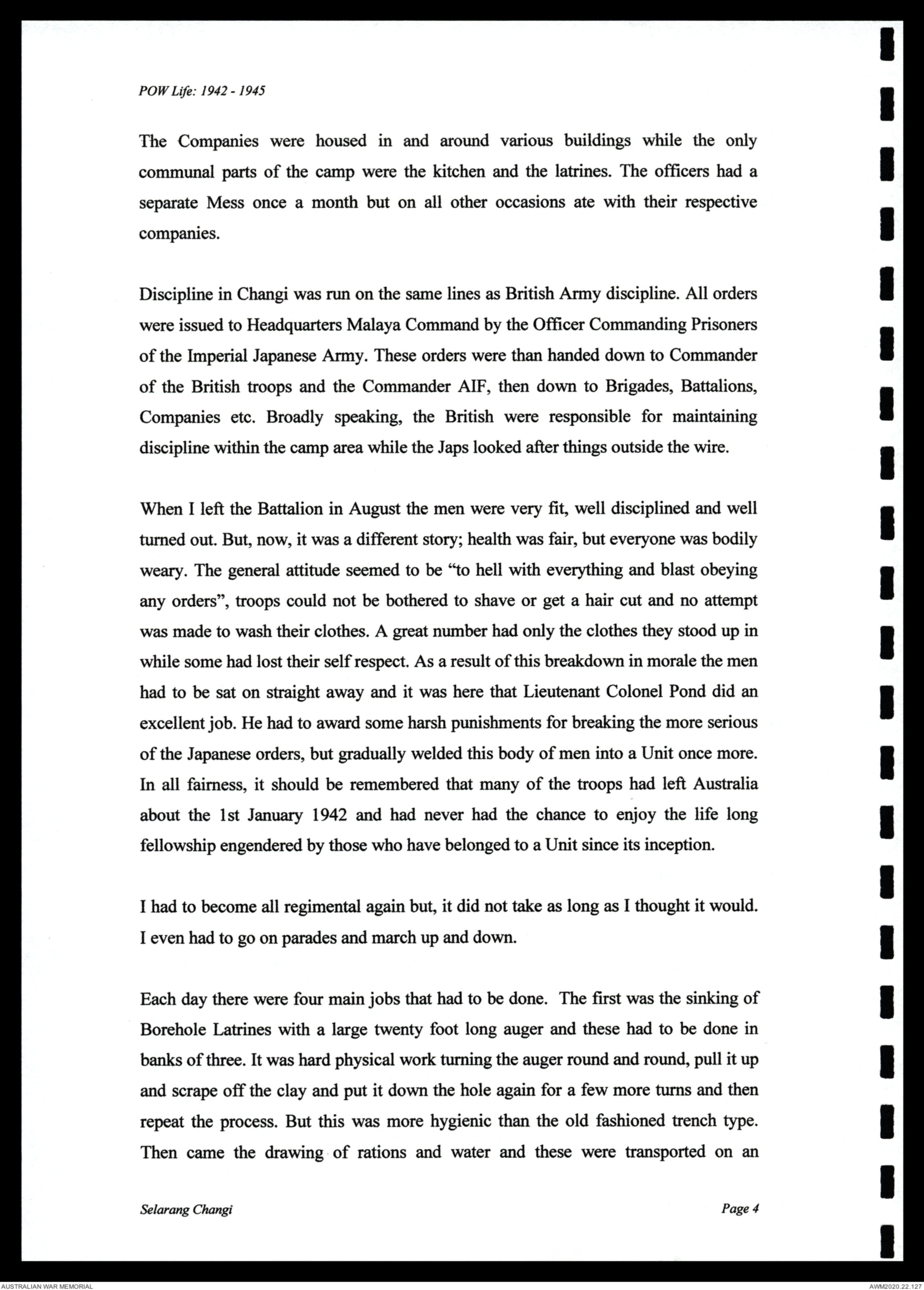
The Companies were housed in and around various buildings while the only
communal parts of the camp were the kitchen and the latrines. The officers had a
separate Mess once a month but on all other occasions ate with their respective
companies.
Discipline in Changi was run on the same lines as British Army discipline. All orders
were issued to Headquarters Malaya Command by the Officer Commanding Prisoners
of the Imperial Japanese Army. These orders were than handed down to Commander
of the British troops and the Commander AIF, then down to Brigades, Battalions,
Companies etc. Broadly speaking, the British were responsible for maintaining
discipline within the camp area while the Japs looked after things outside the wire.
When I left the Battalion in August the men were very fit, well disciplined and well
turned out. But now, it was a different story; health was fair, but everyone was bodily
weary. The general attitude seemed to be "to hell with everything and blast obeying
any orders", troops could not be bothered to shave or get a hair cut and no attempt
was made to wash their clothes. A great number had only the clothes they stood up in
while some had lost their self respect. As a result of this breakdown in morale the men
had to be sat on straight away and it was here that Lieutenant Colonel Pond did an
excellent job. He had to award some harsh punishments for breaking the more serious
of the Japanese orders, but gradually welded this body of men into a Unit once more.
In all fairness, it should be remembered that many of the troops had left Australia
about the 1st January 1942 and had never had the chance to enjoy the life long
fellowship engendered by those who have belonged to a Unit since its inception.
I had to become all regimental again but, it did not take as long as I thought it would.
I even had to go on parades and march up and down.
Each day there were four main jobs that had to be done. The first was the sinking of
Borehole Latrines with a large twenty foot long auger and these had to be done in
banks of three. It was hard physical work turning the auger round and round, pull it up
and scrape off the clay and put it down the hole again for a few more turns and then
repeat the process. But this was more hygienic than the old fashioned trench type.
Then came the drawing of rations and water and these were transported on an
Selarang Changi
Page 4
POW Life: 1942 - 1945
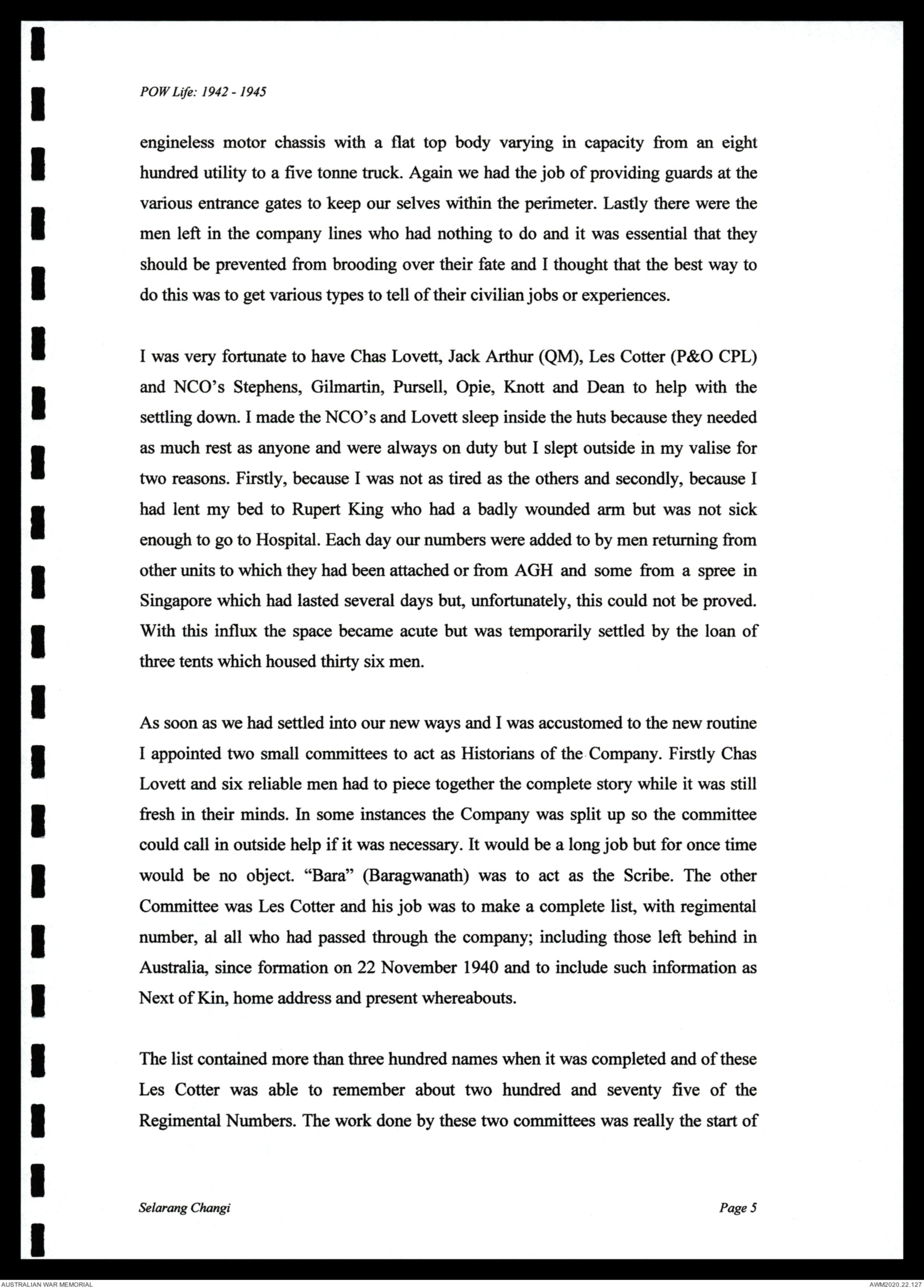
engineless motor chassis with a flat top body varying in capacity from an eight
hundred utility to a five tonne truck. Again we had the job of providing guards at the
various entrance gates to keep our selves within the perimeter. Lastly there were the
men left in the company lines who had nothing to do and it was essential that they
should be prevented from brooding over their fate and I thought that the best way to
do this was to get various types to tell of their civilian jobs or experiences.
I was very fortunate to have Chas Lovett, Jack Arthur (QM), Les Cotter (P&O CPL)
and NCO's Stephens, Gilmartin, Pursell, Opie, Knott and Dean to help with the
settling down. I made the NCO's and Lovett sleep inside the huts because they needed
as much rest as anyone and were always on duty but I slept outside in my valise for
two reasons. Firstly, because I was not as tired as the others and secondly, because i
had lent my bed to Rupert King who had a badly wounded arm but was not sick
enough to go to Hospital. Each day our numbers were added to by men returning from
other units to which they had been attached or from AGH and some from a spree in
Singapore which had lasted several days but, unfortunately, this could not be proved.
With this influx the space became acute but was temporarily settled by the loan of
three tents which housed thirty six men.
As soon as we had settled into our new ways and I was accustomed to the new routine
I appointed two small committees to act as Historians of the Company. Firstly Chas
Lovett and six reliable men had to piece together the complete story while it was still
fresh in their minds. In some instances the Company was split up so the committee
could call in outside help if it was necessary. It would be a long job but for once time
would be no object. "Bara" (Baragwanath) was to act as the Scribe. The other
Committee was Les Cotter and his job was to make a complete list, with regimental
number, al all who had passed through the company; including those left behind in
Australia, since formation on 22 November 1940 and to include such information as
Next of Kin, home address and present whereabouts.
The list contained more than three hundred names when it was completed and of these
Les Cotter was able to remember about two hundred and seventy five of the
Regimental Numbers. The work done by these two committees was really the start of
Selarang Changi
Page 5
POW Life: 1942 - 1945
the Battalion records as other Companies soon followed our example. Jack Bruce was
a great help to us as he had access to the files at second Echelon.
A vast amount of work went into the story of the Company. Someone would write of
an incident and then hand it to another for his criticism and eventually four or five
people would be involved in getting at the truth of the matter before it was finally
written up in the book of words by "Bara". When I returned I got a quote from a
publisher for one copy to go to the next of kin of those who did not return and one for
those who said that they would be interested in such a screed. When it came to the
point of actually raising the necessary funds it was a different matter and I decided to
let the matter drop although Harry Archdall kindly offered to help cut the losses if I
wanted to get on with the printing. I had two or three copies typewritten privately and
then gave "Bara's" mother the original version which had been written in Changi.
The first big difference with the Imperial Japanese Army concerned military etiquette
and took place in the first couple of days. The British prisoners from generals down to
privates were not saluting the Japanese and Indian sentries and soldiers. General
Heath replied that, under the Hague Convention, Officer POW did not have to salute
those of lesser rank. The Japanese were very clever, they could easily overcome this
silly convention; it was just a matter of the British officers removing their badges of
rank and then they would all be equal with no rank. However, as a special concession
they could wear a star on the flap of their left breast pocket but it must be remembered
that this star was not a badge of rank, just a means of identifying the British officers to
the British troops. Later on Field officers were allowed to mount their solitary Pip on
a piece of red cloth as a further distinguishing mark.
No one fancied saluting a Japanese or in some cases a Korean coolie but it had to be
done but it was very much against the grain to salute a renegade Sikh who a few days
before had been fighting on our side but was now an ally of the Japanese. Failure to
salute could mean a clout over the ear or some prolonged physical exercises such as
hand presses. A clout or two and we soon got into the required habit.
The day I took over the Company the IJA called for the first of three big work parties
to go into Singapore to clean up the mess caused by the fighting. Command AIF were
informed that these men would be back in two weeks. This was a slight
Selarang Changi
Page 6
POW Life: 1942 - 1945
understatement as it was not until December that I saw them again. Other large parties
went into the City on 11 March and 5 May. These three were known as the "Great
World" Thomson Road and River Valley Road Work Parties. As I said their man job
was cleaning up the debris but this word "debris" had a rather special meaning in that
it include loading onto Japan bound ships all material which could help their war
effort and it included building a shrine to the IJA at Bukit Timah. I missed all these
parties as my tummy was continually playing up with a mild form of dysentery.
Thursday, 26 February 1942 was a date to be remembered as it was the last day of
issue of European rations and the first of RICE and other IJA delicacies. The meals
were lousy for a long time after the change over as the cooks did not get the hang of
cooking rice in large quantities; enough for seventy five to one hundred men; in one
container for some days. At first it was just a sticky mess.
The first Japanese issue was, theoretically, 482 grams Rice, 99 Vegetables, 19.7
Sugar, 50 Salt, 4.9 Oil for Cooking, 4.9 Tea, 20 Pepper, with twenty eight grams to
the ounce this gave us an intake of 2lb 6oz of food per day, if we were lucky enough
to have had the full issue delivered by the Nips. The normal AIF ration added up to
5lb 7ozs. This first Nip ration remained in force until October 1942 and after that
there were ten main changes in the rice and vegetable ration. All meals for the Unit
were prepared in a central kitchen and then split up into Company lots. At first there
were many complaints of unequal distribution and also of withholding a portion of the
daily issue, the officers were getting more than the men. Most of the trouble stemmed
from the reinforcements and it took a little time to convince them that there were no
malpractices in the catering department with Bert Kemp running things. I still reckon
he was the only honest Quarter Master in the Army.
At the end of February, all POW paraded for the first of the "Humiliation Parades".
On these occasions all the men turned out for inspection by some high ranking officer.
The easiest formation to adopt was in file facing inwards along the main road through
the camp. We got all spruced up and then set off for our position which, for this first
parade, was down the hill towards Roberts Barracks. Here we stood or sat in the
boiling sun for more than two hours until His Nibs drove past in a car followed by a
Selarang Changi
Page 7
 Deb Parkinson
This transcription item is now locked to you for editing. To release the lock either Save your changes or Cancel.
This lock will be automatically released after 60 minutes of inactivity.