
Diary of service - Donald Morrison, 1940 - 1945 - Part 2

Photograph - see original document
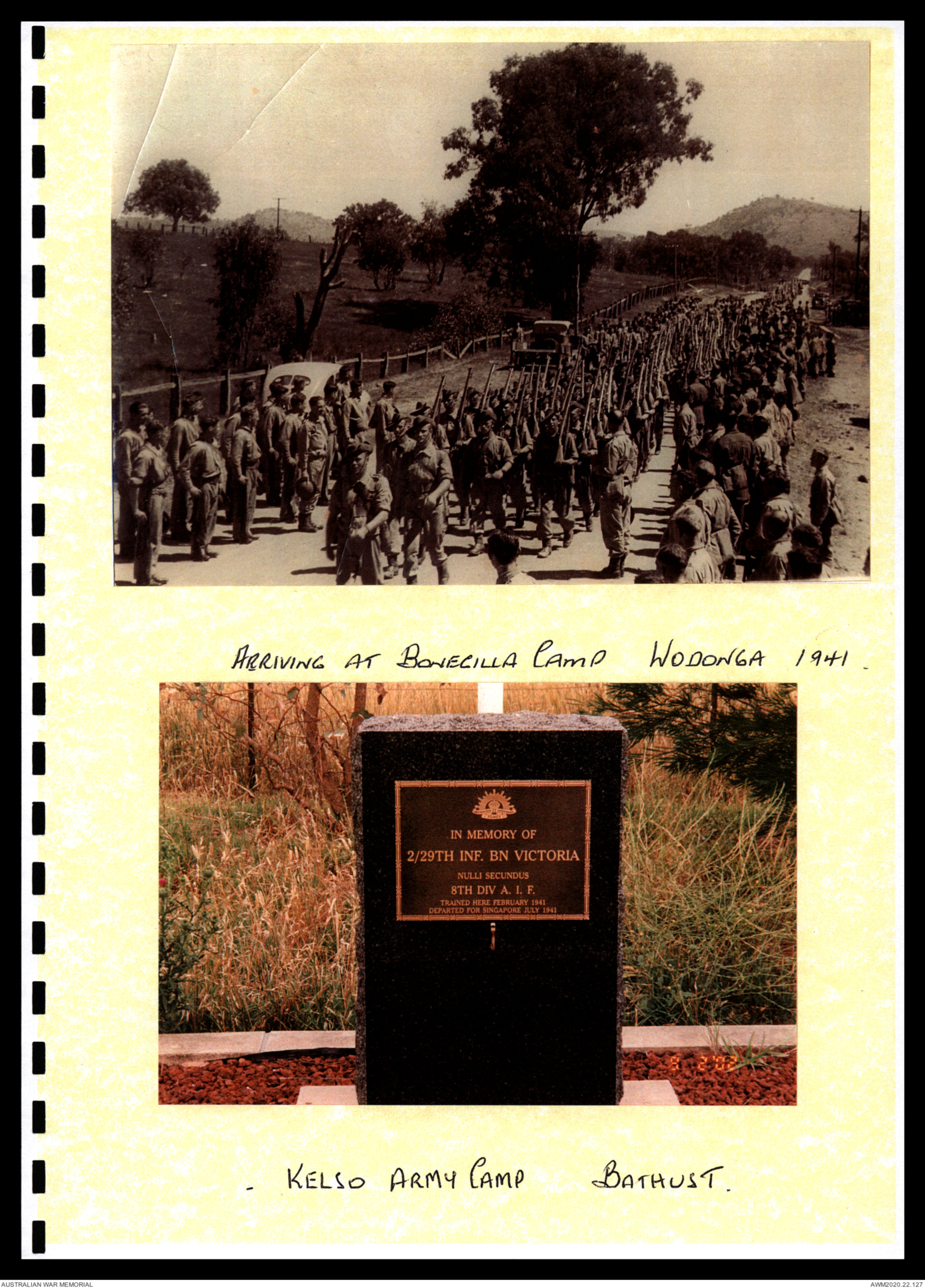
ARRIVING AT BONEGILLA CAMP WODONGA 1941
Photograph - see original document
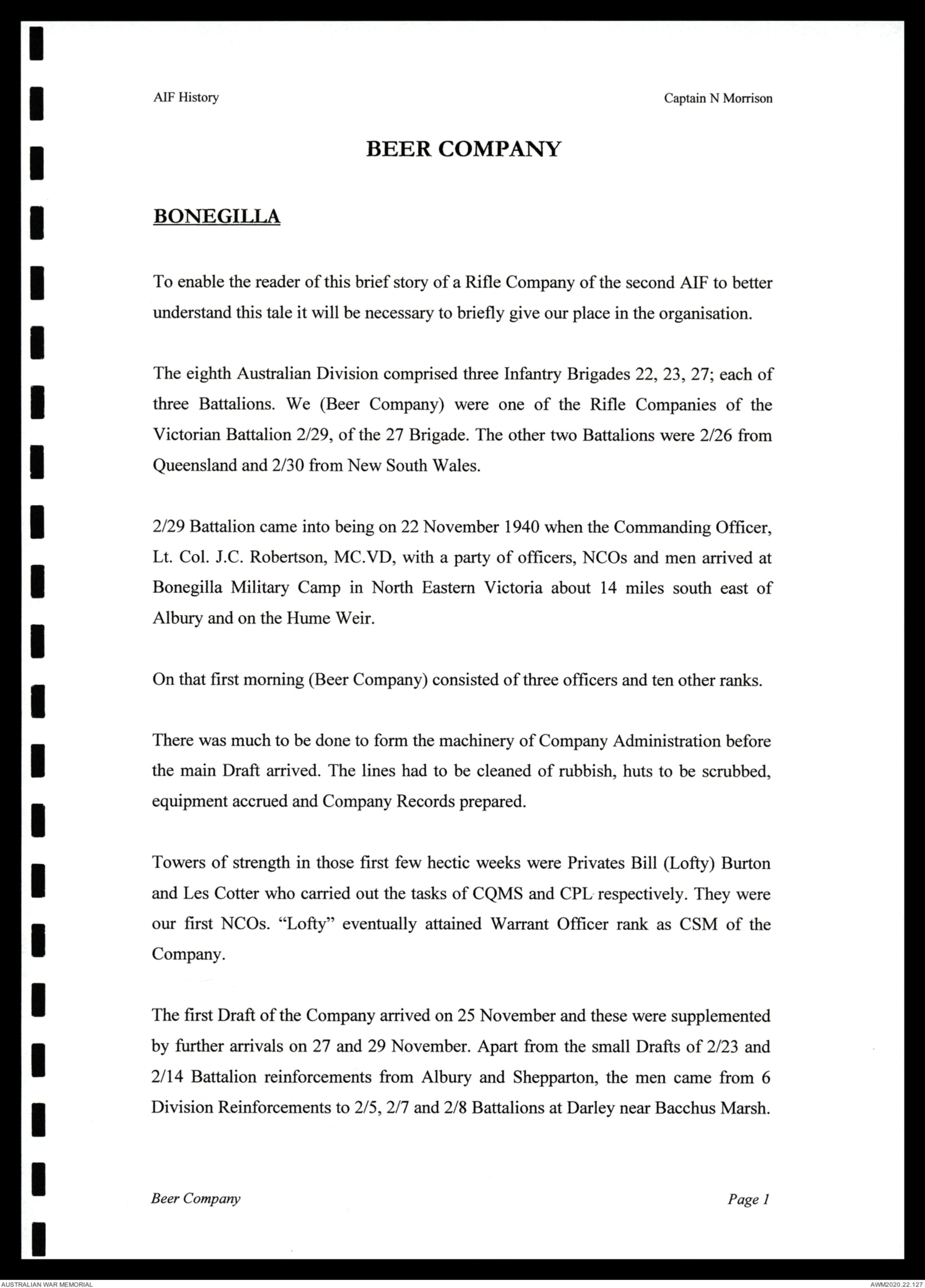
KELSO ARMY CAMP BATHURST
AIF History Captain N Morrison
BEER COMPANY
BONEGILLA
To enable the reader of this brief story of a Rifle Company of the second AIF to better
understand this tale it will be necessary to briefly give our place in the organisation.
The eighth Australian Division comprised three Infantry Brigades 22, 23, 27; each of
three Battalions. We (Beer Company) were one of the Rifle Companies of the
Victorian Battalion 2/29, of the 27 Brigade. The other two Battalions were 2/26 from
Queensland and 2/30 from New South Wales.
2/29 Battalion came into being on 22 November 1940 when the Commanding Officer,
Lt. Col. J.C. Robertson, MC.VD, with a party of officers, NCOs and men arrived at
Bonegilla Military Camp in North Eastern Victoria about 14 miles south east of
Albury and on the Hume Weir.
On that first morning (Beer Company) consisted of three officers and ten other ranks.
There was much to be done to form the machinery of Company Administration before
the main Draft arrived. The lines had to be cleaned of rubbish, huts to be scrubbed,
equipment accrued and Company Records prepared.
Towers of strength in those first few hectic weeks were Privates Bill (Lofty) Burton
and Les Cotter who carried out the tasks of CQMS and CPL respectively. They were
our first NCOs. "Lofty" eventually attained Warrant Officer rank as CSM of the
Company.
The first Draft of the Company arrived on 25 November and these were supplemented
by further arrivals on 27 and 29 November. Apart from the small Drafts of 2/23 and
2/14 Battalion reinforcements from Albury and Shepparton, the men came from 6
Division Reinforcements to 2/5, 2/7 and 2/8 Battalions at Darley near Bacchus Marsh.
Beer Company Page 1
AIF History Captain N Morrison
Fresh from winter billets, the men found the new camp a vast sprawling maze of huts
in a warm dry climate such as they had not previously experienced.
The new arrivals were welcomed by the three officers who tried to get the men settled
in and make them as comfortable as possible. The layout and routine of the camp was
explained and then came the unpopular announcement that all NCOs had to take down
their stripes and earn them all over again.
Amongst the arrivals were NCOs who were attached to the Battalion as instructors
with the chance, if they made the grade of becoming senior NCO and of acquiring
their VX numbers; they all made good. We had attached to us Sergeants Atkinson,
Irvine, Mawson and Martin.
Elementary training recapitulation began; this was necessary as the syllabus of
training in the various camps varied considerably. After elementary squad drill and
weapon training: irksome to the men who always prefer to “wait until we get into
action”. The platoons sorted themselves into defined sections and tactical training was
commenced.
About a week after our formation, we met the officer commanding the Company who
took over from Lieutenant Morrison. This was Captain Basil Maher, an experienced
soldier who has started his military career as a private in the citizen forces and had
risen to Captain in the Militia. He spent some time on the home service list with an
AIF training depot at Mt Martha and then went as adjutant to an A.A. Unit at Ballarat
before taking up his appointment with 2/29. Basil Maher, unfortunately killed at Parit
Sulong, Malaya, was an inspiring leader, had the confidence of his men and was
directly responsible for the discipline and fighting qualities of the Company. In civil
life he was an officer of the Victorian Taxation Department and a well known athlete.
On 3 December Lieutenant Morrison was evacuated to the Camp Hospital with
Pneumonia. Being concerned with the lack of visitors he decided to keep a hot box
well stocked with light refreshments by his bed. After this information had been
promulgated many well wishers gathered daily at the Morrison sick bed. At this stage
Beer Company Page 2
AIF History Captain N Morrison
it could be mentioned of the friendships made with the nurses by members of the
Company.
It was an extremely sad parting that night in January 1941, when the nurses entrained
for embarkation in Sydney to join the AIF in the Middle East. “Bara’s”; sister was one
of the 7. During the church service held the morning after the nurses departure there
was a pathetic scene noticed by only a few. The closing hymn was “for those in
peril on the sea”. Alas the strain was too much for one love lorne subaltern, he broke
down completely and burst into tears.
A mild but entertaining form of recreation in those days was trying to master the art of
Boomerang throwing. The tutor was Wally Carter, a full blooded aborigine from the
Wimmera. Many tried their hands at throwing but few became proficient. Even the
nurses were prevailed upon to try their skills. “Wally” was one of our best cricketers.
He left us at Bathurst and went to 2/14 reinforcements.
As the weather grew warmer the boys became eager for a swim. Through the
Battalion syllabus of training the Company conducted regular swim parades at the
Hume Weir. Non swimmers were looked after and coaches chosen to instruct them.
Quite a number of the lads learnt to swim at Bonegilla. In spite of all our efforts none
of the Company gained a place in the Battalion team that swam at Albury against the
other units stationed in the camp.
It was close now to Christmas and a Battalion greeting card was made available to all
at a nominal charge. Everyone eagerly anticipated a period of leave which was
particularly welcome as owing to being transferred to a new unit many of the troops
had no leave for several weeks. A number of the Company availed themselves of a
few extra days AWOL. But this was paid for at the rate of 10/- per day of absence,
forfeiture of pay for that time and a lecture from the CO.
Shortly after leave, the Company were transported to the Albury Rifle Range where
the men fired over ranges from 100 to 500 yards.
Beer Company Page 3
AIF History Captain N Morrison
The course lasted three days and during the night an exercise of the platoon in attack
was conducted. A second range practice was held at Wodonga. The Company firing
Light Machine Guns and, at night, “Tracer”; Later another day at the Albury Range
completed the first part of the range work.
Early in January 1941, the Company received its third platoon Commander,
Lieutenant, CG Lovett who went to Number 12 Platoon.
The canteen service and recreation facilities were features of Bonegilla Camp. The
wet canteen had just been introduced and did a huge trade during the stifling summer
nights; so great did this trade become that Battalion Wet Canteens were opened. For
non participants of alcohol, delicious milk, supplied by local dairy farms was
available. Also stocked in the canteens were stationery, clothing, groceries, sweets,
tobacco, and such like, everything a soldier could want. There were five large
recreation huts for reading and writing, one of which was equipped as a theatre where
free talkies and concerts were given. Tea and biscuits were obtainable for a small
charge at the huts run by the comforts fund, YMCA, Salvation Army and the various
Churches.
Social activities took the boys beyond the camp bounds to Wodonga and Albury with
their recreation rooms, Theatre, dances and shops.
Early in the New Year a Battalion Ball was held in the Ritz Cabaret and it proved a
great success. Other Battalions sponsored dances which we attended and regular
Friday and Saturday night dances run by the Rex Palais were always popular. On
Sundays, the Camp was open to visitors and picnics round the weir and further out
into the country were the order of the day. The more fortunate possessors of cars were
able to visit Tallangatta, Kiewa and Bethanga, where troops were very popular with
the hospitable inhabitants.
Company concerts were inaugurated by Captain Maher, the first being held in the
Company Mess Hut with Lieutenant Lovett as MC. It was here that the talent of
Company Mess Hut with Lieutenant Lovett as MC. It was here that the talent of
Private Les Bennett, as an excellent pianist and organiser was discovered. This was
Beer Company Page 4
AIF History Captain N Morrison
the forerunner of many concerts and later developed into the Battalion concert party
which gave many public performances for patriotic appeals, notably at Blayney and
Young in NSW. After we moved to Bathurst, it achieved the height of its success
Young in NSW. After we moved to Bathurst, it achieved the height of its success
when it was “Put on the Air”.
“Beer Company” also started tabloid sports which were later taken up by the other
companies and eventually were included in the syllabus of training.
A notable event took place near the end of January 1941, when the Governor
General, Lord Gowrie, paid a visit to Bonegilla. The few days training for this
Ceremony were conducted under very trying conditions and many men collapsed with
the heat on the final day of rehearsal. The review held in the Bonegilla Racecourse
was a magnificent spectacle and a large crown turned out to witness the March go
past
with nearly five thousand men.
Preparation for a further ceremony was then commenced. The Military Board set
aside 14 February 1941 for a March through Melbourne of AIF Troops from
Bonegilla to aid the Greek War Appeal. During the many practices for the March the
troops became familiar with the Regimental March “Sussex by the Sea”, played by
the newly formed Battalion band. Just after midnight on the great day the Battalion
entrained for Melbourne and on arrival marched to the forming up place in Alexandra
Gardens. The “Q” staff provided a very good breakfast for the hungry men even if the
Soyer stoves did look out of place on the beautifully kept lawns. After a wash and
shave, and a change we were ready to march off in column of route. The ablutions of
the men were a source of amusement to the crowd and a “Picnic” for the press
photographers.
Brigadier E.F. Lind C.B.E., D.S.O., V.D., commanding 23 Brigade, lead the March
past of 2/21, 2/22, 2/29, 2/40 Battalions who marched in that order. Brigadier Norman
Marshall D.S.O., M.C., commanding 27 Brigade took his place in front of the Unit.
We had Captain Maher at the head of the Company and the men marched very well. It
was one of the most impressive functions that Melbourne had seen. The men were
wearing summer dress, shorts and open neck shirts and looked real “Bronze Anzacs”.
Beer Company Page 5
AIF History Captain N Morrison
After dismissal, the troops enjoyed an extended leave, and on return to Bonegilla,
preparations were made to transfer the Battalion to Bathurst NSW, where the other
Battalions of the Brigade were also concentrating.
Beer Company Page 6
AIF History Captain N Morrison
BATHURST TRAINING
The Unit at the Albury Station on the afternoon of 24 February 1941.
Before leaving the station everyone received an excellent meal on the platform, which
was served by the volunteer workers. During the long night journey a break of ten
minutes was made at Young, NSW, where tea and sandwiches were served by the
hospitable citizens. This was our first experience of the wonderful kindness of the
people of this town, who by adopting the Battalion will be forever remembered in the
hearts of old “Beer Company” and the rest of the Company.
Bathurst was reached early the following morning. The Company derailed at Kelso, a
small Village two miles out of the town. We marched through the Village and halted
for breakfast on a rise overlooking the bleak plains that were to become so familiar in
the months to follow. From here transport took us to the camp which was more widely
scattered than Bonegilla. Bonegilla and Bathurst Camps had only one point of
similarity in the layout and that was the so called Civic Centre (Canteen, Picture
Theatre, Post Office etc).
Bonegilla was made to accommodate a Brigade and attached troops; each Unit being
grouped around its own Headquarters. Bathurst was laid out in Blocks, each of which
accommodated 500, but no thought was given to the grouping of Units. We were a
good ten minutes walk from Battalion Headquarters. The layout, as used by Southern
Command, was easily the better of the two.
The country was more undulating than our old homes and finished in the rugged
foothills of the Hume Range, which rose in the background. A sharp drop in the
temperature at night and our elevation of more than 2,000 feet, should have prepared
us for the winter months but no one thought of such things, as we prepared to build a
new home.
Training was now expected to be of a much more advanced nature and after a few
days settling in, we always had our midday meal in the field. Food was distributed
from hot boxes brought out in the Company utility.
Beer Company Page 7
AIF History Captain N Morrison
At one stage, the jam ration was very light, so the C.Q.M.S tried his hand at the
culinary art of Jam Making from Quinces “Gathered” by the boys; a very tasty supply
was made.
Training was now in full swing and the rugged hills of Bathurst were soon discovered
by the Company. The first training area contained Peel Trig, a steep ridge and
adjoining a chain of hills. Company exercises consisted of Platoons in attack and
defence each day in the training area. A distance of two to four miles was made with
the Company deployed.
After a little while, all night exercises began and these consisted of the occupation of
a perimeter defence which necessitated wiring and slit trench digging. How useful the
latter was to become in Malaya. Blackout conditions were enforced and the glow of a
surreptitious cigarette would bring that soon to be familiar cry “Put out that Bloody
cigarette”.
While still at Bonegilla, it was decided that the Company should have its own flag.
The first design submitted to the CO for approval was rejected. This consisted of a
green background in the centre of which was a Tiger’s Head with the words “Beer
Company” underneath. The final design was a green background with the Regimental
Colours enclosed in Boomerangs and “B” Company 2/29 Battalion in black lettering.
The flag was made and donated to the Company by friends of Private Les Bennett. To
these friends the Company owes a debt of gratitude for their kindness and generosity.
The flag was flown daily at the edge of the Company Parade Ground at Bathurst and
in Malaya. Alas, like many other valuable things it was lost during the fighting.
The first important night tactical scheme was the Company’s occupation of a
defensive position near Peel Village. After a move across the country in the dark early
hours, the way was lost only once. A dawn attack was made on the village and the
enemy driven out. Much endurance was necessary for these stunts as many miles were
covered on foot over rough country and the men were laden with “impedimenta”.
Beer Company Page 8
AIF History Captain N Morrison
As the days grew shorter and the nights colder the troops experienced great
discomfort in sleeping out in the field. During exercises of this nature, the equipment
could not be reduced, so bedding was cut to a minimum.
So far, we had no changes in commissioned ranks but, several N.C.Os had
temporarily held the appointment of C.S.M. In late March Sergeant Lew Martin who
had been Platoon 6 Sergeant, received a Warrant Commission and took over the
duties of C.S.M. He was posted to the O.T.C. at Liverpool when Sergeant Mawson
took his place until we too were sent to O.T.C. and unfortunately was unable to rejoin
us before we embarked. W.O. Martin returned to the company in July 1941, and
carried on until he received his Commission in Malaya.
In April 1941, Lieutenant Morrison, who was 2IC of the Company, and our first
Officer was promoted to Captain. This was expected as befitted a 2IC, but all were
genuinely pleased to hear of his promotion.
On the night prior to April leave, the Company took part in an all night March across
country. It traversed a route about 23 miles in length and covered some very rough
ground. As far as possible, however, it achieved no useful purpose unless the idea was
to bring about an extra degree of tiredness and thus reduce the amount of noise on the
leave train.
In May the Company commenced tactical exercises of several days duration. These
exercises included all ranks and were scheduled so that we had to dig in, in the
darkness. The first of these exercises has been and always will be referred to as the
“Wambool Schemozzle”. No more need to be said. However, we did improve as time
went on.
Our first ceremonial since the jaunt through Melbourne, earlier in the year, was a
March through Bathurst, in aid of the War Appeal. The Company went on foot to the
Showgrounds where an excellent meal was provided from a Mobile Kitchen, before
we went to the starting line.
Beer Company Page 9
Last edited by:
 Loretta Corbett
Last edited on:
This transcription item is now locked to you for editing. To release the lock either Save your changes or Cancel.
This lock will be automatically released after 60 minutes of inactivity.