
Letter and photograph of Robert Leslie Holden, 1915-1916 - Part 2
11
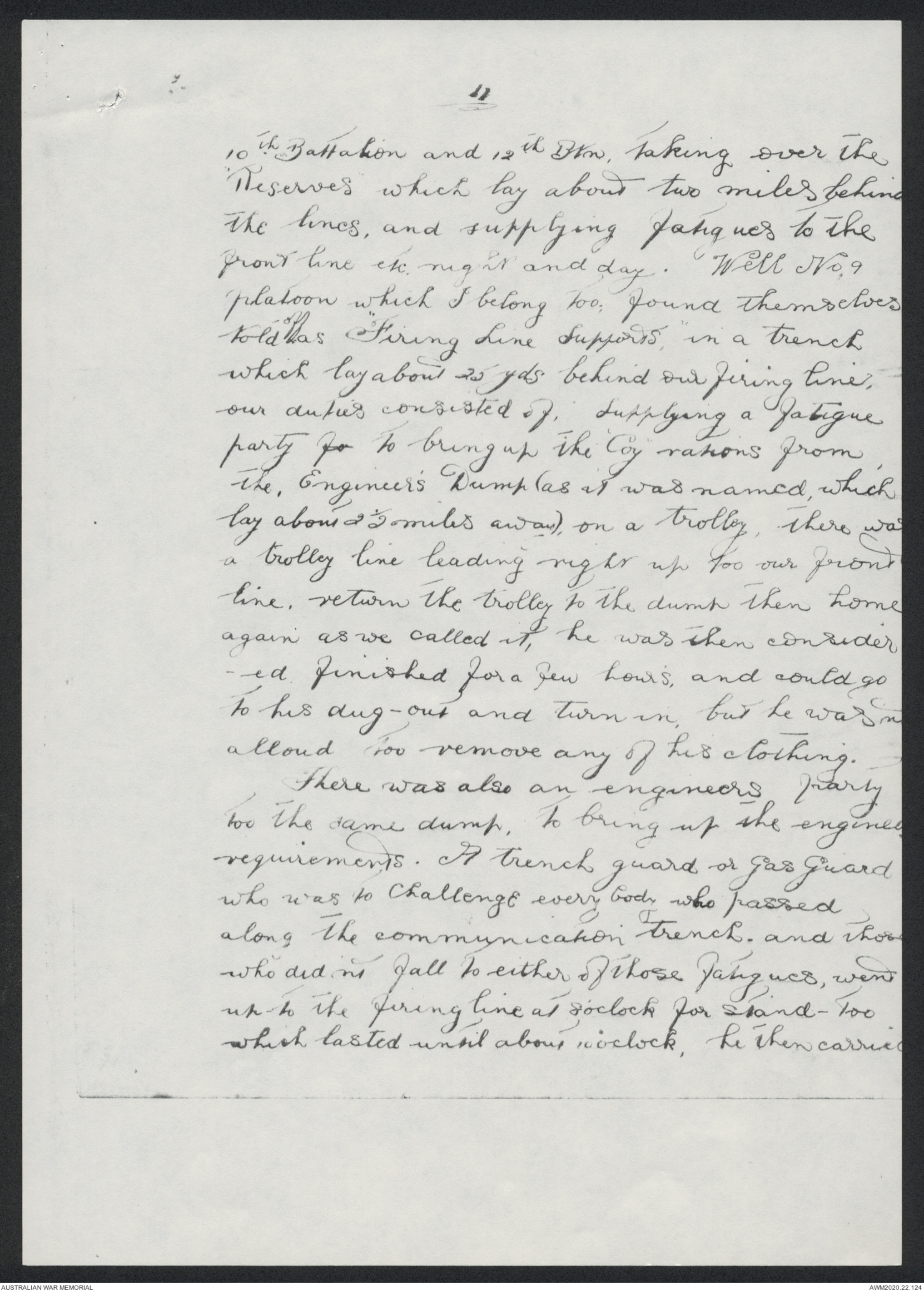
10th Battalion and 12th Btn, taking over the
"Reserves" which lay about two miles behind
the lines, and supplying fatigues to the
front line etc. night and day. Well No.9
platoon which I belong too, found themselves
told ^off as "Firing Line Supports," in a trench
which lay about 25 yds behind our firing line,
our duties consisted of, supplying a fatigue
party fo to bring up the "Coy" rations from
the, Engineer's Dump (as it was named, which
lay about 2½ miles away), on a trolley, there was
a trolley line leading right up too our front
line, return the trolley to the dump then home
again as we called it, he was then considered
finished for a few hours, and could go
to his dug-out and turn in, but he wasn
alloud too remove any of his clothing.
There was also an engineers party
too the same dump, to bring up the enginee
requirements. A trench guard or Gas Guard
who was to challenge every body who passed
along the communication trench. and those
who didnt fall to either of those fatigues, went
up to the firing line at 8 o'clock for the stand-too
which lasted until about 10 o'clock, he then carried
12
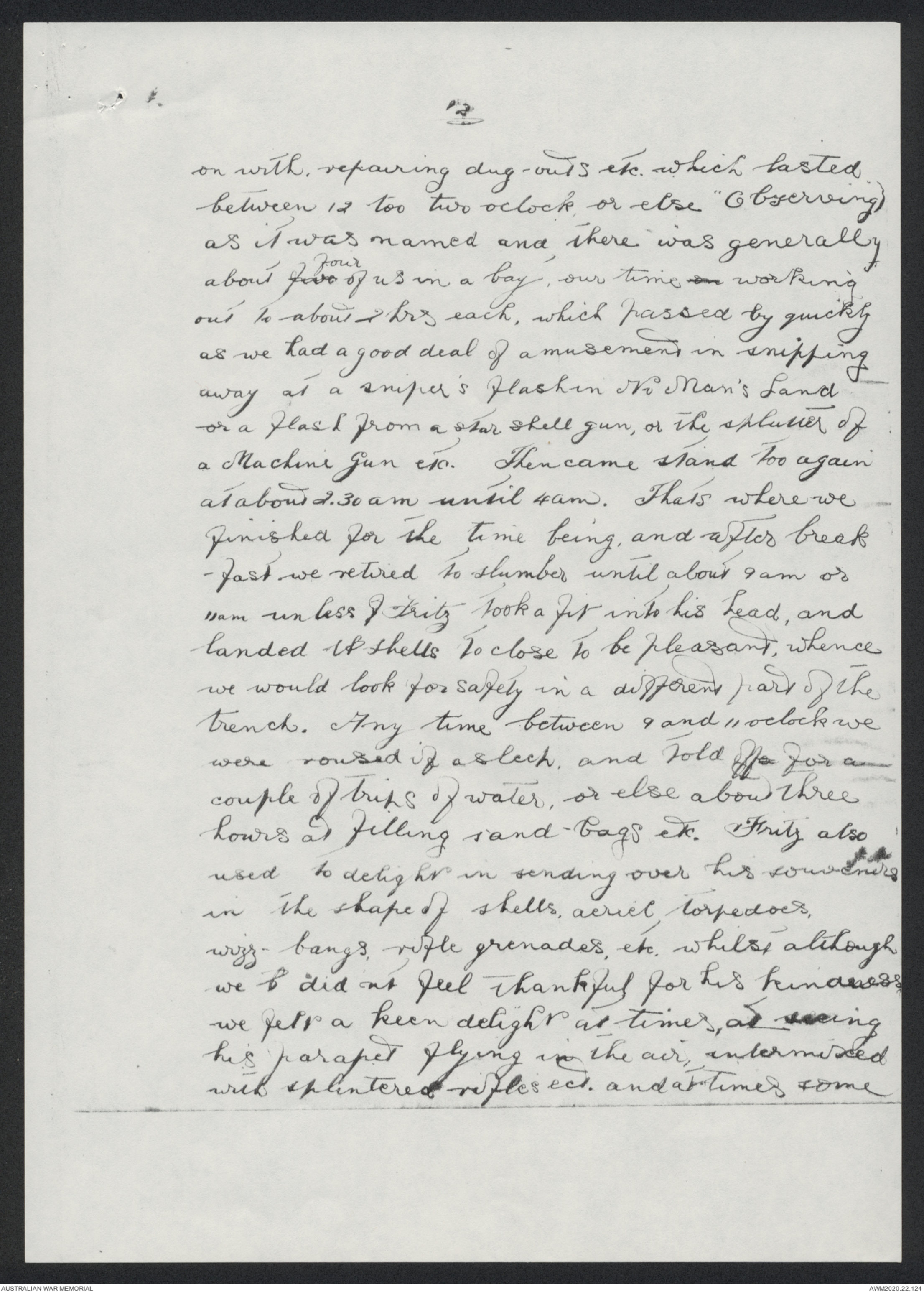
on with, repairing dug-outs etc. which lasted
between 12 too two oclock or else "Observing)
as it was named and, there was generally
about five ∧four of us in a bay, our time on working
out to about 2 hrs each, which passed by quickly
as we had a good deal of amusement in snipping
away at a sniper's flash in No Man's Land
or a flash from a star shell gun, or the splutter of
a Machine Gun etc. Then came stand too again
at about 2.30 am until 4 am. Thats where we
finished for the time being, and after breakfast
we retired to slumber until about 9 am or
11 am unless Fritz took a fit into his head, and
landed it shells to close to be pleasant, whence
we would look for safety in a different part of the
trench. Any time between 9 and 11 oclock we
were roused if asleep, and told offe for a
couple of trips of water, or else about three
hours at filling sand-bags etc. Fritz also
used to delight in sending over his souvenirs
in the shape of shells, aeriel torpedoes,
wizz-bangs, rifle grenades, etc. whilst although
we b didnt feel thankful for his kindness
we felt a keen delight at times, at seeing
his parapet flying in the air, intermixed
with splintered rifles ect. and at times some
13
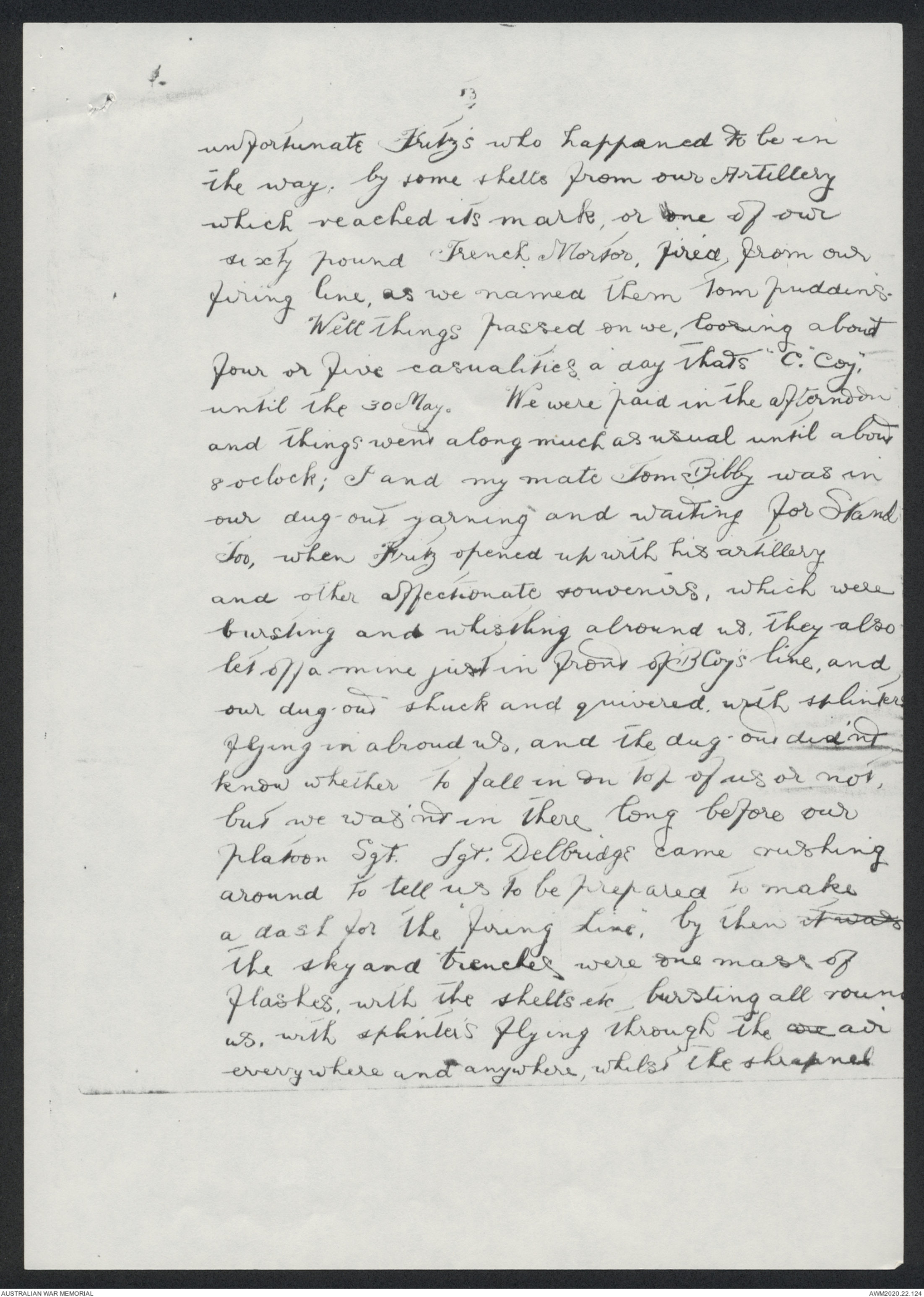
unfortunate Fritz's who happened to be in
the way. by some shells from our Artillery
which reached its mark, or one of our
sixty pound Trench Mortor, fired from our
firing line, as we named them Tom pudding.
Well things passed on we, loosing about
four or five casualties a day thats "C."Coy",
until the 30 May. We were paid in the afternoon
and things went along much as usual until about
8 oclock; I and my mate Tom Bibby was in
our dug-out yarning and waiting for Stand
Too, when Fritz opened up with his artillery
and other affectionate souvenirs, which were
bursting and whistling alround us.They also
let off a mine just in front of 'B Coy's' line, and
our dug-out shuck and quivered, with splinters
flying in alroud us, and the dug-out did'nt
know whether to fall in on top of us or not,
but we was'nt in there long before our
platoon Sgt. Sgt. Delbridge came rushing
around to tell us to be prepared to make
a dash for the "Firing Line", by then it was
the sky and trenches were one mass of
flashes, with the shells etc bursting all round
us, with splinter's flying through the are air
everywhere and anywhere, whilst the shrapnel
14
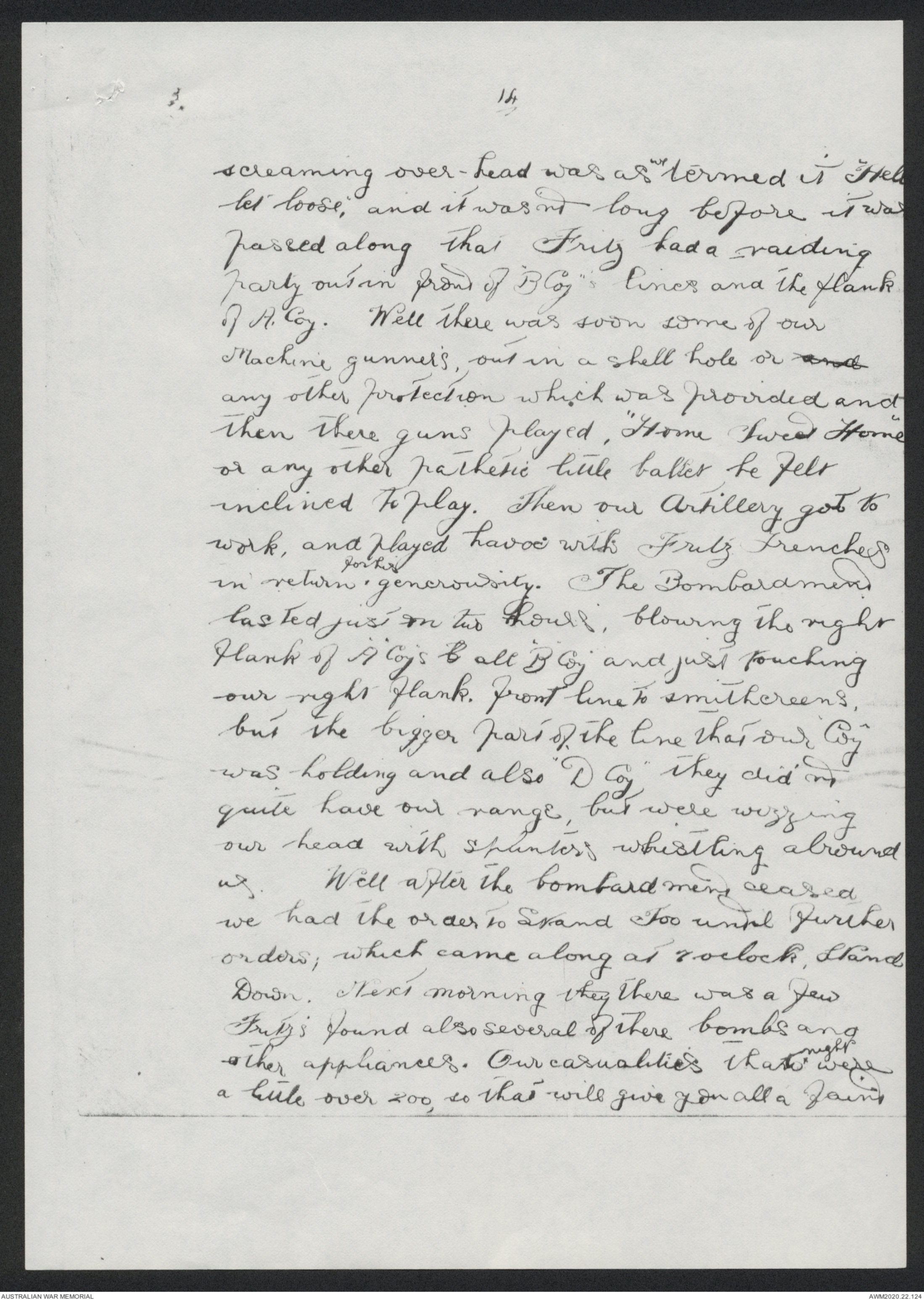
screaming over-head was as ∧we termed it "Hell
let loose," and it was'nt long before it was
passed along that Fritz had a raiding
party out in front of "B Coy"s lines and the flank
of A. Coy. Well there was soon some of our
Machine gunner's, out in a shell hole or and
any other protection which was provided and
then there guns played, "Home Sweet Home"
or any other pathetic little ballet he felt
inclined to play. Then our Artillery got to
work, and played havoc with Fritz Trenches
in return ∧for his generosity. The Bombardment
lasted just on two hours, blowing the right
flank of 'A' Coy'sb all 'B Coy' and just touching
our right flank. front line to smithereens,
but the bigger part of the line that our "Coy"
was holding and also "D Coy", they did'nt
quite have our range, but were wizzing
our head with splinters whistling alround
us. Well after the bombardment ceased
we had the order to Stand Too until further
orders; which came along at 7 oclock, Stand
Down. Next morning they there was a few
Fritz's found also several of there bombs and
other appliances. Our casualties that ^night were
a little over 200, so that will give you all a faint
15
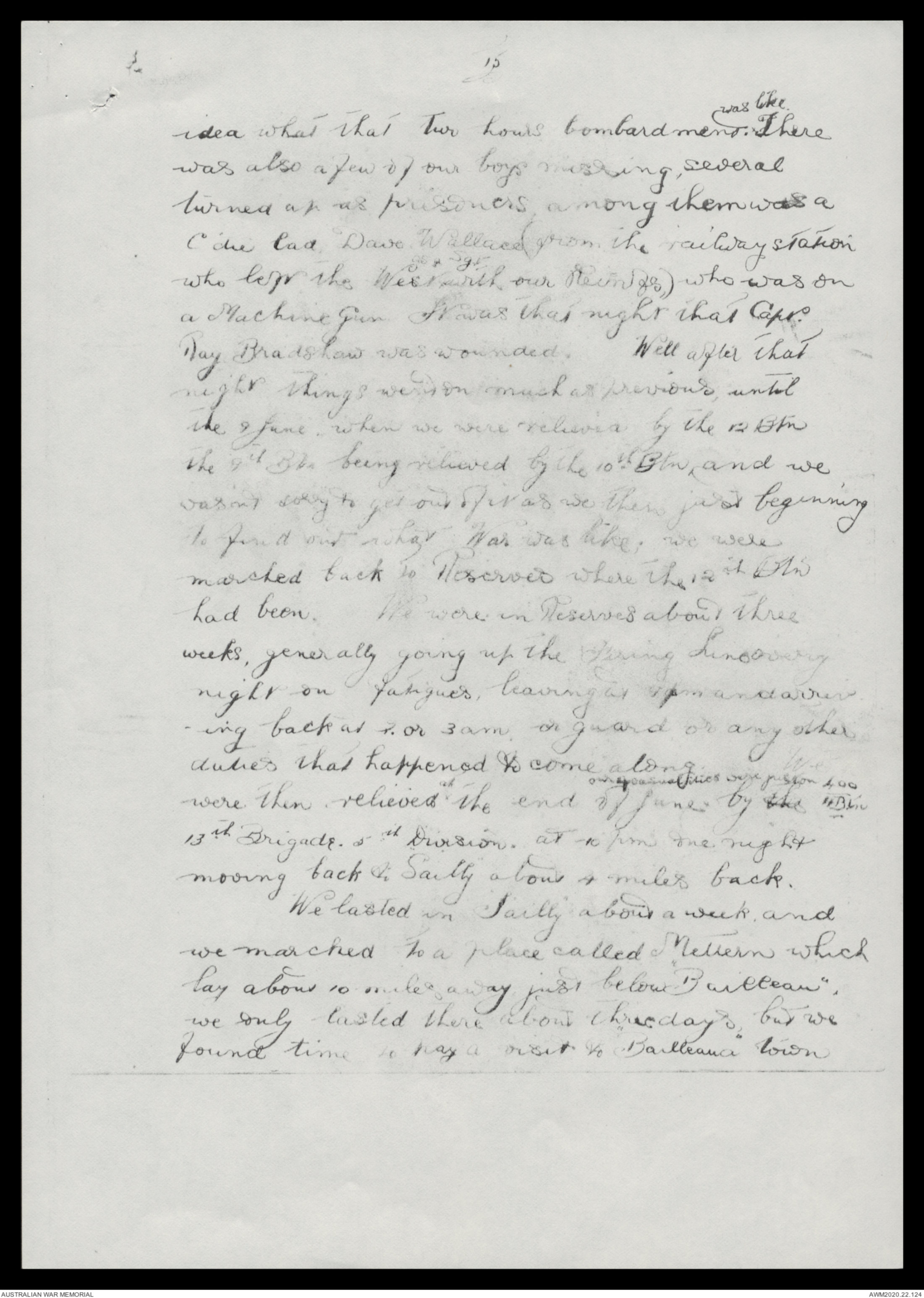
idea what that two hours bombardment ^was like. There
was also a few of our boys missing, several
turned up as prisoners, among them was a
C'die lad, Dave Wallace (from the railway station
who left the West ^as a Sgt with our Reinfs,) who was on
a Machine Gun It was that night that Capt.
Ray Bradshaw was wounded. Well after that
night things went on much as previous, until
the 9 June, when we were relieved by the 12 Btn
the 9th Btn being relieved by the 10th Btn, and we
was'nt sorry to get out of it as we then just beginning
to find out what War was like; we were
marched back to Reserves where the 12th Btn
had been. We were in Reserves about three
weeks, generally going up the Firing Line every
night on fatigues, leaving at 9 pm and arriving
back at 2 or 3 am, or guard or any other
duties that happened to come along. We
were then relieved ^at the end of June ^our casualties were just on 400 by the 4Btn
13th Brigade. 5th Division. at 10 pm one night
moving back to Sailly about 4 miles back.
We lasted in Sailly about a week, and
we marched to a place called Mettern which
lay about 10 miles away just below "Bailleau",
we only lasted there about three days but we
found time to pay a visit to "Bailleau" town
16
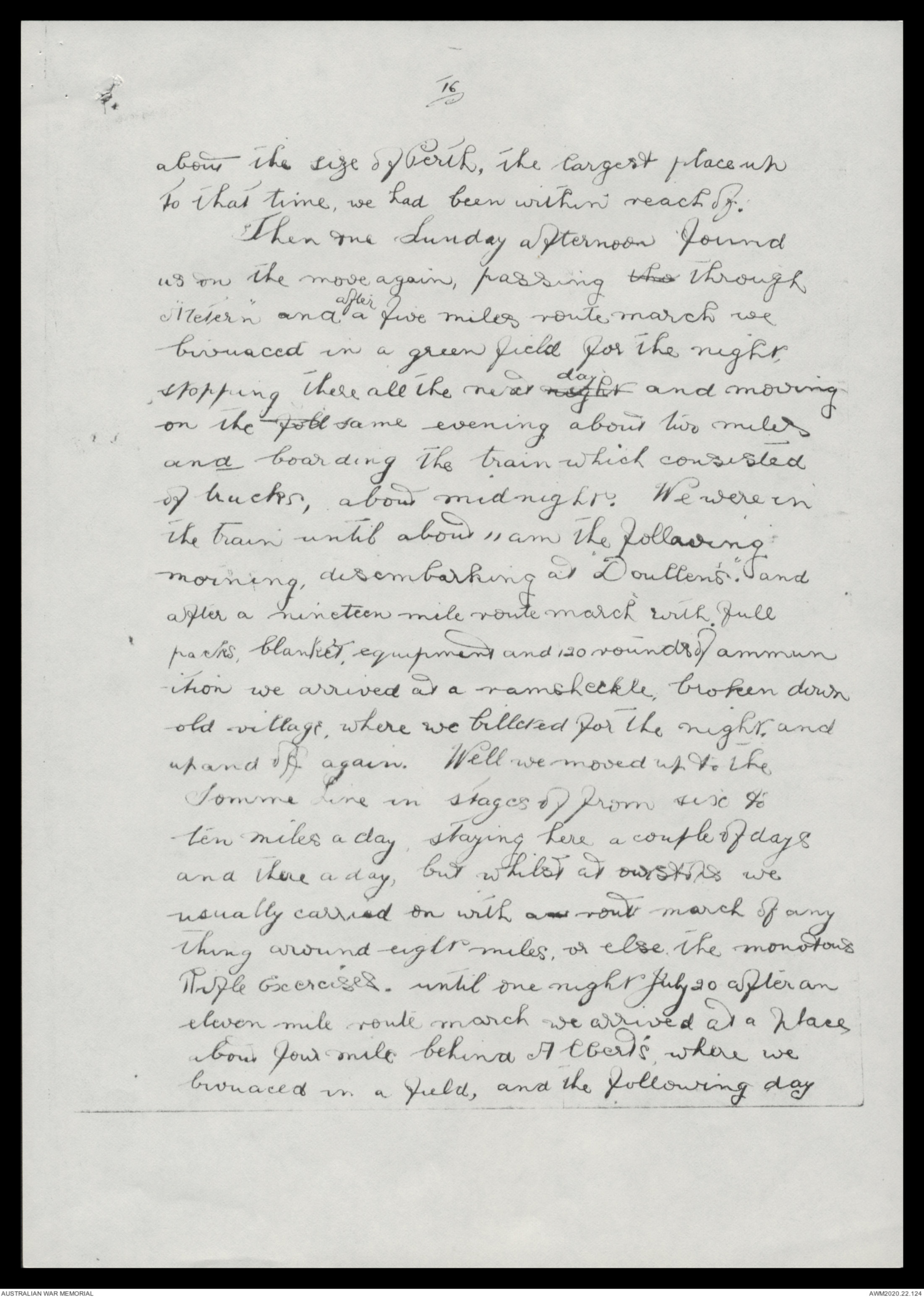
about the size of Perth, the largest place up
to that time, we had been within reach of.
Then one Sunday afternoon found
us on the move again, passing tho through
"Metern" and ∧after a five miles route march we
bivuaced in a green field for the night,
stopping there all the next night ∧day and moving
on the foll same evening about two miles
and boarding the train which consisted
of trucks, about midnight. We were in
the train until about 11 am the following
morning, disembarking at "Doullens". and
after a nineteen mile route march with full
packs, blanket, equipment and 120 rounds of ammunition
we arrived at a ramshackle, broken down
old village, where we billeted for the night, and
up and off again. Well we moved up to the
Somme Line in stages of from six to
ten miles a day, staying here a couple of days
and there a day, but whilst at our stops we
usually carried on with an route march of any
thing around eight miles, or else the monotous
Rifle Exercises, until one night July 20 after an
eleven mile route march we arrived at a place
about four mile behind Albert's, where we
bivuaced in a field, and the following day
17
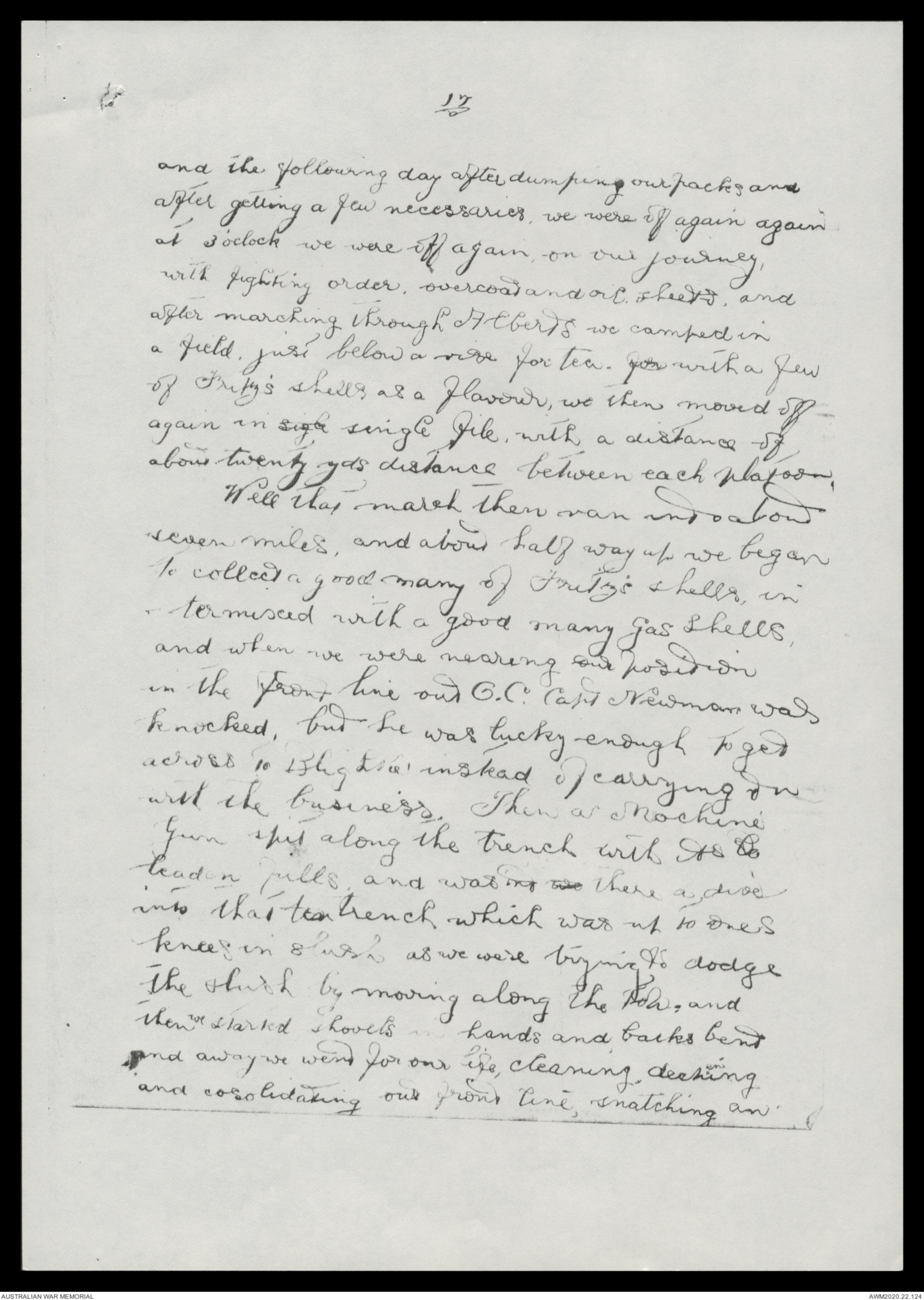
and the following day after dumping our packs and
after getting a few necessaries we were off again again
at 3 o'clock we were off again on our journey,
with fighting order, overcoat and oil, sheets, and
after marching through Alberts we camped in
a field, just below a rise for tea. for with a few
of Fritz's shells as a flavour, we then moved off
again in sigle single file, with a distance of
about twenty yds distance between each platoon.
Well that march then ran into about
seven miles, and about half way up we began
to collect a good many of Fritz's shells, intermixed
with a good many Gas shells,
and when we were nearing our position
in the front line our O.C. Capt Newman was
knocked, but he was lucky enough to get
across to Blightie, instead of carrying on
with the business. Then a Machine
Gun spit along the trench with its lo
lead on frills and wating we there a dive
into that ten trench which was up to ones
knees in slush as we were trying to dodge
the slush by moving along the top, and
then we started shovels in hands and backs bent
and away we went for our life, cleaning, deckening
and cosolidating our front line, snatching an
18
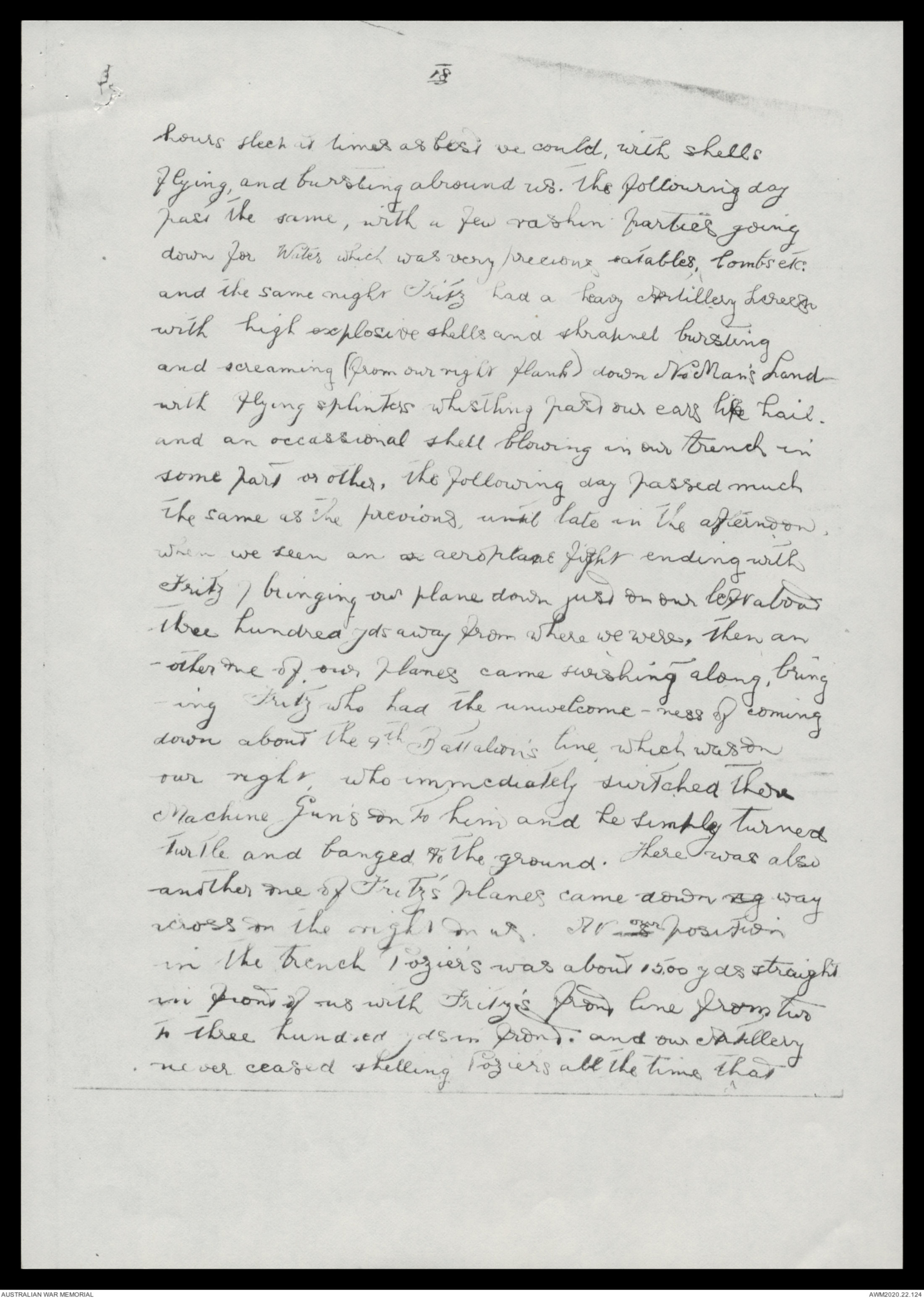
hours sleep at times as best we could, with shells
flying, and bursting alround us. the following day
past the same, with a few rashin parties going
down for Water which was very precious, eatables, bombs etc.
and the same night Fritz had a heavy Artillery Screen
with high explosive shells and shrapnel bursting
and screaming (from our right flank) down No Man's Land
with flying splinters whistling past our ears like hail.
and an occasional shell blowing in our trench in
some part or other, the following day passed much
the same as the previous, until late in the afternoon,
when we seen an ar aeroplane fight ending with
Fritz, bringing our plane down just on our left about
three hundred yds away from where we were, then another
one of our planes came swishing along, bringing
Fritz who had the unwelcome-ness of coming
down about the 9th Battalion's line, which was on
our right, who immediately switched there
Machine Guns on to him and he simply turned
Turtle and banged to the ground. There was also
another one of Fritz's planes came down rig way
across on the right on us. At xxs ∧our position
in the trench Pozier's was about 15.00 yds straight
in front of us with Fritz's front line from two
to three hundred yds in front. and our Artillery
never ceased shelling Pozier's all the time that
19
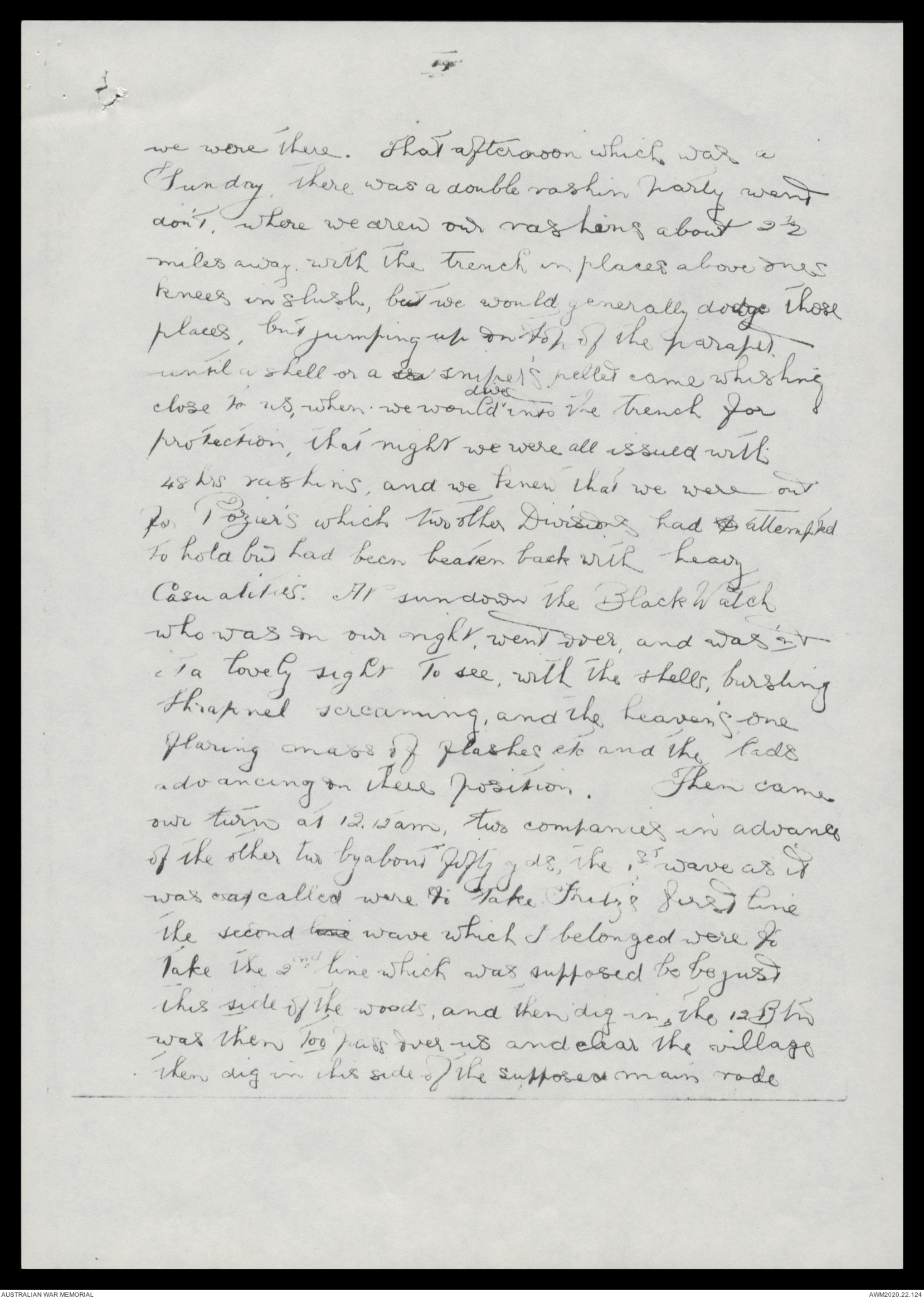
we were there. That afternoon which was a
Sunday, there was a double rashin party went
don't, where we drew our rashins about 2½
miles away with the trench in places above ones
knees in slush, but we would generally dodge those
places, but jumping up on top of the parapet
until a shell or a Fri sniper's pellet came whisling
close to us, when we would ^dive into the trench for
protection, that night we were all issued with
48 hrs rashins, and we knew that we were out
for Pozier's which two other Divisions had t attempted
to hold but had been beaten back with heavy
Casualities. At sundown the Black Watch
who was on our right, went over, and was'nt
it a lovely sight to see, with the shells, bursting
shrapnel screaming, and the heaven's one
flaring mass of flashes etc and the lads
advancing on there position. Then came
our turn at 12.15 am, two companies in advance
of the other two by about fifty yds, the 1st wave as it
was cas called were to take Fritz's first line
the second line wave which I belonged were to
take the 2nd line which was supposed be be just
this side of the woods, and then dig in, the 12 Btn
was then too pass over us and clear the village
then dig in this side of the supposed main rode
20
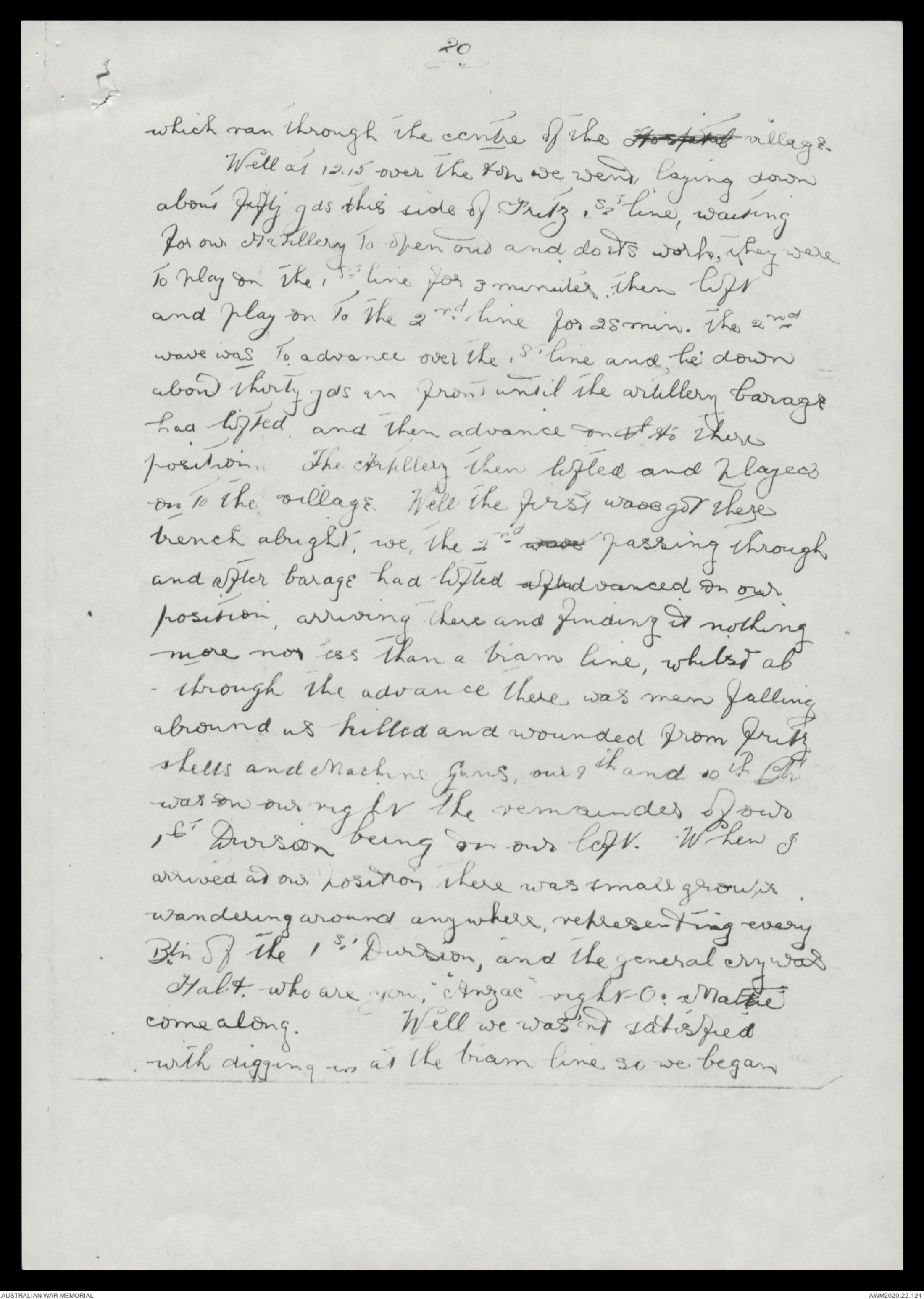
which ran through the centre of the Hospital village.
Well at 12.15 over the top we went, laying down
about fifty yds this side of Fritz 1st line, waiting
for our Artillery to open out and do its work, they were
to play on the 1st line for 3 minutes, then lift
and play on to the 2nd line for 25 min. The 2nd
wave was to advance over the 1st line and lie down
about thirty yds in front until the artillery barage
had lifted, and then advance on tl to there
position. The Artillery then lifted and played
on to the village. Well the first wave got there
trench alright, we, the 2nd wave passing through
and after barage had lifted aft advanced on our
position, arriving there and finding it nothing
more nor less than a tram line, whilst althrough
the advance there was men falling
alround us killed and wounded from Fritz
shells and Machine Guns, and 9th and 10th Btn
was on our right the remainder of our
1st Division being on our left. When I
arrived at our position there was small groups
wandering around anywhere, representing every
Btn of the 1st Division, and the general cry was
Halt, who are you, "Anzac" right-O. Mattie
come along. Well we was'nt satisfied
with digging in at the tram line so we began
 Loretta Corbett
This transcription item is now locked to you for editing. To release the lock either Save your changes or Cancel.
This lock will be automatically released after 60 minutes of inactivity.