
Letters from Charles Edwin Gatliff to his family, January - September 1918 - Part 8
No 15 1 France 7 23.7.18
Dear Father & Mother,
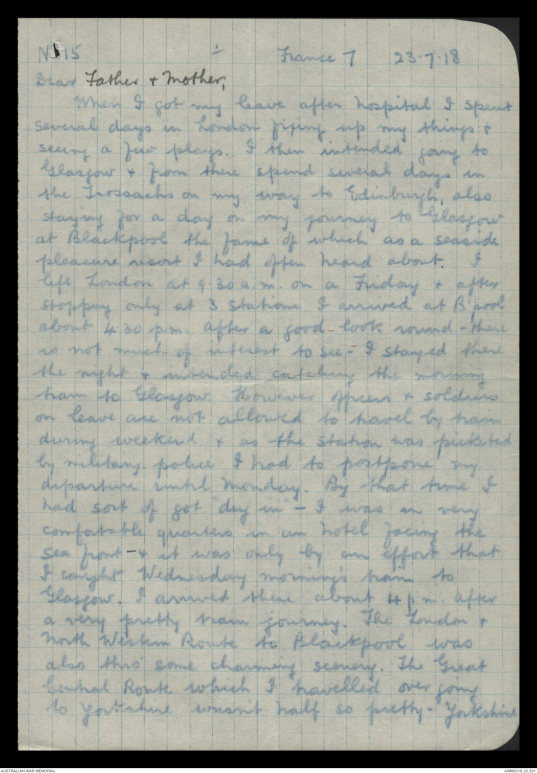
When I got my leave after hospital I spent
several days in London fixing up my things &
seeing a few plays. I then intended going to
Glasgow & from there spend several days in
the Trossachs on my way to Edinburgh, also
staying for a day on my journey to Glasgow
at Blackpool the fame of which as a seaside
pleasure resort I had often heard about. I
left London at 9.30 a.m. on a Friday & after
stopping only at 3 stations I arrived at B’pool
about 4.30 p.m. after a good look round - there
is not much of interest to see - I stayed there
the night & intended catching the morning
train to Glasgow. However officers & soldiers
on leave are not allowed to travel by train
during weekend & as the station was picketed
by military police I had to postpone my
departure until Monday. By that time I
had sort of got “dug in” - I was in very
comfortable quarters in an hotel facing the
sea front - & it was only by an effort that
I caught Wednesday morning’s train to
Glasgow. I arrived there about 4 pm. after
a very pretty train journey. The London &
North Western Route to Blackpool was
also thro' some charming scenery. The Great
Central Route which I travelled over going
to Yorkshire wasn't half so pretty - Yorkshire
No 15 2 7 23.7.18
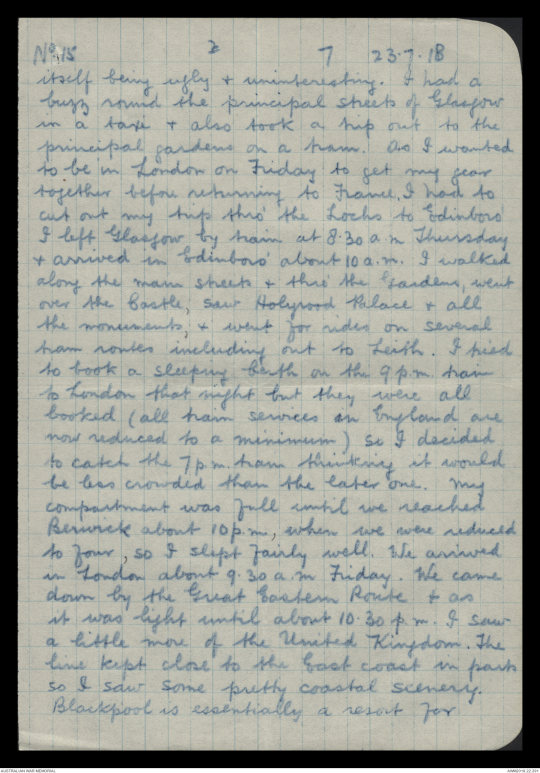
itself being ugly & uninteresting. I had a
buzz round the principal streets of Glasgow
in a taxi & also took a trip out to the
principal gardens on a tram. As I wanted
to be in London on Friday to get my gear
together before returning to France, I had to
cut out my trip thro' the Lochs to Edinboro'
I left Glasgow by train at 8.30 a.m. Thursday
& arrived in Edinboro' about 10 a.m. I walked
along the main streets & thro' the Gardens, went
over the Castle, saw Holyrood Palace & all
the monuments, & went for rides on several
tram routes including out to Leith. I tried
to book a sleeping berth on the 9 p.m. train
to London that night but they were all
booked (all train services in England are
now reduced to a minimum) so I decided
to catch the 7 p.m. train thinking it would
be less crowded than the later one. My
compartment was full until we reached
Berwick about 10 p.m, when we were reduced
to four, so I slept fairly well. We arrived
in London about 9.30 a.m. Friday. We came
down by the Great Eastern Route & as
it was light until about 10.30 p.m. I saw
a little more of the United Kingdom. The
line kept close to the East coast in parts
so I saw some pretty coastal scenery.
Blackpool is essentially a resort for
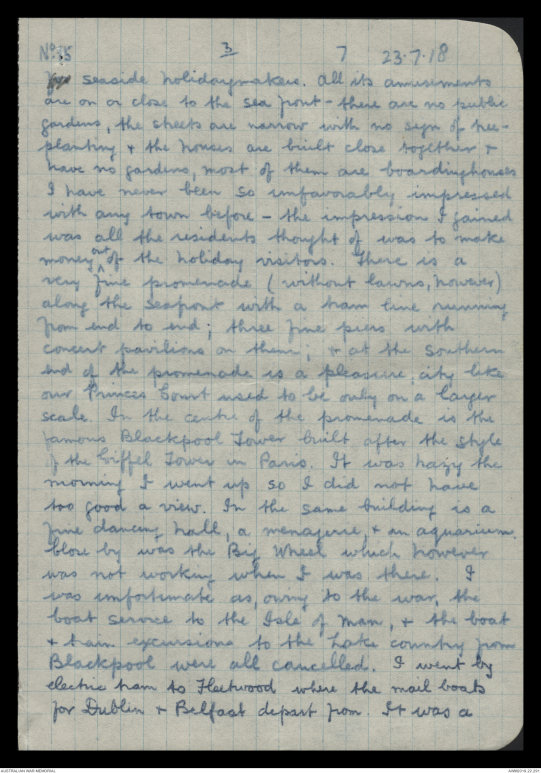
No 15 3 7 23.7.18for seaside holidaymakers. All its amusements
are on or close to the sea front - there are no public
gardens, the streets are narrow with no sign of tree-planting
& the houses are built close together &
have no gardens, most of them are boardinghouses
I have never been so unfavourably impressed
with any town before - the impression I gained
was all the residents thought of was to make
money ^out of the holiday visitors. There is a
very fine promenade (without lawns, however)
along the seafront with a tram line running
from end to end; three fine piers with
concert pavilions on them; & at the southern
end of the promenade is a pleasure city like
our Princes Court used to be only on a larger
scale. In the centre of the promenade is the
famous Blackpool Tower built after the style
of the Eiffel Tower in Paris. It was hazy the
morning I went up so I did not have
too good a view. In the same building is a
fine dancing hall, a menagerie, & an aquarium.
Close by was the Big Wheel which however
was not working when I was there. I
was unfortunate as, owing to the war, the
boat service to the Isle of Man, & the boat
& train excursions to the Lake country from
Blackpool were all cancelled. I went by
electric tram to Fleetwood where the mail boats
for Dublin & Belfast depart from. It was a
No.15 4 7 23.7.18
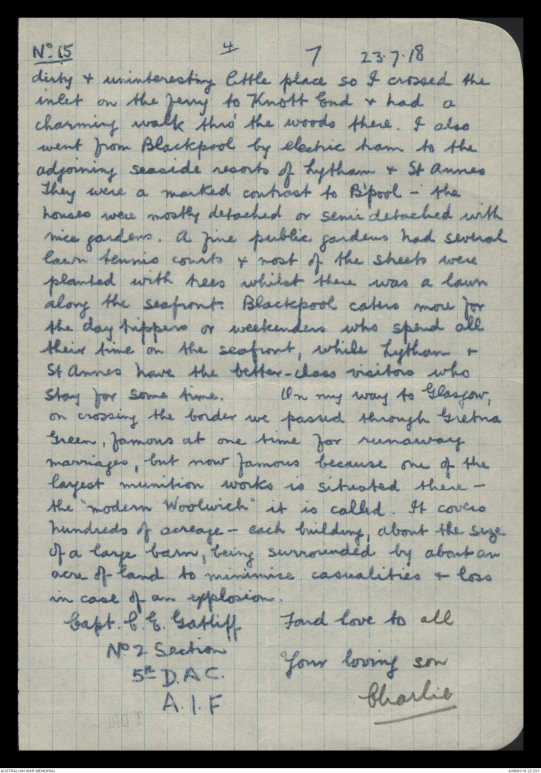
dirty & uninteresting lttle place so I crossed the
inlet on the ferry to Knott End & had a
charming walk thro' the woods there. I also
went from Blackpool by electric tram to the
adjoining seaside resorts of Lytham & St Annes
They were a marked contrast to B'pool - the
houses were mostly detached or semi detached with
nice gardens. A fine public gardens had several
lawn tennis courts & most of the streets were
planted with trees whilst there was a lawn
along the seafront. Blackpool caters more for
the day trippers or weekenders who spend all
their time on the seafront, while Lytham &
St Annes have the better-class visitors who
stay for some time. On my way to Glasgow,
on crossing the border we passed through Gretna
Green, famous at one time for runaway
marriages, but now famous because one of the
largest munition works is situated there -
the "modern Woolwich" it is called. It covers
hundreds of acreage - each building, about the size
of a large barn, being surrounded by about an
acre of land to minimise causalities & loss
in case of explosion.
Fond love to all
Your loving son
Charlie
Capt. C.E. Gatliff
No 2 Section
5th D.A.C.
A.I.F
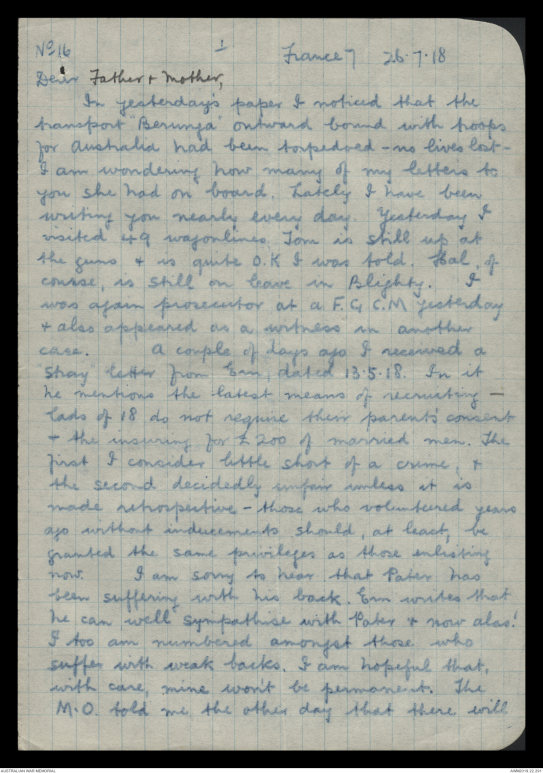
No 16 1 France 7 26.7.18
Dear Father & Mother,
In yesterday’s paper I noticed that the
transport “Berunga” outward bound with troops
for Australia had been torpedoed - no lives lost -
I am wondering how many of my letters to
you she had on board. Lately I have been
writing you nearly every day. Yesterday I
visited 49 wagonlines; Tom is still up at
the guns & is quite O.K I was told. Hal, of
course, is still on leave in Blighty. I
was again prosecutor at a F.G.C.M yesterday
& also appeared as a witness in another
case. A couple of days ago I received a
“Stray” letter from Ern, dated 13.5.18. In it
he mentions the latest means of recruiting -
lads of 18 do not require their parents' consent
- the insuring of £200 of married men. The
first I consider little short of a crime, &
the second decidedly unfair unless it is
made retrospective - those who volunteered years
ago without inducements should, at least, be
granted the same privileges as those enlisting
now. I am sorry to hear that Pater has
been suffering with his back. Ern writes that
he can well sympathise with Pater & now alas!
I too am numbered amongst those who
suffer with weak backs. I am hopeful that,
with care, mine won’t be permanent. The
M.O. told me the other day that there will
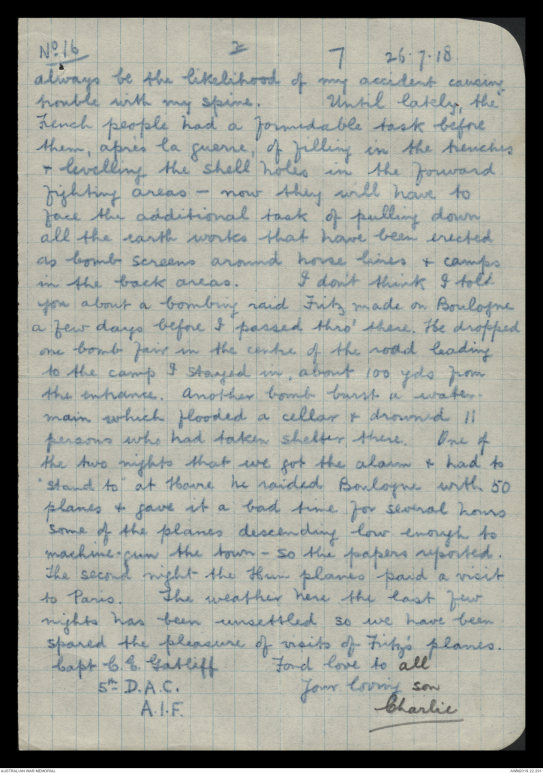
No 16 2 7 26.7.18
always be the likelihood of my accident causing
trouble with my spine. Until lately, the
French people had a formidable task before
them, aprés la guerre, of filling in the trenches
& levelling the shell holes in the forward
fighting areas - now they will have to
face the additional task of pulling down
all the earth works that have been erected
as bomb screens around horse lines & camps
in the back areas. I don’t think I told
you about a bombing raid Fritz made on Boulogne
a few days before I passed thro’ there. He dropped
one bomb fair in the centre of the road leading
to the camp I stayed in, about 100 yds from
the entrance. Another bomb burst a water
main which flooded a cellar & drowned 11
persons who had taken shelter there. One of
the two nights that we got the alarm & had to
“stand to” at Havre he raided Boulogne with 50
planes & gave it a bad time for several hours
some of the planes descending low enough to
machine-gun the town - so the papers reported.
The second night the Hun planes paid a visit
to Paris. The weather here the last few
nights has been unsettled so we have been
spared the pleasure of visits of Fritz’s planes.
Fond love to all
Your loving son
Charlie
Capt C.E. Gatliff
5th D.A.C.
A.I.F.
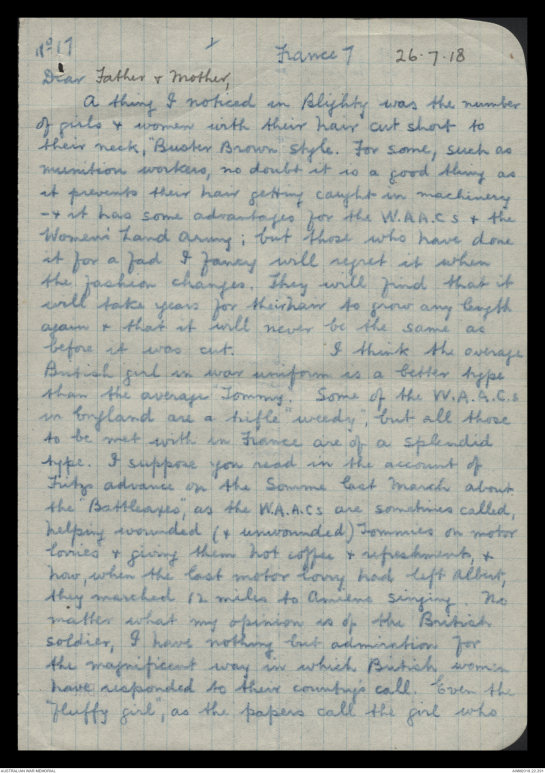
No 17 1 France 7 26.7.18
Dear Father & Mother,
A thing I noticed in Blighty was the number
of girls & women with their hair cut short to
their neck, "Buster Brown" style. For some, such as
munition workers, no doubt it is a good thing as
it prevents hair getting caught in machinery
- & it has some advantages for W.A.A.Cs & the
Womens' Land Army; but those who have done
it for a fad I fancy will regret it when
the fashion changes. They will find that it
will take years for their hair to grow any length
again & that it will never be the same as
before it was cut. I think the average
British girl in war uniform is a better type
than the average “Tommy”. Some of the W.A.A.C.s
in England are a trifle “weedy”, but all those
to be met with in France are of a splendid
type. I suppose you read in the account of
Fritzs advance on the Somme last March about
the “Battleaxes”, as the W.A.A.Cs are sometimes called,
helping wounded (& unwounded) Tommies on motor
lorries & giving them hot coffee & refreshments, &
how, when the last motor lorry had left Albert,
they marched 12 miles to Amiens singing. No
matter what my opinion is of the British
soldier, I have nothing but admiration for
the magnificent way in which British women
have responded to their country’s call. Even the
“fluffy girl”, as the papers call the girl who
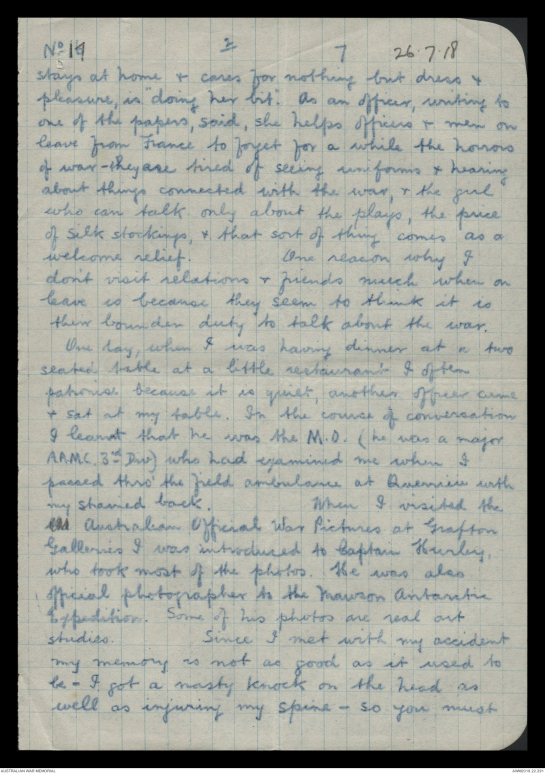
No 17 2 7 26.7.18
stays at home & cares for nothing but dress &
pleasure, is “doing her bit”. As an officer, writing to
one of the papers, said, she helps officers & men on
leave from France to forget for a while the horrors
of war - they are tired of seeing uniforms & hearing
about things connected with the war, & the girl
who can talk only about the plays, the price
of silk stockings, & that sort of thing comes as a
welcome relief. One reason why I
don’t visit relations & friends much when on
leave is because they seem to think it is
their bounden duty to talk about the war.
One day, I was having dinner at a two
seater table at a little restaurant I often
patronise because it is quiet, another officer came
& sat at my table. In the course of conversation
I learnt that he was the M.O. (he was a major
A.A.M.C. 3rd Div) who had examined me when I
passed thro’ the field ambulance at Querriere with
my strained back. When I visited thexx Australian Official War Pictures at Grafton
Galleries I was introduced to Captain Hurley,
who took most of the photos. He was also
official photographer to the Mawson Antarctic
Expedition. Some of his photos are real art
studies. Since I met with my accident
my memory is not as good as it used to
be - I got a nasty knock on the head as
well as injuring my spine - so you must
No 17 3 7 26.7.18
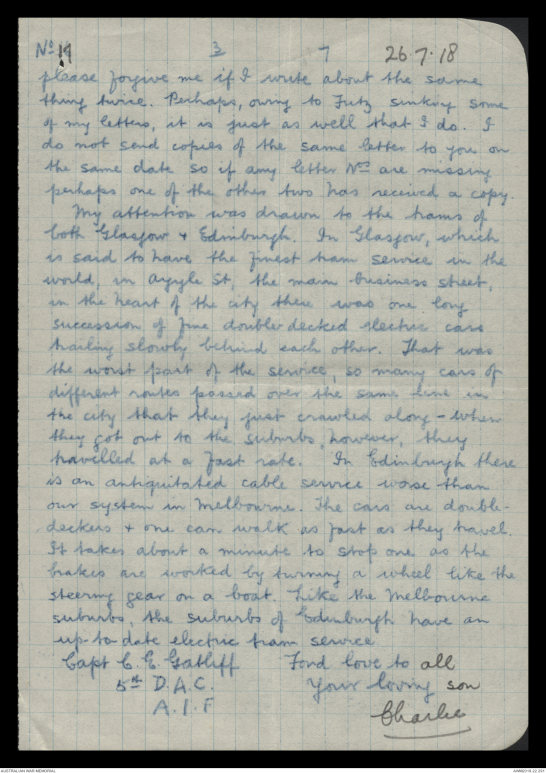
please forgive me if I write the same
thing twice. Perhaps, owing to Fritz sinking some
of my letters, it is just as well that I do. I
do not send copies of the same letter to you on
the same date so if any letter Nos are missing
perhaps one of the other two has received a copy.
My attention was drawn to the trams of
both Glasgow & Edinburgh. In Glasgow, which
is said to have the finest tram service in the
world, in Argyle St, the main business street,
in the heart of the city there was one long
succession of fine double-decked electric cars
trailing slowly behind each other. That was
the worst part of the service, so many cars of
different routes passed over the same line in
the city that they just crawled along - when
they got out to the suburbs however, they
travelled at a fast rate. In Edinburgh there
is an antiquitated cable service worse than
our system in Melbourne. The cars are double-deckers
& one can walk as fast as they travel.
It takes about a minute to stop one as the
brakes are worked by turning a wheel like the
steering gear on a boat. Like the Melbourne
suburbs, the suburbs of Edinburgh have an
up-to-date electric tram service
Fond love to all
Your loving son
Charlie
Capt C.E. Gatliff
5th D.A.C.
A.I.F.
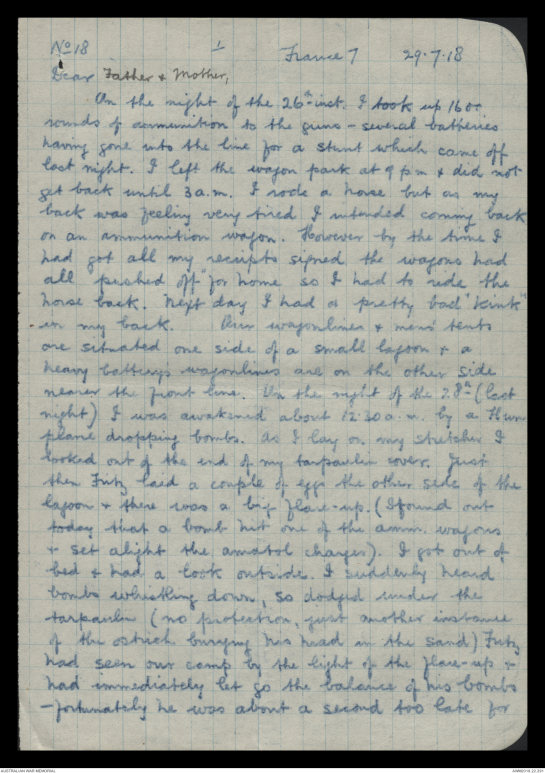
No 18 1 France 7 29.7.18
Dear Father & Mother,
On the night of the 26th inst. I took up 1600
rounds of ammunition to the guns - several batteries
having gone into the line for a stunt which came off
last night. I left the wagon park at 9 p.m & did not
get back until 3 a.m. I rode a horse but as my
back was feeling very tired I intended coming back
on an ammunition wagon. However by the time I
had got all my receipts signed the wagons had
all pushed off for home so I had to ride the
horse back. Next day I had a pretty bad “kink”
in my back. Our wagonlines & men’s tents
are situated one side of a small lagoon & a
heavy battery’s wagonlines are on the other side
nearer the front line. On the night of the 28th (last
night) I was awakened about 12.30 a.m. by a Hun
plane dropping bombs. As I lay on my stretcher I
looked out of the end of my tarpaulin cover. Just
then Fritz laid a couple of eggs the other side of the
lagoon & there was a big flare-up. (I found out
today that a bomb hit one of the ammn. wagons
& set alight the amatol charges). I got out of
bed & had a look outside. I suddenly heard
bombs whistling down, so dodged under the
tarpaulin (no protection, just another instance
of the ostrich burying his head in the sand) Fritz
had seen our camp by the light of the flare-up &
had immediately let go the balance of his bombs
- fortunately he was about a second too late for
 Marisa Bortolotto
This transcription item is now locked to you for editing. To release the lock either Save your changes or Cancel.
This lock will be automatically released after 60 minutes of inactivity.