
Service notebook of Harold Gordon Cornell - 1917 - Part 9
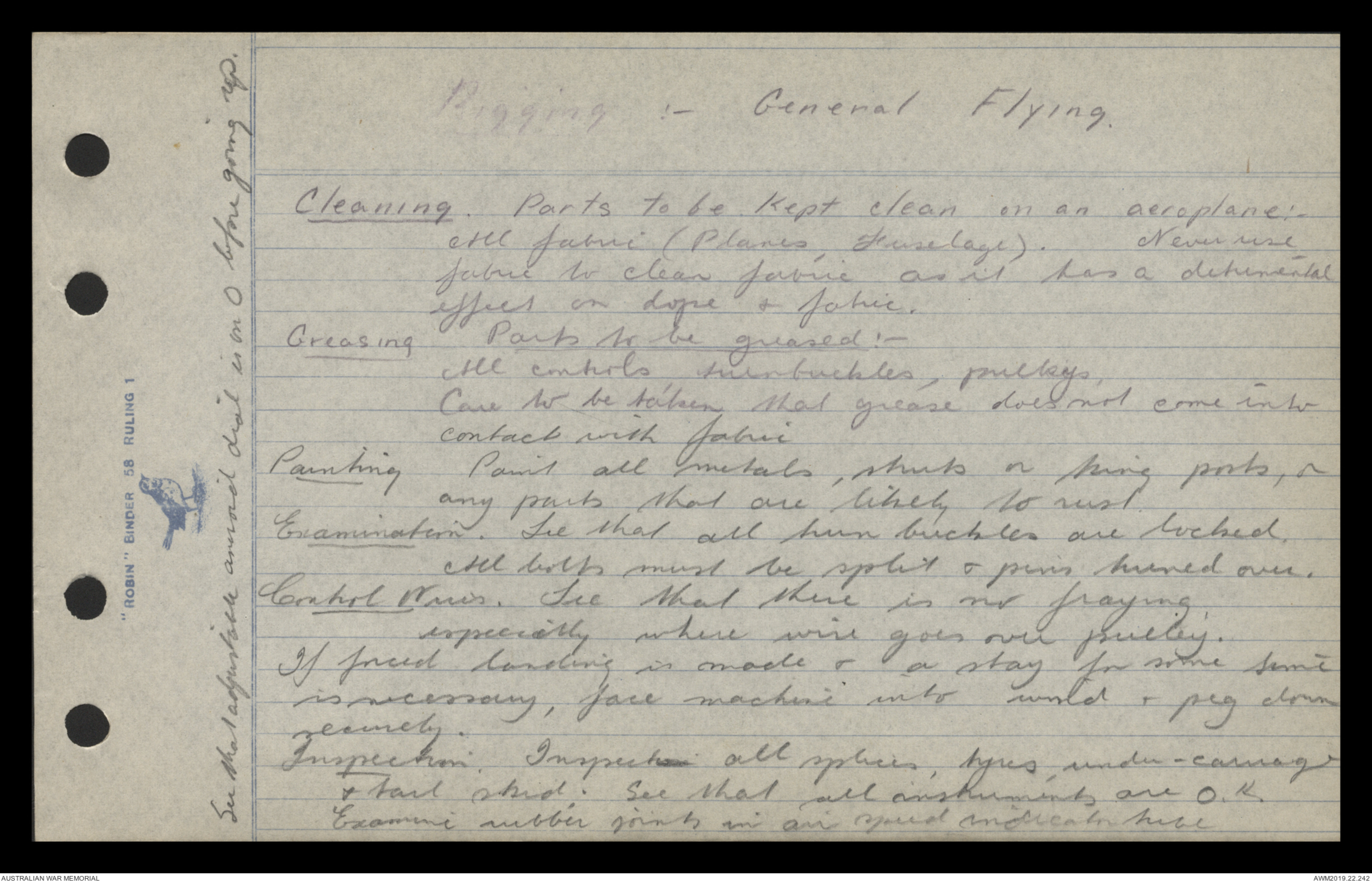
Rigging :- General Flying.
Cleaning. Parts to be kept clean on an aeroplane:-
All fabric (Planes, Fuselage). Never use
fabric to clean fabric as it has a detrimental
effect on dope & fabric.
Greasing Parts to be greased:-
All controls, turnbuckles, pulleys,
Care to be taken that grease does not come into
contact with fabric
Painting Paint all metals, struts or hing posts, or
any parts that are likely to rust.
Examination. See that all turnbuckles are locked.
All bolts must be split & pins turned over.
Control Wires. See that there is no fraying,
especially where wire goes over a pulley.
If forced landing is made & a stay for some time
is necessary, face machine into wind & peg down
securely.
Inspection. Inspection all splices, tyres, under-carriage
& tail stud; See that all instruments are O.K.
Examine rubber joints in air speed indicator tube
[*See that adjustable aneroid dial is on 0 before going up.*]
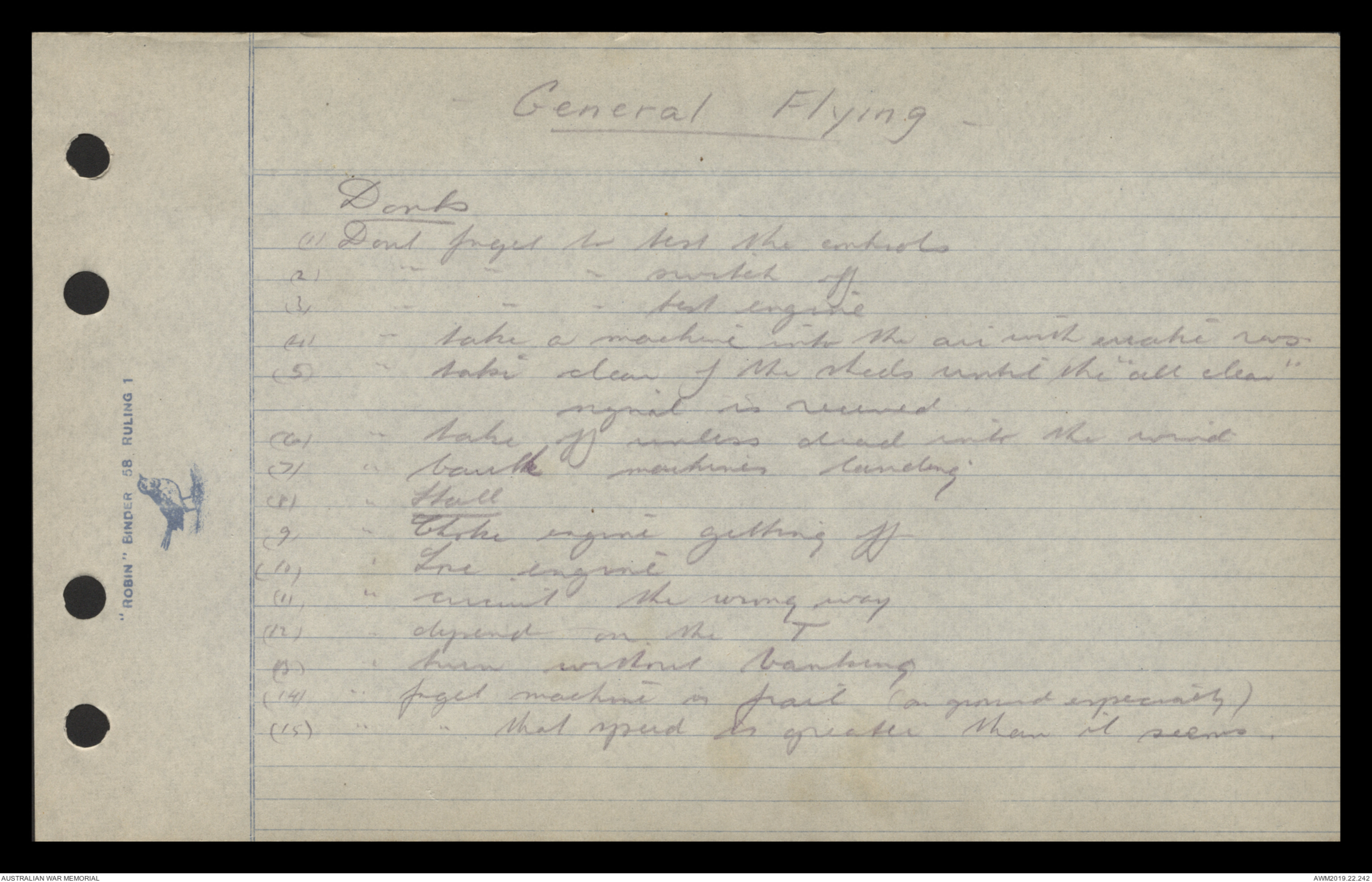
General Flying.
Donts
(1) Dont forget to test the controls
(2) " " " switch off
(3) " " " test engine
(4) " take a machine into the air with erratic revs.
(5) " take clear of the sheds until the "all clear"
signal is received
(6) " take off unless head into the wind
(7) " baulk machines landing
(8) " Stall
(9) " Choke engine getting off
(10) " Lose engine
(11) " circuit the wrong way
(12) " depend on the T
(13) " turn without banking
(14) " forget machine is frail (on ground especially)
(15) " " that speed is greater than it seems.
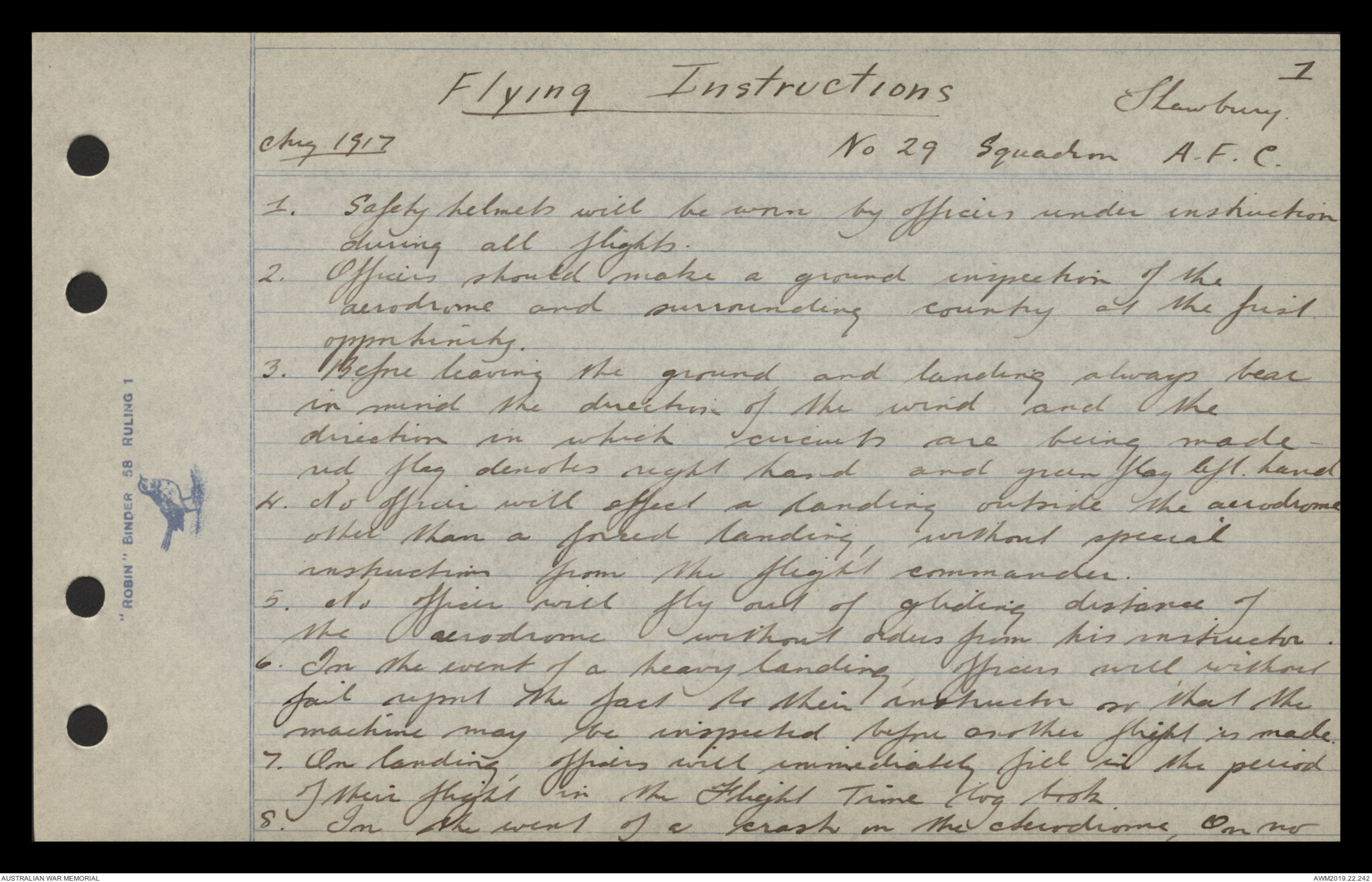
1
Flying Instructions
Shawbury
Aug 1917
No 29 Squadron A.F.C.
1. Safety helmets will be worn by officers under instruction
during all flights.
2. Officers should make a ground inspection of the
aerodrome and surrounding country at the first
opportunity.
3. Before leaving the ground and landing always bear
in mind the direction of the wind and the
direction in which currents are being made -
red flag denotes right hand and green flag left hand
4. No officer will effect a landing outside the aerodrome
other than a forced landing, without special
instructions from the flight commander.
5. No officer will fly out of gliding distance of
the aerodrome without orders from his instructor.
6. In the event of a heavy landing, officers will without
fail report the fact to their instructor so that the
machine may be inspected before another flight is made.
7. On landing, officers will immediately fill in the period
of their flight in the Flight Time log book.
8. In the event of a crash on the Aerodrome, On no
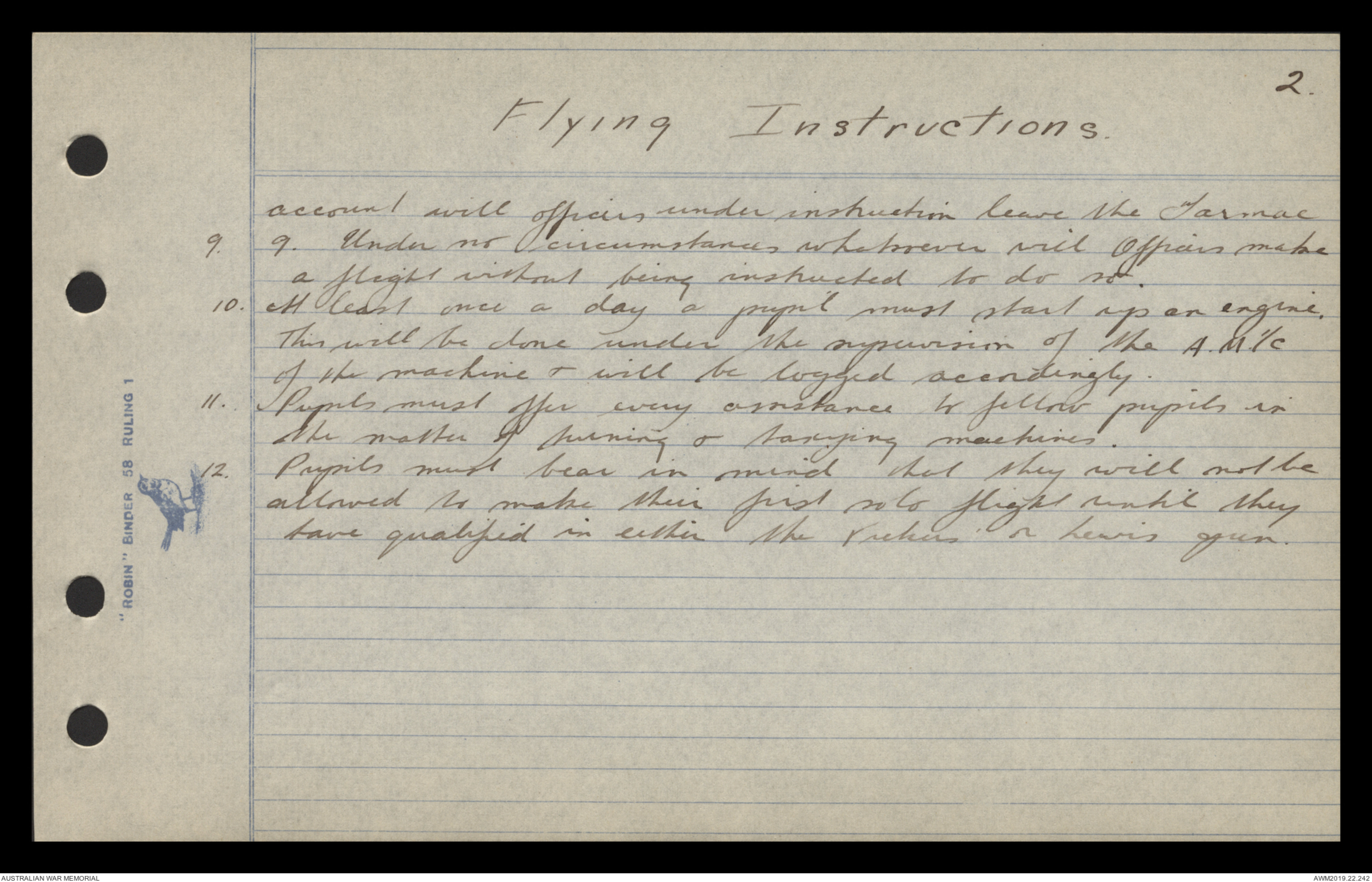
2.
Flying Instructions.
account will officers under instruction leave the Tarmac
9. 9. Under no circumstances whatsoever will officers make
a flight without being instructed to do so.
10. At least once a day a pupil must start up an engine.
This will be done under the supervision of the A.M. i/c
of the machine & will be logged accordingly.
11. Pupils must offer every assistance to fellow pupils in
the matter of turning or taxying machines.
12. Pupils must bear in mind that they will not be
allowed to make their first solo flight until they
have qualified in either the Vickers or Lewis gun.
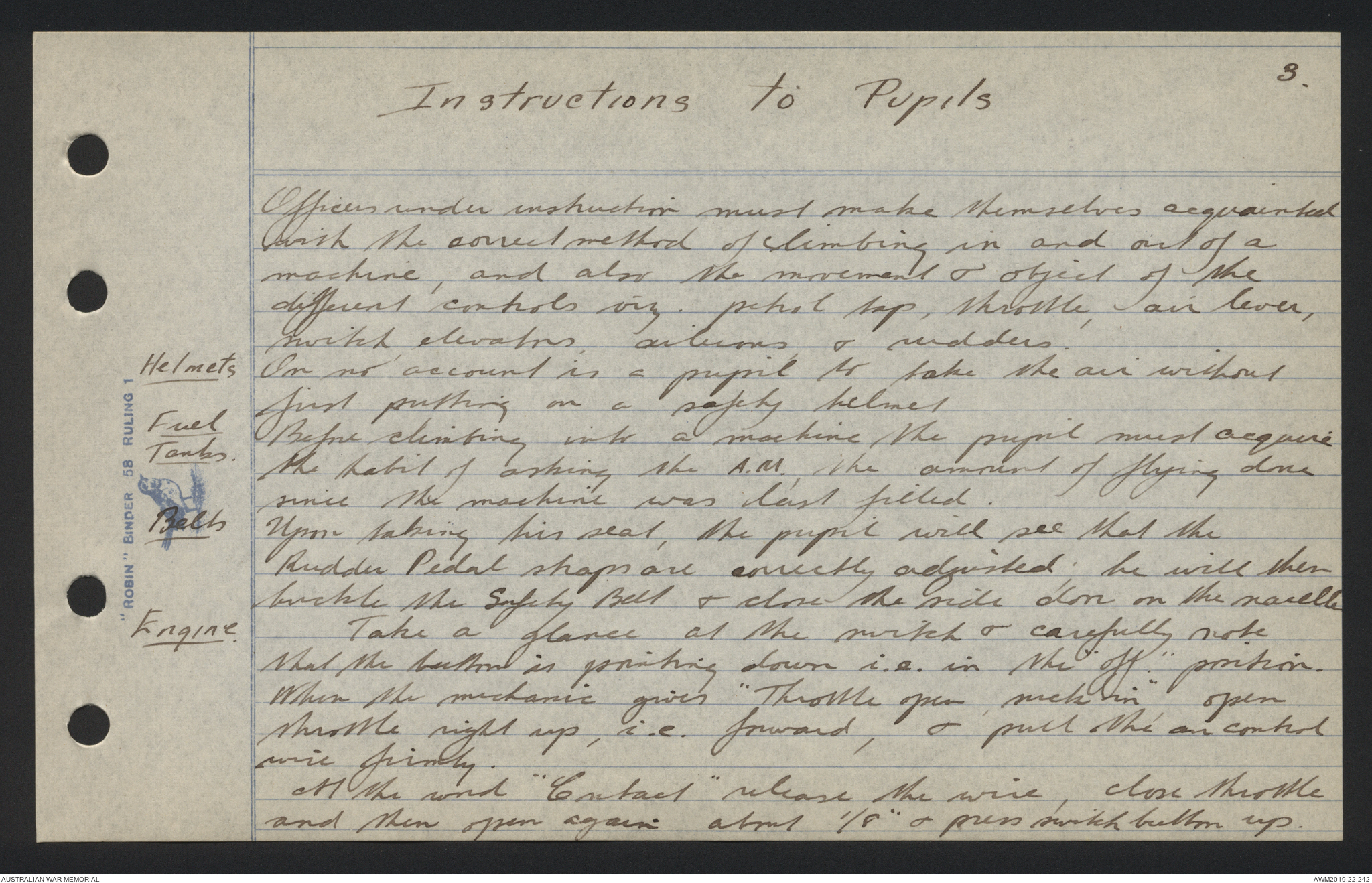
3.
Instructions to Pupils
Officers under instruction must make themselves acquainted
with the correct method of climbing in and out of a
machine, and also the movement & object of the
different controls viz. petrol tap, throttle, air lever,
switch elevators, ailerons & rudders.
Helmets On no account is a pupil to take to the air without
first putting on a safety helmet
Fuel Tanks. Before climbing into a machine the pupil must acquire
the habit of asking the A.M. the amount of flying done
since the machine was last filled.
Belts Upon taking his seat, the pupil will see that the
Rudder Pedal straps are correctly adjusted; he will then
buckle the Safety Belt & close the side door on the nacelle
Engine. Take a glance at the switch & carefully note
that the button is pointing down i.e. in the "off" position.
When the mechanic gives "Throttle open, suck in" open
throttle right up, i.e. forward, & pull the air control
wire firmly.
At the word "Contact" release the wire, close throttle
and then open again about 1/8" & press switch button up.
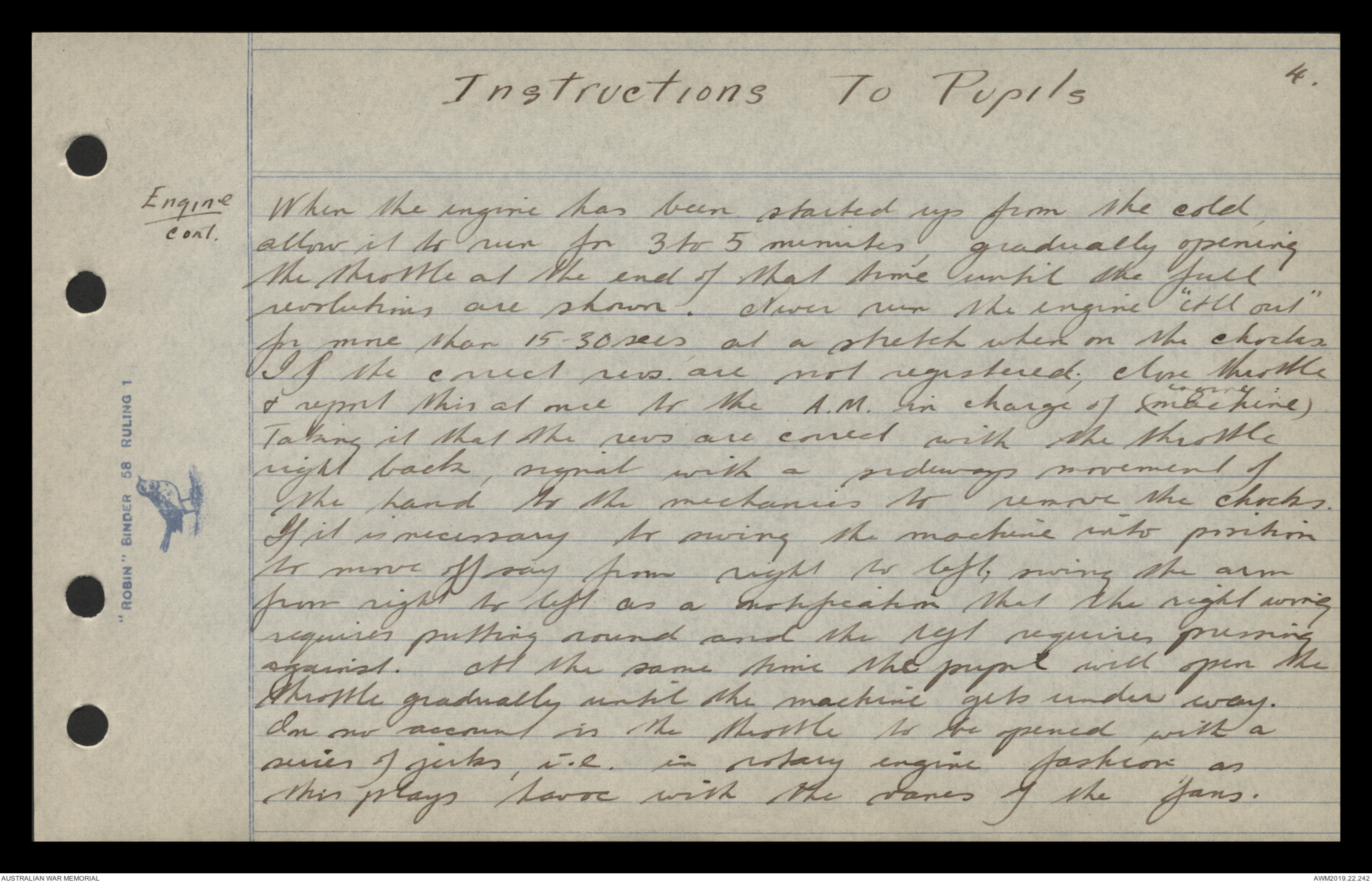
4.
Instructions to Pupils
Engine cont. When the engine has been started up from the cold,
allow it to run for 3 to 5 minutes, gradually opening
the throttle at the end of that time until the full
revolutions are shown. Never run the engine "All out"
for more than 15-30 secs at a stretch when on the chocks.
If the correct revs are not registered, close throttle
& report this at once to the A.M. in charge of (machine) casing
Taking it that the revs are correct with the throttle
right back, signal with a sideways movement of
the hand to the mechanics to remove the chocks.
If it is necessary to swing the machine into position
to move off say from right to left, swing the arm
from right to left as a notification that the right wing
requires pulling round and the left requires pressing
against. At the same time the pupil will open the
throttle gradually until the machine gets underway.
On no account is the throttle to be opened with a
series of jerks, i.e. in rotary engine fashion as
this plays havoc with the vanes of the fans.
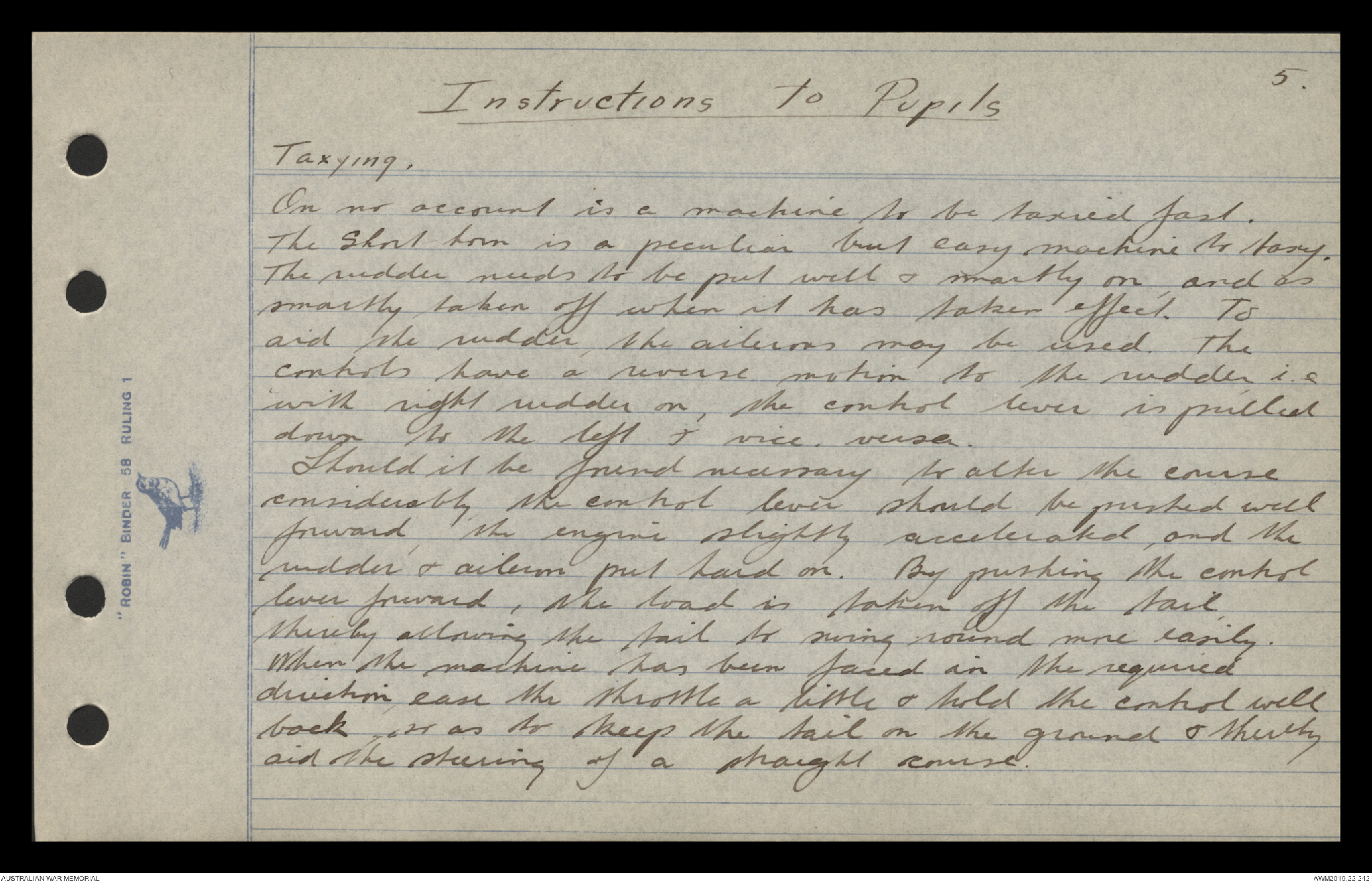
5.
Instructions to Pupils
Taxying.
On no account is a machine to be taxied fast.
The Short horn is a peculiar but easy machine to taxy
The rudder needs to be put well & smartly on, and as
smartly taken off when it has taken effect. To
aid the rudder, the ailerons may be used. The
controls have a reverse motion to the rudder, i.e.
with right rudder on, the control lever is pulled
down to the left & vice versa.
Should it be found necessary to alter the course
considerably the control lever should be pushed well
forward, the engine slightly accelerated, and the
rudder & aileron put hard on. By pushing the control
lever forward, the load is taken off the tail,
thereby allowing the tail to swing around more easily.
When the machine has been faced in the required
direction ease the throttle a little & hold the control well
back, so as to keep the tail on the ground & thereby
aid the steering of a straight course.
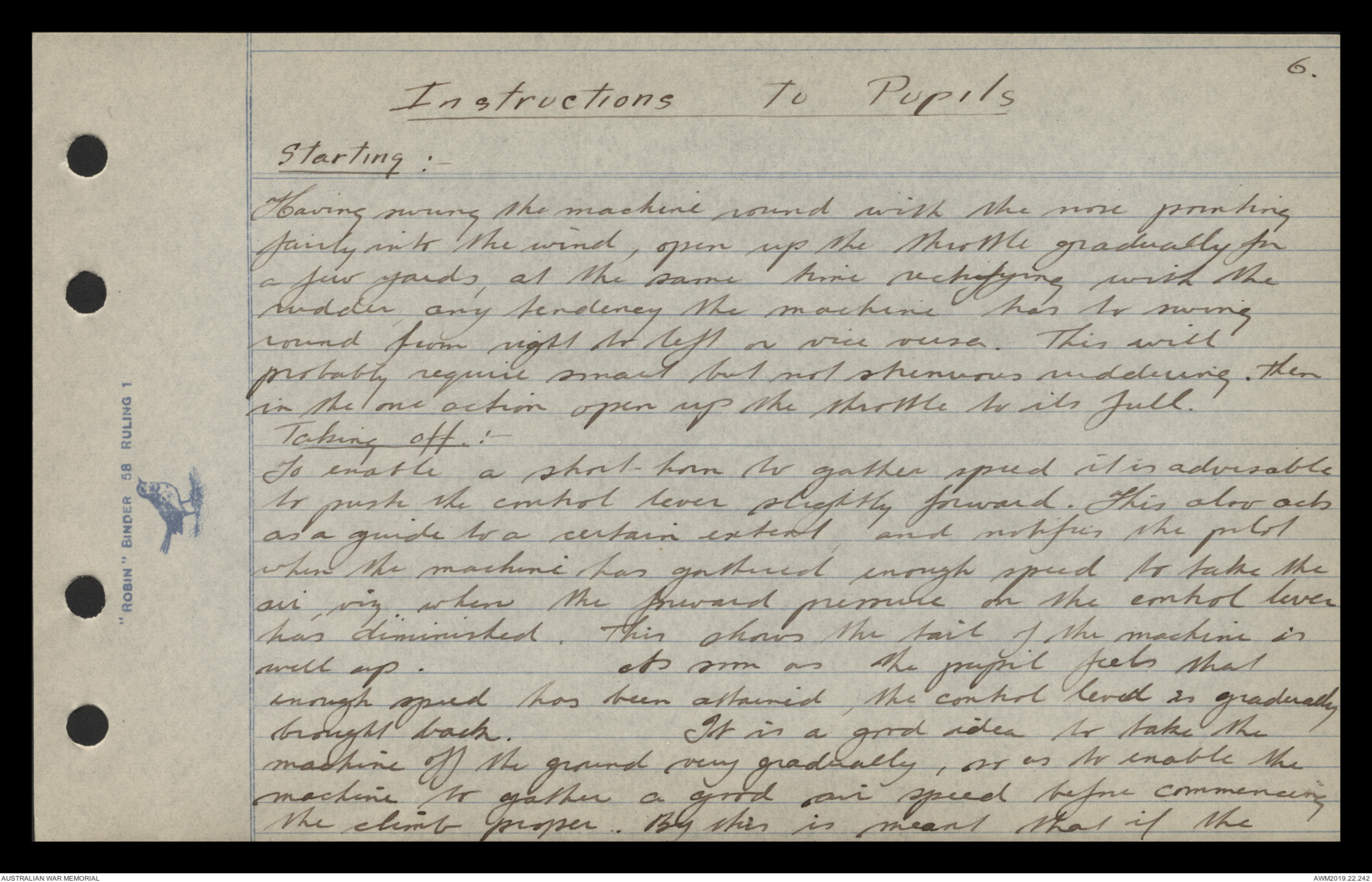
6.
Instructions to Pupils
Starting :
Having swung the machine round with the nose pointing
fairly into the wind, open up the throttle gradually for
a few yards, at the same time rectifying with the
rudder any tendency the machine has to swing
round from right to left or vice versa. This will
probably require smart but not strenuous ruddering.Then
in the one action open up the throttle to its full.
Taking off :-
To enable a short-horn to gather speed it is advisable
to push the control lever slightly forward. This also acts
as a guide to a certain extent, and notifies the pilot
when the machine has gathered enough speed to take the
air, viz, where the forward pressure on the control lever
has diminished. This shows the tail of the machine is
well up. As soon as the pupil feels that
enough speed has been attained, the control lever is gradually
brought back. It is a good idea to take the
machine off the ground very gradually, so as to enable the
machine to gather a good air speed before commencing
the climb proper. By this is meant that if the
7.
Instructions to Pupils
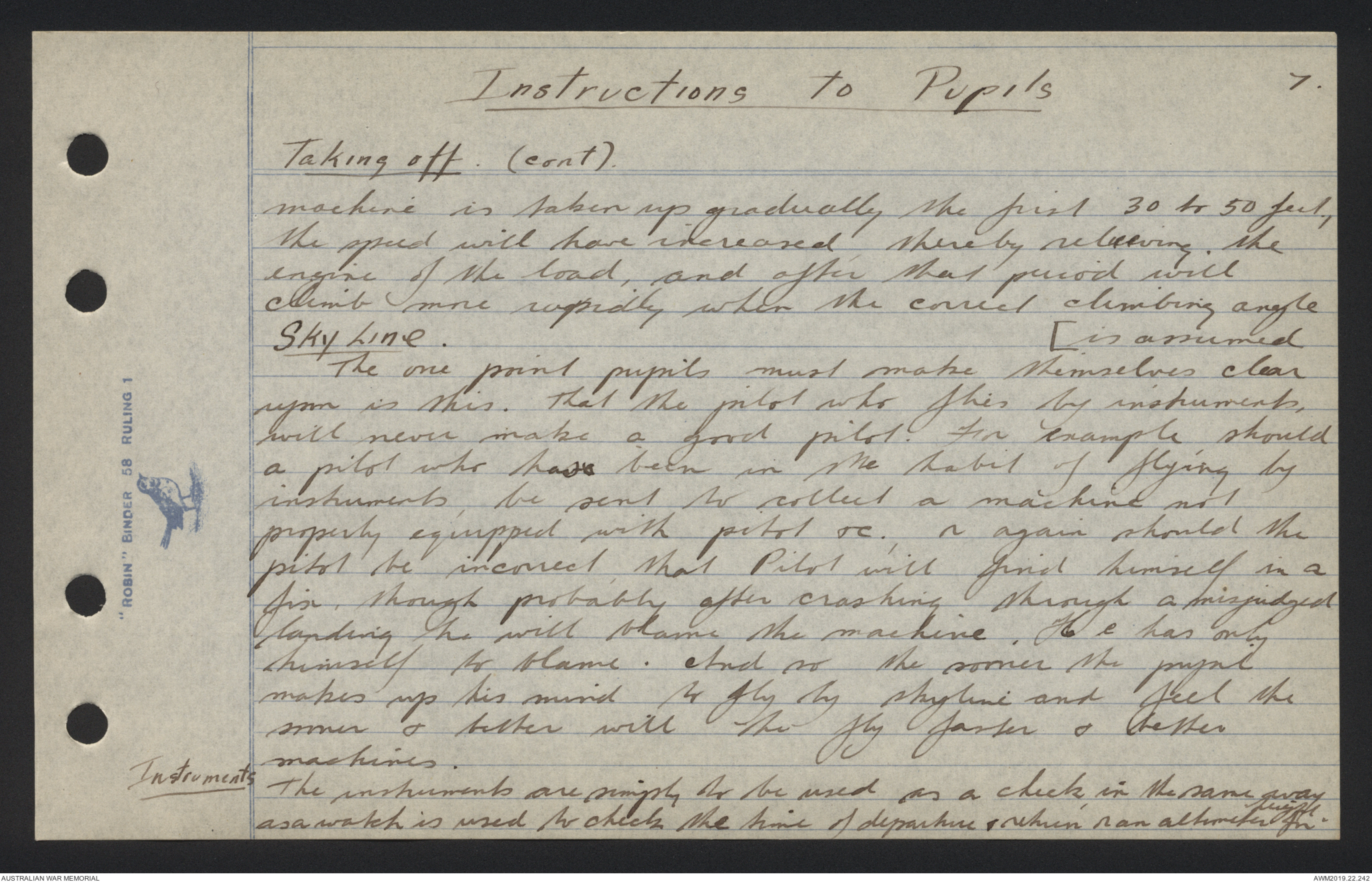
Taking off. (cont).
machine is taken up gradually the first 30 to 50 feet,
the speed will have increased, thereby relieving the
engine of the load, and after that period will
climb more rapidly when the correct climbing angle
[is assumed.
Sky Line.
The one point pupils must make themselves clear
upon is this. That the pilot who flies by instruments,
will never make a good pilot. For example, should
a pilot who has been in the habit of flying by
instruments, be sent to collect a machine not
properly equipped with pitot &c, or again should the
pitot be incorrect, that Pilot will find himself in a
fix, though probably after crashing through a misjudged
landing he will blame the machine. He has only
himself to blame. And so the sooner the pupil
makes up his mind to fly by skyline and feel, the
sooner & better will he fly faster & better
machines.
Instruments The instruments are simply to be used as a check in the same way
as a watch is used to check the time of departure & return or an altimeter for height.
8.
Instructions to Pupils
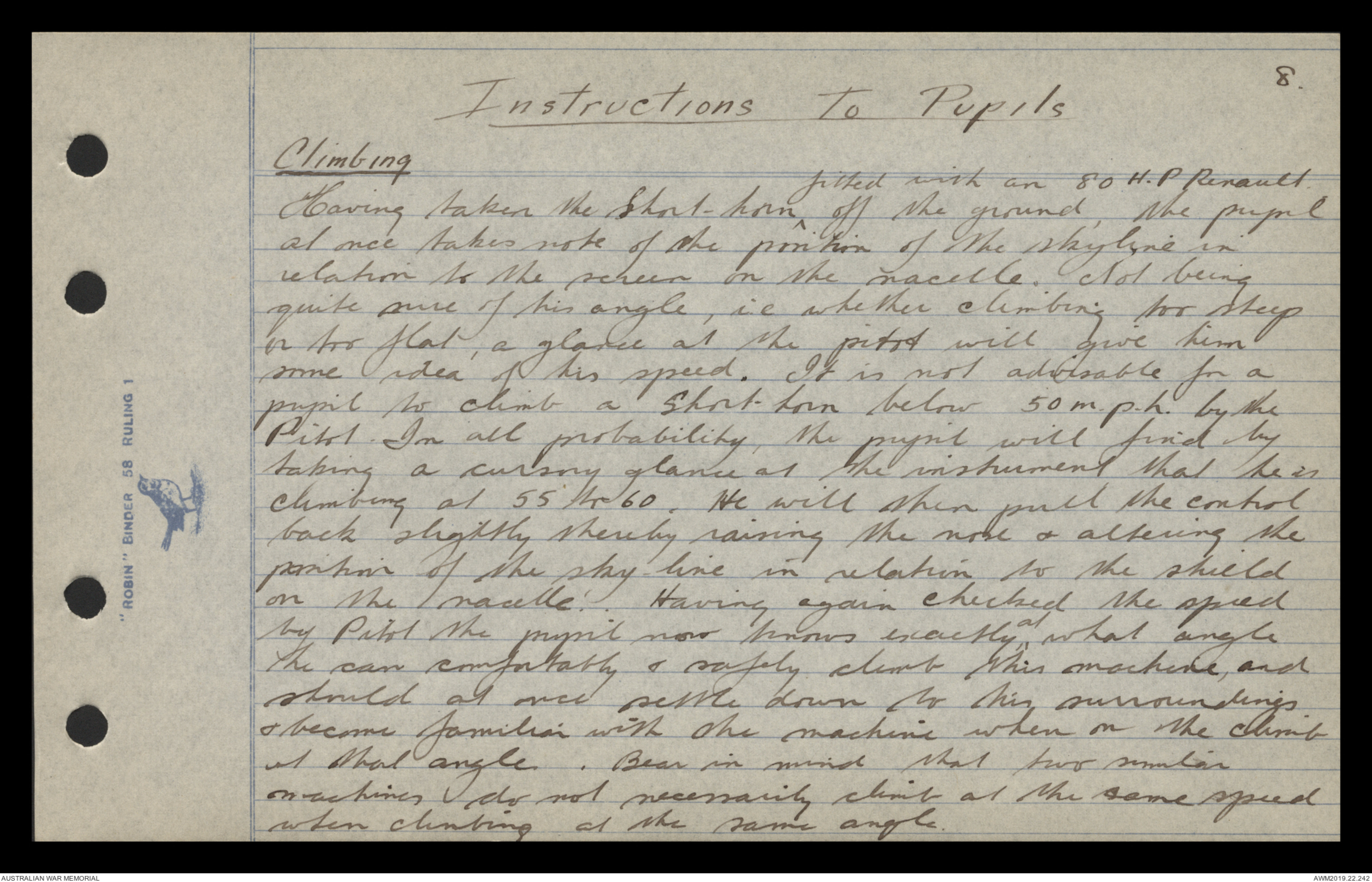
Climbing
Having taken the Short-horn ^fitted with an 80 H.P Renault off the ground, the pupil
at once takes note of the position of the skyline in
relation to the screen on the nacelle. Not being
quite sure of his angle, i.e. whether climbing too steep
or too flat, a glance at the pitot will give him
some idea of his speed. It is not advisable for a
pupil to climb a Short horn below 50 m.p.h. by the
Pitot. In all probability, the pupil will find by
taking a cursory glance at the instrument that he is
climbing at 55 to 60. He will then pull the control
back slightly thereby raising the nose & altering the
position of the sky-line in relation to the shield
on the nacelle. Having again checked the speed
by Pitot the pupil now knows exactly &at what angle
he can comfortably & safely climb the machine, and
should at once settle down to his surroundings
& become familiar with the machine when on the climb
at that angle. Bear in mind that two similar
machines do not necessarily climb at the same speed
when climbing at the same angle.
 Jen
Jen This transcription item is now locked to you for editing. To release the lock either Save your changes or Cancel.
This lock will be automatically released after 60 minutes of inactivity.