
Notebook of James Stuart Leslie Ross - Part 11
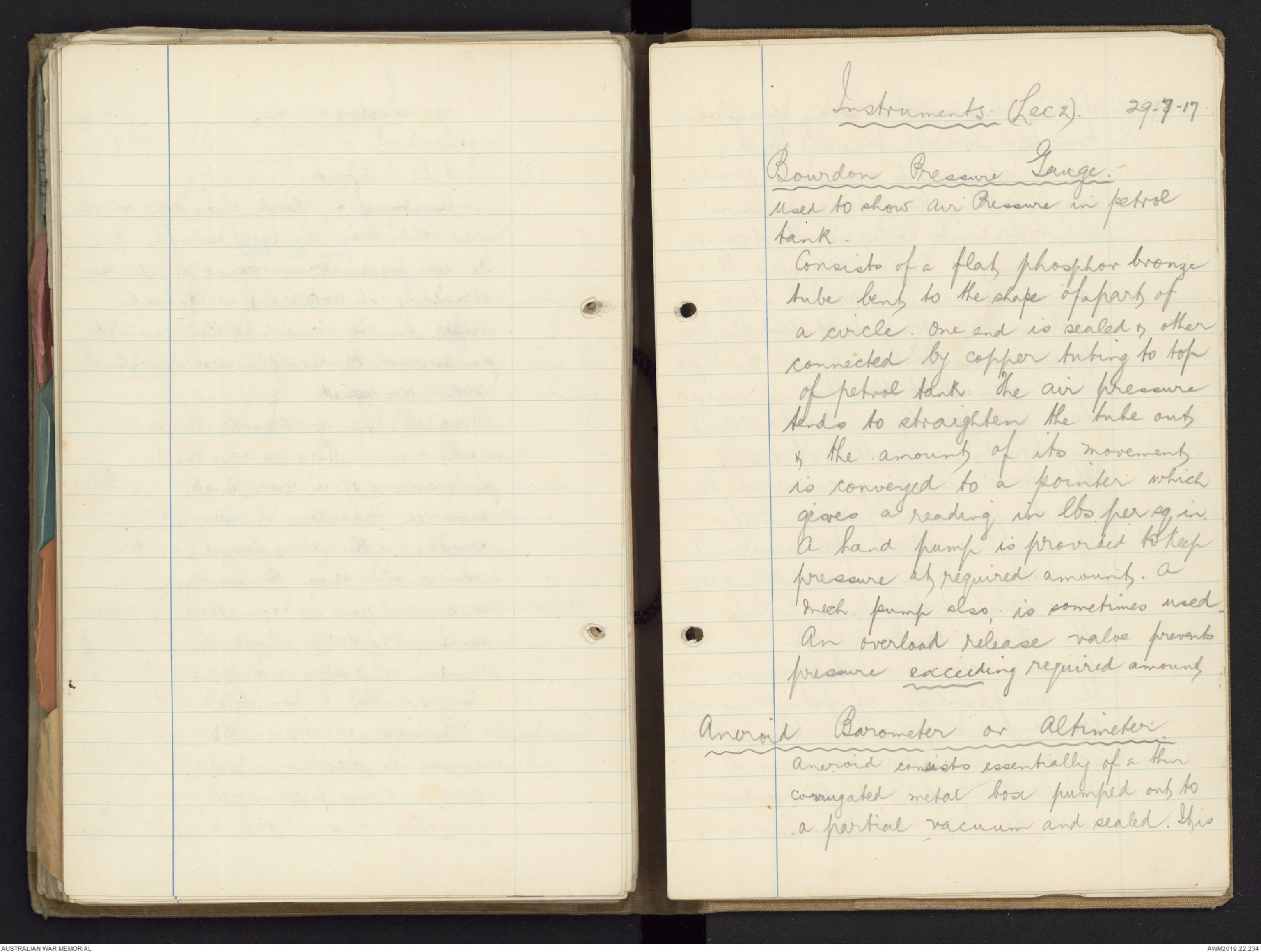



Instruments (Lec2) 29.7.17
Bourdon Pressure Gauge.
used to show air Pressure in petrol
tank.
Consists of a flat phosphor bronze
tube bent to the shape of a part of
a circle. One end is sealed & other
connected by copper tubing to top
of petrol tank. The air pressure
tends to straighten the tube out
& the amount of its movement
is conveyed to a pointer which
gives a reading in lbs per sq in.
A hand pump is provided to keep
pressure at required amount. A
mech. pump also, is sometimes used.
An overload release valve prevents
pressure exceeding required amount
Aneroid Barometer or Altimeter
Aneroid consists essentially of a thin
corrugated metal box pumped out to
a partial vacuum and sealed. It is
held in tension by a strong spring which
tends to distort the box out with a
power, which is, at sea level about
equal to the atmospheric pressure
which tends to collapse the box in.
On rising to higher altitudes the
atmos. pressure decreases which
allows the spring to distort the box
to an extent depending on the height.
This movement of the box is conveyed
to a pointer by means of a delicate
& magnifying system of levers,
the movement being converted to
a rotary motion by means of a
fine silver chain passing round
a pulley on the pointer spindle.
A stave spring tends to keep
the chain taut. As the
pressure varies on the ground,
the zero position of pointer is not
constant. To allow for this, a thumb
screw is provided by means of
which the dial may be rotated
unit the Zero mark coincides with
Instruments (contd) 29-7-17
the position of the pointer. The
instrument is compensated for errors
caused by changes in temperature.
The dial is graduated in thousands
of feet
List of Instruments carried on dashboard
1. Rev. Indicator - R.P.M of engine.
2. Air Speed Indicator - Speed of machine
through the air in M.P.H.
3. Altimeter - Height in thousands of feet.
4. Pressure Gauge - air pressure in petrol
tank.
5. Petrol Gauge - amount of petrol in tank
6. Clinometer - Lateral Stability.
7. Transmitting Thermometer - Temperature
of water in radiator.
8. Compass.
9. Watch.
Trans Therm. Tube D container
filled with liquid ether which
transfer heat from radiator to
instruments.
Wireless Lecture 1 20-7-17
Instruments
1. Sterling Transmitter
2. 6-volt Accumulator
3. Aerial Wire
4. Aerial Bracket.
5 Safety Plug.
Tuning. The closed cct or primary clip
placed on wave length required,
the open cct or aerial clip always
remains on the outside turn. The
Aerial is the same length in feet
as the wave length in metres.
Safety Plug is a protection against fire. It should
never be inserted until it is
necessary to transmit. It should always
be removed immediately transmitting is
finished.
Hand-drawn diagram - see original document
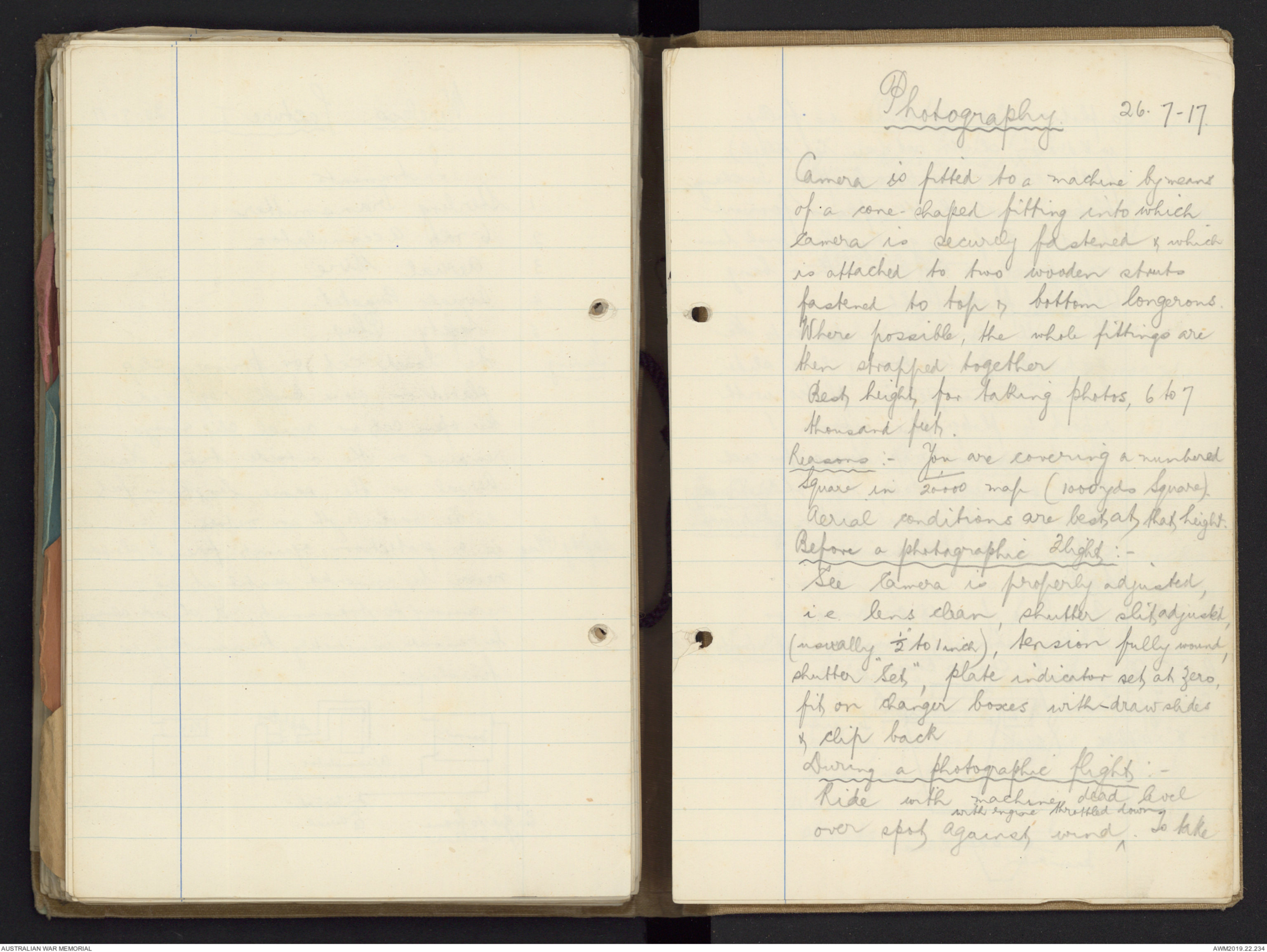
Photography 26.7-17
Camera is fitted to a machine by means
of a cone-shaped fitting into which
camera is securely fastened & which
is attached to two wooden struts
fastened to top & bottom longerons.
Where possible, the whole fittings are
then strapped together
Best height for taking photos, 6 to 7
thousand feet.
Reasons:- You are covering a numbered
square in 1/20000 map (1000 yds Square).
Aerial conditions are best at that height.
Before a photographic Flight:-
See Camera is properly adjusted,
i.e. lens clean, shutter slit adjusted,
(usually ½" to 1 inch), tension fully wound,
shutter "Set", plate indicator set at zero,
fit on charger boxes withdraw slides
& clip back
During a photographic flight:-
Ride with machine dead level
over spot against wind ^with engines throttled down. To take
a photographic, see handle is fully
withdrawn, shutter set, (see "Set" Wheel)
pull release (this takes the photo.) To change
plate & reset shutter, press forward
handle 2/3 of way gently & then push home
very firmly & withdraw with a bang.
After a photo. flight
Pass all remaining plates into the
exposed plate box & close slide.
Release tension, deliver plates with
report to photographic reports.
Report contains map reference for each
plate exposed, date, time of day (roughly)
flying heights, general weather conditions
& type & no. of machine.
Sighting
By means of sight on camera, or
looking straight down one of struts
hand drawn diagram see original
Photography 26 -7.17
Flying Height in Inches x 5" =
Lens Focus
Distance covered by side of plate taken
6000 x 12 x 5
8 x 36 = 1250 yds
4/5 = 1000 yds
Area taken by plate 4" x 5"=
1250 yds x 1000 yds
27.7.17
Uses of Photographs:-
To Staff, For study before an attack.
To artillery Shows progress of bombardment.
Batteries can be located by tracks
& blast marks & greater accuracy
can be attained for pinpoints.
To Pilots & Observers Study of photos
before a flight. For purposes
of comparison. Before going on
contact patrol, careful study of
photo is absolutely essential.
Used to show & record results of
shoots.
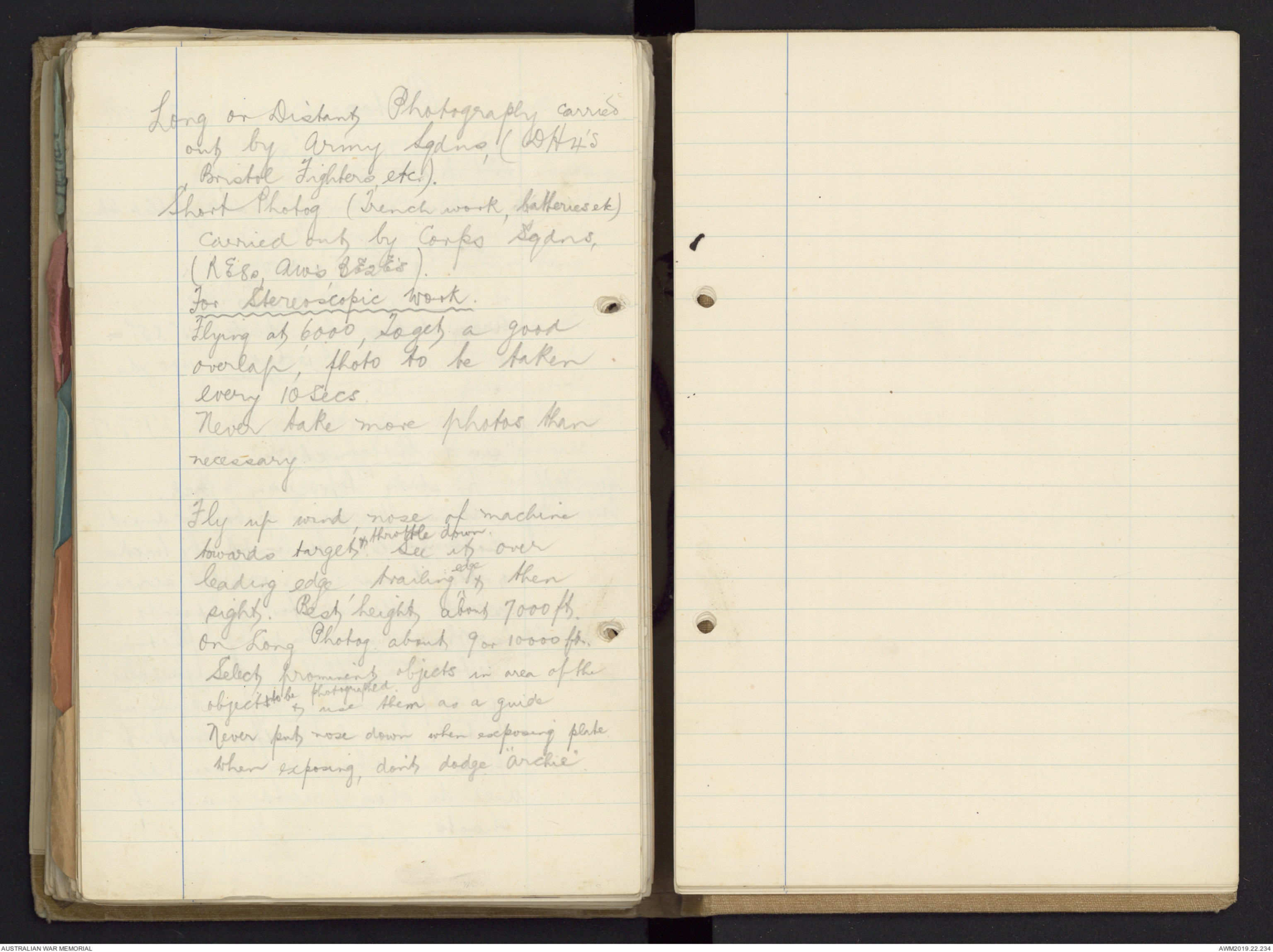
Long or Distant, Photography carried
out by Army Sqdns, (DH4's
Bristol Fighters, etc).
Short Photog (Trench work, batteries etc)
carried out by Corps Sqdns,
(RE8s, AW's BE2 E's).
For Stereoscopic Work.
Flying at 6,000, To get a good
overlap, photo to be taken
every 10 secs.
Never take more photos than
necessary
Fly up wind, nose of machine
towards target, ^& throttle down. See it over
leading edge, trailing ^edge & then
sight. Best height about 7000 ft.
On Long Photog about 9 or 10000 ft.
Select prominent objects in area of the
objects ^to be photographed. & use them as a guide
Never put nose down when exposing plate
When exposing, don't dodge "Archie".
 Diane Ware
This transcription item is now locked to you for editing. To release the lock either Save your changes or Cancel.
This lock will be automatically released after 60 minutes of inactivity.