
Notebook of James Stuart Leslie Ross - Part 10
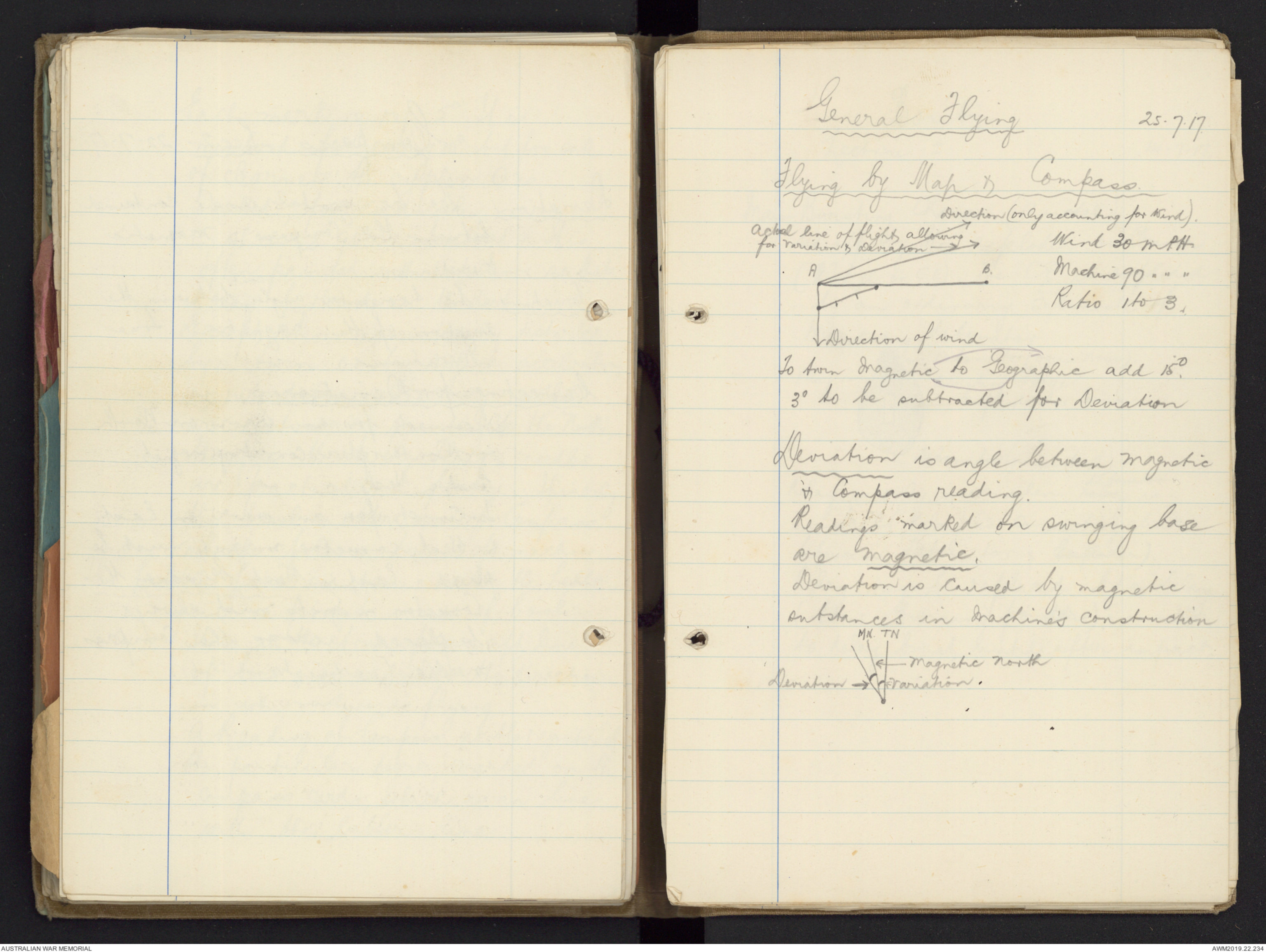




General Flying 25.7.17
Flying by Map & Compass
Hand drawn diagram - see original document
Deviation is angle between Magnetic
& Compass reading.
Readings marked on swinging base
are Magnetic.
Deviation is caused by magnetic
substances in machine's construction
Hand drawn diagram - see original document
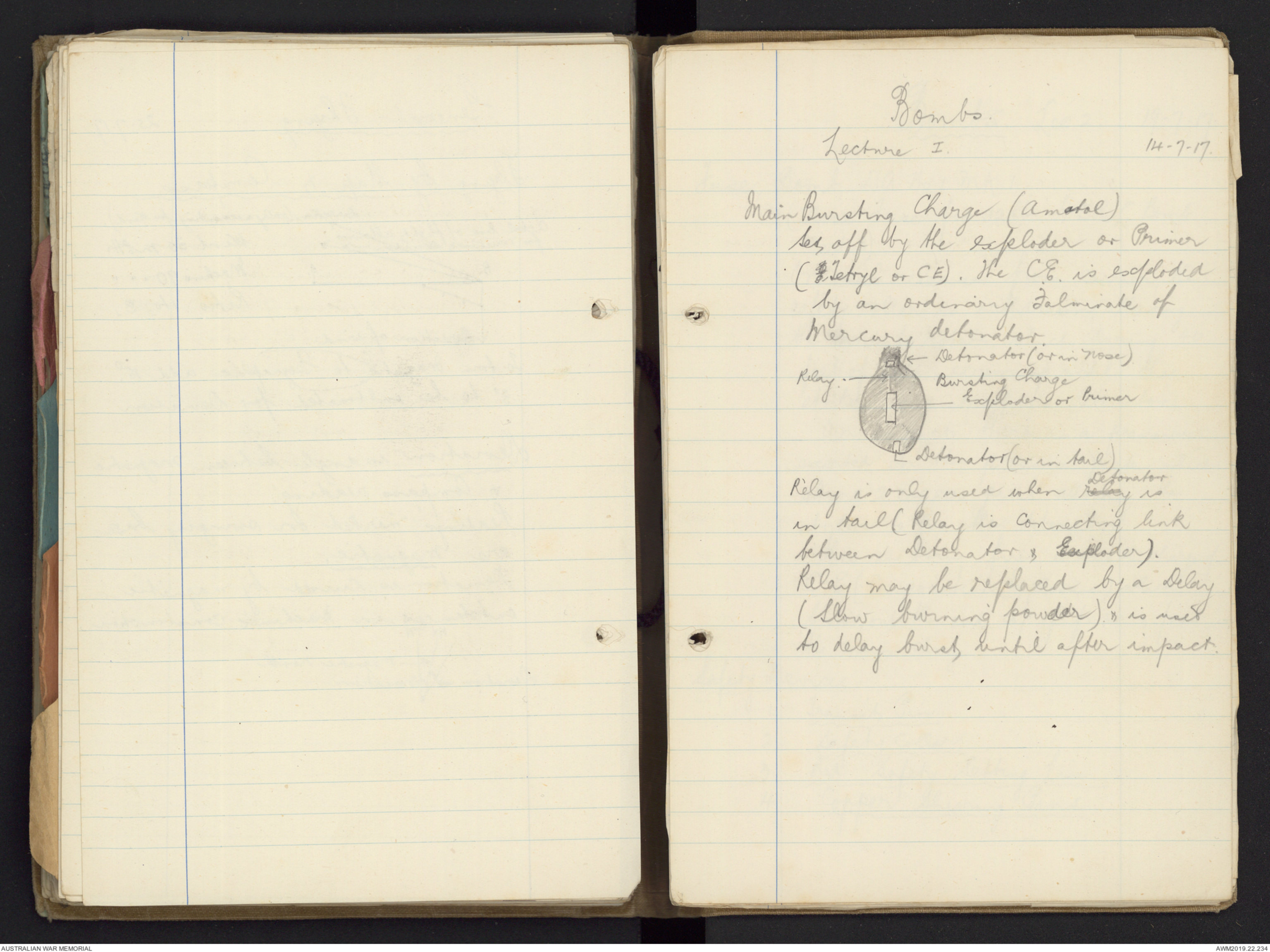
Bombs.
Lecture I. 14-7-17
Main Bursting Charge (Amatol)
Set off by the exploder or Primer
( T Tetryl or CE). The C.E. is exploded
by an ordinary Fulminate of
Mercury detonator.
Hand drawn diagram - see original document
Relay is only used when relay Detonator is
in tail (Relay is connecting link
between Detonator & Exploder).
Relay may be replaced by a Delay
(Slow burning powder) & is used
to delay burst, until after impact.
Bombs. Lec. 2. 19-7-17.
Fuse, bomb, D.A. No.1. MK.1
(Nose Fuse for 112lb. H.E.R.L. Bomb
Mark 3).
On real release from carrier, the
safety collar is withdrawn, allowing
the vane to rotate, which during 40
feet of fall screws up until the
striker is just off the detonator.
On impact there is a pressure
exerted on the pressure plate which
shears 2 copper pins allowing the
striker to fire the detonator.
This in turn fires a small charge of
C.E. (Composition Explosive) which
blows out the end cap of fuse & fires
the main charge.
Safety Devices
1. Transit Pin
2 Safety Collar
3 Red Safety Setting Line.
4 Copper Shearing Pins.
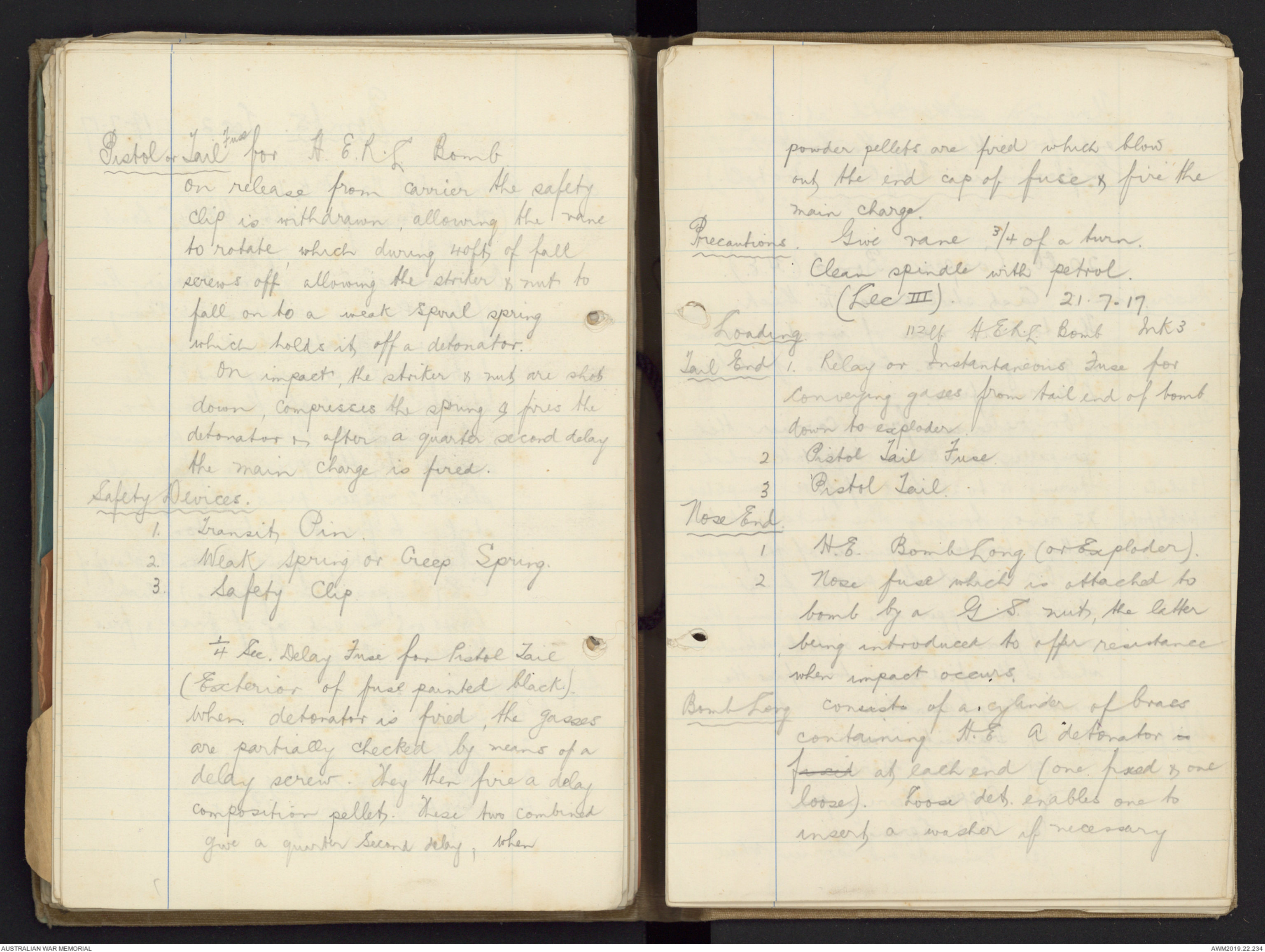
Pistol or Tail Fuse for H.E.R.L. Bomb
On release from carrier the safety
clip is withdrawn, allowing the vane
to rotate, which during 40ft of fall
screws off allowing the striker & nut to
fall on to a weak spiral spring
which holds it off a detonator.
On impact, the striker & nut are shot
down. compresses the spring & fires the
detonator & after a quarter second delay
the main charge is fired.
Safety Devices.
1 Transit Pin.
2 Weak spring or Creep Spring/
3 Safety Clip
¼ Sec. Delay Fuse for Pistol Tail
(Exterior of fuse painted black).
When detonator is fired, the gasses
are partially checked by means of a
delay screw. They then fire a delay
composition pellet. These two combined
give a quarter second delay, when
powder pellets are fired which blow
out the end cap of fuse & fire the
main charge.
Precautions. Give vane ¾ of a turn.
Clean spindle with petrol.
(Lec III). 21.7.17
Loading 112lb H.E.R.L. Bomb Mk 3
Tail End 1. Relay or Instantaneous Fuse for
conveying gases from tail end of bomb
down to exploder.
2. Pistol Tail Fuse
3. Pistol Tail.
Nose End
1 H.E. Bomb Long (or Exploder).
2 Nose fuse which is attached to
bomb by a G.S. nut, the latter
being introduced to offer resistance
when impact occurs.
Bomb Long Consists of a cylinder of brass
containing H.E. A detonator is
fixed at each end (one fixed & one
loose). Loose det. enables one to
insert a washer if necessary
There is a silk cord at fixed
end for withdrawing the bomb long
(Explosive is Tetryl or Trotyl).
20lb. Cooper Bomb (H.E.)
Description:- Cast steel case 5/16" thick.
The tail is made of wood & carries
4 guiding vanes. Bomb is fired by a
D.A. nose fuse.
The Action On release from carrier the
propeller is allowed to rotate which
during 15 to 25 feet of fall completes
25 revs, bringing the striker into line
with detonator & spindle of the propellor.
[*(3 wheels
rotates by prop)*]
On impact the prop is pushed in,
shearing a copper wire & compressing the
spring & forces the striker on to the detonator
which is then fired & in turn fires the
main charge (amatol)
Safety Devices.
(1) Transit Cover
(2) Socking Wire
(3) Copper shearing pin
(4) Creep Spring
(5) Numerals on Carrier Wheel
Bombs. (Lec 4 Contd.) 21.7.17
To Prepare Bomb.
(1) Unscrew transit cover
(2) Unscrew fuse
(3) Insert detonator in base end
of bomb.
(4) Replace fuse & place bomb in
20 lbs C.F.S. Carrier seeing that
the special copper attachment
engages with prop. which prevents
same from rotating until released.
(5) Before flight cut transit
locking wire.
(6) If bomb is not placed immediately
in C.F.S. carrier, replace transit
cover.
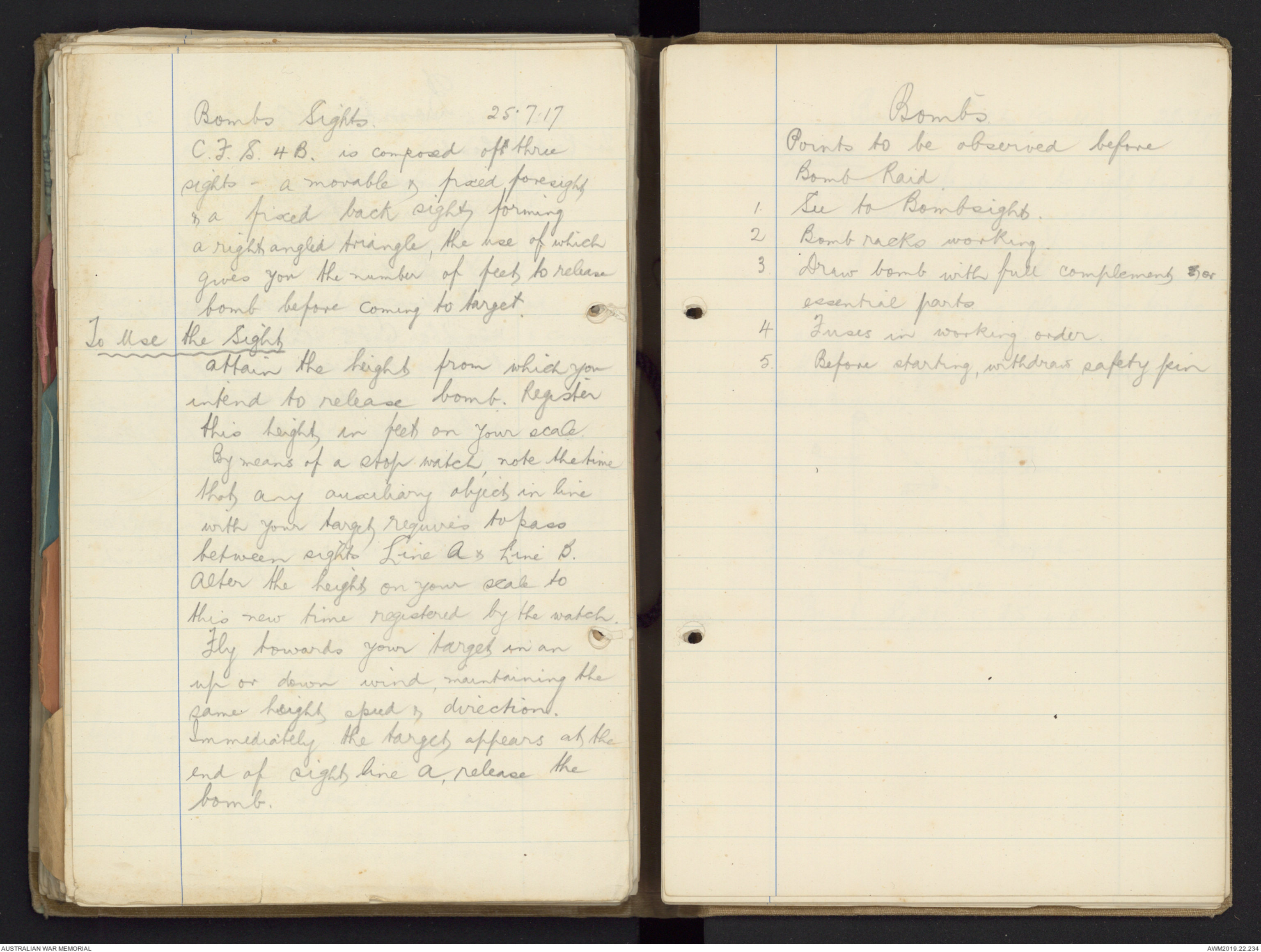
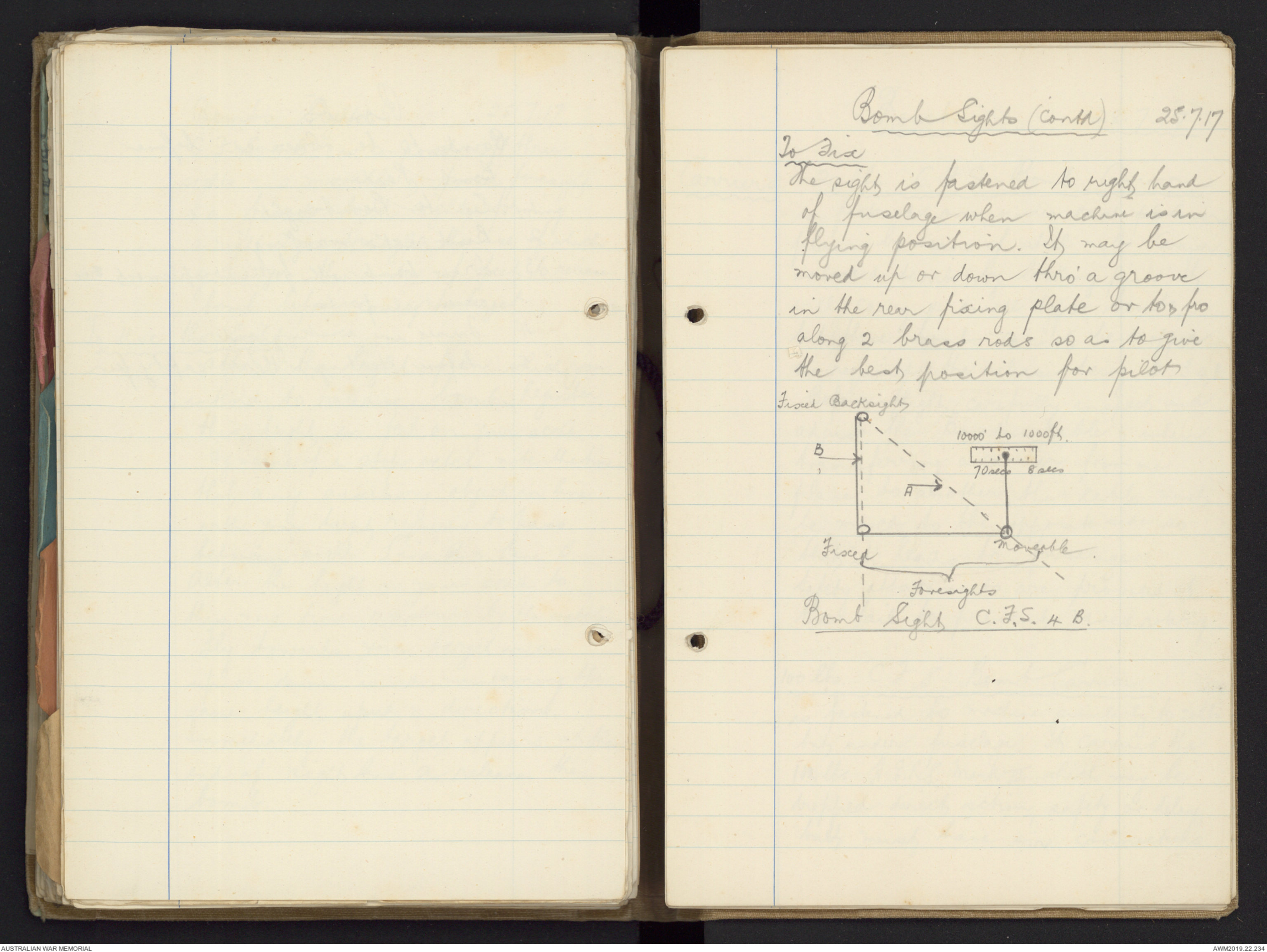
Bomb Sights 25.7.17
C.F.S. 4B is composed off three
sights - a movable & fixed foresight
& a fixed back sight forming
a right angled triangle, the use of which
gives you the number of feet to release
bomb before coming to target.
To Use the Sight.
Attain the height from which you
intend to release bomb. Register
this height in feet on your scale
By means of a stop watch, note the time
that any auxiliary object in line
with your target requires to pass
between sights Line A & Line B.
Alter the height on your scale to
this new time registered by the watch.
Fly towards your target in an
up or down wind, maintaining the
same height, speed & direction.
Immediately the target appears at the
end of sight line A, release the
bomb.
Bombs.
Points to be observed before
Bomb Raid.
1 See to Bombsight.
2 Bomb racks working.
3 Draw bomb with full complement xor
essential parts
4 Fuses in working order.
5 Before starting, withdraw safety pin
Bomb Sights (contd.) 25.7.17
To Fix
The sight is fastened to right hand
of fuselage when machine is in
flying position. It may be
moved up or down thro' a groove
in the rear fixing plate or to & fro
along 2 brass rods so as to give
the best position for pilot
Hand drawn diagram - see original document
Bombs 28.7.17
Carriers 20lbs CFS Bomb Carrier. -
is fastened one under each pl lower
plane by means of steel ribs. Carrier
is locked to ribs by locking pins. It
will carry 4 small type bombs,
but these bombs cannot be dropped
as required, the release being 2, 3, 4, 1.
Before flight, carefully inspect and
adjust the Bowden Cable & when
transferring a carrier from one
plane to another, the cable must
be moved to the opposite side so
that it leads to fuselage.
Safety attachments are provided at
the tail to prevent vanes rotating.
100 lbs CFS. Bomb Carrier.
is fixed to machine similarly to 20lbs
but under fuselage. It carries the
112 lbs H.E.R.L. Mark III which may be
dropped direct action, safety or delay,
but must have wire connections
to safety fuses connecting with the
carrier safety hooks.
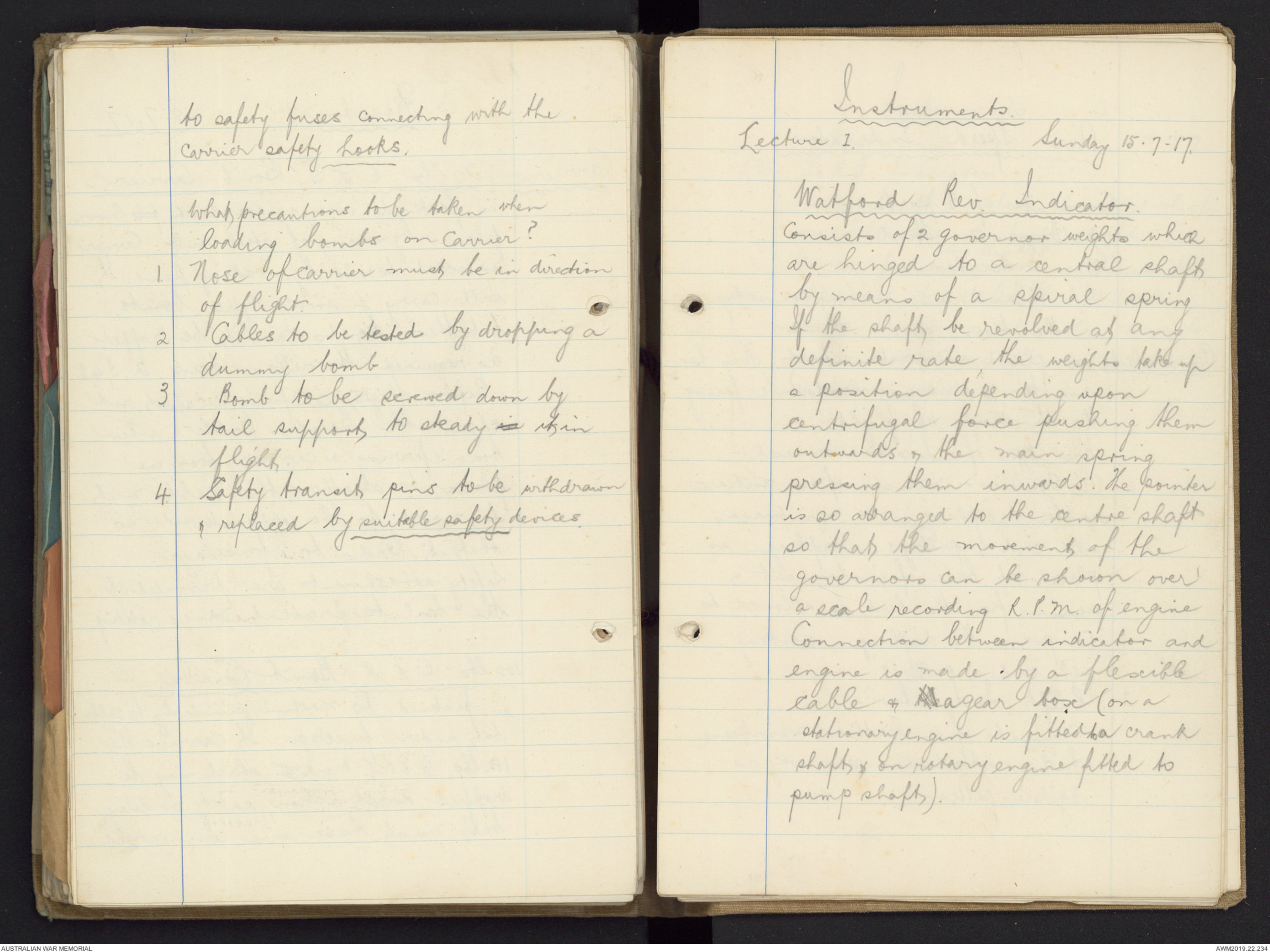
What precautions to be taken when
loading bombs on carrier?
1 Nose of carrier must be in direction
of flight.
2 Cables to be tested by dropping a
dummy bomb
3 Bomb to be screwed down by
tail support to steady in it in
flight
4 Safety transit pins to be withdrawn
& replaced by suitable safety devices.
Instruments
Lecture 1. Sunday 15.7.17
Watford Rev. Indicator
Consists of 2 governor weights which
are hinged to a central shaft
by means of a spiral spring
If the shaft be revolved at any
definite rate the weights take up
a position depending upon
centrifugal force pushing them
outwards & the main spring
pressing them inwards. The pointer
is so arranged to the centre shaft
so that the movement of the
governors can be shown over
a scale recording R.P.M. of engine
Connection between indicator and
engine is made by a flexible
cable & the a gear box (on a
stationary engine is fitted to a crank
shaft & on rotary engine fitted to
pump shaft).
Air Speed Indicator.
Consists of 3 parts :-
(1) Pressure Head.
(2) Indicator
(3) Aluminium Tubing connecting
the two.
Pressure Head is placed on outer struts. This has
an open & a semi-closed tube facing
the direction of flight.
Three types of indicators are used :-
(1) Ogilvie - consists of an india-rubber
diaphragm or membrane,
silk cord & pulleys. Diaphragm is
placed at base of instrument &
pressure from the head is allowed to
compress the diaphragm working
silk cord & pulleys.
2. Clift Indicator :-
Consists of a leather membrane
which is attached in same way as
Ogilvie pattern.
Instruments.
Lecture I 15.7.17
(3) R.A.F. Indicator :-
Consists of 2 metal chambers which
are held to a central shaft. As
the air pressure ^from the head increases inside the
chambers, it rotates the central
shaft. This movement is then carried to
pointer which records over a scale
M.P.H. air speed.
 Jen
Jen This transcription item is now locked to you for editing. To release the lock either Save your changes or Cancel.
This lock will be automatically released after 60 minutes of inactivity.