
Notebook of James Stuart Leslie Ross - Part 3

12-7-17
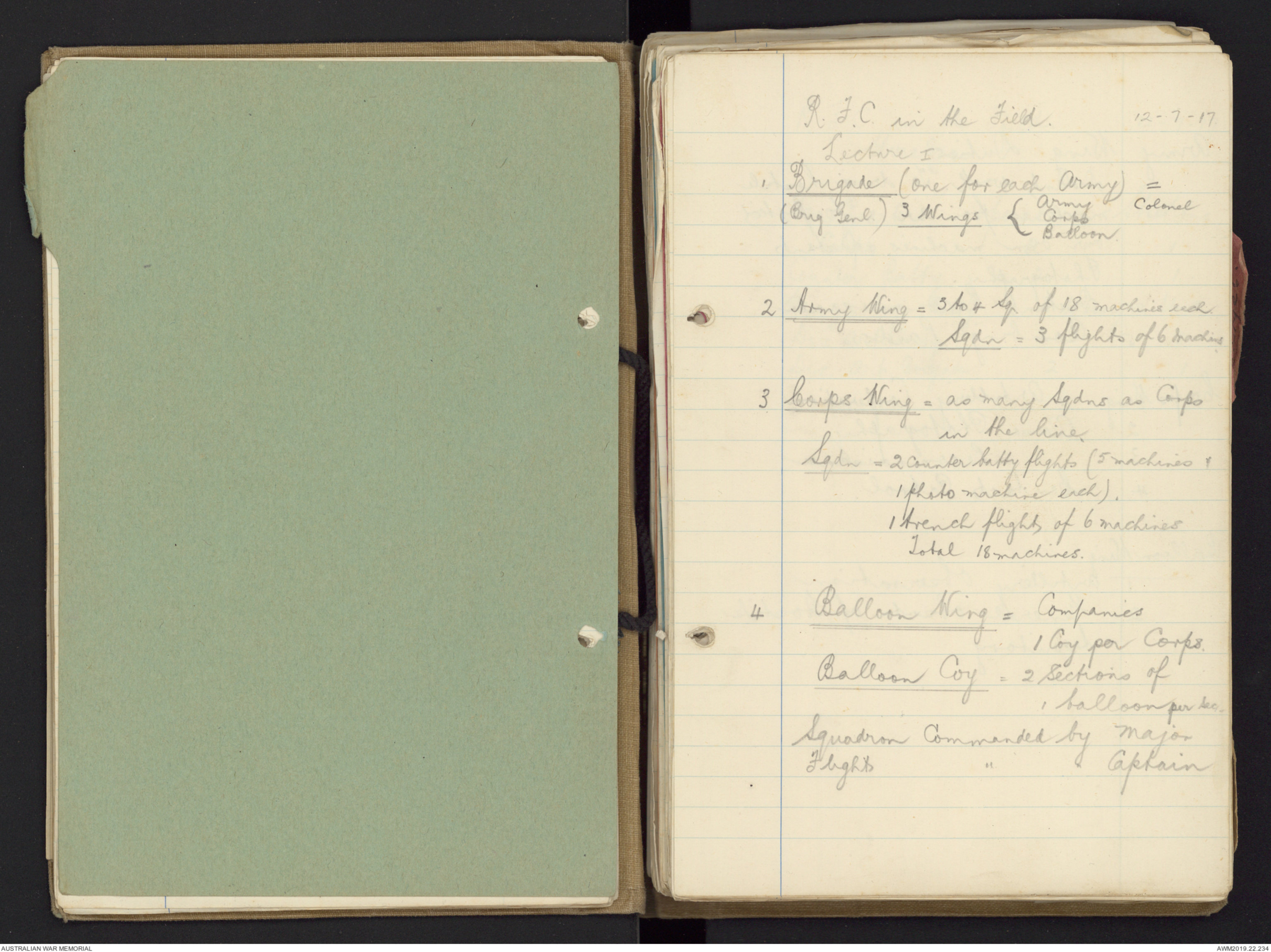
R.F.C in the Field.
Lecture I
1 Brigade (one for each Army) =
(Brig Genl.) 3 Wings {Army Colonel
{Corps
{Balloon
2 Army Wing = 3 to 4 Sq of 18 machines each
Sqdn = 3 flights of 6 machines
3 Corps Wing = as many Sqdns as Corps
in the line.
Sqdn = 2 counter battery flights (5 machines &
1 photo machine each).
1 trench flights of 6 machines
Total 18 machines.
4 Balloon Wing = Companies
1 Coy per Corps.
Balloon Coy = 2 Sections of
1 balloon per Sec.
Squadron Commanded by Major
Flight " by Captain
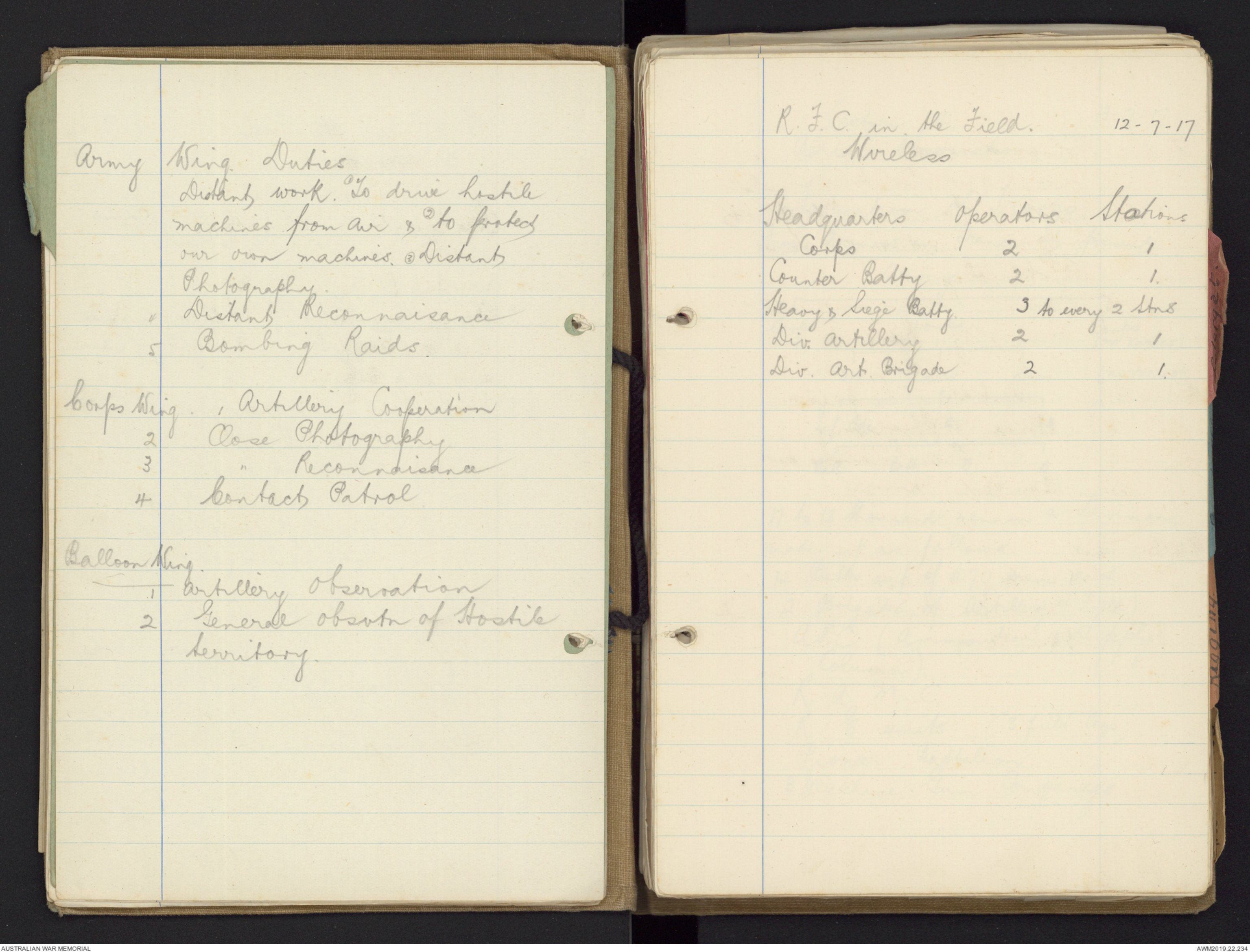
Army Wing. Duties
Distant work. (1)To drive hostile
machines from air & (2) to protect
our own machines. (3) Distant
Photography.
4 Distant Reconnaissance
5 Bombing Raids.
Corps Wing. 1 Artillery Cooperation
2 Close Photography
3 " Reconnaisance
4 Contact Patrol
Balloon Wing.
1 Artillery Observation
2 General obsvtn of Hostile
territory.
12-7-17
R.F.C. in the Field.
Wireless
Headquarters Operators Stations
Corps 2 1
Counter Batty 2 1.
Heavy & Siege Batty 3 to every 2 Stns.
Div. Artillery 2 1
Div. Art. Brigade 2 1.
13-7-17
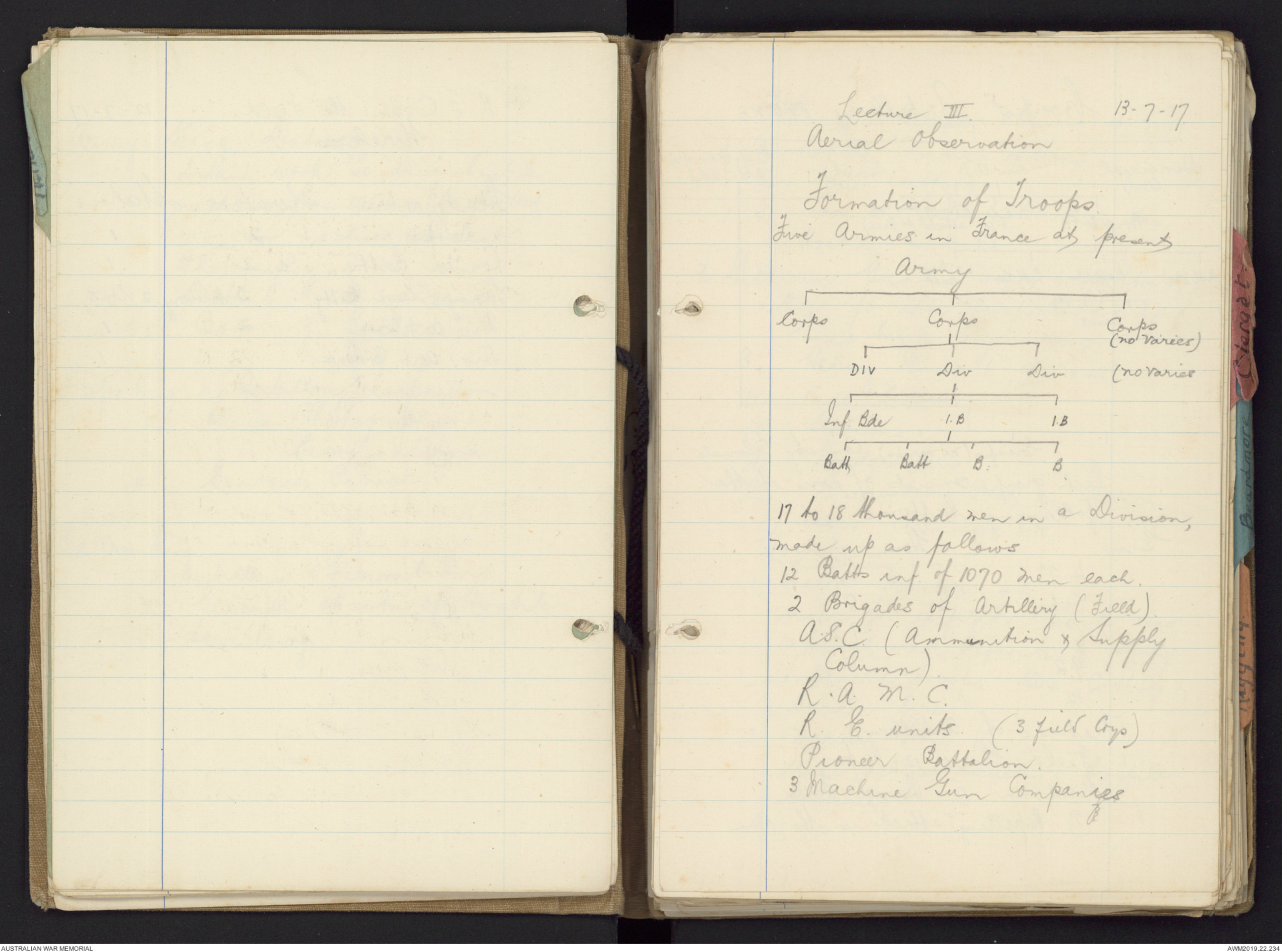
Lecture III
Aerial Observation
Formation of Troops
Five Armies in France at present
Hand drawn diagram - see original document
17 to 18 thousand men in a Division,
made up as follows
12 Batts inf. of 1070 men each.
2 Brigades of Artillery (Field).
A.S.C. (Ammunition & Supply
Column).
R.A.M.C.
R.E. units (3 Field Coys)
Pioneer Battalion.
3 Machine Gun Companies
Corps Artillery B.G.C.RA
Hand drawn diagram - see original document
Each group consists of some of the
following batteries.
Gun How.
4.7" 6"
60 pr 8"
6" 9.2"
9.2" 12"
12" 15"
Natures of Artillery.
1 Field Guns. 13 & 18 pr.
Used in (1) Barage Fire
(2) Repelling attacks in the opn
13-7.17.
Lecture III Aerial Obs.
(3) Raking Communications
(4) Wire Cutting
(5) Counter Battery Work on close
Hostile Batteries.
2. Medium Guns. 4.7" & 60 pr (bore 5")
Used for same purposes as Field
Guns but a longer range
3. Heavy Guns 6", 9.2" & 12".
(1) Rest billets.
(2) Stations
(3) Headquarters.
(4) Observation Post as Church
Towers, Chimneys etc.
Howitzers.
1. Field Howitzers. 4.5"
Used for enfilade work, also
against weak defences & badly
entrenched troops. Wire cutting &
barage fire.
2. Medium How. 6"
Used against trenches & hostile
batteries.
13.7.17
Lec. III
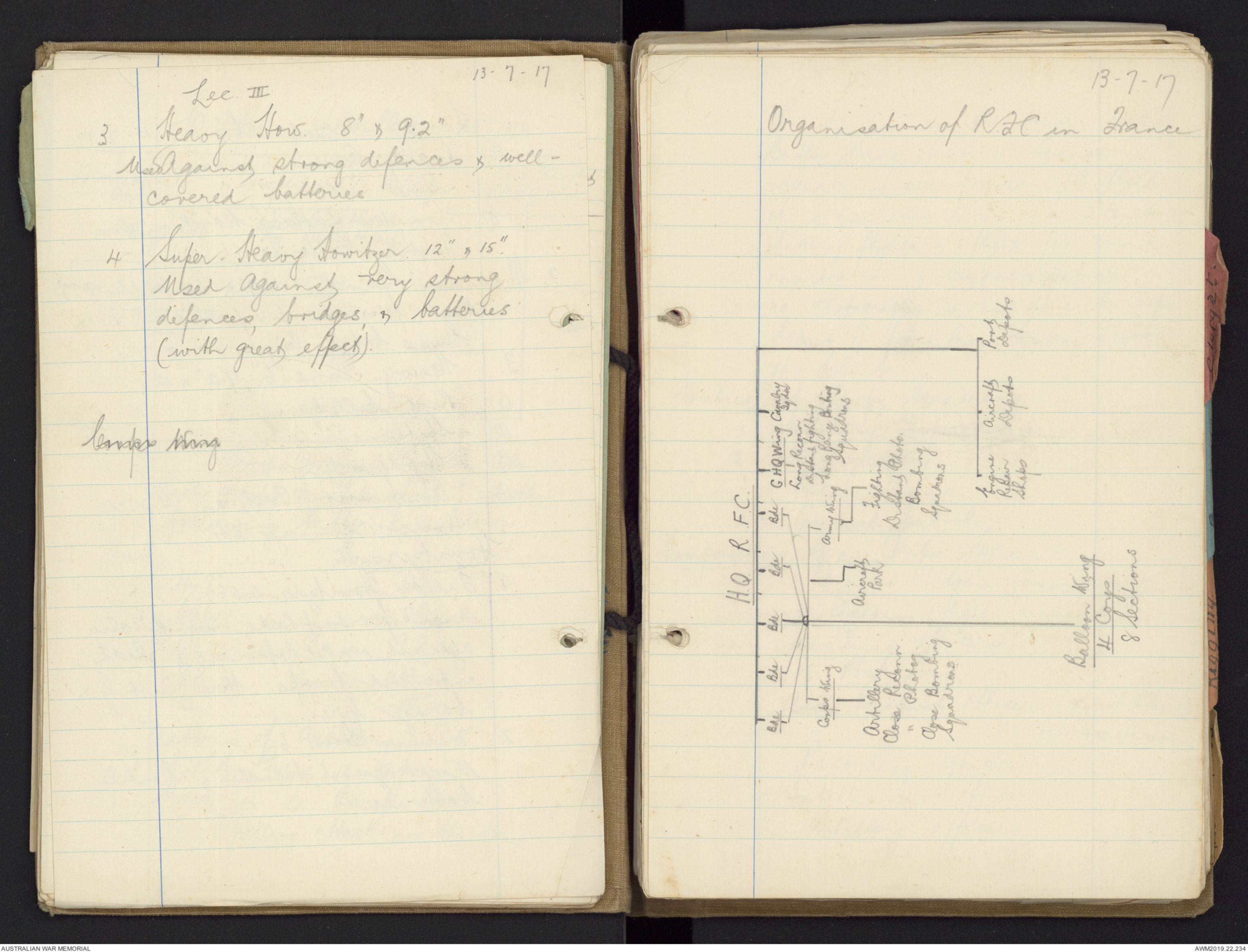
3. Heavy How. 8" & 9.2"
Used Against strong defences & well -
covered batteries
4 Super Heavy Howitzer 12" & 15"
Used against very strong
defences, bridges, & batteries
(with great effect).Corps Wing
13-7-17
Organisation of R.F.C. in France
Hand drawn diagram - see original document
13-7.17
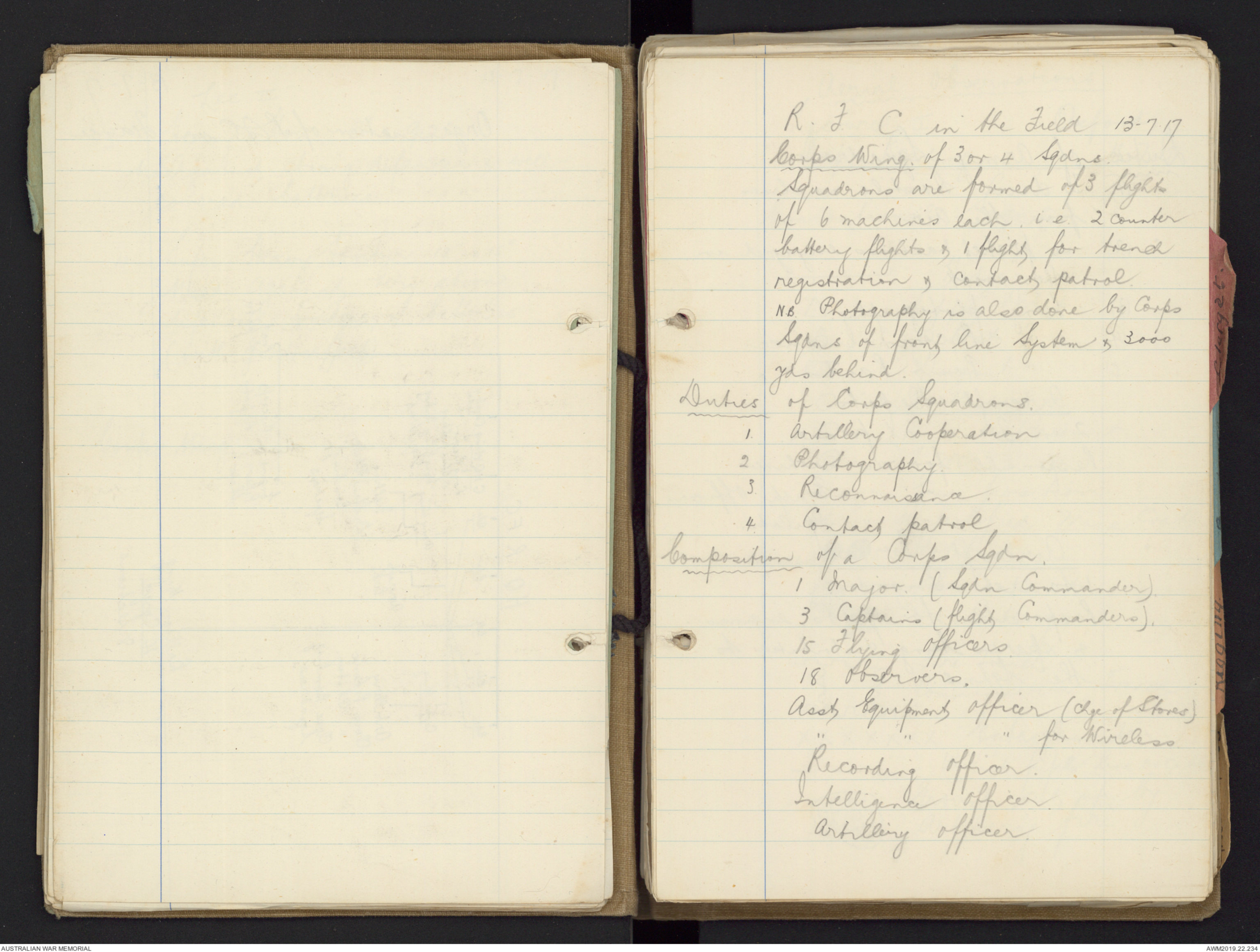
R.F.C. in the Field
Corps Wing. of 3 or 4 Sqdns.
Squadrons are formed of 3 flights
of 6 machines each. i.e. 2 counter
battery flights & 1 flight for trend
registration & contact patrol.
N.B. Photography is also done by Corps
Sqdns of front line System & 3000
yds behind.
Duties of Corps Squadrons.
1. Artillery Cooperation
2. Photography.
3. Reconnaissance.
4. Contact patrol.
Composition of a Corps Sqdn.
1 Major (Sqdn Commander).
3 Captains (flight Commanders).
15 Flying officers.
18 observers.
Asst Equipment officer (Chge of Stores).
" " " for Wireless.
Recording officer.
Intelligence officer.
Artillery officer.
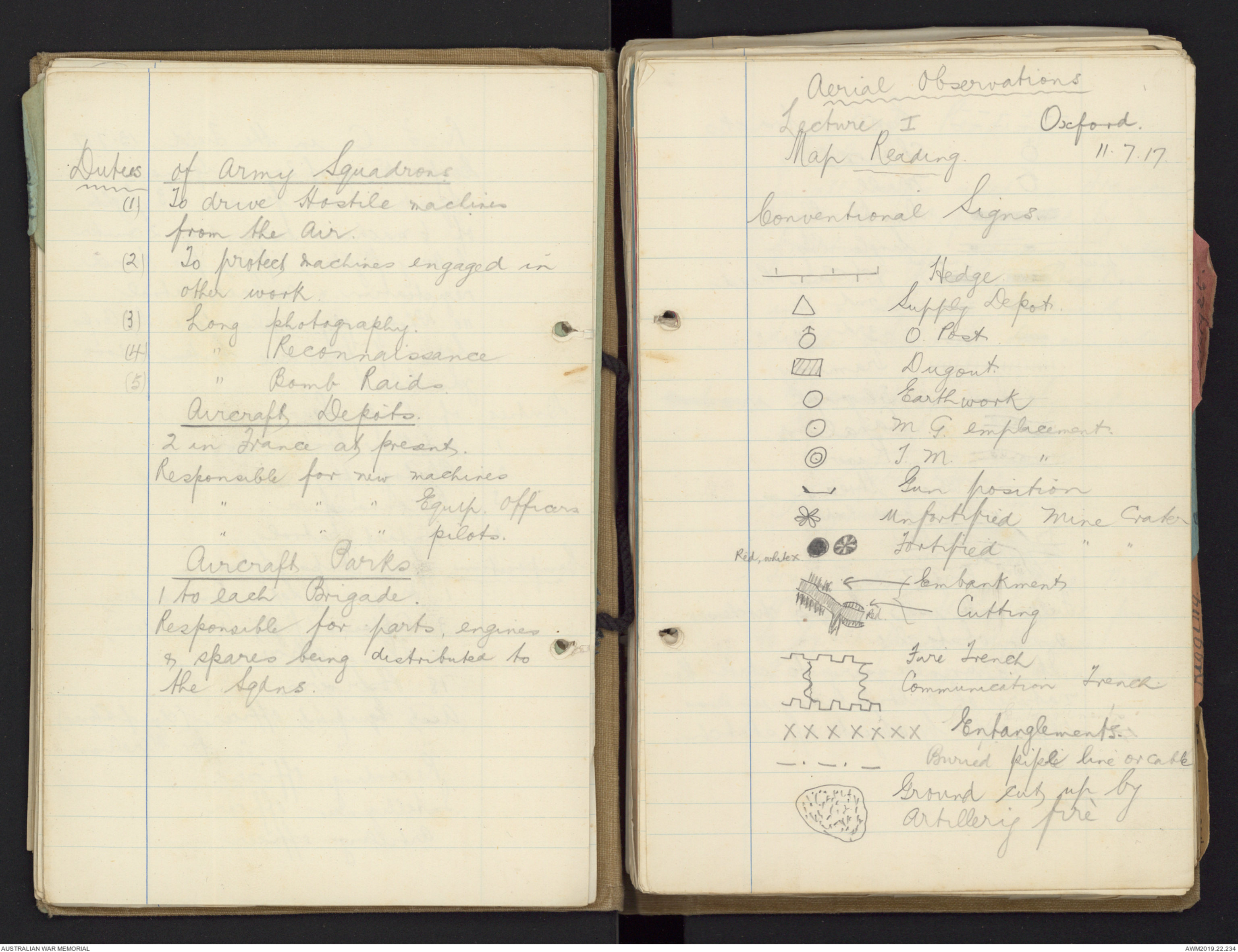
Duties of Army Squadrons
(1) To drive Hostile machines
from the Air.
(2) To protect machines engaged in
other work.
(3) Long photography.
(4) " Reconnaissance
(5) " Bomb Raids.
Aircraft Depots.
2 in France at present.
Responsible for new machines
" " " Equip. officers
" " " pilots.
Aircraft Parks
1 to each Brigade.
Responsible for parts, engines
& spares being distributed to
the Sqdns.
Aerial Observations
Lecture I Oxford
Map Reading. 11.7.17.
Conventional Signs
Hand drawn images - see original document
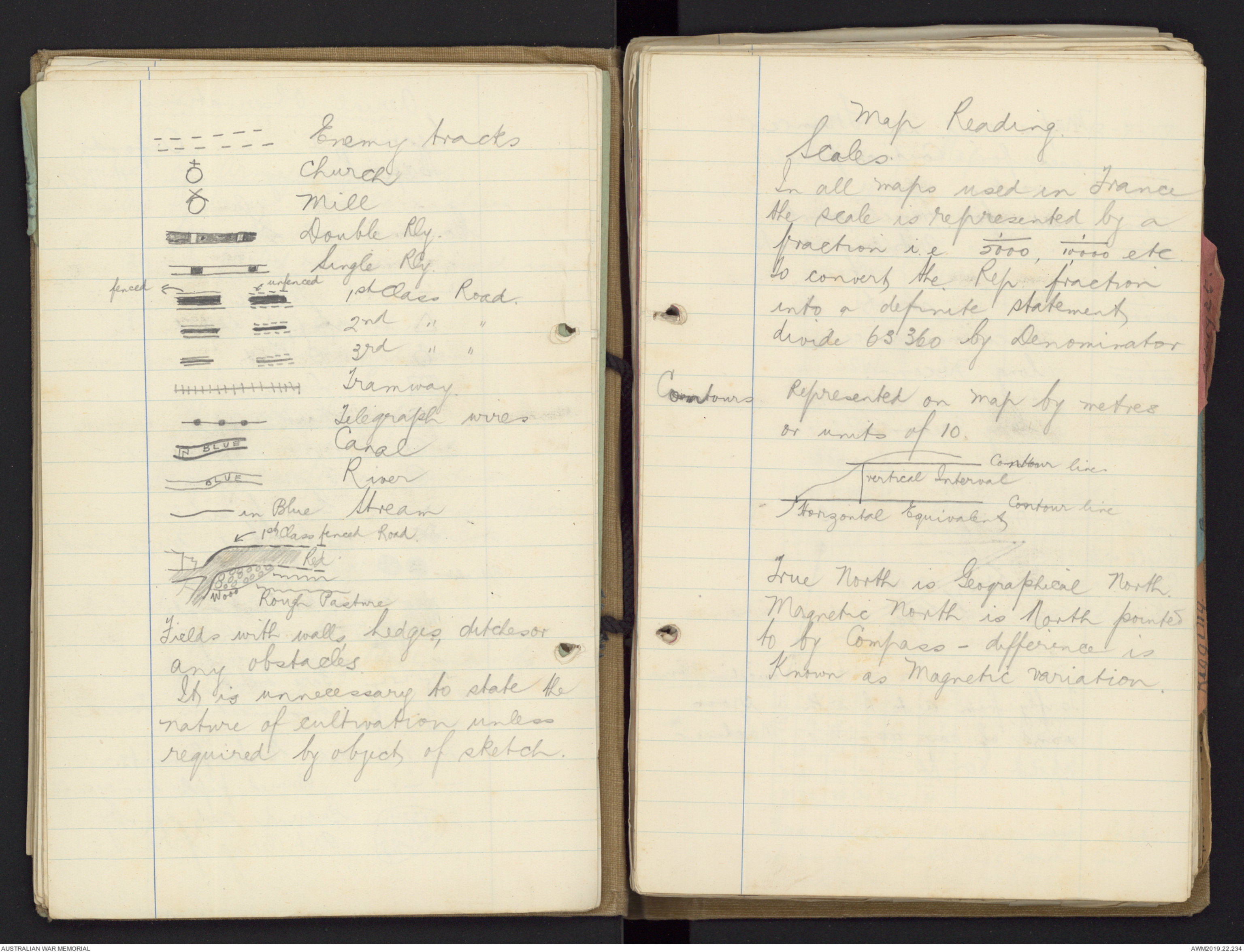
Hand drawn images - see original document
Fields with walls, hedges, ditches or
any obstacles.
It is unnecessary to state the
nature of cultivation unless
required by objects of sketch.
Map Reading.
Scales.
In all maps used in France
the scale is represented by a
fraction i.e. 1/5000, 1/10,000 etc.
To convert the Rep fraction
into a definite statement
divide 63 360 by Denominator
Contours Represented on map by metres
or units of 10.
Hand drawn diagram - see original document
True North is Geographical North.
Magnetic North is North pointed
to by Compass - difference is
known as Magnetic variation.
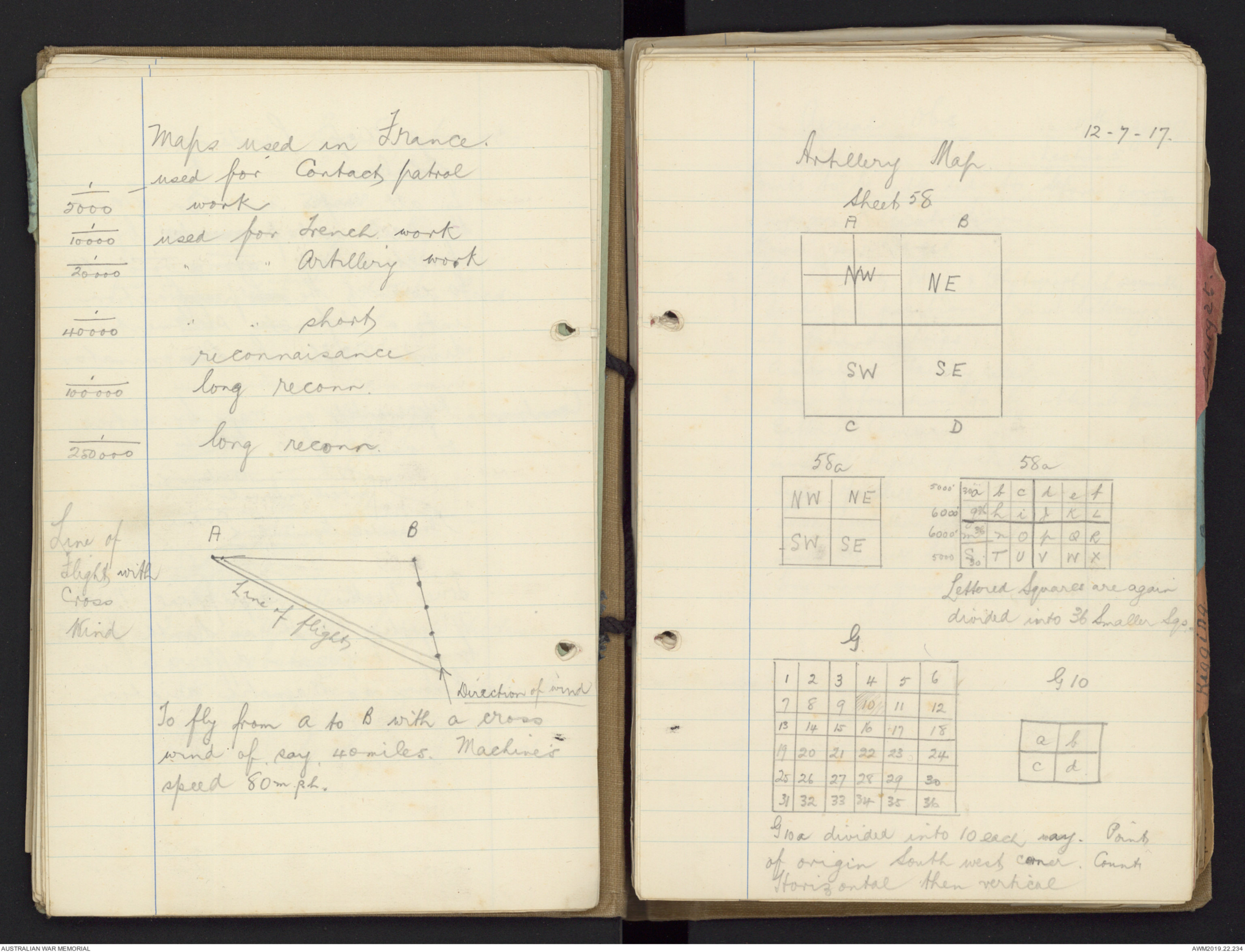
Maps used in France.
1/2000 - used for Contact patrol
work
1/10000 used for Trench work
1/20000 " " Artillery work
1/40000 " " short
reconnaisance
1/100000 long reconn.
1/250000 long reconn.
Line of
Flight with
Cross
Wind
Hand drawn diagram - see original document
To fly from A to B with a cross
wind of, say, 40 miles. Machine's
speed 80 m.p.h.
12-7-17.
Artillery Map
Hand drawn diagrams - see original document
Aerial Obs.
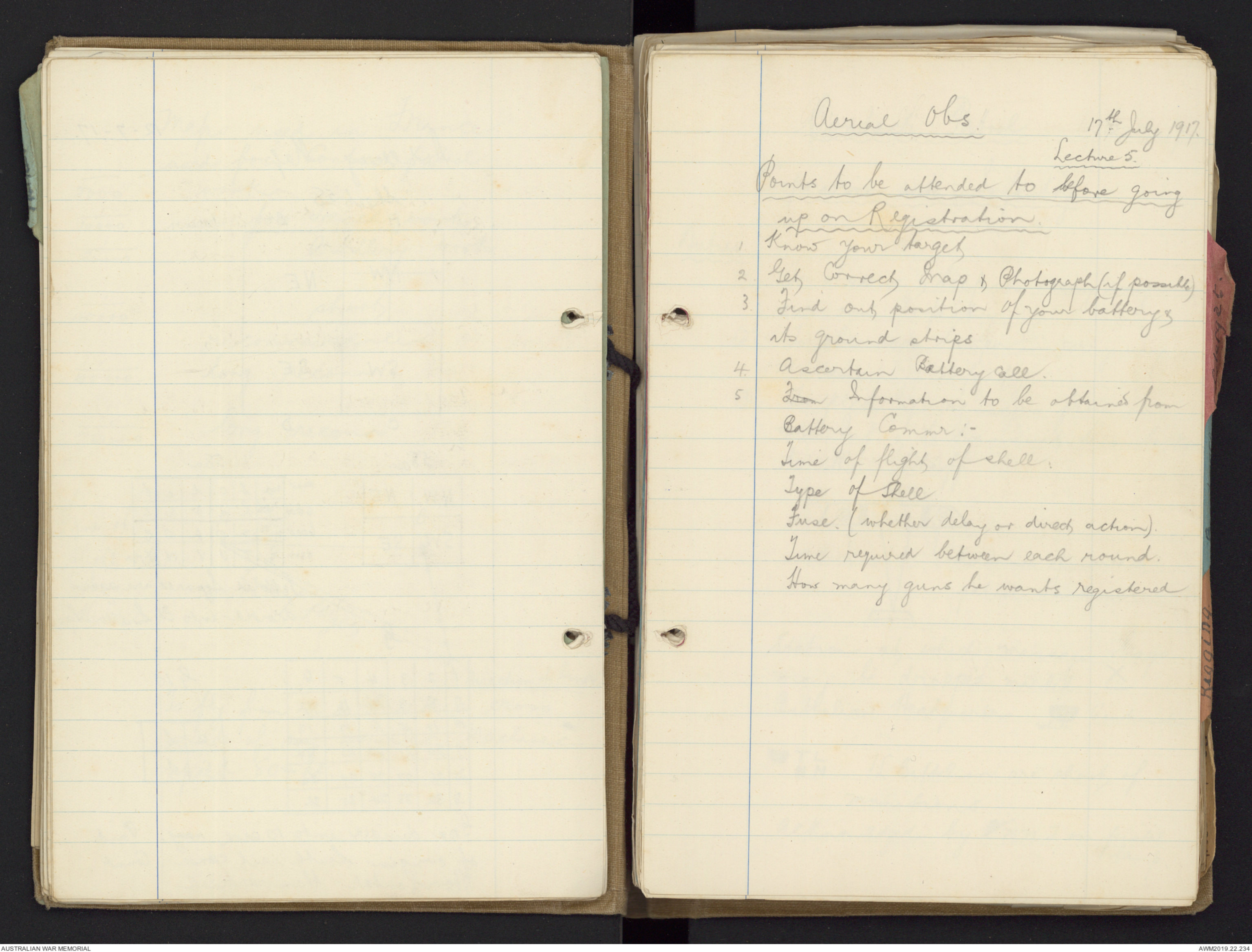
17th July 1917.
Lecture 5.
Points to be attended to before going
up on Registration.
1 Know your target
2 Get Correct Map & Photograph (if possible)
3. Find out position of your battery &
its ground strips
4. Ascertain Battery call.
5. From Information to be obtained from
Battery Commr:-
Time of flight of shell.
Type of Shell
Fuse. (whether delay or direct action).
Time required between each round.
How many guns he wants registered.
 Sam scott
This transcription item is now locked to you for editing. To release the lock either Save your changes or Cancel.
This lock will be automatically released after 60 minutes of inactivity.